Single-dish observations and non-LTE analysis of CH3OH, HCN, and CO line emission in the Oort cloud comet C/2017 K2 (PANSTARRS)
Pith reviewed 2026-06-27 19:18 UTC · model grok-4.3
The pith
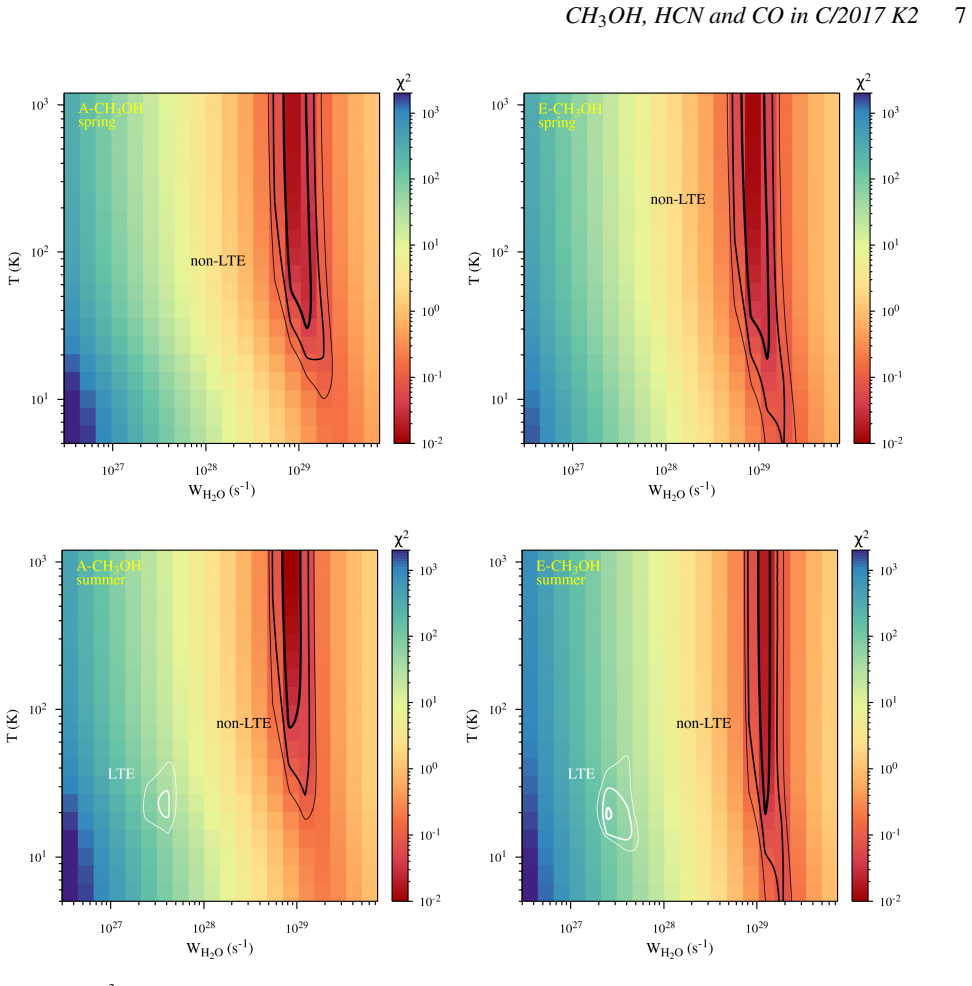
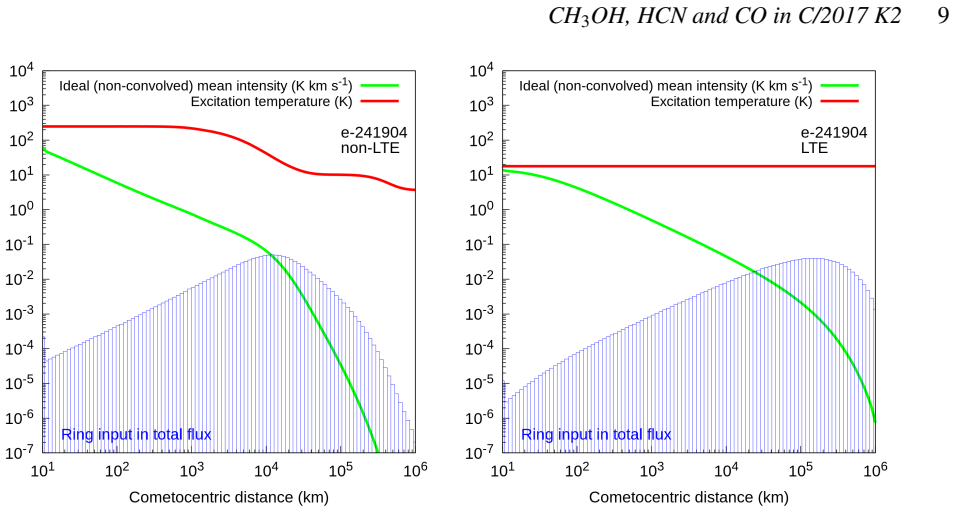
Non-LTE effects dominate molecular excitation in the coma of comet C/2017 K2 and must be included to derive accurate production rates.
A machine-rendered reading of the paper's core claim, the machinery that carries it, and where it could break.
Core claim
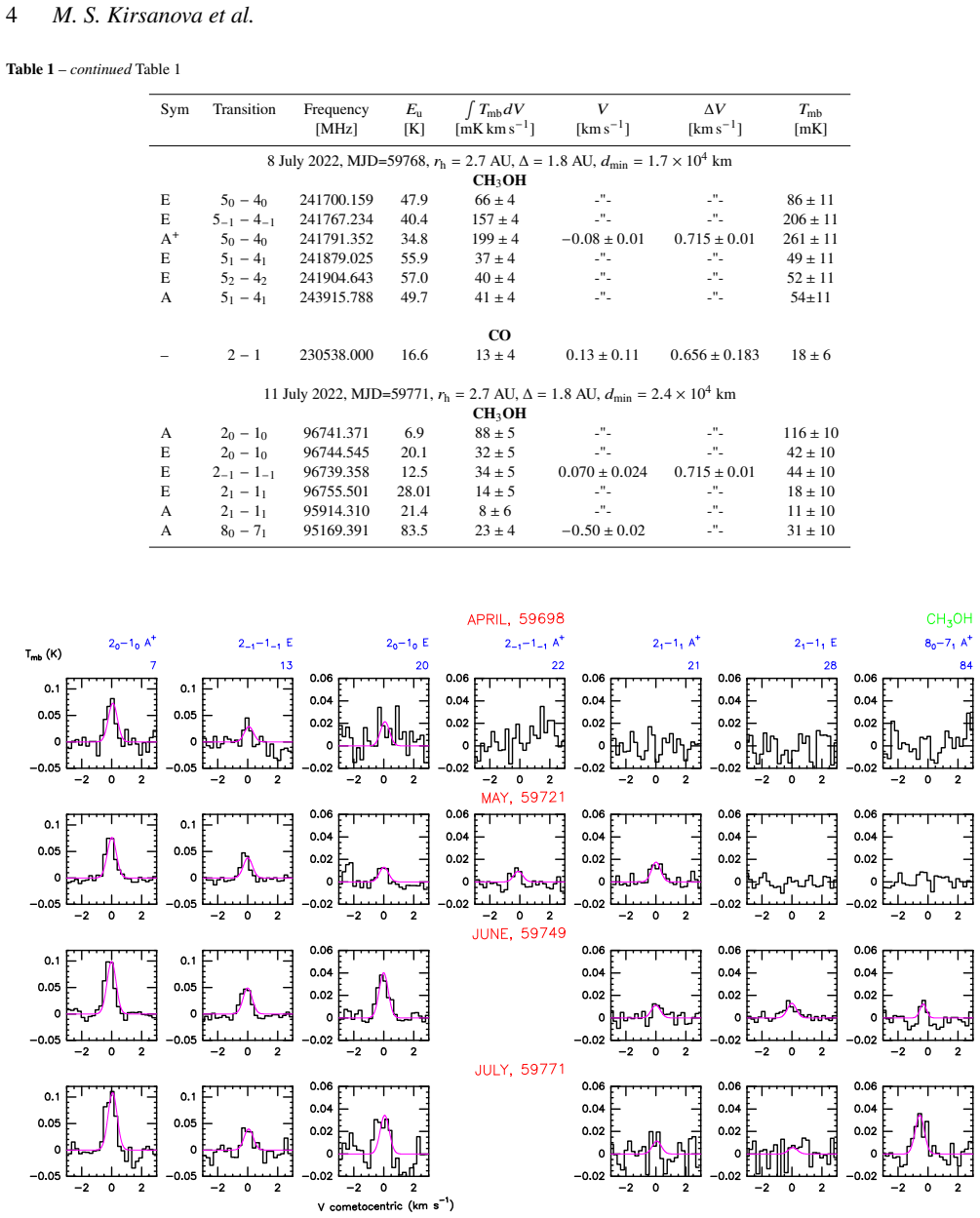
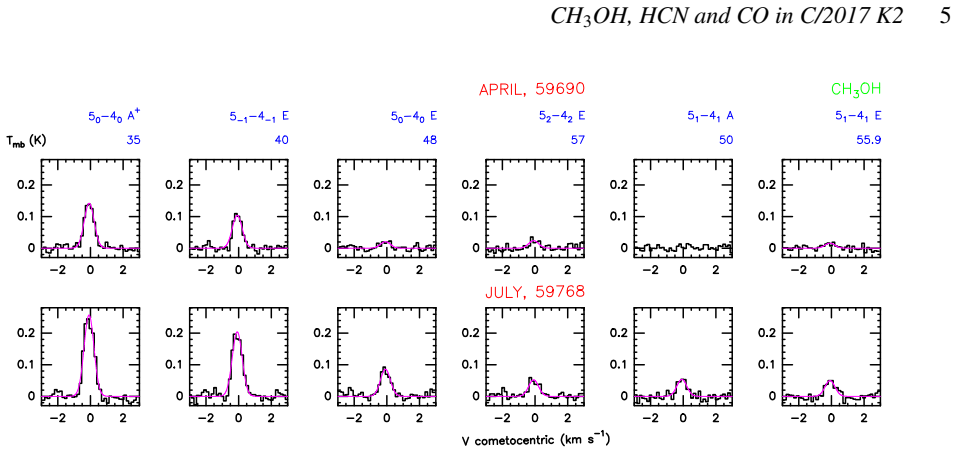
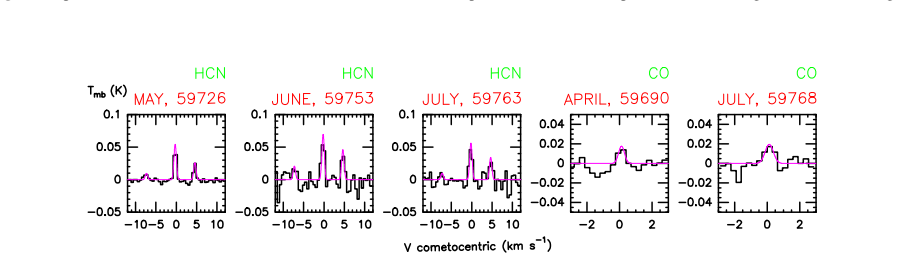
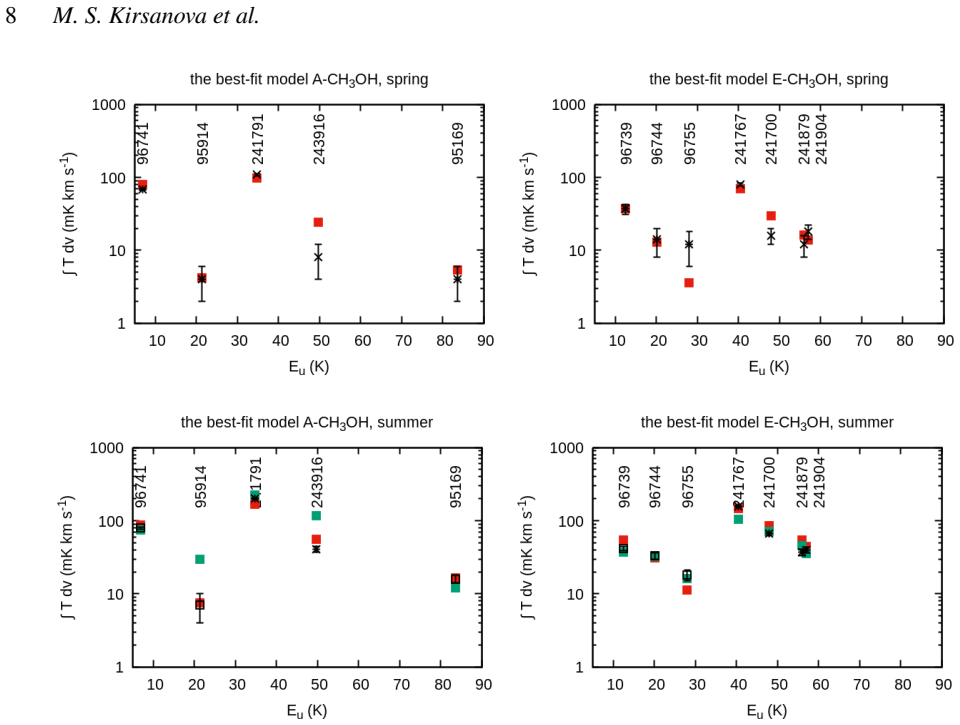
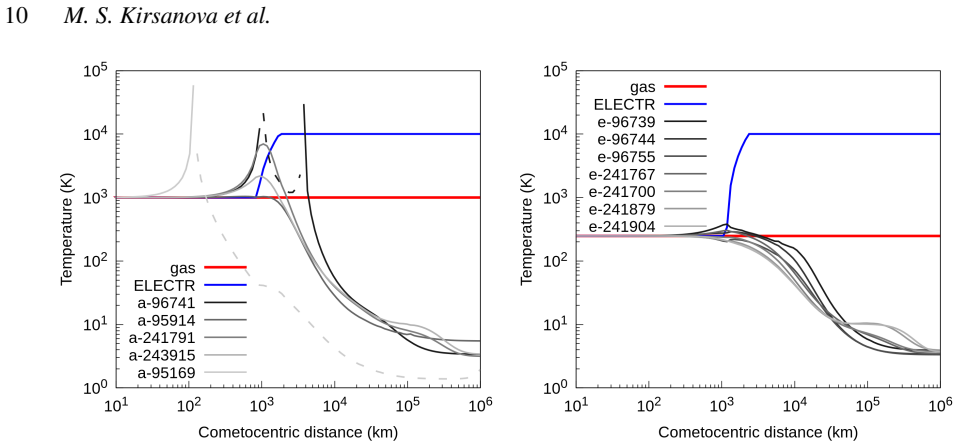
As heliocentric distance decreased, CH3OH line intensities increased by factors of 1.1-4.0 with the strongest changes in high-energy lines, while CO and HCN brightness remained constant. Best-fit models give Tgas greater than 100 K and Q(H2O) of (3-10) times 10 to the 28 molecules per second. The methanol-to-water abundance is 0.01-0.04. Non-LTE effects are dominant in the coma and must be accounted for to derive accurate molecular production rates; weak non-thermal excitation is also present, including possible maser activity in the CH3OH 8(0)-7(1) line.
What carries the argument
Non-LTE excitation models applied to single-dish molecular line observations of the cometary coma.
If this is right
- Methanol production rates increase markedly with decreasing heliocentric distance while CO and HCN rates do not.
- Gas kinetic temperatures in the coma exceed 100 K during the observed period.
- Methanol-to-water abundance ratios lie between 0.01 and 0.04 and vary with time.
- Specific methanol transitions show evidence of non-thermal excitation that can produce weak maser action.
Where Pith is reading between the lines
- The same non-LTE corrections are likely required for production-rate estimates in other comets observed beyond 2.5 AU.
- The selective rise in high-energy methanol lines may trace changes in the coma density or temperature profile as the comet warms.
- Higher-resolution mapping could test whether the reported maser candidate is spatially extended or localized.
Load-bearing premise
The adopted non-LTE excitation models and collision rates accurately describe the physical conditions in the coma without major unknown processes or incorrect input parameters.
What would settle it
Production rates derived from the same spectra using an LTE assumption that match the non-LTE results within measurement error would falsify the dominance of non-LTE effects.
Figures
read the original abstract
We present pre-perihelion observations of methanol, carbon monoxide, and hydrogen cyanide in the Oort cloud comet C/2017 K2 (PANSTARRS), performed with the APEX 12-m and Onsala 20-m telescopes from April to July 2022. As the comets heliocentric distance decreased from 3.4 to 2.7 AU, CH3OH line intensities increased substantially (by factors of 1.1-4.0), with the most pronounced enhancement in lines with the upper-level energies Eu > 40K. In contrast, the brightness of the CO and HCN lines remained constant. We estimate the best-fit gas kinetic temperatures Tgas > 100 K and water production rate of Q(H2O)=(3-10)*10(28) 1/s. The derived methanol-to-water abundance ratio approx. 0.01-0.04, depending on the observed period. Our results demonstrate that non-LTE effects are dominant in the coma and must be accounted for to accurately derive molecular production rates. We also report weak non-thermal excitation, including potential maser activity in the CH3OH 8(0)-7(1) line.
Editorial analysis
A structured set of objections, weighed in public.
Referee Report
Summary. The manuscript reports pre-perihelion single-dish observations of CH3OH, HCN, and CO emission lines in Oort-cloud comet C/2017 K2 (PANSTARRS) with the APEX 12-m and Onsala 20-m telescopes between rh = 3.4–2.7 AU. CH3OH intensities rose by factors of 1.1–4.0 (strongest for Eu > 40 K lines) while CO and HCN remained constant; non-LTE excitation modeling yields Tgas > 100 K, Q(H2O) = (3–10) × 10^28 s^–1, and CH3OH/H2O ≈ 0.01–0.04. The authors conclude that non-LTE effects dominate the coma and must be included to derive accurate production rates, and note possible weak non-thermal excitation including potential maser action in the CH3OH 8(0)–7(1) line.
Significance. If the adopted collision rates and non-LTE model are shown to be reliable, the work supplies direct observational evidence that non-LTE excitation must be treated explicitly when converting line intensities to production rates at these heliocentric distances, and adds a data point on possible weak maser activity in cometary methanol.
major comments (2)
- [non-LTE modeling section (inferred from abstract and methods description)] The central claim that non-LTE effects dominate (and that LTE is insufficient) rests entirely on the fidelity of the input collision rates (primarily H2O–CH3OH) and the assumed coma density/temperature profile in the non-LTE code. No sensitivity tests to plausible variations in those rates or to alternative excitation mechanisms are presented, so it remains possible that systematic error in the model inputs could reproduce the observed selective brightening of high-Eu CH3OH lines without non-LTE dominance being required.
- [results and discussion of derived parameters] The reported Tgas > 100 K and the CH3OH/H2O abundance range are derived quantities that depend on the same unvalidated collision-rate set; an independent check (e.g., comparison with contemporaneous infrared or millimeter data from another facility, or with published laboratory rates) is needed before the production-rate corrections can be treated as robust.
minor comments (2)
- [abstract] The abstract states Q(H2O) = (3–10)×10(28) 1/s; the notation should be standardized to scientific notation and the time unit made explicit (s^–1).
- [methods] The manuscript should clarify whether the same non-LTE model parameters were used for all three molecules or whether molecule-specific adjustments were introduced post-hoc.
Simulated Author's Rebuttal
We thank the referee for the careful and constructive review of our manuscript. We address the two major comments point by point below, indicating the revisions we will make.
read point-by-point responses
-
Referee: The central claim that non-LTE effects dominate (and that LTE is insufficient) rests entirely on the fidelity of the input collision rates (primarily H2O–CH3OH) and the assumed coma density/temperature profile in the non-LTE code. No sensitivity tests to plausible variations in those rates or to alternative excitation mechanisms are presented, so it remains possible that systematic error in the model inputs could reproduce the observed selective brightening of high-Eu CH3OH lines without non-LTE dominance being required.
Authors: The selective brightening of high-Eu CH3OH lines (factors of 1.1–4.0) while low-Eu lines and other species remain nearly constant cannot be reproduced by a uniform increase in production rate under LTE conditions, because LTE intensities would scale proportionally across all lines. The non-LTE model with standard literature collision rates reproduces this Eu-dependent trend. We agree that explicit sensitivity tests strengthen the analysis and will add them in the revised manuscript by varying the H2O–CH3OH collision rates within published uncertainties and by testing alternative density profiles. revision: yes
-
Referee: The reported Tgas > 100 K and the CH3OH/H2O abundance range are derived quantities that depend on the same unvalidated collision-rate set; an independent check (e.g., comparison with contemporaneous infrared or millimeter data from another facility, or with published laboratory rates) is needed before the production-rate corrections can be treated as robust.
Authors: Tgas is constrained by the observed line ratios in the non-LTE fit, and the CH3OH/H2O ratio follows from comparing the modeled Q(CH3OH) to the Q(H2O) range required to match the data. We will expand the discussion to include direct comparison of our derived CH3OH/H2O values (0.01–0.04) with published ratios for other Oort-cloud comets and with available laboratory collision-rate references. Contemporaneous multi-facility data for this comet at rh = 3.4–2.7 AU are not available. revision: partial
- An independent check using contemporaneous infrared or millimeter observations from another facility, as no such data exist for C/2017 K2 during the April–July 2022 period.
Circularity Check
No circularity: observational fits to new data using external models
full rationale
The paper reports new single-dish observations of CH3OH, HCN and CO lines in comet C/2017 K2, then fits gas kinetic temperature and production rates to those intensities using a non-LTE excitation code whose collision rates and radiative pumping terms are taken from the literature. The central claim that non-LTE effects dominate follows directly from the inability of LTE models to reproduce the observed selective brightening of high-Eu CH3OH lines as heliocentric distance decreases; no step reduces by construction to a fitted parameter renamed as a prediction, nor to a self-citation chain, nor to an ansatz smuggled via prior work by the same authors. The derivation chain is therefore self-contained against external benchmarks.
Axiom & Free-Parameter Ledger
free parameters (2)
- CH3OH/H2O abundance ratio
- Q(H2O)
axioms (1)
- domain assumption Non-LTE radiative transfer models with adopted collision rates accurately represent coma conditions
Reference graph
Works this paper leans on
-
[1]
Ingredients for solar-like systems: protostar IRAS 16293-2422 B versus comet 67P/Churyumov-Gerasimenko. , keywords =. doi:10.1093/mnras/stz2430 , archivePrefix =. 1908.11290 , primaryClass =
-
[2]
The Interstellar Heritage of Comets. , keywords =. doi:10.3847/1538-3881/ae0cae , archivePrefix =. 2509.20530 , primaryClass =
-
[3]
The Ice Chemistry in Comets and Planet-forming Disks: Statistical Comparison of CH _ 3 OH, H _ 2 CO, and NH _ 3 Abundance Ratios. , keywords =. doi:10.3847/2041-8213/ad5a6d , adsurl =
-
[4]
Observations of distant comet C/2011 KP36 (Spacewatch): photometry, spectroscopy, and polarimetry. , keywords =. doi:10.1051/0004-6361/202039668 , adsurl =
-
[5]
Soviet Astronomy Letters , year = 1983, month = feb, volume =
Monte Carlo simulation of CH _ 3 OH masers. Soviet Astronomy Letters , year = 1983, month = feb, volume =
1983
-
[6]
Soviet Astronomy Letters , year = 1983, month = feb, volume =
The Water Maser Emission from Comet Bradfield 1974III. Soviet Astronomy Letters , year = 1983, month = feb, volume =
1983
-
[7]
INASAN Science Reports , keywords =
Comparison of methods for estimation of physical parameters of molecular clumps using methanol lines. INASAN Science Reports , keywords =. doi:10.51194/INASAN.2025.10.1.002 , adsurl =
-
[8]
Models of class II methanol masers based on improved molecular data. , keywords =. doi:10.1111/j.1365-2966.2005.09077.x , archivePrefix =. astro-ph/0504194 , primaryClass =
-
[9]
Wall, J. V. and Jenkins, C. R. , year=. Practical Statistics for Astronomers , publisher=
-
[10]
Long-term monitoring of the outgassing and composition of comet 67P/Churyumov-Gerasimenko with the Rosetta/MIRO instrument , DOI= "10.1051/0004-6361/201834960", url= "https://doi.org/10.1051/0004-6361/201834960", journal =
-
[11]
Production and kinematics of CO in comet C/1995 O1 (Hale-Bopp) at large post-perihelion distances* , DOI= "10.1051/0004-6361:20030178", url= "https://doi.org/10.1051/0004-6361:20030178", journal =
-
[12]
Revelations on Jupiter's formation, evolution and interior: Challenges from Juno results. , keywords =. doi:10.1016/j.icarus.2022.114937 , archivePrefix =. 2202.10041 , primaryClass =
-
[13]
, year = 2003, month = mar, volume =
The Galileo probe: how it has changed our understanding of Jupiter. , year = 2003, month = mar, volume =. doi:10.1016/S1387-6473(02)00272-5 , adsurl =
-
[14]
Asteroids, Comets, and Meteors: ACM 2002 , year = 2002, editor =
The organic volatile composition of Oort cloud comets: evidence for chemical diversity in the giant-planets' nebular region. Asteroids, Comets, and Meteors: ACM 2002 , year = 2002, editor =
2002
-
[15]
The Planetary Science Journal , keywords =
The Evolution in Coma Molecular Composition of Comet C/2017 K2 (PanSTARRS) across the H _ 2 O Sublimation Zone: ALMA Imaging of a H _ 2 O-dominated Coma. The Planetary Science Journal , keywords =. doi:10.3847/PSJ/ae4d40 , archivePrefix =. 2511.05662 , primaryClass =
-
[16]
AAS/Division for Planetary Sciences Meeting Abstracts \#28 , year = 1996, series =
JPL's On-Line Solar System Data Service. AAS/Division for Planetary Sciences Meeting Abstracts \#28 , year = 1996, series =
1996
-
[17]
A new 3 mm band receiver for the Onsala 20 m antenna. , keywords =. doi:10.1051/0004-6361/201425573 , adsurl =
-
[18]
Astrophysical Bulletin , year = 2025, month = september, volume =
Gas-phase and Surface Chemistry in the Region of Formation of Massive Stars RCW 120. Astrophysical Bulletin , year = 2025, month = september, volume =
2025
-
[19]
Astronomy Reports , keywords =
Luminosity Outbursts in Protoplanetary Discs: A Three-Phase Astrochemical Model. Astronomy Reports , keywords =. doi:10.1134/S1063772922060014 , adsurl =
-
[20]
Astrochemistry and compositions of planetary systems. , keywords =. doi:10.1016/j.physrep.2020.09.004 , archivePrefix =. 2010.03529 , primaryClass =
-
[21]
Evolution of the reservoirs of volatiles in the protosolar nebula. , keywords =. doi:10.1051/0004-6361/202244670 , archivePrefix =. 2301.02482 , primaryClass =
-
[22]
Ices on pebbles in protoplanetary discs. , keywords =. doi:10.1093/mnras/stae597 , archivePrefix =. 2403.02895 , primaryClass =
-
[23]
Distant Comet C/2017 K2 and the Cohesion Bottleneck
Distant Comet C/2017 K2 and the Cohesion Bottleneck. , keywords =. doi:10.3847/1538-3881/aaf38c , archivePrefix =. 1811.07180 , primaryClass =
work page internal anchor Pith review Pith/arXiv arXiv doi:10.3847/1538-3881/aaf38c 2017
-
[24]
Terrestrial deuterium-to-hydrogen ratio in water in hyperactive comets
Terrestrial deuterium-to-hydrogen ratio in water in hyperactive comets. , keywords =. doi:10.1051/0004-6361/201935554 , archivePrefix =. 1904.09175 , primaryClass =
work page internal anchor Pith review Pith/arXiv arXiv doi:10.1051/0004-6361/201935554 1904
-
[25]
Pumping the interstellar methanol masers. , keywords =. doi:10.1093/mnras/259.1.203 , adsurl =
-
[26]
European Planetary Science Congress , year = 2020, month = sep, eid =
Observations of OH masers of comets in 1.6GHz frequency band using the Irbene RT32 radio telescope. European Planetary Science Congress , year = 2020, month = sep, eid =. doi:10.5194/epsc2020-171 , adsurl =
-
[27]
Research in Astronomy and Astrophysics , keywords =
FAST Observations of Four Comets to Search for the Molecular Line Emissions between 1.0 and 1.5 GHz Frequencies. Research in Astronomy and Astrophysics , keywords =. doi:10.1088/1674-4527/ad7823 , archivePrefix =. 2409.06227 , primaryClass =
-
[28]
, year = 2014, month = jun, volume =
Search for the 22 GHz water maser emission in selected comets. , year = 2014, month = jun, volume =. doi:10.1016/j.pss.2014.03.004 , adsurl =
-
[29]
Water Maser Emission from Comets. , keywords =. doi:10.1086/301342 , adsurl =
-
[30]
, keywords =
A search for the 1.35-cm line of H2O in comets Kohler /1977 XIV/ and Meier /1978 XXI/. , keywords =
1977
-
[31]
The Planetary Science Journal , keywords =
A JWST Study of the Remarkable Oort Cloud Comet C/2017 K2 (PanSTARRS). The Planetary Science Journal , keywords =. doi:10.3847/PSJ/add1d5 , archivePrefix =. 2504.19849 , primaryClass =
-
[32]
Dark cloud-type chemistry in photodissociation regions with moderate ultraviolet field. , keywords =. doi:10.1093/mnras/stab2361 , archivePrefix =. 2108.05387 , primaryClass =
-
[33]
Complex organic molecules in strongly UV-irradiated gas
Complex organic molecules in strongly UV-irradiated gas. , keywords =. doi:10.1051/0004-6361/201730459 , archivePrefix =. 1705.06612 , primaryClass =
work page internal anchor Pith review Pith/arXiv arXiv doi:10.1051/0004-6361/201730459
-
[34]
Astrochemistry: Recent Successes and Current Challenges , year = 2005, editor =
Pathways to Molecular Complexity. Astrochemistry: Recent Successes and Current Challenges , year = 2005, editor =
2005
-
[35]
Multi-transitional observations of methanol in Comet Hale-Bopp (1995 O1). , keywords =. doi:10.1051/0004-6361:20020677 , adsurl =
-
[36]
The Dependence of H _ 2 CO and CH _ 3 OH Formation on the Temperature and Thickness of H _ 2 O-CO Ice during the Successive Hydrogenation of CO. , keywords =. doi:10.1086/375634 , adsurl =
-
[37]
CB17: Inferring the dynamical history of a prestellar core with chemo-dynamical models
CB 17: Inferring the Dynamical History of a Prestellar Core with Chemodynamical Models. , keywords =. doi:10.1086/504372 , archivePrefix =. astro-ph/0603600 , primaryClass =
work page internal anchor Pith review Pith/arXiv arXiv doi:10.1086/504372
-
[38]
Cometary activity of distant object C/2002 VQ94 (LINEAR). , keywords =. doi:10.1051/0004-6361:20065967 , adsurl =
-
[39]
Photometry, spectroscopy, and polarimetry of distant comet C/2014 A4 (SONEAR)
Photometry, spectroscopy, and polarimetry of distant comet C/2014 A4 (SONEAR). , keywords =. doi:10.1051/0004-6361/201935077 , archivePrefix =. 1905.02465 , primaryClass =
work page internal anchor Pith review Pith/arXiv arXiv doi:10.1051/0004-6361/201935077 2014
-
[40]
Comets and the Origin and Evolution of Life
-
[41]
, year = 2011, month = sep, volume =
The Chemical Composition of Comets Emerging Taxonomies and Natal Heritage. , year = 2011, month = sep, volume =
2011
-
[42]
, keywords =
CO and Other Volatiles in Distantly Active Comets. , keywords =
-
[43]
Seungwon Lee and Paul. Non-LTE radiative transfer for sub-millimeter water lines in Comet 67P/Churyumov-Gerasimenko , journal =. 2011 , issn =. doi:https://doi.org/10.1016/j.icarus.2011.07.007 , url =
-
[44]
Perihelion observations of interstellar comet 3I/ATLAS with the IRAM 30-m telescope. , keywords =. doi:10.1051/0004-6361/202659316 , adsurl =
-
[45]
, keywords =
The Solar System Beyond Neptune. , keywords =
-
[46]
Onsala 20-m observations and radiative transfer modelling
Emission from HCN and CH _ 3 OH in comets. Onsala 20-m observations and radiative transfer modelling. , keywords =. doi:10.1051/0004-6361/202142583 , archivePrefix =. 2202.03396 , primaryClass =
-
[47]
Bulletin de la Societe Royale des Sciences de Liege , year = 1957, month = jan, volume =
Distribution d'intensit \'e dans la t \^e te d'une com \`e te. Bulletin de la Societe Royale des Sciences de Liege , year = 1957, month = jan, volume =
1957
-
[48]
Molecular Emission Line Formation in Prestellar Cores
Molecular Emission Line Formation in Prestellar Cores. , keywords =. doi:10.1086/592564 , archivePrefix =. 0808.2375 , primaryClass =
work page internal anchor Pith review Pith/arXiv arXiv doi:10.1086/592564
-
[49]
Astronomy Reports , year = 2004, month = apr, volume =
A Method for Molecular-Line Radiative-Transfer Computations and Its Application to a Two-Dimensional Model for the Starless Core L1544. Astronomy Reports , year = 2004, month = apr, volume =. doi:10.1134/1.1704676 , adsurl =
-
[50]
The Pure Rotational Line Emission of Ortho-Water Vapor in Comets. I. Radiative Transfer Model. , keywords =. doi:10.1086/424439 , adsurl =
-
[51]
Update of the CODE catalogue and some aspects of the dynamical status of Oort Cloud comets. arXiv e-prints , keywords =. doi:10.48550/arXiv.2508.20780 , archivePrefix =. 2508.20780 , primaryClass =
-
[52]
What long-period comets tell us about the Oort Cloud. , keywords =. doi:10.1051/0004-6361/202243728 , adsurl =
-
[53]
Population Diagram Analysis of Molecular Line Emission. , keywords =. doi:10.1086/307195 , adsurl =
-
[54]
Analytical methods for measuring the parameters of interstellar gas using methanol observations. Astronomy Reports , keywords =. doi:10.1134/S1063772916080047 , archivePrefix =. 1710.07605 , primaryClass =
work page internal anchor Pith review Pith/arXiv arXiv doi:10.1134/s1063772916080047
-
[55]
Photodissociation and photoionisation of atoms and molecules of astrophysical interest
Photodissociation and photoionisation of atoms and molecules of astrophysical interest. , keywords =. doi:10.1051/0004-6361/201628742 , archivePrefix =. 1701.04459 , primaryClass =
work page internal anchor Pith review Pith/arXiv arXiv doi:10.1051/0004-6361/201628742
-
[56]
Solar Flux Variability and the Lifetimes of Cometary H _ 2 O and OH. , keywords =. doi:10.1006/icar.1994.1014 , adsurl =
-
[57]
The IRAM-30 m line survey of the Horsehead PDR. IV. Comparative chemistry of H _ 2 CO and CH _ 3 OH. , keywords =. doi:10.1051/0004-6361/201322460 , archivePrefix =. 1310.6231 , primaryClass =
work page internal anchor Pith review Pith/arXiv arXiv doi:10.1051/0004-6361/201322460
-
[58]
Rotational excitation of methanol in collisions with molecular hydrogen. , keywords =. doi:10.1093/mnras/stad3303 , adsurl =
-
[59]
Geometrical model of jets in cometary comae , journal =
Valerii Kleshchonok and Holger Sierks , keywords =. Geometrical model of jets in cometary comae , journal =. 2025 , issn =. doi:https://doi.org/10.1016/j.icarus.2024.116300 , url =
-
[60]
Infrared Compositional Measurements in Comet C/2017 K2 (Pan-STARRS) at Heliocentric Distances Beyond 2.3 au. , keywords =. doi:10.3847/1538-3881/ada154 , archivePrefix =. 2409.05789 , primaryClass =
-
[61]
The pre-perihelion evolution of the activity of comet C/2017 K2 (PANSTARRS) during the water ice-line crossover. arXiv e-prints , keywords =. doi:10.48550/arXiv.2408.01636 , archivePrefix =. 2408.01636 , primaryClass =
-
[62]
Photometry, rotation period determination and dust coma numerical study of comet C/2017 K2 (PanStarrs). , keywords =. doi:10.1016/j.icarus.2024.116267 , adsurl =
-
[63]
NEOWISE Observations of Distant Active Long-period Comets C/2014 B1 (Schwartz), C/2017 K2 (Pan-STARRS), and C/2010 U3 (Boattini). , keywords =. doi:10.3847/1538-3881/ad0cf4 , archivePrefix =. 2402.01962 , primaryClass =
-
[64]
Coma environment of comet C/2017 K2 around the water ice sublimation boundary observed with VLT/MUSE. , keywords =. doi:10.1051/0004-6361/202345989 , archivePrefix =. 2305.01385 , primaryClass =
-
[65]
2024, doi: 10.3847/2041-8213/ad18d9 20
Diurnal Ejection of Boulder Clusters on Comet 67P Lasting beyond 3 au. , keywords =. doi:10.3847/2041-8213/ad18d9 , archivePrefix =. 2401.10051 , primaryClass =
-
[66]
Cometary outbursts in the Oort cloud. , keywords =. doi:10.1016/j.icarus.2024.116066 , archivePrefix =. 2312.14314 , primaryClass =
-
[67]
CO _ 2 as the main parent source of atomic oxygen in comet C/2017 K2 (Pan-STARRS). , keywords =. doi:10.1051/0004-6361/202245550 , adsurl =
-
[68]
Astronomicheskij Tsirkulyar , keywords =
The Hot Dust of Comet C/2017 K2 (PanSTARRS). Astronomicheskij Tsirkulyar , keywords =. doi:10.24412/0236-2457-1654-1-7 , adsurl =
-
[69]
AAS/Division for Planetary Sciences Meeting Abstracts , year = 2022, series =
A Collection of Narrowband Photometry and Imaging of Comets: Results from PanSTARRS (C/2017 K2), 67P/Churyumov-Gerasimenko, 38P/Stephan-Oterma, and 64P/Swift-Gehrels. AAS/Division for Planetary Sciences Meeting Abstracts , year = 2022, series =
2017
-
[70]
AAS/Division for Planetary Sciences Meeting Abstracts , year = 2022, series =
The Volatile Composition of Comet C/2017 K2 (PanSTARRS) Beyond the Water Sublimation Region: ALMA Imaging of CO, HCN, H _ 2 CO, and Cold, Highly Extended CH _ 3 OH at 3.5 4 au from the Sun. AAS/Division for Planetary Sciences Meeting Abstracts , year = 2022, series =
2017
-
[71]
Research Notes of the American Astronomical Society , keywords =
On the Spatial Distribution of Polarization and Color of a Distant Comet C/2017 K2 (PanSTARRS). Research Notes of the American Astronomical Society , keywords =. doi:10.3847/2515-5172/acb214 , adsurl =
-
[72]
CO-Driven Activity in Comet C/2017 K2 (PANSTARRS)
CO-driven Activity in Comet C/2017 K2 (PANSTARRS). , keywords =. doi:10.3847/2041-8213/aa921f , archivePrefix =. 1710.03876 , primaryClass =
work page internal anchor Pith review Pith/arXiv arXiv doi:10.3847/2041-8213/aa921f 2017
-
[73]
Prediscovery Observations and Orbit of Comet C/2017 K2 (PANSTARRS)
Pre-discovery Observations and Orbit of Comet C/2017 K2 (PANSTARRS). , keywords =. doi:10.3847/1538-3881/aa9be1 , archivePrefix =. 1711.06355 , primaryClass =
work page internal anchor Pith review Pith/arXiv arXiv doi:10.3847/1538-3881/aa9be1 2017
-
[74]
Comet C/2017 K2 (PANSTARRS): dynamically old or new?
Comet C/2017 K2 (PANSTARRS): Dynamically Old or New?. Research Notes of the American Astronomical Society , keywords =. doi:10.3847/2515-5172/aabf8f , archivePrefix =. 1804.07292 , primaryClass =
work page internal anchor Pith review Pith/arXiv arXiv doi:10.3847/2515-5172/aabf8f 2017
-
[75]
Note on the dynamical evolution of C/2017 K2 PANSTARRS
Dynamical evolution of C/2017 K2 PANSTARRS. , keywords =. doi:10.1051/0004-6361/201832917 , archivePrefix =. 1802.10380 , primaryClass =
work page internal anchor Pith review Pith/arXiv arXiv doi:10.1051/0004-6361/201832917 2017
-
[76]
The Astronomer's Telegram , keywords =
TRAPPIST comets production rates: C/2017 K2 (PanSTARRS), C/2022 E3 (ZTF), C/2022 P1 (NEOWISE), and 73P/SW-3. The Astronomer's Telegram , keywords =
2017
-
[77]
AAS/Division for Planetary Sciences Meeting Abstracts , year = 2022, series =
Coma Volatile Composition of Comet C/2017 K2 (PanSTARRS) at Heliocentric Distances 2.5 3.0 au. AAS/Division for Planetary Sciences Meeting Abstracts , year = 2022, series =
2017
-
[78]
ApJ , fjournal=
Fournier, Paul , title=. ApJ , fjournal=
-
[79]
An important paper , journal=
-
[80]
Another Unreal Paper , journal=
discussion (0)
Sign in with ORCID, Apple, or X to comment. Anyone can read and Pith papers without signing in.