Three-Step Conditional Diffusion 3D Reconstruction for Light-Field Microscopy
Pith reviewed 2026-06-30 11:40 UTC · model grok-4.3
The pith
A three-step conditional diffusion model reconstructs 3D volumes from light-field microscopy with higher fidelity and better generalization than prior methods.
A machine-rendered reading of the paper's core claim, the machinery that carries it, and where it could break.
Core claim
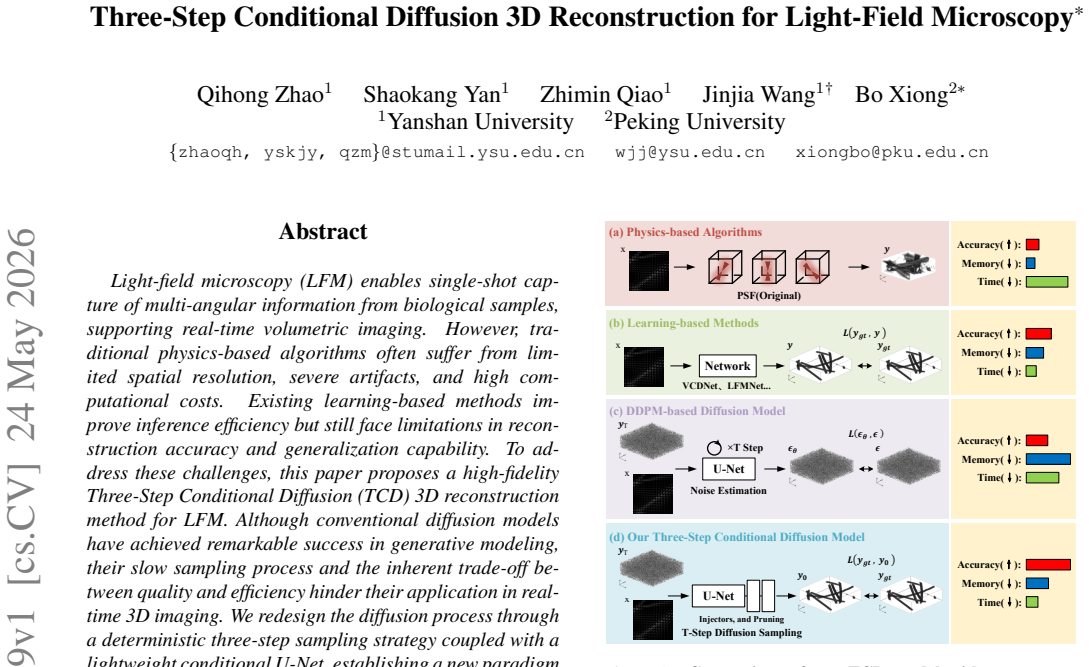
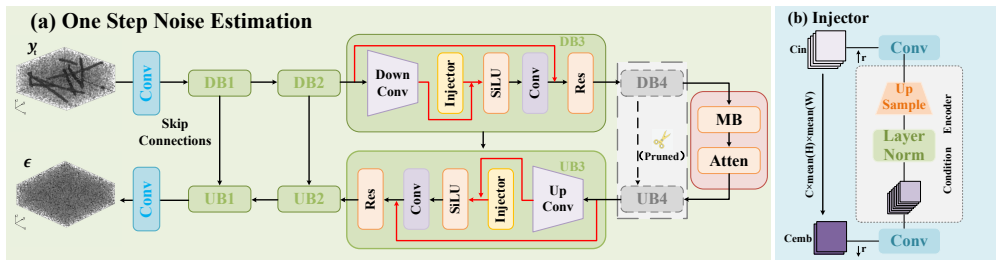
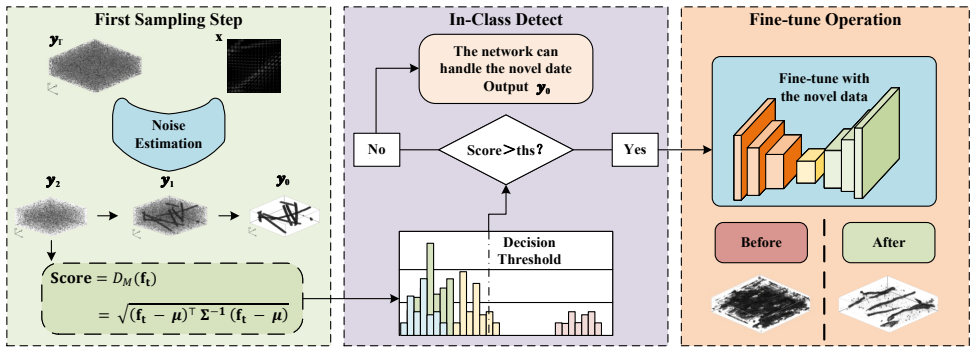
The authors establish that their Three-Step Conditional Diffusion (TCD) method, built on a deterministic three-step sampling strategy paired with a lightweight conditional U-Net and an Inter-Class Detection module, produces higher-fidelity 3D reconstructions and stronger cross-dataset generalization than state-of-the-art alternatives for light-field microscopy.
What carries the argument
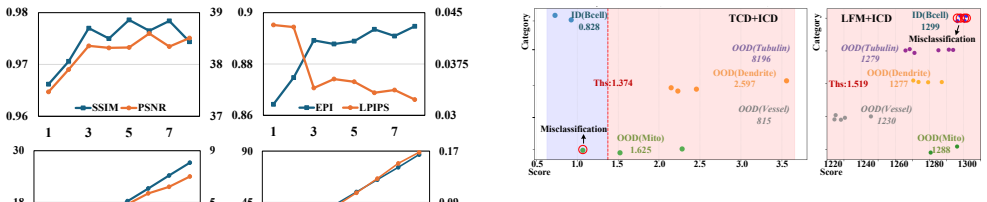
The Three-Step Conditional Diffusion (TCD) process, which applies deterministic three-step sampling to a conditional U-Net together with the Inter-Class Detection (ICD) module that identifies out-of-distribution inputs.
If this is right
- The three-step sampling removes the quality-efficiency trade-off that normally limits diffusion models in real-time imaging.
- Cross-dataset results indicate the model maintains accuracy when input distributions shift.
- The ICD module adds reliability by detecting anomalous samples at inference time.
- Overall the method supplies a practical route to efficient high-fidelity volumetric reconstruction from single light-field captures.
Where Pith is reading between the lines
- If the deterministic reduction works here, similar fixed-step sampling may be testable on conditioned diffusion tasks in other imaging domains.
- Success would imply that full iterative diffusion is often unnecessary once strong conditioning is available.
- The approach could support closed-loop live imaging setups where 3D volumes must be produced and acted on within seconds.
Load-bearing premise
A fixed deterministic three-step sampling schedule inside a lightweight conditional network can deliver the same or better reconstruction quality as full diffusion while working reliably on varied biological samples.
What would settle it
A controlled test on a new dataset in which TCD shows measurably lower reconstruction accuracy, slower inference, or poorer generalization than current leading methods would falsify the performance claims.
Figures
read the original abstract
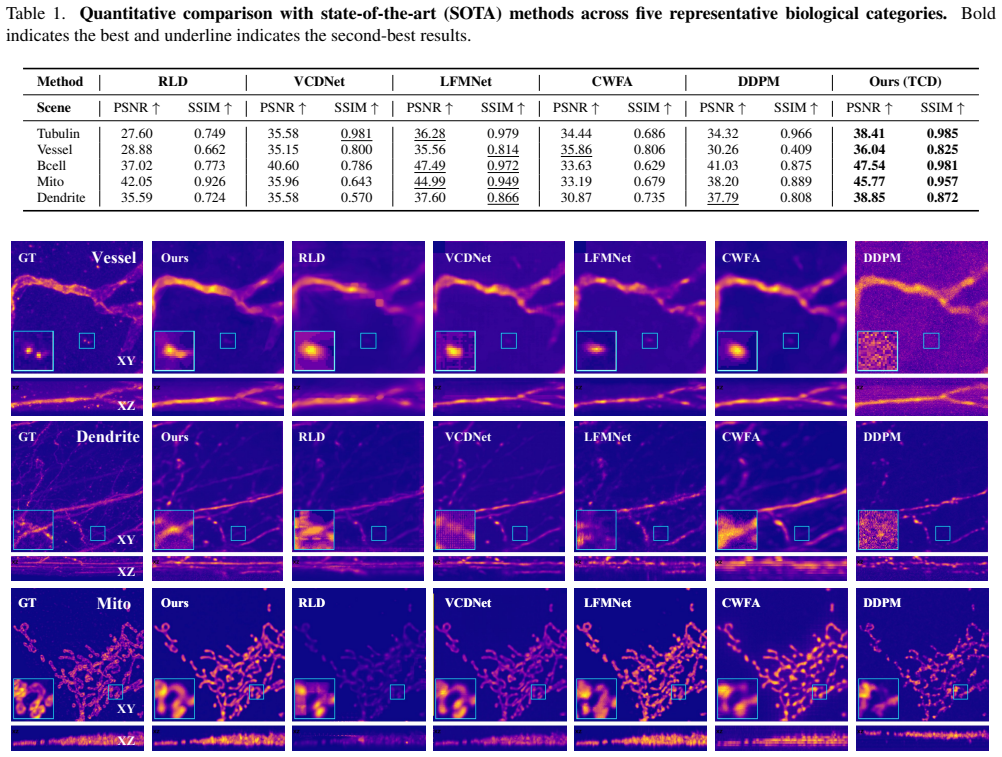
Light-field microscopy (LFM) enables single-shot capture of multi-angular information from biological samples, supporting real-time volumetric imaging. However, traditional physics-based algorithms often suffer from limited spatial resolution, severe artifacts, and high computational costs. Existing learning-based methods improve inference efficiency but still face limitations in reconstruction accuracy and generalization capability. To address these challenges, this paper proposes a high-fidelity Three-Step Conditional Diffusion (TCD) 3D reconstruction method for LFM. Although conventional diffusion models have achieved remarkable success in generative modeling, their slow sampling process and the inherent trade-off between quality and efficiency hinder their application in real-time 3D imaging. We redesign the diffusion process through a deterministic three-step sampling strategy coupled with a lightweight conditional U-Net, establishing a new paradigm for fast and accurate volumetric reconstruction. Furthermore, an Inter-Class Detection (ICD) module is incorporated to identify out-of-distribution or anomalous inputs during inference, thereby enhancing model stability and reliability. Extensive experiments and cross-dataset evaluations demonstrate that TCD significantly outperforms state-of-the-art methods in both reconstruction fidelity and generalization, providing an efficient and practical 3D reconstruction solution for light-field microscopy.
Editorial analysis
A structured set of objections, weighed in public.
Referee Report
Summary. The paper proposes a Three-Step Conditional Diffusion (TCD) method for 3D reconstruction in light-field microscopy. It introduces a deterministic three-step sampling strategy paired with a lightweight conditional U-Net and an Inter-Class Detection (ICD) module to address the quality-efficiency trade-off in diffusion models, claiming improved reconstruction fidelity, efficiency, and generalization across datasets via extensive experiments and cross-dataset evaluations.
Significance. If the experimental claims hold, the work could offer a practical advance for real-time volumetric imaging in biological applications by providing an efficient alternative to both physics-based and existing learning-based LFM reconstruction methods. No mention of machine-checked proofs, reproducible code releases, or parameter-free derivations is present in the provided text.
major comments (1)
- Abstract: the central claim that TCD 'significantly outperforms state-of-the-art methods in both reconstruction fidelity and generalization' is asserted without any quantitative results, error metrics, baselines, ablation studies, or method implementation details supplied in the available text, rendering the claim unverifiable from the manuscript as presented.
Simulated Author's Rebuttal
We thank the referee for the detailed review and the opportunity to clarify our presentation. We address the major comment below.
read point-by-point responses
-
Referee: Abstract: the central claim that TCD 'significantly outperforms state-of-the-art methods in both reconstruction fidelity and generalization' is asserted without any quantitative results, error metrics, baselines, ablation studies, or method implementation details supplied in the available text, rendering the claim unverifiable from the manuscript as presented.
Authors: The full manuscript includes a dedicated Experiments section (Section 4) that reports quantitative results using standard metrics such as PSNR, SSIM, and MAE, with direct comparisons against multiple state-of-the-art baselines (both physics-based and learning-based), ablation studies on the three-step sampling, conditional U-Net, and ICD module, cross-dataset generalization tests, and full implementation details including network architecture and training protocols. The abstract is intended as a concise summary of these findings. If the version provided to the referee contained only the abstract, we can supply the complete manuscript or, if preferred, revise the abstract to include one or two key quantitative highlights while respecting length constraints. revision: partial
Circularity Check
No significant circularity detected
full rationale
The abstract and available description present a methodological proposal (deterministic three-step sampling with conditional U-Net and ICD module) whose central claims rest on asserted experimental outcomes rather than any closed derivation chain. No equations, parameter fits, self-citations, or uniqueness theorems are exhibited that would allow a reduction of outputs to inputs by construction. The reader's assessment of zero circularity is therefore confirmed; the work is treated as self-contained against external benchmarks until full equations are inspected.
Axiom & Free-Parameter Ledger
Reference graph
Works this paper leans on
-
[1]
Fast near-whole–brain imaging in adult drosophila during responses to stimuli and behavior.PLoS biology, 17(2):e2006732, 2019
Sophie Aimon, Takeo Katsuki, Tongqiu Jia, Logan Grosenick, Michael Broxton, Karl Deisseroth, Terrence J Sejnowski, and Ralph J Greenspan. Fast near-whole–brain imaging in adult drosophila during responses to stimuli and behavior.PLoS biology, 17(2):e2006732, 2019. 2
2019
-
[2]
The light field camera: Extended depth of field, aliasing, and superresolution.IEEE transactions on pattern analysis and machine intelligence, 34(5):972–986, 2011
Tom E Bishop and Paolo Favaro. The light field camera: Extended depth of field, aliasing, and superresolution.IEEE transactions on pattern analysis and machine intelligence, 34(5):972–986, 2011. 2
2011
-
[3]
Wave optics theory and 3-d deconvolution for the light field microscope.Optics express, 21(21):25418–25439, 2013
Michael Broxton, Logan Grosenick, Samuel Yang, Noy Co- hen, Aaron Andalman, Karl Deisseroth, and Marc Levoy. Wave optics theory and 3-d deconvolution for the light field microscope.Optics express, 21(21):25418–25439, 2013. 1, 2, 7
2013
-
[4]
Invertible diffusion models for compressed sensing.IEEE Transactions on Pat- tern Analysis and Machine Intelligence, 2025
Bin Chen, Zhenyu Zhang, Weiqi Li, Chen Zhao, Jiwen Yu, Shijie Zhao, Jie Chen, and Jian Zhang. Invertible diffusion models for compressed sensing.IEEE Transactions on Pat- tern Analysis and Machine Intelligence, 2025. 2
2025
-
[5]
Three-dimensional residual channel attention networks denoise and sharpen flu- orescence microscopy image volumes.Nature methods, 18 (6):678–687, 2021
Jiji Chen, Hideki Sasaki, Hoyin Lai, Yijun Su, Jiamin Liu, Yicong Wu, Alexander Zhovmer, Christian A Combs, Ivan Rey-Suarez, Hung-Yu Chang, et al. Three-dimensional residual channel attention networks denoise and sharpen flu- orescence microscopy image volumes.Nature methods, 18 (6):678–687, 2021. 2
2021
-
[6]
Opportunities and challenges of diffusion models for gener- ative ai.National Science Review, 11(12):nwae348, 2024
Minshuo Chen, Song Mei, Jianqing Fan, and Mengdi Wang. Opportunities and challenges of diffusion models for gener- ative ai.National Science Review, 11(12):nwae348, 2024. 3
2024
-
[7]
Optical-aberrations- corrected light field re-projection for high-quality plenoptic imaging.Optics Express, 28(3):3057–3072, 2020
Yanqin Chen, Xin Jin, and Bo Xiong. Optical-aberrations- corrected light field re-projection for high-quality plenoptic imaging.Optics Express, 28(3):3057–3072, 2020. 2
2020
-
[8]
Rapid whole brain imaging of neural ac- tivity in freely behaving larval zebrafish (danio rerio).elife, 6:e28158, 2017
Lin Cong, Zeguan Wang, Yuming Chai, Wei Hang, Chun- feng Shang, Wenbin Yang, Lu Bai, Jiulin Du, Kai Wang, and Quan Wen. Rapid whole brain imaging of neural ac- tivity in freely behaving larval zebrafish (danio rerio).elife, 6:e28158, 2017. 1
2017
-
[9]
Diffusion models beat gans on image synthesis.Advances in neural informa- tion processing systems, 34:8780–8794, 2021
Prafulla Dhariwal and Alexander Nichol. Diffusion models beat gans on image synthesis.Advances in neural informa- tion processing systems, 34:8780–8794, 2021. 3
2021
-
[10]
Don’t drop your samples! coherence-aware training benefits conditional diffusion
Nicolas Dufour, Victor Besnier, Vicky Kalogeiton, and David Picard. Don’t drop your samples! coherence-aware training benefits conditional diffusion. InProceedings of the IEEE/CVF Conference on Computer Vision and Pattern Recognition, pages 6264–6273, 2024. 3
2024
-
[11]
Out-of-distribution (ood) detection and generalization improved by augmenting adversarial mixup samples.Electronics, 12(6):1421, 2023
Kyungpil Gwon and Joonhyuk Yoo. Out-of-distribution (ood) detection and generalization improved by augmenting adversarial mixup samples.Electronics, 12(6):1421, 2023. 2
2023
-
[12]
Denoising dif- fusion probabilistic models.Advances in neural information processing systems, 33:6840–6851, 2020
Jonathan Ho, Ajay Jain, and Pieter Abbeel. Denoising dif- fusion probabilistic models.Advances in neural information processing systems, 33:6840–6851, 2020. 2, 3, 7
2020
-
[13]
A simple unified framework for detecting out-of-distribution samples and adversarial attacks.Advances in neural infor- mation processing systems, 31, 2018
Kimin Lee, Kibok Lee, Honglak Lee, and Jinwoo Shin. A simple unified framework for detecting out-of-distribution samples and adversarial attacks.Advances in neural infor- mation processing systems, 31, 2018. 3
2018
-
[14]
Light field microscopy
Marc Levoy, Ren Ng, Andrew Adams, Matthew Footer, and Mark Horowitz. Light field microscopy. InAcm siggraph 2006 papers, pages 924–934. 2006. 2
2006
-
[15]
Record- ing and controlling the 4d light field in a microscope using microlens arrays.Journal of microscopy, 235(2):144–162,
Marc Levoy, Zhengyun Zhang, and Ian McDowall. Record- ing and controlling the 4d light field in a microscope using microlens arrays.Journal of microscopy, 235(2):144–162,
-
[16]
Faster diffusion: Rethinking the role of the encoder for diffusion model inference.Advances in Neural Information Processing Systems, 37:85203–85240,
Senmao Li, Taihang Hu, Joost van de Weijer, Fahad S Khan, Tao Liu, Linxuan Li, Shiqi Yang, Yaxing Wang, Ming-Ming Cheng, and Jian Yang. Faster diffusion: Rethinking the role of the encoder for diffusion model inference.Advances in Neural Information Processing Systems, 37:85203–85240,
-
[17]
Incorporating the image formation process into deep learning improves network per- formance.Nature Methods, 19(11):1427–1437, 2022
Yue Li, Yijun Su, Min Guo, Xiaofei Han, Jiamin Liu, Har- shad D Vishwasrao, Xuesong Li, Ryan Christensen, Titas Sengupta, Mark W Moyle, et al. Incorporating the image formation process into deep learning improves network per- formance.Nature Methods, 19(11):1427–1437, 2022. 2
2022
-
[18]
Shiyu Liang, Yixuan Li, and Rayadurgam Srikant. Enhanc- ing the reliability of out-of-distribution image detection in neural networks.arXiv preprint arXiv:1706.02690, 2017. 3
-
[19]
Residual denoising diffu- sion models
Jiawei Liu, Qiang Wang, Huijie Fan, Yinong Wang, Yan- dong Tang, and Liangqiong Qu. Residual denoising diffu- sion models. InProceedings of the IEEE/CVF Conference on Computer Vision and Pattern Recognition, pages 2773– 2783, 2024. 2, 3
2024
-
[20]
Phase- space deconvolution for light field microscopy.Optics ex- press, 27(13):18131–18145, 2019
Zhi Lu, Jiamin Wu, Hui Qiao, You Zhou, Tao Yan, Zijing Zhou, Xu Zhang, Jingtao Fan, and Qionghai Dai. Phase- space deconvolution for light field microscopy.Optics ex- press, 27(13):18131–18145, 2019. 2
2019
-
[21]
Conditional image-to-video gener- ation with latent flow diffusion models
Haomiao Ni, Changhao Shi, Kai Li, Sharon X Huang, and Martin Renqiang Min. Conditional image-to-video gener- ation with latent flow diffusion models. InProceedings of the IEEE/CVF Conference on Computer Vision and Pattern Recognition, pages 18444–18455, 2023. 3
2023
-
[22]
Fast light-field 3d microscopy with out-of- distribution detection and adaptation through conditional normalizing flows.Biomedical Optics Express, 15(2):1219– 1232, 2024
Josu ´e Page Vizca´ıno, Panagiotis Symvoulidis, Zeguan Wang, Jonas Jelten, Paolo Favaro, Edward S Boyden, and To- bias Lasser. Fast light-field 3d microscopy with out-of- distribution detection and adaptation through conditional normalizing flows.Biomedical Optics Express, 15(2):1219– 1232, 2024. 2, 7
2024
-
[23]
Simultaneous whole-animal 3d imaging of neuronal activity using light-field microscopy.Nature methods, 11(7):727– 730, 2014
Robert Prevedel, Young-Gyu Yoon, Maximilian Hoffmann, Nikita Pak, Gordon Wetzstein, Saul Kato, Tina Schr ¨odel, Ramesh Raskar, Manuel Zimmer, Edward S Boyden, et al. Simultaneous whole-animal 3d imaging of neuronal activity using light-field microscopy.Nature methods, 11(7):727– 730, 2014. 2
2014
-
[24]
Deep-learning-based noise correction method for light-field fluorescence microscopy.Photonics Research, 13(9):2547– 2565, 2025
Bohan Qu, Zhouyu Jin, You Zhou, Bo Xiong, and Xun Cao. Deep-learning-based noise correction method for light-field fluorescence microscopy.Photonics Research, 13(9):2547– 2565, 2025. 1
2025
-
[25]
High-resolution image synthesis with latent diffusion models
Robin Rombach, Andreas Blattmann, Dominik Lorenz, Patrick Esser, and Bj ¨orn Ommer. High-resolution image synthesis with latent diffusion models. InProceedings of the IEEE/CVF conference on computer vision and pattern recognition, pages 10684–10695, 2022. 3
2022
-
[26]
Mm-diffusion: Learning multi-modal diffusion mod- els for joint audio and video generation
Ludan Ruan, Yiyang Ma, Huan Yang, Huiguo He, Bei Liu, Jianlong Fu, Nicholas Jing Yuan, Qin Jin, and Baining Guo. Mm-diffusion: Learning multi-modal diffusion mod- els for joint audio and video generation. InProceedings of the IEEE/CVF Conference on Computer Vision and Pattern Recognition, pages 10219–10228, 2023. 3
2023
-
[27]
Photorealistic text-to-image diffusion models with deep language understanding.Advances in neural information processing systems, 35:36479–36494, 2022
Chitwan Saharia, William Chan, Saurabh Saxena, Lala Li, Jay Whang, Emily L Denton, Kamyar Ghasemipour, Raphael Gontijo Lopes, Burcu Karagol Ayan, Tim Salimans, et al. Photorealistic text-to-image diffusion models with deep language understanding.Advances in neural information processing systems, 35:36479–36494, 2022. 3
2022
-
[28]
Advances in two-photon scanning and scanless microscopy technologies for func- tional neural circuit imaging.Proceedings of the IEEE, 105 (1):139–157, 2016
Simon R Schultz, Caroline S Copeland, Amanda J Foust, Pe- ter Quicke, and Renaud Schuck. Advances in two-photon scanning and scanless microscopy technologies for func- tional neural circuit imaging.Proceedings of the IEEE, 105 (1):139–157, 2016. 2
2016
-
[29]
Image formation anal- ysis and high resolution image reconstruction for plenoptic imaging systems.Applied optics, 52(10):D22–D31, 2013
Sapna A Shroff and Kathrin Berkner. Image formation anal- ysis and high resolution image reconstruction for plenoptic imaging systems.Applied optics, 52(10):D22–D31, 2013. 1, 2
2013
-
[30]
Deep unsupervised learning using nonequilibrium thermodynamics
Jascha Sohl-Dickstein, Eric Weiss, Niru Maheswaranathan, and Surya Ganguli. Deep unsupervised learning using nonequilibrium thermodynamics. InInternational confer- ence on machine learning, pages 2256–2265. pmlr, 2015. 3
2015
-
[31]
Score-Based Generative Modeling through Stochastic Differential Equations
Yang Song, Jascha Sohl-Dickstein, Diederik P Kingma, Ab- hishek Kumar, Stefano Ermon, and Ben Poole. Score-based generative modeling through stochastic differential equa- tions.arXiv preprint arXiv:2011.13456, 2020. 3
work page internal anchor Pith review Pith/arXiv arXiv 2011
-
[32]
Artifact-free deconvolution in light field microscopy.Optics express, 27(22):31644– 31666, 2019
Anca Stefanoiu, Josue Page, Panagiotis Symvoulidis, Gil G Westmeyer, and Tobias Lasser. Artifact-free deconvolution in light field microscopy.Optics express, 27(22):31644– 31666, 2019. 2
2019
-
[33]
3d deconvolu- tion in fourier integral microscopy
Anca Stefanoiu, Gabriele Scrofani, Genaro Saavedra, Manuel Mart´ınez-Corral, and Tobias Lasser. 3d deconvolu- tion in fourier integral microscopy. InComputational Imag- ing V, pages 56–63. SPIE, 2020. 2
2020
-
[34]
Autodeconj: a gpu- accelerated imagej plugin for 3d light-field deconvolution with optimal iteration numbers predicting.Bioinformatics, 39(1):btac760, 2023
Changqing Su, Yuhan Gao, You Zhou, Yaoqi Sun, Cheng- gang Yan, Haibing Yin, and Bo Xiong. Autodeconj: a gpu- accelerated imagej plugin for 3d light-field deconvolution with optimal iteration numbers predicting.Bioinformatics, 39(1):btac760, 2023. 2
2023
-
[35]
Generaliza- tion of neural network models for complex network dynam- ics.Communications Physics, 7(1):348, 2024
Vaiva Vasiliauskaite and Nino Antulov-Fantulin. Generaliza- tion of neural network models for complex network dynam- ics.Communications Physics, 7(1):348, 2024. 3
2024
-
[36]
V olume recon- struction for light field microscopy
Herman Verinaz-Jadan, Pingfan Song, Carmel L Howe, Amanda J Foust, and Pier Luigi Dragotti. V olume recon- struction for light field microscopy. InICASSP 2020-2020 IEEE International Conference on Acoustics, Speech and Signal Processing (ICASSP), pages 1459–1463. IEEE, 2020. 1, 2
2020
-
[37]
Shift-invariant- subspace discretization and volume reconstruction for light field microscopy.IEEE Transactions on Computational Imaging, 8:286–301, 2022
Herman Verinaz-Jadan, Pingfan Song, Carmel L Howe, Amanda J Foust, and Pier Luigi Dragotti. Shift-invariant- subspace discretization and volume reconstruction for light field microscopy.IEEE Transactions on Computational Imaging, 8:286–301, 2022. 1, 2
2022
-
[38]
Learning to recon- struct confocal microscopy stacks from single light field im- ages.IEEE transactions on computational imaging, 7:775– 788, 2021
Josue Page Vizcaino, Federico Saltarin, Yury Belyaev, Ruth Lyck, Tobias Lasser, and Paolo Favaro. Learning to recon- struct confocal microscopy stacks from single light field im- ages.IEEE transactions on computational imaging, 7:775– 788, 2021. 2, 7
2021
-
[39]
Real-time volumetric reconstruction of biological dynamics with light-field microscopy and deep learning.Nature methods, 18(5):551–556, 2021
Zhaoqiang Wang, Lanxin Zhu, Hao Zhang, Guo Li, Chengqiang Yi, Yi Li, Yicong Yang, Yichen Ding, Mei Zhen, Shangbang Gao, et al. Real-time volumetric reconstruction of biological dynamics with light-field microscopy and deep learning.Nature methods, 18(5):551–556, 2021. 2, 7
2021
-
[40]
3D Gaussian Adaptive Reconstruction for Fourier Light-Field Microscopy
Chenyu Xu, Zhouyu Jin, Chengkang Shen, Hao Zhu, Zhan Ma, Bo Xiong, You Zhou, Xun Cao, and Ning Gu. 3d gaussian adaptive reconstruction for fourier light-field mi- croscopy.arXiv preprint arXiv:2505.12875, 2025. 1
work page internal anchor Pith review Pith/arXiv arXiv 2025
-
[41]
Out-of-distribution detection based on distance metric learning
Donghun Yang, Iksoo Shin, Mai Ngoc Kien, Hoyong Kim, Chanhee Yu, and Myunggwon Hwang. Out-of-distribution detection based on distance metric learning. InThe 9th In- ternational Conference on Smart Media and Applications, pages 214–218, 2020. 3, 6
2020
-
[42]
Light field microscopy in biological imaging.Journal of Innova- tive Optical Health Sciences, 16(01):2230017, 2023
Chengqiang Yi, Lanxin Zhu, Dongyu Li, and Peng Fei. Light field microscopy in biological imaging.Journal of Innova- tive Optical Health Sciences, 16(01):2230017, 2023. 1
2023
-
[43]
Adding conditional control to text-to-image diffusion models
Lvmin Zhang, Anyi Rao, and Maneesh Agrawala. Adding conditional control to text-to-image diffusion models. In Proceedings of the IEEE/CVF international conference on computer vision, pages 3836–3847, 2023. 3
2023
-
[44]
V2v3d: View-to-view denoised 3d reconstruction for light field mi- croscopy
Jiayin Zhao, Zhenqi Fu, Tao Yu, and Hui Qiao. V2v3d: View-to-view denoised 3d reconstruction for light field mi- croscopy. InProceedings of the Computer Vision and Pattern Recognition Conference, pages 26451–26461, 2025. 2, 3
2025
-
[45]
Sparse deconvolution im- proves the resolution of live-cell super-resolution fluores- cence microscopy.Nature biotechnology, 40(4):606–617,
Weisong Zhao, Shiqun Zhao, Liuju Li, Xiaoshuai Huang, Shijia Xing, Yulin Zhang, Guohua Qiu, Zhenqian Han, Yingxu Shang, De-en Sun, et al. Sparse deconvolution im- proves the resolution of live-cell super-resolution fluores- cence microscopy.Nature biotechnology, 40(4):606–617,
-
[46]
Aberration modeling in deep learning for volumetric reconstruction of light-field microscopy.Laser & Photonics Reviews, 17(10):2300154, 2023
You Zhou, Zhouyu Jin, Qianhui Zhao, Bo Xiong, and Xun Cao. Aberration modeling in deep learning for volumetric reconstruction of light-field microscopy.Laser & Photonics Reviews, 17(10):2300154, 2023. 1
2023
-
[47]
Disorder- invariant implicit neural representation.IEEE Transactions on Pattern Analysis and Machine Intelligence, 46(8):5463– 5478, 2024
Hao Zhu, Shaowen Xie, Zhen Liu, Fengyi Liu, Qi Zhang, You Zhou, Yi Lin, Zhan Ma, and Xun Cao. Disorder- invariant implicit neural representation.IEEE Transactions on Pattern Analysis and Machine Intelligence, 46(8):5463– 5478, 2024. 2
2024
discussion (0)
Sign in with ORCID, Apple, or X to comment. Anyone can read and Pith papers without signing in.