REVIEW 4 major objections 4 minor 85 references
Reaction coordinates and rate constants for liquid droplet nucleation: quantifying the interplay between driving force and memory
T0 review · 4 major / 4 minor · reviewed 2026-08-14 · deepseek-v4-flash
Pith's one-line read At low supersaturation, droplet nucleation is steered by density memory, not cluster size alone.
desk verdict A solid, well-written proof-of-principle that the canonical nucleation coordinate n is not enough at low supersaturation, with a plausible qualitative claim supported by autocorrelation analyses, but with genuine open questions about basis completeness and low-S benchmarks. read the letter →
The pith
A machine-rendered reading of the paper's core claim, the machinery that carries it, and where it could break.
The reading
What carries the argument
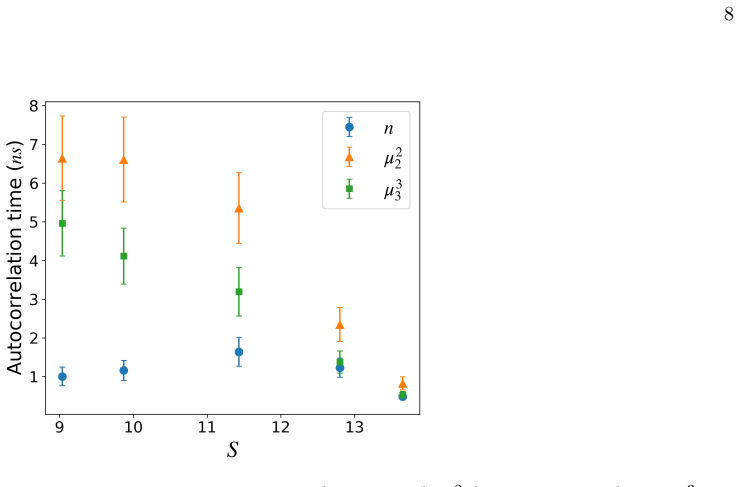
The load-bearing machinery is SGOOP (spectral gap optimization of order parameters), which builds a transition matrix $K_{mn} = \Lambda\sqrt{\pi_n/\pi_m}$ for each candidate one-dimensional coordinate from the stationary density $\pi$ and a dynamical prefactor $\Lambda$ (the mean number of nearest-neighbor transitions, or equivalently the diffusivity divided by $2d^2$). The coordinate with the largest spectral gap—the separation between slow and fast eigenvalues of $K$—is the one that makes the projected dynamics as Markovian as possible. The companion diagnostic is the autocorrelation time of each order parameter, which exposes which variables carry memory. Together these identify the optimized coordinate with the direction of slowest diffusion in order-parameter space, explaining why density-fluctuation moments dominate the reaction coordinate at low supersaturation despite having barriers similar to $n$.
What would settle it
At the lowest supersaturation $S_5$, add a non-redundant slow descriptor (for example cluster asphericity or a bond-orientational order parameter) to the SGOOP optimization. If the spectral gap improves substantially beyond the three-variable coordinate, or if infrequent-metadynamics rates shift, then the three coordination moments do not span the slow dynamics and the central claim would be falsified.
Extended reading notes
Core claim
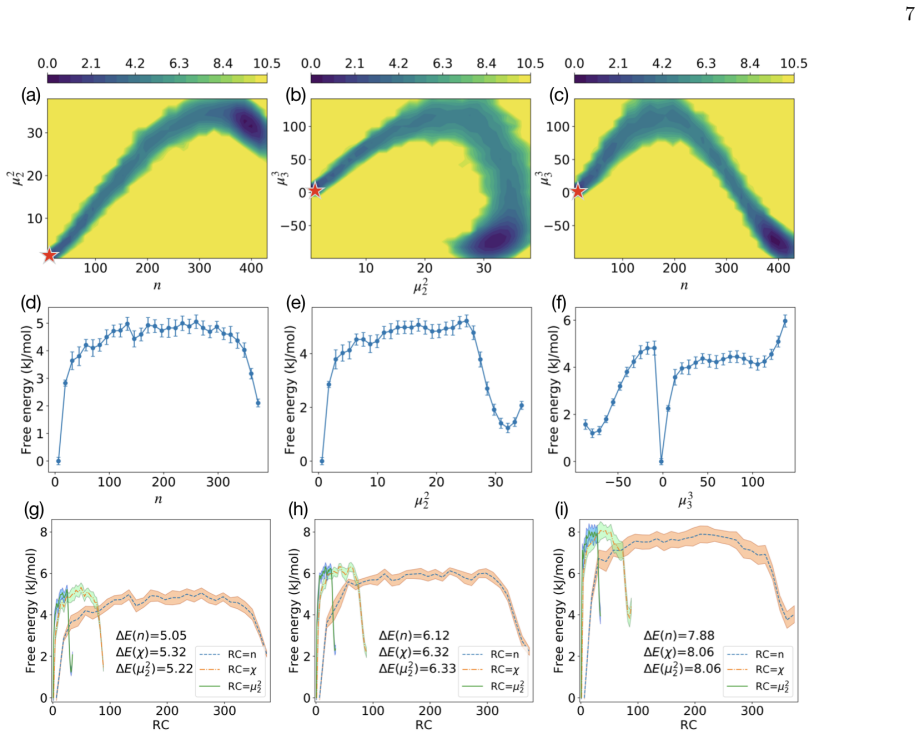
The paper's central discovery is that the best Markovian reaction coordinate for liquid-droplet nucleation is set by diffusion anisotropy, not by barrier height. At each supersaturation the free-energy barriers along $n$, $\mu_2^2$, and $\mu_3^3$ are nearly the same, so they cannot explain the spectral-gap ranking of candidate coordinates. Instead, the autocorrelation times of $\mu_2^2$ and $\mu_3^3$ lengthen steadily relative to $n$ as supersaturation decreases, making density fluctuations the slowest, most memory-laden variables in the system. SGOOP therefore selects a coordinate dominated by $\mu_2^2$, with a modest positive weight on $n$ and a smaller negative weight on $\mu_3^3$: $\chi = 0.15n + 0.65\mu_2^2 - 0.15\mu_3^3$. In infrequent metadynamics, this coordinate gives shorter reweighted nucleation times than $n$-only biasing at the three lowest supersaturations and better agreement with the benchmark rate at $S=11.43$, with acceleration factors approaching $10^4$ relative to unbiased molecular dynamics.
Load-bearing premise
The approach assumes that cluster size plus the second and third moments of the local coordination number capture every slow motion that matters for nucleation; if some other slow feature, such as detailed cluster shape or internal ordering, acts independently, the optimized coordinate could miss it and the rate estimates could stay biased even though statistical checks pass.
Editorial extensions
If this is right
- At weak supersaturation, biasing only the cluster size $n$ leaves slow density and shape fluctuations hidden, and this systematically inflates the nucleation time; the optimized three-variable coordinate removes that bias.
- The advantage of the optimized coordinate over $n$ grows as supersaturation falls, so reaction-coordinate optimization pays off most where unbiased simulation is hardest and classical nucleation theory is least reliable.
- Infrequent metadynamics with the optimized coordinate preserves Poisson-distributed first-passage statistics while reaching accelerations of roughly $10^4$ relative to unbiased molecular dynamics, making it a practical route to nucleation rates near the threshold.
- The optimized coordinate is transferable across the five supersaturations studied, so a single $\chi$ can serve as the biasing variable over a range of driving forces.
- Because the barriers along the three order parameters are nearly equal, reaction-coordinate choice for nucleation must be based on dynamical memory and diffusivity, not on free-energy barriers alone.
Reading between the lines
- The paper leaves open how the optimal weights vary continuously with supersaturation; a systematic per-$S$ optimization might reveal a scaling relation between the weight on density moments and critical nucleus size or surface tension.
- The same autocorrelation-time diagnostic could be applied to other slow descriptors the paper did not test, such as cluster asphericity or orientational order; if any of these further widens the spectral gap at low saturation, the three-variable span is incomplete.
- The 'direction of slowest diffusion wins' principle likely generalizes beyond vapor-to-liquid nucleation to crystal nucleation, polymorph selection, and self-assembly, where several order parameters with different diffusivities compete for the reaction coordinate.
- Because the optimized coordinate was chosen at one supersaturation and held fixed, re-optimizing at each supersaturation could reduce the remaining discrepancy between computed and benchmark rates at $S_3$ and below.
Signed reviews
Editorial analysis
A structured set of objections, weighed in public.
Referee Report
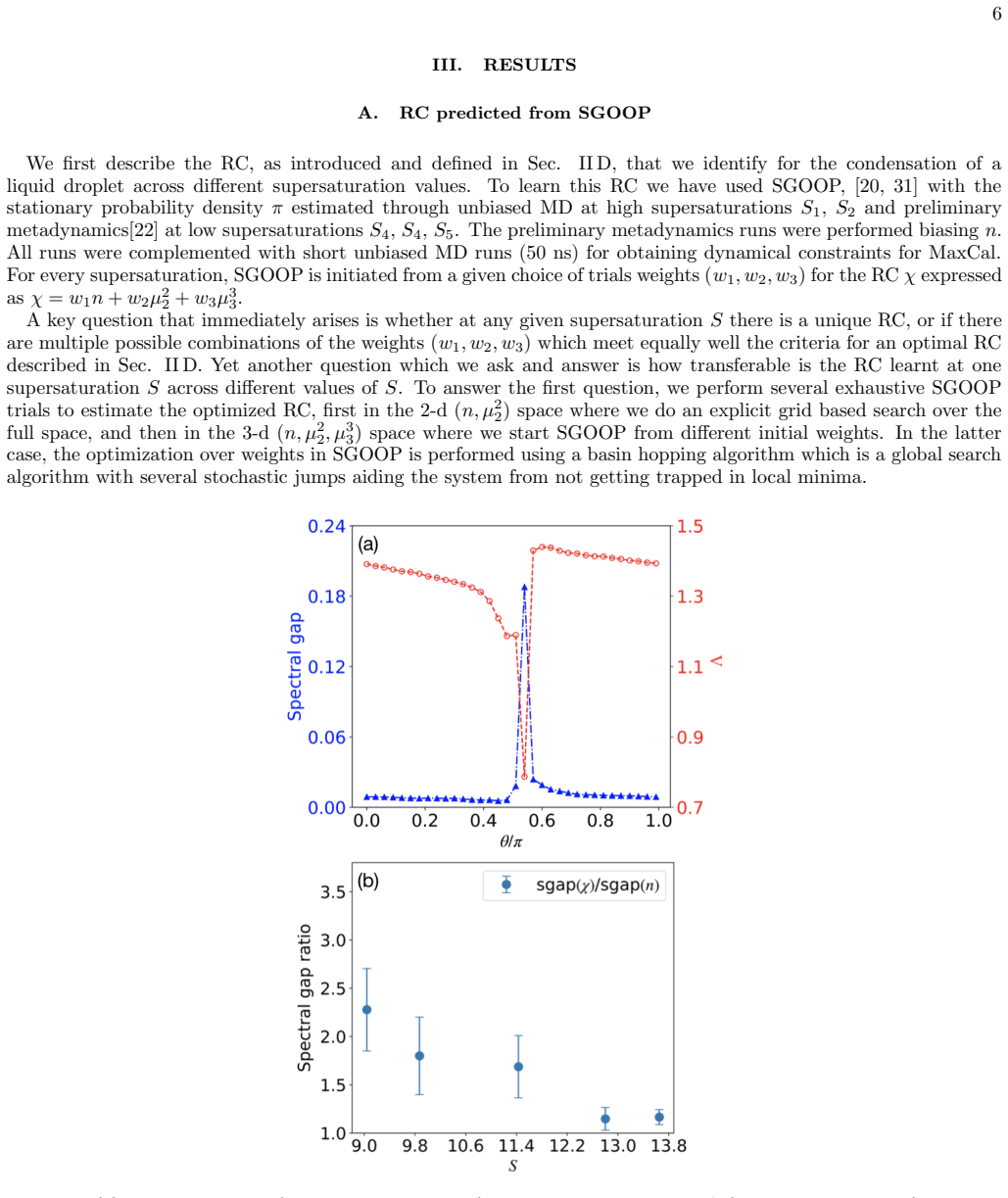
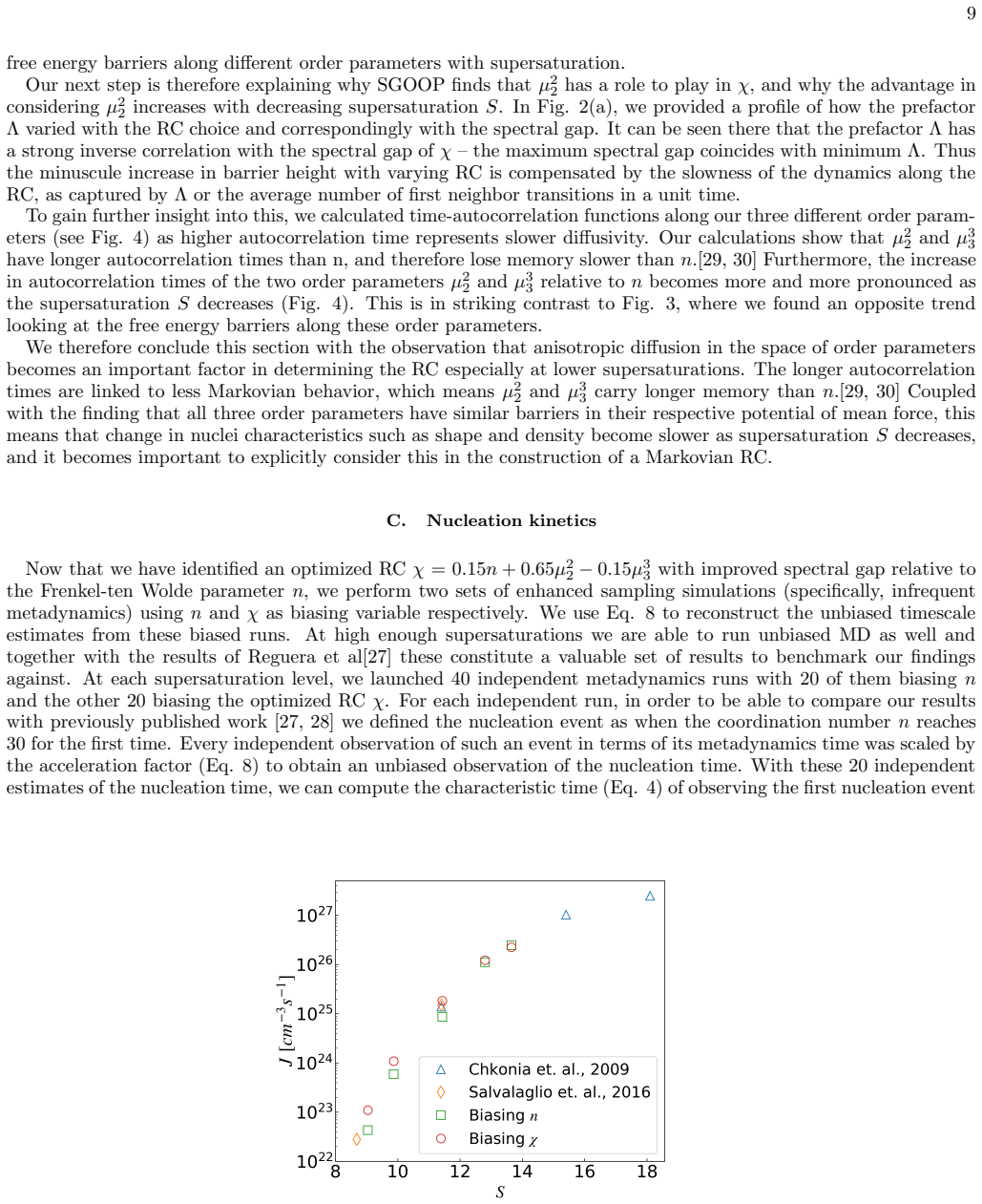
Summary. This manuscript revisits homogeneous nucleation of a Lennard-Jones droplet in a supersaturated vapor, using all-atom MD simulations at five supersaturation levels (S = 13.65, 12.80, 11.43, 9.87, 9.04). The authors apply SGOOP to construct a one-dimensional reaction coordinate χ = 0.15n + 0.65μ_2^2 − 0.15μ_3^3, a linear combination of the number of liquid-like atoms n and the second and third moments of the coordination-number distribution. They find that the spectral gap of χ relative to n increases as supersaturation decreases, that the three order parameters have similar free-energy barriers, and that the autocorrelation times of μ_2^2 and μ_3^3 become increasingly longer than that of n at lower supersaturation. From these observations they conclude that density and shape fluctuations are slow, memory-carrying degrees of freedom that should be part of a Markovian nucleation RC, especially near the lower supersaturations studied. They then use infrequent metadynamics biased on χ to estimate nucleation rates, reporting an acceleration factor of up to about 8 × 10^3 relative to unbiased MD and improved agreement with an external benchmark at S = 11.43.
Significance. The central claim is significant: it challenges the common practice of using n alone as the reaction coordinate for droplet nucleation and provides a principled way to incorporate density and shape fluctuations. The conclusion is supported by multiple mutually reinforcing analyses: spectral-gap ratios computed from 20 independent runs for each state, free-energy comparisons along three order parameters, and direct autocorrelation-time measurements from unbiased MD. The use of an external benchmark at S = 11.43 and the public availability of the SGOOP code are additional strengths. If the low-supersaturation results hold up, the paper will be a useful demonstration that SGOOP combined with infrequent metadynamics can uncover and exploit slow, non-size degrees of freedom in nucleation, with implications for other enhanced-sampling applications.
major comments (4)
- [III A / Eqs. (5)–(7)] The SGOOP stationary density π used at S4 and S5 is estimated from well-tempered metadynamics runs that bias only n (Section III A), even though the paper's thesis is that n is not a sufficient reaction coordinate. If n misses slow orthogonal degrees of freedom, the deposited bias may not equilibrate the μ_2^2 and μ_3^3 directions, so the π used to compute spectral gaps for μ-heavy RCs at low S could be systematically inaccurate. Please provide a convergence test for π in the (n, μ_2^2, μ_3^3) space (for example, a block-analysis comparison of the free-energy surface from independent runs, or a self-consistent recalculation of π after biasing along the optimized χ). Without such a test, the low-S spectral-gap ratios in Fig. 2(b) should be regarded as tentative.
- [III C / Table II] The nucleation event is defined throughout as n reaching 30 for the first time, chosen to match earlier work. However, the authors note in Fig. 1 that n ≈ 30 is the critical size at S = 11.43, and for the lower supersaturations S4 = 9.87 and S5 = 9.04 the critical nucleus should be larger. With a fixed threshold n = 30, first-passage events at S4 and S5 may be recrossings of subcritical clusters rather than nucleations, so the J values in Table II at those states are not necessarily true nucleation rates. Please report the barrier-top position in n at each S (from the free-energy profiles in Fig. 3) and either adopt an S-dependent critical-size event definition or present evidence (for example, the distribution of n at the moment the system first commits to the liquid basin) that n = 30 is post-critical at all S studied.
- [III A / Fig. 2(b)] The RC weights are optimized only at S = 11.43 (via a basin-hopping search in the (w1, w2, w3) space) and then fixed at (0.15, 0.65, −0.15) for all supersaturations. The claim that the RC becomes increasingly dominated by density fluctuations as S decreases is supported by showing that this fixed χ yields a larger spectral gap relative to n at lower S, but that does not establish that the optimal weight set changes with S. I recommend re-running SGOOP independently at each supersaturation (at least at S4 and S5) and reporting the resulting weight sets; if the optimal weights vary with S, the central claim should be phrased in terms of the changing optimal RC rather than the transferability of a single fixed χ.
- [IV / Section III A] The three-order-parameter basis (n, μ_2^2, μ_3^3) is assumed to span the slow subspace relevant to nucleation, but no test is offered for additional slow variables such as cluster asphericity or bond-orientational order. Since the thesis is that χ is a Markovian RC, the completeness of this basis is load-bearing. Even a simple diagnostic—computing autocorrelation times of a geometric asphericity parameter or a Steinhardt Q6 in the same unbiased trajectories used for Fig. 4—would help determine whether an unsampled slow mode exists. At minimum, the manuscript should explicitly state this completeness assumption as a limitation in the Discussion, alongside the deferred extension to additional order parameters.
minor comments (4)
- [II A / Eq. (3)] The notation μ_2^2 and μ_3^3 is ambiguous: the superscripts are easily mistaken for powers of the moments rather than part of the order-parameter label. Please define a clearer convention (for example, μ_2 and μ_3, or a table of symbols) and use it consistently throughout.
- [III C / References] In Section III C the authors write 'Reguera et al [27]', but reference [27] is Chkonia, Wölk, Strey, Wedekind, and Reguera. The citation style should match the reference list to avoid attributing the work to a different author set.
- [III C / Table II] The Kolmogorov-Smirnov p-values are computed from 20 independent runs per reaction coordinate. With this sample size the test has limited power to detect residual bias in the reweighted first-passage times; the authors should note this limitation when interpreting the p-values as evidence of Markovianity.
- [II D / Eq. (5)] The derivation of the SGOOP transition matrix would benefit from a brief statement of the discretization parameters (grid spacing and lag time) used in the numerical construction of K, as these affect the spectral gap and the reported optimization results.
Circularity Check
No significant circularity: the optimized RC weights are a genuine optimization output, and the central claim about longer-lived density fluctuations is supported by independent autocorrelation-time and rate-benchmark evidence.
full rationale
The paper's central result — that as supersaturation decreases the reaction coordinate ceases to be simply the number of liquid-like atoms and must include local density fluctuations — is not equivalent to any input by construction. SGOOP takes as inputs a stationary density estimate and short-trajectory dynamical transition counts along candidate reaction coordinates (Eqs. 5–7); the output weights (w1,w2,w3) = (0.15, 0.65, −0.15) are obtained by maximizing the spectral gap, i.e., they are an optimized output rather than a pre-supplied premise. The claim that mu2^2 and mu3^3 carry longer memory is separately established in Fig. 4 from unbiased MD autocorrelation functions, and the nucleation-rate comparison at S = 11.43 is checked against the external Reguera et al. data (Ref. 27). The paper's many self-citations (SGOOP Refs. 20, 31–33; infrequent metadynamics Refs. 44, 67) cite the methodological machinery; they do not supply the physical conclusion, and no uniqueness theorem from the authors' prior work is invoked to forbid alternative order parameters. The possible incompleteness of the three-order-parameter basis or of the n-biased stationary density at low supersaturation is a convergence/ergodicity risk, not a definitional circularity. No quoted equation or fitted parameter makes the predicted RC or rate equal by construction to the input data.
Assumptions & free parameters
free parameters (4)
- RC weights (w1, w2, w3) =
(0.15, 0.65, -0.15)
- Liquid-like threshold cl =
5
- Nucleation event criterion =
n = 30
- Metadynamics bias parameters (h, omega, Delta t, gamma) =
Table I: h = 0.01-0.2 kJ/mol, omega = 0.5 kJ/mol, Delta t = 25 ps, gamma = 5 or 8
assumptions (5)
- domain assumption SGOOP/MaxCal rate matrix (Eq. 5) provides a valid transition model for any candidate reaction coordinate, and spectral gap maximization identifies the optimal RC.
- domain assumption Infrequent metadynamics reweighting (Eq. 8) recovers unbiased kinetics when the bias variable is a good reaction coordinate and bias deposition is infrequent relative to barrier crossing.
- domain assumption Nucleation events follow a Poisson process (Eq. 4), so the survival probability decays exponentially and the characteristic time can be fit from independent observations.
- domain assumption Autocorrelation times measured from unbiased MD in the metastable gas basin are representative of the memory of the order parameters during the nucleation process.
- domain assumption The Lennard-Jones argon model at NVT with the given parameters is a valid model for studying homogeneous nucleation of a liquid droplet.
Cite this review
Pith. "Pith review of Reaction coordinates and rate constants for liquid droplet nucleation: quantifying the interplay between driving force and memory." pith.science (2026). https://pith.science/paper/FDV4HONX
@misc{pith2026190804846,
  author       = {Pith},
  title        = {Pith review of: Reaction coordinates and rate constants for liquid droplet nucleation: quantifying the interplay between driving force and memory},
  year         = {2026},
  howpublished = {\url{https://pith.science/paper/FDV4HONX}},
  note         = {Machine review of arXiv:1908.04846}
}
read the original abstract
In this work we revisit the classic problem of homogeneous nucleation of a liquid droplet in a supersaturated vapor phase. We consider this at different extents of the driving force, which here is the extent of supersaturation, and calculate a reaction coordinate (RC) for nucleation as the driving force is varied. The RC is constructed as a linear combination of three order parameters, where one accounts for the number of liquid-like atoms, and the other two for local density fluctuations. The RC is calculated from all-atom biased and unbiased molecular dynamics (MD) simulations using the spectral gap optimization approach "SGOOP" [P. Tiwary and B. J. Berne, Proc. Natl. Acad. Sci. U. S. A. 113, 2839 (2016)]. Our key finding is that as the supersaturation decreases, the RC ceases to simply be the number of liquid-like atoms, and instead it becomes important to explicitly consider local density fluctuations that correlate with shape and density variations in the nucleus. All three order parameters are found to have similar barriers in their respective potentials of mean force, however, as the supersaturation decreases the density fluctuations decorrelate slower and thus carry longer memory. Thus at lower supersaturations density fluctuations are non-Markovian and can not be simply ignored from the RC by virtue of being noise. Finally, we use this optimized RC to calculate nucleation rates in the infrequent metadynamics framework, and show it leads to more accurate estimate of the nucleation rate with four orders of magnitude acceleration relative to unbiased MD.
Figures

Figures from the paper (2 more)
Reference graph
Works this paper leans on
- [1]
-
[2]
The distribution of the coordination numbers captures the variations in density of the liquid phase and thus can be used to study the local properties of the liquid droplets
space where it can be seen that at roughly the critical size of n = 30 different µ2 2 can represent clusters with strikingly different profiles in terms of shape, density and compactness. The distribution of the coordination numbers captures the variations in density of the liquid phase and thus can be used to study the local properties of the liquid droplet...
-
[3]
Spectral gap optimization of order parameters (SGOOP)
space at supersaturation 11.43, for a 2 ns interval between 33 ns to 35 ns. The panels are the snapshots at similar n but different µ2 2, showing clearly how there can be clusters with same n but otherwise very different properties including density an compactness. For instance here, at higher µ2 2, the cluster is visibly more compact than the one at lower ...
2016
-
[4]
space where we do an explicit grid based search over the full space, and then in the 3-d ( n,µ 2 2,µ 3
-
[5]
space where we start SGOOP from different initial weights. In the latter case, the optimization over weights in SGOOP is performed using a basin hopping algorithm which is a global search algorithm with several stochastic jumps aiding the system from not getting trapped in local minima. FIG. 2: (a) The spectral gap (blue asterisks, left axis) and dynamical...
-
[6]
Both the maximal spectral gap and minimum Λ take place at θ = 0.5π. (b) Mean spectral gap ratio at five different supersaturation levels S1–S5: For each supersaturation, we averaged the spectral gap ratios calculated from 20 independent biased runs, and the error bars represent the standard error from the averaged results. In the 2-d χ =w1n +w2µ2 2 optimiza...
-
[7]
The corresponding energy barriers ∆E(RC) along three different putative RCs are also shown
The regions between errorbars are filled. The corresponding energy barriers ∆E(RC) along three different putative RCs are also shown. It can be seen that as S decreases the barrier difference decreases. All energies are in units of kJ/mol. RCχ≡ cos(θ)n + sin(θ)µ2 2 in the (n,µ 2
-
[8]
space. Here as shown in Fig. 2(a) for S = 11.43, we find that the spectral gap profile has a sharp peak when the RC is almost exclusively comprised of µ2 2, i.e. θ≈ π/2 and µ2 2 has around 8 times higher weight in the RC than n. Such a µ2 2–heavy RC is obtained irrespective of any S value, showing unequivocally that the second moment µ2 2 plays a more impor...
Show all 85 references
-
[9]
space. Here we find that there are many combinations ( w1,w 2,w 3) with similarly enhanced spectral gaps relative to the traditional choice of χ =n, but with a common theme that the second moment and the third moment consistently show up in the optimized RC. Thus to summarize s...
-
[10]
leads to RC predominantly comprised of µ2 2, (b) RC optimization in (n,µ 2 2,µ 3
-
[11]
In other words, the RC is quite degenerate, but considering µ2 2 andµ3 3 in the RC is important for a more accurate description of the nucleation process
leads to a RC invariably with weights for all 3 variables, but with multiple local maxima in the spectral gap profile. In other words, the RC is quite degenerate, but considering µ2 2 andµ3 3 in the RC is important for a more accurate description of the nucleation process. In t...
-
[12]
3 (a)-(c)), all three order parameters change in a very correlated manner until the barrier is reached and nucleation is essentially complete ( n >100)
The 2-d profiles show that starting from the gas phase (red stars in Fig. 3 (a)-(c)), all three order parameters change in a very correlated manner until the barrier is reached and nucleation is essentially complete ( n >100). The 1-d free energies along the three order paramet...
-
[13]
3 (g)-(i), we show the free energies along three different RC choices, namely n, µ2 2 and the optimized χ = 0.15n + 0.65µ2 2− 0.15µ3 3, for three differentS values
In Fig. 3 (g)-(i), we show the free energies along three different RC choices, namely n, µ2 2 and the optimized χ = 0.15n + 0.65µ2 2− 0.15µ3 3, for three differentS values. As S is decreased, invariably there is a small but consistent improvement in the barrier height when viewe...
-
[14]
Barducci, G
A. Barducci, G. Bussi, and M. Parrinello, Phys Rev Lett 100, 020603 (2008)
2008
-
[15]
B. J. Murray, T. W. Wilson, S. Dobbie, Z. Cui, S. M. Al-Jumur, O. M¨ ohler, M. Schnaiter, R. Wagner, S. Benz, M. Niemand, et al., Nature Geoscience 3, 233 (2010)
2010
-
[16]
Mazur, Science 168, 939 (1970)
P. Mazur, Science 168, 939 (1970)
1970
-
[17]
J. R. Cox, L. A. Ferris, and V. R. Thalladi, Angewandte Chemie International Edition 46, 4333 (2007)
2007
-
[18]
Erdemir, A
D. Erdemir, A. Y. Lee, and A. S. Myerson, Current opinion in drug discovery & development 10, 746 (2007)
2007
-
[19]
E. D. Sloan, Nature 426, 353 (2003)
2003
-
[20]
Hammerschmidt, Industrial & Engineering Chemistry 26, 851 (1934)
E. Hammerschmidt, Industrial & Engineering Chemistry 26, 851 (1934)
1934
-
[21]
J. D. Harper, C. M. Lieber, and P. T. Lansbury Jr, Chemistry & biology 4, 951 (1997)
1997
-
[22]
S. I. Cohen, S. Linse, L. M. Luheshi, E. Hellstrand, D. A. White, L. Rajah, D. E. Otzen, M. Vendruscolo, C. M. Dobson, and T. P. Knowles, Proceedings of the National Academy of Sciences 110, 9758 (2013)
2013
-
[23]
G. C. Sosso, J. Chen, S. J. Cox, M. Fitzner, P. Pedevilla, A. Zen, and A. Michaelides, Chemical reviews 116, 7078 (2016)
2016
-
[24]
G. M. Torrie and J. P. Valleau, Journal of Computational Physics 23, 187 (1977)
1977
-
[25]
Kumar, J
S. Kumar, J. M. Rosenberg, D. Bouzida, R. H. Swendsen, and P. A. Kollman, Journal of computational chemistry 13, 1011 (1992)
1992
-
[26]
Laio and M
A. Laio and M. Parrinello, Proc Natl Acad Sci 99, 12562 (2002)
2002
-
[27]
atS = 11.43, the lower characteristic time (with similar p-values) can be seen as further evidence of the benefit of biasingχ instead ofn. This is because in metadynamics the presence of missing slow degrees of freedom from explicit consideration in the biasing variable typical...
-
[28]
T. S. van Erp, D. Moroni, and P. G. Bolhuis, The Journal of chemical physics 118, 7762 (2003)
2003
-
[29]
Moroni, T
D. Moroni, T. S. van Erp, and P. G. Bolhuis, Physica A: Statistical Mechanics and its Applications 340, 395 (2004)
2004
-
[30]
R. J. Allen, D. Frenkel, and P. R. ten Wolde, The Journal of chemical physics 124, 024102 (2006)
2006
-
[31]
R. J. Allen, C. Valeriani, and P. R. ten Wolde, J. Phys.: Cond. Matt. 21, 463102 (2009)
2009
-
[33]
Tiwary and B
P. Tiwary and B. J. Berne, Proc. Natl. Acad. Sci. 113, 2839 (2016)
2016
-
[34]
Berezhkovskii and A
A. Berezhkovskii and A. Szabo, J. Chem. Phys. 122, 014503 (2005)
2005
-
[35]
Valsson, P
O. Valsson, P. Tiwary, and M. Parrinello, Ann. Rev. Phys. Chem. 67, 159 (2016)
2016
-
[36]
Sarupria and P
S. Sarupria and P. G. Debenedetti, J. Phys. Chem. Lett. 3, 2942 (2012)
2012
-
[37]
R. S. DeFever and S. Sarupria, J. Chem. Phys. 150, 024103 (2019)
2019
-
[38]
Dellago, P
C. Dellago, P. G. Bolhuis, and D. Chandler, The Journal of chemical physics 108, 9236 (1998)
1998
-
[39]
Bolhuis et al., Faraday Discussions 110, 421 (1998)
P. Bolhuis et al., Faraday Discussions 110, 421 (1998)
1998
-
[40]
Chkonia, J
G. Chkonia, J. W¨ olk, R. Strey, J. Wedekind, and D. Reguera, The Journal of chemical physics 130, 064505 (2009)
2009
-
[41]
Salvalaglio, P
M. Salvalaglio, P. Tiwary, G. M. Maggioni, M. Mazzotti, and M. Parrinello, J. Chem. Phys. 145, 211925 (2016)
2016
-
[42]
Kuipers and G
J. Kuipers and G. Barkema, Physical Review E 79, 062101 (2009)
2009
-
[43]
Ford, Proceedings of the Institution of Mechanical Engineers, Part C: Journal of Mechanical Engineering Science 218, 883 (2004)
I. Ford, Proceedings of the Institution of Mechanical Engineers, Part C: Journal of Mechanical Engineering Science 218, 883 (2004)
2004
-
[44]
Tiwary and B
P. Tiwary and B. J. Berne, J. Chem. Phys. 147, 152701 (2017)
2017
-
[45]
Tiwary and B
P. Tiwary and B. J. Berne, J. Chem. Phys. 145, 054113 (2016), URL http://scitation.aip.org/content/aip/journal/ jcp/145/5/10.1063/1.4959969
2016 doi
-
[46]
Smith, D
Z. Smith, D. Pramanik, S.-T. Tsai, and P. Tiwary, J. Chem. Phys. 149, 234105 (2018)
2018
-
[47]
Weber and M
A. Weber and M. Volmer, Zeitschrift f¨ ur Physikalische Chemie119, 277 (1926). 12
1926
-
[48]
Farkas, Zeitschrift f¨ ur physikalische Chemie125, 236 (1927)
L. Farkas, Zeitschrift f¨ ur physikalische Chemie125, 236 (1927)
1927
-
[49]
Becker and W
R. Becker and W. D¨ oring, Annalen der Physik416, 719 (1935)
1935
-
[50]
Y. B. Zeldovich, Acta Physicochem., USSR 18, 1 (1943)
1943
-
[51]
H. J. Maris, Comptes Rendus Physique 7, 946 (2006)
2006
-
[52]
V. I. Kalikmanov, Classical Nucleation Theory (Springer Netherlands, Dordrecht, 2013), pp. 17–41, ISBN 978-90-481-3643- 8, URL https://doi.org/10.1007/978-90-481-3643-8_3
2013 doi
-
[53]
Berezhkovskii and A
A. Berezhkovskii and A. Szabo, J. Chem. Phys. 135, 074108 (2011)
2011
-
[54]
van der Zwan and J
G. van der Zwan and J. T. Hynes, J. Chem. Phys. 77, 1295 (1982)
1982
-
[55]
J. T. Hynes, Annual Review of Physical Chemistry 36, 573 (1985)
1985
-
[56]
Peters, P
B. Peters, P. G. Bolhuis, R. G. Mullen, and J.-E. Shea, J. Chem. Phys. 138, 054106 (2013)
2013
-
[57]
Tiwary and M
P. Tiwary and M. Parrinello, Phys. Rev. Lett. 111, 230602 (2013)
2013
-
[58]
M. Rao, B. Berne, and M. Kalos, The Journal of Chemical Physics 68, 1325 (1978)
1978
-
[59]
H. Wang, H. Gould, and W. Klein, Physical Review E 76, 031604 (2007)
2007
-
[60]
Kalikmanov, J
V. Kalikmanov, J. W¨ olk, and T. Kraska, The Journal of chemical physics 128, 124506 (2008)
2008
-
[61]
P. R. ten Wolde and D. Frenkel, Science 277, 1975 (1997)
1997
-
[62]
Trudu, D
F. Trudu, D. Donadio, and M. Parrinello, Physical review letters 97, 105701 (2006)
2006
-
[63]
Moroni, P
D. Moroni, P. R. Ten Wolde, and P. G. Bolhuis, Physical review letters 94, 235703 (2005)
2005
-
[64]
S. G. Kwon, G. Krylova, P. J. Phillips, R. F. Klie, S. Chattopadhyay, T. Shibata, E. E. Bunel, Y. Liu, V. B. Prakapenka, B. Lee, et al., Nature materials 14, 215 (2015)
2015
-
[65]
J. Zhou, Y. Yang, Y. Yang, D. S. Kim, A. Yuan, X. Tian, C. Ophus, F. Sun, A. K. Schmid, M. Nathanson, et al., Nature 570, 500 (2019)
2019
-
[66]
P. R. ten Wolde and D. Frenkel, The Journal of chemical physics 109, 9901 (1998)
1998
-
[67]
G. A. Tribello, F. Giberti, G. C. Sosso, M. Salvalaglio, and M. Parrinello, Journal of chemical theory and computation 13, 1317 (2017)
2017
-
[68]
G. A. Tribello, M. Ceriotti, and M. Parrinello, Proc. Natl. Acad. Sci. 107, 17509 (2010)
2010
-
[69]
S. M. Kathmann, G. K. Schenter, and B. C. Garrett, J. Chem. Phys. 120, 9133 (2004)
2004
-
[70]
S. I. Resnick, Adventures in stochastic processes (Springer Science & Business Media, 2013)
2013
-
[71]
Salvalaglio, P
M. Salvalaglio, P. Tiwary, and M. Parrinello, J. Chem. Theor. Comp. 10, 1420 (2014)
2014
-
[72]
Bussi, D
G. Bussi, D. Donadio, and M. Parrinello, The Journal of chemical physics 126, 014101 (2007)
2007
-
[73]
Lindahl, B
E. Lindahl, B. Hess, and D. Van Der Spoel, Molecular modeling annual 7, 306 (2001)
2001
-
[74]
C. C. e. a. Massimiliano Bonomi, Giovanni Bussi, Nature methods 16, 670 (2019)
2019
-
[75]
Berezhkovskii and A
A. Berezhkovskii and A. Szabo, The Journal of chemical physics 135, 074108 (2011)
2011
-
[76]
P. D. Dixit, A. Jain, G. Stock, and K. A. Dill, J. Chem. Theor. Comp. 11, 5464 (2015)
2015
-
[77]
E. T. Jaynes, Ann. Rev. Phys. Chem. 31, 579 (1980)
1980
-
[78]
Press´ e, K
S. Press´ e, K. Ghosh, J. Lee, and K. A. Dill, Rev. Mod. Phys. 85, 1115 (2013), URL http://link.aps.org/doi/10.1103/ RevModPhys.85.1115
2013
-
[79]
P. D. Dixit, J. Wagoner, C. Weistuch, S. Press´ e, K. Ghosh, and K. A. Dill, The Journal of chemical physics 148, 010901 (2018)
2018
-
[80]
Tiwary and M
P. Tiwary and M. Parrinello, J. Phys. Chem. B 119, 736 (2014)
2014
-
[81]
Tiwary and B
P. Tiwary and B. Berne, The Journal of chemical physics 147, 152701 (2017)
2017
-
[82]
Bicout and A
D. Bicout and A. Szabo, J. Chem. Phys. 109, 2325 (1998)
1998
-
[83]
Tiwary and B
P. Tiwary and B. Berne, Proceedings of the National Academy of Sciences 113, 2839 (2016)
2016
-
[84]
Casasnovas, V
R. Casasnovas, V. Limongelli, P. Tiwary, P. Carloni, and M. Parrinello, J. Am. Chem. Soc. 139, 4780 (2017)
2017
-
[85]
Peters and B
B. Peters and B. L. Trout, The Journal of chemical physics 125, 054108 (2006)
2006
-
[86]
R. B. Best and G. Hummer, Proc. Natl. Acad. Sci. 102, 6732 (2005)
2005
Reviewed August 14, 2026 · model on record in the stance chip above.
Discussion (0). Continue with ORCID to comment.