A magnetar formation in binary neutron star merger
Pith reviewed 2026-06-27 12:00 UTC · model grok-4.3
The pith
Binary neutron star mergers amplify magnetic fields to magnetar strength within 3 milliseconds
A machine-rendered reading of the paper's core claim, the machinery that carries it, and where it could break.
Core claim
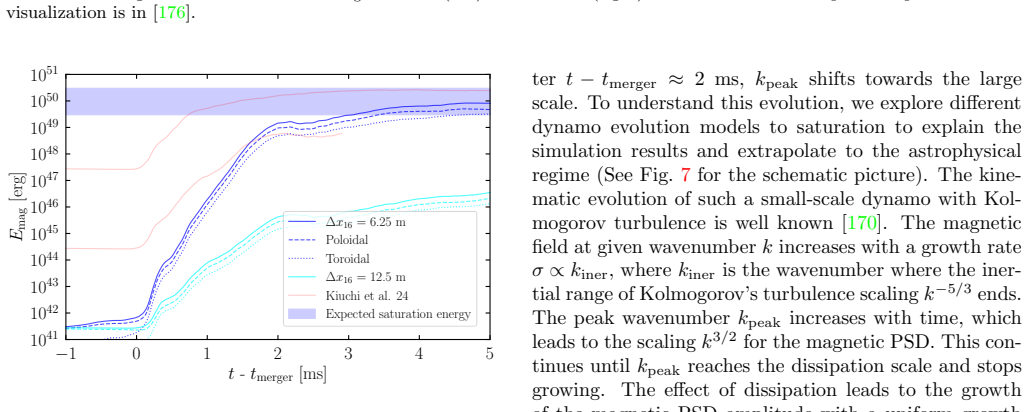
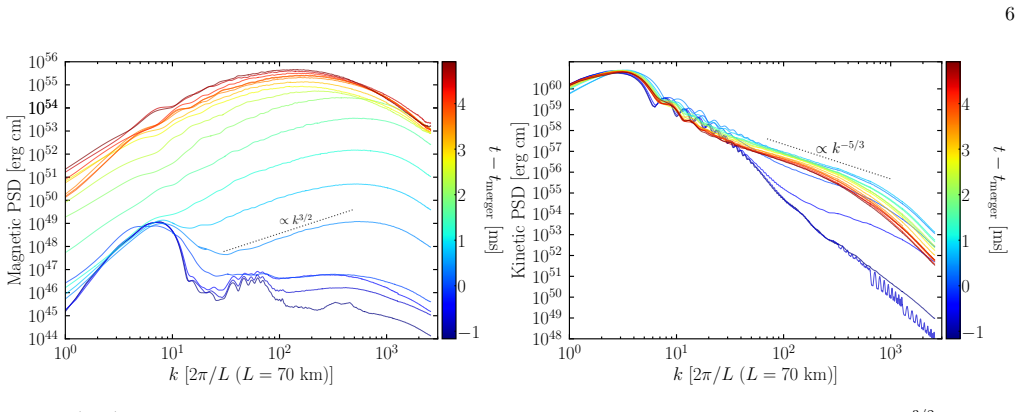
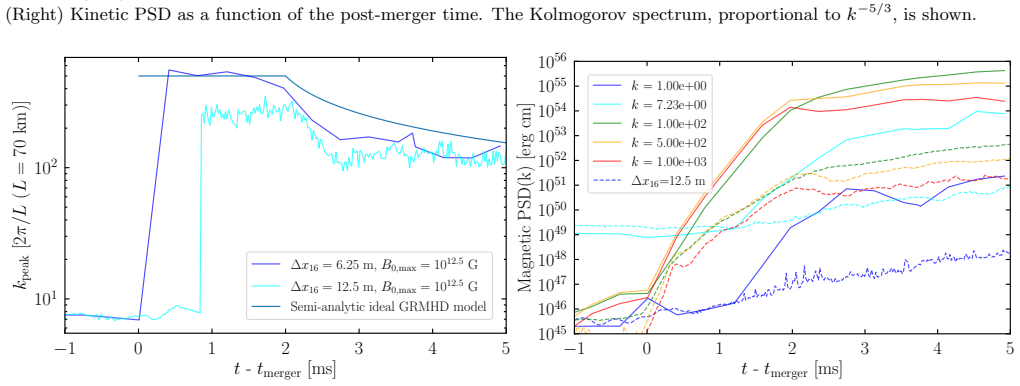
In this high-resolution simulation the Kelvin-Helmholtz instability that appears when the two neutron stars touch amplifies the magnetic field to an expected electromagnetic saturation energy of approximately 10 to the 50 ergs within 3 milliseconds after merger. The magnetic and kinetic power spectral densities reproduce the Kazantsev and Kolmogorov forms respectively. The process produces a stellar-scale field increase by a factor of at least 316. The authors conclude that a magnetar may therefore form at least temporarily following neutron star mergers in a few milliseconds.
What carries the argument
The Kelvin-Helmholtz instability at the contact interface between the merging neutron stars, which generates turbulence that amplifies the magnetic field to saturation
If this is right
- A magnetar can form temporarily within milliseconds after a neutron star merger
- The amplified field reaches an energy level of about 10 to the 50 ergs that is expected for magnetar activity
- Stellar-scale magnetic field strength increases by a factor of at least 316
- The magnetic and kinetic spectra follow the Kazantsev and Kolmogorov forms indicating turbulent amplification
Where Pith is reading between the lines
- This channel could account for some observed magnetars without requiring separate formation routes in isolated stars
- Post-merger remnants in events like GW170817 could carry strong fields that affect ejecta dynamics and electromagnetic signals
- Repeating the calculation with varied initial field strengths or mass ratios would test how robust the rapid growth is
Load-bearing premise
The initial peak magnetic field of 3.16 times 10 to the 12 gauss is representative of real binary neutron stars and the grid spacing is fine enough to resolve the instability without numerical artifacts dominating the growth
What would settle it
A simulation at still higher resolution or with a weaker initial field that fails to reach 10 to the 50 erg saturation energy within a few milliseconds, or an observation of a recent merger remnant whose early electromagnetic output is inconsistent with that energy scale
Figures
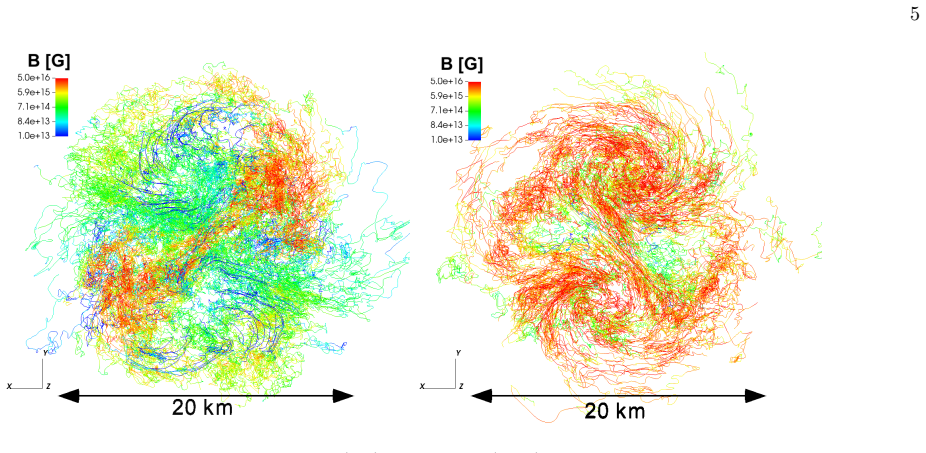
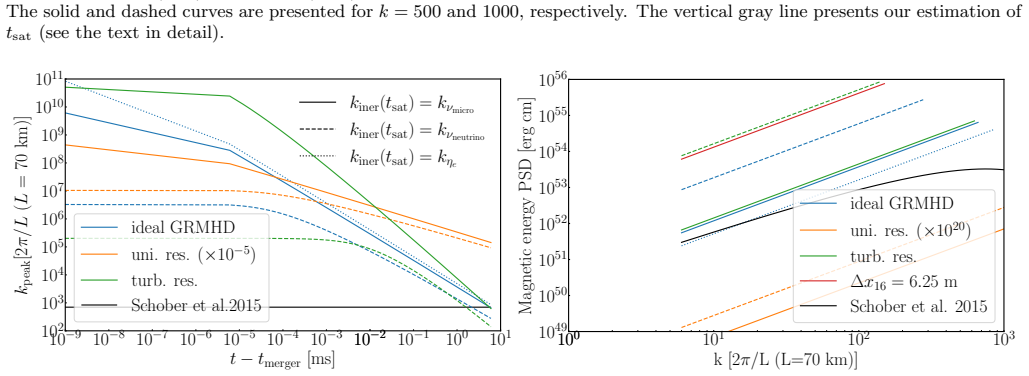
read the original abstract
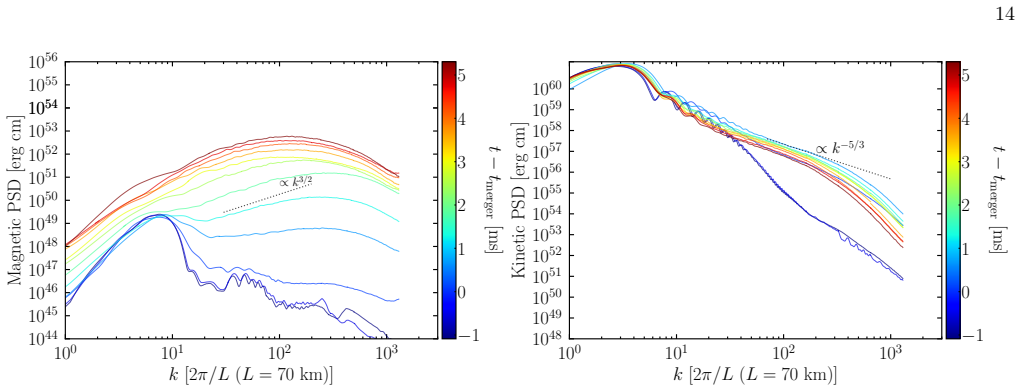
We conduct a global general relativistic neutrino-radiation-transfer magnetohydrodynamics simulation of a $1.35$-$1.35M_\odot$ binary neutron star with the unprecedented spatial resolution of $6.25$\,m on the Japanese supercomputer FUGAKU. The total consumed CPU time is $\approx 530$ million core hours. We initialize the binary neutron star's magnetic field to be $3.16\times 10^{12}$~G at maximum, which is compatible with the upper end of the observed binary pulsars. We demonstrate that the Kelvin-Helmholtz instability that emerges when the two neutron stars touch amplifies the magnetic field to an expected electromagnetic saturation energy of $\sim 10^{50}$~erg within $3$~ms after the merger. The spectral analysis indicates that the Kazantsev and Kolmogorov spectra are reproduced in the magnetic and kinetic power spectral densities, respectively. We also find that it induces stellar-scale magnetic field amplification by at least a factor of $316$. We conclude that a magnetar may form at least temporarily following neutron star mergers in a few ms.
Editorial analysis
A structured set of objections, weighed in public.
Referee Report
Summary. The manuscript presents a global general relativistic neutrino-radiation-transfer magnetohydrodynamics simulation of a 1.35-1.35 M⊙ binary neutron star merger at 6.25 m spatial resolution on the Fugaku supercomputer (∼530 million core hours). The initial magnetic field has a maximum of 3.16×10^12 G. The central claim is that the Kelvin-Helmholtz instability at contact amplifies the field to an electromagnetic saturation energy of ∼10^50 erg within 3 ms post-merger, reproduces Kazantsev and Kolmogorov spectra in the magnetic and kinetic power spectral densities, and produces stellar-scale amplification by a factor of at least 316, implying that a magnetar may form temporarily in a few ms.
Significance. If the numerical results hold, the work would establish that KHI-driven amplification can produce magnetar-strength fields on millisecond timescales in BNS mergers, with direct implications for short GRB engines, kilonova modeling, and EM counterparts to GW events. The achieved resolution and scale of the computation are technical strengths that advance the state of the art in the field.
major comments (2)
- [Methods (simulation setup and resolution)] Methods (simulation setup and resolution): The results are reported at a single grid resolution of 6.25 m with no resolution study, convergence tests, or error budget provided. Prior BNS MHD literature has established that KHI magnetic energy growth remains resolution-dependent until an inertial range is fully developed; without such tests the reported saturation energy of ∼10^50 erg and ≥316× amplification cannot be shown to be free of grid-scale numerical resistivity or dissipation.
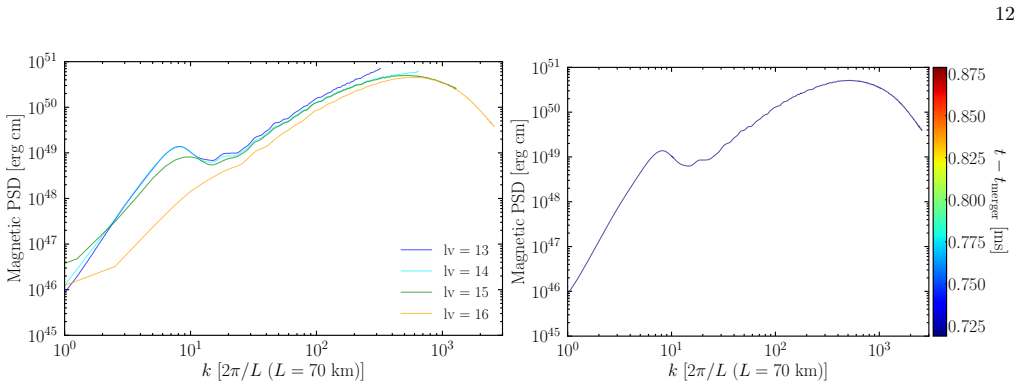
- [Results (spectral analysis)] Results (spectral analysis): The manuscript states that Kazantsev and Kolmogorov spectra are reproduced, but provides no quantification of the inertial-range extent, fitting ranges, or comparison to lower-resolution runs. This leaves open whether the spectra support a physical dynamo saturation or are still influenced by numerical effects at the grid scale.
minor comments (1)
- [Abstract and Methods] The abstract and methods could more explicitly state how the neutrino-radiation-transfer module couples to the MHD evolution and whether it affects the reported magnetic amplification timescale.
Simulated Author's Rebuttal
We thank the referee for their constructive comments and recognition of the computational scale of our simulation. We address each major comment below.
read point-by-point responses
-
Referee: The results are reported at a single grid resolution of 6.25 m with no resolution study, convergence tests, or error budget provided. Prior BNS MHD literature has established that KHI magnetic energy growth remains resolution-dependent until an inertial range is fully developed; without such tests the reported saturation energy of ∼10^50 erg and ≥316× amplification cannot be shown to be free of grid-scale numerical resistivity or dissipation.
Authors: We agree that a dedicated resolution study would provide stronger evidence of convergence. However, each simulation at 6.25 m resolution requires approximately 530 million core hours, rendering additional runs at multiple resolutions computationally prohibitive. We selected this resolution as the highest achieved to date for global GR neutrino-radiation MHD BNS merger simulations, guided by prior literature indicating that resolutions of order 10 m or finer are required to capture KHI amplification. We will add a paragraph in the Methods section justifying the resolution choice with references to earlier resolution studies on KHI in BNS systems and noting that the emergence of the expected spectral slopes is consistent with an inertial range being resolved. We do not claim the results are fully converged but argue they represent a significant advance at this scale. revision: partial
-
Referee: The manuscript states that Kazantsev and Kolmogorov spectra are reproduced, but provides no quantification of the inertial-range extent, fitting ranges, or comparison to lower-resolution runs. This leaves open whether the spectra support a physical dynamo saturation or are still influenced by numerical effects at the grid scale.
Authors: We will revise the spectral analysis section to include quantitative details: the specific wavenumber ranges over which power-law fits were performed, the measured slopes with uncertainties, the estimated extent of the inertial range, and explicit comparisons to the theoretical Kazantsev (magnetic) and Kolmogorov (kinetic) indices. We will also reference spectra from lower-resolution BNS MHD simulations in the literature to demonstrate that our higher resolution extends the inertial range and reduces the influence of grid-scale dissipation. These additions will clarify that the observed spectra support physical dynamo action rather than numerical artifacts. revision: yes
Circularity Check
Simulation result independent of fitted parameters or self-citation
full rationale
The paper reports an emergent outcome from direct numerical evolution of GR neutrino-radiation MHD equations on a 6.25 m grid, with initial B_max taken from the upper end of observed binary pulsar values rather than adjusted to match the target 10^50 erg or 316x amplification. No algebraic reduction, parameter fitting to the reported saturation energy, or load-bearing self-citation chain is present in the derivation; the KHI-driven growth is the computed result of the time-dependent simulation.
Axiom & Free-Parameter Ledger
free parameters (1)
- Initial maximum magnetic field =
3.16e12 G
axioms (2)
- standard math Equations of general-relativistic magnetohydrodynamics with neutrino radiation transfer
- domain assumption Kelvin-Helmholtz instability develops at the contact interface and drives turbulent amplification
Forward citations
Cited by 1 Pith paper
-
Subgrid Modelling for Relativistic Magnetohydrodynamics with Machine Learning
First neural-network subgrid model for special relativistic MHD reproduces 4x-higher-resolution magnetic field amplification in 3D Kelvin-Helmholtz tests at 44x speedup.
Reference graph
Works this paper leans on
-
[1]
B. P. Abbott et al. (LIGO Scientific, Virgo), Phys. Rev. Lett.119, 161101 (2017), arXiv:1710.05832 [gr-qc]
Pith/arXiv arXiv 2017
-
[2]
B. P. Abbott et al. (LIGO Scientific, Virgo, Fermi GBM, INTEGRAL, IceCube, AstroSat Cadmium Zinc Telluride Imager Team, IPN, Insight-Hxmt, ANTARES, Swift, AGILE Team, 1M2H Team, Dark Energy Camera GW-EM, DES, DLT40, GRAWITA, Fermi-LAT, ATCA, ASKAP, Las Cumbres Observa- tory Group, OzGrav, DWF (Deeper Wider Faster Program), AST3, CAASTRO, VINROUGE, MAS- TE...
Pith/arXiv arXiv 2017
-
[3]
B. P. Abbott et al. (LIGO Scientific, Virgo), Astrophys. J. Lett.892, L3 (2020), arXiv:2001.01761 [astro-ph.HE]
arXiv 2020
-
[4]
B. P. Abbott et al. (LIGO Scientific, Virgo), Phys. Rev. X9, 011001 (2019), arXiv:1805.11579 [gr-qc]
Pith/arXiv arXiv 2019
-
[5]
B. P. Abbott et al. (LIGO Scientific, Virgo), Phys. Rev. Lett.121, 161101 (2018), arXiv:1805.11581 [gr-qc]
Pith/arXiv arXiv 2018
-
[6]
Arcavi et al., Nature551, 64 (2017), arXiv:1710.05843 [astro-ph.HE]
I. Arcavi et al., Nature551, 64 (2017), arXiv:1710.05843 [astro-ph.HE]
Pith/arXiv arXiv 2017
-
[7]
K. D. Alexander et al., Astrophys. J. Lett.848, L21 (2017), arXiv:1710.05457 [astro-ph.HE]
Pith/arXiv arXiv 2017
-
[8]
A. Bauswein, O. Just, H.-T. Janka, and N. Stergioulas, Astrophys. J. Lett.850, L34 (2017), arXiv:1710.06843 [astro-ph.HE]
Pith/arXiv arXiv 2017
-
[9]
S. Banerjee, H. Hamidani, K. Kawaguchi, and M. Tanaka, (2026), arXiv:2601.20495 [astro-ph.HE]
arXiv 2026
-
[10]
S. Banerjee, M. Tanaka, D. Kato, G. Gaigalas, K. Kawaguchi, and N. Domoto, Astrophys. J.934, 117 (2022), arXiv:2204.06861 [astro-ph.HE]
arXiv 2022
-
[11]
S. Banerjee, M. Tanaka, K. Kawaguchi, D. Kato, and G. Gaigalas, Astrophys. J.901, 29 (2020), arXiv:2008.05495 [astro-ph.HE]
arXiv 2020
-
[12]
M. Breschi, A. Perego, S. Bernuzzi, W. Del Pozzo, V. Nedora, D. Radice, and D. Vescovi, Mon. Not. Roy. Astron. Soc.505, 1661 (2021), arXiv:2101.01201 [astro- ph.HE]
arXiv 2021
-
[13]
M. W. Coughlin, T. Dietrich, B. Margalit, and B. D. Metzger, Mon. Not. Roy. Astron. Soc.489, L91 (2019), arXiv:1812.04803 [astro-ph.HE]
arXiv 2019
-
[14]
M. W. Coughlin et al., Mon. Not. Roy. Astron. Soc. 480, 3871 (2018), arXiv:1805.09371 [astro-ph.HE]
Pith/arXiv arXiv 2018
-
[15]
K. Chiba, M. Tanaka, S. Wanajo, S. Fujibayashi, K. Kawaguchi, and K. Hotokezaka, (2026), arXiv:2604.05703 [astro-ph.HE]
Pith/arXiv arXiv 2026
-
[16]
R. Chornock et al., Astrophys. J. Lett.848, L19 (2017), arXiv:1710.05454 [astro-ph.HE]
Pith/arXiv arXiv 2017
-
[17]
D. A. Coulter et al., Science358, 1556 (2017), arXiv:1710.05452 [astro-ph.HE]
Pith/arXiv arXiv 2017
-
[18]
P. S. Cowperthwaite et al., Astrophys. J. Lett.848, L17 (2017), arXiv:1710.05840 [astro-ph.HE]
Pith/arXiv arXiv 2017
-
[19]
I. M. Christie, A. Lalakos, A. Tchekhovskoy, R. Fern´ andez, F. Foucart, E. Quataert, and D. Kasen, Mon. Not. Roy. Astron. Soc.490, 4811 (2019), arXiv:1907.02079 [astro-ph.HE]
arXiv 2019
-
[20]
V. Decoene, C. Gu´ epin, K. Fang, K. Kotera, and B. D. Metzger, JCAP04, 045 (2020), arXiv:1910.06578 [astro- ph.HE]
arXiv 2020
-
[21]
T. Dietrich, M. W. Coughlin, P. T. H. Pang, M. Bulla, J. Heinzel, L. Issa, I. Tews, and S. Antier, Science370, 1450 (2020), arXiv:2002.11355 [astro-ph.HE]
arXiv 2020
- [22]
-
[23]
N. Domoto, J.-J. Lee, M. Tanaka, H.-G. Lee, W. Aoki, M. N. Ishigaki, S. Wanajo, D. Kato, and K. Hotokezaka, Astrophys. J.956, 113 (2023), arXiv:2309.01198 [astro- ph.HE]
arXiv 2023
- [24]
- [25]
-
[26]
M. R. Drout et al., Science358, 1570 (2017), arXiv:1710.05443 [astro-ph.HE]
Pith/arXiv arXiv 2017
-
[27]
S. De, D. Finstad, J. M. Lattimer, D. A. Brown, E. Berger, and C. M. Biwer, Phys. Rev. Lett.121, 091102 (2018), [Erratum: Phys.Rev.Lett. 121, 259902 (2018)], arXiv:1804.08583 [astro-ph.HE]
Pith/arXiv arXiv 2018
-
[28]
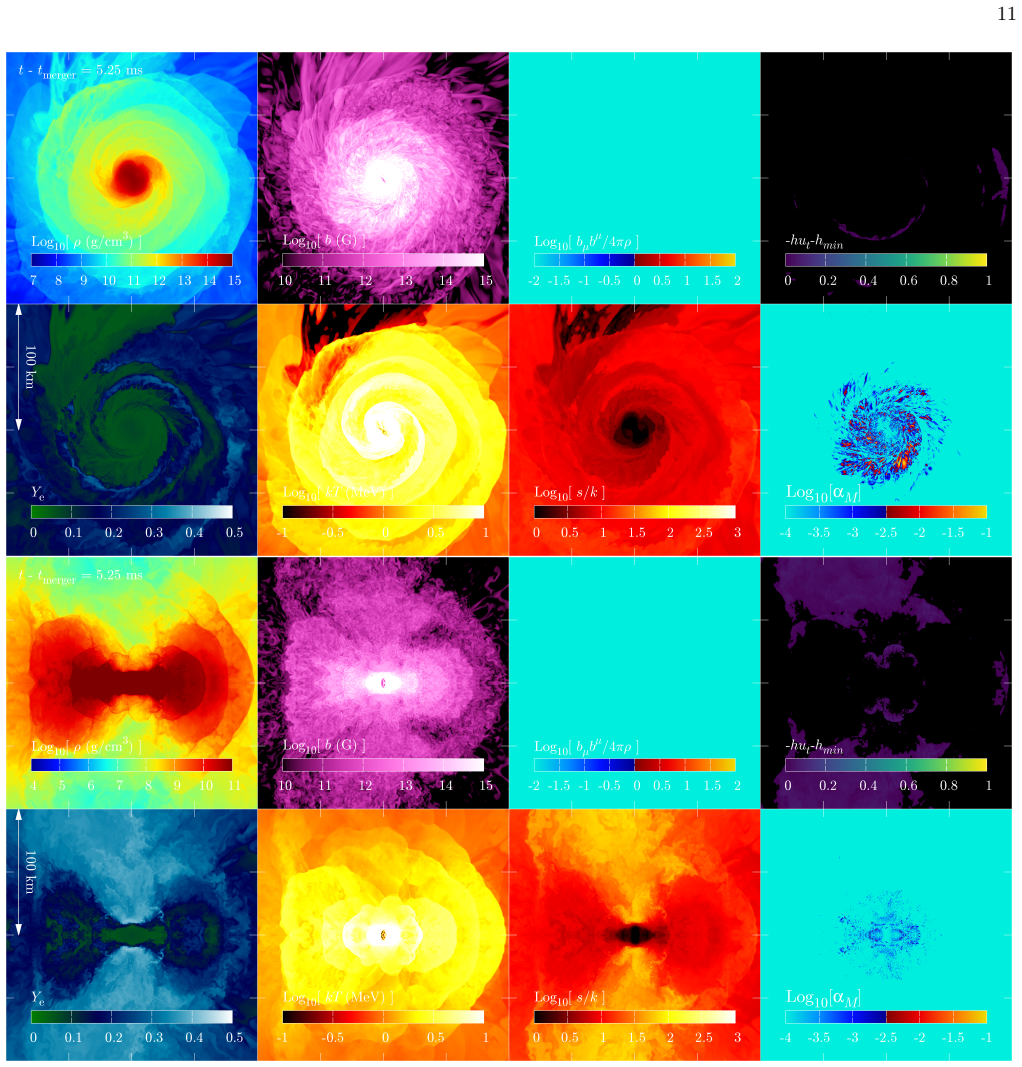
M. Soares-Santos et al. (DES, Dark Energy Cam- era GW-EM), Astrophys. J. Lett.848, L16 (2017), 11 FIG. 5. Snapshot of an orbital plane (top) and a meridional plane (bottom) att−t merger ≈5 ms. From the top-left to the down-right panel, the rest-mass density, the magnetic-field strength, the magnetization parameter, the unboundness of the fluid with the Be...
Pith/arXiv arXiv 2017
-
[29]
P. L. Espino, D. Radice, F. Zappa, R. Gamba, and S. Bernuzzi, Phys. Rev. D109, 103027 (2024), arXiv:2311.12923 [astro-ph.HE]
arXiv 2024
-
[30]
P. L. Espino, P. Hammond, D. Radice, S. Bernuzzi, R. Gamba, F. Zappa, L. F. Longo Micchi, and A. Perego, Phys. Rev. Lett.132, 211001 (2024), arXiv:2311.00031 [astro-ph.HE]
arXiv 2024
-
[31]
G. R. Farrar, Phys. Rev. Lett.134, 081003 (2025), arXiv:2405.12004 [astro-ph.HE]
arXiv 2025
-
[32]
G. R. Farrar, Astrophys. J. Lett.994, L7 (2025), arXiv:2506.22625 [astro-ph.HE]
arXiv 2025
-
[33]
R. Fern´ andez, A. Tchekhovskoy, E. Quataert, F. Fou- cart, and D. Kasen, Mon. Not. Roy. Astron. Soc.482, 12 100 101 102 103 k [2π/L (L = 70 km)] 1045 1046 1047 1048 1049 1050 1051 Magnetic PSD [erg cm] lv = 13 lv = 14 lv = 15 lv = 16 100 101 102 103 k [2π/L (L = 70 km)] 1045 1046 1047 1048 1049 1050 1051 Magnetic PSD [erg cm] 0.725 0.750 0.775 0.800 0.82...
Pith/arXiv arXiv 2019
-
[34]
W. Fong et al., Astrophys. J. Lett.848, L23 (2017), arXiv:1710.05438 [astro-ph.HE]
Pith/arXiv arXiv 2017
-
[35]
S. Fujibayashi, K. Kiuchi, N. Nishimura, Y. Sekiguchi, and M. Shibata, Astrophys. J.860, 64 (2018), arXiv:1711.02093 [astro-ph.HE]
Pith/arXiv arXiv 2018
-
[36]
S. Fujibayashi, M. Shibata, S. Wanajo, K. Kiuchi, K. Kyutoku, and Y. Sekiguchi, Phys. Rev. D102, 123014 (2020), arXiv:2009.03895 [astro-ph.HE]
arXiv 2020
-
[37]
S. Fujibayashi, S. Wanajo, K. Kiuchi, K. Kyutoku, Y. Sekiguchi, and M. Shibata, Astrophys. J.901, 122 (2020), arXiv:2007.00474 [astro-ph.HE]
arXiv 2020
-
[38]
S. Fujibayashi, M. Shibata, S. Wanajo, K. Kiuchi, K. Kyutoku, and Y. Sekiguchi, Phys. Rev. D101, 083029 (2020), arXiv:2001.04467 [astro-ph.HE]
arXiv 2020
-
[39]
S. Fujibayashi, K. Kiuchi, S. Wanajo, K. Kyutoku, Y. Sekiguchi, and M. Shibata, Astrophys. J.942, 39 (2023), arXiv:2205.05557 [astro-ph.HE]
arXiv 2023
-
[40]
F. Foucart et al., Phys. Rev. D99, 044008 (2019), arXiv:1812.06988 [gr-qc]
Pith/arXiv arXiv 2019
-
[41]
F. Foucart, P. C.-K. Cheong, M. D. Duez, L. E. Kidder, H. P. Pfeiffer, and M. A. Scheel, Phys. Rev. D110, 083028 (2024), arXiv:2407.15989 [astro-ph.HE]
arXiv 2024
-
[42]
F. Foucart, M. D. Duez, L. E. Kidder, H. P. Pfeiffer, and M. A. Scheel, Phys. Rev. D110, 024003 (2024), arXiv:2404.18674 [astro-ph.HE]
arXiv 2024
-
[43]
F. Foucart, M. D. Duez, R. Haas, L. E. Kidder, H. P. Pfeiffer, M. A. Scheel, and E. Spira-Savett, (2022), arXiv:2210.05670 [astro-ph.HE]
arXiv 2022
-
[44]
F. Foucart, P. Moesta, T. Ramirez, A. J. Wright, S. Darbha, and D. Kasen, Phys. Rev. D104, 123010 (2021), arXiv:2109.00565 [astro-ph.HE]
arXiv 2021
-
[45]
O. Gottlieb, B. D. Metzger, E. Quataert, D. Issa, T. Martineau, F. Foucart, M. D. Duez, L. E. Kidder, H. P. Pfeiffer, and M. A. Scheel, Astrophys. J. Lett. 958, L33 (2023), arXiv:2309.00038 [astro-ph.HE]
arXiv 2023
-
[46]
O. Gottlieb, B. D. Metzger, F. Foucart, and E. Ramirez-Ruiz, Astrophys. J.984, 77 (2025), arXiv:2411.13657 [astro-ph.HE]
arXiv 2025
-
[47]
A. Hajela et al., Astrophys. J. Lett.886, L17 (2019), arXiv:1909.06393 [astro-ph.HE]
arXiv 2019
-
[48]
A. Hajela et al., Astrophys. J. Lett.927, L17 (2022), arXiv:2104.02070 [astro-ph.HE]
arXiv 2022
-
[49]
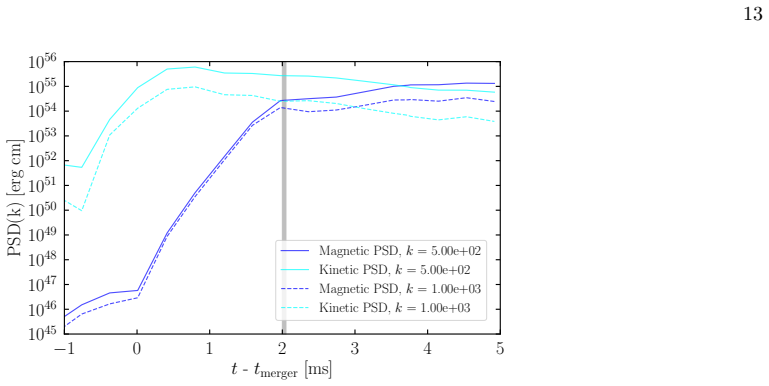
H. Hamidani, K. Kiuchi, and K. Ioka, Mon. Not. Roy. Astron. Soc.491, 3192 (2020), arXiv:1909.05867 [astro- ph.HE]. 13 −1 0 1 2 3 4 5 t - tmerger [ms] 1045 1046 1047 1048 1049 1050 1051 1052 1053 1054 1055 1056 PSD(k) [erg cm] Magnetic PSD, k = 5.00e+02 Kinetic PSD, k = 5.00e+02 Magnetic PSD, k = 1.00e+03 Kinetic PSD, k = 1.00e+03 FIG. 8. Magnetic (blue) a...
arXiv 2020
-
[50]
H. Hamidani, S. S. Kimura, M. Tanaka, and K. Ioka, Astrophys. J.963, 137 (2024), arXiv:2312.06286 [astro- ph.HE]
arXiv 2024
-
[51]
Hamidani, K
H. Hamidani, K. Ioka, S. S. Kimura, and M. Tanaka, PoSICRC2023, 1455 (2023)
2023
-
[52]
K. Hotokezaka, K. Kiuchi, M. Shibata, E. Nakar, and T. Piran, Astrophys. J.867, 95 (2018), arXiv:1803.00599 [astro-ph.HE]
Pith/arXiv arXiv 2018
-
[53]
K. Hotokezaka, M. Tanaka, D. Kato, and G. Gaigalas, Mon. Not. Roy. Astron. Soc.526, L155 (2023), arXiv:2307.00988 [astro-ph.HE]
arXiv 2023
-
[54]
K. Hotokezaka, M. Tanaka, D. Kato, and G. Gaigalas, Mon. Not. Roy. Astron. Soc.515, L89 (2022), arXiv:2204.00737 [astro-ph.HE]
arXiv 2022
-
[55]
K. Hotokezaka, M. Tanaka, D. Kato, and G. Gaigalas, Mon. Not. Roy. Astron. Soc.506, 5863 (2021), arXiv:2102.07879 [astro-ph.HE]
arXiv 2021
-
[56]
P. Hammond, I. Hawke, and N. Andersson, Phys. Rev. D107, 043023 (2023), arXiv:2205.11377 [astro-ph.HE]
arXiv 2023
-
[57]
P. Hammond, I. Hawke, and N. Andersson, Phys. Rev. D104, 103006 (2021), arXiv:2108.08649 [astro-ph.HE]
arXiv 2021
-
[58]
W. Ishizaki, K. Kiuchi, K. Ioka, and S. Wanajo, As- trophys. J.922, 185 (2021), arXiv:2104.04708 [astro- ph.HE]
arXiv 2021
-
[59]
W. Ishizaki, K. Ioka, and K. Kiuchi, Astrophys. J. Lett. 916, L13 (2021), arXiv:2104.04433 [astro-ph.HE]
arXiv 2021
-
[60]
K. Ioka and T. Nakamura, PTEP2018, 043E02 (2018), arXiv:1710.05905 [astro-ph.HE]
Pith/arXiv arXiv 2018
- [61]
-
[62]
K. Kiuchi, K. Kyutoku, Y. Sekiguchi, and M. Shi- bata, Phys. Rev. D97, 124039 (2018), arXiv:1710.01311 [astro-ph.HE]
Pith/arXiv arXiv 2018
- [63]
-
[64]
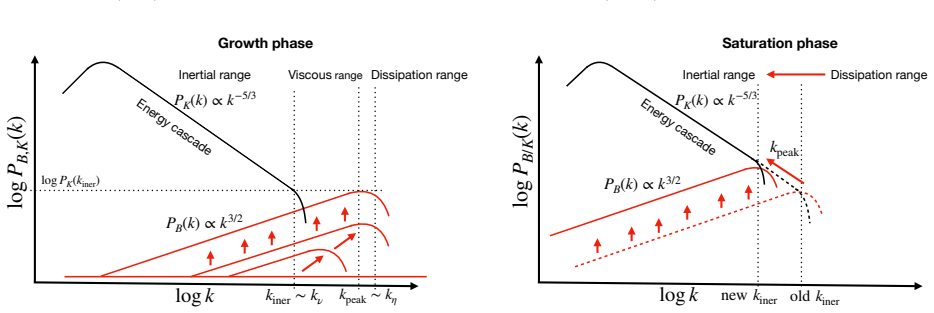
K. Kiuchi, A. Reboul-Salze, M. Shibata, and Y. Sekiguchi, Nature Astron.8, 298 (2024), arXiv:2306.15721 [astro-ph.HE]. 14 100 101 102 103 k [2π/L (L = 70 km)] 1044 1045 1046 1047 1048 1049 1050 1051 1052 1053 10541054 1055 1056 Magnetic PSD [erg cm] ∝ k3/2 −1 0 1 2 3 4 5 t−tmerger[ms] 100 101 102 103 k [2π/L (L = 70 km)] 1048 1049 1050 1051 1052 1053 1054...
arXiv 2024
-
[65]
D. Kato, M. Tanaka, G. Gaigalas, L. Kitovien˙ e, and P. Rynkun, Mon. Not. Roy. Astron. Soc.535, 2670 (2024), arXiv:2501.13286 [astro-ph.HE]
arXiv 2024
-
[66]
K. Kawaguchi, S. Fujibayashi, M. Shibata, M. Tanaka, and S. Wanajo, Astrophys. J.913, 100 (2021), arXiv:2012.14711 [astro-ph.HE]
arXiv 2021
-
[67]
K. Kawaguchi, M. Shibata, and M. Tanaka, (2019), 10.3847/1538-4357/ab61f6, arXiv:1908.05815 [astro-ph.HE]
-
[68]
K. Kawaguchi, M. Shibata, and M. Tanaka, Astro- phys. J. Lett.865, L21 (2018), arXiv:1806.04088 [astro- ph.HE]
Pith/arXiv arXiv 2018
-
[69]
L. Kitovien˙ e, G. Gaigalas, P. Rynkun, N. Domoto, M. Tanaka, and D. Kato, Mon. Not. Roy. Astron. Soc. 538, 92 (2025), arXiv:2502.20424 [astro-ph.HE]
arXiv 2025
-
[70]
D. Kasen, B. Metzger, J. Barnes, E. Quataert, and E. Ramirez-Ruiz, Nature551, 80 (2017), arXiv:1710.05463 [astro-ph.HE]
Pith/arXiv arXiv 2017
-
[71]
M. M. Kasliwal et al., Science358, 1559 (2017), arXiv:1710.05436 [astro-ph.HE]
Pith/arXiv arXiv 2017
-
[72]
C. D. Kilpatrick et al., Science358, 1583 (2017), arXiv:1710.05434 [astro-ph.HE]
Pith/arXiv arXiv 2017
-
[73]
J. Lippuner, R. Fern´ andez, L. F. Roberts, F. Foucart, D. Kasen, B. D. Metzger, and C. D. Ott, Mon. Not. Roy. Astron. Soc.472, 904 (2017), arXiv:1703.06216 [astro-ph.HE]
Pith/arXiv arXiv 2017
-
[74]
C. Musolino, L. Rezzolla, and E. R. Most, Astrophys. J. Lett.984, L61 (2025), arXiv:2410.06253 [astro-ph.HE]
arXiv 2025
-
[75]
C. Musolino, R. Duqu´ e, and L. Rezzolla, Astrophys. J. Lett.966, L31 (2024), arXiv:2402.11009 [astro-ph.HE]
arXiv 2024
-
[76]
E. R. Most, L. J. Papenfort, V. Dexheimer, M. Hanauske, S. Schramm, H. St¨ ocker, and L. Rezzolla, Phys. Rev. Lett.122, 061101 (2019), arXiv:1807.03684 [astro-ph.HE]
Pith/arXiv arXiv 2019
-
[77]
E. R. Most, L. J. Papenfort, and L. Rezzolla, Mon. Not. Roy. Astron. Soc.490, 3588 (2019), arXiv:1907.10328 [astro-ph.HE]
arXiv 2019
-
[78]
E. R. Most, L. J. Papenfort, L. R. Weih, and L. Rez- zolla, Mon. Not. Roy. Astron. Soc.499, L82 (2020), arXiv:2006.14601 [astro-ph.HE]
arXiv 2020
-
[79]
E. R. Most and C. A. Raithel, Phys. Rev. D104, 124012 (2021), arXiv:2107.06804 [astro-ph.HE]
arXiv 2021
-
[80]
E. R. Most, A. Haber, S. P. Harris, Z. Zhang, M. G. Al- ford, and J. Noronha, (2022), arXiv:2207.00442 [astro- ph.HE]
arXiv 2022
discussion (0)
Sign in with ORCID, Apple, or X to comment. Anyone can read and Pith papers without signing in.