The cosmic ray ionization rate from H3+ observations can be overestimated due to neglect of time-dependent chemistry
Pith reviewed 2026-06-28 18:01 UTC · model grok-4.3
The pith
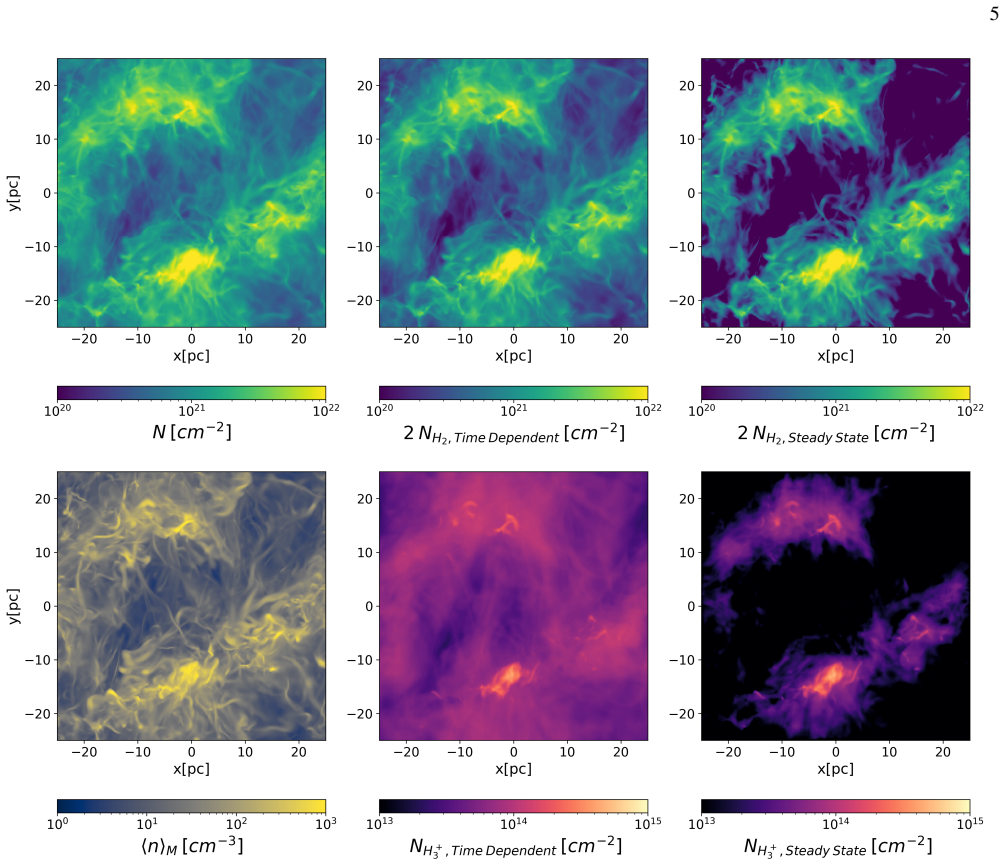
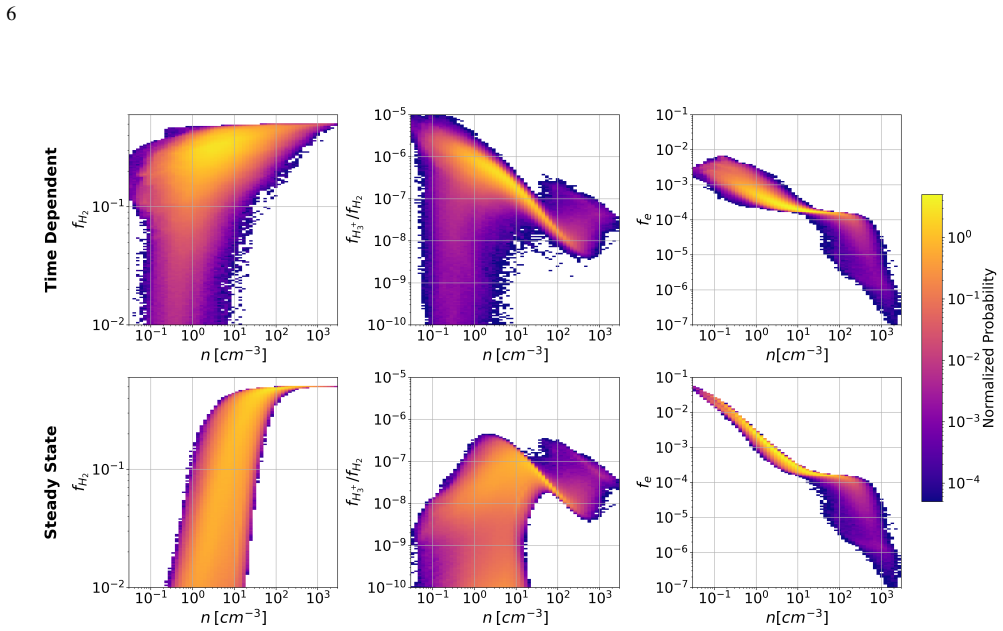
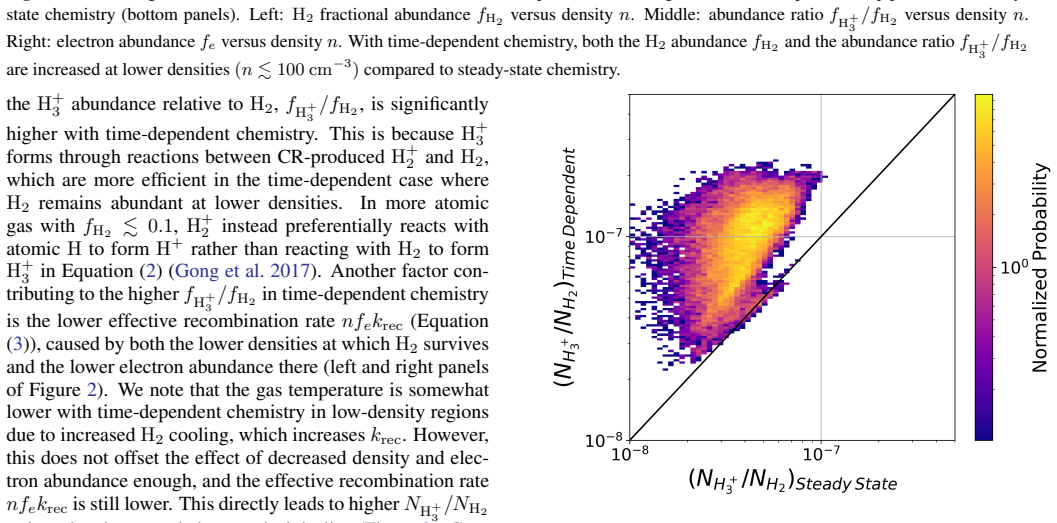
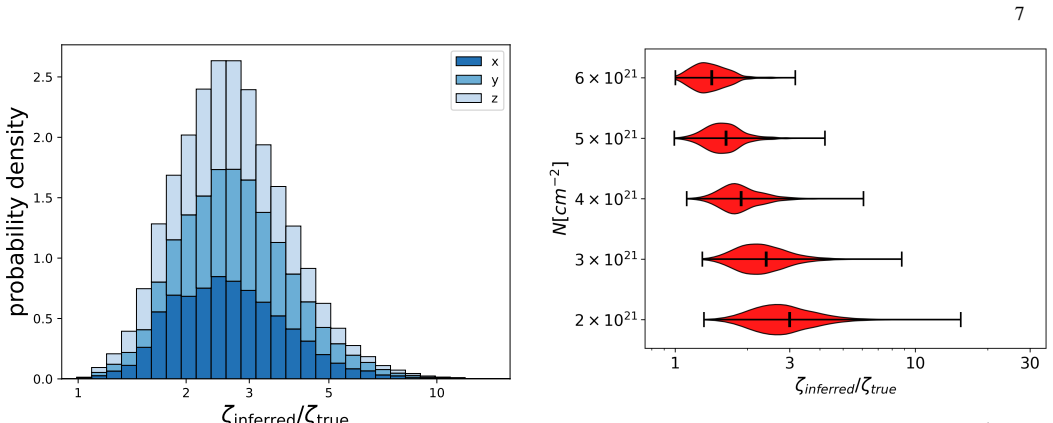
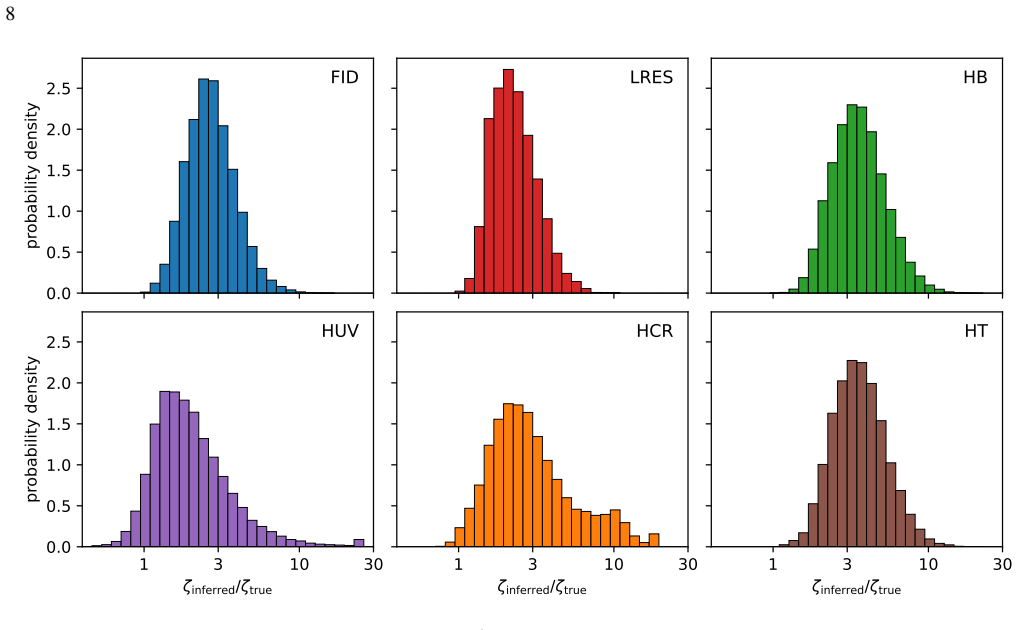
Time-dependent chemistry causes H3+ observations to overestimate the cosmic ray ionization rate by a factor of about three.
A machine-rendered reading of the paper's core claim, the machinery that carries it, and where it could break.
Core claim
By post-processing 3D MHD simulations with coupled chemistry and driven turbulence using steady-state abundance calculations for different CRIR values, the inferred CRIR is a factor of ∼2-5 higher than the true CRIR used in the time-dependent runs, with a median ratio of ≈3. Accounting for time-dependent chemistry yields an average CRIR per H2 of ζ_H2 = 2×10^{-17} s^{-1} from the H3+ observations, consistent with a constant value over the column density range N=(2-6)×10^{21} cm^{-2}. The bias is larger for stronger magnetic fields, weaker FUV fields, and stronger turbulence.
What carries the argument
Post-processing of time-dependent MHD-chemistry simulation outputs with steady-state H2 and H3+ abundance solvers to replicate observational CRIR inference.
If this is right
- The true cosmic ray ionization rate in diffuse molecular clouds is lower than values inferred under steady-state assumptions.
- The ionization rate shows no significant variation with column density between 2 and 6×10^{21} cm^{-2}.
- The overestimation factor increases with stronger magnetic fields, weaker FUV radiation, and stronger turbulence.
- Chemical and thermal models of the interstellar medium should adopt the lower corrected rate.
Where Pith is reading between the lines
- Similar steady-state biases may affect other molecular tracers used to infer ionization or density in turbulent regions.
- Galaxy-scale models of cosmic-ray transport and heating could require downward revision if local rates are systematically lower.
- Targeted observations in clouds with measured turbulence strengths could test the predicted dependence of the bias on magnetic field and radiation field strength.
Load-bearing premise
The post-processing procedure that fits steady-state abundances to the time-dependent simulation outputs accurately reproduces the analysis methods applied to real telescope observations of H3+ and H2.
What would settle it
Independent measurements of the cosmic ray ionization rate in the same diffuse clouds using gamma-ray emission or another tracer that does not rely on H3+ would settle the issue if they match the lower time-dependent value rather than the higher steady-state inferences.
Figures
read the original abstract
The cosmic ray ionization rate (CRIR) is a key parameter governing the physical, chemical and thermal evolution of the interstellar medium. The primary technique for measuring the CRIR in diffuse molecular clouds relies on observations of ${\rm H_3^+}$. Previous analyses of these observations have derived the CRIR under the assumption of steady-state chemistry. Here, we investigate the effect of time-dependent chemistry on the inferred CRIR from ${\rm H_3^+}$ observations. We perform 3D MHD simulations with coupled chemistry and driven turbulence. Following procedures similar to those used in the literature to analyze ${\rm H_3^+}$ observations, we conduct mock CRIR measurements by post-processing our simulations with different values of the CRIR to obtain steady-state abundances of ${\rm H_2}$ and ${\rm H_3^+}$. By comparing those with the abundances from time-dependent chemistry, we determine the best-fitting value of the CRIR. We find that the abundances of both ${\rm H_2}$ and ${\rm H_3^+}$ are higher in time-dependent chemistry simulations than in the steady-state case, especially in low-density regions. Furthermore, the inferred CRIR under the steady-state assumption is a factor of $\sim 2-5$ higher than the true CRIR, with a median value of $\zeta_\mathrm{inferred}/\zeta_\mathrm{true} \approx 3$. This bias increases with stronger magnetic fields, weaker FUV radiation fields, and stronger turbulence. Accounting for time-dependent chemistry, we report an average CRIR per ${\rm H_2}$ of $\zeta_{H_2} = 2\times 10^{-17}~\mathrm{s^{-1}}$ from the ${\rm H_3^+}$ observations. The CRIR is consistent with a constant value over the column density range of $N=(2-6)\times10^{21}~\mathrm{cm^{-2}}$.
Editorial analysis
A structured set of objections, weighed in public.
Referee Report
Summary. The manuscript uses 3D MHD simulations with time-dependent chemistry and driven turbulence to test the effect of the steady-state assumption on CRIR inferences from H3+ observations. By post-processing the same density/temperature fields with varied steady-state CRIR values and comparing to the time-dependent abundances, the authors find that the inferred CRIR is overestimated by a factor of ~2-5 (median ~3). They report a revised average ζ_H2 = 2×10^{-17} s^{-1} that remains constant over N=(2-6)×10^{21} cm^{-2}.
Significance. If the bias factor is robust, the result would downward-revise CRIR values derived from existing H3+ data, with direct consequences for models of diffuse-cloud chemistry, heating rates, and ionization balance. The time-dependent simulation framework itself is a strength, as is the reported constancy of the corrected CRIR across the observed column-density range.
major comments (1)
- [Abstract / post-processing description] The post-processing procedure that generates the steady-state abundances (described as 'similar to those used in the literature') is load-bearing for the central factor-of-~3 bias claim. It is not shown that the fitting reproduces the exact observational steps (velocity-resolved spectra, excitation corrections, beam averaging, and the specific H3+ transitions) applied to real telescope data; without this match the reported bias does not directly apply to published H3+ measurements.
minor comments (3)
- [Methods] The chemical network size, included reactions, and any truncation criteria are not specified, limiting assessment of whether the time-dependent vs. steady-state difference is robust to network completeness.
- [Methods] Numerical resolution of the MHD grid and the exact procedure for fitting the steady-state CRIR (including any χ² definition or column-density weighting) are not reported, preventing reproduction of the median ratio ζ_inferred/ζ_true ≈ 3.
- [Results] The dependence of the bias on magnetic-field strength, FUV intensity, and turbulence driving is stated but not quantified with specific parameter values or figures showing the trend.
Simulated Author's Rebuttal
We thank the referee for their constructive review and for recognizing the significance of the time-dependent chemistry framework. We respond to the single major comment below.
read point-by-point responses
-
Referee: [Abstract / post-processing description] The post-processing procedure that generates the steady-state abundances (described as 'similar to those used in the literature') is load-bearing for the central factor-of-~3 bias claim. It is not shown that the fitting reproduces the exact observational steps (velocity-resolved spectra, excitation corrections, beam averaging, and the specific H3+ transitions) applied to real telescope data; without this match the reported bias does not directly apply to published H3+ measurements.
Authors: We appreciate the referee drawing attention to the precise match between our post-processing and real observational pipelines. Our approach, described in Section 3, solves the steady-state chemical network for H2 and H3+ at the local density and temperature extracted from the MHD simulation, then identifies the CRIR value that best reproduces the time-dependent column densities; this mirrors the standard inference method used in the H3+ literature (e.g., comparing observed N(H3+)/N(H2) ratios to steady-state model grids). We do not perform full forward modeling of velocity-resolved spectra, excitation corrections, or beam averaging. The dominant bias we report originates in the chemical abundances themselves: time-dependent H3+ is systematically higher than the steady-state solution at the same n and T, especially at low densities. Observational processing steps would be applied identically to both the time-dependent and steady-state cases and therefore do not remove the relative offset. Nevertheless, to strengthen applicability, we have revised the methods section to explicitly list the assumptions of our mock procedure and added a paragraph in the discussion noting that full radiative-transfer mocks could be pursued in future work. The factor-of-~3 bias is therefore presented as the chemical contribution to the overestimate. revision: partial
Circularity Check
No significant circularity; simulation-based bias calibration is independent of observational inputs
full rationale
The derivation compares abundances from time-dependent 3D MHD+chemistry runs (with known input CRIR) against steady-state post-processing on the same density/temperature fields to quantify the inference bias. The true CRIR is an external simulation parameter; the inferred value is obtained by separate fitting. This forward-model comparison does not reduce to a self-definition or fitted input renamed as prediction. The final adjusted CRIR value applies the simulation-derived factor to literature observations, but the factor itself is not forced by construction from those observations. No load-bearing self-citation or ansatz smuggling is present in the provided text.
Axiom & Free-Parameter Ledger
free parameters (2)
- CRIR values used in post-processing
- turbulence driving parameters
axioms (2)
- domain assumption The chemical network accurately captures formation and destruction pathways for H2 and H3+ under diffuse-cloud conditions
- domain assumption Post-processing with steady-state solver replicates the analysis pipeline used on real H3+ observations
Reference graph
Works this paper leans on
-
[1]
Bacalla, X. L., Linnartz, H., Cox, N. L. J., et al. 2019, A&A, 622, A31, doi: 10.1051/0004-6361/201833039
-
[2]
Beck, R., & Wielebinski, R. 2013, in Planets, Stars and Stellar Systems: V olume 5: Galactic Structure and Stellar Populations, ed. T. D. Oswalt & G. Gilmore (Dordrecht: Springer), 641–723, doi: 10.1007/978-94-007-5612-0 13
-
[3]
2019, ApJ, 885, 109, doi: 10.3847/1538-4357/ab487b
Bialy, S., Neufeld, D., Wolfire, M., Sternberg, A., & Burkhart, B. 2019, ApJ, 885, 109, doi: 10.3847/1538-4357/ab487b
-
[4]
Bialy, S., Chemke, A., Neufeld, D. A., et al. 2026, Nature Astronomy, 10, 540, doi: 10.1038/s41550-025-02771-9
-
[5]
R., Collier Cameron, A., et al
Bisbas, T. G., Bell, T. A., Viti, S., Yates, J., & Barlow, M. J. 2012, MNRAS, 427, 2100, doi: 10.1111/j.1365-2966.2012.22077.x
-
[6]
Black, J. H., & Dalgarno, A. 1977, ApJS, 34, 405, doi: 10.1086/190455
-
[7]
Cardelli, J. A., Sofia, U. J., Savage, B. D., Keenan, F. P., & Dufton, P. L. 1994, ApJL, 420, L29, doi: 10.1086/187155
-
[8]
Caselli, P., Walmsley, C. M., Terzieva, R., & Herbst, E. 1998, ApJ, 499, 234, doi: 10.1086/305624
-
[9]
Crutcher, R. M., Wandelt, B., Heiles, C., Falgarone, E., & Troland, T. H. 2010, The Astrophysical Journal, 725, 466, doi: 10.1088/0004-637X/725/1/466
-
[10]
Cummings, A. C., Stone, E. C., Heikkila, B. C., et al. 2016, ApJ, 831, 18, doi: 10.3847/0004-637X/831/1/18
-
[11]
Draine, B. T. 1978, ApJS, 36, 595, doi: 10.1086/190513
-
[12]
Draine, B. T., & Bertoldi, F. 1996, ApJ, 468, 269, doi: 10.1086/177689
-
[13]
2024, A&A, 685, A82, doi: 10.1051/0004-6361/202347628
Edenhofer, G., Zucker, C., Frank, P., et al. 2024, A&A, 685, A82, doi: 10.1051/0004-6361/202347628
-
[14]
Federman, S. R., Weber, J., & Lambert, D. L. 1996, ApJ, 463, 181, doi: 10.1086/177233
-
[15]
Glassgold, A. E., & Langer, W. D. 1974a, ApJ, 193, 73, doi: 10.1086/153130 —. 1974b, ApJ, 193, 73, doi: 10.1086/153130
-
[16]
Glover, S. C. O., Federrath, C., Mac Low, M.-M., & Klessen, R. S. 2010, MNRAS, 404, 2, doi: 10.1111/j.1365-2966.2009.15718.x
-
[17]
Glover, S. C. O., & Mac Low, M.-M. 2007, ApJS, 169, 239, doi: 10.1086/512238
-
[18]
2023, A&A, 669, A74, doi: 10.1051/0004-6361/202243902
Valdivia, V . 2023, A&A, 669, A74, doi: 10.1051/0004-6361/202243902
-
[19]
Gong, M., Ostriker, E. C., & Kim, C.-G. 2018, ApJ, 858, 16, doi: 10.3847/1538-4357/aab9af
-
[20]
Gong, M., Ostriker, E. C., Kim, C.-G., & Kim, J.-G. 2020, ApJ, 903, 142, doi: 10.3847/1538-4357/abbdab
-
[21]
Gong, M., Ostriker, E. C., & Wolfire, M. G. 2017, ApJ, 843, 38, doi: 10.3847/1538-4357/aa7561
-
[22]
Gong, M., Ho, K. W., Stone, J. M., et al. 2023, ApJS, 268, 42, doi: 10.3847/1538-4365/aceaf9
-
[23]
2019, ApJ, 887, 93, doi: 10.3847/1538-4357/ab5362
Green, G. M., Schlafly, E., Zucker, C., Speagle, J. S., & Finkbeiner, D. 2019, ApJ, 887, 93, doi: 10.3847/1538-4357/ab5362
work page internal anchor Pith review doi:10.3847/1538-4357/ab5362 2019
-
[24]
2020, A&A, 643, A17, doi: 10.1051/0004-6361/201937387
Guillet, V ., Hennebelle, P., Pineau des Forˆets, G., et al. 2020, A&A, 643, A17, doi: 10.1051/0004-6361/201937387
-
[25]
Hasegawa, T. I., & Herbst, E. 1993, MNRAS, 261, 83, doi: 10.1093/mnras/261.1.83
-
[26]
Heiles, C., & Troland, T. H. 2005, The Astrophysical Journal, 624, 773, doi: 10.1086/428896
-
[27]
Ho, K. W., Yuen, K. H., Flauger, R., & Kritsuk, A. G. 2025, PhRvD, 112, L101302, doi: 10.1103/vhhn-33jw
-
[28]
Hu, C.-Y ., Sternberg, A., & van Dishoeck, E. F. 2021, ApJ, 920, 44, doi: 10.3847/1538-4357/ac0dbd
-
[29]
Indriolo, N., Geballe, T. R., Oka, T., & McCall, B. J. 2007, ApJ, 671, 1736, doi: 10.1086/523036
-
[30]
Indriolo, N., & McCall, B. J. 2012, ApJ, 745, 91, doi: 10.1088/0004-637X/745/1/91 11
-
[31]
Indriolo, N., Neufeld, D. A., Gerin, M., et al. 2015, ApJ, 800, 40, doi: 10.1088/0004-637X/800/1/40
-
[32]
Indriolo, N., Ivlev, A. V ., Pellegrin, T., et al. 2026, ApJ, 997, 123, doi: 10.3847/1538-4357/ae21ba
-
[33]
Ivlev, A. V ., Silsbee, K., Padovani, M., & Galli, D. 2021, ApJ, 909, 107, doi: 10.3847/1538-4357/abdc27
-
[34]
R., Walch, S., Seifried, D., et al
Joshi, P. R., Walch, S., Seifried, D., et al. 2019, MNRAS, 484, 1735, doi: 10.1093/mnras/stz052
-
[35]
2023, PASA, 40, e046, doi: 10.1017/pasa.2023.43
Koley, A. 2023, PASA, 40, e046, doi: 10.1017/pasa.2023.43
-
[36]
G., Flauger, R., & Ustyugov, S
Kritsuk, A. G., Flauger, R., & Ustyugov, S. D. 2018, PhRvL, 121, 021104, doi: 10.1103/PhysRevLett.121.021104
-
[37]
Lallement, R., Vergely, J. L., Babusiaux, C., & Cox, N. L. J. 2022, A&A, 661, A147, doi: 10.1051/0004-6361/202142846
-
[38]
K., & Botero, J
Linder, F., Janev, R. K., & Botero, J. 1995, in Atomic and Molecular Processes in Fusion Edge Plasmas, ed. R. K. Janev, 397
1995
-
[39]
McCall, B. J., Huneycutt, A. J., Saykally, R. J., et al. 2003, Nature, 422, 500, doi: 10.1038/nature01498
-
[40]
Mouschovias, T. C., Tassis, K., & Kunz, M. W. 2006, ApJ, 646, 1043, doi: 10.1086/500125
-
[41]
Neufeld, D. A., & Wolfire, M. G. 2017a, ApJ, 845, 163, doi: 10.3847/1538-4357/aa6d68 —. 2017b, ApJ, 845, 163, doi: 10.3847/1538-4357/aa6d68
-
[42]
Neufeld, D. A., Welty, D. E., Ivlev, A. V ., et al. 2024, ApJ, 973, 143, doi: 10.3847/1538-4357/ad7264
-
[43]
Obolentseva, M., Ivlev, A. V ., Silsbee, K., et al. 2024, ApJ, 973, 142, doi: 10.3847/1538-4357/ad71ce O’Donnell, E. J., & Watson, W. D. 1974, ApJ, 191, 89, doi: 10.1086/152944
-
[44]
E., Sipil¨a, O., Segura-Cox, D
Pineda, J. E., Sipil¨a, O., Segura-Cox, D. M., et al. 2024, A&A, 686, A162, doi: 10.1051/0004-6361/202347997
-
[45]
2021, A&A, 656, A109, doi: 10.1051/0004-6361/202141776
Redaelli, E., Sipil¨a, O., Padovani, M., et al. 2021, A&A, 656, A109, doi: 10.1051/0004-6361/202141776
-
[46]
Savage, B. D., & Sembach, K. R. 1996, ARA&A, 34, 279, doi: 10.1146/annurev.astro.34.1.279
-
[47]
Shingledecker, C. N., & Herbst, E. 2018, Physical Chemistry Chemical Physics (Incorporating Faraday Transactions), 20, 5359, doi: 10.1039/C7CP05901A
-
[48]
V ., Sipil¨a, O., Caselli, P., & Zhao, B
Silsbee, K., Ivlev, A. V ., Sipil¨a, O., Caselli, P., & Zhao, B. 2020, A&A, 641, A39, doi: 10.1051/0004-6361/202038063
-
[49]
Sofia, U. J., Lauroesch, J. T., Meyer, D. M., & Cartledge, S. I. B. 2004, ApJ, 605, 272, doi: 10.1086/382592
-
[50]
Sonnentrucker, P., Welty, D. E., Thorburn, J. A., & York, D. G. 2007, ApJS, 168, 58, doi: 10.1086/508687
-
[51]
Spitzer, Jr., L., & Tomasko, M. G. 1968, ApJ, 152, 971, doi: 10.1086/149610
-
[52]
Stone, E. C., Cummings, A. C., Heikkila, B. C., & Lal, N. 2019, Nature Astronomy, 3, 1013, doi: 10.1038/s41550-019-0928-3
-
[53]
Stone, J. M., Tomida, K., White, C. J., & Felker, K. G. 2020, ApJS, 249, 4, doi: 10.3847/1538-4365/ab929b
-
[54]
I., Caselli, P., Dulieu, F., & Jim´enez-Serra, I
Vasyunin, A. I., Caselli, P., Dulieu, F., & Jim´enez-Serra, I. 2017, ApJ, 842, 33, doi: 10.3847/1538-4357/aa72ec
-
[55]
Wakelam, V ., Smith, I. W. M., Herbst, E., et al. 2010, SSRv, 156, 13, doi: 10.1007/s11214-010-9712-5
-
[56]
2016, MNRAS, 460, 2050, doi: 10.1093/mnras/stw1124
Zhao, B., Caselli, P., Li, Z.-Y ., et al. 2016, MNRAS, 460, 2050, doi: 10.1093/mnras/stw1124
discussion (0)
Sign in with ORCID, Apple, or X to comment. Anyone can read and Pith papers without signing in.