REVIEW 3 major objections 4 minor 44 references
Unequal Verdicts: Investigating Gender Bias in LLM-Based Fake News Detection
T0 review · 3 major / 4 minor · reviewed 2026-08-05 · deepseek-v4-flash
Pith's one-line read Gender presentation alone shifts LLM fact-check verdicts on up to 35% of identical statements, with male-skeptic patterns in most models.
desk verdict First systematic gender-bias measurement in LLM fact-checking, but the headline flip rates need a stochasticity baseline before they can be read as gender effects. read the letter →
The pith
A machine-rendered reading of the paper's core claim, the machinery that carries it, and where it could break.
The reading
What carries the argument
The controlled setup is an augmented version of a hand-labeled political statement benchmark in which each statement is paired with three job-title variants—Neutral, Male, and Female—while the claim text is unchanged. The paper measures bias with pairwise flip rates and directional/conditional flip rates, a Gender-Cue Sensitivity Index (the share of statements with any label disagreement across the three variants), a Unique Disagreement Rate (which variant is the sole outlier), and the standard fairness metrics Demographic Parity, Equalized Odds, and Equal Opportunity. The Gender-Cue Sensitivity Index is the headline instability measure, while the male-female fairness metrics capture systema
What would settle it
Run the same experiment with gender conveyed by matched first names or pronouns instead of gendered job-title words; if the flip rates largely disappear, the effect is lexical rather than gender-based.
Extended reading notes
Core claim
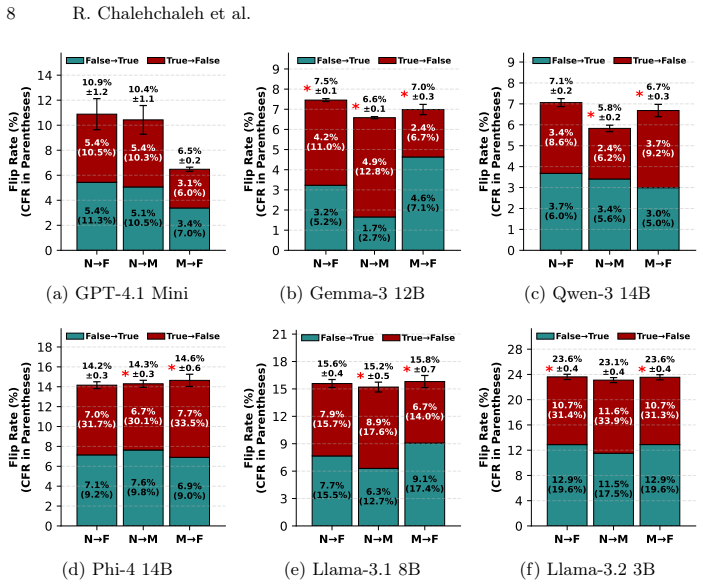
The paper's central claim is that LLMs exhibit measurable gender bias in fake news detection: identical statements receive different veracity labels depending solely on whether the speaker's job title is worded as neutral, male, or female. The authors demonstrate this by augmenting a real-world benchmark of hand-labeled political statements with three gender variants for every speaker job title and prompting six state-of-the-art LLMs to output true/false verdicts. All six models showed gender sensitivity, with the least sensitive model still flipping 5.8% of verdicts between some pairs and the most sensitive flipping over 23% between male and female variants. Five models displayed statistica
Load-bearing premise
The flip rates are attributed entirely to gender presentation, but the gendered job-title variants (e.g., "Congressman" versus "Congresswoman") are never validated against a control condition, so lexical differences could inflate the measured effect.
Editorial extensions
If this is right
- Automated fact-checking systems built on current LLMs will issue conflicting verdicts for the same claim depending on the speaker's presented gender, which breaks the promise of objective veracity assessment.
- Fairness metrics should become a standard part of fake news detection evaluation, not just accuracy, because a model can look accurate while systematically favoring or penalizing one gender.
- Because bias direction is model-specific, architecture, training data, and alignment choices can be adjusted to reduce it; the paper notes at least one model shows no significant directional effect.
- The released gender-augmented dataset allows other researchers and practitioners to benchmark debiasing strategies directly against a common controlled setup.
- Content moderation policies that rely on LLM verdicts need to account for gender-specific error rates, especially given prior evidence that false labels on true news reduce public belief in true news.
Reading between the lines
- The binary true/false prompt may understate real-world gender bias: deployed systems that output confidence scores or free-text explanations could show larger or more subtle gender effects than a forced two-way verdict.
- The same augmentation recipe can be transferred directly to race, age, and other demographic markers, and the released dataset makes those extensions straightforward to build.
- Since five models show directional bias in opposite directions, ensembling models or balancing gendered prompts could plausibly cancel some systematic favoritism; this is a testable mitigation strategy, not a claim in the paper.
- The observation that true statements were more gender-sensitive than false statements in five of six models suggests gender cues mainly modulate skepticism when a claim is plausible, which may make the effect harder to detect in accuracy-based evaluations.
Editorial analysis
A structured set of objections, weighed in public.
Referee Report
Summary. The paper investigates whether LLM fact-checking verdicts change when the speaker's job title is presented in Neutral, Male, or Female form. The authors augment the LIAR benchmark with three gender variants of speaker job titles for 8,243 statements, prompt six LLMs (Phi-4 14B, Llama-3.1 8B, Llama-3.2 3B, Gemma-3 12B, Qwen-3 14B, GPT-4.1 Mini) to return True/False, and quantify disagreement via pairwise flip rates (FR), directional flip rates, conditional flip rates (CFR), a Gender-Cue Sensitivity Index (GSI), Unique Disagreement Rate, and Demographic Parity/Equalized Odds/Equal Opportunity metrics. Five runs with different seeds are averaged. The central reported finding is that all models show gender sensitivity: GSI ranges from 9.79% to 35.13% and Male–Female flip rates from 6.5% to 23.6%, with five models showing statistically significant directional asymmetries. The augmented dataset is released.
Significance. If the causal claim is established, the result is important for deployed automated fact-checking: it would show that speaker gender presentation alone can change LLM veracity judgments on identical statements, with direct reliability and fairness consequences. The paper has concrete strengths: it uses a real-world benchmark, performs a two-stage human-verified augmentation, releases the dataset, evaluates multiple models and multiple complementary metrics, and reports standard deviations over seeds. These strengths make the empirical resource valuable. However, the paper's headline quantity is pairwise disagreement between gender variants, not a causal gender-effect estimate. The absence of a same-prompt stochasticity baseline and the lack of a non-gender lexical control mean the central claim is not yet supported at the level the abstract and Section 6 assert. The directional tests are less vulnerable to symmetric sampling noise, but they do not establish the existence or magnitude of gender sensitivity.
major comments (3)
- [§4.3, §5.1, Abstract] The paper reports FR and GSI as evidence that gender cues change predictions, but it never reports the same-prompt self-flip rate FR(g,g) across the five seeded runs, nor the sampling temperature or decoding strategy. Under stochastic decoding, two samples from the same variant can disagree with probability up to 50% (2p(1-p) when both conditions have the same label probability p). Thus the headline values — GSI 9.79–35.13%, Male–Female flip rates 6.5–23.6% — are pairwise disagreements that could arise partly or wholly from sampling noise, not from gender. Directional asymmetries (FR^{1→0} vs FR^{0→1}) estimate differences in label probabilities and are less affected by symmetric noise, but the paper's existence/magnitude claim ('gender presentation alone drives substantial prediction instability,' Section 6) requires a baseline. Please supply FR(g,g), or use greedy decoding, or compare
- [§3, §4.1] The statement that 'only gender presentation varies' (Section 4) is not strictly supported by the construction. The variants are lexically different words — e.g., Congressman vs Congresswoman, Businessman vs Businesswoman, Male Artist vs Female Artist — so non-gender lexical associations, token-frequency effects, or collocational stereotypes could contribute to the observed flips. The examples in Table 1 also show only gender-lexical differences, not a matched surface form. A control condition with non-gender lexical perturbations of comparable magnitude, or variants such as 'female speaker' vs 'male speaker' applied uniformly, would help isolate gender presentation. Without such a control, the abstract's 'based solely on gender presentation' is an overstatement.
- [§4.3 Statistical Testing] The statistical procedure is under-specified. The text says predictions are 'aggregate[d] across R=5 runs' and then a Wilcoxon signed-rank test is applied, but it does not state whether the unit is the statement, whether the aggregation is majority voting or averaging, how the paired differences are formed, or how many comparisons enter the Holm–Bonferroni correction per model. Table 2 reports 'Asymmetry (%)' and Cohen's d but no p-values or confidence intervals. Since the directional-bias claim is a stated contribution, the testing protocol and effect-size uncertainty should be fully specified so the reader can assess whether the significant asymmetries survive a sound paired test.
minor comments (4)
- [§4.3 Inference Settings] Please specify the exact generation parameters (temperature, top-p, max tokens) for each model. The phrase 'recommended default generation parameters' is not reproducible, and temperature is directly relevant to the stochasticity baseline issue above.
- [§5.2] The interpretation that GPT-4.1 Mini's higher Neutral UDR 'may reflect the model's safety alignment mechanisms' is speculative; no evidence is provided that RLHF triggers on explicit gender terms. Please label this as a hypothesis or provide supporting analysis.
- [§4.3 Dataset Usage] Phi-4 14B excluded 7.18% of statements due to invalid outputs, while other models excluded <0.01%. This differential exclusion could bias the sample for that model; please discuss or provide a robustness check.
- [§5.3] Fairness disparities (ΔDP, ΔEO, ΔEOpp) are reported with error bars but no significance tests. Given that Section 5.3 states 'all models exhibit measurable gender-based disparities,' a test or confidence interval would strengthen the claim.
Circularity Check
No circularity: all headline quantities are direct applications of explicitly defined metrics to raw model outputs, with no fitted parameters and no load-bearing self-citation.
full rationale
The paper's derivation chain is strictly empirical. The augmented LIAR dataset is external; the gender variants are human-reviewed transformations of an existing benchmark. Every reported quantity (FR, directional FR, CFR, GSI, UDR, DP, EO, EOpp) is a closed-form definition applied directly to the binary model outputs yhat_i^g and the ground-truth labels y_i. There is no fitted parameter that is later renamed as a prediction, no model whose parameters are estimated from the target labels, and no uniqueness theorem invoked to force a conclusion. The sole self-citation, reference [6], appears in a Related Work sentence surveying whether bias may affect fake news detection; it is contextual and does not ground the measured flip rates or sensitivity indices. The skeptical concern that no same-prompt stochasticity baseline is reported is a threat to causal identification (sampling noise could explain some flips), but it is not circularity: the paper does not claim to derive gender causality from an equation that already assumes it. Under the provided rules, such validity concerns do not raise the circularity score.
Assumptions & free parameters
assumptions (3)
- domain assumption LIAR ground-truth labels y_i are accurate for the veracity of each statement
- ad hoc to paper The three job-title variants differ only in gender presentation and not in other task-relevant content
- domain assumption Non-binary model outputs can be excluded without biasing the measured sensitivity
Cite this review
Pith. "Pith review of Unequal Verdicts: Investigating Gender Bias in LLM-Based Fake News Detection." pith.science (2026). https://pith.science/paper/FEZNRIT7
@misc{pith2026260803627,
  author       = {Pith},
  title        = {Pith review of: Unequal Verdicts: Investigating Gender Bias in LLM-Based Fake News Detection},
  year         = {2026},
  howpublished = {\url{https://pith.science/paper/FEZNRIT7}},
  note         = {Machine review of arXiv:2608.03627}
}
read the original abstract
Large Language Models (LLMs) are increasingly used for automated fact-checking, yet their susceptibility to gender bias in this context remains underexplored. This study presents the first systematic investigation of gender bias in LLM-based fake news detection using real-world data. We augment the LIAR benchmark with three gender variants of speaker job titles (Neutral, Male, Female) for each statement to test whether veracity judgments vary solely based on gender presentation. Six state-of-the-art LLMs are evaluated across multiple bias and fairness metrics. All models exhibit gender sensitivity: 9.79%-35.13% of statements receive inconsistent labels across the three variants, with Male-Female comparisons showing 6.5%-23.6% flip rates. Two primary bias manifestations are identified: instability (inconsistent judgments) and directionality (systematic favoritism). Five models show statistically significant directional effects, with the strongest effects displaying male-skeptic patterns. These findings demonstrate that gender bias undermines both reliability and fairness in LLM-based fake news detection, highlighting the need for bias-aware evaluation and mitigation strategies. The augmented dataset is publicly released to support future research.
Figures


Figures from the paper (1 more)

Reference graph
Works this paper leans on
-
[6]
So- cial Network Analysis and Mining15(1), 1–16 (2025).https://doi.org/10.1007/ s13278-025-01505-z
Chalehchaleh, R., Farahbakhsh, R., Crespi, N.: Addressing data scarcity in mul- tilingual fake news detection: an llm-based dataset augmentation approach. So- cial Network Analysis and Mining15(1), 1–16 (2025).https://doi.org/10.1007/ s13278-025-01505-z
work page 2025
-
[1]
Alghamdi, J., Luo, S., Lin, Y.: A comprehensive survey on machine learning approaches for fake news detection. Multimedia Tools and Applications83(17), 51009–51067 (2024).https://doi.org/10.1007/s11042-023-17470-8
-
[2]
Altoe,F.,Moreira,C.,Pinto,H.S.,Jorge,J.A.:Onlinefakenewsopinionspreadand belief change: A systematic review. Human Behavior and Emerging Technologies 2024(1), 1069670 (2024).https://doi.org/10.1155/2024/1069670
-
[3]
Evaluating Gender Bias of LLMs in Making Morality Judgements
Bajaj, D., Lei, Y., Tong, J., Huang, R.: Evaluating gender bias of llms in making morality judgements. arXiv preprint arXiv:2410.09992 (2024)
work page Pith review arXiv 2024
-
[4]
Bender, E.M., Gebru, T., McMillan-Major, A., Shmitchell, S.: On the dangers of stochastic parrots: Can language models be too big? p. 610–623. FAccT ’21, Association for Computing Machinery, New York, NY, USA (2021).https://doi. org/10.1145/3442188.3445922
arXiv 2021
-
[5]
Boissonneault, D., Hensen, E.: Fake news detection with large language models on the liar dataset. Preprint, Research Square (2024).https://doi.org/10.21203/ rs.3.rs-4465815/v1, version 1, posted May 23, 2024
work page 2024
-
[7]
AI Magazine45(3), 354–368 (2024).https://doi.org/10.1002/ aaai.12188
Chen, C., Shu, K.: Combating misinformation in the age of LLMs: Opportunities and challenges. AI Magazine45(3), 354–368 (2024).https://doi.org/10.1002/ aaai.12188
2024
-
[8]
In: Companion Proceedings of the Web Conference
Dacon, J., Liu, H.: Does gender matter in the news? detecting and examining gender bias in news articles. In: Companion Proceedings of the Web Conference
Show all 44 references
-
[9]
Proceedings of the National Academy of Sciences121(50), e2322823121 (2024).https://doi.org/ 10.1073/pnas.2322823121
DeVerna, M.R., Yan, H.Y., Yang, K.C., Menczer, F.: Fact-checking information from large language models can decrease headline discernment. Proceedings of the National Academy of Sciences121(50), e2322823121 (2024).https://doi.org/ 10.1073/pnas.2322823121
2024 doi
- [10]
-
[11]
American Psy- chologist80(6), 867–878 (2024).https://doi.org/10.1037/amp0001448
Ecker, U.K.H., Tay, L.Q., Roozenbeek, J., van der Linden, S., Cook, J., Oreskes, N., Lewandowsky, S.: Why misinformation must not be ignored. American Psy- chologist80(6), 867–878 (2024).https://doi.org/10.1037/amp0001448
2024 doi
-
[12]
Scientific Re- ports14(1), 5224 (Mar 2024).https://doi.org/10.1038/s41598-024-55686-2
Fang, X., Che, S., Mao, M., Zhang, H., Zhao, M., Zhao, X.: Bias of AI-generated content: an examination of news produced by large language models. Scientific Re- ports14(1), 5224 (Mar 2024).https://doi.org/10.1038/s41598-024-55686-2
2024 doi
-
[13]
Computational Linguistics50(3), 1097–1179 (Sep 2024).https: //doi.org/10.1162/coli_a_00524
Gallegos, I.O., Rossi, R.A., Barrow, J., Tanjim, M.M., Kim, S., Dernoncourt, F., Yu, T., Zhang, R., Ahmed, N.K.: Bias and fairness in large language mod- els: A survey. Computational Linguistics50(3), 1097–1179 (Sep 2024).https: //doi.org/10.1162/coli_a_00524
2024 doi
-
[14]
Chalehchaleh et al
Ganguli, D., Lovitt, L., Kernion, J., Askell, A., Bai, Y., Kadavath, S., Mann, B., Perez, E., Schiefer, N., Ndousse, K., Jones, A., Bowman, S., Chen, A., Conerly, T., DasSarma, N., Drain, D., Elhage, N., El-Showk, S., Fort, S., Hatfield-Dodds, Z., Henighan, T., Hernandez, D., ...
2022
-
[15]
In: Proceedingsofthe30thInternationalConferenceonNeuralInformationProcessing Systems
Hardt, M., Price, E., Srebro, N.: Equality of opportunity in supervised learning. In: Proceedingsofthe30thInternationalConferenceonNeuralInformationProcessing Systems. p. 3323–3331. NIPS’16, Curran Associates Inc., Red Hook, NY, USA (2016)
2016
-
[16]
Fundamental Research5(1), 332–346 (2025).https://doi.org/10
Hu, B., Mao, Z., Zhang, Y.: An overview of fake news detection: From a new perspective. Fundamental Research5(1), 332–346 (2025).https://doi.org/10. 1016/j.fmre.2024.01.017
2025
-
[17]
In: 2025 8th Interna- tional Conference on Advanced Algorithms and Control Engineering (ICAACE)
Huang, T., Yi, J., Yu, P., Xu, X.: Unmasking digital falsehoods: A comparative analysis of llm-based misinformation detection strategies. In: 2025 8th Interna- tional Conference on Advanced Algorithms and Control Engineering (ICAACE). pp. 2470–2476 (2025).https://doi.org/10.11...
2025
-
[18]
In: Proceedings of the 2024 SIAM Interna- tional Conference on Data Mining (SDM)
Jiang, B., Tan, Z., Nirmal, A., Liu, H.: Disinformation detection: An evolv- ing challenge in the age of llms. In: Proceedings of the 2024 SIAM Interna- tional Conference on Data Mining (SDM). pp. 427–435. SIAM (2024).https: //doi.org/10.1137/1.9781611978032.50
2024 doi
-
[19]
In: Proceedings of The ACM Collective Intelligence Conference
Kotek, H., Dockum, R., Sun, D.: Gender bias and stereotypes in large language models. In: Proceedings of The ACM Collective Intelligence Conference. p. 12–24. CI ’23, Association for Computing Machinery, New York, NY, USA (2023).https: //doi.org/10.1145/3582269.3615599
2023
-
[21]
IEEE Transactions on Artificial Intelligence6(2), 458–476 (2025).https://doi.org/10.1109/TAI.2024
Kuntur, S., Wróblewska, A., Paprzycki, M., Ganzha, M.: Under the influence: A survey of large language models in fake news detection. IEEE Transactions on Artificial Intelligence6(2), 458–476 (2025).https://doi.org/10.1109/TAI.2024. 3471735
2025 doi
-
[22]
Information Systems Frontiers26(2), 443–458 (Apr 2024).https://doi.org/10.1007/s10796-022-10242-z
Olan, F., Jayawickrama, U., Arakpogun, E.O., Suklan, J., Liu, S.: Fake news on Social Media: the Impact on Society. Information Systems Frontiers26(2), 443–458 (Apr 2024).https://doi.org/10.1007/s10796-022-10242-z
2024 doi
-
[23]
In: 2022 IEEE International Confer- ence on Big Data (Big Data)
Orsini, H., Bao, H., Zhou, Y., Xu, X., Han, Y., Yi, L., Wang, W., Gao, X., Zhang, X.: Advcat: Domain-agnostic robustness assessment for cybersecurity- critical applications with categorical inputs. In: 2022 IEEE International Confer- ence on Big Data (Big Data). pp. 1060–1069 ...
2022
-
[24]
In: Koyejo, S., Mo- hamed, S., Agarwal, A., Belgrave, D., Cho, K., Oh, A
Ouyang, L., Wu, J., Jiang, X., Almeida, D., Wainwright, C., Mishkin, P., Zhang, C., Agarwal, S., Slama, K., Ray, A., Schulman, J., Hilton, J., Kelton, F., Miller, L., Simens, M., Askell, A., Welinder, P., Christiano, P.F., Leike, J., Lowe, R.: Training language models to follo...
2022
-
[25]
Future Internet16(8) (2024).https: //doi.org/10.3390/fi16080298
Papageorgiou, E., Chronis, C., Varlamis, I., Himeur, Y.: A survey on the use of large language models (llms) in fake news. Future Internet16(8) (2024).https: //doi.org/10.3390/fi16080298
2024 doi
-
[26]
Pelrine, K., Imouza, A., Thibault, C., Reksoprodjo, M., Gupta, C., Christoph, J., Godbout, J.F., Rabbany, R.: Towards reliable misinformation mitigation: Gener- alization, uncertainty, and gpt-4 (2023)
2023
-
[27]
Qu, Y., Roitero, K., Barbera, D.L., Spina, D., Mizzaro, S., Demartini, G.: Com- bining human and machine confidence in truthfulness assessment. J. Data and Information Quality15(1) (Dec 2022).https://doi.org/10.1145/3546916 Investigating Gender Bias in LLM-Based Fake News Detection 15
2022 doi
-
[28]
Knowledge-Based Systems319, 113569 (2025).https://doi.org/10.1016/j.knosys.2025.113569
Radaideh,M.I.,Kwon,O.H.,Radaideh,M.I.:Fairnessandsocialbiasquantification in large language models for sentiment analysis. Knowledge-Based Systems319, 113569 (2025).https://doi.org/10.1016/j.knosys.2025.113569
2025
-
[29]
Computational Linguistics pp
Resnik, P.: Large language models are biased because they are large language mod- els. Computational Linguistics pp. 1–21 (03 2025).https://doi.org/10.1162/ coli_a_00558
2025
-
[30]
Rocha, Y.M., De Moura, G.A., Desidério, G.A., De Oliveira, C.H., Lourenço, F.D., de Figueiredo Nicolete, L.D.: The impact of fake news on social media and its influ- enceonhealthduringthecovid-19pandemic:asystematicreview.JournalofPublic Health31(7),1007–1016(2023).https://doi...
2023 doi
-
[31]
In: Companion Proceedings of the ACM on Web Conference 2025
Russo, M., Merenda, F., Gomez-Perez, J.M., Vidal, M.E.: Tracing bias for fairer content-based misinformation detection. In: Companion Proceedings of the ACM on Web Conference 2025. p. 2670–2679. WWW ’25, Association for Comput- ing Machinery, New York, NY, USA (2025).https://d...
2025 doi
-
[32]
Knowledge and Information Systems 67(4), 3139–3158 (2025).https://doi.org/10.1007/s10115-024-02337-7
Saeidnia, H.R., Hosseini, E., Lund, B., Tehrani, M.A., Zaker, S., Molaei, S.: Arti- ficial intelligence in the battle against disinformation and misinformation: a sys- tematic review of challenges and approaches. Knowledge and Information Systems 67(4), 3139–3158 (2025).https:...
2025 doi
-
[33]
In: Faleńska, A., Basta, C., Costa-jussà, M., Goldfarb-Tarrant, S., Nozza, D
Sobhani, N., Delany, S.: Towards fairer NLP models: Handling gender bias in clas- sification tasks. In: Faleńska, A., Basta, C., Costa-jussà, M., Goldfarb-Tarrant, S., Nozza, D. (eds.) Proceedings of the 5th Workshop on Gender Bias in Natural Language Processing (GeBNLP). pp. ...
2024 doi
-
[34]
In: Proceedings of the 2024 on ACM SIGSAC Conference on Computer and Communications Security
Tang, K., Zhou, W., Zhang, J., Liu, A., Deng, G., Li, S., Qi, P., Zhang, W., Zhang, T., Yu, N.: Gendercare: A comprehensive framework for assessing and reducing gender bias in large language models. In: Proceedings of the 2024 on ACM SIGSAC Conference on Computer and Communica...
2024
-
[35]
In: 2024 20th IEEE International Colloquium on Signal Processing & Its Applications (CSPA)
Teo, T.W., Chua, H.N., Jasser, M.B., Wong, R.T.: Integrating large language mod- els and machine learning for fake news detection. In: 2024 20th IEEE International Colloquium on Signal Processing & Its Applications (CSPA). pp. 102–107 (2024). https://doi.org/10.1109/CSPA60979....
2024
-
[36]
In: Gendered Technology in Translation and Interpreting, pp
Vanmassenhove, E.: Gender bias in machine translation and the era of large lan- guage models. In: Gendered Technology in Translation and Interpreting, pp. 225–
-
[37]
Sánchez del Vas, R., Tuñón Navarro, J.: Disinformation on the covid-19 pan- demic and the russia-ukraine war: Two sides of the same coin? Humanities and Social Sciences Communications11(1), 851 (2024).https://doi.org/10.1057/ s41599-024-03355-0
2024
-
[38]
kelly is a warm person, joseph is a role model
Wan, Y., Pu, G., Sun, J., Garimella, A., Chang, K.W., Peng, N.: “kelly is a warm person, joseph is a role model”: Gender biases in LLM-generated reference let- ters. In: Bouamor, H., Pino, J., Bali, K. (eds.) Findings of the Association for Computational Linguistics: EMNLP 202...
2023 doi
-
[39]
liar, liar pants on fire
Wang, W.Y.: “liar, liar pants on fire”: A new benchmark dataset for fake news de- tection. In: Barzilay, R., Kan, M.Y. (eds.) Proceedings of the 55th Annual Meet- ing of the Association for Computational Linguistics (Volume 2: Short Papers). 16 R. Chalehchaleh et al. pp. 422–4...
2017 doi
-
[40]
Journal of Machine Learning Research 24(257), 1–8 (2023)
Weerts, H., DudÃk, M., Edgar, R., Jalali, A., Lutz, R., Madaio, M.: Fairlearn: As- sessing and improving fairness of ai systems. Journal of Machine Learning Research 24(257), 1–8 (2023)
2023
-
[41]
In: Proceedings of the 2023 ACM Conference on Fairness, Accountability, and Transparency
Wolfe, R., Yang, Y., Howe, B., Caliskan, A.: Contrastive language-vision ai models pretrained on web-scraped multimodal data exhibit sexual objectification bias. In: Proceedings of the 2023 ACM Conference on Fairness, Accountability, and Transparency. p. 1174–1185. FAccT ’23, ...
2023
-
[42]
ACM Transactions on Knowledge Discovery from Data18(6) (Apr 2024).https: //doi.org/10.1145/3649506
Yang, J., Jin, H., Tang, R., Han, X., Feng, Q., Jiang, H., Zhong, S., Yin, B., Hu, X.: Harnessing the power of llms in practice: A survey on chatgpt and beyond. ACM Transactions on Knowledge Discovery from Data18(6) (Apr 2024).https: //doi.org/10.1145/3649506
2024 doi
-
[43]
In: Wu, J.L., Su, M.H
Yeh, K.C., Chi, J.A., Lian, D.C., Hsieh, S.K.: Evaluating interfaced LLM bias. In: Wu, J.L., Su, M.H. (eds.) Proceedings of the 35th Conference on Computational Linguistics and Speech Processing (ROCLING 2023). pp. 292–299. The Associa- tion for Computational Linguistics and C...
2023
-
[44]
Yi, J., Xu, Z., Huang, T., Yu, P.: Challenges and Innovations in LLM-Powered Fake News Detection: A Synthesis of Approaches and Future Directions, p. 87–93. Association for Computing Machinery, New York, NY, USA (2025).https://doi. org/10.1145/3728725.3728739
2025
-
[2021]
p. 385–392. WWW ’21, Association for Computing Machinery, New York, NY, USA (2021).https://doi.org/10.1145/3442442.3452325
2021
Reviewed August 5, 2026 · model on record in the stance chip above.
Discussion (0). Sign in to comment.