REVIEW 5 minor 45 references
Rotation Invariant Convolutions for 3D Point Clouds Deep Learning
T0 review · 0 major / 5 minor · reviewed 2026-08-14 · deepseek-v4-flash
Pith's one-line read Distances and angles to a centroid reference vector make point-cloud convolutions rotation invariant.
desk verdict A clean and honest rotation-invariant point cloud convolution whose central claim survives scrutiny; the soft spots are pseudocode detail and evaluation rigor, not the math. read the letter →
The pith
A machine-rendered reading of the paper's core claim, the machinery that carries it, and where it could break.
The reading
What carries the argument
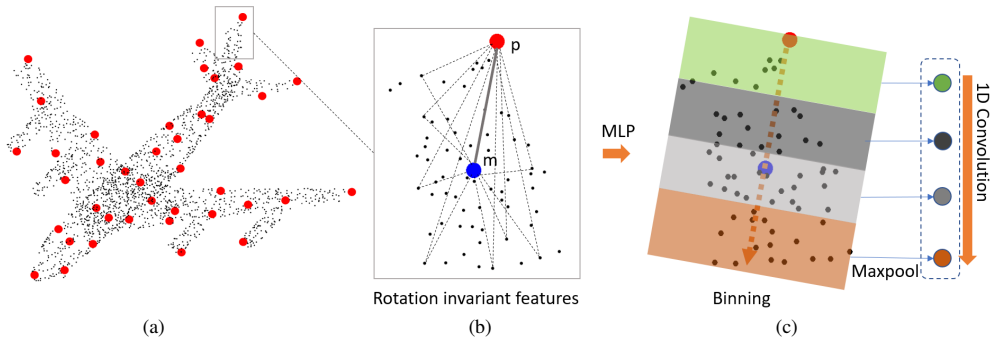
The load-bearing object is the rotation-invariant feature $\mathrm{RIF}(x; \vec{pm}) = [d_0, d_1, \alpha_0, \alpha_1]$, computed for every point $x$ in a local neighborhood of a reference point $p$, with $m$ the centroid of that neighborhood. The vector $\vec{pm}$ serves as a local orientation reference: distances and angles to $p$ and $m$ do not change under rigid motions, so the features carry no dependence on the global frame. A shared MLP lifts these features, the local space is divided into ordered bins along $\vec{pm}$, and each bin is max-pooled; the ordered bin features then make a 1D convolution well-defined, which is how point-order invariance is obtained. When $p$ and $m$ coincide—symmetrically distributed neighbors—the paper selects the farthest point to $p$ as $m$ to avoid the degenerate reference vector.
What would settle it
Retrain the RIConv classification network on ModelNet40 with only z-axis rotations, then test it on a fixed set of non-axis-aligned SO3 rotations and measure per-category accuracy; if the overall accuracy falls well below the reported 86.4% or the accuracy standard deviation across repeated rotation sets exceeds roughly 0.1, the claimed rotation invariance is not holding. A second, more local check: place a point at the exact centroid of its neighborhood and compare the bin assignments and output features before and after an infinitesimal rotation; any abrupt change would reveal the degenerate-reference failure.
Extended reading notes
Core claim
The central discovery is that a point cloud convolution can be made rotation invariant without leaving Euclidean space, by defining each local point's feature as $[d_0, d_1, \alpha_0, \alpha_1]$: the distances from the point to the reference point and to the neighborhood centroid, and the angles those two segments make with the reference vector pointing from the reference point to the centroid. The operator then bins the lifted features along that reference vector, max-pools per bin, and applies a 1D convolution, which absorbs the issue of point ordering. The paper's claim is that this single operator is agnostic to both point rotation and point order, and that a compact network built from it produces nearly identical accuracy whether it is trained and tested with z-axis rotations, trained and tested with arbitrary SO3 rotations, or trained with z-rotations and tested with SO3 rotations. In the hardest case, training with z-rotations and testing with SO3 rotations, the network keeps 86.4% accuracy on ModelNet40 classification, where PointNet, PointNet++, and PointCNN drop to 12.8%, 28.6%, and 41.2%, respectively; on ShapeNet part segmentation it reaches 75.3 mIoU in the same cross-rotation setting.
Load-bearing premise
The whole construction depends on the centroid-to-point vector staying a well-defined local reference under rotation, and on the farthest-point fallback, used when that vector collapses to zero, not introducing discontinuities.
Editorial extensions
If this is right
- A network trained only with z-axis rotations can be deployed on arbitrary SO3-rotated point clouds without retraining or rotation augmentation, holding about 86.4% classification accuracy on ModelNet40.
- The same operator serves both classification and part segmentation: on ShapeNet part segmentation it reaches 75.5 mIoU under SO3/SO3 and 75.3 under z/SO3, with consistent per-category results.
- Rotation invariance is achieved with only 0.70M parameters, roughly five times fewer than PointNet, because the network does not need to memorize many rotated views.
- The binning strategy subsumes the point-ordering problem: the ordered, max-pooled bins give a fixed-size feature sequence on which a 1D convolution can act.
- Using original coordinates instead of geometric features raises classification accuracy to 91.8% in the no-rotation setting, indicating a trade-off between invariance and discriminative power that the paper leaves open.
Reading between the lines
- Editorial inference: fusing raw coordinates with the geometric features—rather than dropping coordinates—is the natural next experiment suggested by the paper's own 91.8% coordinate-only result; it could recover discriminative power while preserving cross-rotation consistency.
- Editorial inference: the degeneracy noted when the reference point equals the centroid is described in the text but not in Algorithm 1; the farthest-neighbor fallback may preserve invariance for symmetric neighborhoods but could introduce discontinuous bin assignments under small perturbations, so a production implementation should handle that case explicitly.
- Editorial inference: the binning discretization fixes an angular resolution; shapes with fine local detail would likely benefit from more bins in the first layer, and this is testable by sweeping the 4/2/1 bin schedule.
- Editorial inference: the same recipe of distances and angles could plausibly extend to scale invariance by normalizing the distances, or to non-rigid settings by replacing the centroid with a more stable anchor, though the paper does not explore these options.
Signed reviews
Editorial analysis
A structured set of objections, weighed in public.
Referee Report
Summary. The paper proposes RIConv, a convolution operator for 3D point clouds that is invariant to rigid motions and to the ordering of input points. For each reference point p, the K nearest neighbors form a local point set; the centroid m is computed, and the vector pm serves as a local reference direction. Each neighbor x is encoded by four scalar features, two distances and two angles (Eq. 1), which are lifted by a shared MLP. The local points are then divided into ordered bins along pm, max-pooled per bin, and processed by a 1D convolution to produce the output feature. The operator is used in a compact CNN for object classification and in an encoder-decoder with skip connections for part segmentation. Experiments on ModelNet40 report 86.5%, 86.4%, and 86.4% classification accuracy for the z/z, SO3/SO3, and z/SO3 rotation settings, and on ShapeNet part segmentation report 75.5 and 75.3 mIoU for SO3/SO3 and z/SO3. The paper also includes ablations, per-category tables, and a discussion of limitations.
Significance. If the results hold, the paper makes a useful contribution: a simple and compact point-cloud convolution whose rotation invariance is guaranteed by construction rather than achieved through data augmentation. The core idea is clean and well grounded: the features in Eq. (1) are distances and angles measured relative to pm, so rigid transformations leave them unchanged, and the binning plus max-pooling step makes the operator symmetric with respect to the order of neighboring points. The reported consistency between SO3/SO3 and z/SO3 (86.4 vs 86.4 for classification, 75.5 vs 75.3 for part segmentation) is strong empirical evidence for the invariance claim. The manuscript also provides public code, ablation studies, per-category results, and an honest discussion of the accuracy trade-off in the z/z setting. These are concrete strengths that support the central claim.
minor comments (5)
- [Section 3.1 / Algorithm 1] The degenerate-centroid fallback described in Section 3.1 is not present in Algorithm 1, which unconditionally computes pm as m - p. As written, the pseudocode produces a zero reference vector whenever p and m coincide, leaving the angle features and bin boundaries undefined; please add the farthest-point fallback to the algorithm and specify how binning is defined in that case. The fallback is rotation-equivariant, so the central invariance claim is unaffected, but the current pseudocode is not a complete specification of the operator.
- [Table 1 / Section 5.1] The column labeled "Acc. std." is described in the text as the standard deviation of accuracy across the three rotation scenarios, not as a repeated-run or seed-to-seed variation. Please state this explicitly in the table caption to avoid misinterpretation, and consider reporting repeated-run statistics for at least the main configurations.
- [Algorithm 1, line 6] The binning step is described only verbally as "divide local space into s bins along pm"; please provide the explicit projection formula (for example, t = ((x - p) · pm) / ||pm||^2) and state how empty bins are handled during max-pooling.
- [Equation (1)] The symbols d0, d1, α0, and α1 are not formally defined in the text; please define them explicitly as the distances from x to p and m and the angles between (x-p) or (x-m) and the reference vector pm, respectively.
- [Section 3.2 / point-order claim] The paper states that the network is agnostic to point orders, yet nearest-neighbor search and farthest-point sampling can have order-dependent tie-breaking; a sentence clarifying that ties are resolved consistently or by input index would make the claim precise.
Circularity Check
No significant circularity: RIConv's rotation invariance is a direct geometric construction, and the reported accuracies are independent empirical measurements.
full rationale
The central derivation is self-contained. Equation (1) defines RIF(x; pm) = [d0,d1,alpha0,alpha1] as Euclidean distances and angles measured against pm = m - p, and the invariance claim follows directly from the fact that rigid transformations preserve distances and angles while sending p, m, and every neighbor to correspondingly rotated positions; the features and the binning cells therefore rotate with the cloud. This is a construction, not a reduction of a prediction to its input. The binning and maxpooling mechanism in Section 3.2 and Algorithm 1 is fully specified and gives point-order agnosticism through the permutation invariance of maxpooling; the reference to ShellNet [45] is only a relevance note and is not load-bearing, and [44] is a self-citation of the conference version, not an evidentiary premise. The benchmark accuracies (86.5/86.4/86.4 and 75.5/75.3 mIoU) are measured outcomes, not fitted constants. The degenerate-centroid caveat in Section 3.1 (farthest-point fallback) is under-specified in Algorithm 1 and can produce discontinuous features when the centroid crosses the reference point, but it preserves rotation equivariance and therefore does not threaten the central claim; this is a robustness and reproducibility issue, not circularity.
Assumptions & free parameters
free parameters (5)
- Number of bins per convolution layer =
4, 2, 1
- Neighborhood size K =
64, 32, 16
- Number of output feature vectors for classifier =
64
- Downsampling point counts =
256, 128, 64 (classification); 512, 128, 32 (segmentation)
- Number of convolution layers =
3
assumptions (4)
- standard math Euclidean distances and angles are invariant under rigid transformations (translations and rotations).
- standard math The centroid of a point set transforms equivariantly under rotations: if all points rotate by R, the centroid rotates to the rotated centroid.
- standard math Farthest point sampling is equivariant under rigid transformations, so representative points rotate consistently with the cloud.
- domain assumption Local rotation-invariant geometric features (distances and angles) retain enough discriminative information for object classification and part segmentation.
Cite this review
Pith. "Pith review of Rotation Invariant Convolutions for 3D Point Clouds Deep Learning." pith.science (2026). https://pith.science/paper/FF2EU552
@misc{pith2026190806297,
  author       = {Pith},
  title        = {Pith review of: Rotation Invariant Convolutions for 3D Point Clouds Deep Learning},
  year         = {2026},
  howpublished = {\url{https://pith.science/paper/FF2EU552}},
  note         = {Machine review of arXiv:1908.06297}
}
read the original abstract
Recent progresses in 3D deep learning has shown that it is possible to design special convolution operators to consume point cloud data. However, a typical drawback is that rotation invariance is often not guaranteed, resulting in networks being trained with data augmented with rotations. In this paper, we introduce a novel convolution operator for point clouds that achieves rotation invariance. Our core idea is to use low-level rotation invariant geometric features such as distances and angles to design a convolution operator for point cloud learning. The well-known point ordering problem is also addressed by a binning approach seamlessly built into the convolution. This convolution operator then serves as the basic building block of a neural network that is robust to point clouds under 6DoF transformations such as translation and rotation. Our experiment shows that our method performs with high accuracy in common scene understanding tasks such as object classification and segmentation. Compared to previous works, most importantly, our method is able to generalize and achieve consistent results across different scenarios in which training and testing can contain arbitrary rotations.
Figures


Figures from the paper (4 more)


Reference graph
Works this paper leans on
-
[1]
write newline
" write newline "" before.all 'output.state := FUNCTION fin.entry add.period write newline FUNCTION new.block output.state before.all = 'skip after.block 'output.state := if FUNCTION new.sentence output.state after.block = 'skip output.state before.all = 'skip after.sentence 'output.state := if if FUNCTION not #0 #1 if FUNCTION and 'skip pop #0 if FUNCTIO...
-
[2]
M. Abadi, P. Barham, J. Chen, Z. Chen, A. Davis, J. Dean, M. Devin, S. Ghemawat, G. Irving, M. Isard, et al. Tensorflow: A system for large-scale machine learning. In 12th \ USENIX \ Symposium on Operating Systems Design and Implementation ( \ OSDI \ 16) , pages 265--283, 2016
work page 2016
- [3]
-
[4]
Y. Ben-Shabat, M. Lindenbaum, and A. Fischer. 3dmfv: Three-dimensional point cloud classification in real-time using convolutional neural networks. IEEE Robotics and Automation Letters , 3:3145--3152, 2018
work page 2018
-
[5]
M. M. Bronstein , J. Bruna , Y. LeCun , A. Szlam , and P. Vandergheynst . Geometric deep learning: Going beyond euclidean data. IEEE Signal Processing Magazine , 34(4):18--42, 2017
work page 2017
-
[6]
A. X. Chang, T. A. Funkhouser, L. J. Guibas, P. Hanrahan, Q.-X. Huang, Z. Li, S. Savarese, M. Savva, S. Song, H. Su, J. Xiao, L. Yi, and F. Yu. Shapenet: An information-rich 3d model repository. arXiv preprint arXiv:1512.03012 , 2015
arXiv 2015
-
[7]
A. Dai, A. X. Chang, M. Savva, M. Halber, T. Funkhouser, and M. Niessner. Scannet: Richly-annotated 3d reconstructions of indoor scenes. In CVPR , pages 5828--5839, 2017
work page 2017
-
[8]
H. Deng, T. Birdal, and S. Ilic. Ppf-foldnet: Unsupervised learning of rotation invariant 3D local descriptors. In ECCV , 2018
work page 2018
Show all 45 references
-
[9]
Esteves, C
C. Esteves, C. Allen-Blanchette, A. Makadia, and K. Daniilidis. Learning so (3) equivariant representations with spherical cnns. In ECCV , pages 52--68, 2018
2018
-
[10]
Groueix, M
T. Groueix, M. Fisher, V. G. Kim, B. Russell, and M. Aubry. AtlasNet: A Papier-M\^ach\'e Approach to Learning 3D Surface Generation . In CVPR , 2018
2018
-
[11]
Hermosilla, T
P. Hermosilla, T. Ritschel, P.-P. Vazquez, A. Vinacua, and T. Ropinski. Monte carlo convolution for learning on non-uniformly sampled point clouds. ACM Transactions on Graphics , 2018
2018
-
[12]
Hua, Q.-H
B.-S. Hua, Q.-H. Pham, D. T. Nguyen, M.-K. Tran, L.-F. Yu, and S.-K. Yeung. Scenenn: A scene meshes dataset with annotations. In International Conference on 3D Vision , 2016
2016
-
[13]
Hua, M.-K
B.-S. Hua, M.-K. Tran, and S.-K. Yeung. Point-wise convolutional neural network. In CVPR , 2018
2018
-
[14]
Huang, W
Q. Huang, W. Wang, and U. Neumann. Recurrent slice networks for 3d segmentation on point clouds. In CVPR , 2018
2018
-
[15]
Khoury, Q.-Y
M. Khoury, Q.-Y. Zhou, and V. Koltun. Learning compact geometric features. In ICCV , 2017
2017
-
[16]
Klokov and V
R. Klokov and V. Lempitsky. Escape from cells: Deep kd-networks for the recognition of 3d point cloud models. In International Conference on Computer Vision , pages 863--872, 2017
2017
-
[17]
Landrieu and M
L. Landrieu and M. Simonovsky. Large-scale point cloud semantic segmentation with superpoint graphs. In CVPR , 2018
2018
-
[18]
Le and Y
T. Le and Y. Duan. Pointgrid: A deep network for 3d shape understanding. CVPR , 2018
2018
-
[19]
J. Li, B. M. Chen, and G. H. Lee. So-net: Self-organizing network for point cloud analysis. In CVPR , 2018
2018
-
[20]
Y. Li, R. Bu, M. Sun, and B. Chen. Pointcnn: Convolution on x-transformed points. Advances in Neural Information Processing Systems , 2018
2018
-
[21]
Y. Li, S. Pirk, H. Su, C. R. Qi, and L. J. Guibas. Fpnn: Field probing neural networks for 3d data. In Advances in Neural Information Processing Systems , pages 307--315, 2016
2016
-
[22]
X. Liu, Z. Han, Y.-S. Liu, and M. Zwicker. Point2sequence: Learning the shape representation of 3d point clouds with an attention-based sequence to sequence network. In Association for the Advancement of Artificial Intelligence , 2019
2019
-
[23]
Masci, D
J. Masci, D. Boscaini, M. M. Bronstein, and P. Vandergheynst. Geodesic convolutional neural networks on riemannian manifolds. In The IEEE International Conference on Computer Vision (ICCV) Workshops , 2015
2015
-
[24]
Maturana and S
D. Maturana and S. Scherer. VoxNet: A 3D Convolutional Neural Network for Real-Time Object Recognition . In International Conference on Intelligent Robots and Systems , 2015
2015
-
[25]
C. R. Qi, H. Su, K. Mo, and L. J. Guibas. Pointnet: Deep learning on point sets for 3d classification and segmentation. In CVPR , 2017
2017
-
[26]
C. R. Qi, H. Su, M. Nie ner, A. Dai, M. Yan, and L. J. Guibas. Volumetric and multi-view cnns for object classification on 3d data. In CVPR , pages 5648--5656, 2016
2016
-
[27]
C. R. Qi, L. Yi, H. Su, and L. J. Guibas. Pointnet++: Deep hierarchical feature learning on point sets in a metric space. In Advances in Neural Information Processing Systems , pages 5105--5114, 2017
2017
-
[28]
Y. Rao, J. Lu, and J. Zhou. Spherical fractal convolutional neural networks for point cloud recognition. In Computer Vision and Pattern Recognition (CVPR) , 2019
2019
-
[29]
Riegler, A
G. Riegler, A. O. Ulusoy, and A. Geiger. Octnet: Learning deep 3d representations at high resolutions. In CVPR , 2017
2017
-
[30]
Ronneberger, P
O. Ronneberger, P. Fischer, and T. Brox. U-net: Convolutional networks for biomedical image segmentation. In International Conference on Medical image computing and computer-assisted intervention , pages 234--241. Springer, 2015
2015
-
[31]
Y. Shen, C. Feng, Y. Yang, and D. Tian. Mining point cloud local structures by kernel correlation and graph pooling. In CVPR , volume 4, 2018
2018
-
[32]
H. Su, S. Maji, E. Kalogerakis, and E. Learned-Miller. Multi-view convolutional neural networks for 3d shape recognition. In International Conference on Computer Vision , pages 945--953, 2015
2015
-
[33]
Tatarchenko, J
M. Tatarchenko, J. Park, V. Koltun, and Q.-Y. Zhou. Tangent convolutions for dense prediction in 3d. In CVPR , pages 3887--3896, 2018
2018
-
[34]
P.-S. Wang, Y. Liu, Y.-X. Guo, C.-Y. Sun, and X. Tong. O-cnn: Octree-based convolutional neural networks for 3d shape analysis. ACM Transactions on Graphics , 36(4):72, 2017
2017
-
[35]
Wang, C.-Y
P.-S. Wang, C.-Y. Sun, Y. Liu, and X. Tong. Adaptive o-cnn: A patch-based deep representation of 3d shapes. ACM Transactions on Graphics , 2018
2018
-
[36]
Y. Wang, Y. Sun, Z. Liu, S. E. Sarma, M. M. Bronstein, and J. M. Solomon. Dynamic graph cnn for learning on point clouds. ACM Transactions on Graphics , 2019
2019
-
[37]
Z. Wu, S. Song, A. Khosla, F. Yu, L. Zhang, X. Tang, and J. Xiao. 3d shapenets: A deep representation for volumetric shapes. In CVPR , pages 1912--1920, 2015
1912
-
[38]
S. Xie, S. Liu, Z. Chen, and Z. Tu. Attentional shapecontextnet for point cloud recognition. In CVPR , 2018
2018
-
[39]
Y. Xu, T. Fan, M. Xu, L. Zeng, and Y. Qiao. Spidercnn: Deep learning on point sets with parameterized convolutional filters. In ECCV , 2018
2018
-
[40]
Y. Yang, C. Feng, Y. Shen, and D. Tian. Foldingnet: Point cloud auto-encoder via deep grid deformation. In CVPR , 2018
2018
-
[41]
L. Yi, V. G. Kim, D. Ceylan, I.-C. Shen, M. Yan, H. Su, C. Lu, Q. Huang, A. Sheffer, and L. Guibas. A scalable active framework for region annotation in 3d shape collections. ACM Transactions on Graphics , 2016
2016
-
[42]
L. Yi, H. Su, X. Guo, and L. J. Guibas. Syncspeccnn: Synchronized spectral cnn for 3d shape segmentation. In CVPR , pages 2282--2290, 2017
2017
-
[43]
A. Zeng, S. Song, M. Nie ner, M. Fisher, J. Xiao, and T. Funkhouser. 3DMatch : Learning local geometric descriptors from RGB-D reconstructions. In CVPR , 2017
2017
-
[44]
Zhang, B.-S
Z. Zhang, B.-S. Hua, D. W. Rosen, and S.-K. Yeung. Rotation invariant convolutions for 3d point clouds deep learning. In International Conference on 3D Vision (3DV) , 2019
2019
-
[45]
Zhang, B.-S
Z. Zhang, B.-S. Hua, and S.-K. Yeung. Shellnet: Efficient point cloud convolutional neural networks using concentric shells statistics. In International Conference on Computer Vision (ICCV) , 2019
2019
Reviewed August 14, 2026 · model on record in the stance chip above.
Discussion (0). Continue with ORCID to comment.