REVIEW 4 major objections 5 minor 14 references
From Frame-Level Recognition to Event-Level Confirmation: Repair Traces and Runtime Failure Analysis of Public-Space Gesture Interaction
T0 review · 4 major / 5 minor · reviewed 2026-08-02 · deepseek-v4-flash
Pith's one-line read Public-space gesture failures arise at the boundary where frame-level recognition becomes a user-visible event, not inside the recognition model itself.
desk verdict An honest, well-scoped case study with a usable failure taxonomy, but the taxonomy rests on one developer's extraction from unpublished repair traces, so it is plausible, not demonstrated. read the letter →
The pith
A machine-rendered reading of the paper's core claim, the machinery that carries it, and where it could break.
The reading
What carries the argument
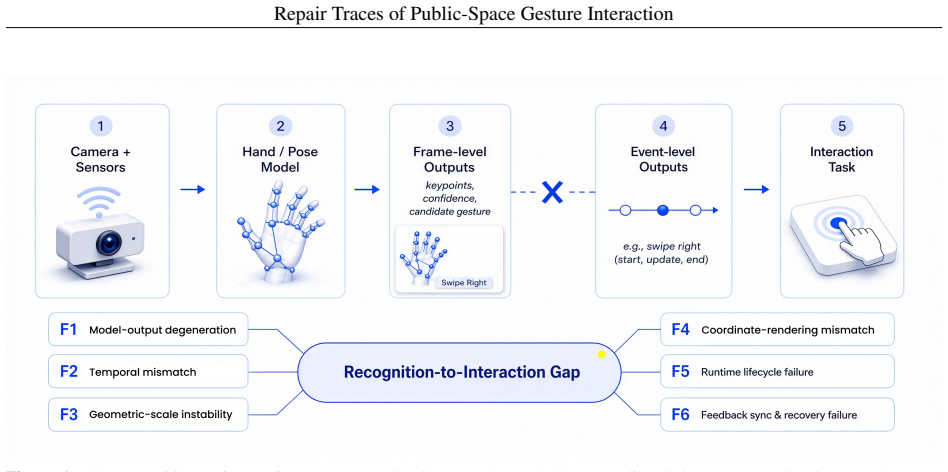
The recognition-to-interaction gap and the event-level runtime abstraction. The abstraction is not a model; it is a layer that receives frame-level landmarks, confidence values, and candidate gestures, rejects implausible observations, normalizes by hand scale, tolerates short-term hand loss, aggregates candidates via voting or hysteresis, checks legal state-machine transitions, and emits a confirmed or rejected event while managing coordinate alignment, resource lifecycle, and prompt synchronization. This machinery carries the argument because it maps each failure class to a specific runtime mechanism.
What would settle it
Run a multi-site field study where failure logs are coded independently by several analysts across at least three kiosk deployments; if the six classes do not recur, or if most recorded failures resolve by improving frame-recognition accuracy alone, the recognition-to-interaction gap would not be the dominant failure boundary claimed.
Extended reading notes
Core claim
The central claim is the recognition-to-interaction gap: single-frame errors, brief hand loss, coordinate offsets, state-machine edge cases, and resource leaks become visible failures because no event-confirmation runtime exists between the hand-landmark model and the task. The paper does not offer a new recognizer or accuracy numbers; it offers a deployment-grounded taxonomy, a runtime abstraction with three sublayers—event confirmation, runtime maintenance, and feedback synchronization—and five cross-case findings showing that frame-level recognition errors alone cannot explain the observed field failures.
Load-bearing premise
The taxonomy's load-bearing premise—explicitly conceded in Sections 4.2 and 4.6—is that eight repair records from one project and the twenty failure instances extracted by the system developer faithfully represent field failures of public-space gesture interaction; if those records are incomplete or idiosyncratic, the six classes do not generalize.
Editorial extensions
If this is right
- Practitioners can classify field-reported gesture bugs into six working classes and route them to the corresponding runtime mechanism instead of retuning confidence thresholds in isolation.
- A public-space interaction system should treat event confirmation as a first-class component, with temporal windows, hand-loss tolerance, scale normalization, and state recovery.
- Coordinate alignment and resource lifecycle management belong in gesture-system test plans, since they surface only under long-running field use.
- Feedback synchronization must be tested as part of event delivery, not as a UI afterthought.
- The six classes are explicitly a working taxonomy, not an exhaustive one, so other deployments may extend or refine the classes.
Reading between the lines
- This reading suggests the taxonomy could seed a shared failure-reporting checklist for gesture kiosks, letting teams compare which failure classes dominate in different venues.
- If the runtime abstraction is correct, a testable extension is to inject frame-level disturbances—hand loss, scale jitter, coordinate offsets—and measure whether the event-confirmation layer suppresses user-visible failures, which would quantify what repair traces only suggest.
- The strongest hidden implication is that recognition accuracy and user-perceived reliability can diverge: a recognizer with high frame accuracy may still fail interaction-level goals, so evaluation metrics should include event-level outcomes such as confirmed-event rate and stuck-state rate.
Editorial analysis
A structured set of objections, weighed in public.
Referee Report
Summary. The paper analyzes 8 engineering repair records from a scenic-area interactive kiosk deployment, covering four gesture tasks (two-hand bowing, single-hand fist shaking, two-hand catching control, and knowledge-graph node hovering). From these records the authors extract 20 failure instances and organize them into six non-exclusive 'working failure classes': model-output degeneration, temporal mismatch, geometric-scale instability, coordinate-rendering mismatch, runtime lifecycle failure, and feedback synchronization/recovery failure. They also propose an event-level runtime abstraction, consisting of event confirmation, runtime maintenance, and feedback synchronization sublayers, that sits between frame-level hand-landmark outputs and task-level interaction events. The paper is explicitly scoped as a constrained case study: it does not claim statistical generalization, measured accuracy improvements, or a new recognition model.
Significance. If the taxonomy and runtime abstraction are accepted, the paper provides a useful practitioner-oriented vocabulary for debugging public-space gesture interaction: it redirects attention from isolated frame-level recognition thresholds to event confirmation, state-machine recovery, coordinate consistency, lifecycle hygiene, and feedback synchronization. The paper's strengths include its careful epistemic labeling (Table 1/Table 2), the explicit mapping of representative instances to underlying identifiers (Table 3), the full instance table (Appendix A), and unusually candid validity-threat disclosure (Sections 4.6 and 8.2). The analysis is reproducible in the modest sense that codes and mappings are shown, even though raw repair documents are not. The main risk is that the central taxonomy depends on one engineer's extraction from unshown records; this risk is acknowledged by the authors but not mitigated by independent coding or raw-traces excerpts.
major comments (4)
- [§4.2 / §4.6 / Appendix A] The six-class taxonomy is the central contribution, but it rests entirely on 20 failure instances extracted by the system developer from 8 repair documents, with no inter-coder agreement and no raw repair-trace excerpts. Table 10 lists only source filenames, not the content of the records or the step-by-step chain from each record to each FI. As the authors themselves state, this introduces developer-as-analyst bias. Because the reader cannot see how the instances were identified or classified, the possibility that the six classes were imposed on the material rather than emerging from it remains open. A revision should provide either (a) an independent coding of at least a subset of the repair records, (b) anonymized excerpts of the repair traces alongside each FI with a traceability matrix, or (c) an explicit reframing of the taxonomy as 'one engineer's interpretation' in the title and
- [§4.2 inclusion criteria vs. abstract/introduction claim] The inclusion criteria require that each failure instance have at least one engineering hypothesis, repair attempt, or runtime mechanism. This systematically excludes pure recognition errors that were never diagnosed, never repaired, or simply accepted. The abstract and introduction present the recognition-to-interaction gap as the 'different failure boundary' exposed by deployment. If the paper is read as claiming that field failures are predominantly non-recognition failures, the selection criterion makes that conclusion partly self-fulfilling. The paper generally avoids statistical frequency claims, but the framing ('deployed systems expose a different failure boundary', 'not primarily frame-level recognition errors' in the reader's summary, if that reflects the intended claim) invites exactly that interpretation. Please add an explicit caveat in the abstract and Section 1 that the sa
- [§7.1 / Figure 5] The bowing-module case is presented as a representative repair trace showing that parameter tuning (P1–P3) 'failed' while state recovery (P4) 'explained what tuning could not'. However, the paper does not report the criteria by which a tuning round was judged to have failed, nor the field feedback or runtime evidence behind that judgment. Since this case is used to support Finding 1 and the broader argument that recognition-level tuning is insufficient, the evidence for the failure of P1–P3 should be made explicit. If the judgment comes from the engineer's field observations, that should be said; if it comes from qualitative feedback, a short excerpt or a summary of the feedback would strengthen the claim. Otherwise the reader cannot distinguish a well-supported negative result from a rhetorical narrative.
- [§5 / Table 4] The coverage of the taxonomy is very uneven: F1 (model-output degeneration) has only 2 instances, both from the two-hand bowing task, and F6 (feedback synchronization) has only 3 instances, all from the UI/speech-prompt records. The authors acknowledge this in Section 8.2, but the consequence is that two of the six classes are supported by a single module each. This is acceptable for a case-study taxonomy, but the paper should more prominently state that classes F1 and F6 are provisional, based on one task each, and that cross-task validation is needed. Currently this caveat appears only in a later limitations paragraph; it should be visible in the definition of Table 5.
minor comments (5)
- [§6.2, Eqs. (1)–(2)] The variables q_t, r_t, h_t, p_t are listed but not defined operationally (e.g., how 'temporal consistency' is computed). Since the authors explicitly state this is not a fitted model, a brief sentence explaining that these are placeholders for whichever heuristic the task uses would help readers without implying a concrete algorithm.
- [Table 10] The source filenames in Table 10 are broken across lines in a way that makes them hard to read (e.g., 'mazu-PrayerTracker-experiment-record-2 026-04-29.md'). Please format these as monospaced text or group the document IDs with cleaner line breaks.
- [Abstract / keyword formatting] The abstract text in the manuscript appears to have missing spaces (e.g., 'Deployingpublic-spacegestureinteraction'). This is likely a rendering artifact, but please ensure the final camera-ready version has normal word spacing.
- [§7.2, Table 7] The 'Before repair' and 'Repair action' columns mix quantitative changes (threshold 0.3 -> 0.2, window 15 -> 30) with structural changes (single-vector -> four-vector average). Consider separating parameter changes from algorithmic changes so the reader can distinguish what was tuned vs. what was redesigned.
- [§8.1] The sentence 'The main point is that... these mechanisms should not remain scattered patches' is more argumentative than the rest of the paper. While it is a legitimate design statement, consider softening it to 'we organize these mechanisms into a runtime layer' to match the paper's descriptive tone.
Circularity Check
No significant circularity: the taxonomy and runtime abstraction are explicitly descriptive, grounded in the same repair traces they organize, with no fitted parameters, predictions, or load-bearing self-citations.
full rationale
The paper makes no predictive or fitted-model claim that could reduce by construction to its inputs. Equations (1)-(2) are explicitly labeled as a heuristic description, not a fitted model: 'It is not used in any experiment in this paper and is not a methodological contribution' (Section 6.2). The six failure classes are presented as 'a working classification derived from the current 8 repair records and 20 failure instances' (Section 5), and the event-level runtime abstraction is described as organizing 'recurring repair mechanisms' that 'is used to explain failure instances rather than to claim a new algorithm or a verified performance gain' (Introduction). This is an inductive, grounded case-study organization rather than a circular derivation. The paper's own limitation statements identify the relevant threats: Section 4.6 states 'the 20 failure instances are not random samples' and 'the instances were extracted by the system developer, which introduces developer-as-analyst bias'; Section 8.2 reiterates that 'This is not a formal qualitative coding study.' The inclusion criterion requiring an issue to correspond to 'at least one engineering hypothesis, repair attempt, or runtime mechanism' (Section 4.2) means the sample is selected for mechanism-related failures, and the paper's findings are correspondingly framed as existence claims ('some field failures cannot be explained as recognition errors alone'), not as statistical generalizations. No self-citation chain is load-bearing: the references are external literature, and the paper does not invoke a uniqueness theorem or prior work by the same authors to force its classification. The need for independent coding of raw traces is a validity concern, not a circularity concern. Therefore, the derivation is self-contained within its stated case-study scope, and no specific circular reduction can be exhibited.
Assumptions & free parameters
assumptions (3)
- domain assumption The 8 repair documents accurately preserve the actual field failures and repairs (including failed attempts) that occurred during deployment.
- domain assumption The system developer's extraction of 20 failure instances from the documents is a valid analytical basis despite the acknowledged developer-as-analyst bias.
- domain assumption Failure instances observed in one scenic-area project can support a working taxonomy applicable to public-space gesture interaction more broadly.
invented entities (2)
-
recognition-to-interaction gap
-
event-level runtime abstraction
Cite this review
Pith. "Pith review of From Frame-Level Recognition to Event-Level Confirmation: Repair Traces and Runtime Failure Analysis of Public-Space Gesture Interaction." pith.science (2026). https://pith.science/paper/FFAGOBUQ
@misc{pith2026260721601,
  author       = {Pith},
  title        = {Pith review of: From Frame-Level Recognition to Event-Level Confirmation: Repair Traces and Runtime Failure Analysis of Public-Space Gesture Interaction},
  year         = {2026},
  howpublished = {\url{https://pith.science/paper/FFAGOBUQ}},
  note         = {Machine review of arXiv:2607.21601}
}
read the original abstract
Public-space gesture interaction is often evaluated as a frame-level recognition problem, but deployed systems expose a different failure boundary. In scenic kiosks, exhibition halls, and service terminals, users experience whether an intended action becomes a stable interaction event, not whether individual hand-landmark frames are correct. We call this the recognition-to-interaction gap. This paper analyzes 8 engineering repair records from a scenic-area interactive kiosk project, covering 4 gesture tasks: two-hand bowing, single-hand fist shaking, two-hand catching control, and knowledge-graph node hovering. From these traces, we extract 20 failure instances and organize them into six non-exclusive working failure classes: model-output degeneration, temporal mismatch, geometric-scale instability, coordinate-rendering mismatch, runtime lifecycle failure, and feedback synchronization and recovery failure. We further organize recurring repair mechanisms into an event-level runtime abstraction between the hand-landmark model and the interaction task. The contribution is deliberately bounded: a deployment-grounded failure taxonomy, an event-confirmation runtime abstraction, and case-study findings. We do not claim a new recognition model, large-scale user evaluation, or quantified accuracy gains.
Figures


Figures from the paper (2 more)


Reference graph
Works this paper leans on
-
[1]
Designing touchless gestural interactions for public displays in-the-wild
Vito Gentile, Alessio Malizia, Salvatore Sorce, and Antonio Gentile. Designing touchless gestural interactions for public displays in-the-wild. InHuman-Computer Interaction: Interaction Technologies (HCII 2015), volume 9170 ofLecture Notes in Computer Science, pages 24–34. Springer, 2015. doi: 10.1007/978-3-319-20916-6_3
-
[2]
Real world responses to interactive gesture based public displays
John Hardy, Enrico Rukzio, and Nigel Davies. Real world responses to interactive gesture based public displays. InProceedingsofthe10thInternationalConferenceonMobileandUbiquitousMultimedia(MUM),pages33–42,
-
[3]
Hilary Hutchinson, Wendy Mackay, Bo Westerlund, Benjamin B. Bederson, Allison Druin, Catherine Plaisant, MichelBeaudouin-Lafon,StéphaneConversy,HelenEvans,HeikoHansen,NicolasRoussel,andBjörnEiderbäck. Technologyprobes: Inspiringdesignforandwithfamilies. InProceedingsoftheSIGCHIConferenceonHuman Factors in Computing Systems (CHI), pages 17–24, 2003. doi: 1...
arXiv 2003
-
[4]
Challenges in public display deployments: A taxonomy of external factors
Ville Mäkelä, Sumita Sharma, Jaakko Hakulinen, Tomi Heimonen, and Markku Turunen. Challenges in public display deployments: A taxonomy of external factors. InProceedings of the 2017 CHI Conference on Human Factors in Computing Systems (CHI), pages 3426–3440, 2017. doi: 10.1145/3025453.3025798
arXiv 2017
-
[5]
Daniel Michelis and Jörg Müller. The audience funnel: Observations of gesture based interaction with multiple largedisplaysinacitycenter.InternationalJournalofHuman-ComputerInteraction,27(6):562–579,2011. doi: 10.1080/10447318.2011.555299. 12 Repair Traces of Public-Space Gesture Interaction
arXiv 2011
-
[6]
Sushmita Mitra and Tinku Acharya. Gesture recognition: A survey.IEEE Transactions on Systems, Man, and Cybernetics, Part C: Applications and Reviews, 37(3):311–324, 2007. doi: 10.1109/TSMCC.2007.893280
arXiv 2007
-
[7]
Looking glass: A field study on noticing interactivity of a shop window
Jörg Müller, Robert Walter, Gilles Bailly, Michael Nischt, and Florian Alt. Looking glass: A field study on noticing interactivity of a shop window. InProceedings of the SIGCHI Conference on Human Factors in Computing Systems (CHI), pages 297–306, 2012. doi: 10.1145/2207676.2207718
arXiv 2012
-
[8]
Pavlovic, Rajeev Sharma, and Thomas S
Vladimir I. Pavlovic, Rajeev Sharma, and Thomas S. Huang. Visual interpretation of hand gestures for human- computerinteraction: Areview.IEEETransactionsonPatternAnalysisandMachineIntelligence,19(7):677–695, 1997
1997
Show all 14 references
-
[9]
Rautaray and Anupam Agrawal
Siddharth S. Rautaray and Anupam Agrawal. Vision based hand gesture recognition for human computer interaction: A survey.Artificial Intelligence Review, 43(1):1–54, 2015. doi: 10.1007/s10462-012-9356-9
2015 doi
-
[10]
Interactivepublicambientdisplays: Transitioningfromimplicittoexplicit, public to personal, interaction with multiple users
DanielVogelandRavinBalakrishnan. Interactivepublicambientdisplays: Transitioningfromimplicittoexplicit, public to personal, interaction with multiple users. InProceedings of the 17th Annual ACM Symposium on User Interface Software and Technology (UIST), pages 137–146, 2004. do...
2004
-
[11]
StrikeAPose: Revealing mid-air gestures on public displays
Robert Walter, Gilles Bailly, and Jörg Müller. StrikeAPose: Revealing mid-air gestures on public displays. In Proceedings of the SIGCHI Conference on Human Factors in Computing Systems (CHI), pages 841–850, 2013. doi: 10.1145/2470654.2470774
2013
-
[12]
Researchcontributionsinhuman-computerinteraction.interactions,23 (3):38–44, 2016
JacobO.WobbrockandJulieA.Kientz. Researchcontributionsinhuman-computerinteraction.interactions,23 (3):38–44, 2016. doi: 10.1145/2907069
2016 doi
-
[13]
The N-th in- cense has been offered
Fan Zhang, Valentin Bazarevsky, Andrey Vakunov, Andrei Tkachenka, George Sung, Chuo-Ling Chang, and Matthias Grundmann. MediaPipe hands: On-device real-time hand tracking.arXiv preprint arXiv:2006.10214, 2020. A Full Failure Instance Table Table 9:Full list of 20 failure insta...
2006 arXiv
-
[2011]
doi: 10.1145/2107596.2107600
Reviewed August 2, 2026 · model on record in the stance chip above.
Discussion (0). Sign in to comment.