REVIEW 6 major objections 5 minor 4 cited by
T2VWorldBench: A Benchmark for Evaluating World Knowledge in Text-to-Video Generation
T0 review · 6 major / 5 minor · reviewed 2026-08-06 · deepseek-v4-flash
Pith's one-line read This paper claims that current text-to-video models, despite generating visually convincing clips, systematically fail to act on world knowledge: the best models score about 0.68 out of 1 across quality, realism, relevance, and consistency.
desk verdict A useful benchmark idea undercut by an unvalidated VLM judge on static frame grids and no released assets; the central '0.68' result is not established as written. read the letter →
The pith
A machine-rendered reading of the paper's core claim, the machinery that carries it, and where it could break.
The reading
What carries the argument
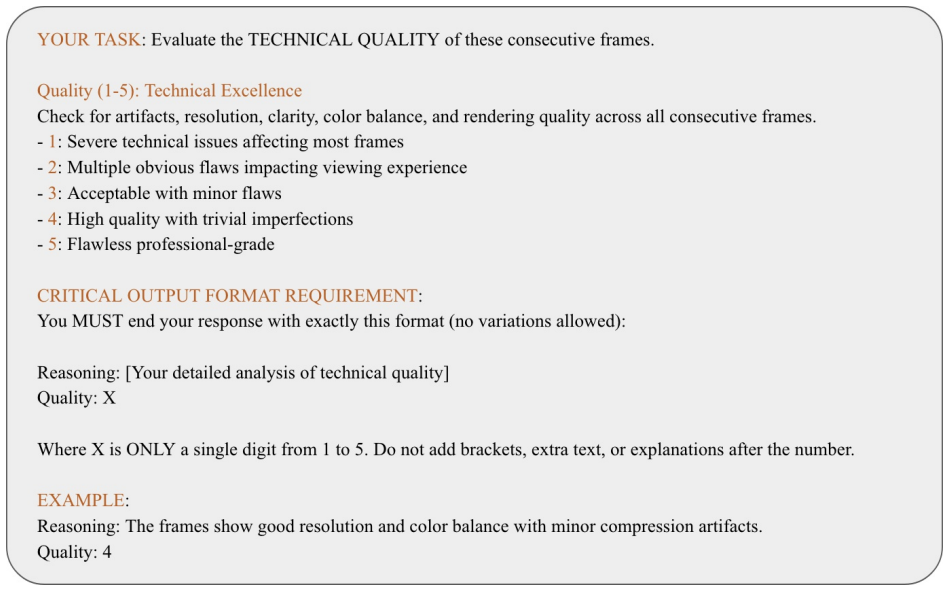
The carrying mechanism is an explanation-grounded, vision-language evaluation protocol. Each of the 1,200 prompts is paired with a human-authored explanation that spells out the world knowledge and reasoning chain an ideal video should show; the evaluator, LLaVA-1.6-34B, receives a base prompt containing both the original text and that explanation, then a metric-specific prompt for one of four dimensions: quality, realism, relevance, or consistency. Videos are tiled into 3x3 grids of nine consecutive frames, the vision-language model scores every grid, and the minimum grid score becomes the video's score for that dimension. Final scores are the average of the automated score and two human annotators' scores, so the benchmark claims to combine scalable evaluation with human preference.
What would settle it
Take a sample of the generated videos, have independent human raters score the same four dimensions, and compute the agreement with the automated scores: if the correlation is low on causality or consistency, the reported 0.68 average does not measure world knowledge. A sharper test is to feed the evaluator two videos built from the same nine frames in different temporal orders, such as a ball falling versus rising; if it gives nearly identical scores, it cannot be measuring temporal or causal consistency at all.
Extended reading notes
Core claim
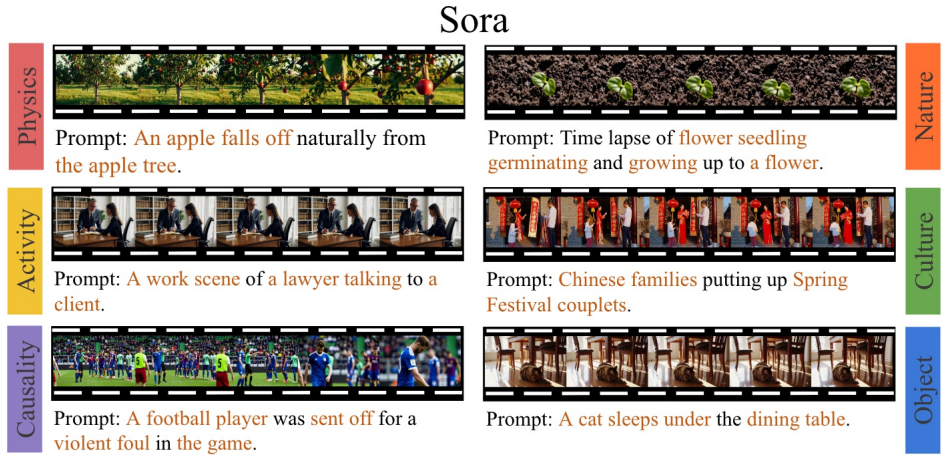
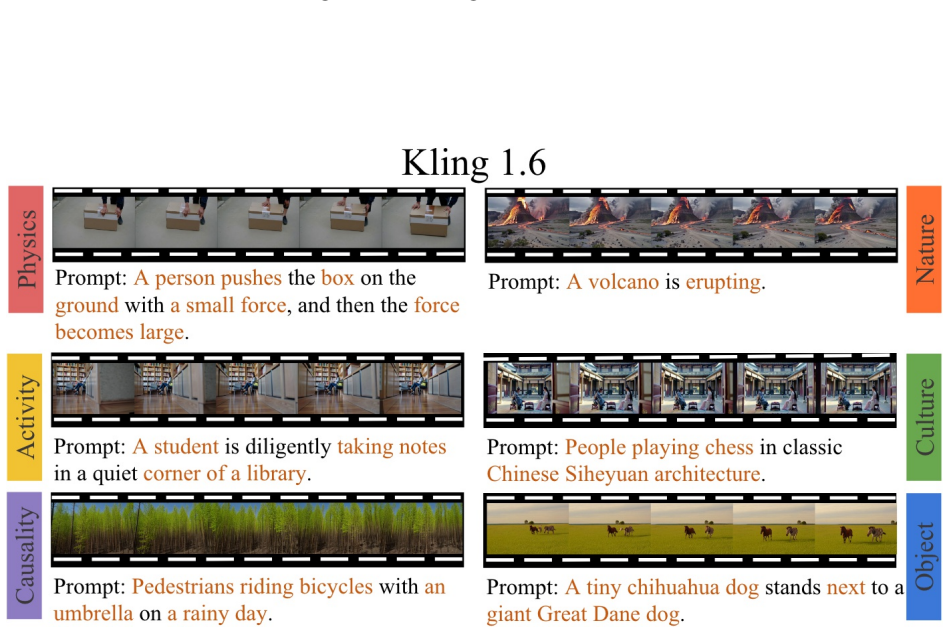
The paper's central claim is that state-of-the-art text-to-video models do not reliably convert world knowledge into correct video. Across 1,200 prompts covering physics, nature, activity, culture, causality, and object, the best performers (Wan 2.1 and LTX Video) average about 0.68 on a 0–1 scale, with most models scoring below 0.70 in at least one domain, and causality and culture consistently the weakest areas. The paper argues this exposes a generation-stage gap: models often grasp the semantics of a prompt yet output video that violates real-world logic, such as a man walking past a banana peel without slipping after the prompt says he steps on it. Because each prompt is paired with human-authored explanations of the required world knowledge, the low scores are meant to measure knowledge integration rather than surface visual quality.
Load-bearing premise
The whole score table rests on the assumption that a vision-language model looking at nine-frame still grids can reliably spot violations of physics, causality, and cultural detail, and that its scores track what human raters would say; the paper does not validate that agreement.
Editorial extensions
If this is right
- If the benchmark is valid, current text-to-video models are not reliable tools for educational, historical, cultural, or scientific-communication videos where factual correctness matters.
- Because causality and culture are the weakest dimensions, progress in those two areas would move overall scores the most, and visual polish alone will not close the gap.
- The higher scores on activity and object suggest the bottleneck is reasoning about event sequences and cultural grounding, not low-level generation quality.
- The hybrid scoring protocol lets the benchmark be rerun automatically as models improve, giving a repeatable yardstick for world-knowledge progress.
- The observed gap between understanding and generation implies that improving prompt comprehension alone will not help; the generation process itself needs to be constrained by physical and causal knowledge.
Reading between the lines
- One consequence the paper leaves implicit: a grid-of-stills evaluator may under-punish motion errors, so the true gap on physics and causality could be even larger than 0.68 suggests.
- The same prompt-plus-explanation protocol could be ported to longer videos or to video-native evaluators; if scores shift substantially, the grid sampling, not the models, would be driving the reported ranking.
- A testable extension would be to train or fine-tune a video model with explicit physical or causal supervision and check whether it breaks the pattern of scoring high on activity but low on causality.
- The benchmark's structure could also be reused to test whether adding a world-knowledge retrieval step, rather than bigger training data, improves cultural and causal video generation.
Editorial analysis
A structured set of objections, weighed in public.
Referee Report
Summary. The paper introduces T2VWorldBench, a benchmark for evaluating world knowledge in text-to-video (T2V) generation, consisting of 1,200 prompts across six categories (physics, nature, activity, culture, causality, object) and 60 subcategories. It evaluates ten T2V models using a hybrid protocol in which two human annotators and the vision-language model LLaVA-1.6-34B score videos on quality, realism, relevance, and consistency; the automatic branch evaluates 3x3 grids of nine consecutive frames and takes the minimum grid score as the video-level score. The main finding is that the best models achieve only about 0.68 on a 0-1 scale, with all models below 0.70, leading the authors to conclude in Observation 4.1 that current T2V models are far from mastering world-knowledge-intensive generation.
Significance. If the benchmark and its evaluation are valid, T2VWorldBench would address an important gap by focusing on world knowledge rather than surface-level appearance, and its taxonomy of prompts could be a useful resource. The paper also combines human and automated assessment and provides qualitative examples that illustrate incorrect generations. However, the central quantitative claim is not yet established: the automated judge is not validated against human judgments, the scoring protocol has unresolved inconsistencies, and no benchmark assets are released. As it stands, the paper's contribution is a promising framework that requires substantial additional validation before its headline conclusion can be accepted.
major comments (6)
- [Section 3.3, Observation 4.1, Table 2] The central claim that SOTA T2V models are 'far from mastering' world knowledge rests entirely on the automatic evaluation protocol in Section 3.3, where LLaVA-1.6-34B scores 3x3 grids of nine consecutive frames and the minimum grid score is adopted as the video score. For the benchmark's core categories (causality, physics, consistency), the target errors are inherently temporal—e.g., a slip after stepping on a banana peel, water spilling after a glass is knocked over, or a seed germinating continuously. A static grid cannot represent motion or timing, and the paper provides no evidence that LLaVA-1.6-34B can infer such dynamics from stills, no correlation between VLM scores and human scores, no control videos with known violations, and no error analysis. Consequently, Table 2 and Observation 4.1 do not establish that the models fail on world knowledge.
- [Section 3.3, Eq. (1), Table 2] The hybrid scoring protocol is internally inconsistent: the text states that the average of manual and automatic scores is computed 'for each evaluation dimension, namely quality, realism, and relevance,' yet Eq. (1) defines the overall score as the average of four dimensions including consistency. If consistency is scored only by the VLM, the overall scores in Table 2 are a blend of different protocols per dimension and are not comparable; if this is a typo, the intended fusion for consistency must be stated and implemented consistently.
- [Section 3.3, minimum grid score aggregation] The decision to take the minimum score across all 3x3 grids as the video-level score is not justified or analyzed. A single grid that is degraded due to sampling or a transient artifact will dominate the video score, systematically lowering all model scores. The paper reports no sensitivity analysis (e.g., using the mean or median grid score) to demonstrate that the qualitative finding—that models score below 0.70—is robust to this aggregation choice.
- [Section 4.3, Table 3] The human evaluation involves only two annotators, with Pearson correlations of 0.623 for quality and 0.617 for realism—levels usually described as moderate agreement. The paper does not report per-prompt standard deviations, confidence intervals, or how disagreements between annotators were resolved, and since Eq. (1) averages human and automatic scores, the noise in both instruments propagates directly into the results in Table 2. At minimum, the authors should report the variance and an inter-annotator agreement measure that accounts for chance, and should show that the ranking of models is stable under different plausible scoring variants.
- [Abstract, Section 2] The paper claims to present 'the first systematic evaluation framework' for world knowledge in text-to-video generation, but this is contradicted by work cited in Section 2, notably [MLT+24] ('Towards world simulator') and [GHS+25] (T2VPhysBench), which already target physical commonsense in video generation. The authors should position their contribution against these benchmarks with a detailed comparison of scope, prompt design, and evaluation protocol; as written, the novelty claim is overstated.
- [Section 3.2, reproducibility] For a benchmark contribution, the paper does not release the 1,200 prompts, the human-authored explanations that are essential to the automatic evaluation, the generated videos, or the evaluation code. Without these assets, the benchmark cannot be used or independently verified, which is a serious limitation for a paper whose primary contribution is a dataset and an evaluation protocol.
minor comments (5)
- [Eq. (1)] The term 'Realims' in Eq. (1) should be 'Realism'.
- [Section 4.2] The section header 'Quantitative Study' describes a qualitative analysis; the header should be changed to 'Qualitative Study'.
- [Section 2] The related-work section cites many papers on high-order flow matching and lazy propagation (e.g., [CGL+25b], [GLL+25], [SSZ+25]) that are not clearly connected to text-to-video evaluation; these citations appear to be self-promotion rather than relevant context and should be pruned.
- [Section 3.1 / Appendix A] Section 3.1 states that videos are generated at 'each model's lowest available resolution, typically 720p,' but Appendix A reports that Mochi-1 outputs 480p and LTX Video outputs 512p; the resolution policy should be clarified, and its effect on quality scores should be acknowledged.
- [Section 3.3, Figure 3] Figure 3 is referenced as the base prompt template, but the figure caption does not mention that the 'explanation' input shown in the figure is the human-authored explanation described earlier; please make the connection explicit.
Circularity Check
No load-bearing circularity: the benchmark's world-knowledge scores rest on human-authored explanations, human annotations, and independent model outputs, while the many same-team citations are peripheral and do not support the headline claim.
full rationale
I walked the paper's claimed derivation chain: prompt construction in Section 3.2, the evaluation protocol in Section 3.3, the scoring formula in Eq. (1), the human-annotator agreement analysis in Section 4.3, and the headline observations in Section 4.1. The model scores are empirical measurements of generated videos, not quantities derived from assumptions that already contain the conclusion. The human-authored explanations are described as reference points for evaluating whether a generated video matches world-knowledge expectations, and they are created before and independently of the ten models' outputs; this is reference-anchored evaluation, not self-definitional circularity. The automatic judge is given the explanation as part of the prompt, but the evaluated models do not receive that explanation, so the measured quantity is not forced by construction. Eq. (1) simply averages four scored dimensions, and Eq. (2) is a standard Pearson correlation between annotators; neither equation encodes the central finding. The closest concern is the absence of validation showing that LLaVA-1.6-34B on static 3x3 grids agrees with human judgments about temporal and physical consistency; that is a correctness or construct-validity risk, not a circularity, because the VLM is not fitted to the benchmark outcome and the paper's conclusion is not an input to the scoring rule. Finally, the related-work section contains numerous same-team citations such as [GHH+25], [GHS+25], [CGH+25], [LSS+25a], [SSZ+25], and [CSY25], but they are used for contextual positioning and future-directions remarks, not as load-bearing evidence for Observations 4.1-4.3 or Table 2; removing them would not change the benchmark results. I therefore find no circular step and assign score 2 only to reflect the volume of non-load-bearing self-citations.
Assumptions & free parameters
free parameters (3)
- Rubric level scores =
0.2, 0.4, 0.6, 0.8, 1.0
- Equal-weight dimension averaging =
weights 0.25 each
- Grid minimum-score aggregation =
min over grids
assumptions (4)
- domain assumption Human-authored explanations for each of the 1,200 prompts are complete and correct references of world knowledge.
- domain assumption LLaVA-1.6-34B can accurately grade video quality, realism, relevance, and consistency from 3x3 grids of nine frames.
- domain assumption Two human annotators with 'expertise in AI' are sufficient to establish ground truth for world-knowledge alignment.
- standard math Standard probability and statistics background for Pearson correlation.
Cite this review
Pith. "Pith review of T2VWorldBench: A Benchmark for Evaluating World Knowledge in Text-to-Video Generation." pith.science (2026). https://pith.science/paper/FFGQ5LYH
@misc{pith2026250718107,
  author       = {Pith},
  title        = {Pith review of: T2VWorldBench: A Benchmark for Evaluating World Knowledge in Text-to-Video Generation},
  year         = {2026},
  howpublished = {\url{https://pith.science/paper/FFGQ5LYH}},
  note         = {Machine review of arXiv:2507.18107}
}
read the original abstract
Text-to-video (T2V) models have shown remarkable performance in generating visually reasonable scenes, while their capability to leverage world knowledge for ensuring semantic consistency and factual accuracy remains largely understudied. In response to this challenge, we propose T2VWorldBench, the first systematic evaluation framework for evaluating the world knowledge generation abilities of text-to-video models, covering 6 major categories, 60 subcategories, and 1,200 prompts across a wide range of domains, including physics, nature, activity, culture, causality, and object. To address both human preference and scalable evaluation, our benchmark incorporates both human evaluation and automated evaluation using vision-language models (VLMs). We evaluated the 10 most advanced text-to-video models currently available, ranging from open source to commercial models, and found that most models are unable to understand world knowledge and generate truly correct videos. These findings point out a critical gap in the capability of current text-to-video models to leverage world knowledge, providing valuable research opportunities and entry points for constructing models with robust capabilities for commonsense reasoning and factual generation.
Figures


Figures from the paper (17 more)





Forward citations
Cited by 4 Pith papers
-
Detecting AI-Generated Video: A Vision-Language Dual-View Survey
AIGC-V detection should be treated as factual fidelity verification and organized by a four-layer vision-language dual-view taxonomy spanning cues, motion, cross-modal consistency, and world-level reasoning.
-
When Cultures Move: Measuring and Improving Multicultural Text-to-Video Generation
MAVEN is a multi-agent prompt refinement framework that improves cultural fidelity in text-to-video generation, demonstrated on a new benchmark of 243 prompts and 972 videos across Chinese, American, and Romanian cultures.
-
When Cultures Move: Measuring and Improving Multicultural Text-to-Video Generation
MAVEN introduces a multi-agent system for refining prompts in multicultural text-to-video generation and releases a benchmark of 243 prompts and 972 videos showing improved cultural relevance via parallel agent specia...
-
When Cultures Move: Measuring and Improving Multicultural Text-to-Video Generation
Parallel, role-specialized prompt agents improve cultural relevance in text-to-video generation, with a new cross-cultural benchmark showing the largest gains for location cues.
Reference graph
Works this paper leans on
-
[3]
High-Order Matching for One-Step Shortcut Diffusion Models
[CGL+25b] Bo Chen, Chengyue Gong, Xiaoyu Li, Yingyu Liang, Zhizhou Sha, Zhenmei Shi, Zhao Song, and Mingda Wan. High-order matching for one-step shortcut diffusion models. arXiv preprint arXiv:2502.00688 ,
-
[4]
Video latent flow matching: Optimal polynomial projections for video interpolation and extrapolation
[CSY25] Yang Cao, Zhao Song, and Chiwun Yang. Video latent flow matching: Optimal polynomial projections for video interpolation and extrapolation. arXiv preprint arXiv:2502.00500,
-
[5]
Teaching video diffusion model with latent physical phenomenon knowledge
[CWL+24] Qinglong Cao, Ding Wang, Xirui Li, Yuntian Chen, Chao Ma, and Xiaokang Yang. Teaching video diffusion model with latent physical phenomenon knowledge. arXiv preprint arXiv:2411.11343,
-
[6]
Videocrafter1: Open diffusion models for high-quality video generation
[CXH+23] Haoxin Chen, Menghan Xia, Yingqing He, Yong Zhang, Xiaodong Cun, Shaoshu Yang, Jinbo Xing, Yaofang Liu, Qifeng Chen, Xintao Wang, et al. Videocrafter1: Open diffusion models for high-quality video generation. arXiv preprint arXiv:2310.19512,
-
[8]
Tc-bench: Benchmarking temporal compositionality in text-to-video and image-to-video generation
[FLS+24] Weixi Feng, Jiachen Li, Michael Saxon, Tsu-jui Fu, Wenhu Chen, and William Yang Wang. Tc-bench: Benchmarking temporal compositionality in text-to-video and image-to-video generation. arXiv preprint arXiv:2406.08656 ,
-
[9]
[GHH+25] Xuyang Guo, Zekai Huang, Jiayan Huo, Yingyu Liang, Zhenmei Shi, Zhao Song, and Jiahao Zhang. Can you count to nine? a human evaluation benchmark for counting limits in modern text-to-video models. arXiv preprint arXiv:2504.04051 ,
-
[10]
On computational limits of flowar models: Expressivity and efficiency
[GKL+25] Chengyue Gong, Yekun Ke, Xiaoyu Li, Yingyu Liang, Zhizhou Sha, Zhenmei Shi, and Zhao Song. On computational limits of flowar models: Expressivity and efficiency. arXiv preprint arXiv:2502.16490 ,
-
[11]
Theoretical Guarantees for High Order Trajectory Refinement in Generative Flows
[GLL+25] Chengyue Gong, Xiaoyu Li, Yingyu Liang, Jiangxuan Long, Zhenmei Shi, Zhao Song, and Yu Tian. Theoretical guarantees for high order trajectory refinement in generative flows. arXiv preprint arXiv:2503.09069 ,
Show all 32 references
-
[13]
Ltx-video: Realtime video latent diffusion
[HCB+24] Yoav HaCohen, Nisan Chiprut, Benny Brazowski, Daniel Shalem, Dudu Moshe, Eitan Richardson, Eran Levin, Guy Shiran, Nir Zabari, Ori Gordon, et al. Ltx-video: Realtime video latent diffusion. arXiv preprint arXiv:2501.00103 ,
-
[14]
Clip- score: A reference-free evaluation metric for image captioning
26 [HHF+21] Jack Hessel, Ari Holtzman, Maxwell Forbes, Ronan Le Bras, and Yejin Choi. Clip- score: A reference-free evaluation metric for image captioning. In Proceedings of the 2021 Conference on Empirical Methods in Natural Language Processing , pages 7514–7528,
2021
-
[15]
Vbench++: Com- prehensive and versatile benchmark suite for video generative models
[HZX+24] Ziqi Huang, Fan Zhang, Xiaojie Xu, Yinan He, Jiashuo Yu, Ziyue Dong, Qianli Ma, Nattapol Chanpaisit, Chenyang Si, Yuming Jiang, et al. Vbench++: Com- prehensive and versatile benchmark suite for video generative models. arXiv preprint arXiv:2411.13503,
-
[16]
On computational limits and provably efficient criteria of visual autoregressive models: A fine-grained complexity analysis
[KLL+25] Yekun Ke, Xiaoyu Li, Yingyu Liang, Zhizhou Sha, Zhenmei Shi, and Zhao Song. On computational limits and provably efficient criteria of visual autoregressive models: A fine-grained complexity analysis. arXiv preprint arXiv:2501.04377 ,
-
[17]
Notice of removal: Videofusion: Decom- posed diffusion models for high-quality video generation
[LCZ+23] Zhengxiong Luo, Dayou Chen, Yingya Zhang, Yan Huang, Liang Wang, Yujun Shen, Deli Zhao, Jingren Zhou, and Tieniu Tan. Notice of removal: Videofusion: Decom- posed diffusion models for high-quality video generation. In 2023 IEEE/CVF Con- ference on Computer Vision and ...
2023
-
[18]
Ho- far: High-order augmentation of flow autoregressive transformers
[LSS+25a] Yingyu Liang, Zhizhou Sha, Zhenmei Shi, Zhao Song, and Mingda Wan. Ho- far: High-order augmentation of flow autoregressive transformers. arXiv preprint arXiv:2503.08032,
-
[19]
Theoretical foundation of flow-based time series generation: Provable approximation, generalization, and efficiency
[LSY25] Jiangxuan Long, Zhao Song, and Chiwun Yang. Theoretical foundation of flow-based time series generation: Provable approximation, generalization, and efficiency. arXiv preprint arXiv:2503.14076,
-
[20]
Towards world simulator: Craft- ing physical commonsense-based benchmark for video generation
28 [MLT+24] Fanqing Meng, Jiaqi Liao, Xinyu Tan, Wenqi Shao, Quanfeng Lu, Kaipeng Zhang, Yu Cheng, Dianqi Li, Yu Qiao, and Ping Luo. Towards world simulator: Craft- ing physical commonsense-based benchmark for video generation. arXiv preprint arXiv:2410.05363,
-
[21]
Phybench: A phys- ical commonsense benchmark for evaluating text-to-image models
[MSL+24] Fanqing Meng, Wenqi Shao, Lixin Luo, Yahong Wang, Yiran Chen, Quanfeng Lu, Yue Yang, Tianshuo Yang, Kaipeng Zhang, Yu Qiao, et al. Phybench: A phys- ical commonsense benchmark for evaluating text-to-image models. arXiv preprint arXiv:2406.11802,
-
[22]
Wise: A world knowledge-informed semantic evaluation for text-to-image generation
[NNZ+25] Yuwei Niu, Munan Ning, Mengren Zheng, Weiyang Jin, Bin Lin, Peng Jin, Jiaqi Liao, Chaoran Feng, Kunpeng Ning, Bin Zhu, et al. Wise: A world knowledge-informed semantic evaluation for text-to-image generation. arXiv preprint arXiv:2503.07265 ,
-
[23]
Videoagent: Self-improving video generation
[SVC+24] Achint Soni, Sreyas Venkataraman, Abhranil Chandra, Sebastian Fischmeister, Percy Liang, Bo Dai, and Sherry Yang. Videoagent: Self-improving video generation. arXiv preprint arXiv:2410.10076,
-
[24]
Cinemaster: A 3d-aware and controllable framework for cinematic text-to-video generation
[WLS+25] Qinghe Wang, Yawen Luo, Xiaoyu Shi, Xu Jia, Huchuan Lu, Tianfan Xue, Xin- tao Wang, Pengfei Wan, Di Zhang, and Kun Gai. Cinemaster: A 3d-aware and controllable framework for cinematic text-to-video generation. arXiv preprint arXiv:2502.08639,
-
[25]
Respond beyond language: A benchmark for video generation in response to realistic user intents
[WLY+25] Shuting Wang, Yunqi Liu, Zixin Yang, Ning Hu, Zhicheng Dou, and Chenyan Xiong. Respond beyond language: A benchmark for video generation in response to realistic user intents. arXiv preprint arXiv:2506.01689 ,
-
[26]
Cogvideox: Text-to-video diffusion models with an expert transformer
[YTZ+24] Zhuoyi Yang, Jiayan Teng, Wendi Zheng, Ming Ding, Shiyu Huang, Jiazheng Xu, Yuanming Yang, Wenyi Hong, Xiaohan Zhang, Guanyu Feng, et al. Cogvideox: Text-to-video diffusion models with an expert transformer. arXiv preprint arXiv:2408.06072,
-
[27]
Dragnuwa: Fine-grained control in video generation by integrating text, image, and trajectory
[YWL+23] Shengming Yin, Chenfei Wu, Jian Liang, Jie Shi, Houqiang Li, Gong Ming, and Nan Duan. Dragnuwa: Fine-grained control in video generation by integrating text, image, and trajectory. arXiv preprint arXiv:2308.08089 ,
-
[28]
Video as the new language for real-world decision making
30 [YWPH+24] Sherry Yang, Jacob Walker, Jack Parker-Holder, Yilun Du, Jake Bruce, Andre Bar- reto, Pieter Abbeel, and Dale Schuurmans. Video as the new language for real-world decision making. arXiv preprint arXiv:2402.17139 ,
-
[29]
Videograin: Modulating space-time attention for multi-grained video editing.arXiv preprint arXiv:2502.17258,
[YZFY25] Xiangpeng Yang, Linchao Zhu, Hehe Fan, and Yi Yang. Videograin: Modulating space-time attention for multi-grained video editing.arXiv preprint arXiv:2502.17258,
-
[30]
Vbench-2.0: Advancing video gen- eration benchmark suite for intrinsic faithfulness
[ZHL+25] Dian Zheng, Ziqi Huang, Hongbo Liu, Kai Zou, Yinan He, Fan Zhang, Yuanhan Zhang, Jingwen He, Wei-Shi Zheng, Yu Qiao, et al. Vbench-2.0: Advancing video gen- eration benchmark suite for intrinsic faithfulness. arXiv preprint arXiv:2503.21755 ,
-
[31]
Worldgenbench: A world- knowledge-integrated benchmark for reasoning-driven text-to-image generation.arXiv preprint arXiv:2505.01490,
[ZJX+25] Daoan Zhang, Che Jiang, Ruoshi Xu, Biaoxiang Chen, Zijian Jin, Yutian Lu, Jian- guo Zhang, Liang Yong, Jiebo Luo, and Shengda Luo. Worldgenbench: A world- knowledge-integrated benchmark for reasoning-driven text-to-image generation.arXiv preprint arXiv:2505.01490,
-
[32]
Text-to- image diffusion models in generative ai: A survey
[ZZZK23] Chenshuang Zhang, Chaoning Zhang, Mengchun Zhang, and In So Kweon. Text-to- image diffusion models in generative ai: A survey. arXiv preprint arXiv:2303.07909 ,
-
[2014]
Deepseek-r1: Incentivizing rea- soning capability in llms via reinforcement learning
[GYZ+25] Daya Guo, Dejian Yang, Haowei Zhang, Junxiao Song, Ruoyu Zhang, Runxin Xu, Qihao Zhu, Shirong Ma, Peiyi Wang, Xiao Bi, et al. Deepseek-r1: Incentivizing rea- soning capability in llms via reinforcement learning. arXiv preprint arXiv:2501.12948,
-
[2023]
Bridging the intent gap: Knowledge- enhanced visual generation
25 [CXL+24] Yi Cheng, Ziwei Xu, Dongyun Lin, Harry Cheng, Yongkang Wong, Ying Sun, Joo Hwee Lim, and Mohan Kankanhalli. Bridging the intent gap: Knowledge- enhanced visual generation. arXiv preprint arXiv:2405.12538 ,
-
[2024]
Text-to-image diffusion models cannot count, and prompt refinement cannot help
[CGH+25] Yuefan Cao, Xuyang Guo, Jiayan Huo, Yingyu Liang, Zhenmei Shi, Zhao Song, Jiahao Zhang, and Zhen Zhuang. Text-to-image diffusion models cannot count, and prompt refinement cannot help. arXiv preprint arXiv:2503.06884 ,
-
[2025]
Richspace: Enriching text-to-video prompt space via text embedding interpolation
[CGL+25a] Yuefan Cao, Chengyue Gong, Xiaoyu Li, Yingyu Liang, Zhizhou Sha, Zhenmei Shi, and Zhao Song. Richspace: Enriching text-to-video prompt space via text embedding interpolation. arXiv preprint arXiv:2501.09982 ,
Reviewed August 6, 2026 · model on record in the stance chip above.
Discussion (0). Sign in to comment.