REVIEW 4 major objections 4 minor 14 references
Experiences Applying Lean R&D in Industry-Academia Collaboration Projects
T0 review · 4 major / 4 minor · reviewed 2026-08-10 · deepseek-v4-flash
Pith's one-line read Lean R&D is suitable for industry-academia innovation projects, on the evidence of 57 stakeholder responses and delivered MVPs.
desk verdict Useful industrial experience report, but the abstract overclaims effectiveness beyond what a self-selected acceptance survey can support. read the letter →
The pith
A machine-rendered reading of the paper's core claim, the machinery that carries it, and where it could break.
The reading
What carries the argument
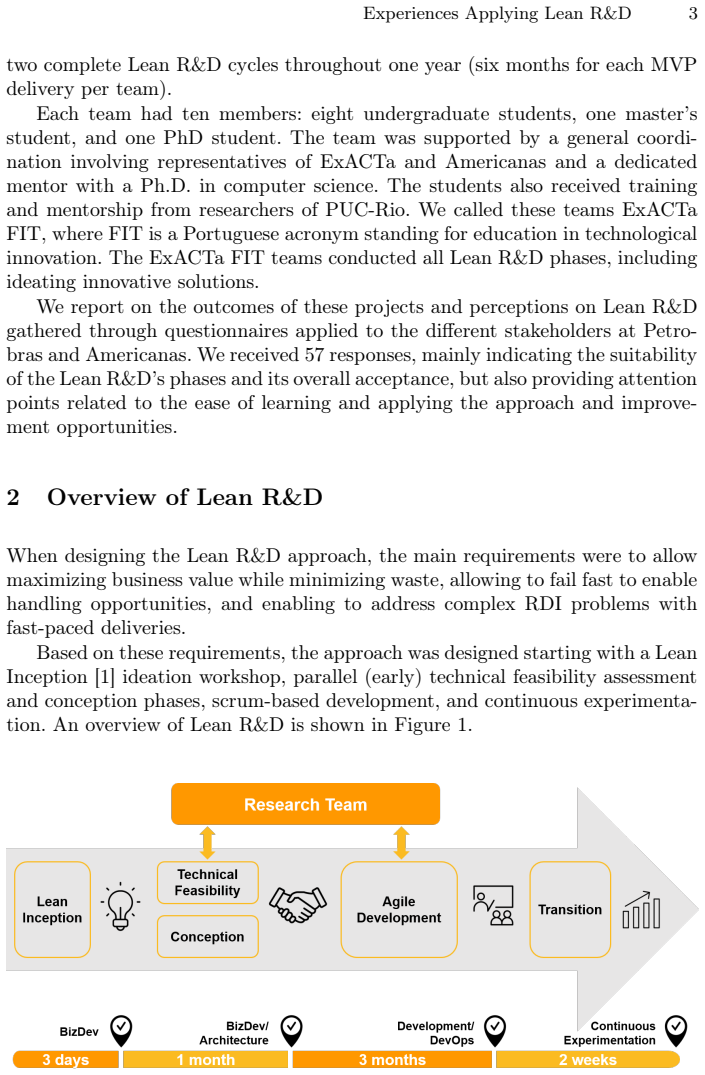
Lean R&D is the central object: a phased process that starts with a Lean Inception co-creation workshop to define an MVP and business hypotheses, followed by parallel technical feasibility and conception work, Scrum-based agile development, and a transition phase using continuous experimentation. Four steering-committee checkpoints sit between these phases and decide whether the project proceeds, fails fast, or is handed over, making the checkpoint decision the main waste-reduction mechanism. A dedicated research team supports the development team on technical feasibility, which is what lets the process address research uncertainties early.
What would settle it
A matched comparison study in which new industry-academia projects are randomly assigned to Lean R&D or to a conventional plan-driven R&D contract, with independent evaluators who do not know which process was used, measuring time-to-MVP, business outcomes, and stakeholder acceptance, would settle whether the reported suitability is specific to Lean R&D or common to well-resourced collaborations.
Extended reading notes
Core claim
The paper's central claim is that Lean R&D succeeds as a framework for industry-academia R&D by structuring innovation around four checkpoints and five phases: Lean Inception, technical feasibility, conception, agile development, and transition with continuous experimentation. Each checkpoint lets a steering committee kill weak ideas early or approve progression, which the authors identify as the mechanism for avoiding wasted effort on unpromising projects. The evidence presented is a set of 57 questionnaire responses indicating agreement with the suitability of each phase and with statements of perceived usefulness, ease of use, and intention to adopt, plus delivered MVPs that in one case were loaded into a scaled agile release train and in another were integrated into an industrial inspection system. The paper positions Lean R&D as complementary to larger-scale delivery frameworks rather than a replacement for them.
Load-bearing premise
The load-bearing premise is that the 57 questionnaire responses and the companies' reported business outcomes reflect genuine effectiveness, even though the respondents took part in projects run and evaluated by the same team that designed the process, and no comparison baseline was used.
Editorial extensions
If this is right
- Lean R&D can take an idea from conception to a deployed MVP in roughly six months per cycle, a pace that fits industry partners' short-term innovation windows.
- The four checkpoints give sponsors an explicit mechanism to stop unpromising efforts before further investment, which the authors identify as a way to avoid waste.
- The approach works with both experienced R&D professionals and less experienced students, provided mentoring and training are in place.
- MVPs produced by Lean R&D can feed into larger delivery pipelines: in the reported oil and gas case an MVP was rolled into a scaled agile release train for multi-site deployment.
- Measurable business outcomes are achievable from the process, including international patent applications, an inventor award, and a company-calculated return exceeding 20 times the R&D investment.
Reading between the lines
- If the acceptance pattern is real, the strongest untested consequence is that Lean R&D's value is independent of the two partner companies' particular conditions; testing the same process with smaller or less innovation-mature firms would reveal that.
- Because the paper's evidence is self-report from projects run by the process's designers, a fair reading treats these results as feasibility evidence; a head-to-head comparison with a plan-driven R&D contract would be needed to claim superiority.
- The student-team experience suggests an additional benefit the paper leaves implicit: Lean R&D can double as a talent-development pipeline, training students in business hypothesis testing and MVP delivery while producing industry value.
- One testable extension would be to instrument the checkpoints themselves, measuring how often steering committees actually stop or redirect weak ideas, since the waste-avoidance claim rests on those decisions being binding.
Signed reviews
Editorial analysis
A structured set of objections, weighed in public.
Referee Report
Summary. This industrial experience paper reports on the application of Lean R&D, an agile research-and-development approach developed at PUC-Rio, to industry-academia collaboration projects with Petrobras (oil and gas) and Americanas (retail). The paper describes the Lean R&D phases and checkpoints, reports project outcomes including patent applications, energy savings, and an ROI estimate, and analyzes 57 questionnaire responses from team members, managers, and sponsors assessing phase suitability and overall acceptance, largely using Technology Acceptance Model statements. The abstract claims that the findings highlight Lean R&D's effectiveness in transforming ideas into meaningful business outcomes, while the discussion acknowledges the absence of a formal baseline or direct comparison to alternative frameworks.
Significance. If the claims were fully supported, the paper would provide useful practitioner guidance on structuring fast-moving industry-academia innovation projects. The paper's strengths are its concrete description of a real process, two different application contexts (experienced R&D staff at Petrobras and student teams at Americanas), an openly linked questionnaire data set, and explicit attention to stakeholder feedback and improvement opportunities. The reported stakeholder acceptance and the successful delivery of MVP-based projects are valuable experience data for the software engineering community. However, the evidence as presented supports claims about perceived suitability and acceptance, not the stronger effectiveness claim made in the abstract and conclusion.
major comments (4)
- [Abstract and Section 5] The central claim that Lean R&D is 'effective in transforming ideas into meaningful business outcomes' is stronger than the evidence presented. Section 5 explicitly acknowledges the absence of a formal baseline or direct comparison to alternative frameworks, and the outcome evidence is a combination of company-reported figures and self-reported perceptions from participants in the authors' own projects. The abstract and conclusion should be revised to state the narrower claim that stakeholders perceived Lean R&D as suitable and accepted it, and that the approach was associated with the reported project deliveries, rather than asserting demonstrated effectiveness.
- [Section 4.1] The quantitative business outcomes—energy savings comparable to a city of 20,000 inhabitants per refinery, faster equipment-inspection report completion, and an ROI exceeding 1:20—are presented without any measurement protocol, sample size, confidence interval, or calculation method. The ROI in Section 6 is stated to be 'calculated by the company,' and no public report or data artifact supporting these numbers is linked. Since these figures are the main objective support for the 'business outcomes' claim, the paper must either provide the measurement details or a reference to an auditable source, or clearly label each figure as an unaudited company claim.
- [Section 2 and Section 3] The reported successes are conditional on passing Lean R&D's internal checkpoints, which can reject MVP outlines, technical feasibility results, MVP readiness, and business-hypothesis validation. The paper provides no denominator: there is no count of Lean Inceptions conducted, MVP outlines rejected, projects stopped at later checkpoints, or MVPs that failed to transition. Without these filtered cases, the observed successes cannot be attributed to Lean R&D 'transforming ideas' rather than to the process selecting ideas that already had high potential or whose failures were not reported. Reporting the number and outcomes of filtered projects is necessary to support the fail-fast property and the effectiveness claim.
- [Section 4.3 and Section 5] The evaluation instrument was designed by the same authors who developed Lean R&D and was administered to participants in projects run by those authors; the questionnaire data are therefore partly an internal assessment, as the reader's report notes. Although the paper mentions the lack of a baseline, it does not state which conclusions remain robust under this constraint. The paper should add an explicit sentence in the discussion clarifying that the acceptance and suitability findings reflect the perceptions of participating stakeholders and do not constitute an independent effectiveness evaluation.
minor comments (4)
- [Section 4.1] The phrase 'joined MVP vision' should be 'joint MVP vision,' and the sentence beginning 'It is noteworthy...' contains a missing breaking space between 'to' and 'sustain'.
- [Section 6] The statement 'their ROI ... exceeds the IAC investment by a factor of more than 1:20' is ambiguous: specify whether the ROI is annual or project-total, which of the two Petrobras projects it covers, and how the company computed it.
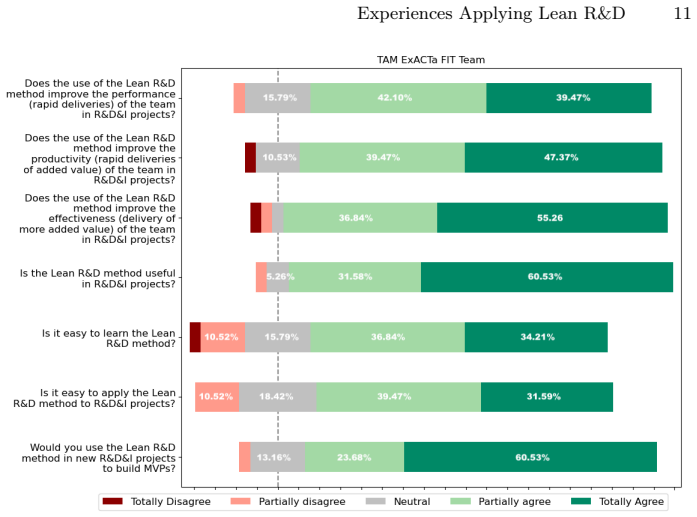
- [Figures 2 through 7] The figures report Likert-scale results, but the captions do not state the exact question wording or the number of respondents per item; adding a small table with response counts and the full statement text would improve reproducibility and readability.
- [Section 2] The description of the checkpoints would benefit from a short numbered list mapping each checkpoint to the specific decision and the criteria used, to make the go/no-go logic easier for practitioners to apply.
Circularity Check
No significant circularity: the effectiveness claim rests on independently reported project outcomes and a standard technology-acceptance survey, not on a definitional or fitted reduction.
full rationale
The paper does not derive its central claim from its own assumptions by construction. Lean R&D is introduced as a designed approach referencing external sources for Lean, Lean Startup, and continuous software engineering, with self-citations only supplying background detail on the approach. The reported evidence consists of two kinds: project outcomes (patents, a company-calculated ROI, a company LinkedIn statement) and 57 questionnaire responses using the Technology Acceptance Model. Neither outcome is defined as the survey result, and no parameter is fitted to a subset of data and then renamed as a prediction. The first checkpoint does filter projects before they proceed, so successes are conditioned on passing internal go/no-go gates; however, the paper does not define effectiveness as passing those gates, and the patent, ROI, and company communications are external to the checkpoint criterion. This is a selection-threat to external validity, not a circularity of the kind where an equation or definition reduces to its own input. The authors explicitly acknowledge the absence of a formal baseline or comparison to alternative frameworks in Section 5, which weakens the strength of the causal claim but does not make the reasoning circular. Self-citations to prior Lean R&D papers are used for describing the method, not as the sole justification for the new empirical conclusion, and external references support the constituent ideas. The evaluation is not independent in the sense that the authors designed both the approach and the questionnaire, which is a legitimate bias concern; under the specified circularity taxonomy, however, that concern is an independence and reporting limitation rather than a demonstrated circular step. No specific equation, fitted parameter, or uniqueness theorem is invoked in a way that makes the conclusion equivalent to the input.
Assumptions & free parameters
assumptions (3)
- domain assumption Self-reported Likert responses from project participants accurately represent their true perceptions of Lean R&D's suitability and acceptance.
- domain assumption Company-reported outcomes (patents, ROI greater than 20:1, energy savings) are accurate and attributable to Lean R&D.
- domain assumption The two case companies are representative enough to support general claims about Lean R&D in industry-academia collaboration.
Cite this review
Pith. "Pith review of Experiences Applying Lean R&D in Industry-Academia Collaboration Projects." pith.science (2026). https://pith.science/paper/FFH4Y2K6
@misc{pith2026250111774,
  author       = {Pith},
  title        = {Pith review of: Experiences Applying Lean R&D in Industry-Academia Collaboration Projects},
  year         = {2026},
  howpublished = {\url{https://pith.science/paper/FFH4Y2K6}},
  note         = {Machine review of arXiv:2501.11774}
}
read the original abstract
Lean R&D has been used at PUC-Rio to foster industry-academia collaboration in innovation projects across multiple sectors. This industrial experience paper describes recent experiences and evaluation results from applying Lean R&D in partnership with Petrobras in the oil and gas sector and Americanas in retail. The findings highlight Lean R&D's effectiveness in transforming ideas into meaningful business outcomes. Based on responses from 57 participants - including team members, managers, and sponsors - the assessment indicates that stakeholders find the structured phases of Lean R&D well-suited to innovation projects and endorse the approach. Although acknowledging that successful collaboration relies on various factors, this industrial experience positions Lean R&D as a promising framework for industry-academia projects focused on achieving rapid, impactful results for industry partners.
Figures


Figures from the paper (5 more)



Reference graph
Works this paper leans on
-
[1]
Caroli, P.: Lean Inception: how to align people and build the right product. Editora Caroli (2018)
work page 2018
-
[2]
Journal of Systems and Software123, 176–189 (2017)
Fitzgerald,B.,Stol,K.J.:Continuoussoftwareengineering:Aroadmapandagenda. Journal of Systems and Software123, 176–189 (2017)
work page 2017
-
[3]
IEEE software23(6), 88–95 (2006)
Gorschek, T., Garre, P., Larsson, S., Wohlin, C.: A model for technology transfer in practice. IEEE software23(6), 88–95 (2006)
work page 2006
-
[4]
Gorschek, T., Mendez, D.: Solving problems or enabling problem-solving? from pu- rity in empirical software engineering to effective co-production (invited keynote). In: Software Quality: Future Perspectives on Software Engineering Quality: 13th International Conference, SWQD 2021, Vienna, Austria, January 19–21, 2021, Pro- ceedings 13. pp. 109–116. Sprin...
work page 2021
-
[5]
In: 2020 46th Eu- romicro Conference on Software Engineering and Advanced Applications (SEAA)
Kalinowski, M., Batista, S.T., Lopes, H., Barbosa, S., Poggi, M., Silva, T., Vil- lamizar,H.,Chueke,J.,Teixeira,B.,Pereira,J.A.,etal.:Towardsleanr&d:anagile research and development approach for digital transformation. In: 2020 46th Eu- romicro Conference on Software Engineering and Advanced Applications (SEAA). pp. 132–136. IEEE (2020)
work page 2020
-
[6]
Kalinowski, M., Lopes, H., Teixeira, A.F., da Silva Cardoso, G., Kuramoto, A., Itagyba, B., Batista, S.T., Pereira, J.A., Silva, T., Warrak, J.A., et al.: Lean r&d: An agile research and development approach for digital transformation. In: Product-Focused Software Process Improvement: 21st International Conference, Experiences Applying Lean R&D 15 PROFES ...
work page 2020
-
[7]
Kuramoto, A.S.R., De Oliveira, A.D.C.M., Torres, P.H.L., Fernandes, W.P.D., Lopes, H.C.V., Schwaner, W.K., Paravidino, B.I., Pereira, C.S., Happ, P.N., Co- mandulli, S., et al.: Method of assessment of the quality of the burn of the gases in the flare and adjustment to the vapor flow rate in a continuous and constant way (2023), uS Patent App. 17/890,539
work page 2023
-
[8]
Kuramoto, A.S.R., Marques, S.A., Sant, H.M., Campos, A.B., Dos Reis, R.A.G., Etter, J.A.N., Moraes, P.R., Marques, A.T.A., Comandulli, S., Kalinowski, M., et al.: Method for detecting inaccuracies and gaps and for suggesting deterioration mechanisms and actions in inspection reports (2023), uS Patent App. 18/061,068
work page 2023
Show all 14 references
-
[9]
CRc Press (2011)
Monden, Y.: Toyota production system: an integrated approach to just-in-time. CRc Press (2011)
2011
-
[10]
Crown Currency (2011)
Ries, E.: The lean startup: How today’s entrepreneurs use continuous innovation to create radically successful businesses. Crown Currency (2011)
2011
-
[11]
https:// scaledagileframework.com/ (2023), accessed: 2025-01-20
Scaled Agile, Inc.: Scaled Agile Framework (SAFe). https:// scaledagileframework.com/ (2023), accessed: 2025-01-20
2023
-
[12]
In: ICEIS (2)
Teixeira, B.R., Ferreira, B., de Damasceno, A.L.B., Barbosa, S.D., Novello, C., Villamizar, H., Kalinowski, M., Silva, T., Chueke, J., Lopes, H., et al.: Lessons learned from a lean r&d project. In: ICEIS (2). pp. 345–352 (2021)
2021
-
[13]
https://www.timeshighereducation.com/world-university-rankings/2023/ latin-america-university-rankings (2023), accessed: August 2023
Times Higher Education: Latin America University Rankings 2023. https://www.timeshighereducation.com/world-university-rankings/2023/ latin-america-university-rankings (2023), accessed: August 2023
2023
-
[14]
IEEE software29(2), 67–73 (2011)
Wohlin, C., Aurum, A., Angelis, L., Phillips, L., Dittrich, Y., Gorschek, T., Grahn, H., Henningsson, K., Kagstrom, S., Low, G., et al.: The success factors powering industry-academia collaboration. IEEE software29(2), 67–73 (2011)
2011
Reviewed August 10, 2026 · model on record in the stance chip above.
Discussion (0). Continue with ORCID to comment.