REVIEW 4 major objections 4 minor 101 references
Two-photon blockade and photon-induced tunneling generated by squeezing
T0 review · 4 major / 4 minor · reviewed 2026-08-14 · deepseek-v4-flash
Pith's one-line read A driven harmonic cavity coupled to a squeezed reservoir can produce two-photon blockade and related nonclassical photon correlations without any atom or Kerr nonlinearity in the cavity.
desk verdict The main generation claim is plausible and new, but the analytical section has concrete formula errors that must be fixed before the SCS/DSTS simulation claims can be trusted. read the letter →
The pith
A machine-rendered reading of the paper's core claim, the machinery that carries it, and where it could break.
The reading
What carries the argument
The load-bearing device is a squeezed reservoir, inserted into the master equation (17) through the anomalous Lindblad terms involving the reservoir squeezing parameter $M$; these terms describe two-photon absorption and emission, and replacing the cavity's Kerr nonlinearity with this two-photon dissipation is what makes blockade possible in a linear system. A secondary mechanism is the Gaussian-state simulation: for the squeezed coherent states and displaced squeezed thermal states, the paper derives explicit closed formulas for $g^{(2)}(0)$ and $g^{(3)}(0)$ (Eqs. (20), (22), (25), (26)) and uses the orderings of those two numbers to mark out parameter regions realizing each effect in Table II.
What would settle it
Integrate the master equation (17) in a truncated Fock basis without assuming a Gaussian steady state, and compare the resulting $g^{(2)}(0)$ and $g^{(3)}(0)$ curves with the displaced-squeezed-thermal formulas at nonzero detuning; a visible disagreement would show that the steady-state identification, and with it the claimed universality, is not exact.
Extended reading notes
Core claim
The central claim is that the steady state of a coherently driven harmonic cavity coupled to a squeezed reservoir can exhibit the full hierarchy of photon-number correlation effects classified by the pair $(g^{(2)}(0),g^{(3)}(0))$: standard single-photon blockade, two-photon blockade under the refined criteria, three-photon tunneling, and three nonstandard types of single-photon blockade (Table II). The origin of these effects is the two-photon decay channel created by the anomalous correlation of the reservoir, i.e. the terms proportional to $M$ and $M^*$ in Eq. (17), which play a role analogous to the two-photon driving and dissipation that in other systems yield the same steady states as a Kerr nonlinearity. The paper also shows analytically that squeezed coherent states and displaced squeezed thermal states reproduce these correlation orderings, and that the displaced squeezed thermal states are nonclassical exactly when the squeezing parameter exceeds $r_0 = \frac{1}{2}\ln(1+2n_{\mathrm{th}})$, Eq. (24).
Load-bearing premise
The load-bearing premise is that the steady state of the driven cavity coupled to the squeezed reservoir is exactly one of the Gaussian states analyzed here, a displaced squeezed thermal state, so the clean analytic formulas apply; this equivalence is proven only at exact resonance, while the paper's numerical results at nonzero detuning rely on it without a proof.
Editorial extensions
If this is right
- A driven linear cavity with a squeezed reservoir can serve as a source of nonclassical light with sub-Poissonian photon statistics, without embedding an atom or a Kerr medium in the cavity.
- Two-photon blockade appears only under the refined criteria involving $g^{(3)}(0)$ and $g^{(4)}(0)$; checking only $g^{(2)}(0)\ge 1$ and $g^{(3)}(0)<1$ would miss it, so experiments should report higher-order correlations.
- The same correlation-order classification can be read off from analytic formulas for Gaussian states, giving a fast way to search parameter regimes before simulating the full dissipative dynamics.
- Thermal noise is destructive: even tiny mean reservoir photon numbers shrink or erase the two-photon blockade region, so low-temperature engineered reservoirs are needed.
- The mechanism extends naturally to microwave superconducting circuits, where squeezed reservoirs are already available, suggesting a route to blockade experiments without intrinsic nonlinearity.
Reading between the lines
- Editorial extension: if the Markovian squeezed reservoir is replaced by a degenerate parametric amplifier feeding the cavity through a beam splitter, the same correlation signatures should appear, giving a concrete experimental test beyond the paper's model.
- Editorial extension: the Gaussian-state simulation suggests that the steady state at nonzero detuning, if it stays Gaussian, admits an exact analytic form; a proof of this would sharpen all the numerics.
- Editorial extension: the classification by orderings of $g^{(2)}$ and $g^{(3)}$ is a state-agnostic diagnostic that could be applied to other dissipative quantum systems, including phonon or exciton systems, without assuming photon blockade specifically.
Signed reviews
Editorial analysis
A structured set of objections, weighed in public.
Referee Report
Summary. The paper proposes that a driven harmonic cavity coupled to a squeezed reservoir—i.e., a linear system with engineered dissipation rather than an intrinsic nonlinearity—can generate two-photon blockade, photon-induced tunneling, and several nonstandard types of single-photon blockade. The authors solve the Lindblad master equation (17) numerically and characterize the steady state with the Hamsen et al. correlation criteria. They also derive analytical expressions for second- and third-order correlation functions of squeezed coherent states (SCS) and displaced squeezed thermal states (DSTS) and use those to map regions in parameter space where these states ``simulate'' the same photon correlations. A final section relates the effects to nonclassicality via the entanglement potential.
Significance. The central physical idea is attractive and the master-equation part rests on standard methods: if a squeezed reservoir alone can induce two-photon blockade in a harmonic cavity, this would substantially broaden the toolbox of quantum reservoir engineering. The classification of correlation types and the nonclassicality analysis using entanglement potentials are useful. However, the analytical SCS/DSTS correlation formulas in Sec. IV contain demonstrable elementary errors, so the simulation claims and the analytical boundaries that support them are not currently established. The numerical generation claims in Sec. III may survive, but they lack the numerical details needed for verification.
major comments (4)
- [Sec. IV.A, Eq. (20)] Equation (20) is incorrect. For α=0 (squeezed vacuum) it gives g^(2)(0)=3+2/sinh^2(r), whereas the exact photon-number distribution P_{2m}=(2m)!/(2^{2m}(m!)²)tanh^{2m}(r)/cosh(r) yields g^(2)(0)=3+1/sinh^2(r); Eq. (25) with nth=0 gives the correct value. Equation (20) also fails the coherent-state limit r→0, where it does not reduce to g^(2)(0)=1. Since Eqs. (29)-(32) and Figures 4 and 10 are based on this formula, the SCS analytical results and region plots are not reliable.
- [Sec. IV.B, Eqs. (22) and (26)] The third-order formulas are also incorrect for general displacement. In the limit r→0, nth=0, both Eq. (22) and Eq. (26) should reduce to g^(3)(0)=1 for a coherent state |α>, but they give -12+4/α² (e.g., -8 for α=1). The squeezed-vacuum limit α=0 is reproduced correctly (the exact value is 15+9/sinh^2(r), not 15+6/sinh^2(r)), but this does not redeem the general formulas. Since the refined two-photon-blockade criteria in Figures 10 and 11 require both g^(2) and g^(3), the SCS/DSTS simulation claims are unsupported.
- [Sec. III, Figs. 3 and 9] The numerical steady-state solutions of Eq. (17) underlie the central generation claim, but the manuscript does not specify the truncation of the Fock space or provide convergence checks. Please state the Hilbert-space cutoff and show that the reported blockade and tunneling regions, especially the green regions in Fig. 9, are converged with respect to that cutoff.
- [Secs. III, IV, and Appendix B] The relation between the steady state of the master equation and the SCS/DSTS family is established only at Δ=0 via the Bogoliubov transformation in Appendix B. For Δ≠0, Appendix B itself notes that additional quadratic terms appear. The paper should state explicitly whether the finite-detuning numerical results in Sec. III are claimed to be exact SCS/DSTS states or merely analogous simulations, and clarify the status of the Δ≠0 points in Figs. 3 and 9.
minor comments (4)
- [Sec. IV.B, Eq. (26)] The symbol B appears in Eq. (26) without definition; it should presumably be C as defined below Eq. (21).
- [Sec. IV.C, item (iii)] The condition g^(2)(0)<g^(3)(0)<1 is labelled "nonstandard three-PT," but according to Table II case (d) and Sec. II.C this condition defines single-photon blockade of type 3. The label should be corrected.
- [Sec. IV.A] The text reads "10 6 randomly generated SCS" and should read "10^6".
- [Fig. 12 caption] The caption refers to "vertical thin solid lines" while the text refers to a single "red vertical line"; please make the description consistent.
Circularity Check
No significant circularity found; the central claim rests on direct numerical master-equation solutions and analytic evaluations against external criteria, not on self-citation or fitted inputs.
full rationale
The paper's main claim is that a driven harmonic cavity coupled to a squeezed reservoir can generate two-photon blockade and related effects, with the criteria for blockade taken from Hamsen et al. (external experimental work), not from the authors' prior results. The generation result in Sec. III is obtained by integrating the Lindblad master equation (17) and directly evaluating g(2)(0) and g(3)(0) against those external criteria; no parameter is fitted to force the inequalities, and the plotted regions are scanned physical parameters (epsilon, M, n, Delta). The SCS/DSTS simulations in Sec. IV are analytic evaluations of g(k)(0) from the definitions (18) and (23), and the boundaries alpha0, alpha1, and alpha2 are derived by solving the resulting inequalities, not imposed by construction. Appendix B gives an independent derivation connecting the Delta=0 squeezed-reservoir master equation to a squeezed coherent state via a Bogoliubov transformation, so the relation between the reservoir model and the Gaussian states is derived rather than assumed. Existing self-citations (e.g., Refs. [53,74,96]) are contextual or provide standard background and are not load-bearing for the central claim. The paper itself notes in Sec. II A that the Hamsen criteria are only a 'PB witness,' which is a limitation but not a circularity. Even if the closed-form expressions in Sec. IV contained algebraic errors in limiting cases, that would be a correctness defect, not a circularity, because the master-equation results are obtained independently. Under the rules for this pass, the honest finding is no significant circularity.
Assumptions & free parameters
free parameters (5)
- epsilon (driving amplitude)
- n (reservoir mean photon number)
- M (reservoir squeezing parameter)
- Delta (detuning)
- gamma (damping rate) =
1 (units)
assumptions (5)
- domain assumption Markovian master equation (17) with squeezed reservoir describes the cavity dynamics.
- domain assumption The steady state of Eq. (17) exists and is unique and can be obtained by numerical solution.
- domain assumption The refined criteria Eq. (8) from Hamsen et al. are an appropriate witness for multi-photon blockade.
- standard math Glauber-Sudarshan P-function nonnegativity defines classicality; entanglement potential Eq. (37) quantifies nonclassicality.
- ad hoc to paper The steady state of the driven cavity coupled to a squeezed reservoir at Delta=0 is a squeezed coherent state, and for finite Delta or thermal photons a displaced squeezed thermal state; this identification underlies the simulation.
Cite this review
Pith. "Pith review of Two-photon blockade and photon-induced tunneling generated by squeezing." pith.science (2026). https://pith.science/paper/FFJDGZFM
@misc{pith2026190808414,
  author       = {Pith},
  title        = {Pith review of: Two-photon blockade and photon-induced tunneling generated by squeezing},
  year         = {2026},
  howpublished = {\url{https://pith.science/paper/FFJDGZFM}},
  note         = {Machine review of arXiv:1908.08414}
}
read the original abstract
Inspired by the recent experiment of Hamsen et al. [Phys. Rev. Lett. 118, 133604 (2017)], which demonstrated two-photon blockade in a driven nonlinear system (composed of a harmonic cavity with a driven atom), we show that two-photon blockade and other nonstandard types of photon blockade and photon-induced tunneling can be generated in a driven harmonic cavity without an atom or any other kind of nonlinearity, but instead coupled to a nonlinear (i.e., squeezed) reservoir. We also simulate these single- and two-photon effects with squeezed coherent states and displaced squeezed thermal states.
Figures


Figures from the paper (8 more)


Reference graph
Works this paper leans on
-
[1]
Y”, and blue by “B
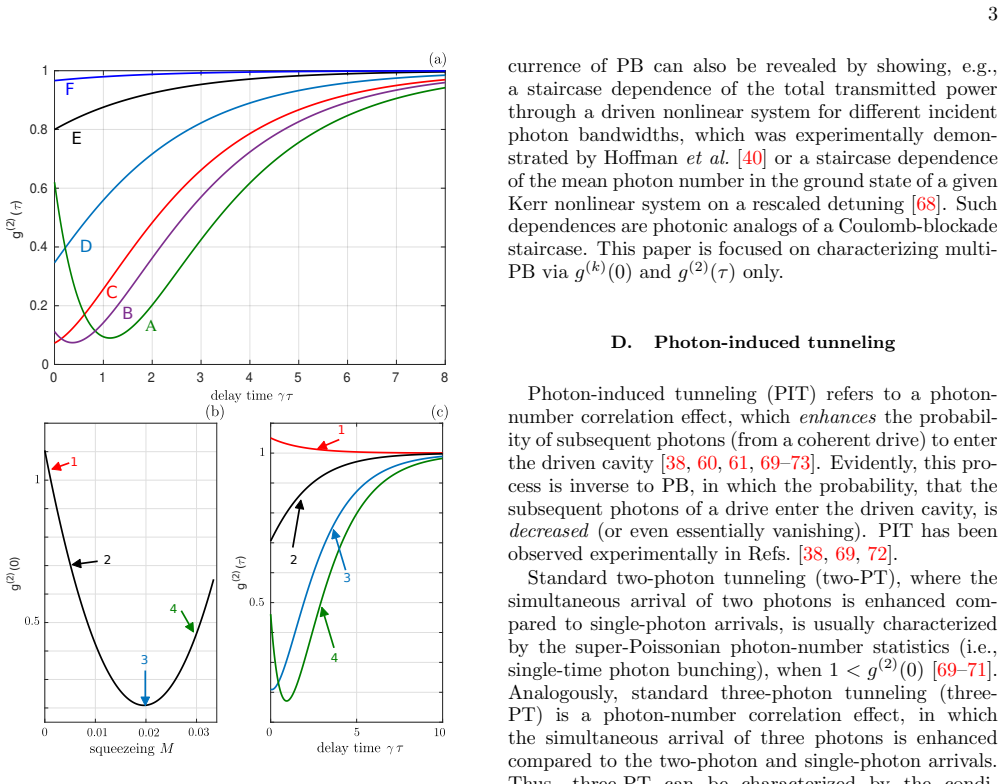
Moreover, in panel (a) we set ε/γ =0.05 (curve A), 0.06 (B), 0.07 (C), 0.1 (D), 0.2 (E), and 0.5 (F), and assume that the reservoir is maximally squeezed with the reservoir mean photon number n = 0.003, which corresponds to M = 0.017. Theτ-dependences for the four specific points in panel (b) are shown in panel (c). In panels (b) and (c) we set ε/γ = 0.07 ...
-
[2]
Dodonov, ‘Nonclassical’ states in quantum optics: A ‘squeezed’ review of the first 75 years , J
V. Dodonov, ‘Nonclassical’ states in quantum optics: A ‘squeezed’ review of the first 75 years , J. Opt. B: Quant. Semiclass. Opt. 4, R1 (2002)
2002
-
[3]
D. F. Walls, Squeezed states of light , Nature 306, 141 (1983)
1983
-
[4]
Loudon and P
R. Loudon and P. Knight, Squeezed Light, J. Mod. Opt. 34, 709 (1987)
1987
-
[5]
Dodonov and V
V. Dodonov and V. Man’ko, eds.,Theory of Nonclassical States of Light (Taylor & Francis, London, 2002)
2002
-
[6]
P. D. Drummond and Z. Ficek, eds.,Quantum Squeezing (Springer Berlin Heidelberg, 2004)
2004
-
[7]
U. L. Andersen, T. Gehring, C. Marquardt, and G. Leuchs, 30 years of squeezed light generation, Physica Scripta 91, 053001 (2016)
2016
-
[8]
E. H. Kennard, Zur Quantenmechanik einfacher Bewe- gungstypen, Zeitschrift f¨ ur Physik44, 326 (1927)
1927
Show all 101 references
-
[9]
Infeld and J
L. Infeld and J. Pleba´ nski,On a certain class of unitary transformations, Acta Phys. Pol. 14, 41 (1955)
1955
-
[10]
Pleba´ nski,Wave Functions of a Harmonic Oscillator , Phys
J. Pleba´ nski,Wave Functions of a Harmonic Oscillator , Phys. Rev. 101, 1825 (1956)
1956
-
[11]
J. N. Hollenhorst, Quantum limits on resonant-mass gravitational-radiation detectors, Phys. Rev. D 19, 1669 (1979)
1979
-
[12]
C. M. Caves, K. S. Thorne, R. W. P. Drever, V. D. 18 Sandberg, and M. Zimmermann,On the measurement of a weak classical force coupled to a quantum-mechanical oscillator. I. Issues of principle , Rev. Mod. Phys. 52, 341 (1980)
1980
-
[13]
Dodonov, V
V. Dodonov, V. Man’ko, and V. Rudenko, Nondemo- lition measurements in gravitational-wave experiments , Sov. Phys. JETP 51, 443 (1980)
1980
-
[14]
C. M. Caves, Quantum-mechanical noise in an interfer- ometer, Phys. Rev. D 23, 1693 (1981)
1981
-
[15]
R. E. Slusher, L. W. Hollberg, B. Yurke, J. C. Mertz, and J. F. Valley, Observation of Squeezed States Gener- ated by Four-Wave Mixing in an Optical Cavity , Phys. Rev. Lett. 55, 2409 (1985)
1985
-
[16]
L.-A. Wu, H. J. Kimble, J. L. Hall, and H. Wu, Gener- ation of Squeezed States by Parametric Down Conver- sion, Phys. Rev. Lett. 57, 2520 (1986)
1986
-
[17]
R. M. Shelby, M. D. Levenson, S. H. Perlmutter, R. G. DeVoe, and D. F. Walls,Broad-Band Parametric Deam- plification of Quantum Noise in an Optical Fiber , Phys. Rev. Lett. 57, 691 (1986)
1986
-
[18]
X. Gu, A. F. Kockum, A. Miranowicz, Y.-X. Liu, and F. Nori, Microwave photonics with superconducting quantum circuits, Physics Reports 718-719, 1 (2017)
2017
-
[19]
LIGO Scientific Collaboration, Enhanced sensitivity of the LIGO gravitational wave detector by using squeezed states of light , Nature Photonics 7, 613 (2013)
2013
-
[20]
Grote, K
H. Grote, K. Danzmann, K. L. Dooley, R. Schnabel, J. Slutsky, and H. Vahlbruch,First Long-Term Applica- tion of Squeezed States of Light in a Gravitational-Wave Observatory, Phys. Rev. Lett. 110, 181101 (2013)
2013
-
[21]
Bartkowiak, L.-A
M. Bartkowiak, L.-A. Wu, and A. Miranowicz, Quan- tum circuits for amplification of Kerr nonlinearity via quadrature squeezing, J. Phys. B 47, 145501 (2014)
2014
-
[22]
X.-Y. L¨ u, Y. Wu, J. Johansson, H. Jing, J. Zhang, and F. Nori, Squeezed Optomechanics with Phase-Matched Amplification and Dissipation , Phys. Rev. Lett. 114, 093602 (2015)
2015
-
[23]
Lemonde, N
M.-A. Lemonde, N. Didier, and A. A. Clerk, Enhanced nonlinear interactions in quantum optomechanics via mechanical amplification , Nature Commun. 7, 11338 (2016)
2016
-
[24]
W. Qin, A. Miranowicz, P.-B. Li, X.-Y. L¨ u, J. You, and F. Nori, Exponentially Enhanced Light-Matter In- teraction, Cooperativities, and Steady-State Entangle- ment Using Parametric Amplification , Phys. Rev. Lett. 120, 093601 (2018)
2018
-
[25]
Leroux, L
C. Leroux, L. Govia, and A. Clerk, Enhancing Cavity Quantum Electrodynamics via Antisqueezing: Synthetic Ultrastrong Coupling , Phys. Rev. Lett. 120, 093602 (2018)
2018
-
[26]
W. Qin, V. Macr` ı, A. Miranowicz, S. Savasta, and F. Nori, Emission of photon pairs by mechanical stimu- lation of the squeezed vacuum, Phys. Rev. A100, 062501 (2019)
2019
-
[27]
A. F. Kockum, A. Miranowicz, S. D. Liberato, S. Savasta, and F. Nori, Ultrastrong coupling between light and matter , Nature Reviews Physics 1, 19 (2019)
2019
-
[28]
Ridolfo, M
A. Ridolfo, M. Leib, S. Savasta, and M. J. Hartmann, Photon Blockade in the Ultrastrong Coupling Regime , Phys. Rev. Lett. 109, 193602 (2012)
2012
-
[29]
A. L. Boit´ e, M.-J. Hwang, H. Nha, and M. B. Ple- nio, Fate of photon blockade in the deep strong-coupling regime, Phys. Rev. A 94, 033827 (2016)
2016
-
[30]
Imamo˘ glu, H
A. Imamo˘ glu, H. Schmidt, G. Woods, and M. Deutsch, Strongly Interacting Photons in a Nonlinear Cavity , Phys. Rev. Lett. 79, 1467 (1997)
1997
-
[31]
Leo´ nski and A
W. Leo´ nski and A. Kowalewska-Kud laszyk, Quan- tum Scissors: Finite-Dimensional States Engineering , Progress in Optics 56, 131 (2011)
2011
-
[32]
Tian and H
L. Tian and H. J. Carmichael, Quantum trajectory sim- ulations of two-state behavior in an optical cavity con- taining one atom , Phys. Rev. A 46, R6801 (1992)
1992
-
[33]
Leo´ nski and R
W. Leo´ nski and R. Tana´ s,Possibility of producing the one-photon state in a kicked cavity with a nonlinear Kerr medium, Phys. Rev. A 49, R20 (1994)
1994
-
[34]
Y.-X. Liu, A. Miranowicz, Y. B. Gao, J. Bajer, C. P. Sun, and F. Nori, Qubit-induced phonon blockade as a signature of quantum behavior in nanomechanical res- onators, Phys. Rev. A 82, 032101 (2010)
2010
-
[35]
Didier, S
N. Didier, S. Pugnetti, Y. M. Blanter, and R. Fazio, Detecting phonon blockade with photons , Phys. Rev. B 84, 54503 (2011)
2011
-
[36]
Miranowicz, J
A. Miranowicz, J. Bajer, N. Lambert, Y.-X. Liu, and F. Nori, Tunable multiphonon blockade in coupled nanomechanical resonators, Phys. Rev. A 93, 013808 (2016)
2016
-
[37]
X. Wang, A. Miranowicz, H.-R. Li, and F. Nori, Method for observing robust and tunable phonon blockade in a nanomechanical resonator coupled to a charge qubit , Phys. Rev. A 93, 063861 (2016)
2016
-
[38]
K. M. Birnbaum, A. Boca, R. Miller, A. D. Boozer, T. E. Northup, and H. J. Kimble, Photon blockade in an optical cavity with one trapped atom, Nature 436, 87 (2005)
2005
-
[39]
Faraon, I
A. Faraon, I. Fushman, D. Englund, N. Stoltz, P. Petroff, and J. Vuˇ ckovi´ c,Coherent generation of non- classical light on a chip via photon-induced tunnelling and blockade, Nature Physics 4, 859 (2008)
2008
-
[40]
C. Lang, D. Bozyigit, C. Eichler, L. Steffen, J. M. Fink, A. A. Abdumalikov, M. Baur, S. Filipp, M. P. da Silva, A. Blais, and A. Wallraff,Observation of Resonant Pho- ton Blockade at Microwave Frequencies Using Corre- lation Function Measurements , Phys. Rev. Lett. 106, 243601 (2011)
2011
-
[41]
A. J. Hoffman, S. J. Srinivasan, S. Schmidt, L. Spietz, J. Aumentado, H. E. T¨ ureci, and A. A. Houck, Dis- persive Photon Blockade in a Superconducting Circuit , Phys. Rev. Lett. 107, 053602 (2011)
2011
-
[42]
Reinhard, T
A. Reinhard, T. Volz, M. Winger, A. Badolato, K. J. Hennessy, E. L. Hu, and A. Imamo˘ glu, Strongly corre- lated photons on a chip , Nature Photonics 6, 93 (2011)
2011
-
[43]
Peyronel, O
T. Peyronel, O. Firstenberg, Q.-Y. Liang, S. Hoffer- berth, A. V. Gorshkov, T. Pohl, M. D. Lukin, and V. Vuleti´ c,Quantum nonlinear optics with single pho- tons enabled by strongly interacting atoms , Nature 488, 57 (2012)
2012
-
[44]
M¨ uller, A
K. M¨ uller, A. Rundquist, K. A. Fischer, T. Sarmiento, K. G. Lagoudakis, Y. A. Kelaita, C. S. Mu˜ noz, E. del Valle, F. P. Laussy, and J. Vuˇ ckovi´ c,Coherent Genera- tion of Nonclassical Light on Chip via Detuned Photon Blockade, Phys. Rev. Lett. 114, 233601 (2015)
2015
-
[45]
Hamsen, K
C. Hamsen, K. N. Tolazzi, T. Wilk, and G. Rempe, Two-Photon Blockade in an Atom-Driven Cavity QED System, Phys. Rev. Lett. 118, 133604 (2017)
2017
-
[46]
Snijders, J
H. Snijders, J. Frey, J. Norman, H. Flayac, V. Savona, A. Gossard, J. Bowers, M. van Exter, D. Bouwmeester, and W. L¨ offler,Observation of the Unconventional Pho- ton Blockade, Phys. Rev. Lett. 121, 043601 (2018). 19
2018
-
[47]
Vaneph, A
C. Vaneph, A. Morvan, G. Aiello, M. F´ echant, M. Aprili, J. Gabelli, and J. Est` eve,Observation of the Unconventional Photon Blockade in the Microwave Do- main, Phys. Rev. Lett. 121, 043602 (2018)
2018
-
[48]
Leo´ nski and A
W. Leo´ nski and A. Miranowicz,Kerr nonlinear coupler and entanglement, J. Opt. B 6, S37 (2004)
2004
-
[49]
Miranowicz and W
A. Miranowicz and W. Leo´ nski,Two-mode optical state truncation and generation of maximally entangled states in pumped nonlinear couplers , J. Phys. B 39, 1683 (2006)
2006
-
[50]
T. C. H. Liew and V. Savona, Single Photons from Coupled Quantum Modes, Phys. Rev. Lett. 104, 183601 (2010)
2010
-
[51]
Bamba, A
M. Bamba, A. Imamo˘ glu, I. Carusotto, and C. Ciuti, Origin of strong photon antibunching in weakly non- linear photonic molecules, Phys. Rev. A 83, 021802(R) (2011)
2011
-
[52]
Flayac and V
H. Flayac and V. Savona, Unconventional photon block- ade, Phys. Rev. A 96, 053810 (2017)
2017
-
[53]
Shamailov, A
S. Shamailov, A. Parkins, M. Collett, and H. Carmichael, Multi-photon blockade and dress- ing of the dressed states , Opt. Commun. 283, 766 (2010)
2010
-
[54]
Miranowicz, M
A. Miranowicz, M. Paprzycka, Y.-X. Liu, J. Bajer, and F. Nori, Two-photon and three-photon blockades in driven nonlinear systems , Phys. Rev. A 87, 023809 (2013)
2013
-
[55]
G. H. Hovsepyan, A. R. Shahinyan, and G. Y. Kryuchkyan, Multiphoton blockades in pulsed regimes beyond stationary limits , Phys. Rev. A 90, 013839 (2014)
2014
-
[56]
Carmichael, Breakdown of Photon Blockade: A Dis- sipative Quantum Phase Transition in Zero Dimensions, Phys
H. Carmichael, Breakdown of Photon Blockade: A Dis- sipative Quantum Phase Transition in Zero Dimensions, Phys. Rev. X 5, 031028 (2015)
2015
-
[57]
Deng, G.-X
W.-W. Deng, G.-X. Li, and H. Qin, Enhancement of the two-photon blockade in a strong-coupling qubit-cavity system, Phys. Rev. A 91, 043831 (2015)
2015
-
[58]
C. J. Zhu, Y. P. Yang, and G. S. Agarwal, Collective multiphoton blockade in cavity quantum electrodynam- ics, Phys. Rev. A 95, 063842 (2017)
2017
-
[59]
Felicetti, D
S. Felicetti, D. Z. Rossatto, E. Rico, E. Solano, and P. Forn-D´ ıaz,Two-photon quantum Rabi model with su- perconducting circuits, Phys. Rev. A 97, 013851 (2018)
2018
-
[60]
Felicetti, M.-J
S. Felicetti, M.-J. Hwang, and A. L. Boit´ e,Ultrastrong- coupling regime of nondipolar light-matter interactions , Phys. Rev. A 98, 053859 (2018)
2018
-
[61]
Huang, A
R. Huang, A. Miranowicz, J.-Q. Liao, F. Nori, and H. Jing, Nonreciprocal Photon Blockade , Phys. Rev. Lett. 121, 153601 (2018)
2018
-
[62]
B. Li, R. Huang, X. Xu, A. Miranowicz, and H. Jing, Nonreciprocal unconventional photon blockade in a spin- ning optomechanical system, Photonics Research 7, 630 (2019)
2019
-
[63]
Miranowicz, W
A. Miranowicz, W. Leo´ nski, S. Dyrting, and R. Tana´ s, Quantum state engineering in finite-dimensional Hilbert space, Acta Phys. Slov. 46, 451 (1996)
1996
-
[64]
Leo´ nski,Fock states in a Kerr medium with para- metric pumping, Phys
W. Leo´ nski,Fock states in a Kerr medium with para- metric pumping, Phys. Rev. A 54, 3369 (1996)
1996
-
[65]
Leo´ nski and A
W. Leo´ nski and A. Miranowicz,Quantum-optical states in finite-dimensional Hilbert space. II. state generation , Adv. Chem. Phys. 119(I), 195 (2001)
2001
-
[66]
Leo´ nski,Finite-dimensional coherent-state genera- tion and quantum-optical nonlinear oscillator models , Phys
W. Leo´ nski,Finite-dimensional coherent-state genera- tion and quantum-optical nonlinear oscillator models , Phys. Rev. A 55, 3874 (1997)
1997
-
[67]
Miranowicz, K
A. Miranowicz, K. Pi¸ atek, and R. Tana´ s, Coherent states in a finite-dimensional Hilbert space , Phys. Rev. A 50, 3423 (1994)
1994
-
[68]
Miranowicz, W
A. Miranowicz, W. Leo´ nski, and N. Imoto, Quantum- optical states in finite-dimensional Hilbert space. I. gen- eral formalism, Adv. Chem. Phys. 119(I), 155 (2001)
2001
-
[69]
Liu, X.-W
Y.-X. Liu, X.-W. Xu, A. Miranowicz, and F. Nori, From blockade to transparency: Controllable photon transmis- sion through a circuit-QED system , Phys. Rev. A 89, 043818 (2014)
2014
-
[70]
Majumdar, M
A. Majumdar, M. Bajcsy, A. Rundquist, and J. Vuˇ ckovi´ c,Loss-Enabled Sub-Poissonian Light Gen- eration in a Bimodal Nanocavity, Phys. Rev. Lett. 108, 183601 (2012)
2012
-
[71]
Majumdar, M
A. Majumdar, M. Bajcsy, and J. Vuˇ ckovi´ c,Probing the ladder of dressed states and nonclassical light generation in quantum-dot–cavity QED , Phys. Rev. A 85, 041801 (2012)
2012
-
[72]
Xu, Y.-J
X.-W. Xu, Y.-J. Li, and Y.-X. Liu, Photon-induced tun- neling in optomechanical systems , Phys. Rev. A 87, 025803 (2013)
2013
-
[73]
Rundquist, M
A. Rundquist, M. Bajcsy, A. Majumdar, T. Sarmiento, K. Fischer, K. G. Lagoudakis, S. Buckley, A. Y. Pig- gott, and J. Vuˇ ckovi´ c,Nonclassical higher-order photon correlations with a quantum dot strongly coupled to a photonic-crystal nanocavity, Phys. Rev. A 90, 023846 (2014)
2014
-
[74]
C. Zhai, R. Huang, H. Jing, and L.-M. Kuang, Mechan- ical switch of photon blockade and photon-induced tun- neling, Opt. Express 27, 27649 (2019)
2019
-
[75]
Miranowicz, J
A. Miranowicz, J. Bajer, M. Paprzycka, Y.-X. Liu, A. M. Zagoskin, and F. Nori, State-dependent photon blockade via quantum-reservoir engineering , Phys. Rev. A 90, 033831 (2014)
2014
-
[76]
Lemonde, N
M.-A. Lemonde, N. Didier, and A. A. Clerk, Antibunch- ing and unconventional photon blockade with Gaussian squeezed states, Phys. Rev. A 90, 063824 (2014)
2014
-
[77]
Miranowicz, M
A. Miranowicz, M. Bartkowiak, X. Wang, Y.-X. Liu, and F. Nori, Testing nonclassicality in multimode fields: A unified derivation of classical inequalities , Phys. Rev. A 82, 013824 (2010)
2010
-
[78]
Radulaski, K
M. Radulaski, K. A. Fischer, K. G. Lagoudakis, J. L. Zhang, and J. Vuˇ ckovi´ c, Photon blockade in two- emitter-cavity systems, Phys. Rev. A 96, 011801 (2017)
2017
-
[79]
Peˇ rina Jr., V
J. Peˇ rina Jr., V. Mich´ alek, and O. Haderka, Higher- order sub-Poissonian-like nonclassical fields: Theoret- ical and experimental comparison , Phys. Rev. A 96, 033852 (2017)
2017
-
[80]
Peˇ rina Jr., V
J. Peˇ rina Jr., V. Mich´ alek, and O. Haderka,Simultane- ous observation of higher-order non-classicalities based on experimental photocount moments and probabilities , Sci. Rep. 9, 8961 (2019)
2019
-
[81]
G. S. Agarwal, Master Equation Methods in Quantum Optics, Progress in Optics 11, 1 (1973)
1973
-
[82]
Peˇ rina,Quantum Statistics of Linear and Nonlinear Optical Phenomena (Kluwer, Dordrecht, 1991)
J. Peˇ rina,Quantum Statistics of Linear and Nonlinear Optical Phenomena (Kluwer, Dordrecht, 1991)
1991
-
[83]
M. O. Scully and M. S. Zubairy, Quantum Optics (Cam- bridge University Press, Cambridge, England, 1997)
1997
-
[84]
Lukˇ s, V
A. Lukˇ s, V. Peˇ rinov´ a, and J. Peˇ rina,Principal squeezing of vacuum fluctuations , Opt. Commun. 67, 149 (1988)
1988
-
[85]
Loudon, Graphical representation of squeezed-state variances, Opt
R. Loudon, Graphical representation of squeezed-state variances, Opt. Commun. 70, 109 (1989)
1989
-
[86]
Vogel and D
W. Vogel and D. Welsch,Quantum Optics (Wiley-VCH, Weinheim, 2006). 20
2006
-
[87]
Loudon, The Quantum Theory of Light (Oxford Uni- versity Press, Oxford, 1973)
R. Loudon, The Quantum Theory of Light (Oxford Uni- versity Press, Oxford, 1973)
1973
-
[88]
C. T. Lee, Measure of the nonclassicality of nonclassical states, Phys. Rev. A 44, R2775 (1991)
1991
-
[89]
Hillery, Nonclassical distance in quantum optics , Phys
M. Hillery, Nonclassical distance in quantum optics , Phys. Rev. A 35, 725 (1987)
1987
-
[90]
Kenfack and K
A. Kenfack and K. ˙Zyczkowski, Negativity of the Wigner function as an indicator of non-classicality , J. Opt. B: Quantum Semicl. Opt. 6, 396 (2004)
2004
-
[91]
Miranowicz, K
A. Miranowicz, K. Bartkiewicz, A. Pathak, J. Peˇ rina Jr., Y. Chen, and F. Nori, Statistical mixtures of states can be more quantum than their superpositions: Comparison of nonclassicality measures for single-qubit states , Phys. Rev. A 91, 042309 (2015)
2015
-
[92]
J. K. Asb´ oth, J. Calsamiglia, and H. Ritsch,Computable Measure of Nonclassicality for Light , Phys. Rev. Lett. 94, 173602 (2005)
2005
-
[93]
Horodecki, P
R. Horodecki, P. Horodecki, M. Horodecki, and K. Horodecki, Quantum entanglement, Rev. Mod. Phys. 81, 865 (2009)
2009
-
[94]
Miranowicz, K
A. Miranowicz, K. Bartkiewicz, N. Lambert, Y. Chen, and F. Nori, Increasing relative nonclassicality quanti- fied by standard entanglement potentials by dissipation and unbalanced beam splitting, Phys. Rev. A 92, 062314 (2015)
2015
-
[95]
Eltschka and J
C. Eltschka and J. Siewert, Negativity as an Estima- tor of Entanglement Dimension , Phys. Rev. Lett. 111, 100503 (2013)
2013
-
[96]
Bartkowiak, A
M. Bartkowiak, A. Miranowicz, X. Wang, Y.-X. Liu, W. Leo´ nski, and F. Nori, Sudden vanishing and reap- pearance of nonclassical effects: General occurrence of finite-time decays and periodic vanishings of nonclas- sicality and entanglement witnesses , Phys. Rev. A 83, 053814 (2011)
2011
-
[97]
I. I. Arkhipov, J. Peˇ rina Jr., J. Svozil´ ık, and A. Mira- nowicz, Nonclassicality Invariant of General Two-Mode Gaussian States, Sci. Rep. 6, 26523 (2016)
2016
-
[98]
Bartolo, F
N. Bartolo, F. Minganti, W. Casteels, and C. Ciuti, Ex- act steady state of a Kerr resonator with one- and two- photon driving and dissipation: Controllable Wigner- function multimodality and dissipative phase transitions, Phys. Rev. A 94, 033841 (2016)
2016
-
[99]
Minganti, N
F. Minganti, N. Bartolo, J. Lolli, W. Casteels, and C. Ciuti, Exact results for Schr¨ odinger cats in driven- dissipative systems and their feedback control , Sc. Rep. 6, 26987 (2016)
2016
-
[100]
An, S.-J
J.-H. An, S.-J. Wang, H.-G. Luo, and C.-L. Jia, Produc- tion of squeezed state of single mode cavity field by the coupling of squeezed vacuum field reservoir in nonau- tonomous case, Chin. Phys. Lett. 21, 1 (2004)
2004
-
[101]
Fearn and M
H. Fearn and M. Collett, Representations of Squeezed States with Thermal Noise, J. Mod. Opt.35, 553 (1988)
1988
Reviewed August 14, 2026 · model on record in the stance chip above.
Discussion (0). Continue with ORCID to comment.