REVIEW 3 major objections 5 minor 44 references
Driven phase-mixed Alfv\'en waves in a partially ionized solar plasma
T0 review · 3 major / 5 minor · reviewed 2026-08-07 · deepseek-v4-flash
Pith's one-line read A finite-lifetime wave driver lets Alfvén pulses damp more slowly and carry more energy into the corona.
desk verdict Finite-lifetime Alfvén drivers in a partially ionized chromosphere: a clean, useful comparison with continuous drivers, but the headline claim about exponential-to-algebraic damping rests on undisclosed fits in a case the authors themselves attribute to numerical truncation. read the letter →
The pith
A machine-rendered reading of the paper's core claim, the machinery that carries it, and where it could break.
The reading
What carries the argument
The central object is the linearized, incompressible, single-fluid MHD equation for the magnetic-field perturbation $b$, which combines phase mixing with ohmic, Cowling (ambipolar), and viscous dissipation: $\partial^2 b/\partial t^2 = v_A^2(x)\,\partial^2 b/\partial z^2 + [(\eta+\nu_v)\,\partial^2/\partial x^2 + (\eta_C+\nu_v)\,\partial^2/\partial z^2]\partial b/\partial t - \nu_v[\eta\,\partial^2/\partial x^2 + \eta_C\,\partial^2/\partial z^2]\nabla^2 b$. The driver is a single-period pulse, the ionization degree $\mu$ fixes the transport coefficients, and the four Alfvén speed profiles (homogeneous, cosine, mild tanh, steep tanh) set the phase-mixing strength. The paper measures damping through the integrated displacement of the wave profile rather than its peak amplitude, because broadening and amplitude loss compete; this displacement measure is what reveals the exponential-to-algebraic transition.
What would settle it
Rerun the one-period pulse simulations in a stratified chromosphere with height-dependent ionization, transport coefficients, and Alfvén speed profile taken from a solar atmospheric model; if the pulse no longer shows an extended algebraic damping phase or no longer reaches greater heights than the continuous wave, the central claim would fail.
Extended reading notes
Core claim
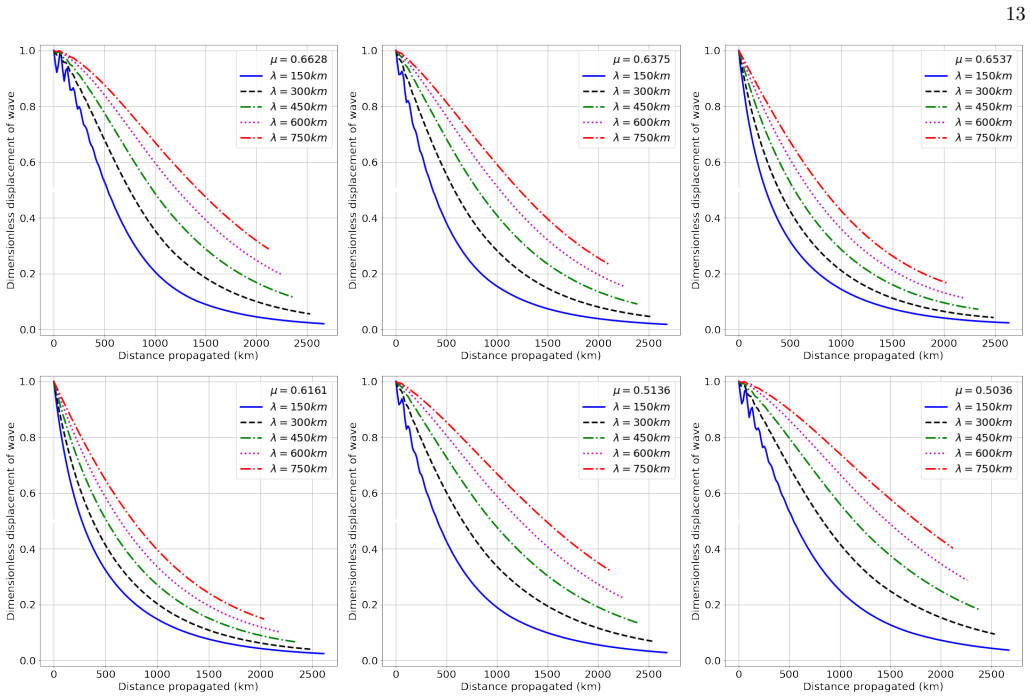
The authors find that in a partially ionized, transversally inhomogeneous plasma, phase-mixed Alfvén pulses have a lower overall decay rate than continuously driven waves of the same frequency and amplitude. The damping profile changes from exponential to algebraic once the pulse has propagated beyond a distance set by the ionization degree, the Alfvén speed gradient, and the driver frequency; this transition is not caused directly by phase mixing but by partial ionization introducing extra Cowling diffusion that mixes the many frequencies a pulse contains. Phase mixing widens the pulse, increasing its effective wavelength and reducing longitudinal gradients, while a continuous driver preserves the wavelength through constant energy injection at the base. The paper also shows that heating rates are identical to the continuous case until the driver is switched off, and that with ionization degrees $\mu\approx 0.5181$--$0.6570$ and a 2.5 km s$^{-1}$ amplitude, phase-mixed pulses can balance quiet-Sun chromospheric radiative losses while still sending more energy farther upward than continuous waves do.
Load-bearing premise
The central damping results rest on the assumption that a single-fluid, linearized, isothermal MHD model with constant transport coefficients, no gravitational stratification, and a fixed nine-to-one density contrast faithfully represents the partially ionized chromosphere.
Editorial extensions
If this is right
- Impulsively driven Alfvén waves deposit less energy in the chromosphere than continuous waves of the same frequency and amplitude, allowing pulses to reach greater heights with more energy left.
- Phase mixing of a pulse broadens its profile, so its effective wavelength grows and longitudinal-gradient damping (mainly Cowling diffusion) becomes progressively weaker.
- For ionization degrees near $\mu=0.6$, the difference between pulse and continuous damping is largest, while near full or very weak ionization the difference shrinks.
- With steep cross-field Alfvén speed gradients, all simulated wavelengths dissipate more than 80 percent of their energy within roughly 2000 km, showing that strong phase mixing is efficient regardless of driver type.
- Continuous drivers are the stronger chromospheric heating candidates, while single-period pulses are the more plausible carriers of Alfvén energy into the corona.
Reading between the lines
- The paper leaves implicit that the exponential-to-algebraic transition is a spectral effect: because a pulse is a superposition of frequency components, the onset distance of the algebraic regime should shift with the driver's bandwidth, a prediction testable by chirped or multi-period drivers.
- An extension of the paper's logic is that the crossover distance should vary with height in the real Sun, since ionization degree, Alfvén speed, and density contrast all change with altitude; height-resolved observations of transient transverse oscillations could look for the predicted broadening and slower-than-exponential decay.
- The paper does not state this, but if pulses carry more energy to the corona, then chromospheric heating estimates based on continuous sinusoidal drivers may overestimate how much Alfvén energy is deposited low down, while coronal heating estimates based on the same drivers may underestimate the available energy flux.
Editorial analysis
A structured set of objections, weighed in public.
Referee Report
Summary. This paper studies linear, incompressible, single-fluid MHD simulations of shear Alfvén waves in a partially ionized, transversally inhomogeneous plasma, comparing a single-period pulse driver with a continuous harmonic driver. The governing equation (5) includes shear viscosity, Ohmic diffusion, and Cowling diffusion, with transport coefficients evaluated from the AL c7 model. The paper reports that pulses damp less than continuous waves, that displacement-based damping lengths increase with wavelength and decrease with steeper Alfvén-speed gradients and with ionization degrees near μ≈0.6, that pulse and continuous heating rates are initially identical, and that the pulse damping profile can change from exponential to algebraic, which the authors interpret as allowing pulses to carry more energy into the corona.
Significance. If the central claims hold, the paper makes a useful contribution by showing that the choice of wave driver affects where Alfvén-wave energy is deposited in the partially ionized chromosphere, with pulses potentially more efficient at transporting energy to the corona and continuous drivers more efficient at heating the chromosphere. The model setup is clearly described, the comparison with McMurdo et al. (2023) is appropriate, and the use of physical transport coefficients is a step beyond idealized treatments. However, the key new result—the exponential-to-algebraic damping transition and the resulting lower decay rate—currently rests on qualitative fits and on a homogeneous case in which the authors themselves attribute profile changes to numerical truncation. The absence of convergence tests and the lack of a demonstrated connection between the displacement measure and the energy decay leave the main quantitative conclusion insufficiently supported.
major comments (3)
- [Section 4.2, Figures 6–7] The abstract's central claim that Alfvén pulses possess a lower overall decay rate due to a change in damping profile from exponential to algebraic is not quantitatively supported. The evidence is a qualitative assessment and fits to an unspecified 'combination of functions'; no functional form, fitted exponents, breakpoints, or uncertainties are reported. Moreover, the example in Figure 6 uses the homogeneous P1 profile, the case for which Section 4 states that pulse broadening is due to truncation errors in the finite-difference scheme. Since Section 3.1 also states that pulse profiles change with spatial and temporal resolution whereas continuous-driver profiles do not, the algebraic tail could be a numerical artifact. A spatial and temporal convergence study for the pulse runs, together with a transparent fit procedure, is required before the change of damping regime can be regarded as physical.
- [Section 4.3, Eq. (7)] The paper defines the damping length using the integrated displacement D = ∫|b| dz and asserts that the square of this displacement 'reproduces the decay of E to high accuracy', where E is the normalized energy. This equivalence is not demonstrated and is not generally true for a pulse that broadens and changes shape. Because the conclusion that pulses carry more energy into the corona is an energy statement, the paper should compute E(t) directly, quantify the error of the displacement proxy, and base the damping-length analysis on the quantity that actually measures energy.
- [Section 5, limitations] The quantitative conclusions—damping lengths, heating rates, and the suggestion that pulses can balance chromospheric radiative losses and heat the corona—are drawn from a model with constant transport coefficients, an isothermal background, no gravitational stratification, and a fixed Alfvén-speed profile. The authors acknowledge these omissions, but the discussion should go further and state which conclusions are robust to them. In particular, because the dissipative coefficients and the Alfvén-speed gradient vary strongly with height in the chromosphere, the stratified case could change the relative damping of pulses and continuous waves, not just the absolute rates, and the paper should either address this or temper the solar-atmosphere claims.
minor comments (5)
- [Abstract and Section 4.2] The phrase 'lower overall decay rate' is never precisely defined; consider defining it in terms of E(t) or of the displacement measure actually used.
- [Section 4.2] The sentence 'By fitting a combination of functions' should give the actual functional forms and fitting method; otherwise Figure 6 cannot be reproduced or independently assessed.
- [Figure 7] The green/red/gray classification of damping-profile changes is subjective; provide quantitative criteria, such as fit residuals or a statistical test for a change in decay law.
- [Equation (7)] Equation (7) is called the 'normalized pulse energy' even though the text immediately notes it is not exact; this wording is confusing and should be revised.
- [Throughout] There are several typographical and formatting artifacts, including 'Alfvén' with a nonstandard accent in the title and the 'LATEXtwocolumnstyle' line; these should be cleaned up.
Circularity Check
Central pulse-damping result is not circular; one definitional statement about identical initial heating rates inflates a construction property into a finding.
-
self definitional
[Section 4.4 (Heating rates), paragraph following Eq. (8)]
"Both derivatives are dependent on the amplitude of the wave and hence initially (at least for time steps up to the point where the pulse driver is switched off), the heating rates for the Alfvén pulse and the continuously driven Alfvén wave are identical since the pulses are generated by a continuous driver lasting only a finite time."
The pulse driver is defined as the same sinusoidal driver as the continuous case, switched off after one period. Therefore the initial equality of the wave profile, and hence of the heating rate computed from Eq. (8), is a direct consequence of the driver construction, not an independent numerical finding. The abstract presents this as a result ('Our findings indicate...'), but it reduces by definition to the setup. This is a minor tautology and does not support the main exponential-to-algebraic damping claim, which rests on the independent pulse simulations and their fits.
full rationale
The main claim that Alfvén pulses damp more slowly than continuously driven waves, with a change from exponential to algebraic decay, is not circular. Pulses are simulated by solving Eq. (5) with a time-dependent driver that is turned off after one period; the comparison with the continuous-driver case uses the same solver, background, and parameters, and no fitted parameter is used to produce the pulse evolution. The exponential-to-algebraic transition is an empirical characterization of the simulation output, although the fitting function is not disclosed (a reproducibility issue, not circularity). The reliance on McMurdo et al. (2023) for the numerical solver, transport coefficients, and continuous-wave envelopes is normal prior-work citation rather than a load-bearing self-citation: the pulse-specific results are new simulations, and the cited work is itself an independent numerical study. The only genuinely tautological element is the statement that pulse and continuous drivers have identical initial heating rates, which is true by construction because the pulse is a truncated continuous driver. Concerns about numerical artifacts in the homogeneous P1 case and undisclosed fits are correctness/validation risks, not derivation-circularity, so they do not raise the score. Score 2 reflects the minor definitional statement while the central derivation is self-contained.
Assumptions & free parameters
free parameters (4)
- Alfvén speed cross-field gradient (profile shape and steepness) =
vA varies by factor 3 over l_inh = 300 km; tanh widths 0.1 l_inh (P3) and 0.03 l_inh (P4)
- Ionization degree mu =
0.5036 to 0.6628 (neutral fraction roughly 2-50%)
- Driver frequency / initial wavelength =
27-133 mHz; wavelengths 150-750 km
- Damping-profile fit coefficients =
not reported
assumptions (5)
- domain assumption Single-fluid MHD with Cowling diffusion, ambipolar diffusion, magnetic diffusion, and shear viscosity captures Alfvén wave damping in a partially ionized plasma.
- domain assumption The plasma is isothermal, quasi-neutral, hydrogen-only, with constant collisional cross-sections and constant background magnetic field.
- domain assumption Linearized incompressible MHD is valid for the wave amplitudes considered.
- domain assumption Neglecting gravitational stratification and height/time dependence of the Alfvén speed and dissipative coefficients does not change the qualitative conclusions.
- domain assumption A pulse can be treated as a superposition of exponentially damped monochromatic waves, yielding algebraic decay after summing over frequencies.
Cite this review
Pith. "Pith review of Driven phase-mixed Alfv\'en waves in a partially ionized solar plasma." pith.science (2026). https://pith.science/paper/FFR6FBXW
@misc{pith2026250608732,
  author       = {Pith},
  title        = {Pith review of: Driven phase-mixed Alfv\'en waves in a partially ionized solar plasma},
  year         = {2026},
  howpublished = {\url{https://pith.science/paper/FFR6FBXW}},
  note         = {Machine review of arXiv:2506.08732}
}
read the original abstract
Phase mixing has long been understood to be a viable mechanism for expediting the dissipation of Alfv\'en wave energy resulting in the subsequent heating of the solar atmosphere. To fulfil the conditions necessary for phase mixing to occur, we consider the cross-field gradient in the Alfv\'en speed as a free parameter in our model. Using a single-fluid description of a partially ionized chromospheric plasma, we explore the efficiency of damping of shear Alfv\'en waves subject to phase mixing when a pulse wave driver is employed. Our results demonstrate a strong dependence of the dissipation length of shear Alfv\'en waves on both the ionization degree of the plasma and the gradient of the Alfv\'en speed. When assessing the efficiency of phase mixing across various inhomogeneities, our findings indicate that waves originating from a pulse driver exhibit initially identical heating rates as those generated by a continuous wave driver. One key difference observed was that Alfv\'en pulses possess a lower overall decay rate due to a change in damping profile from exponential to algebraic. This discrepancy arises from the absence of a consistent injection of energy into the base of the domain, that preserves longitudinal gradients of the magnetic field perturbations more effectively. These findings demonstrate the importance of understanding the relations between the wave driver, damping mechanisms, and propagation dynamics in resolving the atmospheric heating problem.
Figures


Figures from the paper (8 more)




Reference graph
Works this paper leans on
-
[1]
Anfinogentov, S., Nistic` o, G., & Nakariakov, V. M. 2013, A&A, 560, A107, doi: 10.1051/0004-6361/201322094
-
[2]
Avrett, E. H., & Loeser, R. 2008, ApJS, 175, 229, doi: 10.1086/523671
doi:10.1086/523671 2008
-
[3]
Bate, W., Jess, D. B., Nakariakov, V. M., et al. 2022, ApJ, 930, 129, doi: 10.3847/1538-4357/ac5c53
-
[4]
Braginskii, S. I. 1965, Reviews of Plasma Physics, 1, 205
1965
-
[5]
Musielak, Z. E. 2014, Acta Physica Polonica A, 125, 158, doi: 10.12693/APhysPolA.125.158
-
[6]
2017, A&A, 601, A122, doi: 10.1051/0004-6361/201730403
Danilovic, S. 2017, A&A, 601, A122, doi: 10.1051/0004-6361/201730403
-
[7]
2013, Ap&SS, 343, 11, doi: 10.1007/s10509-012-1241-0
Ebadi, H., & Hosseinpour, M. 2013, Ap&SS, 343, 11, doi: 10.1007/s10509-012-1241-0
-
[8]
Fang, C., Tang, Y. H., Xu, Z., Ding, M. D., & Chen, P. F. 2006, ApJ, 643, 1325, doi: 10.1086/501342
Show all 44 references
-
[9]
K., et al
Gafeira, R., Lagg, A., Solanki, S. K., et al. 2017, ApJS, 229, 6, doi: 10.3847/1538-4365/229/1/6
2017 doi
-
[10]
2019, A&A, 626, A33, doi: 10.1051/0004-6361/201935376
Hansteen, V., Ortiz, A., Archontis, V., et al. 2019, A&A, 626, A33, doi: 10.1051/0004-6361/201935376
2019 doi
-
[11]
H., Archontis, V., Pereira, T
Hansteen, V. H., Archontis, V., Pereira, T. M. D., et al. 2017, ApJ, 839, 22, doi: 10.3847/1538-4357/aa6844
2017 doi
-
[12]
S., Tu, C
He, J. S., Tu, C. Y., Marsch, E., et al. 2009, A&A, 497, 525, doi: 10.1051/0004-6361/200810777
2009 doi
-
[13]
Heyvaerts, J., & Priest, E. R. 1983, A&A, 117, 220
1983
-
[14]
W., Brooks, S
Hood, A. W., Brooks, S. J., & Wright, A. N. 2002, Proceedings of the Royal Society of London Series A, 458, 2307, doi: 10.1098/rspa.2002.0959
2002
-
[15]
W., Ireland, J., & Priest, E
Hood, A. W., Ireland, J., & Priest, E. R. 1997, A&A, 318, 957
1997
-
[16]
K., Stangalini, M., et al
Jafarzadeh, S., Solanki, S. K., Stangalini, M., et al. 2017, ApJS, 229, 10, doi: 10.3847/1538-4365/229/1/10
2017 doi
-
[17]
B., Mathioudakis, M., Erd´ elyi, R., et al
Jess, D. B., Mathioudakis, M., Erd´ elyi, R., et al. 2009, Science, 323, 1582, doi: 10.1126/science.1168680
2009 doi
-
[18]
Joshi, J., Rouppe van der Voort, L. H. M., & de la Cruz Rodr ´ ıguez, J. 2020, A&A, 641, L5, doi: 10.1051/0004-6361/202038769
2020 doi
-
[19]
Kilpua, E. K. J. 2024, A&A, 681, A60, doi: 10.1051/0004-6361/202245638
2024 doi
-
[20]
2012, ApJ, 749, 136, doi: 10.1088/0004-637X/749/2/136
Leenaarts, J., Carlsson, M., & Rouppe van der Voort, L. 2012, ApJ, 749, 136, doi: 10.1088/0004-637X/749/2/136
2012 doi
-
[21]
2015, ApJ, 802, 136, doi: 10.1088/0004-637X/802/2/136 Mart ´ ınez-Sykora, J., Hansteen, V., & Moreno-Insertis, F
Leenaarts, J., Carlsson, M., & Rouppe van der Voort, L. 2015, ApJ, 802, 136, doi: 10.1088/0004-637X/802/2/136 Mart ´ ınez-Sykora, J., Hansteen, V., & Moreno-Insertis, F. 2011, ApJ, 736, 9, doi: 10.1088/0004-637X/736/1/9 Mart ´ ınez-Sykora, J., Pontieu, B. D., Hansteen, V. H., ...
2015 doi
-
[22]
W., de Pontieu, B., Carlsson, M., et al
McIntosh, S. W., de Pontieu, B., Carlsson, M., et al. 2011, Nature, 475, 477, doi: 10.1038/nature10235
2011 doi
-
[23]
2023, ApJ, 958, 81, doi: 10.3847/1538-4357/ad0364
McMurdo, M., Ballai, I., Verth, G., Alharbi, A., & Fedun, V. 2023, ApJ, 958, 81, doi: 10.3847/1538-4357/ad0364
2023 doi
-
[24]
2008, Astronomische Nachrichten, 329, 780, doi: 10.1002/asna.200811031
Mocanu, G., Marcu, A., Ballai, I., & Orza, B. 2008, Astronomische Nachrichten, 329, 780, doi: 10.1002/asna.200811031
2008 doi
-
[25]
J., Freij, N., Reid, A., et al
Nelson, C. J., Freij, N., Reid, A., et al. 2017, ApJ, 845, 16, doi: 10.3847/1538-4357/aa7e7a Nistic` o, G., Nakariakov, V. M., & Verwichte, E. 2013, A&A, 552, A57, doi: 10.1051/0004-6361/201220676
2017 doi
-
[26]
J., & De Pontieu, B
Okamoto, T. J., & De Pontieu, B. 2011, ApJL, 736, L24, doi: 10.1088/2041-8205/736/2/L24
2011 doi
-
[27]
J., Hood, A
Pascoe, D. J., Hood, A. W., de Moortel, I., & Wright, A. N. 2012, A&A, 539, A37, doi: 10.1051/0004-6361/201117979
2012 doi
-
[28]
J., Hood, A
Pascoe, D. J., Hood, A. W., De Moortel, I., & Wright, A. N. 2013, A&A, 551, A40, doi: 10.1051/0004-6361/201220620 17
2013 doi
-
[29]
J., Wright, A
Pascoe, D. J., Wright, A. N., De Moortel, I., & Hood, A. W. 2015, A&A, 578, A99, doi: 10.1051/0004-6361/201321328
2015 doi
-
[30]
Rawat, A., & Gupta, G. R. 2023, MNRAS, 525, 4815, doi: 10.1093/mnras/stad2426 Rouppe van der Voort, L. H. M., Rutten, R. J., & Vissers, G. J. M. 2016, A&A, 592, A100, doi: 10.1051/0004-6361/201628889
2023 doi
-
[31]
S., & Petrukhin, N
Ruderman, M. S., & Petrukhin, N. S. 2018, A&A, 620, A44, doi: 10.1051/0004-6361/201833639
2018 doi
-
[32]
J., Vissers, G
Rutten, R. J., Vissers, G. J. M., Rouppe van der Voort, L. H. M., S¨ utterlin, P., & Vitas, N. 2013, in Journal of Physics Conference Series, Vol. 440, Journal of Physics Conference Series (IOP), 012007, doi: 10.1088/1742-6596/440/1/012007
2013 doi
-
[33]
K., & Singh, B
Srivastava, A. K., & Singh, B. 2023, Physics, 5, 655, doi: 10.3390/physics5030043
2023 doi
-
[34]
Sukarmadji, A. R. C., & Antolin, P. 2024, ApJL, 961, L17, doi: 10.3847/2041-8213/ad1402
2024 doi
-
[35]
2010, A&A, 524, A23, doi: 10.1051/0004-6361/201014845
Terradas, J., Goossens, M., & Verth, G. 2010, A&A, 524, A23, doi: 10.1051/0004-6361/201014845
2010 doi
-
[36]
O., & McLaughlin, J
Thurgood, J. O., & McLaughlin, J. A. 2013, A&A, 558, A127, doi: 10.1051/0004-6361/201322021
2013 doi
-
[37]
K., Morton, R
Tiwari, A. K., Morton, R. J., & McLaughlin, J. A. 2021, ApJ, 919, 74, doi: 10.3847/1538-4357/ac10c4
2021 doi
-
[38]
2016, Physics of Plasmas, 23, 122906, doi: 10.1063/1.4972574 Van Damme, H
Tsiklauri, D. 2016, Physics of Plasmas, 23, 122906, doi: 10.1063/1.4972574 Van Damme, H. J., De Moortel, I., Pagano, P., & Johnston, C. D. 2020, A&A, 635, A174, doi: 10.1051/0004-6361/201937266
2016 doi
-
[39]
Rutten, R. J. 2013, ApJ, 774, 32, doi: 10.1088/0004-637X/774/1/32
2013 doi
-
[40]
2014, MNRAS, 445, 1614, doi: 10.1093/mnras/stu1887
Vranjes, J. 2014, MNRAS, 445, 1614, doi: 10.1093/mnras/stu1887
2014 doi
-
[41]
Vranjes, J., & Krstic, P. S. 2013, A&A, 554, A22, doi: 10.1051/0004-6361/201220738
2013 doi
-
[42]
Voort, L., & Rutten, R. J. 2011, ApJ, 736, 71, doi: 10.1088/0004-637X/736/1/71
2011 doi
-
[43]
L., & Noyes, R
Withbroe, G. L., & Noyes, R. W. 1977, ARA&A, 15, 363, doi: 10.1146/annurev.aa.15.090177.002051
1977
-
[44]
2016, in American Institute of Physics Conference Series, Vol
Yang, L., Zhang, L., He, J., et al. 2016, in American Institute of Physics Conference Series, Vol. 1720, Solar Wind 14 (AIP), 040022, doi: 10.1063/1.4943833
2016 doi
Reviewed August 7, 2026 · model on record in the stance chip above.
Discussion (0). Sign in to comment.