REVIEW 3 major objections 5 minor 37 references
Mapping ground-based coronagraphic images to Helioprojective-Cartesian coordinate system by image registration
T0 review · 3 major / 5 minor · reviewed 2026-08-15 · deepseek-v4-flash
Pith's one-line read A new algorithm registers ground-based coronal images to Helioprojective Cartesian coordinates using 211 Å EUV reference images, reaching sub-0.1-arcsecond convergence on good data.
desk verdict Useful enabling tool with honest limitations, but the headline 0.1'' accuracy claim outruns what is actually measured. read the letter →
The pith
A machine-rendered reading of the paper's core claim, the machinery that carries it, and where it could break.
The reading
What carries the argument
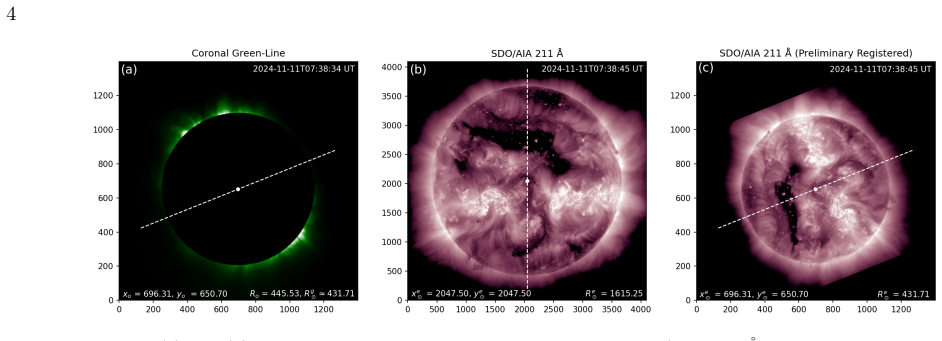
The load-bearing mechanism is an iterated similarity-transform registration built from local phase information. Each iteration transforms the EUV and green-line images to polar coordinates around the current estimate of the solar center, keeps only the annulus from about 1.04 to 1.25 solar radii, and applies the Scharr edge filter to turn diffuse coronal structure into sharper features. Thirty-six overlapping azimuthal windows, each 150 degrees wide, are cross-correlated in the Fourier domain; a localized upsampled discrete Fourier transform locates each correlation peak to subpixel accuracy. The resulting point pairs feed a least-squares RANSAC solver for translation, rotation, and scale, and the EUV image is resampled and the process repeated until the parameter updates fall below 0.05 pixel. The edge-enhancement step is what keeps the correlation peaks from drifting, and the iteration is what absorbs the initial error in assuming the occulter center coincides with the solar center.
What would settle it
Take a space-based 211 Å image, apply a known similarity transformation (rotation, scale, translation), hide the disk behind an occulter-sized mask, add noise at the level of a typical ground-based coronagraph, and run APRIL; if the recovered parameters differ from the injected ones by more than about 0.4 arcseconds on good-quality frames, the precision claim is falsified.
Extended reading notes
Core claim
The central claim is that the low-contrast, occulter-obscured green-line corona can be registered to 211 Å EUV images accurately enough to recover the green-line image's solar center, solar radius, and polar-axis angle, and therefore to map it into Helioprojective Cartesian coordinates. The registrations are obtained automatically: after a coarse alignment using the occulter geometry, the images are converted to polar coordinates over the radial band from 1.04 to 1.25 solar radii, edge-enhanced with the Scharr operator, divided into 36 overlapping azimuthal subregions, and matched by Fourier cross-correlation with subpixel refinement. A RANSAC fit of a similarity transform rejects bad matches, and the whole procedure is iterated until the translation and rotation updates converge to zero. The paper reports that on good data the iteration converges to sub-0.1-arcsecond alignment and that repeated runs on most days show scatter below 0.2 pixels, about 0.4 arcseconds, with the recovered solar radius following its expected annual variation. On this basis the method is offered as a general tool for coronagraphs that observe the green line.
Load-bearing premise
The method inherits its absolute pointing from the EUV reference images: if that instrument's pointing is off, every derived solar-center coordinate is off by the same amount, and the paper does not check the derived coordinates against an independent reference such as star positions or known simulated shifts.
Editorial extensions
If this is right
- Existing multi-year green-line coronagraph archives can be re-reduced into Helioprojective Cartesian coordinates without needing a visible solar limb.
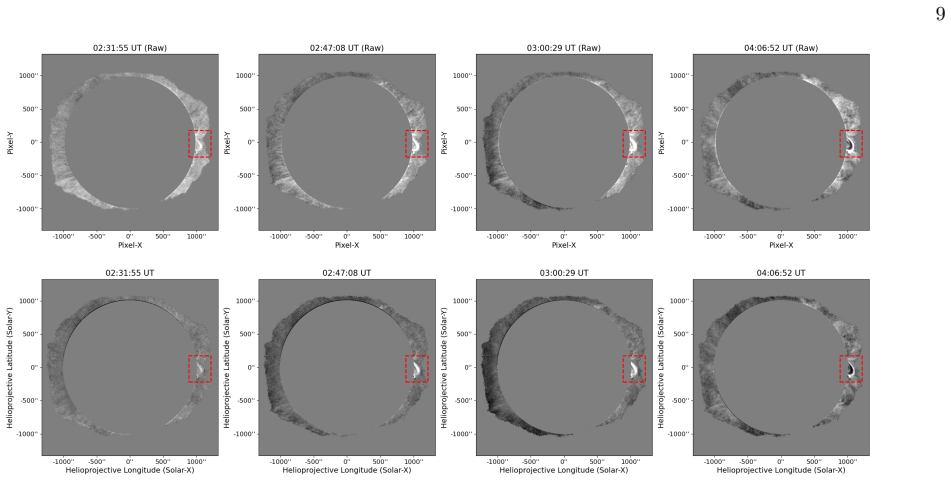
- Base-difference movies built from APRIL-registered frames show only real coronal changes, not apparent shifts from pointing drift.
- The drift of the solar center relative to the occulter, tracked over a day, gives a quantitative record of guiding-system error that can be used to correct pointing.
- Coronagraphs without any guiding system, including small or balloon-borne instruments, can still produce absolutely positioned data if their images contain green-line structure.
- Registrations are computed per frame, so fast, short-timescale transients can be studied without first averaging frames.
Reading between the lines
- Because the absolute reference is the EUV image pointing, the true absolute accuracy is capped by the accuracy of that instrument's pointing solution; the 0.1 arcsecond figure measures convergence, not an independent absolute check.
- The method should be testable on synthetic data: warp a 211 Å image by known rotation, scale, and translation, inject realistic noise and an occulter mask, and see whether APRIL recovers the injected parameters to the claimed tolerance.
- The same subregion-cross-correlation machinery could plausibly register other coronal emission lines to one another once a stable structural correspondence is established, extending the approach beyond green-line data.
- The requirement of visible coronal structure means the method is season-limited; a practical pipeline would need to flag low-contrast epochs rather than silently failing.
Signed reviews
Editorial analysis
A structured set of objections, weighed in public.
Referee Report
Summary. The paper presents APRIL, an automatic registration algorithm that aligns ground-based coronal green-line images (from YOGIS and SICG) with SDO/AIA 211 Å images using local cross-correlation in polar coordinates, edge enhancement, and RANSAC, and then derives Helioprojective Cartesian Coordinates (HCC) from the inferred similarity transformation. The method is tested on 100 days of YOGIS data spanning 2013–2024, plus one day of SICG data, and the authors release catalogs, FITS files, and movies. The headline claim is a registration accuracy better than 0.1 arcsecond under optimal data quality and a precision no worse than 0.4 arcsecond in most cases.
Significance. If properly validated, the method addresses a real need: ground-based coronagraphs often lack reliable absolute pointing, and a robust registration against AIA 211 Å images provides a practical path to HCC coordinates for multi-instrument studies. The use of an external reference frame (the AIA WCS) is a strength, and the release of registration parameters and FITS files is a useful community resource. The explicit limitation that the method requires coronal structures and is not applicable near solar minimum is honest and appropriate. However, the central accuracy claim currently conflates an internal convergence threshold and RANSAC repeatability with absolute accuracy; the scientific significance depends on adding an independent absolute validation or clearly reframing the claim as internal precision.
major comments (3)
- [Section 3.1 and Abstract/Conclusion] The claim of 'accuracy no less than 0.1 arcsecond' is not supported by the reported evidence. Section 3.1 states that the iteration terminates when |Δx| < 0.05 pixel and |Δy| < 0.05 pixel, which is a stopping criterion, not a measured registration error against ground truth. The only external comparison mentioned is that the recovered daily solar radius 'closely matches' the expected value, but no quantitative residual is given. Please either provide an absolute validation (e.g., injected synthetic shifts, comparison with star positions, or an independent ephemeris/pointing solution) or revise the abstract and conclusion to state that 0.1 arcsecond is the convergence tolerance / internal precision rather than absolute accuracy.
- [Section 3.2, Table 1, Eq. (10)] The metrics Xstd, Ystd, Rstd, and the rank in Eq. (10) are computed from standard deviations over only four RANSAC repetitions of the same image. These quantify repeatability of the stochastic solver, not the accuracy of the mapping relative to the true helioprojective coordinates. The statement that 'precision remained robust ... within 0.2 pixels (~0.4 arcsecond) and could achieve an accuracy better than 0.05 pixel (~0.1 arcsecond) under optimal conditions' therefore overstates external performance. Please relabel these as repeatability/precision metrics and add a separate accuracy assessment against known coordinates.
- [Section 2.2 / Section 3.1, Eq. (9)] The absolute HCC mapping inherits the SDO/AIA 211 Å WCS and the assumption that the AIA pointing is an accurate absolute reference. Because no independent check (star crossings, simulated shifts, or comparison with solar ephemeris residuals) is performed, the absolute accuracy of the final HCC coordinates is not established. This is not a flaw in the registration concept, but it must be stated explicitly as an assumption and either tested or removed from the headline accuracy claims.
minor comments (5)
- [Section 3.1, after Eq. (9)] There is a typo in the sentence defining the aligned solar center: '(xg⊙, yg⊙) = (xe′⊙, xe′⊙)' should read '(xg⊙, yg⊙) = (xe′⊙, ye′⊙)'.
- [Table 1] The table reports Xstd, Ystd, Rstd, and R⊙ without stating their units; the text later refers to pixels, but this should be stated in the table header or caption for clarity.
- [Abstract] The phrase 'with an accuracy of no less than 0.1 arcsecond' is ambiguous; 'accuracy of 0.1 arcsecond or better' would be clearer, and the claim should explicitly distinguish convergence tolerance from measured accuracy.
- [Section 2.2, Step 2] The azimuthal width w is stated to have an optimal value of 150 degrees, but no sensitivity analysis or justification is provided; a brief plot or discussion of how the results vary with w would strengthen the method description.
- [Section 3.2] The RANSAC-based standard deviations are computed from only four repetitions, which is a small sample for estimating stochastic variability; this should be noted as a limitation or the number of repetitions should be increased.
Circularity Check
The 0.1'' accuracy claim is the algorithm's own convergence tolerance/repeatability, not a measured absolute error; the HCC mapping itself is externally grounded via AIA WCS.
-
self definitional
[Abstract; §3.1 (iteration termination); §4 (Conclusion)]
"Based on test results, the iteration terminates when |∆x| < 0.05 pixel and |∆y| < 0.05 pixel, corresponding to approximately 0.1′′. ... It achieves a registration accuracy better than 0.1′′ under optimal data quality, while maintaining a precision no worse than 0.4′′ in most cases."
The headline accuracy is not an externally measured error. Section 3.1 defines the stopping condition as |Δx|,|Δy| < 0.05 pixel ≈ 0.1''; Section 3.2's precision numbers are standard deviations across four RANSAC repetitions, i.e., repeatability; and the Conclusion (and Abstract) restate that internal threshold as 'registration accuracy better than 0.1''.' No star crossings, injected synthetic shifts, or ephemeris comparison are used to validate the absolute HCC coordinates. Therefore the 0.1'' figure is identical by construction to the algorithm's own convergence tolerance (or to its internal repeatability scatter), not a measured accuracy against a known coordinate reference.
full rationale
The core registration pipeline is not circular in its mapping: ground-based green-line images are aligned to SDO/AIA 211 Å images whose helioprojective coordinates come from the AIA WCS, an external reference frame. The use of X. Zhang et al. (2022) to justify 211 Å as a good structural match is an empirical, self-cited but non-load-bearing justification; the registration itself is measureable and would work or fail on real coronal features. The 'rank' statistic and RANSAC scatter are internal consistency metrics, not external validation. The one genuinely self-referential element is the accuracy claim: the 0.1'' value quoted in the Abstract and Conclusion is exactly the iteration stopping tolerance (0.05 pixel) or the best-case repeatability scatter, and no independent absolute-error test (e.g., known star positions, injected shifts, or ephemeris comparison) is reported. Thus the central accuracy claim reduces by construction to the method's own convergence threshold, which is a partial circularity. The rest of the derivation chain is externally grounded, so the score is 6 rather than higher.
Assumptions & free parameters
free parameters (3)
- Azimuthal width w =
150 degrees
- Convergence tolerance =
0.05 pixel (approx 0.1 arcsec)
- RANSAC sample size n =
25
assumptions (5)
- domain assumption Green-line (Fe XIV 5303 Å) intensities are highly correlated with SDO/AIA 211 Å intensities (correlation 0.89 to 0.99).
- domain assumption The transformation between the two images is a similarity transform (translation, rotation, uniform scaling).
- domain assumption The occulter center is approximately the solar center and the solar radius is approximately occulter radius divided by 1.03 (YOGIS) or 1.05 (SICG).
- domain assumption The SDO/AIA 211 Å images provide an accurate absolute reference frame.
- domain assumption Clear coronal structures are present around the solar disk.
Cite this review
Pith. "Pith review of Mapping ground-based coronagraphic images to Helioprojective-Cartesian coordinate system by image registration." pith.science (2026). https://pith.science/paper/FH6JVRV4
@misc{pith2026250717670,
  author       = {Pith},
  title        = {Pith review of: Mapping ground-based coronagraphic images to Helioprojective-Cartesian coordinate system by image registration},
  year         = {2026},
  howpublished = {\url{https://pith.science/paper/FH6JVRV4}},
  note         = {Machine review of arXiv:2507.17670}
}
read the original abstract
A few ground-based solar coronagraphs have been installed in western China for observing the low-layer corona in recent years. However, determining the Helioprojective Coordinates for the coronagraphic data with high precision is an important but challenging step for further research with other multi-wavelength data. In this paper, we propose an automatic coronal image registration method that combines local statistical correlation and feature point matching to achieve accurate registration between ground-based coronal green-line images and space-based 211 {\AA} images. Then, the accurate field of view information of the coronal green-line images can be derived, allowing the images to be mapped to the Helioprojective Cartesian Coordinates with an accuracy of no less than 0.1''. This method has been extensively validated using 100 days of coronal data spanning an 11-year period, demonstrating its broad applicability to ground-based coronagraphs equipped with green-line observations. It significantly enhances the scientific value of ground-based coronal data, enabling comprehensive studies of coronal transient activities and facilitating the joint analysis of data from multiple instruments. Additionally, it holds potential for future applications in improving the pointing accuracy of coronagraphs.
Figures


Figures from the paper (4 more)



Reference graph
Works this paper leans on
-
[1]
, " * write output.state after.block = add.period write newline
ENTRY address archivePrefix author booktitle chapter doi edition editor eprint howpublished institution journal key month number organization pages publisher school series title misctitle type volume year version url label extra.label sort.label short.list INTEGERS output.state before.all mid.sentence after.sentence after.block FUNCTION init.state.consts ...
-
[2]
write newline
" write newline "" before.all 'output.state := FUNCTION format.url url empty "" new.block "" url * "" * if FUNCTION format.eprint eprint empty "" archivePrefix empty "" archivePrefix "arXiv" = new.block " " eprint * " " * new.block " " eprint * " " * if if if FUNCTION format.doi doi empty "" " " doi * " " * if FUNCTION format.pid doi empty eprint empty ur...
-
[3]
thebibliography [1] 20pt to REFERENCES 6pt =0pt \@twocolumntrue 12pt -12pt 10pt plus 3pt =0pt =0pt =1pt plus 1pt =0pt =0pt -12pt =13pt plus 1pt =20pt =13pt plus 1pt \@M =10000 =-1.0em =0pt =0pt 0pt =0pt =1.0em @enumiv\@empty 10000 10000 `\.\@m \@noitemerr \@latex@warning Empty `thebibliography' environment \@ifnextchar \@reference \@latexerr Missing key o...
arXiv 2017
-
[4]
Astropy Collaboration , Robitaille , T. P., Tollerud , E. J., et al. 2013, title Astropy: A community Python package for astronomy , , 558, A33, 10.1051/0004-6361/201322068
-
[5]
Bak-Steslicka , U., Gibson , S., & Chmielewska , E. 2016, title Line-of-sight velocity as a tracer of coronal cavity magnetic structure , FrASS, 3, 7, 10.3389/fspas.2016.00007
arXiv 2016
-
[6]
Brueckner , G. E., Howard , R. A., Koomen , M. J., et al. 1995, title The Large Angle Spectroscopic Coronagraph (LASCO) , , 162, 357, 10.1007/BF00733434
-
[7]
Druckm \"u ller , M. 2009, title Phase Correlation Method for the Alignment of Total Solar Eclipse Images , , 706, 1605, 10.1088/0004-637X/706/2/1605
-
[8]
Feng, T., Dai, W., Wang, R., & Ji, K. 2018, title High-accuracy Registration Method of Solar High-resolution Observation Images and Full-disk Solar Images, AR&T, 15, 69. http://www.ati.ac.cn/en/article/id/2255
work page 2018
Show all 37 references
-
[9]
R., Hudson , H
Fletcher , L., Dennis , B. R., Hudson , H. S., et al. 2011, title An Observational Overview of Solar Flares , , 159, 19, 10.1007/s11214-010-9701-8
2011 doi
-
[10]
T., & Fienup, J
Guizar-Sicairos, M., Thurman, S. T., & Fienup, J. R. 2008, title Efficient subpixel image registration algorithms, OptL, 33, 156, 10.1364/OL.33.000156
2008 doi
-
[11]
1999, title A New Imaging System of the Corona at Norikura , , 51, 383, 10.1093/pasj/51.3.383
Ichimoto , K., Noguchi , M., Tanaka , N., et al. 1999, title A New Imaging System of the Corona at Norikura , , 51, 383, 10.1093/pasj/51.3.383
1999 doi
-
[12]
2019, title An automatic approach of mapping the solar high-resolution image to helioprojective-Cartesian coordinates system, ChSBu, 64, 1738
Ji, K., Liu, H., Jin, Z., Shang, Z., & Qiang, Z. 2019, title An automatic approach of mapping the solar high-resolution image to helioprojective-Cartesian coordinates system, ChSBu, 64, 1738
2019
-
[13]
R., Title , A
Lemen , J. R., Title , A. M., Akin , D. J., et al. 2012, title The Atmospheric Imaging Assembly (AIA) on the Solar Dynamics Observatory (SDO) , , 275, 17, 10.1007/s11207-011-9776-8
2012 doi
-
[14]
Q., Chen , Y
Liang , Y., Qu , Z. Q., Chen , Y. J., et al. 2021, title Registration and imaging polarimetry of the Fe 6374 A red coronal line during the 2017 total solar eclipse , , 503, 5715, 10.1093/mnras/stab463
2021 doi
-
[15]
2023, title A 50-mm balloon-borne white-light coronagraph: I.Basic structure and experiments on the ground , SSPMA, 53, 259611, 10.1360/SSPMA-2022-0363
Lin , J., Song , T., Sun , M., et al. 2023, title A 50-mm balloon-borne white-light coronagraph: I.Basic structure and experiments on the ground , SSPMA, 53, 259611, 10.1360/SSPMA-2022-0363
2023 doi
-
[16]
Liu , D., Yu , X., Zhang , H., et al. 2025, title Study on Real-time Monitoring Method for Dust-scattered Stray Light in the Spectral Imaging CoronaGraph of the Chinese Meridian Project Phase II , RAA, 25, 015014, 10.1088/1674-4527/ad9a34
2025 doi
-
[17]
2014, title The first coronagraph in China settled in Lijiang, Yunnan , Amateur Astronomer (China), 1, 60
Liu , Y. 2014, title The first coronagraph in China settled in Lijiang, Yunnan , Amateur Astronomer (China), 1, 60
2014
-
[18]
2021, title Ground experiment of a 50 mm balloon-borne coronagraph for near space project , in SPIE, Vol
Liu , Y., Zhang , X., Song , T., et al. 2021, title Ground experiment of a 50 mm balloon-borne coronagraph for near space project , in SPIE, Vol. 12070, 2021SPIE12070, ed. C. Rao , C. Veillet , X. Ma , B. Fan , F. Liu , & M. Collados Vera , 120700B, 10.1117/12.2605310
2021 doi
-
[19]
1933, title The Study of the Solar Corona without an Eclipse (with Plate V) , , 27, 265
Lyot , B. 1933, title The Study of the Solar Corona without an Eclipse (with Plate V) , , 27, 265
1933
-
[20]
R., & Lacatus , D
Mettes , H., Lecinski , A. R., & Lacatus , D. 2022, title Coalignment of Skylab Imagery for CME Analysis , in AGUFM, Vol. 2022, SH53B--05
2022
-
[21]
S., Korendyke , C
Morrill , J. S., Korendyke , C. M., Brueckner , G. E., et al. 2006, title Calibration of the Soho/Lasco C3 White Light Coronagraph , , 233, 331, 10.1007/s11207-006-2058-1
2006 doi
-
[22]
Pratt, W. K. 1974, title Correlation techniques of image registration, ITAES, 353
1974
-
[23]
Schwenn , R., dal Lago , A., Huttunen , E., & Gonzalez , W. D. 2005, title The association of coronal mass ejections with their effects near the Earth , AnGeo, 23, 1033, 10.5194/angeo-23-1033-2005
2005 doi
-
[24]
Sha , F., Liu , Y., Zhang , X., & Song , T. 2023, title Characterization and Correction of the Scattering Background Produced by Dust on the Objective Lens of the Lijiang 10-cm Coronagraph , , 298, 139, 10.1007/s11207-023-02233-3
2023 doi
-
[25]
2022, title Coronal Quasi-periodic Fast-mode Propagating Wave Trains , , 297, 20, 10.1007/s11207-022-01953-2
Shen , Y., Zhou , X., Duan , Y., et al. 2022, title Coronal Quasi-periodic Fast-mode Propagating Wave Trains , , 297, 20, 10.1007/s11207-022-01953-2
2022 doi
-
[26]
2025, title Toward Automated Coronal Observations: A New Integrated System Based on the Lijiang 10 cm Coronagraph, Univ, 11, 154
Song, T., Liu, Y., Zhang, X., et al. 2025, title Toward Automated Coronal Observations: A New Integrated System Based on the Lijiang 10 cm Coronagraph, Univ, 11, 154
2025
-
[27]
2012, The sun: an introduction (Springer Science & Business Media)
Stix, M. 2012, The sun: an introduction (Springer Science & Business Media)
2012
-
[28]
T., Bobra , M
SunPy Community , Barnes , W. T., Bobra , M. G., et al. 2020, title The SunPy Project: Open Source Development and Status of the Version 1.0 Core Package , , 890, 68, 10.3847/1538-4357/ab4f7a
2020 doi
-
[29]
2025, title Photometric Calibration of Spectral Imaging CoronaGraph with Dual-wavelength Observation , RAA, 25, 055013, 10.1088/1674-4527/adcc7d
Tang , N., Liu , W.-X., Mao , X.-L., et al. 2025, title Photometric Calibration of Spectral Imaging CoronaGraph with Dual-wavelength Observation , RAA, 25, 055013, 10.1088/1674-4527/adcc7d
2025 doi
-
[30]
W., Wang , T., et al
Tian , H., McIntosh , S. W., Wang , T., et al. 2012, title Persistent Doppler Shift Oscillations Observed with Hinode/EIS in the Solar Corona: Spectroscopic Signatures of Alfv \'e nic Waves and Recurring Upflows , , 759, 144, 10.1088/0004-637X/759/2/144
2012 doi
-
[31]
2019, title Upgraded Coronal Multi-channel Polarimeter (UCoMP) , in 2019shin conf, 131
Tomczyk , S., & Landi , E. 2019, title Upgraded Coronal Multi-channel Polarimeter (UCoMP) , in 2019shin conf, 131
2019
-
[32]
2024, title China's ground-based space environment monitoring network—Chinese Meridian Project (CMP), SpWea, 22, e2024SW003972
Wang, C., Xu, J., Chen, Z., et al. 2024, title China's ground-based space environment monitoring network—Chinese Meridian Project (CMP), SpWea, 22, e2024SW003972
2024
-
[33]
F., & Howard , T
Webb , D. F., & Howard , T. A. 2012, title Coronal Mass Ejections: Observations , , 9, 3, 10.12942/lrsp-2012-3
2012 doi
-
[34]
2002, title A scheme for coherence-enhancing diffusion filtering with optimized rotation invariance, JVCIR, 13, 103
Weickert, J., & Scharr, H. 2002, title A scheme for coherence-enhancing diffusion filtering with optimized rotation invariance, JVCIR, 13, 103
2002
-
[35]
J., Seaton , D
West , M. J., Seaton , D. B., Wexler , D. B., et al. 2023, title Defining the Middle Corona , , 298, 78, 10.1007/s11207-023-02170-1
2023 doi
-
[36]
2022, title Comparison of the Coronal Green-line Intensities with the EUV Measurements from SDO/AIA , RAA, 22, 075012, 10.1088/1674-4527/ac712e
Zhang , X., Liu , Y., Zhao , M., et al. 2022, title Comparison of the Coronal Green-line Intensities with the EUV Measurements from SDO/AIA , RAA, 22, 075012, 10.1088/1674-4527/ac712e
2022 doi
-
[37]
2003, title Image registration methods: a survey, Image Vis
Zitova, B., & Flusser, J. 2003, title Image registration methods: a survey, Image Vis. Comput., 21, 977
2003
Reviewed August 15, 2026 · model on record in the stance chip above.
Discussion (0). Continue with ORCID to comment.