REVIEW 1 major objections 7 minor 85 references
Catching Disguised Transients with ASTRANet: Anomaly-Aware Spectroscopic Classification and Conformal Calibration
T0 review · 1 major / 7 minor · reviewed 2026-07-10 · glm-5.2
Pith's one-line read When AI confidently mislabels a new star, two kinds of doubt catch it
desk verdict The cross-family read the letter →
The pith
A machine-rendered reading of the paper's core claim, the machinery that carries it, and where it could break.
The reading
What carries the argument
A hierarchical spectral classifier operating on observer-frame spectra without requiring host-galaxy redshift or spectral phase; sixteen embedding-space anomaly scores spanning four physically motivated families (uncertainty, distance, density, hybrid); a gradient-boosted non-linear combiner producing a single cross-family anomaly score; a conformal prediction layer with Mondrian calibration providing per-spectrum p-values and prediction sets; and an AD-stratified Mondrian variant that partitions the calibration set by both predicted class and anomaly-score quintile to achieve uniform conditional coverage across anomaly strata.
What would settle it
A rare-anomaly class not represented in the evaluation set whose spectra are confidently misclassified by the classifier, produce weak signals in all sixteen anomaly scores including the non-linear combiner, and are structurally undetectable by the framework. Such a class would demonstrate that the five-regime taxonomy is incomplete and that cross-family combination is not sufficient for all failure modes.
Extended reading notes
Core claim
The paper's central object is the failure-mode taxonomy: five physically distinct regimes in which closed-set spectroscopic classifiers confidently misclassify rare transients. Two of these regimes, comprising about 43 percent of the rare-anomaly population, are recoverable only through non-linear cross-family combination of multiple anomaly scores, because no single score family fires above threshold on those spectra. This finding directly motivates the architecture: a gradient-boosted combiner integrating sixteen scores from four families (uncertainty, distance, density, hybrid) into a single anomaly probability, supplemented by a conformal calibration layer that provides distribution-free
Load-bearing premise
The 289-spectrum rare-anomaly evaluation set, with some classes having as few as one or ten members, is assumed to represent the full physical diversity of rare transients. If the five failure-mode taxonomy is incomplete or the sample is biased toward particular astrophysical configurations, the necessity of cross-family combination may not generalize to rare classes not represented in this set.
Editorial extensions
If this is right
- Survey pipelines deploying only softmax confidence or only Mahalanobis distance silently lose roughly half of rare-anomaly populations by construction, since cross-family combination is necessary for the disguised-class regimes.
- The AD-stratified conformal calibration approach is generalizable: any anomaly score used as a stratification variable for Mondrian conformal prediction can recover uniform conditional coverage in the high-anomaly operational regime where marginal methods under-cover.
- The finding that classifier-internal UQ and embedding-based AD are structurally orthogonal suggests a three-way operational policy for survey triage: commit when both are low, abstain when UQ is high but AD is low, and alert when AD is high regardless of UQ.
- At LSST scale, every one percent improvement in confidence-aware triage corresponds to roughly one hundred peculiar transients per year that would otherwise be lost to routine classification.
Editorial analysis
A structured set of objections, weighed in public.
Referee Report
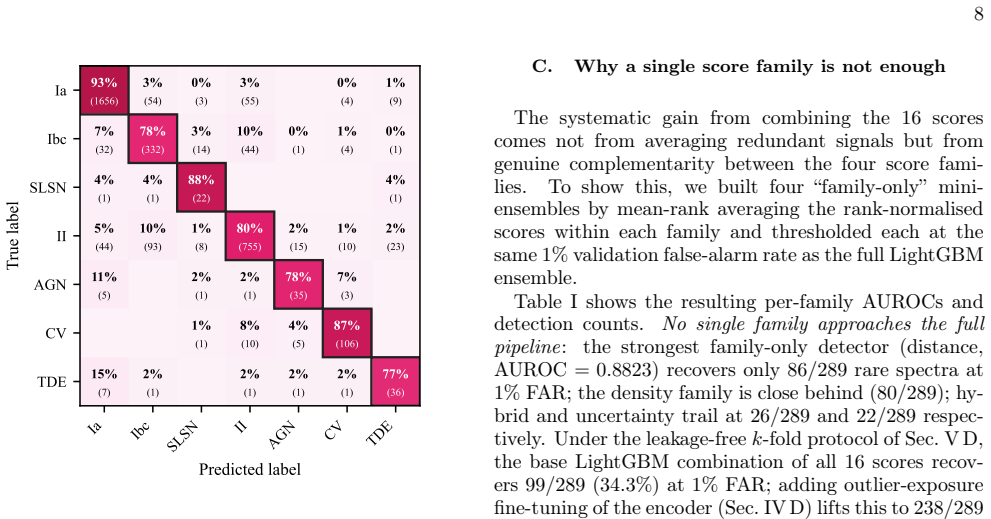
Summary. This manuscript presents ASTRANet, a confidence-aware framework for spectroscopic transient classification comprising three modules: a hierarchical classifier operating on observer-frame spectra without requiring redshift or phase, an anomaly detection layer (ASTRANet-Sentinel) combining 16 embedding-space scores via a gradient-boosted model, and a conformal uncertainty quantification layer (ASTRANet-CP) with a novel AD-stratified Mondrian conformal prediction scheme. The framework is validated on 289 rare/out-of-taxonomy spectra spanning 11 excluded classes. The central claims are: (1) closed-set classifier failure modes separate into five physically distinct regimes, (2) cross-family non-linear combination of anomaly scores is necessary to recover all five regimes, and (3) classifier-internal uncertainty and embedding-based anomaly detection are structurally complementary axes. The conformal coverage properties are empirically validated, and AD-MCP achieves uniform conditional coverage where vanilla Mondrian under-covers.
Significance. The work addresses a genuine and timely problem: spectroscopic triage at the scale of ZTF and LSST requires automated, calibrated confidence assessment, not just point-prediction classification. The redshift-free, phase-free observer-frame architecture is a practical advance for real-time deployment. The failure-mode taxonomy (Sec. II) is a useful conceptual contribution that connects physical regimes to specific anomaly-score signatures. The AD-MCP extension of atypicality-stratified conformal prediction to a learned cross-family ensemble is methodologically novel for astronomical spectroscopy. The leakage-free k-fold protocol (Sec. VD) and the empirical validation of conformal coverage within finite-sample error (Table IV, IX) are commendable. The structural complementarity argument between classifier-internal UQ and cross-family AD (Sec. VIF, Table VII) is well-supported by the population-scale analysis. The framework is being prepared for production integration with the ZTF BOOM broker, which lends practical credibility.
major comments (1)
- Sec. VC, Table I, and the claim that cross-family non-linear combination is 'necessary' (Contributions item 2, Sec. II.f): The key ablation comparing family-only mini-ensembles (86/289 at 1% FAR, no outlier exposure) against the full pipeline (238/289, with outlier exposure) confounds two variables: cross-family combination and outlier-exposure (OE) fine-tuning. OE reshapes the encoder embeddings that all 16 scores depend on (Sec. IVD), so the 137/238 spectra attributed to cross-family interaction may be partly or wholly recoverable by OE-enhanced single-family scores. The non-OE comparison (86 vs. 99, Table I) shows cross-family combination adds only 13 spectra over the best single family without OE — a modest gain that does not support the strong necessity claim. To establish that cross-family combination (rather than OE) drives the improvement, the authors should run OE-enhancedfamily
minor comments (7)
- Sec. IIIb: The rare-anomaly evaluation set includes classes with N<=10 (Ca-rich N=10, BL Lac N=1, Classical Nova N=8). Per-class recovery statistics for these classes (Table III) have large uncertainties. The authors acknowledge this in Sec. VIII (Limitations) but the headline recovery rates (e.g., '40.0%' for Ca-rich) are presented without error bars or confidence intervals. Adding bootstrap intervals for the smallest classes would set appropriate expectations.
- Table X caption: The regimes are labeled A/B/C in the table but I/V in the text (Sec. II, Sec. VII). This mismatch requires cross-referencing and could be unified.
- Sec. VIA: The statement 'the LightGBM-OOF score satisfies the exchangeability assumption conformal prediction requires' is an empirical observation, not a proof. The p-value ECDF being consistent with uniform (Fig. 4) is reassuring but does not formally guarantee exchangeability under arbitrary distribution shift. The authors should soften this language.
- Appendix C, feature importances: The top features (cosine, energy, mahal_global, mahal_within, mahal_class, gmm) span three of four families, which supports the cross-family design. However, the two lowest-ranked features (pca_recon, mrs) are from the density and hybrid families. If these contribute little, a 14-score combiner might perform comparably. An ablation over score count would strengthen the design justification.
- Sec. IVA: The claim that ASTRANet is 'the first fine-grained, multi-class classifier' to operate without redshift on observer-frame spectra should note SNIascore (Ref. 14) as a binary precedent, which it does, but the novelty claim would benefit from explicit comparison to any other redshift-free multi-class attempts if they exist.
- Table XIV: The 'Category' column uses 'SN CC (H)' and 'SN CC (SE)' but the coarse head (Sec. IVA) uses 'SN-CC' as a single superclass. The mapping between the three-way coarse partition and the finer category labels in Table XIV should be clarified.
- Sec. VIH: The AD-MCP fallback for cells with n_min < 10 uses the marginal class threshold. With 1,669 calibration samples and Q=5, this activates for sparse cells. The authors note this affects only rare-class extreme-quintile cells, but the fraction of test samples falling into fallback cells is not reported. This number would help assess the practical impact.
Circularity Check
No significant circularity; derivation is self-contained against external benchmarks and theory.
full rationale
The paper's derivation chain contains no circular steps. The conformal prediction guarantees (Eqs. 1-2, 6-7) rest on established distribution-free theory from Vovk et al. [67], Angelopoulos & Bates [68], and Romano et al. [69] — all external citations with independently verified theorems. The AD-MCP extension (Sec. VIH) applies this theory to a new stratification scheme; its conditional coverage guarantee (Eq. 7) follows from within-cell exchangeability, a standard conformal assumption, not from any result defined in this paper. The cross-family combination claim (Sec. VC) is empirically validated on held-out data under a leakage-free k-fold protocol — the LightGBM combiner is trained on validation data and evaluated on held-out folds, so no detection reduces to its own training input. The structural complementarity claim (Sec. VIF, Table VII) is an empirical observation on held-out test data, not a derived result. The five failure-mode taxonomy (Sec. II) is descriptive. Self-citations to companion works [16, 27, 28, 37] provide context, baselines, and infrastructure but are not load-bearing for any mathematical or methodological claim. The skeptic's concern that OE is confounded with cross-family combination in the ablation (Table I) is a validity concern, not circularity: the paper does not define a quantity in terms of what it claims to predict. Score 1 reflects the presence of non-load-bearing self-citations to companion works.
Assumptions & free parameters
free parameters (5)
- Loss weights (w_f, w_c, w_sc,f, w_sc,c, w_conf, w_H) =
1.5, 0.3, 0.03, 0.05, 0.5, 0.01
- LightGBM hyperparameters =
300 estimators, eta=0.05, num_leaves=31
- AD-MCP quintile bin edges =
5 equal-frequency bins on calibration set
- Outlier exposure margins (lambda_OE, lambda_emb) =
1.0, 1.0
- Confusion penalty pairs and weights =
(TDE->Ia, 0.5), (SLSN->Ibc, 0.3), (II->Ibc, 0.8)
assumptions (4)
- domain assumption Exchangeability of calibration and test spectra
- domain assumption The 289-spectrum rare set spans the full physical diversity of rare anomalies
- standard math Supervised contrastive loss produces a metrically faithful embedding space
- domain assumption Within-cell exchangeability holds for AD-MCP
Cite this review
Pith. "Pith review of Catching Disguised Transients with ASTRANet: Anomaly-Aware Spectroscopic Classification and Conformal Calibration." pith.science (2026). https://pith.science/paper/FH6PAQ6Z
@misc{pith2026260708044,
  author       = {Pith},
  title        = {Pith review of: Catching Disguised Transients with ASTRANet: Anomaly-Aware Spectroscopic Classification and Conformal Calibration},
  year         = {2026},
  howpublished = {\url{https://pith.science/paper/FH6PAQ6Z}},
  note         = {Machine review of arXiv:2607.08044}
}
abstract
Time-domain surveys discover thousands of transients per year, but the spectroscopic identification of rare and physically peculiar objects remains rate-limited by closed-set classifiers that confidently assign every input to a known class -- including spectra that genuinely belong to no known class. We present the \texttt{ASTRANet} framework, a confidence-aware infrastructure for spectroscopic transient classification built around three coupled modules: a hierarchical spectral classifier that operates directly on observer-frame spectra without requiring host-galaxy redshift or spectral phase as inputs; an anomaly detection layer (\texttt{ASTRANet-Sentinel}) that non-linearly combines $16$ embedding-space anomaly scores spanning four physically motivated families; and a conformal uncertainty quantification layer (\texttt{ASTRANet-CP}). We validate the framework on a held-out evaluation set of $289$ rare and out-of-taxonomy transients spanning $11$ classes deliberately excluded from training, chosen to span the full physical diversity of the rare-anomaly population: AGN-related outliers, GRB-related events, gap transients, novae, and peculiar supernovae. Through five astrophysically distinct failure modes of closed-set classifiers, we show that classifier-internal uncertainty and embedding-based anomaly detection are structurally complementary axes of confidence rather than alternative implementations of the same estimator. We further introduce AD-stratified Mondrian conformal prediction (AD-MCP) within \texttt{ASTRANet-CP}, achieving uniform conditional coverage across anomaly-score strata where vanilla Mondrian under-covers in the operational regime. This establishes the methodological infrastructure for confidence-aware spectroscopic discovery in the Vera C.\ Rubin Observatory era.
Figures


Figures from the paper (3 more)


Reference graph
Works this paper leans on
-
[1]
A residual skip connection adds the block input to its output. Stochastic depth [79] with linearly increasing drop probability0→0.1provides implicit ensemble reg- ularisation. Cumulative receptive field:∼250samples. c. Metadata conditioning via FiLM.The metadata vectorc∈R 64 encodes three quantities: spectral phase ϕ(rest-frame days from maximum light, re...
-
[2]
with learning rateη0 = 3×10 −4, weight decay10−4, gradient clip1.0. The schedule uses a5-epoch linear warmup followed by cosine annealing with warm restarts [80],T 0 = 30,T mult = 2,η min = 0.05η 0. EMA [81] of model weights is maintained with decayα= 0.996and used for all validation/test evaluations. Early stopping usesvalidationmacrorecallwithpatience45...
-
[3]
over the test-set embeddings reaches86.8%five-fold accuracy – statistically indistinguishable from the full hi- erarchical classifier head (86.6%, Sec. VA). The class structure visible in the UMAP projection is therefore metrically faithful, not a visualization artifact. The same retrieval operates in two complementary regimes (Fig. 6). (ii) In-distributi...
-
[4]
E. C. Bellm, S. R. Kulkarni, M. J. Graham, R. Dekany, R. M. Smith, R. Riddle, F. J. Masci, G. Helou, T. A. Prince, S. M. Adams, C. Barbarino, T. Barlow, J. Bauer, R. Beck, J. Belicki, R. Biswas, N. Blagorodnova, D. Bodewits, B. Bolin, V. Brinnel, T. Brooke, B. Bue, M. Bulla, R. Burruss, S. B. Cenko, C.-K. Chang, A. Con- nolly, M. Coughlin, J. Cromer, V. C...
work page Pith review arXiv 2019
-
[5]
F. J. Masci, R. R. Laher, B. Rusholme, D. L. Shupe, S. Groom, J. Surace, E. Jackson, S. Monkewitz, R. Beck, D. Flynn, S. Terek, W. Landry, E. Hacopians, V. Desai, J. Howell, T. Brooke, D. Imel, S. Wachter, Q.-Z. Ye, H.- W. Lin, S. B. Cenko, V. Cunningham, U. Rebbapragada, B.Bue, A.A.Miller, A.Mahabal, E.C.Bellm, M.T.Pat- terson, M. Jurić, V. Z. Golkhou, E...
work page Pith review arXiv 2019
-
[6]
M. J. Graham, S. R. Kulkarni, E. C. Bellm, S. M. Adams, C. Barbarino, N. Blagorodnova, D. Bodewits, B. Bolin, P. R. Brady, S. B. Cenko, C.-K. Chang, M. W. Coughlin, K. De, G. Eadie, T. L. Farnham, U. Feindt, A. Franck- owiak, C. Fremling, S. Gezari, S. Ghosh, D. A. Gold- stein, V. Z. Golkhou, A. Goobar, A. Y. Q. Ho, D. Hup- penkothen, Ž. Ivezić, R. L. Jon...
work page Pith review arXiv 2019
-
[7]
M. T. Pattersonet al., PASP131, 018001 (2019)
work page 2019
-
[8]
R. Dekany, R. M. Smith, R. Riddle, M. Feeney, M. Porter, D. Hale, J. Zolkower, J. Belicki, S. Kaye, J. Henning, R. Walters, J. Cromer, A. Delacroix, H. Ro- driguez, D. J. Reiley, P. Mao, D. Hover, P. Murphy, R. Burruss, J. Baker, M. Kowalski, K. Reif, P. Mueller, E. Bellm, M. Graham, and S. R. Kulkarni, PASP132, 038001 (2020), arXiv:2008.04923 [astro-ph.IM]
Show all 85 references
-
[9]
Ivezić, S
Ž. Ivezić, S. M. Kahn,et al., The Astrophysical Journal 873, 111 (2019), arXiv:0805.2366
2019 arXiv
-
[10]
Blagorodnova, J
N. Blagorodnova, J. D. Neill, R. Walters, S. R. Kulkarni, C. Fremling, S. Ben-Ami, R. G. Dekany, J. R. Fucik, N. Konidaris, R. Nash, C.-C. Ngeow, E. O. Ofek, D. O. Sullivan, R. Quimby, A. Ritter, and K. E. Vyhmeister, PASP130, 035003 (2018)
2018
-
[11]
Rigault, J
M. Rigault, J. D. Neill, N. Blagorodnova, A. Dugas, M. Feeney, R. Walters, V. Brinnel, Y. Copin, C. Frem- ling, J. Nordin, and J. Sollerman, A&A627, A115 (2019), arXiv:1902.08526 [astro-ph.IM]
2019 arXiv
-
[12]
R. J. Foley, P. J. Challis, R. Chornock,et al., The Astro- physical Journal767, 57 (2013), arXiv:1212.2209
2013 arXiv
-
[13]
H. B. Perets, A. Gal-Yam, P. A. Mazzali, D. Arnett, D. Kagan, A. V. Filippenko, W. Li, I. Arcavi, S. B. Cenko, D. B. Fox,et al., Nature465, 322 (2010), arXiv:0906.2003 [astro-ph.HE]
2010 arXiv
-
[14]
M. R. Drout, R. Chornock, A. M. Soderberg, N. E. Sanders, R. McKinnon, A. Rest, R. J. Foley, D. Milisavl- jevic, R. Margutti, E. Berger,et al., The Astrophysical Journal794, 23 (2014), arXiv:1405.3668 [astro-ph.HE]
2014 arXiv
-
[15]
A. Y. Q. Ho, D. A. Perley, A. Gal-Yam, R. Lunnan, J. Sollerman, S. Schulze, K. K. Das, D. Dobie, Y. Yao, C. Fremling, S. Adams, S. Anand, I. Andreoni, E. C. Bellm, R. J. Bruch, K. B. Burdge, A. J. Castro-Tirado, A. Dahiwale, K. De, R. Dekany, A. J. Drake, D. A. Duev, M. J. Gra...
2023
-
[16]
T. A. Thompson, J. L. Prieto, K. Z. Stanek, M. D. Kistler, J. F. Beacom, and C. S. Kochanek, The As- trophysical Journal705, 1364 (2009), arXiv:0809.0510 [astro-ph]
2009 arXiv
-
[17]
Fremling, X
C. Fremling, X. J. Hall, M. W. Coughlin, A. S. Dahiwale, D. A. Duev, M. J. Graham, M. M. Kasliwal, E. C. Kool, A. A. Mahabal, A. A. Miller, J. D. Neill, D. A. Perley, M. Rigault, P. Rosnet, B. Rusholme, Y. Sharma, K. M. Shin, D. L. Shupe, J. Sollerman, and R. S. Walters, ApJL ...
2021 arXiv
-
[18]
Sharma, A
Y. Sharma, A. A. Mahabal, J. Sollerman, C. Fremling, S. R. Kulkarni, N. Rehemtulla, A. A. Miller, M. Aubert, 29 T. X. Chen, M. W. Coughlin, M. J. Graham, D. Hale, M. M. Kasliwal, Y.-L. Kim, J. D. Neill, J. N. Pur- dum, B. Rusholme, A. Singh, and N. Sravan, PASP137, 034507 (2025)
2025
-
[19]
M. Xu, A. Sasli, A. Junell, F. F. Nunes, Y.-J. Qin, C. Fremling, S. Rose, T. J. D. Laz, B. Border, A. L. Calloch, S. S. Chaudhary, H. Markoff, A. Raghuvan- shi, N. Rehemtulla, J. Sollerman, Y. Sharma, N. Sravan, J. Adler, T. X. Chen, R. Dekany, R. Riddle, M. M. Kasli- wal, M. ...
2025
-
[20]
W. F. Fortino, F. B. Bianco, P. Protopapas, D. Muthukr- ishna, and A. Brockmeier, Abc-sn: Attention based classifier for supernova spectra (2025), arXiv:2507.22106 [astro-ph.IM]
2025 arXiv
-
[21]
Hendrycks and K
D. Hendrycks and K. Gimpel, ICLR (2017)
2017
-
[22]
C. Guo, G. Pleiss, Y. Sun, and K. Q. Weinberger, in Proceedings of the 34th International Conference on Ma- chine Learning (ICML), Proceedings of Machine Learn- ing Research, Vol. 70 (PMLR, 2017) pp. 1321–1330, arXiv:1706.04599 [cs.LG]
2017 arXiv
-
[23]
M. Hein, M. Andriushchenko, and J. Bitterwolf, inPro- ceedings of the IEEE/CVF Conference on Computer Vi- sion and Pattern Recognition (CVPR)(2019) pp. 41–50, arXiv:1812.05720 [cs.LG]
2019 arXiv
-
[24]
V. A. Villar, M. Cranmer, E. Berger,et al., The As- trophysical Journal Supplement Series255, 24 (2021), arXiv:2103.12102
2021 arXiv
-
[25]
M. V. Pruzhinskaya, K. L. Malanchev, M. V. Kornilov, et al., Monthly Notices of the Royal Astronomical Society 489, 3591 (2019), arXiv:1905.11516
2019 arXiv
-
[26]
Chaini, F
S. Chaini, F. B. Bianco, and A. Mahabal, In search of the unknown unknowns: A multi-metric distance ensemble for out of distribution anomaly detection in astronomical surveys (2025), arXiv:2510.23702 [astro-ph.IM]
2025
-
[27]
Guptaet al., arXiv e-prints (2025),Update with ac- tual MCIF reference., 2503.00000
R. Guptaet al., arXiv e-prints (2025),Update with ac- tual MCIF reference., 2503.00000
2025
-
[28]
Perez, F
E. Perez, F. Strub, H. de Vries, V. Dumoulin, and A. Courville, inProceedings of the AAAI Conference on Artificial Intelligence, Vol. 32 (2018) p. N/A
2018
-
[29]
Muthukrishna, D
D. Muthukrishna, D. Parkinson, and B. E. Tucker, ApJ 885, 85 (2019)
2019
-
[30]
T. J. du Laz, M. W. Coughlin, P. Bachant, J. E. Simones, T. Culino, A. L. Calloch, S. S. Chaudhary, X. J. Hall, T. Barna, D. Warshofsky, M. Graham, M. M. Kasliwal, A. Mahabal, J. S. Bloom, A. Palmese, F. J. Masci, S. L. Groom, R. Dekany, R. L. Riddle, and G. Helou, Boom and ba...
2025 arXiv
-
[31]
Junell, A
A. Junell, A. Sasli, F. F. Nunes, M. Xu, B. Border, N. Re- hemtulla, M. Rizhko, Y.-J. Qin, T. J. D. Laz, A. L. Calloch, S. S. Chaudhary, S. Wu, J. Sollerman, N. Sra- van, S. L. Groom, D. Hale, M. M. Kasliwal, J. Purdum, A. Wold, M. J. Graham, and M. W. Coughlin, Apply- ing mul...
2025 arXiv
-
[32]
Yuksekgonul, L
M. Yuksekgonul, L. Zhang, J. Zou, and C. Guestrin, Be- yond confidence: Reliable models should also consider atypicality (2023), arXiv:2305.18262 [cs.LG]
2023 arXiv
-
[33]
Margutti, B
R. Margutti, B. D. Metzger, R. Chornock, I. Vurm, N. Roth, B. W. Grefenstette, V. Savchenko, R. Cartier, J. F. Steiner, G. Terreran,et al., The Astrophysical Jour- nal872, 18 (2019), arXiv:1810.10720 [astro-ph.HE]
2019 arXiv
-
[34]
D. A. Perley, P. A. Mazzali, L. Yan, S. B. Cenko, S. Gezari, K. Taggart, N. Blagorodnova, C. Frem- ling, B. Mockler, A. Singh,et al., Monthly Notices of the Royal Astronomical Society484, 1031 (2019), arXiv:1808.00969 [astro-ph.HE]
2019 arXiv
-
[35]
C. S. Kochanek, D. M. Szczygieł, and K. Z. Stanek, The Astrophysical Journal758, 142 (2012), arXiv:1202.0281 [astro-ph.SR]
2012 arXiv
-
[36]
Barna, C
T. Barna, C. Fremling, T. Ahumada, I. Andreoni, S. Banerjee, J. S. Bloom, M. Bulla, T. X. Chen, M. W. Coughlin, T.Dietrich, X.J.Hall, A.Junell, B.Rusholme, J. Sollerman, and N. Sravan, Publications of the Astro- nomical Society of the Pacific137, 084105 (2025)
2025
-
[37]
Fremling, D
C. Fremling, D. Perley, A. Y. Q. Ho, and ZTF Collabo- ration, GRB Coordinates Network31629, 1 (2022)
2022
-
[38]
S. J. van der Walt, A. Crellin-Quick, and J. S. Bloom, Journal of Open Source Software4, 1247 (2019)
2019
-
[39]
M. W. Coughlin, J. S. Bloom, G. Nir, S. Antier, T. J. du Laz, S. van der Walt, A. Crellin-Quick, T. Culino, D. A. Duev, D. A. Goldstein, B. F. Healy, V. Karam- belkar, J. Lilleboe, K. M. Shin, L. P. Singer, T. Ahu- mada, S. Anand, E. C. Bellm, R. Dekany, M. J. Graham, M. M. Ka...
2023 arXiv
-
[40]
Sasli, IRIS: Identification and Reduction of Interest- ing Spectra,https://github.com/applecider-ml/IRIS (2026), spectral preprocessing pipeline for transient clas- sification
A. Sasli, IRIS: Identification and Reduction of Interest- ing Spectra,https://github.com/applecider-ml/IRIS (2026), spectral preprocessing pipeline for transient clas- sification
2026
-
[41]
Fremling, A
C. Fremling, A. A. Miller, Y. Sharma, A. Dugas, D. A. Perley, K. Taggart, J. Sollerman, A. Goobar, M. L. Gra- ham, J. D. Neill, J. Nordin, M. Rigault, R. Walters, I. Andreoni, A. Bagdasaryan, J. Belicki, C. Cannella, E. C. Bellm, S. B. Cenko, K. De, R. Dekany, S. Fred- erick, ...
2020 arXiv
-
[42]
D. A. Perley, C. Fremling, J. Sollerman, A. A. Miller, A. S. Dahiwale, Y. Sharma, E. C. Bellm, R. Biswas, T. G. Brink, R. J. Bruch, K. De, R. Dekany, A. J. Drake, D. A. Duev, A. V. Filippenko, A. Gal-Yam, A. Goobar, M. J. Graham, M. L. Graham, A. Y. Q. Ho, I. Irani, M. M. Kasl...
2020
-
[43]
Rehemtulla, A
N. Rehemtulla, A. A. Miller, T. Jegou Du Laz, M. W. Coughlin, C. Fremling, D. A. Perley, Y.-J. Qin, J. Sollerman, A. A. Mahabal, R. R. Laher, R. Riddle, B. Rusholme, and S. R. Kulkarni, ApJ972, 7 (2024), arXiv:2401.15167 [astro-ph.IM]
2024 arXiv
-
[44]
Blagorodnova, J
N. Blagorodnova, J. D. Neill, R. Walters, S. R. Kulka- 30 rni, C. Fremling, S. Ben-Ami, R. G. Dekany, J. R. Fu- cik, N. Konidaris, R. Nash, C.-C. Ngeow, E. O. Ofek, D.O’Sullivan, R.Quimby, A.Ritter,andK.E.Vyhmeis- ter, PASP130, 035003 (2018), arXiv:1710.02917 [astro- ph.IM]
2018 arXiv
-
[45]
Y. L. Kim, M. Rigault, J. D. Neill, M. Briday, Y. Copin, J. Lezmy, N. Nicolas, R. Riddle, Y. Sharma, M. Smith, J. Sollerman, and R. Walters, PASP134, 024505 (2022), arXiv:2203.01346 [astro-ph.IM]
2022 arXiv
-
[46]
J. B. Oke, J. G. Cohen, M. Carr, J. Cromer, A. Din- gizian, F. H. Harris, S. Labrecque, R. Lucinio, W. Schaal, H. Epps, and J. Miller, Publications of the Astronomical Society of the Pacific107, 375 (1995)
1995
-
[47]
S. M. Faber, A. C. Phillips, R. I. Kibrick, B. Alcott, S. L. Allen, J. Burrous, T. Cantrall, D. Clarke, A. L. Coil, D. J. Cowley, M. Davis, W. T. S. Deich, K. Di- etsch, D. K. Gilmore, C. A. Harper, D. F. Hilyard, J. P. Lewis, M.McVeigh, J.Newman, J.Osborne, R.Schiavon, R. J. ...
2003
-
[48]
R. L. Davies, J. R. Allington-Smith, P. Bettess, E. Chad- wick, R. Content, G. N. Dodsworth, R. Haynes, D. Lee, I. J. Lewis, J. Webster, E. Atad, S. M. Beard, M. El- lis, P. R. Hastings, P. R. Williams, T. Bond, D. Cramp- ton, T. J. Davidge, M. Fletcher, B. Leckie, C. L. Mor- ...
1997
-
[49]
R. W. e. a. Pogge, inSPIE, Vol. 7735 (2010)
2010
-
[50]
M. M. Kasliwal, C. Fremling, L. Yan, K. Das, F. Verdi, J. Zmudzinas, C. Martin, E. Kirby, S. Xue, L. Ho, G. Herczeg, X. Wu, Z. Hu, H. Ji, M. Matuszewski, R. Bertz, D. Hale, H. Rodriguez, A. Boden, R. Dekany, R. Smith, D. Reiley, R. Nash, J. Milburn, D. Neill, J. Brugger, R. Za...
2024
-
[51]
Accetta, C
Abdurro’uf, K. Accetta, C. Aerts, V. Silva Aguirre, R. Ahumada, N. Ajgaonkar, N. Filiz Ak, S. Alam, C. Allende Prieto, A. Almeida, F. Anders, S. F. An- derson, B. H. Andrews, B. Anguiano, E. Aquino-Ortíz, A. Aragón-Salamanca, M. Argudo-Fernández, M. Ata, M. Aubert, V. Avila-Re...
2022
-
[52]
DESI Collaboration, A. G. Adame, J. Aguilar, S. Ahlen, S. Alam, G. Aldering, D. M. Alexander, R. Alfarsy, C. Allende Prieto, M. Alvarez, O. Alves, A. Anand, F. Andrade-Oliveira, E. Armengaud, J. Asorey, S. Avila, A.Aviles, S.Bailey, A.Balaguera-Antolínez, O.Ballester, C. Balta...
2024 arXiv
-
[53]
M. M. Kasliwal, C. Cannella, A. Bagdasaryan, T. Hung, U. Feindt, L. P. Singer, M. Coughlin, C. Fremling, R. Walters, D. Duev, R. Itoh, and R. M. Quimby, PASP 131, 038003 (2019)
2019
-
[54]
D. A. Coulter, D. O. Jones, P. McGill, R. J. Foley, P. D. Aleo, M. J. Bustamante-Rosell, D. Chatterjee, K. W. Davis, C. Dickinson, A. Engel, A. Gagliano, W. V. Jacobson-Galán, C. D. Kilpatrick, J. Kutcka, X. K. Le Saux, K. Malanchev, Y. C. Pan, P. J. Quiñonez, C. Rojas-Bravo, ...
2023 arXiv
-
[55]
S. Bai, J. Z. Kolter, and V. Koltun, arXiv preprint arXiv:1803.01271 (2018)
2018 arXiv
-
[56]
M. Ilse, J. M. Tomczak, and M. Welling, inInternational Conference on Machine Learning (ICML)(PMLR, 2018) pp. 2127–2136
2018
-
[57]
Khosla, P
P. Khosla, P. Teterwak, C. Wang, A. Sarna, Y. Tian, P. Isola, A. Maschinot, C. Liu, and D. Krishnan, inAdvances in Neural Information Processing Systems (NeurIPS), Vol. 33 (2020) pp. 18661–18673
2020
-
[58]
T.-Y. Lin, P. Goyal, R. Girshick, K. He, and P. Dollár, inProceedings of the IEEE International Conference on Computer Vision (ICCV)(2017) pp. 2980–2988
2017
-
[59]
Loshchilov and F
I. Loshchilov and F. Hutter, inInternational Conference on Learning Representations (ICLR)(2019)
2019
-
[60]
Zhang, M
H. Zhang, M. Cisse, Y. N. Dauphin, and D. Lopez-Paz, inInternational Conference on Learning Representations (ICLR)(2018)
2018
-
[61]
Y. Cui, M. Jia, T.-Y. Lin, Y. Song, and S. Belongie, inProceedings of the IEEE/CVF Conference on Com- puter Vision and Pattern Recognition (CVPR)(2019)pp. 9268–9277
2019
-
[62]
Lakshminarayanan, A
B. Lakshminarayanan, A. Pritzel, and C. Blundell, in Advances in Neural Information Processing Systems 30 (NIPS 2017)(2017) pp. 6402–6413, arXiv:1612.01474 [stat.ML]
2017 arXiv
-
[63]
Liang, Y
S. Liang, Y. Li, and R. Srikant, Enhancing the reliability of out-of-distribution image detection in neural networks (2020), arXiv:1706.02690 [cs.LG]
2020 arXiv
-
[64]
W. Liu, X. Wang, J. Owens, and Y. Li, NeurIPS (2020)
2020
-
[65]
Leeet al., NeurIPS (2018)
K. Leeet al., NeurIPS (2018)
2018
-
[66]
F. T. Liu, K. M. Ting, and Z.-H. Zhou, inProceedings of the 8th IEEE International Conference on Data Mining (ICDM)(IEEE Computer Society, 2008) pp. 413–422
2008
-
[67]
M. M. Breunig, H.-P. Kriegel, R. T. Ng, and J. Sander, inProceedings of the 2000 ACM SIGMOD International Conference on Management of Data(ACM, 2000) pp. 93–104
2000
-
[68]
G. Ke, Q. Meng, T. Finley, T. Wang, W. Chen, W. Ma, Q. Ye, and T.-Y. Liu, inAdvances in Neural Informa- tion Processing Systems 30 (NIPS 2017)(2017)pp.3146– 3154
2017
-
[69]
Hendrycks, M
D. Hendrycks, M. Mazeika, and T. Dietterich, inInterna- tional Conference on Learning Representations (ICLR) (2019) arXiv:1812.04606
2019 arXiv
-
[70]
V. Vovk, A. Gammerman, and G. Shafer,Algorith- mic Learning in a Random World(Springer, New York, 2005)
2005
-
[71]
A. N. Angelopoulos and S. Bates, Foundations and Trends in Machine Learning16, 494 (2023)
2023
-
[72]
Romano, M
Y. Romano, M. Sesia, and E. J. Candès, inAdvances in Neural Information Processing Systems (NeurIPS) (2020) arXiv:2006.02544
2020 arXiv
-
[73]
M.L.Li, A.Y.Q.Ho, G.Ryan, D.A.Perley, G.P.Lamb, A. J. Nayana, I. Andreoni, G. C. Anupama, E. C. Bellm, E. Berger, J. S. Bloom, E. Burns, I. Caiazzo, P. Chandra, M. W. Coughlin, K. El-Badry, M. J. Graham, M. Kasli- wal, G. K. Keating, S. R. Kulkarni, H. Kumar, F. J. Masci, R.A....
2025 arXiv
-
[74]
Chaini, A
S. Chaini, A. Mahabal, A. Kembhavi, and F. Bianco, Astronomy and Computing48, 100850 (2024)
2024
-
[75]
Swann, M
E. Swann, M. Sullivan, D. Carollo,et al., The Messenger 175, 58 (2019), arXiv:1903.02476
2019 arXiv
-
[76]
Frohmaier, M
C. Frohmaier, M. Sullivan, K. Maguire,et al., inProceed- ings of SPIE, Vol. 13096 (2024) p. 130963X
2024
-
[77]
Schipani, S
P. Schipani, S. Campana, R. Claudi,et al., inProceedings of SPIE, Vol. 11447 (2020) p. 1144709
2020
-
[78]
P. J. Groot, S. Scaringi, and N. Elias-Rosa, arXiv e-prints , arXiv:2512.17404 (2025), arXiv:2512.17404 [astro-ph.IM]
2025
-
[79]
Savitzky and M
A. Savitzky and M. J. E. Golay, Analytical Chemistry 36, 1627 (1964)
1964
-
[80]
Wu and K
Y. Wu and K. He, inEuropean Conference on Computer Vision (ECCV)(Springer, 2018) pp. 3–19
2018
- [81]
-
[82]
Huang, Y
G. Huang, Y. Sun, Z. Liu, D. Sedra, and K. Q. Wein- berger, inEuropean Conference on Computer Vision (ECCV)(Springer, 2016) pp. 646–661
2016
-
[83]
Loshchilov and F
I. Loshchilov and F. Hutter, inInternational Conference on Learning Representations (ICLR)(2017)
2017
-
[84]
B. T. Polyak and A. B. Juditsky, SIAM Journal on Con- trol and Optimization30, 838 (1992)
1992
-
[85]
Izmailov, D
P. Izmailov, D. Podoprikhin, T. Garipov, D. Vetrov, and A. G. Wilson, inProceedings of the Thirty-Fourth Con- ference on Uncertainty in Artificial Intelligence (UAI) (2018) pp. 876–885, arXiv:1803.05407 [cs.LG]
2018 arXiv
Reviewed July 10, 2026 · model on record in the stance chip above.
Discussion (0). Sign in to comment.