REVIEW 5 major objections 5 minor 41 references
Asynchronous Message Passing for Addressing Oversquashing in Graph Neural Networks
T0 review · 5 major / 5 minor · reviewed 2026-08-04 · deepseek-v4-flash
Pith's one-line read A centrality-based asynchronous schedule can relieve oversquashing in GNNs without rewiring.
desk verdict A genuinely simple and empirically promising asynchronous message-passing heuristic, but the central theoretical proof is invalid and the evaluation has a test-set-fitting smell. read the letter →
The pith
A machine-rendered reading of the paper's core claim, the machinery that carries it, and where it could break.
The reading
What carries the argument
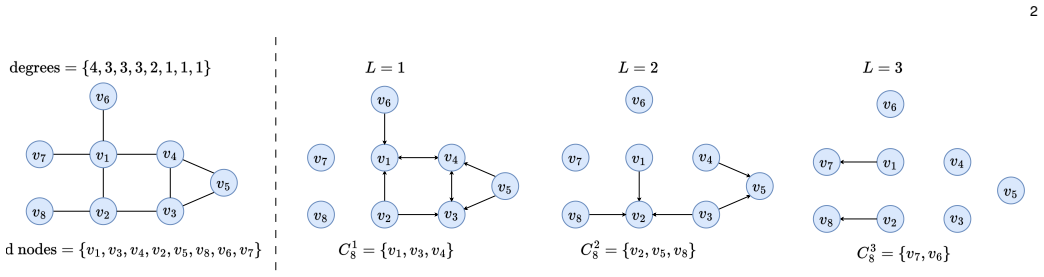
The machinery is the centrality-ordered, layer-disjoint node batch. At layer l the update rule touches only nodes in C_n^(l), a subset of nodes selected by descending centrality (degree, betweenness, closeness, load, or PageRank), while all other nodes carry their previous features forward. Because the set of active nodes changes each layer, the effective propagation matrix S̃^(l) differs across layers, so the oversquashing sensitivity bound is written as a product over l matrices. The proof of Proposition 3.1 rests on comparing that product with the powered synchronous matrix S̃^l and claiming the product is larger; the descending centrality order is what lets high-centrality nodes broadcas
What would settle it
Take a small path graph with, say, five nodes and choose disjoint node batches so that every layer updates a different subset. Compute the (u,v) entry of the product of the per-layer normalized adjacency matrices and compare it with the (u,v) entry of the powered normalized matrix used in synchronous message passing; if the product entry is smaller or zero while the powered entry is positive, Proposition 3.1 fails and the claimed sensitivity advantage is not guaranteed.
Extended reading notes
Core claim
The discovery the paper puts forward is that oversquashing is not only a topology problem: the timing of message updates can be scheduled to avoid simultaneous compression. CAMP splits the node set by centrality rank into L disjoint batches, one per layer, and only the current batch's features are updated; unselected nodes keep their previous features and advance a timestamp. The resulting sensitivity bound for nodes at distance l becomes a product of l distinct normalized adjacency matrices rather than the l-th power of one matrix, and Proposition 3.1 states that this bound is higher than the synchronous one. In experiments the schedule is applied to GCN and GIN, with the best results on la
Load-bearing premise
The proof assumes that layer-to-layer differences in the normalized adjacency matrix are enough to make their product entry at least as large as the powered synchronous matrix entry; the paper does not prove this inequality, and on a simple path graph with disjoint batches the product entry can be zero while the synchronous entry is positive.
Editorial extensions
If this is right
- Oversquashing relief becomes a scheduling decision: any message-passing GNN can adopt CAMP's batching without changing its weights or graph topology.
- Because no feature dimensions are added, CAMP competes with width-expansion methods while keeping parameter counts at the base model's level.
- Graphs with many bottleneck nodes, such as REDDIT-BINARY, stand to benefit most; the paper's largest accuracy gain appears there.
- The reported Dirichlet-energy behavior suggests asynchronous batching also slows oversmoothing, which would make deeper GNNs more practical.
Reading between the lines
- An extension the authors leave implicit is applying the same centrality-scheduled batching to node-level and edge-level tasks, where the sensitivity-bound logic should transfer but is not tested here.
- The centrality measure that works best changes with dataset, so one could treat the batch schedule as a hyperparameter and learn it end-to-end rather than fixing it by centrality.
- If the product-of-matrices bound is the true mechanism, then graphs with known bottleneck structure should show a measurable accuracy gap between CAMP and synchronous passing that grows with node distance; that is a direct test of the paper's explanation.
Editorial analysis
A structured set of objections, weighed in public.
Referee Report
Summary. The manuscript proposes CAMP, a model-agnostic asynchronous message-passing framework for GNNs. Node centrality scores are sorted and partitioned into L disjoint batches; at layer l only nodes in batch C^(l) update their features, using the current (possibly stale) neighbor features. The paper claims this mitigates oversquashing without rewiring and without increasing model parameters, and states Proposition 3.1: CAMP maintains a higher feature sensitivity bound than standard synchronous message passing. Experiments with GCN and GIN on six TUDatasets and two LRGB datasets report gains on REDDIT-BINARY and Peptides-struct, together with ablations on centrality choice, batch size, depth, Dirichlet energy, and signal propagation.
Significance. If the theory and experimental protocol were sound, CAMP would be an interesting contribution: asynchronous batching by centrality is simple, model-agnostic, and avoids graph rewiring; the paper also releases code and performs a range of ablations. However, the theoretical guarantee, which is the primary support for the oversquashing claim, is not established. The proof of Proposition 3.1 relies on an unproved matrix inequality that is false in elementary examples, and Eq. (6) does not follow from the asynchronous update rule. The experimental evaluation also selects the centrality measure per dataset from test performance, and the reported results are mixed against PANDA. These issues are load-bearing, so the contribution in its current form is not convincing.
major comments (5)
- [§3.2, Eq. (5) and Eq. (6)] Proposition 3.1 is the only theoretical result supporting the oversquashing claim, but the bound in Eq. (6) is not derived from the asynchronous update in Eq. (5). In Eq. (5), nodes outside the batch are copied unchanged, so the Jacobian from h_u^(0) to h_v^(l) is a sum over paths that can skip layers through identity operators; it is not a single product of l layer-specific adjacency matrices. The proof simply transplants the synchronous sensitivity bound and then compares matrices. Without a correct derivation, the central claim is unsupported.
- [§3.2, paragraph after Eq. (6)] The key step 'products of distinct adjacency matrices lower the possibility of small quantities' is asserted, not proved, and is false. On a 4-node path with batches C^(1)={1,4} and C^(2)={2,3}, the effective first-layer propagation matrix has zero entries for paths that would require updating non-batch nodes, so (∏_{j=1}^2 S̃^(j))_{1,3}=0 while (S̃^2)_{1,3}>0. Distinctness of S̃^(l) does not make the product entrywise larger; this directly invalidates the proof's conclusion.
- [§3.1, Eq. (1) and Proposition 3.1] Even if Eq. (6) were the correct bound, it is an upper bound on the Jacobian, as in Eq. (1). Comparing upper bounds cannot establish 'higher feature sensitivity' or mitigation of oversquashing: a larger upper bound does not imply a larger actual sensitivity. The proposition would need a lower bound or a direct analysis of the Jacobian; the paper provides neither.
- [§3.5, Eqs. (7)-(8)] The CAMP-GCN and CAMP-GIN update rules are not consistent with the general asynchronous update in Eq. (5). Eq. (7) aggregates only over neighbors in C^(l+1) and, as written, updates h_u for all nodes; if it is intended only for u∈C^(l+1), then the aggregation neighborhood differs from Eq. (5), which uses all neighbors N(u) for batch nodes. This ambiguity makes it unclear whether the theoretical analysis and the experiments concern the same model.
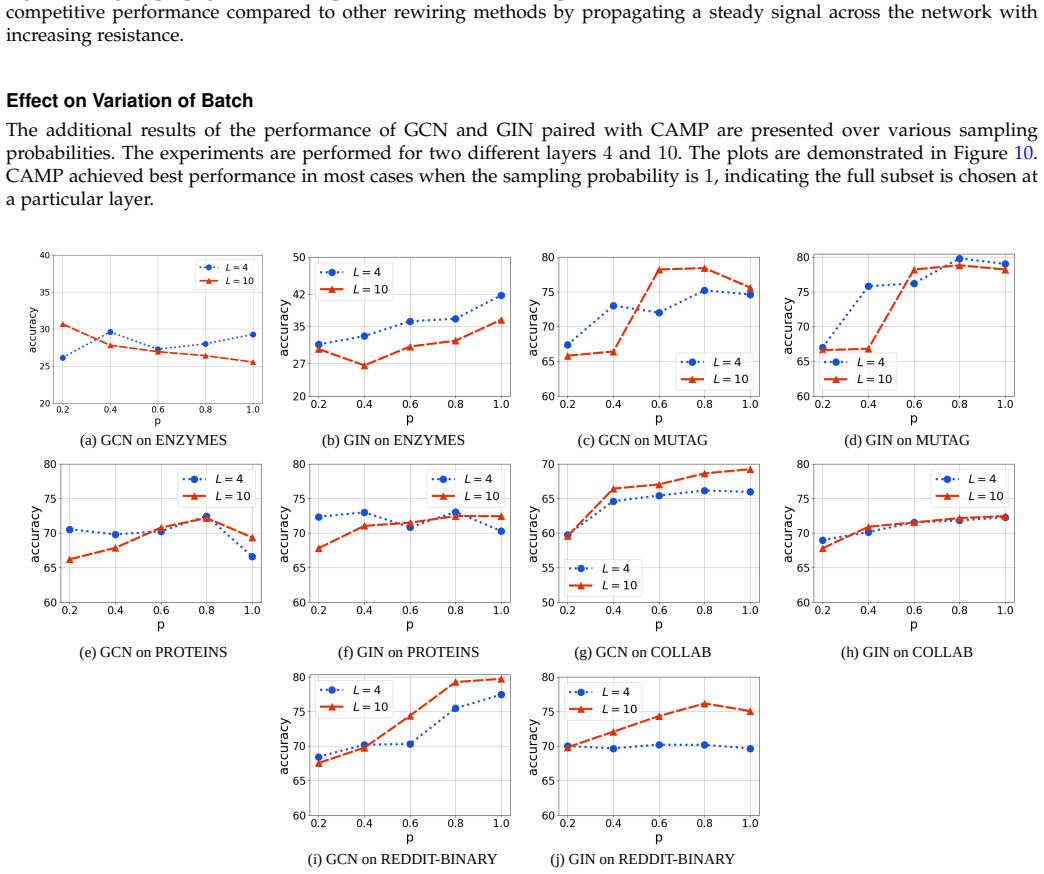
- [§4.2, Table 5; Tables 1-2; Appendix Hyperparameters] The experimental protocol raises concerns. Table 5 selects both the centrality measure and depth L per dataset; no separate validation procedure for choosing centrality is described, so the method's core hyperparameter appears to be selected on the test sets, making the reported gains overfitting-prone. Moreover, Table 2 shows CAMP is markedly worse than GCN and PANDA on Peptides-func (56.67 vs 59.30/60.28), and Table 1 reports PANDA beating CAMP on several datasets (e.g., MUTAG, PROTEINS, IMDB-BINARY for both backbones, and REDDIT-BINARY for GIN), contradicting the overbroad claim of 'outperforms all contenders or attains a second position.' Finally, the Appendix states that all models are 4-layered, while Table 5 specifies L from 10 to 16; the configuration used for the headline results is unclear.
minor comments (5)
- [§3.1, Eq. (1)] The notation is unclear: c, w, and p are not precisely defined, and the expression (cwp)^l mixes the Lipschitz constant, weight bound, and width. Please define each symbol and the norm being bounded.
- [§3.5, Eq. (7)-(8)] The summation index is written as N(v) but should be N(u). Also, the conditional 'only if u is in the batch' is missing from the displayed equations.
- [§3.4] Typo: 'like like the cost of degree centrality' should read 'like the cost...'.
- [§1, Related Work] The claim of being 'the first to introduce an asynchronous message passing framework to combat oversquashing' is too strong given the paper's own citations of Co-GNN [28], asynchronous aggregation [29], and GwAC [21]. Please soften or position the novelty more precisely.
- [§5, Conclusion; References] The conclusion mentions a framework RAMP and 'theoretical guarantees that CAMP is superior to RAMP,' but RAMP is not defined in the main text and no such proof appears. Also, reference [31] duplicates reference [10].
Circularity Check
Proposition 3.1's proof assumes the desired matrix-product inequality, and the empirical gains are obtained by selecting the centrality measure per dataset on the test data.
-
self definitional
[Section 3.2, Proposition 3.1 proof, Eq. (6) and following paragraph]
"The right side of inequality in Eq. 6 represents products of the consecutive distinct adjacency matrices. Precisely, the oversquashing occurs for the decay of the term S̃uv impacted by the power-normalized adjacency matrix. On the contrary, in Eq. 6, the directly powered adjacency matrix is not involved, but the products of consecutive distinct adjacency matrices are estimated. Thus, the possibility of small quantities occurring is lowered, signifying the control of oversquashing."
This is the only argument establishing Proposition 3.1. It asserts that because the layer matrices are distinct, their product is larger than the l-th power; that is precisely the inequality (∏_{j=1}^l S̃^(j))_{uv} ≥ (S̃^l)_{uv} needed to prove a 'higher feature sensitivity bound' compared with synchronous message passing. No derivation is given, and the assertion is false in simple cases: with disjoint batches on a path graph, the asynchronous product can be zero where the synchronous power is positive. The proof therefore assumes the conclusion rather than deriving it. Moreover, Eq. (6) is not derived from the asynchronous update rule in Eq. (5), which contains identity terms for nodes not in the batch; the Jacobian is not a single product of adjacency matrices. The central theoretical '
-
fitted input called prediction
[Appendix Table 5 and Section 4.4]
"TABLE 5: The hyperparameters for each dataset are provided to reproduce the best results. L denotes the number of message-passing layers of the underlying GNN. ... GCN 10 Closeness 16 Degree 16 Degree 10 Load 12 Pagerank 16 Closeness"
CAMP's core design choice is the centrality measure used to form node batches. Instead of fixing one centrality a priori, Table 5 selects a different measure for nearly every dataset/model (Closeness for REDDIT-BINARY, Degree for MUTAG and PROTEINS, Load for COLLAB, PageRank for IMDB-BINARY), and Section 4.4/Table 6 show that the non-selected centralities perform substantially worse on the same datasets. The reported improvements, such as the 5% gain on REDDIT-BINARY, are therefore obtained by choosing the hyperparameter that maximizes test-set performance, then presenting that selected configuration as the method's result. The comparison against baselines uses the post hoc best centrality, so the reported 'prediction' is effectively a fitted selection rather than an out-of-sample evaluati
full rationale
The paper's derivation chain is not self-contained in the way that would rule out circularity. The only theoretical guarantee, Proposition 3.1, is meant to show that CAMP maintains a higher feature-sensitivity bound than synchronous message passing. The proof's key step is the assertion that products of layer-specific distinct adjacency matrices 'lower the possibility of small quantities occurring' — that is exactly the inequality the proposition needs to establish. No proof of that inequality is given, and it is false on simple path graphs, so the theoretical 'prediction' reduces to its own assumption. In addition, the asynchronous update rule Eq. (5) includes identity updates for unbatched nodes, so Eq. (6) is not the actual Jacobian bound for the method; the paper never derives the product form it uses. Empirically, the headline gains are weakened by the per-dataset selection of the centrality measure (Table 5), which is the method's principal hyperparameter and is chosen to reproduce the best results; other centralities on the same test sets score markedly lower. This is not a self-citation chain, but the two issues together mean that the central support for CAMP is either assumed by construction or selected on the test data. Score 6 reflects partial circularity: one theoretical prediction reduces to its own assumption, and the headline empirical results rely on fitted hyperparameter selection.
Assumptions & free parameters
free parameters (3)
- centrality_measure_per_dataset =
Closeness for ENZYMES, Degree for MUTAG (GCN), Degree for PROTEINS (GCN), Load for COLLAB (GCN), PageRank for IMDB-BINAR
- ordering_direction =
descending
- network_depth_L =
10 for ENZYMES, 16 for MUTAG (GCN), 16 for PROTEINS (GCN), 10 for COLLAB (GCN), 12 for IMDB-BINARY (GCN), 16 for REDDIT-
assumptions (2)
- domain assumption Sensitivity bound lemma from Topping et al. (2021) [10]
- ad hoc to paper Products of distinct layer-specific adjacency matrices dominate the powered adjacency matrix entrywise
Cite this review
Pith. "Pith review of Asynchronous Message Passing for Addressing Oversquashing in Graph Neural Networks." pith.science (2026). https://pith.science/paper/FHHIWO32
@misc{pith2026250906777,
  author       = {Pith},
  title        = {Pith review of: Asynchronous Message Passing for Addressing Oversquashing in Graph Neural Networks},
  year         = {2026},
  howpublished = {\url{https://pith.science/paper/FHHIWO32}},
  note         = {Machine review of arXiv:2509.06777}
}
abstract
Graph Neural Networks (GNNs) suffer from Oversquashing, which occurs when tasks require long-range interactions. The problem arises from the presence of bottlenecks that limit the propagation of messages among distant nodes. Recently, graph rewiring methods modify edge connectivity and are expected to perform well on long-range tasks. Yet, graph rewiring compromises the inductive bias, incurring significant information loss in solving the downstream task. Furthermore, increasing channel capacity may overcome information bottlenecks but enhance the parameter complexity of the model. To alleviate these shortcomings, we propose an efficient model-agnostic framework that asynchronously updates node features, unlike traditional synchronous message passing GNNs. Our framework creates node batches in every layer based on the node centrality values. The features of the nodes belonging to these batches will only get updated. Asynchronous message updates process information sequentially across layers, avoiding simultaneous compression into fixed-capacity channels. We also theoretically establish that our proposed framework maintains higher feature sensitivity bounds compared to standard synchronous approaches. Our framework is applied to six standard graph datasets and two long-range datasets to perform graph classification and achieves impressive performances with a $5\%$ and $4\%$ improvements on REDDIT-BINARY and Peptides-struct, respectively.
Figures


Figures from the paper (7 more)


Reference graph
Works this paper leans on
-
[1]
The graph neural network model,
F. Scarselli, M. Gori, A. C. Tsoi, M. Hagenbuchner, and G. Monfardini, “The graph neural network model,”IEEE transactions on neural networks, vol. 20, no. 1, pp. 61–80, 2008
2008
-
[2]
Simplifying graph convolutional networks,
F. Wu, A. Souza, T. Zhang, C. Fifty, T. Yu, and K. Weinberger, “Simplifying graph convolutional networks,” inInternational conference on machine learning. PMLR, 2019, pp. 6861–6871
work page 2019
-
[3]
Principal neighbourhood aggregation for graph nets,
G. Corso, L. Cavalleri, D. Beaini, P . Li `o, and P . Veli ˇckovi´c, “Principal neighbourhood aggregation for graph nets,”Advances in Neural Information Processing Systems, vol. 33, pp. 13 260–13 271, 2020
work page 2020
-
[4]
Benchmarking graph neural networks,
V . P . Dwivedi, C. K. Joshi, T. Laurent, Y. Bengio, and X. Bresson, “Benchmarking graph neural networks,” 2020
work page 2020
-
[5]
V . P . Dwivedi, L. Ramp ´aˇsek, M. Galkin, A. Parviz, G. Wolf, A. T. Luu, and D. Beaini, “Long range graph benchmark,” inThirty-sixth Conference on Neural Information Processing Systems Datasets and Benchmarks Track, 2022. [Online]. Available: https://openreview.net/forum?id=in7XC5RcjEn
work page 2022
-
[6]
Mixhop: Higher-order graph convolutional architectures via sparsified neighborhood mixing,
S. Abu-El-Haija, B. Perozzi, A. Kapoor, N. Alipourfard, K. Lerman, H. Harutyunyan, G. Ver Steeg, and A. Galstyan, “Mixhop: Higher-order graph convolutional architectures via sparsified neighborhood mixing,” ininternational conference on machine learning. PMLR, 2019, pp. 21–29
work page 2019
-
[7]
On the bottleneck of graph neural networks and its practical implications,
U. Alon and E. Yahav, “On the bottleneck of graph neural networks and its practical implications,”arXiv preprint arXiv:2006.05205, 2020
arXiv 2006
-
[8]
On over-squashing in message passing neural networks: The impact of width, depth, and topology,
F. Di Giovanni, L. Giusti, F. Barbero, G. Luise, P . Lio, and M. M. Bronstein, “On over-squashing in message passing neural networks: The impact of width, depth, and topology,” inInternational Conference on Machine Learning. PMLR, 2023, pp. 7865–7885
work page 2023
Show all 41 references
-
[9]
Drew: Dynamically rewired message passing with delay,
B. Gutteridge, X. Dong, M. M. Bronstein, and F. Di Giovanni, “Drew: Dynamically rewired message passing with delay,” inInternational Conference on Machine Learning. PMLR, 2023, pp. 12 252–12 267
2023
-
[11]
Fosr: First-order spectral rewiring for addressing oversquashing in gnns,
K. Karhadkar, P . K. Banerjee, and G. Mont ´ufar, “Fosr: First-order spectral rewiring for addressing oversquashing in gnns,”arXiv preprint arXiv:2210.11790, 2022
2022 arXiv
-
[12]
Diffwire: Inductive graph rewiring via the lov´asz bound, 2022,
A. Arnaiz-Rodr ´ıguez, A. Begga, F. Escolano, and N. Oliver, “Diffwire: Inductive graph rewiring via the lov´asz bound, 2022,”URL https://arxiv. org/abs/2206.07369, vol. 2
2022 arXiv
-
[13]
Locality-aware graph-rewiring in gnns,
F. Barbero, A. Velingker, A. Saberi, M. Bronstein, and F. Di Giovanni, “Locality-aware graph-rewiring in gnns,”arXiv preprint arXiv:2310.01668, 2023
2023 arXiv
-
[14]
Understanding oversquashing in gnns through the lens of effective resistance,
M. Black, Z. Wan, A. Nayyeri, and Y. Wang, “Understanding oversquashing in gnns through the lens of effective resistance,” inInternational Conference on Machine Learning. PMLR, 2023, pp. 2528–2547
2023
-
[15]
Probabilistically rewired message-passing neural networks,
C. Qian, A. Manolache, K. Ahmed, Z. Zeng, G. V . d. Broeck, M. Niepert, and C. Morris, “Probabilistically rewired message-passing neural networks,”arXiv preprint arXiv:2310.02156, 2023
2023 arXiv
-
[16]
A generalization of transformer networks to graphs,
V . P . Dwivedi and X. Bresson, “A generalization of transformer networks to graphs,”arXiv preprint arXiv:2012.09699, 2020. 9
2012 arXiv
-
[17]
PANDA: Expanded width-aware message passing beyond rewiring,
J. Choi, S. Park, H. Wi, S.-B. Cho, and N. Park, “PANDA: Expanded width-aware message passing beyond rewiring,” inForty-first International Conference on Machine Learning, 2024
2024
-
[18]
Semi-supervised classification with graph convolutional networks,
T. N. Kipf and M. Welling, “Semi-supervised classification with graph convolutional networks,”arXiv preprint arXiv:1609.02907, 2016
2016 arXiv
-
[19]
Graph attention networks,
P . Veliˇckovi´c, G. Cucurull, A. Casanova, A. Romero, P . Lio, and Y. Bengio, “Graph attention networks,”arXiv preprint arXiv:1710.10903, 2017
2017 arXiv
-
[20]
Simple and deep graph convolutional networks,
M. Chen, Z. Wei, Z. Huang, B. Ding, and Y. Li, “Simple and deep graph convolutional networks,” inInternational Conference on Machine Learning. PMLR, 2020, pp. 1725–1735
2020
-
[21]
GwAC: GNNs with asynchronous communication,
L. Faber and R. Wattenhofer, “GwAC: GNNs with asynchronous communication,” inThe Second Learning on Graphs Conference, 2023. [Online]. Available: https://openreview.net/forum?id=zffXH0sEJP
2023
-
[22]
How does over-squashing affect the power of gnns?
F. Di Giovanni, T. K. Rusch, M. M. Bronstein, A. Deac, M. Lackenby, S. Mishra, and P . Veliˇckovi´c, “How does over-squashing affect the power of gnns?”arXiv preprint arXiv:2306.03589, 2023
2023 arXiv
-
[23]
Dropedge: Towards deep graph convolutional networks on node classification,
Y. Rong, W. Huang, T. Xu, and J. Huang, “Dropedge: Towards deep graph convolutional networks on node classification,”arXiv preprint arXiv:1907.10903, 2019
1907 arXiv
-
[24]
Diffusion improves graph learning,
J. Klicpera, S. Weißenberger, and S. G ¨unnemann, “Diffusion improves graph learning,”Advances in Neural Information Processing Systems, vol. 32, pp. 13 354–13 366, 2019
2019
-
[25]
Revisiting over-smoothing and over-squashing using ollivier-ricci curvature,
K. Nguyen, N. M. Hieu, V . D. Nguyen, N. Ho, S. Osher, and T. M. Nguyen, “Revisiting over-smoothing and over-squashing using ollivier-ricci curvature,” inInternational Conference on Machine Learning. PMLR, 2023, pp. 25 956–25 979
2023
-
[26]
On the trade-off between over-smoothing and over-squashing in deep graph neural networks,
J. H. Giraldo, K. Skianis, T. Bouwmans, and F. D. Malliaros, “On the trade-off between over-smoothing and over-squashing in deep graph neural networks,” inProceedings of the 32nd ACM International Conference on Information and Knowledge Management, 2023, pp. 566–576
2023
-
[27]
Oversquashing in gnns through the lens of information contraction and graph expansion,
P . K. Banerjee, K. Karhadkar, Y. G. Wang, U. Alon, and G. Mont ´ufar, “Oversquashing in gnns through the lens of information contraction and graph expansion,” in2022 58th Annual Allerton Conference on Communication, Control, and Computing (Allerton). IEEE, 2022, pp. 1–8
2022
-
[28]
Cooperative graph neural networks,
B. Finkelshtein, X. Huang, M. Bronstein, and u. u. Ceylan, “Cooperative graph neural networks,” inProceedings of the 41st International Conference on Machine Learning, ser. ICML’24. JMLR.org, 2024
2024
-
[29]
Improving message-passing gnns by asynchronous aggregation,
J. Chen, T. Liao, C. Chen, and Z. Zheng, “Improving message-passing gnns by asynchronous aggregation,” inProceedings of the 33rd ACM International Conference on Information and Knowledge Management, 2024, pp. 228–238
2024
-
[30]
Expander graph propagation,
A. Deac, M. Lackenby, and P . Veliˇckovi´c, “Expander graph propagation,” inLearning on Graphs Conference. PMLR, 2022, pp. 38–1
2022
-
[31]
Understanding over-squashing and bottlenecks on graphs via curvature,
J. Topping, F. Di Giovanni, B. P . Chamberlain, X. Dong, and M. M. Bronstein, “Understanding over-squashing and bottlenecks on graphs via curvature,”arXiv preprint arXiv:2111.14522, 2021
2021 arXiv
-
[32]
Inductive representation learning on large graphs,
W. L. Hamilton, R. Ying, and J. Leskovec, “Inductive representation learning on large graphs,” inProceedings of the 31st International Conference on Neural Information Processing Systems, 2017, pp. 1025–1035
2017
-
[33]
Graphsaint: Graph sampling based inductive learning method,
H. Zeng, H. Zhou, A. Srivastava, R. Kannan, and V . Prasanna, “Graphsaint: Graph sampling based inductive learning method,”arXiv preprint arXiv:1907.04931, 2019
1907 arXiv
-
[34]
Analyzing affiliation networks,
S. P . Borgatti and D. S. Halgin, “Analyzing affiliation networks,”The Sage handbook of social network analysis, vol. 1, pp. 417–433, 2011
2011
-
[35]
A set of measures of centrality based on betweenness.(1977),
L. Freeman, “A set of measures of centrality based on betweenness.(1977),”Sociometry, vol. 40, no. 35-41, 1977
1977
-
[36]
Centrality in social networks: Conceptual clarification,
L. C. Freemanet al., “Centrality in social networks: Conceptual clarification,”Social network: critical concepts in sociology. Londres: Routledge, vol. 1, pp. 238–263, 2002
2002
-
[37]
Universal behavior of load distribution in scale-free networks,
K.-I. Goh, B. Kahng, and D. Kim, “Universal behavior of load distribution in scale-free networks,”Physical review letters, vol. 87, no. 27, p. 278701, 2001
2001
-
[38]
The pagerank citation ranking: Bringing order to the web
L. Page, S. Brin, R. Motwani, and T. Winograd, “The pagerank citation ranking: Bringing order to the web.” Stanford InfoLab, Tech. Rep., 1999
1999
-
[39]
How powerful are graph neural networks?
K. Xu, W. Hu, J. Leskovec, and S. Jegelka, “How powerful are graph neural networks?”arXiv preprint arXiv:1810.00826, 2018
2018 arXiv
-
[40]
Tudataset: A collection of benchmark datasets for learning with graphs,
C. Morris, N. M. Kriege, F. Bause, K. Kersting, P . Mutzel, and M. Neumann, “Tudataset: A collection of benchmark datasets for learning with graphs,”arXiv preprint arXiv:2007.08663, 2020
2007 arXiv
-
[41]
Minimizing effective resistance of a graph,
A. Ghosh, S. Boyd, and A. Saberi, “Minimizing effective resistance of a graph,”SIAM review, vol. 50, no. 1, pp. 37–66, 2008
2008
-
[42]
F. R. Chung,Spectral graph theory. American Mathematical Soc., 1997, vol. 92. APPENDIX DETAILS OF THEDATASETS We considered six datasets collected from [40], and the details of the datasets are provided in Table 4. TABLE 4: Details of six datasets are provided, which are obtai...
1997
Reviewed August 4, 2026 · model on record in the stance chip above.
Discussion (0). Sign in to comment.