REVIEW 3 major objections 5 minor 1 cited by
Disk Formation in Magnetized Dense Cores with Turbulence and Ambipolar Diffusion
T0 review · 3 major / 5 minor · reviewed 2026-08-14 · deepseek-v4-flash
Pith's one-line read Turbulence and ambipolar diffusion work together to form large, persistent, strongly magnetized protostellar disks in 3D collapse simulations.
desk verdict A solid, systematic simulation study showing turbulence and ambipolar diffusion work together to build persistent but strongly magnetized disks; the main caveat is an AD timestep floor that may under-cook the diffusion in exactly the cells that matter. read the letter →
The pith
A machine-rendered reading of the paper's core claim, the machinery that carries it, and where it could break.
The reading
What carries the argument
The load-bearing machinery is ambipolar diffusion acting as a magnetic-flux redistribution agent, quantified by the diffusion coefficient $\eta_A = Q_A B^2/(4\pi\rho^{3/2})$ with ion density $\rho_i = C\rho^{1/2}$, together with the turbulence-induced warping of the pseudodisk. Ambipolar diffusion lowers the vertical field strength $B_z$ near the protostar, creates a strong-field plateau called the 'diffusion-DEMS', and reduces azimuthal pinching as measured by the field curvature $\kappa_\phi$; both effects reduce the magnetic braking torque $-\Gamma_z = (1/c)[(J\times B)\times r]_z$. The sink-particle treatment, which removes mass and momentum while preserving the magnetic flux, lets the simulations follow the accretion phase, while the warped pseudodisk provides the early disk by letting high-angular-momentum material retain its angular momentum as it falls toward the center.
What would settle it
Re-run the same core-collapse simulations with the ambipolar-diffusion timestep floor removed or weakened and check whether the persistent disks in the standard-diffusion models (M0.0AD1.0 and M1.0AD1.0) still form and survive; if they disappear, the disk-persistence claim rests on the numerical floor rather than on ambipolar diffusion itself.
Extended reading notes
Core claim
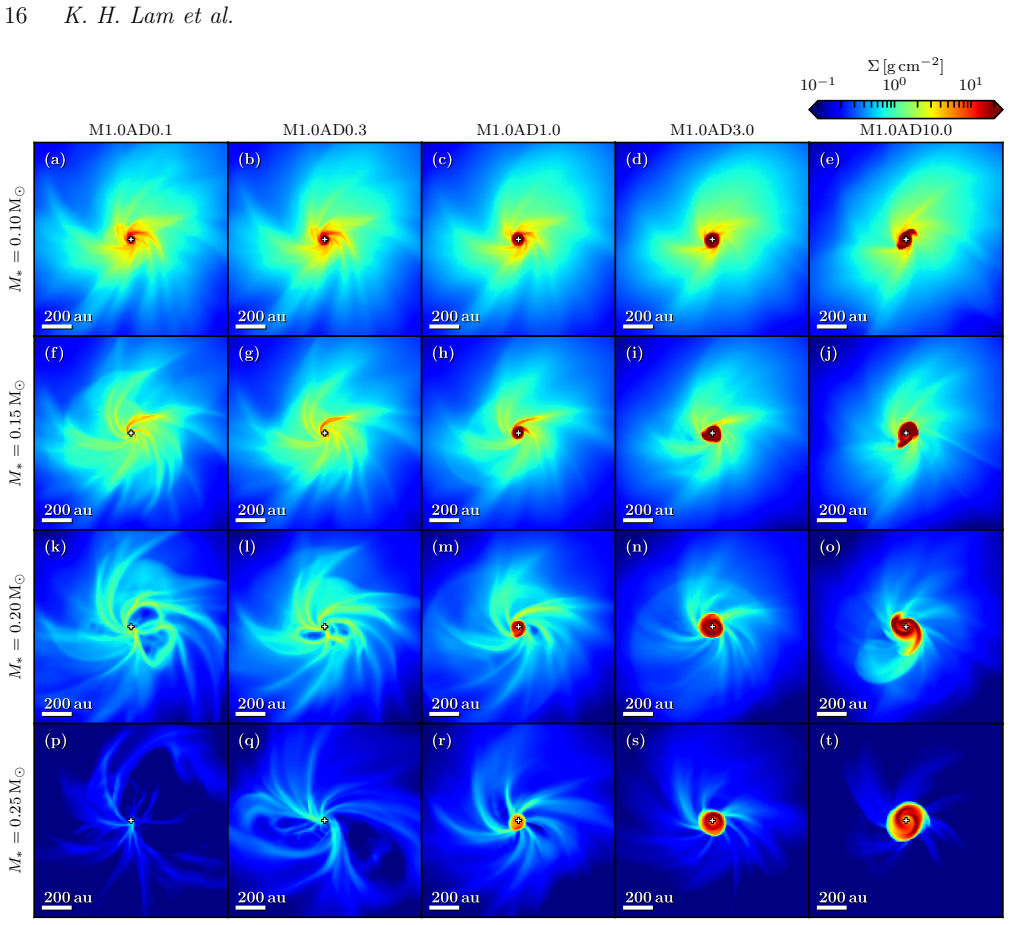
The central claim is that turbulence and ambipolar diffusion are complementary disk-formation agents in the main protostellar accretion phase. Sonic turbulence warps, but does not destroy, the magnetically flattened pseudodisk that feeds the protostar, and it enables a relatively large disk to form early whether or not ambipolar diffusion is present. That early disk does not survive unless ambipolar diffusion is strong enough: ambipolar diffusion redistributes magnetic flux outward and reduces azimuthal field-line pinching in the circumstellar region, lowering the magnetic braking torque that would otherwise strip the disk's angular momentum. In laminar runs, strong ambipolar diffusion produces disks that tend to fragment; initial turbulence suppresses that fragmentation. The paper therefore concludes that turbulence and ambipolar diffusion work together constructively, and that the disks formed this way inherit magnetic fields with plasma beta of order a few tens or smaller, substantially more magnetized than the initial conditions usually assumed in protoplanetary disk modeling.
Load-bearing premise
The load-bearing premise is that the numerical floor on the ambipolar-diffusion timestep, which artificially weakens diffusion in low-density, moderately magnetized cells where diffusion is fastest, does not alter the magnetic-flux redistribution that the paper credits with letting disks survive; if that floor is doing the work, the disk-persistence result is a numerical artifact.
Editorial extensions
If this is right
- A rotationally supported disk formed early by turbulence is transient in ideal MHD; its survival requires an ambipolar diffusivity at least of order the standard value $Q_A$.
- Strong ambipolar diffusion alone yields persistent disks, but these disks are gravitationally unstable and fragment in the laminar runs; adding sonic turbulence removes the fragments.
- The surviving disks have plasma $\beta$ of order 1 to a few tens, with the poloidal field often dominating the toroidal field, so they are much more magnetized than typical protoplanetary-disk simulations assume.
- Resolving the mismatch between these strongly magnetized young disks and the weaker fields used in later disk evolution models requires longer-term, higher-resolution simulations with more realistic thermodynamics and additional non-ideal MHD effects.
- The magnetically induced pseudodisk remains the coherent backbone of the inner accretion flow even under sonic turbulence, so the disk-feeding pattern is warped but not destroyed.
- The early disks induced by turbulence are initially very strongly magnetized, with plasma $\beta$ below unity, which is why they cannot persist without ambipolar diffusion to weaken the field.
Reading between the lines
- If the strong magnetization persists through the protostellar phase, late-stage protoplanetary disk models may need initial poloidal fields with $\beta$ near unity rather than $10^4$-$10^5$; this would change the balance between MRI and wind-driven accretion as well as planet migration rates.
- A direct observational test is possible: ALMA Zeeman or dust-polarization measurements of young, embedded disks should find ordered poloidal fields with $\beta$ in the range of a few to a few tens if this picture is right, whereas older T Tauri disks should be more demagnetized.
- The AD timestep floor, which lowers $\eta_A$ in low-density moderately magnetized cells, is the main numerical caveat; removing it or varying its threshold would show whether the persistence threshold in $Q_A$ is physical or an artifact.
Editorial analysis
A structured set of objections, weighed in public.
Referee Report
Summary. This paper presents a series of 3D non-ideal MHD simulations of disk formation in rotating, magnetized molecular cloud cores, combining for the first time initial turbulence and ambipolar diffusion (AD) during the protostellar mass accretion phase, using the Athena code with sink particles and a zoom-in grid. The authors survey a parameter grid with turbulent Mach numbers M = 0, 0.5, 1 and AD coefficients QA from 0 to 10 times the standard value. They find that turbulence enables the early formation of a relatively large disk, that AD is required for such a disk to persist to later times, and that the two effects work constructively: turbulence helps at early times and AD promotes survival. They also report that AD-enabled disks in laminar runs tend to fragment, with fragmentation suppressed by turbulence. A second central claim is that the formed disks inherit strong magnetic fields, with plasma beta on the order of a few tens or smaller, 2-3 orders of magnitude below typical values adopted in protoplanetary disk simulations.
Significance. If the results hold, this is a useful step forward in the disk formation debate, being among the first studies to treat turbulence and ambipolar diffusion together in the protostellar accretion phase with a sink treatment. The systematic scan over QA and Mach number, the identification of the diffusion-DEMS in 3D, and the quantification of disk magnetization are valuable contributions. The paper also provides useful diagnostics linking the AD timestep floor to its potential impact, and it is careful to note where its conclusions are tentative. However, the main quantitative claims -- the AD strength threshold for persistent disks and the plasma-beta values -- are directly coupled to a numerical approximation whose effect has not been tested. This makes the significance conditional on a relatively inexpensive numerical check.
major comments (3)
- [§2.2(ii), Eq. (7)] The AD timestep floor lowers the ambipolar diffusivity in low-density, moderately magnetized cells, which are exactly the cells where AD acts fastest and where AD-driven flux redistribution is most important. Equation (7) shows that Δt_AD is smallest precisely at low ρ and moderate B, and the floor caps η_A there. The authors state that only a tiny amount of mass is affected, but the affected cells are in the envelope where the flux must diffuse outward to reduce magnetic braking; the mass in those cells can be small while their dynamical effect is large. The paper does not test how the results change when the floor is removed or made less restrictive, nor does it report the actual reduction factor of η_A in the affected cells. The threshold QA ≈ 1 for persistent disks (Section 5) and the derived disk plasma-β values (Section 6.1) therefore remain entangled with this numerical approximation. I request a convergence test with the floor removed or substantially relaxed for at least the key models M0.0AD1.0 and M1.0AD1.0, together with a quantitative report of the mass fraction and the reduction factor of η_A in the affected cells.
- [§2.4, §6.1] The zoom-in resolution is about 10 au, and the 'well-developed disk' criterion requires more than 100 disk cells. With typical disk radii of a few tens to ~100 au, the disks are resolved by only a small number of cells across, and the disk-selection criteria (f = 2, density threshold 3.8e-15 g cm^-3) are applied at this coarse scale. The resolution study in Section 6.2 is only a lower-resolution uniform-grid run that reproduces the same qualitative trend; it does not demonstrate convergence of the disk magnetization diagnostics (λd and β) or of the disk size. Given that the paper's quantitative claim about plasma-β being 2-3 orders of magnitude below protoplanetary disk values is likely resolution-sensitive, I ask for at least one higher-resolution zoom-in run (e.g., of M1.0AD3.0 or M1.0AD10.0) to show that the reported β and λd values do not change substantially with resolution.
- [§6.1, Figs. 15-16] The classification of a disk as present or absent relies on specific thresholds (50 and 100 disk cells) that the authors themselves call 'somewhat arbitrary.' The quantitative conclusion that a persistent disk requires QA ≳ 1 is based on these thresholds, which are not justified by any sensitivity test. While the morphological maps support the qualitative trend, the specific threshold value in QA should be presented as a function of the disk definition, or a broader set of selection parameters should be tested to show that the qualitative conclusion is robust. This is not a request for an entirely new study, but a statement of the uncertainty associated with the stated threshold.
minor comments (5)
- [§2.2(ii)] Please specify the numerical value of the AD timestep floor (the minimum allowed Δt_AD or the equivalent maximum η_A) and the algorithm used to enforce it, so that readers can assess the strength of the approximation.
- [Fig. 10 caption] There is a typo: 'pniched' should be 'pinched'.
- [Figs. 15-16 captions] The text uses 'plamsa-β' and 'polaroidal' (e.g., in the caption of Fig. 15); these should be 'plasma-β' and 'poloidal'.
- [§5, near Fig. 13] The text contains the typo 'AD coeffiecent' (should be 'AD coefficient').
- [§6.2] The comparison to Gray et al. (2018) refers to a 'large misalignment between the turbulence-induced angular momentum (which is set to zero for our simulation as a whole) and the magnetic field.' Please clarify how the net angular momentum was removed from the turbulent velocity field; a short description of the projection method would be useful.
Circularity Check
No circularity: the central disk-formation claims are simulation outputs; self-citations are contextual and not load-bearing.
full rationale
The paper's central claims—that turbulence enables early disk formation, that ambipolar diffusion allows those disks to persist, and that the resulting disks are strongly magnetized with plasma-beta of order a few tens or smaller—are all direct outputs of the numerical simulations, not quantities derived from assumed conclusions. No parameter is fitted to an external target and then renamed as a prediction; the AD coefficient QA is scanned over a range, and disk properties (lambda_d, beta, disk-cell counts) are measured from the simulated flow. Self-citations such as Zhao et al. (2011) for the DEMS concept and Li et al. (2014b) for the warped pseudodisk are used for interpretation and comparison, but the paper's own diagnostics (column density maps, velocity profiles, field distributions, torque calculations) stand independently of those works. The AD timestep floor described in Section 2.2(ii) is a numerical approximation that could affect quantitative results, but it is not a circular step: the floor is not an input that is later relabeled as an output, and the qualitative complementarity of turbulence and AD is not guaranteed by construction. Therefore, no circularity is found.
Assumptions & free parameters
free parameters (6)
- Initial mass-to-flux ratio lambda_core =
2.6 globally, up to 8.4 on the central axis
- Initial rotation ratio beta_rot =
0.03 (Omega about 6e-13 s^-1)
- Turbulence Mach number M =
0.0, 0.5, 1.0
- Ambipolar diffusivity factor Q_A/Q_A,0 =
0.1x, 0.3x, 1x, 3x, 10x the standard value
- Disk selection factor f =
2
- Density threshold for disk cells =
3.8e-15 g cm^-3
assumptions (6)
- domain assumption Gas remains isothermal with P = rho c_s^2 throughout collapse and disk formation.
- domain assumption Ion density follows rho_i = C rho^(1/2) with C set by cosmic-ray ionization equilibrium, and the ion-neutral drag coefficient gamma is constant.
- ad hoc to paper Magnetic flux associated with accreted stellar material is neither destroyed nor removed at the sink; the field in the sink region keeps evolving under constrained transport.
- ad hoc to paper Ambipolar diffusivity is artificially reduced in cells where the AD timestep would be too small, and the affected mass is claimed to be tiny.
- domain assumption Initial turbulent velocity field has a k^-2 power spectrum, is allowed to decay freely, and excess angular momentum is removed before adding solid-body rotation.
- ad hoc to paper Disk cells are selected by the four Masson et al. criteria with factor f = 2 and density threshold 3.8e-15 g cm^-3.
Cite this review
Pith. "Pith review of Disk Formation in Magnetized Dense Cores with Turbulence and Ambipolar Diffusion." pith.science (2026). https://pith.science/paper/FINL66UP
@misc{pith2026190811806,
  author       = {Pith},
  title        = {Pith review of: Disk Formation in Magnetized Dense Cores with Turbulence and Ambipolar Diffusion},
  year         = {2026},
  howpublished = {\url{https://pith.science/paper/FINL66UP}},
  note         = {Machine review of arXiv:1908.11806}
}
abstract
Disks are essential to the formation of both stars and planets, but how they form in magnetized molecular cloud cores remains debated. This work focuses on how the disk formation is affected by turbulence and ambipolar diffusion (AD), both separately and in combination, with an emphasis on the protostellar mass accretion phase of star formation. We find that a relatively strong, sonic turbulence on the core scale strongly warps but does not completely disrupt the well-known magnetically-induced flattened pseudodisk that dominates the inner protostellar accretion flow in the laminar case, in agreement with previous work. The turbulence enables the formation of a relatively large disk at early times with or without ambipolar diffusion, but such a disk remains strongly magnetized and does not persist to the end of our simulation unless a relatively strong ambipolar diffusion is also present. The AD-enabled disks in laminar simulations tend to fragment gravitationally. The disk fragmentation is suppressed by initial turbulence. The ambipolar diffusion facilitates the disk formation and survival by reducing the field strength in the circumstellar region through magnetic flux redistribution and by making the field lines there less pinched azimuthally, especially at late times. We conclude that turbulence and ambipolar diffusion complement each other in promoting disk formation. The disks formed in our simulations inherit a rather strong magnetic field from its parental core, with a typical plasma-$\beta$ of order a few tens or smaller, which is 2-3 orders of magnitude lower than the values commonly adopted in MHD simulations of protoplanetary disks. To resolve this potential tension, longer-term simulations of disk formation and evolution with increasingly more realistic physics are needed.
Figures


Figures from the paper (12 more)




Forward citations
Cited by 1 Pith paper
-
Dust and Gas Transport in Substructured Nonideal MHD Wind-Launching Disks with Embedded Planets
In magnetized wind-launching disks, planet-opened gaps remain partially permeable: small grains and gas leak through, while large grains are filtered, making substructures regulators rather than barriers.
Reference graph
Works this paper leans on
-
[1]
H., 2003, @doi [ ] 10.1086/379243 , http://ui.adsabs.harvard.edu/abs/2003ApJ...599..363A 599, 363
Allen A., Li Z.-Y., Shu F. H., 2003, @doi [ ] 10.1086/379243 , http://ui.adsabs.harvard.edu/abs/2003ApJ...599..363A 599, 363
doi:10.1086/379243 2003
-
[2]
Bai X.-N., 2017, @doi [ ] 10.3847/1538-4357/aa7dda , http://ui.adsabs.harvard.edu/abs/2017ApJ...845...75B 845, 75
-
[3]
Bai X.-N., Stone J. M., 2011, @doi [ ] 10.1088/0004-637X/736/2/144 , http://ui.adsabs.harvard.edu/abs/2011ApJ...736..144B 736, 144
-
[4]
Balbus S. A., Hawley J. F., 1991, @doi [ ] 10.1086/170270 , http://ui.adsabs.harvard.edu/abs/1991ApJ...376..214B 376, 214
doi:10.1086/170270 1991
-
[5]
Bergin E. A., Tafalla M., 2007, @doi [ ] 10.1146/annurev.astro.45.071206.100404 , http://ui.adsabs.harvard.edu/abs/2007ARA
arXiv 2007
-
[6]
Blandford R. D., Payne D. G., 1982, @doi [ ] 10.1093/mnras/199.4.883 , http://ui.adsabs.harvard.edu/abs/1982MNRAS.199..883B 199, 883
-
[7]
Chen C.-Y., Ostriker E. C., 2014, @doi [ ] 10.1088/0004-637X/785/1/69 , http://ui.adsabs.harvard.edu/abs/2014ApJ...785...69C 785, 69
-
[8]
Chen C.-Y., Ostriker E. C., 2018, @doi [ ] 10.3847/1538-4357/aad905 , http://ui.adsabs.harvard.edu/abs/2018ApJ...865...34C 865, 34
Show all 67 references
-
[9]
B., Basu S., Kunz M
Dapp W. B., Basu S., Kunz M. W., 2012, @doi [ ] 10.1051/0004-6361/201117876 , http://ui.adsabs.harvard.edu/abs/2012A
2012 doi
-
[10]
J., 2007, @doi [ ] 10.1086/522825 , https://ui.adsabs.harvard.edu/abs/2007ApJ...671..878D 671, 878
Desch S. J., 2007, @doi [ ] 10.1086/522825 , https://ui.adsabs.harvard.edu/abs/2007ApJ...671..878D 671, 878
2007 doi
-
[12]
T., McKee C
Draine B. T., McKee C. F., 1993, @doi [ ] 10.1146/annurev.aa.31.090193.002105 , http://ui.adsabs.harvard.edu/abs/1993ARA
1993
-
[13]
T., Roberge W
Draine B. T., Roberge W. G., Dalgarno A., 1983, @doi [ ] 10.1086/160617 , http://ui.adsabs.harvard.edu/abs/1983ApJ...264..485D 264, 485
1983 doi
-
[14]
R., et al., 2014, @doi [Science] 10.1126/science.1258022 , https://ui.adsabs.harvard.edu/abs/2014Sci...346.1089F 346, 1089
Fu R. R., et al., 2014, @doi [Science] 10.1126/science.1258022 , https://ui.adsabs.harvard.edu/abs/2014Sci...346.1089F 346, 1089
2014 doi
-
[15]
H., Allen A., 2006, @doi [ ] 10.1086/505257 , http://ui.adsabs.harvard.edu/abs/2006ApJ...647..374G 647, 374
Galli D., Lizano S., Shu F. H., Allen A., 2006, @doi [ ] 10.1086/505257 , http://ui.adsabs.harvard.edu/abs/2006ApJ...647..374G 647, 374
2006 doi
-
[16]
C., 2011, @doi [ ] 10.1088/0004-637X/729/2/120 , http://ui.adsabs.harvard.edu/abs/2011ApJ...729..120G 729, 120
Gong H., Ostriker E. C., 2011, @doi [ ] 10.1088/0004-637X/729/2/120 , http://ui.adsabs.harvard.edu/abs/2011ApJ...729..120G 729, 120
2011 doi
-
[17]
C., 2013, @doi [ ] 10.1088/0067-0049/204/1/8 , http://ui.adsabs.harvard.edu/abs/2013ApJS..204....8G 204, 8
Gong H., Ostriker E. C., 2013, @doi [ ] 10.1088/0067-0049/204/1/8 , http://ui.adsabs.harvard.edu/abs/2013ApJS..204....8G 204, 8
2013 doi
-
[18]
F., Lazarian A., Santos-Lima R., 2016, @doi [ ] 10.3847/0004-637X/819/2/96 , http://ui.adsabs.harvard.edu/abs/2016ApJ...819...96G 819, 96
Gonz \'a lez-Casanova D. F., Lazarian A., Santos-Lima R., 2016, @doi [ ] 10.3847/0004-637X/819/2/96 , http://ui.adsabs.harvard.edu/abs/2016ApJ...819...96G 819, 96
2016 doi
-
[19]
J., McKee C
Gray W. J., McKee C. F., Klein R. I., 2018, @doi [ ] 10.1093/mnras/stx2406 , http://ui.adsabs.harvard.edu/abs/2018MNRAS.473.2124G 473, 2124
2018 doi
-
[20]
Hennebelle P., Commer c on B., Chabrier G., Marchand P., 2016, @doi [ ] 10.3847/2041-8205/830/1/L8 , http://ui.adsabs.harvard.edu/abs/2016ApJ...830L...8H 830, L8
2016 doi
-
[21]
Hull C. L. H., Zhang Q., 2019, @doi [Frontiers in Astronomy and Space Sciences] 10.3389/fspas.2019.00003 , http://ui.adsabs.harvard.edu/abs/2019FrASS...6....3H 6, 3
2019
-
[22]
Joos M., Hennebelle P., Ciardi A., Fromang S., 2013, @doi [ ] 10.1051/0004-6361/201220649 , http://ui.adsabs.harvard.edu/abs/2013A
2013 doi
-
[23]
K \"o lligan A., Kuiper R., 2018, @doi [ ] 10.1051/0004-6361/201833686 , http://ui.adsabs.harvard.edu/abs/2018A
2018 doi
-
[24]
Krasnopolsky R., K \"o nigl A., 2002, @doi [ ] 10.1086/343890 , http://ui.adsabs.harvard.edu/abs/2002ApJ...580..987K 580, 987
2002 doi
-
[25]
Krasnopolsky R., Li Z.-Y., Shang H., 2010, @doi [ ] 10.1088/0004-637X/716/2/1541 , http://ui.adsabs.harvard.edu/abs/2010ApJ...716.1541K 716, 1541
2010 doi
-
[26]
Krasnopolsky R., Li Z.-Y., Shang H., Zhao B., 2012, @doi [ ] 10.1088/0004-637X/757/1/77 , http://ui.adsabs.harvard.edu/abs/2012ApJ...757...77K 757, 77
2012 doi
-
[27]
Kuffmeier M., Haugb lle T., Nordlund ., 2017, @doi [ ] 10.3847/1538-4357/aa7c64 , http://ui.adsabs.harvard.edu/abs/2017ApJ...846....7K 846, 7
2017 doi
-
[28]
W., Mouschovias T
Kunz M. W., Mouschovias T. C., 2010, @doi [ ] 10.1111/j.1365-2966.2010.17110.x , http://ui.adsabs.harvard.edu/abs/2010MNRAS.408..322K 408, 322
2010
-
[29]
L., Federrath C., 2019, @doi [ ] 10.1093/mnras/stz1053 , https://ui.adsabs.harvard.edu/abs/2019MNRAS.486.3647K 486, 3647
Kuruwita R. L., Federrath C., 2019, @doi [ ] 10.1093/mnras/stz1053 , https://ui.adsabs.harvard.edu/abs/2019MNRAS.486.3647K 486, 3647
2019 doi
-
[30]
Lazarian A., Eyink G., Vishniac E., Kowal G., 2015, @doi [Philosophical Transactions of the Royal Society of London Series A] 10.1098/rsta.2014.0144 , https://ui.adsabs.harvard.edu/abs/2015RSPTA.37340144L 373, 20140144
2015
-
[31]
T., Bate M
Lewis B. T., Bate M. R., 2018, @doi [ ] 10.1093/mnras/sty829 , http://ui.adsabs.harvard.edu/abs/2018MNRAS.477.4241L 477, 4241
2018 doi
-
[32]
Li C., Chen X., 2019, @doi [ ] 10.3847/1538-4365/aafdaa , http://ui.adsabs.harvard.edu/abs/2019ApJS..240...37L 240, 37
2019 doi
-
[33]
F., 1996, @doi [ ] 10.1086/177329 , http://ui.adsabs.harvard.edu/abs/1996ApJ...464..373L 464, 373
Li Z.-Y., McKee C. F., 1996, @doi [ ] 10.1086/177329 , http://ui.adsabs.harvard.edu/abs/1996ApJ...464..373L 464, 373
1996 doi
-
[34]
Li Z.-Y., Krasnopolsky R., Shang H., 2011, @doi [ ] 10.1088/0004-637X/738/2/180 , http://ui.adsabs.harvard.edu/abs/2011ApJ...738..180L 738, 180
2011 doi
-
[35]
E., J rgensen J
Li Z.-Y., Banerjee R., Pudritz R. E., J rgensen J. K., Shang H., Krasnopolsky R., Maury A., 2014a, @doi [Protostars and Planets VI] 10.2458/azu_uapress_9780816531240-ch008 , http://ui.adsabs.harvard.edu/abs/2014prpl.conf..173L pp 173--194
-
[36]
Li Z.-Y., Krasnopolsky R., Shang H., Zhao B., 2014b, @doi [ ] 10.1088/0004-637X/793/2/130 , http://ui.adsabs.harvard.edu/abs/2014ApJ...793..130L 793, 130
-
[37]
S., McKee C
Li P. S., McKee C. F., Klein R. I., 2015, @doi [ ] 10.1093/mnras/stv1437 , https://ui.adsabs.harvard.edu/abs/2015MNRAS.452.2500L 452, 2500
2015 doi
-
[38]
L., Konigl A., Wardle M., 1995, @doi [ ] 10.1086/175477 , https://ui.adsabs.harvard.edu/abs/1995ApJ...442..726M 442, 726
Mac Low M.-M., Norman M. L., Konigl A., Wardle M., 1995, @doi [ ] 10.1086/175477 , https://ui.adsabs.harvard.edu/abs/1995ApJ...442..726M 442, 726
1995 doi
-
[39]
N., Inutsuka S.-I., Matsumoto T., 2011, @doi [ ] 10.1093/pasj/63.3.555 , http://ui.adsabs.harvard.edu/abs/2011PASJ...63..555M 63, 555
Machida M. N., Inutsuka S.-I., Matsumoto T., 2011, @doi [ ] 10.1093/pasj/63.3.555 , http://ui.adsabs.harvard.edu/abs/2011PASJ...63..555M 63, 555
2011 doi
-
[40]
N., Inutsuka S.-i., Matsumoto T., 2014, @doi [ ] 10.1093/mnras/stt2343 , http://ui.adsabs.harvard.edu/abs/2014MNRAS.438.2278M 438, 2278
Machida M. N., Inutsuka S.-i., Matsumoto T., 2014, @doi [ ] 10.1093/mnras/stt2343 , http://ui.adsabs.harvard.edu/abs/2014MNRAS.438.2278M 438, 2278
2014 doi
-
[41]
Martizzi D., Quataert E., Faucher-Gigu \`e re C.-A., Fielding D., 2019, @doi [ ] 10.1093/mnras/sty3273 , http://ui.adsabs.harvard.edu/abs/2019MNRAS.483.2465M 483, 2465
2019 doi
-
[42]
Masson J., Chabrier G., Hennebelle P., Vaytet N., Commer c on B., 2016, @doi [ ] 10.1051/0004-6361/201526371 , http://ui.adsabs.harvard.edu/abs/2016A
2016 doi
-
[43]
N., Inutsuka S.-i., 2017, @doi [ ] 10.3847/1538-4357/aa6a1c , http://ui.adsabs.harvard.edu/abs/2017ApJ...839...69M 839, 69
Matsumoto T., Machida M. N., Inutsuka S.-i., 2017, @doi [ ] 10.3847/1538-4357/aa6a1c , http://ui.adsabs.harvard.edu/abs/2017ApJ...839...69M 839, 69
2017 doi
-
[44]
R., Li Z.-Y., 2009, @doi [ ] 10.1088/0004-637X/698/1/922 , http://ui.adsabs.harvard.edu/abs/2009ApJ...698..922M 698, 922
Mellon R. R., Li Z.-Y., 2009, @doi [ ] 10.1088/0004-637X/698/1/922 , http://ui.adsabs.harvard.edu/abs/2009ApJ...698..922M 698, 922
2009 doi
-
[45]
Mostefaoui S., Kita N. T., Togashi S., Tachibana S., Nagahara H., Morishita Y., 2002, @doi [Meteoritics and Planetary Science] 10.1111/j.1945-5100.2002.tb00825.x , https://ui.adsabs.harvard.edu/abs/2002M&PS...37..421M 37, 421
2002
-
[46]
Okuzumi S., Takeuchi T., Muto T., 2014, @doi [ ] 10.1088/0004-637X/785/2/127 , http://ui.adsabs.harvard.edu/abs/2014ApJ...785..127O 785, 127
2014 doi
-
[47]
Pattle K., Fissel L., 2019, @doi [Frontiers in Astronomy and Space Sciences] 10.3389/fspas.2019.00015 , http://ui.adsabs.harvard.edu/abs/2019FrASS...6...15P 6, 15
2019
-
[48]
Planck Collaboration et al., 2015, @doi [ ] 10.1051/0004-6361/201424082 , http://ui.adsabs.harvard.edu/abs/2015A
2015 doi
-
[49]
M., Lazarian A., 2012, @doi [ ] 10.1088/0004-637X/747/1/21 , http://ui.adsabs.harvard.edu/abs/2012ApJ...747...21S 747, 21
Santos-Lima R., de Gouveia Dal Pino E. M., Lazarian A., 2012, @doi [ ] 10.1088/0004-637X/747/1/21 , http://ui.adsabs.harvard.edu/abs/2012ApJ...747...21S 747, 21
2012 doi
-
[50]
E., Klessen R
Seifried D., Banerjee R., Pudritz R. E., Klessen R. S., 2013, @doi [ ] 10.1093/mnras/stt682 , http://ui.adsabs.harvard.edu/abs/2013MNRAS.432.3320S 432, 3320
2013 doi
-
[51]
H., 1992, The physics of astrophysics
Shu F. H., 1992, The physics of astrophysics. Volume II: Gas dynamics
1992
-
[52]
H., Galli D., Lizano S., Cai M., 2006, @doi [ ] 10.1086/505258 , http://ui.adsabs.harvard.edu/abs/2006ApJ...647..382S 647, 382
Shu F. H., Galli D., Lizano S., Cai M., 2006, @doi [ ] 10.1086/505258 , http://ui.adsabs.harvard.edu/abs/2006ApJ...647..382S 647, 382
2006 doi
-
[53]
C., 2001, @doi [ ] 10.1046/j.1365-8711.2001.04186.x , http://ui.adsabs.harvard.edu/abs/2001MNRAS.323..587S 323, 587
Stehle R., Spruit H. C., 2001, @doi [ ] 10.1046/j.1365-8711.2001.04186.x , http://ui.adsabs.harvard.edu/abs/2001MNRAS.323..587S 323, 587
2001
-
[54]
M., Gardiner T
Stone J. M., Gardiner T. A., Teuben P., Hawley J. F., Simon J. B., 2008, @doi [ ] 10.1086/588755 , http://ui.adsabs.harvard.edu/abs/2008ApJS..178..137S 178, 137
2008 doi
-
[55]
C., 2005, @doi [ ] 10.1086/424480 , http://ui.adsabs.harvard.edu/abs/2005ApJ...618..783T 618, 783
Tassis K., Mouschovias T. C., 2005, @doi [ ] 10.1086/424480 , http://ui.adsabs.harvard.edu/abs/2005ApJ...618..783T 618, 783
2005 doi
-
[56]
N., 2015, @doi [ ] 10.1088/0004-637X/801/2/117 , http://ui.adsabs.harvard.edu/abs/2015ApJ...801..117T 801, 117
Tomida K., Okuzumi S., Machida M. N., 2015, @doi [ ] 10.1088/0004-637X/801/2/117 , http://ui.adsabs.harvard.edu/abs/2015ApJ...801..117T 801, 117
2015 doi
-
[57]
N., Hosokawa T., Sakurai Y., Lin C
Tomida K., Machida M. N., Hosokawa T., Sakurai Y., Lin C. H., 2017, @doi [ ] 10.3847/2041-8213/835/1/L11 , http://ui.adsabs.harvard.edu/abs/2017ApJ...835L..11T 835, L11
2017 doi
-
[58]
Tomisaka K., 2000, @doi [ ] 10.1086/312417 , http://ui.adsabs.harvard.edu/abs/2000ApJ...528L..41T 528, L41
2000 doi
-
[59]
Tsukamoto Y., 2016, @doi [ ] 10.1017/pasa.2016.6 , http://ui.adsabs.harvard.edu/abs/2016PASA...33...10T 33, e010
2016 doi
-
[60]
N., Inutsuka S., 2015a, @doi [ ] 10.1093/mnras/stv1290 , http://ui.adsabs.harvard.edu/abs/2015MNRAS.452..278T 452, 278
Tsukamoto Y., Iwasaki K., Okuzumi S., Machida M. N., Inutsuka S., 2015a, @doi [ ] 10.1093/mnras/stv1290 , http://ui.adsabs.harvard.edu/abs/2015MNRAS.452..278T 452, 278
-
[61]
N., Inutsuka S., 2015b, @doi [ ] 10.1088/2041-8205/810/2/L26 , http://ui.adsabs.harvard.edu/abs/2015ApJ...810L..26T 810, L26
Tsukamoto Y., Iwasaki K., Okuzumi S., Machida M. N., Inutsuka S., 2015b, @doi [ ] 10.1088/2041-8205/810/2/L26 , http://ui.adsabs.harvard.edu/abs/2015ApJ...810L..26T 810, L26
-
[62]
Vaytet N., Commer c on B., Masson J., Gonz \'a lez M., Chabrier G., 2018, @doi [ ] 10.1051/0004-6361/201732075 , http://ui.adsabs.harvard.edu/abs/2018A
2018 doi
-
[63]
Wurster J., Li Z.-Y., 2018, @doi [Frontiers in Astronomy and Space Sciences] 10.3389/fspas.2018.00039 , http://ui.adsabs.harvard.edu/abs/2018FrASS...5...39W 5, 39
2018
-
[64]
J., Bate M
Wurster J., Price D. J., Bate M. R., 2016, @doi [ ] 10.1093/mnras/stw013 , http://ui.adsabs.harvard.edu/abs/2016MNRAS.457.1037W 457, 1037
2016 doi
-
[65]
R., Price D
Wurster J., Bate M. R., Price D. J., 2018, @doi [ ] 10.1093/mnras/sty2212 , http://ui.adsabs.harvard.edu/abs/2018MNRAS.480.4434W 480, 4434
2018 doi
-
[66]
Zhao B., Li Z.-Y., Nakamura F., Krasnopolsky R., Shang H., 2011, @doi [ ] 10.1088/0004-637X/742/1/10 , http://ui.adsabs.harvard.edu/abs/2011ApJ...742...10Z 742, 10
2011 doi
-
[67]
Zhao B., Caselli P., Li Z.-Y., Krasnopolsky R., Shang H., Nakamura F., 2016, @doi [ ] 10.1093/mnras/stw1124 , http://ui.adsabs.harvard.edu/abs/2016MNRAS.460.2050Z 460, 2050
2016 doi
-
[68]
Zhao B., Caselli P., Li Z.-Y., Krasnopolsky R., 2018, @doi [ ] 10.1093/mnras/stx2617 , http://ui.adsabs.harvard.edu/abs/2018MNRAS.473.4868Z 473, 4868
2018 doi
Reviewed August 14, 2026 · model on record in the stance chip above.
Discussion (0). Continue with ORCID to comment.