REVIEW 3 major objections 5 minor 54 references
Contractive Dynamical Imitation Policies for Efficient Out-of-Sample Recovery
T0 review · 3 major / 5 minor · reviewed 2026-08-11 · deepseek-v4-flash
Pith's one-line read This paper claims that imitation policies shaped as contractive dynamical systems recover out-of-sample states with a provable upper bound on loss, because every rollout contracts exponentially toward the expert trajectory.
desk verdict Useful architecture and strong OOS results, but the central contractivity guarantee and the OOS loss bound are not proven; the paper should not be accepted as-is. read the letter →
The pith
A machine-rendered reading of the paper's core claim, the machinery that carries it, and where it could break.
The reading
What carries the argument
The load-bearing construction is the SCDS policy, a continuous-time dynamical system $\dot{z} = f_\theta(z)$ in a latent space, paired with an output map made of a linear projection and $K$ invertible coupling layers. The latent dynamics are a recurrent equilibrium network (REN), a nonlinear model whose parameterization guarantees contractivity at a chosen rate $\gamma$ for all parameters $\theta$; the coupling layers are bijective maps that preserve that contractivity, and the initial latent state is set with a pseudoinverse so the planned state approximates the observed initial state. This architecture lets the paper reduce the out-of-sample recovery question to a comparison of rollouts from nearby initial conditions, which contractivity then turns into an exponential-decay estimate used in Theorem 4.1.
What would settle it
Take $a=0$, $b=1$, $c=2$: the squared-error loss from $a$ to $c$ is $4$, while the sum of the losses via $b$ is $1+1=2$, so the triangle inequality used in the proof of Theorem 4.1 (Appendix A.2, Eq. (16)) fails for MSE. A complete falsifier would be an explicit contractive policy and an out-of-sample state whose measured MSE loss exceeds the claimed upper bound.
Extended reading notes
Core claim
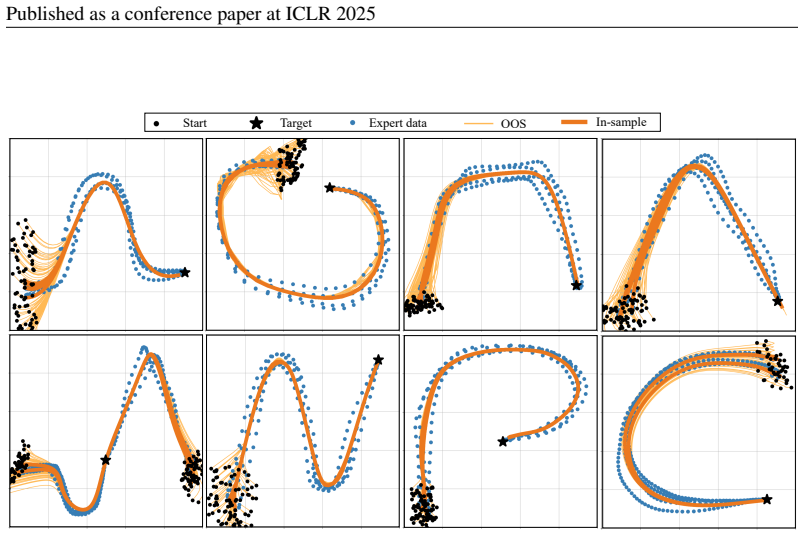
The central claim is that the policy in Eq. (7) is contractive for every parameter choice, with the contraction rate preserved through the output transformation, and that this contractivity directly yields a deployable recovery guarantee. Theorem 4.1 states that, when the out-of-sample initial state lies in a multi-focal ellipse around the training initial states, its MSE loss is bounded by a weighted sum of in-sample rollout errors plus a term that shrinks with the contraction rate and with the size of the uncertainty region; Corollary 4.1.1 extends the same bound to any distribution over that region. The paper presents empirical evidence that these guarantees translate into lower out-of-sample error than stability-only baselines on LASA handwriting motions and Robomimic manipulation tasks, including simulated deployment on a Franka arm and a Jackal robot.
Load-bearing premise
The quantitative upper-bound theorem assumes that the squared-error loss satisfies the triangle inequality, but mean squared error does not: the cross term is dropped in the proof in Appendix A.2. If that assumption fails, the stated worst-case and expected-loss bounds do not follow from contractivity alone.
Editorial extensions
If this is right
- Any rollout started from an out-of-sample state contracts exponentially toward rollouts from in-sample states, so the transient phase is controlled and the target is reached from unseen initial conditions.
- Because contractivity holds for every parameter value, training can be done with unconstrained gradient descent, avoiding the accuracy-versus-stability trade-offs of constrained optimization.
- The bound in Theorem 4.1 is computable from precomputed in-sample errors and inverse-distance weights, so it can serve as a deployment-time certificate for a learned policy.
- State-only training removes the need for expert velocity measurements, eliminating a common source of accumulated error in imitation learning.
- Higher contraction rates or tighter initial-state uncertainty regions directly tighten the certified worst-case and expected loss.
Reading between the lines
- The bound's proof uses the triangle inequality for the squared-error loss, which mean squared error does not satisfy; a direct corollary is that the certificate would become rigorous if the loss were replaced by a true metric, such as Euclidean distance, or if the proof were amended to account for the missing cross term.
- Because the bound is computable from the current state, one could extend SCDS to an online safety monitor that pre-empts rollouts whose certified loss exceeds a threshold, an application the paper does not discuss.
- The inverse-distance weighting in Eq. (9) is a nearest-neighbour-style soft partition of the initial-state space; it would be natural to test whether alternative kernels or learned weights tighten the bound while preserving the zero-loss-at-demonstration property.
- For multi-modal expert behaviors, such as the Robomimic tasks where demonstrations do not share a target, a single contractive system can only contract to an average behavior; an extension would need mixture or mode-conditional contractive policies.
Editorial analysis
A structured set of objections, weighed in public.
Referee Report
Summary. The paper proposes SCDS, a state-only imitation learning method whose policy is a continuous-time dynamical system composed of a contractive recurrent equilibrium network (REN) in a latent space, a linear projection, and a stack of RealNVP coupling layers. The authors claim that this composition is contractive for every parameter choice, enabling unconstrained optimization, and they derive upper bounds on the worst-case and expected out-of-sample loss (Theorem 4.1 and Corollary 4.1.1). The method is evaluated on LASA and Robomimic datasets, with additional deployment in the Isaac Lab simulator, reporting strong out-of-sample recovery compared with stable and non-stable baselines.
Significance. If the theoretical results were correct, this would be a valuable contribution: a contractive-by-construction policy class with unconstrained training and explicit worst-case out-of-sample guarantees would address a real gap in imitation learning. The empirical results are promising, the experiments are fairly extensive, and the authors ship code. However, the central theoretical claims rest on two independent mathematical errors—in the preservation of Euclidean contractivity through coupling layers and in the use of a triangle inequality for the MSE loss—so the main advertised guarantee is not established. The empirical findings may still be of interest, but the paper's headline contribution is the rigorous OOS bound, which is currently unsupported.
major comments (3)
- [App. A.2, Eq. (16)] Theorem 4.1's proof uses the 'triangle inequality for MSE' to claim ℓ(ŷ, y^m) ≤ ℓ(ŷ, ŷ^m) + ℓ(ŷ^m, y^m). Mean squared error does not satisfy the triangle inequality: for scalar values 0, 1, 2, MSE(0,2)=4 while MSE(0,1)+MSE(1,2)=2. The missing cross term is not bounded in the proof, so the displayed upper bound in Theorem 4.1 and the bound in Corollary 4.1.1 do not follow from the preceding inequalities. This is a load-bearing step for the paper's main 'rigorous' deployment guarantee.
- [App. A.1, Proposition 2.1 and Eq. (13)] The preservation of Euclidean contractivity through the output map is not established. First, Lemma A.1 gives ||Pv||²/||v||² ≥ σ_min(P)², hence ||v|| ≤ ||Pv||/σ_min(P), so the denominator in Eq. (13) should be σ_min(P), not σ_min(P)². Second, the paper explicitly advocates latent dimensions Nz > Ny for expressiveness, in which case P ∈ R^{Ny×Nz} necessarily has a nontrivial null space, σ_min(P)=0, and the displayed bound is vacuous. Third, the citation to Manchester & Slotine for 'bijective maps preserve contractivity' concerns contraction in a pulled-back metric, not a single global Euclidean α in the norm of Definition 2.1. A RealNVP coupling layer such as (x1,x2) ↦ (x1, x2 e^{x1}) is bijective but not bi-Lipschitz; combined with a contracting linear latent flow, the ratio of output-trajectory distance to e^{-γt} times the initial output distance can be made arbitrarily large, so no finite α independent of the initial condition satisfies Eq. (2). Consequently the premise of Theorem 4.1—that the composed policy ϕθ is contractive in the output space—is not guaranteed for the proposed architecture.
- [Sec. 5, 'Upper bound' paragraph and Corollary 4.1.1] The constant α in the reported upper bound is not a verified certificate: the paper states it is 'approximated empirically using a Monte Carlo approach' after training. Since Proposition 2.1 does not provide a computable α from the network parameters, the numerical values labeled L^{MSE}_{ub} are post-hoc estimates rather than upper bounds certified by the theory. The claim that the bound 'rigorously establish[es] the reliability of our method in deployment' is therefore stronger than what is delivered.
minor comments (5)
- [Definition 2.1] Definition 2.1 allows an arbitrary Lp norm, but the paper then fixes the L2 norm; this should be stated in the definition itself to avoid ambiguity in Eq. (2) and in the proofs.
- [Sec. 2.3, Eq. (6)] When Nz > Ny, P cannot have full column rank, so z(0) is only a least-squares approximation and ŷ(0) ≠ y0 in general; the paper acknowledges this, but the subsequent contractivity statements for output trajectories starting from exact y0 require an additional argument that is not provided.
- [Assumption 4.1 and App. A.2] The set in Eq. (12) is called a 'multi-focal ellipse', but for M>2 it is a convex multi-center region rather than an ellipse in the usual sense; also App. A.2 refers to it as a 'conic initial set', which appears to be a typo.
- [Theorem 4.1] The geometric-series factor (e^{-2γ}-1)/(e^{-2γ/H}-1) is positive because both numerator and denominator are negative; the authors should state this explicitly to avoid confusion about the sign of the bound.
- [Sec. 5, Table 1] The L^{MSE}_{ub} values would be more informative if the paper reported the number of Monte Carlo samples, the variance of the α estimate, and a comparison of the bound with the observed OOS loss under the same distribution; the claim that the bound is 'relatively tight' is not quantified.
Circularity Check
No significant circularity: the OOS bound is conditional on an imported contractivity guarantee, and the bound's terms are not equivalent to its own fitted inputs by construction.
full rationale
Walking the derivation chain: (i) contractivity of the latent REN is imported from Martinelli et al. (2023, Thm 3; App. D.2-D.3), a prior theorem with an explicit proof and a stated algebraic construction. Although a coauthor of the present paper is on that cited work, the citation is real evidence rather than a restatement of the present paper's target result, so it does not constitute circularity. (ii) Proposition 2.1 (App. A.1) is meant to transport contractivity through the output map; the argument uses Lemma A.1 and cites Manchester and Slotine for bijective maps. Whatever the validity of that step as a mathematical claim (a potential correctness risk), it is not a reduction of the conclusion to the paper's own fitted quantities. (iii) Theorem 4.1 (App. A.2) starts from the definition of L and the contractivity inequality, and its bound has two terms: the weighted training-loss term (i) and an uncertainty term (ii) built from R and alpha. The bound is not made true by construction: alpha is approximated after training rather than solved for to force the inequality, and the training-loss term is an input to the bound, not a renamed version of the OOS loss being predicted. The proof does contain an invalid use of a triangle inequality for MSE and a possible misapplication of Assumption 4.1 in Eq. 19; these are correctness defects, not circularity. No equation in the paper sets the predicted OOS loss equal to a fitted parameter or to a self-cited theorem by definition.
Assumptions & free parameters
free parameters (3)
- gamma (contraction rate) =
[1.0, 18.6], learnable
- R (multi-focal ellipse radius) =
not fixed; OOS samples drawn from a hyper-sphere of radius 0.1||y0|| around training starts
- alpha (contraction constant) =
estimated via Monte Carlo after training (Sec. 5.2)
assumptions (4)
- standard math The REN parameterization of Martinelli et al. (2023) guarantees that the latent dynamics are contractive with rate gamma for any parameters.
- standard math Bijective maps preserve contractivity with the same rate gamma (Manchester & Slotine 2015).
- domain assumption Assumption 4.1: the OOS initial state lies in a multi-focal ellipse with sum of distances to training initial states bounded by R.
- ad hoc to paper The MSE loss is subadditive (triangle inequality).
Cite this review
Pith. "Pith review of Contractive Dynamical Imitation Policies for Efficient Out-of-Sample Recovery." pith.science (2026). https://pith.science/paper/FJONDMM6
@misc{pith2026241207544,
  author       = {Pith},
  title        = {Pith review of: Contractive Dynamical Imitation Policies for Efficient Out-of-Sample Recovery},
  year         = {2026},
  howpublished = {\url{https://pith.science/paper/FJONDMM6}},
  note         = {Machine review of arXiv:2412.07544}
}
read the original abstract
Imitation learning is a data-driven approach to learning policies from expert behavior, but it is prone to unreliable outcomes in out-of-sample (OOS) regions. While previous research relying on stable dynamical systems guarantees convergence to a desired state, it often overlooks transient behavior. We propose a framework for learning policies modeled by contractive dynamical systems, ensuring that all policy rollouts converge regardless of perturbations, and in turn, enable efficient OOS recovery. By leveraging recurrent equilibrium networks and coupling layers, the policy structure guarantees contractivity for any parameter choice, which facilitates unconstrained optimization. We also provide theoretical upper bounds for worst-case and expected loss to rigorously establish the reliability of our method in deployment. Empirically, we demonstrate substantial OOS performance improvements for simulated robotic manipulation and navigation tasks.
Figures


Figures from the paper (18 more)




Reference graph
Works this paper leans on
-
[1]
write newline
" write newline "" before.all 'output.state := FUNCTION n.dashify 't := "" t empty not t #1 #1 substring "-" = t #1 #2 substring "--" = not "--" * t #2 global.max substring 't := t #1 #1 substring "-" = "-" * t #2 global.max substring 't := while if t #1 #1 substring * t #2 global.max substring 't := if while FUNCTION format.date year duplicate empty "emp...
-
[2]
Apprenticeship learning via inverse reinforcement learning
Pieter Abbeel and Andrew Y Ng. Apprenticeship learning via inverse reinforcement learning. In International C onference on M achine L earning , pp.\ 1, 2004
work page 2004
-
[3]
Learning L yapunov-stable polynomial dynamical systems through imitation
Amin Abyaneh and Hsiu-Chin Lin. Learning L yapunov-stable polynomial dynamical systems through imitation. In 7th Annual Conference on Robot Learning, 2023
work page 2023
-
[4]
Globally stable neural imitation policies
Amin Abyaneh, Mariana Sosa Guzmán, and Hsiu-Chin Lin. Globally stable neural imitation policies. In IEEE International Conference on Robotics and Automation (ICRA), pp.\ 15061--15067, 2024
work page 2024
-
[5]
Neural dynamic policies for end-to-end sensorimotor learning
Shikhar Bahl, Mustafa Mukadam, Abhinav Gupta, and Deepak Pathak. Neural dynamic policies for end-to-end sensorimotor learning. Advances in Neural Information Processing Systems, 33: 0 5058--5069, 2020
work page 2020
-
[6]
Learning stable dynamical systems using contraction theory
Caroline Blocher, Matteo Saveriano, and Dongheui Lee. Learning stable dynamical systems using contraction theory. In 14th International Conference on Ubiquitous Robots and Ambient Intelligence (URAI), pp.\ 124--129, 2017
work page 2017
-
[7]
A unified framework for walking and running of bipedal robots
Mahrokh Ghoddousi Boroujeni, Elham Daneshman, Ludovic Righetti, and Majid Khadiv. A unified framework for walking and running of bipedal robots. In 2021 20th International Conference on Advanced Robotics (ICAR), pp.\ 396--403. IEEE, 2021
work page 2021
-
[8]
A PAC-Bayesian Framework for Optimal Control with Stability Guarantees
Mahrokh Ghoddousi Boroujeni, Clara Luc \' a Galimberti, Andreas Krause, and Giancarlo Ferrari-Trecate. A P A C - B ayesian framework for optimal control with stability guarantees. arXiv preprint arXiv:2403.17790, 2024
work page Pith review arXiv 2024
Show all 54 references
-
[9]
Neural ordinary differential equations
Ricky TQ Chen, Yulia Rubanova, Jesse Bettencourt, and David K Duvenaud. Neural ordinary differential equations. Advances in N eural I nformation P rocessing S ystems , 31, 2018
2018
-
[10]
Diffusion policy: V isuomotor policy learning via action diffusion
Cheng Chi, Zhenjia Xu, Siyuan Feng, Eric Cousineau, Yilun Du, Benjamin Burchfiel, Russ Tedrake, and Shuran Song. Diffusion policy: V isuomotor policy learning via action diffusion. The International Journal of Robotics Research, pp.\ 02783649241273668, 2023
2023
-
[11]
Soft- DTW : a differentiable loss function for time-series
Marco Cuturi and Mathieu Blondel. Soft- DTW : a differentiable loss function for time-series. In International C onference on M achine L earning , pp.\ 894--903. PMLR, 2017
2017
-
[12]
Safe control with learned certificates: A survey of neural lyapunov, barrier, and contraction methods for robotics and control
Charles Dawson, Sicun Gao, and Chuchu Fan. Safe control with learned certificates: A survey of neural lyapunov, barrier, and contraction methods for robotics and control. IEEE Transactions on Robotics, 39 0 (3): 0 1749--1767, 2023
2023
-
[13]
An introduction to chaotic dynamical systems
Robert L Devaney. An introduction to chaotic dynamical systems. CRC press, 2021
2021
-
[14]
Density estimation using real NVP
Laurent Dinh, Jascha Sohl-Dickstein, and Samy Bengio. Density estimation using real NVP . In International Conference on Learning Representations, 2017
2017
-
[15]
A physically-consistent bayesian non-parametric mixture model for dynamical system learning
Nadia Figueroa and Aude Billard. A physically-consistent bayesian non-parametric mixture model for dynamical system learning. In 2nd Annual Conference on Robot Learning, pp.\ 927--946, 2018
2018
-
[16]
Learning robust rewards with adversarial inverse reinforcement learning
Justin Fu, Katie Luo, and Sergey Levine. Learning robust rewards with adversarial inverse reinforcement learning. In International Conference on Learning Representations, 2018
2018
-
[17]
Generative adversarial imitation learning
Jonathan Ho and Stefano Ermon. Generative adversarial imitation learning. Advances in N eural I nformation P rocessing S ystems , 29: 0 4572–4580, 2016
2016
-
[18]
Imitation learning: A survey of learning methods
Ahmed Hussein, Mohamed Medhat Gaber, Eyad Elyan, and Chrisina Jayne. Imitation learning: A survey of learning methods. ACM Computing Surveys (CSUR), 50 0 (2): 0 1--35, 2017
2017
-
[19]
Exact indexing of dynamic time warping
Eamonn Keogh and Chotirat Ann Ratanamahatana. Exact indexing of dynamic time warping. Knowledge and I nformation S ystems , 7: 0 358--386, 2005
2005
-
[20]
Learning stable nonlinear dynamical systems with G aussian mixture models
S Mohammad Khansari-Zadeh and Aude Billard. Learning stable nonlinear dynamical systems with G aussian mixture models. IEEE Transactions on Robotics, 27 0 (5): 0 943--957, 2011
2011
-
[21]
Learning control L yapunov function to ensure stability of dynamical system-based robot reaching motions
S Mohammad Khansari - Zadeh and Aude Billard. Learning control L yapunov function to ensure stability of dynamical system-based robot reaching motions. Robotics and Autonomous Systems, 62 0 (6): 0 752--765, 2014
2014
-
[22]
Learning stable deep dynamics models
J Zico Kolter and Gaurav Manek. Learning stable deep dynamics models. Advances in N eural I nformation P rocessing S ystems , 32, 2019
2019
-
[23]
D ART : Noise injection for robust imitation learning
Michael Laskey, Jonathan Lee, Roy Fox, Anca Dragan, and Ken Goldberg. D ART : Noise injection for robust imitation learning. In 1st Conference on R obot L earning , 2017
2017
-
[24]
Winfried Lohmiller and Jean-Jacques E. Slotine. On contraction analysis for non-linear systems. Autom., 34: 0 683--696, 1998
1998
-
[25]
Manchester and Jean-Jacques E
Ian R. Manchester and Jean-Jacques E. Slotine. Control contraction metrics: Convex and intrinsic criteria for nonlinear feedback design. IEEE Transactions on Automatic Control, 62: 0 3046--3053, 2015
2015
-
[26]
GTI: Learning to Generalize across Long-Horizon Tasks from Human Demonstrations
Ajay Mandlekar, Danfei Xu, Roberto Martín-Martín, Silvio Savarese, and Li Fei-Fei. GTI: Learning to Generalize across Long-Horizon Tasks from Human Demonstrations . In Proceedings of Robotics: Science and Systems, Corvalis, Oregon, USA, July 2020
2020
-
[27]
What matters in learning from offline human demonstrations for robot manipulation
Ajay Mandlekar, Danfei Xu, Josiah Wong, Soroush Nasiriany, Chen Wang, Rohun Kulkarni, Li Fei-Fei, Silvio Savarese, Yuke Zhu, and Roberto Mart \' n-Mart \' n. What matters in learning from offline human demonstrations for robot manipulation. In 5th Annual Conference on Robot Le...
2021
-
[28]
Learning to optimize with convergence guarantees using nonlinear system theory
Andrea Martin and Luca Furieri. Learning to optimize with convergence guarantees using nonlinear system theory. IEEE Control Systems Letters, 2024
2024
-
[29]
Manchester, Luca Furieri, and Giancarlo Ferrari-Trecate
Daniele Martinelli, Clara Lucía Galimberti, Ian R. Manchester, Luca Furieri, and Giancarlo Ferrari-Trecate. Unconstrained parametrization of dissipative and contracting neural ordinary differential equations. In 2023 62nd IEEE Conference on Decision and Control (CDC), pp.\ 304...
2023
-
[30]
Kochenderfer
Kunal Menda, Katherine Driggs-Campbell, and Mykel J. Kochenderfer. Ensemble D A gger: A bayesian approach to safe imitation learning. In 2019 IEEE/RSJ International Conference on Intelligent Robots and Systems (IROS), pp.\ 5041--5048, 2019
2019
-
[31]
Orbit: A unified simulation framework for interactive robot learning environments
Mayank Mittal, Calvin Yu, Qinxi Yu, Jingzhou Liu, Nikita Rudin, David Hoeller, Jia Lin Yuan, Ritvik Singh, Yunrong Guo, Hammad Mazhar, Ajay Mandlekar, Buck Babich, Gavriel State, Marco Hutter, and Animesh Garg. Orbit: A unified simulation framework for interactive robot learni...
2023
-
[32]
Neural contractive dynamical systems
Hadi Beik Mohammadi, S ren Hauberg, Georgios Arvanitidis, Nadia Figueroa, Gerhard Neumann, and Leonel Rozo. Neural contractive dynamical systems. In The Twelfth International Conference on Learning Representations, 2024
2024
-
[33]
Learning robot motions with stable dynamical systems under diffeomorphic transformations
Klaus Neumann and Jochen J Steil. Learning robot motions with stable dynamical systems under diffeomorphic transformations. Robotics and Autonomous Systems, 70: 0 1--15, 2015
2015
-
[34]
Normalizing flows for probabilistic modeling and inference
George Papamakarios, Eric Nalisnick, Danilo Jimenez Rezende, Shakir Mohamed, and Balaji Lakshminarayanan. Normalizing flows for probabilistic modeling and inference. Journal of Machine Learning Research, 22 0 (57): 0 1--64, 2021
2021
-
[35]
P y T orch: An imperative style, high-performance deep learning library
Adam Paszke, Sam Gross, Francisco Massa, Adam Lerer, James Bradbury, Gregory Chanan, Trevor Killeen, Zeming Lin, Natalia Gimelshein, Luca Antiga, Alban Desmaison, Andreas Kopf, Edward Yang, Zachary DeVito, Martin Raison, Alykhan Tejani, Sasank Chilamkurthy, Benoit Steiner, Lu ...
2019
-
[36]
Variational discriminator bottleneck: Improving imitation learning, inverse RL , and GAN s by constraining information flow
Xue Bin Peng, Angjoo Kanazawa, Sam Toyer, Pieter Abbeel, and Sergey Levine. Variational discriminator bottleneck: Improving imitation learning, inverse RL , and GAN s by constraining information flow. In International Conference on Learning Representations, 2019
2019
-
[37]
R. Penrose. On best approximate solutions of linear matrix equations. Mathematical Proceedings of the Cambridge Philosophical Society, 52 0 (1): 0 17–19, 1956. doi:10.1017/S0305004100030929
1956 doi
-
[38]
ALVINN : An autonomous land vehicle in a neural network
Dean A Pomerleau. ALVINN : An autonomous land vehicle in a neural network. In Advances in N eural I nformation P rocessing S ystems , volume 1, pp.\ 305--313, 1988
1988
-
[39]
Euclideanizing flows: Diffeomorphic reduction for learning stable dynamical systems
Muhammad Asif Rana, Anqi Li, Dieter Fox, Byron Boots, Fabio Ramos, and Nathan Ratliff. Euclideanizing flows: Diffeomorphic reduction for learning stable dynamical systems. In Learning for Dynamics and Control, pp.\ 630--639. PMLR, 2020
2020
-
[40]
Learning partially contracting dynamical systems from demonstrations
Harish Ravichandar, Iman Salehi, and Ashwin Dani. Learning partially contracting dynamical systems from demonstrations. In 1st Annual Conference on Robot Learning, 2017
2017
-
[41]
Recent advances in robot learning from demonstration
Harish Ravichandar, Athanasios S Polydoros, Sonia Chernova, and Aude Billard. Recent advances in robot learning from demonstration. Annual review of control, robotics, and autonomous systems, 3 0 (1): 0 297--330, 2020
2020
-
[42]
Recurrent equilibrium networks: Flexible dynamic models with guaranteed stability and robustness
Max Revay, Ruigang Wang, and Ian R Manchester. Recurrent equilibrium networks: Flexible dynamic models with guaranteed stability and robustness. IEEE Transactions on Automatic Control, 2023
2023
-
[43]
Efficient reductions for imitation learning
St \'e phane Ross and Drew Bagnell. Efficient reductions for imitation learning. In Proceedings of the thirteenth international conference on artificial intelligence and statistics, pp.\ 661--668. JMLR Workshop and Conference Proceedings, 2010
2010
-
[44]
Learning contracting vector fields for stable imitation learning
Vikas Sindhwani, Stephen Tu, and Mohi Khansari. Learning contracting vector fields for stable imitation learning. arXiv preprint arXiv:1804.04878, 2018
2018 arXiv
-
[45]
Learning deep dynamical systems using stable neural O D E s
Andreas Sochopoulos, Michael Gienger, and Sethu Vijayakumar. Learning deep dynamical systems using stable neural O D E s. In Proceedings of the 2024 IEEE/RSJ International Conference on Intelligent Robots and Systems, 2024
2024
-
[46]
A family of nonparametric density estimation algorithms
Esteban G Tabak and Cristina V Turner. A family of nonparametric density estimation algorithms. Communications on Pure and Applied Mathematics, 66 0 (2): 0 145--164, 2013
2013
-
[47]
Behavioral cloning from observation
Faraz Torabi, Garrett Warnell, and Peter Stone. Behavioral cloning from observation. In Proceedings of the 27th International Joint Conference on Artificial Intelligence, pp.\ 4950--4957, 2018
2018
-
[48]
Contraction theory for nonlinear stability analysis and learning-based control: A tutorial overview
Hiroyasu Tsukamoto, Soon-Jo Chung, and Jean-Jaques E Slotine. Contraction theory for nonlinear stability analysis and learning-based control: A tutorial overview. Annual Reviews in Control, 52: 0 135--169, 2021
2021
-
[49]
P. Erdös I. Vincze. On the approximation of convex, closed plane curves by multifocal ellipses. Journal of Applied Probability, 19 0 (A): 0 89–96, 1982
1982
-
[50]
Learning R iemannian stable dynamical systems via diffeomorphisms
Jiechao Zhang, Hadi Beik Mohammadi, and Leonel Rozo. Learning R iemannian stable dynamical systems via diffeomorphisms. In 6th Annual Conference on Robot Learning, 2022
2022
-
[51]
Maximum entropy inverse reinforcement learning
Brian D Ziebart, Andrew L Maas, J Andrew Bagnell, Anind K Dey, et al. Maximum entropy inverse reinforcement learning. In Association for the Advancement of Artificial Intelligence, volume 8, pp.\ 1433--1438, 2008
2008
-
[52]
@esa (Ref
\@ifxundefined[1] #1\@undefined \@firstoftwo \@secondoftwo \@ifnum[1] #1 \@firstoftwo \@secondoftwo \@ifx[1] #1 \@firstoftwo \@secondoftwo [2] @ #1 \@temptokena #2 #1 @ \@temptokena \@ifclassloaded agu2001 natbib The agu2001 class already includes natbib coding, so you should ...
-
[53]
\@lbibitem[] @bibitem@first@sw\@secondoftwo \@lbibitem[#1]#2 \@extra@b@citeb \@ifundefined br@#2\@extra@b@citeb \@namedef br@#2 \@nameuse br@#2\@extra@b@citeb \@ifundefined b@#2\@extra@b@citeb @num @parse #2 @tmp #1 NAT@b@open@#2 NAT@b@shut@#2 \@ifnum @merge>\@ne @bibitem@firs...
-
[54]
Lift”, “Can
@open @close @open @close and [1] URL: #1 \@ifundefined chapter * \@mkboth \@ifxundefined @sectionbib * \@mkboth * \@mkboth\@gobbletwo \@ifclassloaded amsart * \@ifclassloaded amsbook * \@ifxundefined @heading @heading NAT@ctr thebibliography [1] @ \@biblabel @NAT@ctr \@bibset...
Reviewed August 11, 2026 · model on record in the stance chip above.
Discussion (0). Continue with ORCID to comment.