REVIEW 3 major objections 5 minor 1 cited by
Quasinormal Modes and Greybody Factors of Scalar Field Perturbations in the NED Corrected Charged Black Hole Spacetime
T0 review · 3 major / 5 minor · reviewed 2026-08-16 · deepseek-v4-flash
Pith's one-line read This paper shows that in a charged black hole with a nonlinear-electrodynamics logarithmic correction, the scalar-field quasinormal-mode frequencies and damping rates fall monotonically and nearly linearly with the NED coupling ζ, while…
desk verdict Competent QNM computation for a specific NED black hole, but the greybody-factor section overstates a lower bound as the exact transmission and the GF claim does not hold as written. read the letter →
The pith
A machine-rendered reading of the paper's core claim, the machinery that carries it, and where it could break.
The reading
What carries the argument
The central object is the effective potential barrier $V_{\rm eff}(r)$ for scalar perturbations in the tortoise-coordinate wave equation, together with the metric function $f(r)$ that defines the spacetime. As ζ grows, the barrier peak drops and the barrier broadens, which drives the monotonic decrease of $\omega_R$ and $|\omega_I|$ and the increase of the greybody factor; the computations rely on the sixth-order WKB formula for quasinormal frequencies and the WKB-based bound for the greybody factor.
What would settle it
Compute the quasinormal-mode frequencies with the logarithm written scale-invariantly as $\ln(r/r_0)$ for a range of $r_0$; if the frequencies vary with $r_0$, the model is not predictive and the claimed linear ζ-dependence is an artifact of the chosen units. Alternatively, test the energy conditions of the metric: if the weak energy condition is violated in the exterior region, the spacetime is not a physically viable black hole.
Extended reading notes
Core claim
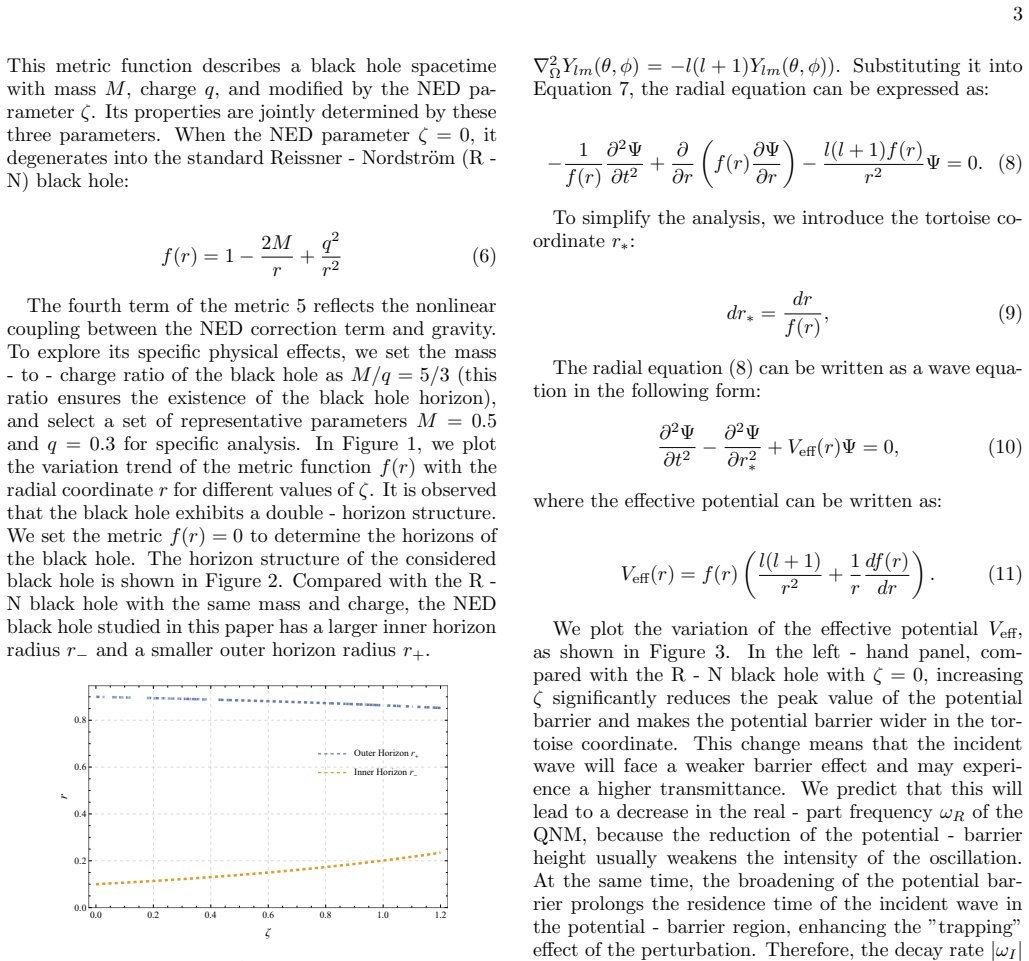
For the spacetime $f(r)=1-\frac{2M}{r}+\frac{q^2}{r^2}-\frac{4q\sqrt{q}\zeta}{3r}\ln(r)$, the paper establishes that increasing the NED parameter ζ monotonically lowers the peak of the scalar-field effective potential $V_{\rm eff}(r)=f(r)\left(\frac{l(l+1)}{r^2}+\frac{1}{r}\frac{df}{dr}\right)$ and widens it in tortoise coordinates. As a consequence, both the oscillation frequency $\omega_R$ and the decay rate $|\omega_I|$ of the fundamental and first-overtone scalar quasinormal modes decrease with ζ, with an approximately linear dependence that sharpens as the angular number $l$ grows. The imaginary part stays negative throughout the studied range, so the spacetime is claimed to remain stable. For greybody factors computed from the WKB bound $\Gamma(\omega)\ge \mathrm{sech}^2\left(\frac{1}{2\omega}\int_{r_h}^\infty V_{\rm eff}(r)dr\right)$, increasing ζ raises the transmission probability for low-frequency waves, while at high frequencies all cases approach unit transmission. The paper interprets these results as a dynamic fingerprint of the confinement-inspired logarithmic correction.
Load-bearing premise
The paper's conclusions all rest on the metric $f(r)=1-\frac{2M}{r}+\frac{q^2}{r^2}-\frac{4q\sqrt{q}\zeta}{3r}\ln(r)$ taken from Ref. [1] being a physically valid black hole spacetime, yet the logarithmic term has an unspecified dimensional scale and no energy-condition or asymptotic-flatness verification is given.
Editorial extensions
If this is right
- For fixed $(l,n)$, both $\omega_R$ and $|\omega_I|$ decrease monotonically with ζ over the range $0\le \zeta\le 1$, with an approximately linear trend that becomes more pronounced for larger $l$.
- The mode lifetime $\tau\propto 1/|\omega_I|$ lengthens as ζ increases, so ringdown signals persist longer in this spacetime than in the corresponding Reissner-Nordström black hole.
- The low-frequency greybody factor increases with ζ, implying enhanced low-energy scalar emission in Hawking radiation and a spectral peak shifted toward lower frequencies.
- The sixth-order WKB and time-domain Prony results agree within about 0.041% for $\omega_R$ and about 4.6% for $|\omega_I|$, which the paper takes as mutual verification of the two methods.
- The approximately linear relation between QNM frequency and ζ could serve as a template for constraining the NED coupling using future gravitational-wave ringdown observations.
Reading between the lines
- If the linear scaling extends beyond the studied ζ range or into the $l\to\infty$ limit, a single slope parameter per multipole could encode the NED coupling, giving a compact search template for gravitational-wave data.
- The logarithmic term $\ln(r)$ in the metric has no specified scale; writing it as $\ln(r/r_0)$ with variable $r_0$ would introduce $r_0$-dependent QNM frequencies, so the predicted linear ζ-dependence must be interpreted as a statement about a fixed scale unless the spacetime is shown to be scale-invariant.
- The monotonic decrease of $|\omega_I|$ with ζ hints at a possible stability boundary beyond the studied range, where a zero-damping or underdamped mode might appear; checking this boundary would clarify the model's domain of validity.
- The greybody-factor bound used is a strict lower bound, so the actual transmission could be larger; computing accurate transmission coefficients would sharpen the predicted Hawking spectrum and connect it to the weak-field limit.
Signed reviews
Editorial analysis
A structured set of objections, weighed in public.
Referee Report
Summary. The paper studies scalar-field perturbations of a charged black hole in a nonlinear electrodynamics model whose metric is f(r) = 1 - 2M/r + q^2/r^2 - 4q√q ζ ln(r)/(3r). The authors compute quasinormal mode (QNM) frequencies for l = 0,...,3 and n = 0,1 using sixth-order WKB and time-domain Prony methods, and report that both the oscillation frequency ω_R and the damping rate |ω_I| decrease monotonically and approximately linearly with the NED parameter ζ. They also compute a quantity they call the greybody factor using the Boonserm–Visser bound, and claim that the low-frequency transmission probability increases with ζ. The central conclusions are that increasing ζ lowers and broadens the effective potential barrier, leading to longer-lived modes and enhanced low-frequency emission.
Significance. If the QNM results are correct, they provide a concrete example of how a logarithmic NED correction to the Reissner–Nordström metric shifts the ringdown spectrum in a monotonic, nearly linear way, which could be useful for constraining ζ with future gravitational-wave observations. The paper has the virtue of using two independent numerical methods for the l = 2, n = 0 mode and presents all numerical data in tabular form. However, the greybody-factor conclusion is not supported by the evidence: the plotted quantity is a lower bound, and the integral in Eq. (17) is not written in the tortoise coordinate required by the bound. The dimensional inconsistency in ln(r) in Eq. (5) also undermines the status of the spacetime model. The QNM results are likely sound, but the paper needs substantial revision before the stated claims are justified.
major comments (3)
- [Sec. VI, Eq. (17), Fig. 7] The greybody-factor result is built on a lower bound, not the actual transmission coefficient. Equation (17) states Γ(ω) ≥ sech^2[(1/(2ω)) ∫_{r_h}^∞ V_eff(r) dr], but Fig. 7 labels the plotted quantity as "Greybody Factor Γ(ω)=|T(ω)|^2" and the text and Conclusion assert that the low-frequency greybody factor increases with ζ. A lower bound that increases with ζ does not imply that the true |T(ω)|^2 increases; the exact value could decrease while remaining above the bound. At low frequencies the sech^2 bound is exponentially small, whereas physical transmission is a power law, so the ordering in Fig. 7 may be an artifact of the bound. Moreover, the standard Boonserm–Visser bound uses the tortoise coordinate integral ∫ V(r*) dr* = ∫ V(r) dr/f(r); as written, the integral over dr is missing the 1/f factor, so it is not clear that the plotted curves satisfy the stated inequality. The greybody-factor conclusions in Sec. VI and the Hawking-radiation predictions in Sec. VII are therefore not established. The authors should either compute the actual transmission coefficient by direct integration of the radial equation or explicitly re-frame all greybody statements as statements about the bound only.
- [Sec. II, Eq. (5)] The metric function contains ln(r) with a dimensionful argument. If an implicit scale r_0 is intended, as in Eq. (2), it should appear explicitly in Eq. (5); otherwise the metric is not scale invariant and its asymptotic structure is not well defined. The paper also does not verify the energy conditions or demonstrate that the spacetime is asymptotically flat in the strict sense needed for the chosen QNM boundary conditions. Since Eq. (5) is the input for all subsequent calculations, the physical validity of the model should be established before interpreting the dynamical results.
- [Sec. IV, Table I] The cross-check between the WKB and Prony methods shows relative differences of 4.2–5.8% in the imaginary part, and it is performed only for l = 2, n = 0. The results in Tables II and III and Figs. 5 and 6 for other l and n are obtained with the WKB method alone. The statement in Sec. VII that the two methods "verify the reliability of the calculations" is stronger than the evidence supports. The authors should either extend the time-domain cross-check to at least one additional angular number (e.g., l = 0 or l = 3) or soften the reliability claim and discuss the expected WKB error for small l, where the approximation is known to be less accurate.
minor comments (5)
- [Sec. VI, text before Eq. (17)] The text says "we employ a semi-analytical WKB approximation method" for the greybody factor, but Eq. (17) is the Boonserm–Visser bound, not a WKB approximation; please correct the attribution.
- [Abstract and Sec. V] The claim of an "approximately linear" dependence of ω_R and |ω_I| on ζ is not quantified. Provide a linear fit slope, intercept, and goodness-of-fit measure, or state explicitly that the linearity is only a qualitative visual observation.
- [Sec. II, Eq. (15)] The symbol r_0 is used both for the scale in the potential (2) and for the location of the potential peak in Eq. (15). Rename the peak location to r_peak to avoid ambiguity.
- [Fig. 6 caption] The caption says "NLED parameter ζ" while the rest of the paper uses NED; please make the acronym consistent.
- [Sec. VI, Fig. 7] If the plotted curve is a lower bound rather than the exact transmission coefficient, the axis label and legend should say "Lower bound on Γ(ω)" rather than "Greybody Factor Γ(ω)=|T(ω)|^2" to avoid misleading readers.
Circularity Check
No circularity: the load-bearing steps are the externally sourced metric and standard numerical methods, with no fitted parameter renamed as a prediction.
full rationale
The paper's derivation chain is not circular. The metric function (5) is imported from the external reference [1] (Mazharimousavi), not from the present authors' prior work, and the effective potential (11) follows by direct substitution into the standard scalar-field perturbation equation. The QNM frequencies are obtained by two independent, standard methods: sixth-order WKB (Eq. (15)) and time-domain evolution with Prony extraction (Eqs. (12)-(14)). Neither method introduces a free parameter fitted to the target frequencies, and the agreement in Table I is an external cross-check rather than a construction of the result. The monotonic decrease of omega_R and |omega_I| with zeta is a numerical consequence of the input potential, not an input assumption. The greybody-factor section is the only concerning passage: Eq. (17) is explicitly an inequality, Gamma(omega) >= sech^2(...), yet Fig. 7 labels the plotted quantity as 'Greybody Factor Gamma(omega)=|T(omega)|^2' and the text asserts a monotonic increase in the true transmission coefficient. This is an overclaim or evidence-mismatch issue, not circularity, because the lower bound is computed from the same potential rather than being identified with the desired result by definition. The few self-citations in the introduction (Refs. [15,16,17]) are contextual and do not carry any load-bearing argument. Therefore the paper scores 0 on circularity, with the greybody-bound mislabeling better classified as a correctness or rigor concern.
Assumptions & free parameters
assumptions (4)
- domain assumption The NED-corrected metric f(r)=1-2M/r+q^2/r^2-4q√q ζ ln(r)/(3r) is a valid, physically meaningful black hole spacetime.
- domain assumption A massless test scalar field obeys the Klein-Gordon equation (7) and reduces to the wave equation (10) with effective potential (11).
- domain assumption The sixth-order WKB approximation (15) yields accurate QNM frequencies for the modes studied, including small l values.
- domain assumption The Boonserm-Visser bound (17) is a reliable proxy for the greybody factor.
Cite this review
Pith. "Pith review of Quasinormal Modes and Greybody Factors of Scalar Field Perturbations in the NED Corrected Charged Black Hole Spacetime." pith.science (2026). https://pith.science/paper/FJPADXVD
@misc{pith2026250412743,
  author       = {Pith},
  title        = {Pith review of: Quasinormal Modes and Greybody Factors of Scalar Field Perturbations in the NED Corrected Charged Black Hole Spacetime},
  year         = {2026},
  howpublished = {\url{https://pith.science/paper/FJPADXVD}},
  note         = {Machine review of arXiv:2504.12743}
}
abstract
Inspired by the quark-antiquark confinement potential, Mazharimousavi et al. \cite{Mazharimousavi:2023okd} proposed a nonlinear electrodynamics (NED) model, and based on this model, they constructed a charged black hole solution that includes a logarithmic correction term ($\propto \frac{\zeta \ln r}{r}$). On the basis of the Reissner-Nordstr\"om metric, this solution realizes a long-range confinement correction by introducing the NED parameter $\zeta$, providing a new theoretical perspective for explaining the anomalies in galaxy rotation curves. To deeply explore the dynamic properties of this black hole solution, this paper combines two complementary methods, namely, time-domain evolution and the WKB approximation, to calculate the quasinormal mode (QNM) spectrum of its scalar field perturbations. The research results show that the oscillation frequencies and decay rates of the low-order QNM modes decrease monotonically with the increase of the NED parameter $\zeta$, and exhibit an approximately linear dependence. The analysis of the greybody factor (GF) indicates that as $\zeta$ increases, the transmittance of the low-frequency scalar field also increases. The enhanced long-range confinement effect caused by the increase of $\zeta$ makes low-frequency perturbations more likely to survive and propagate in space-time on the one hand, and at the same time enhances the transmission ability of the low-frequency scalar field. These characteristics provide key theoretical predictions and potential observational features for testing and constraining such NED models in a strong gravitational field environment in the future using the observational data of gravitational wave astronomy or Hawking radiation.
Figures


Figures from the paper (4 more)


Forward citations
Cited by 1 Pith paper
-
Periodic Timelike Motion and Gravitational Wave Signatures around a Magnetically Charged Black Hole Surrounded by Quintessence
Quintessence shifts orbital radii, turning points, and zoom-whirl parameters for timelike geodesics around a magnetically charged black hole, producing burst-like gravitational waveforms whose phase, timing, and milli...
Reference graph
Works this paper leans on
-
[1]
has the following Lagrangian: ζ= 0 ζ= 0.3 ζ= 0.5 ζ= 0.7 ζ= 0.9 ζ= 1 0.5 1.0 1.5 2.0 2.5 3.0 - 2.0 - 1.5 - 1.0 - 0.5 0.0 0.5 1.0 r f (r) FIG. 1: Variation of the metric function f(r) with the radial coordinate r for different values of ζ, where ζ = 0 corresponds to the case of the standard R - N black hole. L =− 16 3 √ −2F +ζ ζ + p ζ2 + 4 √ −2F √ −2F 3 ζ +...
-
[2]
ζ=0.00 ζ=0.30 ζ=0.60 ζ=0.90 0.5 1.0 1.5 2.0 0.0 0.2 0.4 0.6 0.8 1.0 ωr + Greybody FactorΓ(ωr +) FIG
This is because high-energy waves can easily over- come the barrier, and their transmission behavior is then mainly determined by geometric optics, becoming insen- sitive to the specific structure of the barrier (including the modification introduced by ζ). ζ=0.00 ζ=0.30 ζ=0.60 ζ=0.90 0.5 1.0 1.5 2.0 0.0 0.2 0.4 0.6 0.8 1.0 ωr + Greybody FactorΓ(ωr +) FIG...
-
[3]
S. H. Mazharimousavi, Phys. Lett. B 841, 137948 (2023), arXiv:2305.01048 [gr-qc]
work page Pith review arXiv 2023
-
[4]
B. P. Abbott et al. (LIGO Scientific, Virgo), Phys. Rev. Lett. 116, 061102 (2016), arXiv:1602.03837 [gr-qc]
arXiv 2016
-
[5]
B. P. Abbott et al. (LIGO Scientific, Virgo), Phys. Rev. Lett. 116, 241103 (2016), arXiv:1606.04855 [gr-qc]
arXiv 2016
-
[6]
B. P. Abbott et al. (LIGO Scientific, Virgo), Phys. Rev. Lett. 119, 161101 (2017), arXiv:1710.05832 [gr-qc]
arXiv 2017
-
[7]
R. Abbott et al. (KAGRA, VIRGO, LIGO Scientific), Astrophys. J. Suppl. 267, 29 (2023), arXiv:2302.03676 [gr-qc]
arXiv 2023
-
[8]
K. Akiyama et al. (Event Horizon Telescope), Astrophys. J. Lett. 875, L1 (2019), arXiv:1906.11238 [astro-ph.GA]
arXiv 2019
Show all 57 references
-
[9]
Abbott et al
R. Abbott et al. (LIGO Scientific, KAGRA, VIRGO), As- trophys. J. Lett. 915, L5 (2021), arXiv:2106.15163 [astro- ph.HE]
2021 arXiv
-
[10]
Abbott et al
R. Abbott et al. (LIGO Scientific, Virgo), Phys. Rev. D 102, 043015 (2020), arXiv:2004.08342 [astro-ph.HE]
2020 arXiv
-
[11]
C. V. Vishveshwara, Nature 227, 936 (1970)
1970
-
[12]
Berti, V
E. Berti, V. Cardoso, and A. O. Starinets, Class. Quant. Grav. 26, 163001 (2009), arXiv:0905.2975 [gr-qc]
2009 arXiv
-
[13]
Chandrasekhar, Fundam
S. Chandrasekhar, Fundam. Theor. Phys. 9, 5 (1984)
1984
-
[14]
T. F. M. Spieksma, V. Cardoso, G. Carullo, M. Della Rocca, and F. Duque, Phys. Rev. Lett. 134, 081402 (2025), arXiv:2409.05950 [gr-qc]
2025 arXiv
-
[15]
R. A. Konoplya and A. Zhidenko, Rev. Mod. Phys. 83, 793 (2011), arXiv:1102.4014 [gr-qc]
2011 arXiv
-
[16]
Cardoso, E
V. Cardoso, E. Franzin, and P. Pani, Phys. Rev. Lett. 116, 171101 (2016), [Erratum: Phys.Rev.Lett. 117, 089902 (2016)], arXiv:1602.07309 [gr-qc]
2016 arXiv
-
[17]
D. Liu, Y. Yang, A. ¨Ovg¨ un, Z.-W. Long, and Z. Xu, Eur. Phys. J. C 83, 565 (2023), arXiv:2204.11563 [gr-qc]
2023 arXiv
-
[18]
D. Liu, Y. Yang, S. Wu, Y. Xing, Z. Xu, and Z.-W. Long, Phys. Rev. D 104, 104042 (2021), arXiv:2104.04332 [gr- qc]
2021 arXiv
-
[19]
Liang, D
J. Liang, D. Liu, H.-J. Lin, and Z.-W. Long, Eur. Phys. J. C 85, 251 (2025), arXiv:2412.07172 [gr-qc]
2025 arXiv
-
[20]
Sirera and J
S. Sirera and J. Noller, Phys. Rev. D 107, 124054 (2023), arXiv:2301.10272 [gr-qc]
2023 arXiv
-
[21]
O. J. Tattersall and P. G. Ferreira, Phys. Rev. D 99, 104082 (2019), arXiv:1904.05112 [gr-qc]
2019 arXiv
-
[22]
A. Das, A. Roy Chowdhury, and S. Gangopadhyay, Class. Quant. Grav. 41, 015018 (2024), arXiv:2306.00646 [gr-qc]
2024 arXiv
-
[23]
S. W. Hawking, Commun. Math. Phys. 43, 199 (1975), [Erratum: Commun.Math.Phys. 46, 206 (1976)]
1975
-
[24]
Oshita, JCAP 04, 013 (2023), arXiv:2208.02923 [gr- qc]
N. Oshita, JCAP 04, 013 (2023), arXiv:2208.02923 [gr- qc]
2023 arXiv
- [25]
-
[26]
Okabayashi and N
K. Okabayashi and N. Oshita, Phys. Rev. D 110, 064086 (2024), arXiv:2403.17487 [gr-qc]
2024 arXiv
-
[27]
R. F. Rosato, K. Destounis, and P. Pani, Phys. Rev. D 110, L121501 (2024), arXiv:2406.01692 [gr-qc]
2024 arXiv
-
[28]
Oshita, K
N. Oshita, K. Takahashi, and S. Mukohyama, Phys. Rev. D 110, 084070 (2024), arXiv:2406.04525 [gr-qc]
2024 arXiv
-
[29]
R. A. Konoplya and A. Zhidenko, JCAP 09, 068 (2024), arXiv:2406.11694 [gr-qc]
2024 arXiv
-
[30]
R. A. Konoplya and A. Zhidenko, Phys. Lett. B 861, 139288 (2025), arXiv:2408.11162 [gr-qc]
2025 arXiv
-
[31]
S. W. Hawking and R. Penrose, Proc. Roy. Soc. Lond. A 314, 529 (1970)
1970
-
[32]
Lectures on non-linear electrodynamics,
J. Pleba´ nski, “Lectures on non-linear electrodynamics,” (1970), reprint RX-476
1970
-
[33]
Born and L
M. Born and L. Infeld, Proc. Roy. Soc. Lond. A 144, 425 (1934)
1934
-
[34]
Ayon-Beato and A
E. Ayon-Beato and A. Garcia, Phys. Lett. B 493, 149 (2000), arXiv:gr-qc/0009077
2000 arXiv
-
[35]
Fan and X
Z.-Y. Fan and X. Wang, Phys. Rev. D 94, 124027 (2016), arXiv:1610.02636 [gr-qc]
2016 arXiv
-
[36]
M. E. Rodrigues, E. L. B. Junior, G. T. Marques, and V. T. Zanchin, Phys. Rev. D 94, 024062 (2016), [Adden- dum: Phys.Rev.D 94, 049904 (2016)], arXiv:1511.00569 [gr-qc]
2016 arXiv
-
[37]
K. A. Bronnikov, Int. J. Mod. Phys. D 27, 1841005 (2018), arXiv:1711.00087 [gr-qc]
2018 arXiv
-
[38]
Burinskii and S
A. Burinskii and S. R. Hildebrandt, Phys. Rev. D 65, 104017 (2002), arXiv:hep-th/0202066
2002 arXiv
-
[39]
Kumar, A
R. Kumar, A. Kumar, and S. G. Ghosh, Astrophys. J. 896, 89 (2020), arXiv:2006.09869 [gr-qc]
2020 arXiv
-
[40]
Atamurotov, S
F. Atamurotov, S. Shaymatov, P. Sheoran, and S. Si- wach, JCAP 08, 045 (2021), arXiv:2105.02214 [gr-qc]
2021 arXiv
-
[41]
Sucu and A
E. Sucu and A. ¨Ovg¨ un, Phys. Dark Univ. 44, 101446 (2024), arXiv:2403.07044 [gr-qc]
2024 arXiv
-
[42]
Shaymatov, B
S. Shaymatov, B. Ahmedov, M. De Laurentis, M. Jamil, Q. Wu, A. Wang, and M. Azreg-A¨ ınou, Astrophys. J. 959, 6 (2023), arXiv:2307.10804 [gr-qc]
2023 arXiv
-
[43]
Kumar Walia, Phys
R. Kumar Walia, Phys. Rev. D 110, 064058 (2024), arXiv:2409.13290 [gr-qc]
2024 arXiv
-
[44]
Rehman, G
H. Rehman, G. Abbas, T. Zhu, Q. Wu, and G. Mustafa, Eur. Phys. J. C 84, 988 (2024)
2024
-
[45]
Waseem, N
H. Waseem, N. J. L. S. Lobos, A. ¨Ovg¨ un, and R. C. Pantig, (2025), arXiv:2502.04044 [gr-qc]
2025 arXiv
-
[46]
Gundlach, R
C. Gundlach, R. H. Price, and J. Pullin, Phys. Rev. D 49, 883 (1994), arXiv:gr-qc/9307009
1994 arXiv
-
[47]
Chowdhury and N
A. Chowdhury and N. Banerjee, Phys. Rev. D 102, 124051 (2020), arXiv:2006.16522 [gr-qc]
2020 arXiv
-
[48]
Berti, V
E. Berti, V. Cardoso, J. A. Gonzalez, and U. Sperhake, Phys. Rev. D 75, 124017 (2007), arXiv:gr-qc/0701086
2007 arXiv
-
[49]
B. F. Schutz and C. M. Will, Astrophys. J. Lett. 291, L33 (1985)
1985
-
[50]
Iyer and C
S. Iyer and C. M. Will, Phys. Rev. D 35, 3621 (1987)
1987
-
[51]
Iyer, Phys
S. Iyer, Phys. Rev. D 35, 3632 (1987)
1987
-
[52]
R. A. Konoplya, Phys. Rev. D 68, 024018 (2003), arXiv:gr-qc/0303052. 9
2003 arXiv
-
[53]
Visser, Phys
M. Visser, Phys. Rev. A 59, 427 (1999), arXiv:quant- ph/9901030
1999
-
[54]
Boonserm and M
P. Boonserm and M. Visser, Phys. Rev. D 78, 101502 (2008), arXiv:0806.2209 [gr-qc]
2008 arXiv
- [55]
-
[56]
Boonserm, T
P. Boonserm, T. Ngampitipan, and P. Wongjun, Eur. Phys. J. C 79, 330 (2019), arXiv:1902.05215 [gr-qc]
2019 arXiv
-
[57]
K. D. Kokkotas and B. G. Schmidt, Living Rev. Rel. 2, 2 (1999), arXiv:gr-qc/9909058
1999 arXiv
Reviewed August 16, 2026 · model on record in the stance chip above.
Discussion (0). Continue with ORCID to comment.