REVIEW 2 major objections 5 minor 53 references
DICE: Discrete inverse continuity equation for learning population dynamics
T0 review · 2 major / 5 minor · reviewed 2026-08-06 · deepseek-v4-flash
Pith's one-line read DICE learns the smooth population-level dynamics of a stochastic process directly from sample marginals, without tracking trajectories, and provably recovers the minimal-energy drift as the time step shrinks.
desk verdict DICE is a genuinely new, well-theorized loss for population dynamics, but the claimed well-posedness of the empirical loss is not actually proven — a fixable gap, not a fatal one. read the letter →
The pith
A machine-rendered reading of the paper's core claim, the machinery that carries it, and where it could break.
The reading
What carries the argument
The key machinery is the DICE loss functional, a quadratic objective built from the time-discrete weak form of the continuity equation: $L_{\mathrm{DICE}}(s) = \sum_{j=1}^K \big[ \tfrac{t_j-t_{j-1}}{2}\big(\mathbb{E}_{\rho(t_j)}[\tfrac{1}{2}|\nabla s(t_j,\cdot)|^2] + \mathbb{E}_{\rho(t_{j-1})}[\tfrac{1}{2}|\nabla s(t_{j-1},\cdot)|^2]\big) - \tfrac{1}{2}\big(\mathbb{E}_{\rho(t_j)}[s(t_j,\cdot)+s(t_{j-1},\cdot)] - \mathbb{E}_{\rho(t_{j-1})}[s(t_j,\cdot)+s(t_{j-1},\cdot)]\big)\big]$. The paper shows that its Euler-Lagrange equations are the finite-difference weak form of the continuity equation, so minimizing the loss is equivalent to enforcing discrete mass conservation. The trapezoidal weighting of the kinetic-energy terms makes the loss exactly invariant to adding functions that are constant in space but vary in time, which removes a source of spurious gradients that destabilize training in other formulations. The Poincar\'e inequality supplies coercivity, and the uniform density bounds from the $C^2$ flow-map assumption turn the problem into an elliptic one, giving existence, uniqueness, and error bounds.
What would settle it
Run the known-potential experiment of Section 8.2 at several time spacings $\Delta t_{\max}$ with independently sampled marginals, and compare the learned $\nabla s$ to the analytic $\nabla V$: if the $L^2(\rho)$ error does not shrink roughly linearly as $\Delta t_{\max}$ is halved, Proposition 9's $O(\Delta t_{\max})$ bound is contradicted in the regime it assumes.
Extended reading notes
Core claim
The central discovery is that the inverse continuity-equation problem, learning a vector field from time marginals, can be solved by minimizing a carefully discretized quadratic loss whose Euler-Lagrange equations are exactly the finite-difference weak form of the continuity equation. Namely, the DICE loss $L_{\mathrm{DICE}}(s)$ in equation (28) has as its minimizer a potential $\hat{s}$ whose gradient $\nabla\hat{s}$ satisfies, at each observed time $t_j$, the discrete compatibility equations $(\mathbb{E}_{\rho(t_{j+1})}[\phi] - \mathbb{E}_{\rho(t_{j-1})}[\phi])/(t_{j+1}-t_{j-1}) = \mathbb{E}_{\rho(t_j)}[\nabla\hat{s}(t_j,\cdot)\cdot\nabla\phi]$. The paper proves that this minimizer is unique in the normalized function space, that the loss is invariant under adding spatially constant, time-varying functions even in discrete time, and that the resulting vector field converges to the minimal-energy gradient field with error of order $\Delta t_{\max}$ when the flow map is a $C^2$ diffeomorphism and the densities satisfy Poincar\'e-type bounds. This is established by connecting the time-discrete loss to an elliptic variational problem and using Poincar\'e inequalities to control the optimization.
Load-bearing premise
Everything rests on having time marginal snapshots that are close enough together that the density curve is locally linear, while the underlying flow stays a smooth, non-crossing map with density bounded away from zero; if any of these fails, the error guarantees stop holding.
Editorial extensions
If this is right
- If the error bound is correct, densely spaced time marginals are enough to approximate the minimal-energy drift, even when individual sample trajectories are chaotic.
- DICE training is simulation-free and avoids solving nonlinear optimal transport problems, so each optimization step only requires Monte Carlo estimates of expectations over the observed marginals.
- Generating a trajectory of sample populations with DICE requires a single pass over the physical time interval, whereas time-conditioned generative models need a separate sampling chain for each output time, leading to order-of-magnitude inference speedups.
- The invariance property of the DICE loss keeps the empirical objective bounded below under common neural-network parametrizations, preventing the divergence that can occur when training with the Action Matching loss.
- For reduced modeling, DICE can capture population-level quantities of interest such as moments even when pointwise generated sample paths differ from the original trajectories.
Reading between the lines
- The same discrete weak-form construction could be combined with higher-order finite differences or implicit time stepping, potentially improving the $O(\Delta t_{\max})$ rate while preserving the invariance property.
- An extension the paper leaves open is applying DICE to real experimental snapshot data, where trajectory information is genuinely absent; the current experiments are simulation-based, and this would be a direct test of the method's core assumption.
- The invariance to spatial constants is exact only in the population loss; with finite samples and a fixed neural-network parametrization, the empirical loss may still be biased by expressiveness limitations, so characterizing how network capacity interacts with the inferred field would be a useful follow-up.
- The entropy-regularized variant connects DICE to Fokker-Planck dynamics and SDE-based generation, but the paper leaves the choice of the regularization parameter $\epsilon$ as a hyper-parameter; a principled selection rule would make that connection practically usable.
Editorial analysis
A structured set of objections, weighed in public.
Referee Report
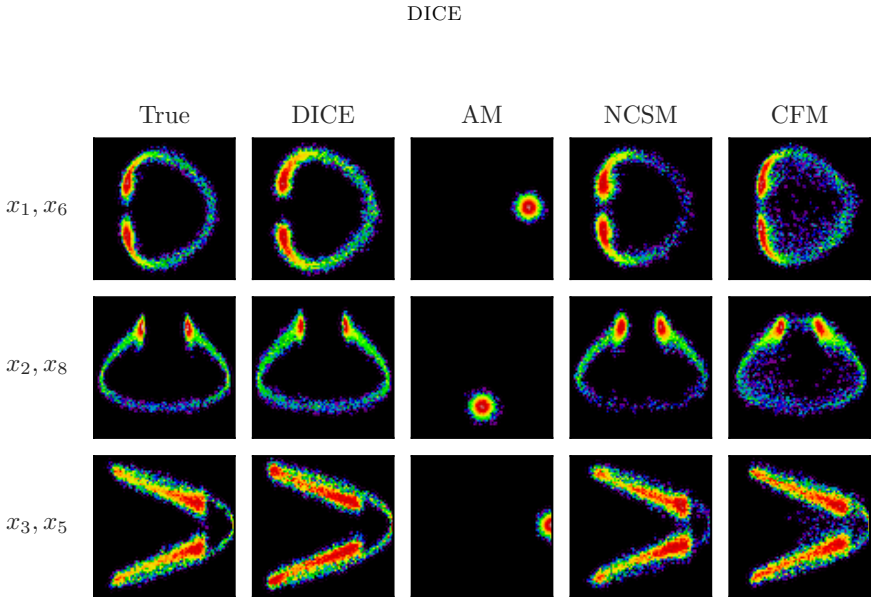
Summary. The paper proposes DICE, a loss function for learning the drift of a stochastic process from independent samples of its law at discrete times. The loss is obtained as the variational form of a time-discrete weak continuity equation; its minimizer is the discrete-time minimal-energy gradient field. The authors prove that the population loss is invariant to spatially constant, time-varying additions (Proposition 3), has a unique minimizer in the normalized space (Proposition 4), and that the minimizer approximates the true minimal-energy gradient field at order O(Δt_max) (Propositions 8 and 9), with a corresponding Wasserstein bound for the generated law (Proposition 11). They contrast DICE with Action Matching, identifying a spurious residual term in the time-discrete AM loss. Numerical experiments on a toy problem, random waves, Vlasov-Poisson instabilities, and a nine-dimensional chaotic system demonstrate stability and fast inference.
Significance. The conceptual contribution is valuable: DICE formulates population-dynamics learning as a convex, simulation-free quadratic problem with a transparent infinite-data limit, and the invariance to spurious constants is a genuinely useful design principle for empirical losses. The theoretical analysis of the population loss is mostly careful: Propositions 2–4 and 8–11 provide a coherent variational and error theory, and the proofs are detailed. The paper also ships reproducible code (GitHub) and includes falsifiable comparisons (e.g., moment predictions for random waves). The main gap is the lack of any finite-sample analysis: the well-posedness and error bounds concern the population loss only, while the actual algorithm minimizes an empirical Monte Carlo loss for which even boundedness below is not guaranteed. The numerical evidence is strong and suggests the method works in practice, but the theoretical claims in the abstract and Section 1.3 are broader than what is proved.
major comments (2)
- [Section 7.1, Eq. (70); Sections 1.3 and 4.3] The paper's well-posedness and error results (Propositions 4, 8, and 9) are proved for the population loss LDICE with exact expectations under Assumptions 1–2, but training minimizes the fully empirical loss Lhat_DICE in Eq. (70). The empirical loss is not bounded below: for K=1, fix s(t0,·) and add to s(t1,·) a sum of narrow smooth bump functions of height M centered at each t1 sample, with zero value at the t0 samples and zero gradient at the centers; the empirical gradient penalty in (70) is unchanged while the linear term decreases by M/2, so the loss tends to −∞ as M→∞. The lower-bound argument in the proof of Proposition 4 (Eq. (93)) relies on the Poincaré inequality for the exact marginals, which empirical measures do not satisfy. Consequently, the 'well-posed discrete optimization problem' claimed in Section 1.3 is not established for the objective actually used in practice, and the O(Δt_max) and Wasserstein error bounds do not transfer to the empirical minimizer.
- [Section 7.1; Sections 5.2–5.4] The manuscript contains no finite-sample error bound. The only statement is 'Replacing the expectations with empirical estimators in LDICE to obtain Lhat_DICE introduces additionally errors that depend on the number of samples.' This leaves unquantified the gap between the minimizer of the empirical loss and the true gradient field, and between the empirical and population losses. Since the method is defined by the empirical loss, the theoretical support for the method as implemented is incomplete. The authors should either state clearly that all formal claims concern the population loss and treat the empirical loss as a heuristic with numerical validation, or add a finite-sample analysis under explicit assumptions on the function class and sample sizes.
minor comments (5)
- [Section 6.3, Eq. (66)] The identity LAM(ŝθ) = LDICE(ŝθ) − θ/(2T) has a sign error; substituting fθ(t) = −θ t²/T²(1 − t/T) into (55) with trapezoidal weights gives R(fθ) = θ/2, so LAM(ŝθ) = LDICE(ŝθ) + θ/(2T) and ∇θ LAM = 1/(2T). The qualitative conclusion that the AM gradient is nonzero at the DICE optimum remains, but the displayed formulas and the subsequent gradient value should be corrected.
- [Equation (70)] The term s(x, tj−1) should read s(tj−1, x) for consistency with the surrounding notation.
- [Proof of Proposition 9, near Eq. (144)] The sentence 'When j > K−2, we can use δ̂t_{j−1}ρ_{j−1} in place of δ̂t_{j+1}ρ_{j+1}' is unclear; it should specify the boundary cases j = K−1, K explicitly.
- [Equation (45)] The displayed bound on the constant C has unbalanced parentheses and is hard to parse; please re-typeset with explicit grouping of the terms C(i), C(ii), and C(vi) from the proof.
- [Section 1.3] The phrase 'the DICE loss defines a well-posed discrete optimization problem' should be qualified to the population loss with exact expectations, in line with the major comment above; otherwise the abstract's claim 'DICE is stable to train' overstates what the theory establishes.
Circularity Check
No significant circularity: the DICE loss is a variational formulation of the discrete weak continuity equation, and the error analysis targets an independently defined minimal-energy field.
full rationale
The paper's central construction is not circular. Proposition 2 defines the DICE loss and verifies that its Euler-Lagrange equations coincide with the discrete weak continuity equation (27); this is a constructive variational formulation rather than a fitted parameter disguised as a prediction. Proposition 4 establishes existence and uniqueness of the minimizer from the Poincaré inequality and strict convexity, without invoking the target gradient field. Proposition 9 bounds the DICE minimizer against the independently defined minimal-energy gradient field ∇s* taken from standard optimal transport theory; the O(Δt_max) estimate is a consistency bound for the finite-difference discretization, with constants depending on derivatives of ρ and s*, not on any fitted quantity. The comparison with Action Matching is supported by the paper's own analytic counterexample in Section 6.3 and by Proposition 12, so the overlapping-author citation to Berman et al. (2024) is motivational and experimental rather than load-bearing. The skeptic's point that the fully empirical loss (70) is not covered by the population-loss well-posedness theory is a correctness and robustness concern, not a circularity: the theoretical derivation is self-contained even if it does not apply verbatim to the sampled objective actually minimized.
Assumptions & free parameters
free parameters (1)
- entropy regularization epsilon =
1e-2 (Vlasov-Poisson 2D); 1.25e-1 (Rayleigh-Benard)
assumptions (4)
- domain assumption Assumption 1: each marginal ρ(t) admits a density satisfying a Poincare inequality with constant λ(t) > 0.
- domain assumption Assumption 2: ρ(0) is bounded above and below and the flow map is a C^2 diffeomorphism.
- domain assumption The density ρ is twice continuously differentiable in time, with ∂tρ in L2 and L∞, and test functions in H^1_0(dx).
- domain assumption Time marginals are sampled sufficiently densely, i.e. Δt_max is small relative to the natural timescale of the density evolution.
Cite this review
Pith. "Pith review of DICE: Discrete inverse continuity equation for learning population dynamics." pith.science (2026). https://pith.science/paper/FK63ISGM
@misc{pith2026250705107,
  author       = {Pith},
  title        = {Pith review of: DICE: Discrete inverse continuity equation for learning population dynamics},
  year         = {2026},
  howpublished = {\url{https://pith.science/paper/FK63ISGM}},
  note         = {Machine review of arXiv:2507.05107}
}
read the original abstract
We introduce the Discrete Inverse Continuity Equation (DICE) method, a generative modeling approach that learns the evolution of a stochastic process from given sample populations at a finite number of time points. Models learned with DICE capture the typically smooth and well-behaved population dynamics, rather than the dynamics of individual sample trajectories that can exhibit complex or even chaotic behavior. The DICE loss function is developed specifically to be invariant, even in discrete time, to spatially constant but time-varying spurious constants that can emerge during training; this invariance increases training stability and robustness. Generating a trajectory of sample populations with DICE is fast because samples evolve directly in the time interval over which the stochastic process is formulated, in contrast to approaches that condition on time and then require multiple sampling steps per time step. DICE is stable to train, in situations where other methods for learning population dynamics fail, and DICE generates representative samples with orders of magnitude lower costs than methods that have to condition on time. Numerical experiments on a wide range of problems from random waves, Vlasov-Poisson instabilities and high-dimensional chaos are included to justify these assertions.
Figures


Figures from the paper (5 more)



Reference graph
Works this paper leans on
-
[1]
Ralph Abraham, Jerrold E. Marsden, and Tudor Ratiu. Manifolds, Tensor Analysis, and Applications. Springer, 1988
work page 1988
-
[2]
Albergo and Eric Vanden-Eijnden
Michael S. Albergo and Eric Vanden-Eijnden. Building normalizing flows with stochastic interpolants. In The Eleventh International Conference on Learning Representations, 2023
2023
-
[3]
Michael S. Albergo, Nicholas M. Boffi, and Eric Vanden-Eijnden. Stochastic interpolants: a unifying framework for flows and diffusions. arXiv, 2303.08797, 2023
arXiv 2023
-
[4]
Kathleen T. Alligood, Tim D. Sauer, and James A. Yorke. Chaos: An Introduction to Dynamical Systems. Springer, 1996
work page 1996
-
[5]
Luigi Ambrosio, Nicola Gigli, and Guiseppe Savaré. Gradient Flows . Birkhäuser-Verlag, 2005
work page 2005
-
[6]
A simple proof of the Poincaré inequality for a large class of probability measures
Dominique Bakry, Franck Barthe, Patrick Cattiaux, and Arnaud Guillin. A simple proof of the Poincaré inequality for a large class of probability measures. Electronic Communications in Probability, 13, 2008
work page 2008
-
[7]
A computational fluid mechanics solution to the Monge - Kantorovich mass transfer problem
Jean-David Benamou and Yann Brenier. A computational fluid mechanics solution to the Monge - Kantorovich mass transfer problem. Numerische Mathematik, 84 0 (3): 0 375--393, 2000
work page 2000
-
[8]
Gallouët, and François-Xavier Vialard
Jean-David Benamou, Thomas O. Gallouët, and François-Xavier Vialard. Second-order models for optimal transport and cubic splines on the Wasserstein space. Foundations of Computational Mathematics, 19 0 (5): 0 1113--1143, 2019
work page 2019
Show all 53 references
-
[9]
A survey of projection-based model reduction methods for parametric dynamical systems
Peter Benner, Serkan Gugercin, and Karen Willcox. A survey of projection-based model reduction methods for parametric dynamical systems. SIAM Review, 57 0 (4): 0 483--531, 2015
2015
-
[10]
Parametric model reduction of mean-field and stochastic systems via higher-order action matching
Jules Berman, Tobias Blickhan, and Benjamin Peherstorfer. Parametric model reduction of mean-field and stochastic systems via higher-order action matching. In The Thirty-eighth Annual Conference on Neural Information Processing Systems, 2024
2024
-
[11]
A registration method for reduced basis problems using linear optimal transport
Tobias Blickhan. A registration method for reduced basis problems using linear optimal transport. SIAM Journal on Scientific Computing, 46 0 (5): 0 A3177--A3204, 2024
2024
-
[12]
Supervised training of conditional Monge maps
Charlotte Bunne, Andreas Krause, and Marco Cuturi. Supervised training of conditional Monge maps. In S. Koyejo, S. Mohamed, A. Agarwal, D. Belgrave, K. Cho, and A. Oh, editors, Advances in Neural Information Processing Systems, volume 35, pages 6859--6872, 2022 a
2022
-
[13]
Proximal optimal transport modeling of population dynamics
Charlotte Bunne, Laetitia Papaxanthos, Andreas Krause, and Marco Cuturi. Proximal optimal transport modeling of population dynamics. In Gustau Camps-Valls, Francisco J. R. Ruiz, and Isabel Valera, editors, Proceedings of The 25th International Conference on Artificial Intellig...
2022
-
[14]
Deep momentum multi-marginal S chr\" o dinger bridge
Tianrong Chen, Guan-Horng Liu, Molei Tao, and Evangelos Theodorou. Deep momentum multi-marginal S chr\" o dinger bridge. In A. Oh, T. Naumann, A. Globerson, K. Saenko, M. Hardt, and S. Levine, editors, Advances in Neural Information Processing Systems, volume 36, pages 57058--...
2023
-
[15]
Fast and smooth interpolation on wasserstein space
Sinho Chewi, Julien Clancy, Thibaut Le Gouic, Philippe Rigollet, George Stepaniants, and Austin Stromme. Fast and smooth interpolation on wasserstein space. In Arindam Banerjee and Kenji Fukumizu, editors, Proceedings of The 24th International Conference on Artificial Intellig...
2021
-
[16]
Nonlinear model reduction on metric spaces
Virginie Ehrlacher, Damiano Lombardi, Olga Mula, and François-Xavier Vialard. Nonlinear model reduction on metric spaces. Application to one-dimensional conservative PDEs in Wasserstein spaces. ESAIM: Mathematical Modelling and Numerical Analysis, 54 0 (6): 0 2159--2197, 2020
2020
-
[17]
Second order analysis on ( P _2(M), W_2 )
Nicola Gigli. Second order analysis on ( P _2(M), W_2 ) . Number 1018 in Memoirs of the American Mathematical Society . American Mathematical Society, 2011
2011
-
[18]
Trudinger
David Gilbarg and Neil S. Trudinger. Elliptic Partial Differential Equations of Second Order, volume 224 of Classics in Mathematics . Springer Berlin Heidelberg, Berlin, Heidelberg, 2001
2001
-
[19]
Trajectory inference with smooth Schrödinger bridges
Wanli Hong, Yuliang Shi, and Jonathan Niles-Weed. Trajectory inference with smooth Schrödinger bridges. arXiv, 2503.00530, March 2025
2025 arXiv
-
[20]
Mapping of coherent structures in parameterized flows by learning optimal transportation with Gaussian models
Angelo Iollo and Tommaso Taddei. Mapping of coherent structures in parameterized flows by learning optimal transportation with Gaussian models. Journal of Computational Physics, 471: 0 111671, 2022
2022
-
[21]
The variational formulation of the Fokker -- Planck equation
Richard Jordan, David Kinderlehrer, and Felix Otto. The variational formulation of the Fokker -- Planck equation. SIAM Journal on Mathematical Analysis, 29 0 (1): 0 1--17, 1998
1998
-
[22]
Optimal transport–inspired deep learning framework for slow-decaying K olmogorov n -width problems: E xploiting S inkhorn loss and W asserstein kernel
Moaad Khamlich, Federico Pichi, and Gianluigi Rozza. Optimal transport–inspired deep learning framework for slow-decaying K olmogorov n -width problems: E xploiting S inkhorn loss and W asserstein kernel. SIAM Journal on Scientific Computing, 47 0 (2): 0 C235--C264, 2025
2025
-
[23]
Boris Kramer, Benjamin Peherstorfer, and Karen E. Willcox. Learning nonlinear reduced models from data with operator inference. Annual Review of Fluid Mechanics, 56 0 (Volume 56, 2024): 0 521--548, 2024
2024
-
[24]
Toward a mathematical theory of trajectory inference
Hugo Lavenant, Stephen Zhang, Young-Heon Kim, and Geoffrey Schiebinger. Toward a mathematical theory of trajectory inference. The Annals of Applied Probability, 34 0 (1A): 0 428 -- 500, 2024
2024
-
[25]
Deep JKO : Time -implicit particle methods for general nonlinear gradient flows
Wonjun Lee, Li Wang, and Wuchen Li. Deep JKO : Time -implicit particle methods for general nonlinear gradient flows. Journal of Computational Physics, 514: 0 113187, October 2024
2024
-
[26]
Yaron Lipman, Ricky T. Q. Chen, Heli Ben-Hamu, Maximilian Nickel, and Matthew Le. Flow matching for generative modeling. In Proceedings of the 11th International Conference on Learning Representations (ICLR), 2023
2023
-
[27]
Flow Straight and Fast : Learning to generate and transfer data with rectified flow
Xingchao Liu, Chengyue Gong, and Qiang Liu. Flow Straight and Fast : Learning to generate and transfer data with rectified flow. In The Eleventh International Conference on Learning Representations , 2023
2023
-
[28]
Edward N. Lorenz. Deterministic nonperiodic flow. Journal of Atmospheric Sciences, 20 0 (2): 0 130 -- 141, 1963
1963
-
[29]
A survey of the Schrödinger problem and some of its connections with optimal transport
Christian Léonard. A survey of the Schrödinger problem and some of its connections with optimal transport. Discrete & Continuous Dynamical Systems - A, 34 0 (4): 0 1533--1574, 2014
2014
-
[30]
Ergodicity for SDEs and approximations: locally Lipschitz vector fields and degenerate noise
Jonathan C Mattingly, Andrew M Stuart, and Desmond J Higham. Ergodicity for SDEs and approximations: locally Lipschitz vector fields and degenerate noise. Stochastic processes and their applications, 101 0 (2): 0 185--232, 2002
2002
-
[31]
Sampling in unit time with kernel F isher-rao flow
Aimee Maurais and Youssef Marzouk. Sampling in unit time with kernel F isher-rao flow. In Ruslan Salakhutdinov, Zico Kolter, Katherine Heller, Adrian Weller, Nuria Oliver, Jonathan Scarlett, and Felix Berkenkamp, editors, Proceedings of the 41st International Conference on Mac...
2024
-
[32]
Almost sure invariance principle for nonuniformly hyperbolic systems
Ian Melbourne and Matthew Nicol. Almost sure invariance principle for nonuniformly hyperbolic systems. Communications in mathematical physics, 260: 0 131--146, 2005
2005
-
[33]
Large deviations for nonuniformly hyperbolic systems
Ian Melbourne and Matthew Nicol. Large deviations for nonuniformly hyperbolic systems. Transactions of the American Mathematical Society, 360 0 (12): 0 6661--6676, 2008
2008
-
[34]
Thiéry, Kainan Wang, and Tan Bui-Thanh
Aaron Myers, Alexandre H. Thiéry, Kainan Wang, and Tan Bui-Thanh. Sequential ensemble transform for Bayesian inverse problems. Journal of Computational Physics, 427: 0 110055, February 2021
2021
-
[35]
Action Matching : Learning stochastic dynamics from samples
Kirill Neklyudov, Rob Brekelmans, Daniel Severo, and Alireza Makhzani. Action Matching : Learning stochastic dynamics from samples. In Andreas Krause, Emma Brunskill, Kyunghyun Cho, Barbara Engelhardt, Sivan Sabato, and Jonathan Scarlett, editors, Proceedings of the 40th Inter...
2023
-
[36]
OT-Flow : Fast and accurate continuous normalizing flows via optimal transport
Derek Onken, Samy Wu Fung, Xingjian Li, and Lars Ruthotto. OT-Flow : Fast and accurate continuous normalizing flows via optimal transport. Proceedings of the AAAI Conference on Artificial Intelligence, 35 0 (10): 0 9223--9232, 2021
2021
-
[37]
The geometry of dissipative evolution equations: the porous medium equation
Felix Otto. The geometry of dissipative evolution equations: the porous medium equation. Communications in Partial Differential Equations, 26 0 (1-2): 0 101--174, January 2001
2001
-
[38]
Peherstorfer
B. Peherstorfer. Breaking the Kolmogorov barrier with nonlinear model reduction. Notices of the American Mathematical Society, 69: 0 725--733, 2022
2022
-
[39]
High- Order structure-preserving algorithms for plasma hybrid models
Stefan Possanner, Florian Holderied, Yingzhe Li, Byung Kyu Na, Dominik Bell, Said Hadjout, and Yaman Güçlü. High- Order structure-preserving algorithms for plasma hybrid models. In Frank Nielsen and Frédéric Barbaresco, editors, Geometric Science of Information , volume 14072,...
2023
-
[40]
A nonparametric ensemble transform method for Bayesian inference
Sebastian Reich. A nonparametric ensemble transform method for Bayesian inference. SIAM Journal on Scientific Computing, 35 0 (4): 0 A2013--A2024, 2013
2013
-
[41]
A nine-dimensional Lorenz system to study high-dimensional chaos
Peter Reiterer, Claudia Lainscsek, Ferdinand Schürrer, Christophe Letellier, and Jean Maquet. A nine-dimensional Lorenz system to study high-dimensional chaos. Journal of Physics A: Mathematical and General, 31 0 (34): 0 7121, 1998
1998
-
[42]
Donsub Rim, Benjamin Peherstorfer, and Kyle T. Mandli. Manifold approximations via transported subspaces: Model reduction for transport-dominated problems. SIAM Journal on Scientific Computing, 45 0 (1): 0 A170--A199, 2023
2023
-
[43]
High-resolution image synthesis with latent diffusion models
Robin Rombach, Andreas Blattmann, Dominik Lorenz, Patrick Esser, and Bj\"orn Ommer. High-resolution image synthesis with latent diffusion models. In Proceedings of the IEEE/CVF Conference on Computer Vision and Pattern Recognition (CVPR), pages 10684--10695, June 2022
2022
-
[44]
Rozza, D
G. Rozza, D. B. P. Huynh, and A. T. Patera. Reduced basis approximation and a posteriori error estimation for affinely parametrized elliptic coercive partial differential equations. Archives of Computational Methods in Engineering, 15 0 (3): 0 229--275, Sep 2008
2008
-
[45]
Fast hybrid tempered ensemble transform filter formulation for Bayesian elliptical problems via Sinkhorn approximation
Sangeetika Ruchi, Svetlana Dubinkina, and Jana De Wiljes. Fast hybrid tempered ensemble transform filter formulation for Bayesian elliptical problems via Sinkhorn approximation. Nonlinear Processes in Geophysics, 28 0 (1): 0 23--41, January 2021
2021
-
[46]
Optimal Transport for Applied Mathematicians, volume 87 of Progress in Nonlinear Differential Equations and Their Applications
Filippo Santambrogio. Optimal Transport for Applied Mathematicians, volume 87 of Progress in Nonlinear Differential Equations and Their Applications . Springer International Publishing, Cham, 2015
2015
-
[47]
Generative modeling by estimating gradients of the data distribution
Yang Song and Stefano Ermon. Generative modeling by estimating gradients of the data distribution. In H. Wallach, H. Larochelle, A. Beygelzimer, F. d Alch\' e -Buc, E. Fox, and R. Garnett, editors, Advances in Neural Information Processing Systems, volume 32. Curran Associates...
2019
-
[48]
Learning diffusion at lightspeed
Antonio Terpin, Nicolas Lanzetti, Mart\' n Gadea, and Florian D\" o rfler. Learning diffusion at lightspeed. In A. Globerson, L. Mackey, D. Belgrave, A. Fan, U. Paquet, J. Tomczak, and C. Zhang, editors, Advances in Neural Information Processing Systems, volume 37, pages 6797-...
2024
-
[49]
Liouville flow importance sampler
Yifeng Tian, Nishant Panda, and Yen Ting Lin. Liouville flow importance sampler. In Ruslan Salakhutdinov, Zico Kolter, Katherine Heller, Adrian Weller, Nuria Oliver, Jonathan Scarlett, and Felix Berkenkamp, editors, Proceedings of the 41st International Conference on Machine L...
2024
-
[50]
T rajectory N et: A dynamic optimal transport network for modeling cellular dynamics
Alexander Tong, Jessie Huang, Guy Wolf, David Van Dijk, and Smita Krishnaswamy. T rajectory N et: A dynamic optimal transport network for modeling cellular dynamics. In Hal Daumé III and Aarti Singh, editors, Proceedings of the 37th International Conference on Machine Learning...
2020
-
[51]
The Lorenz attractor exists
Warwick Tucker. The Lorenz attractor exists. Comptes Rendus de l'Acad \'e mie des Sciences-Series I-Mathematics , 328 0 (12): 0 1197--1202, 1999
1999
-
[52]
Optimal transport: old and new
Cédric Villani. Optimal transport: old and new. Number 338 in Grundlehren der mathematischen Wissenschaften . Springer, Berlin, 2009
2009
-
[53]
Topics in optimal transportation
Cédric Villani. Topics in optimal transportation. Number 58 in Graduate studies in mathematics. American Mathematical Society, 2016
2016
Reviewed August 6, 2026 · model on record in the stance chip above.
Discussion (0). Continue with ORCID to comment.