REVIEW 3 major objections 6 minor 50 references
AI-in-the-Loop Sensing and Communication Joint Design for Edge Intelligence
T0 review · 3 major / 6 minor · reviewed 2026-08-07 · deepseek-v4-flash
Pith's one-line read This paper establishes an explicit upper bound on validation loss as a function of sensing batch sizes, transmission power, and gradient noise in over-the-air federated edge learning, and uses it to design a closed-loop control that…
desk verdict A promising integrated JSAC framework for edge learning, but Algorithm 1 misses the importance weights its own theory requires, so the headline gains are not covered by the analysis. read the letter →
The pith
A machine-rendered reading of the paper's core claim, the machinery that carries it, and where it could break.
The reading
What carries the argument
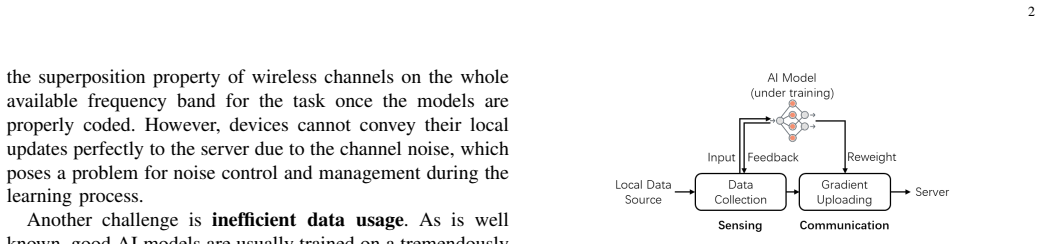
The central object is the roundwise validation-loss bound $\bar J_r$ of Theorem 1, which makes the loss an explicit function of the tunable parameters: it contains the channel denoising factor $c_r$ and the batch size $b_r$ directly, plus a generalization-error term traced back to the mutual information $I(W_r; D_r)$ between model and data. Mutual information is in turn bounded by the variance of per-sample gradients, which is what the sensing control attacks through gradient-norm importance sampling. The communication control then chooses $c_r$ and $b_r$ by balancing terms that favor small batch noise against terms that favor injected SGLD-style gradient noise, yielding a closed-form optimal power schedule. The decomposition of the original optimization into these two decoupled subproblems is what turns the bound into an algorithm.
What would settle it
Inspect the implementation of the adaptive sampling step: after resampling the collected gradient batch according to probabilities proportional to gradient norms, check whether each selected gradient is multiplied by the inverse sampling weight $p_i/q_i$ required by equation (14). A concrete test is to run this step on a synthetic batch with known gradient norms, compare the expected resampled gradient with and without the correction, and look for a nonzero bias; any detectable bias invalidates the unbiasedness premise on which Proposition 1 and Lemma 1 rely.
Extended reading notes
Core claim
On its own terms, the paper's core claim is that the validation loss of an Air-FedSGD system can be bounded from above by a roundwise sum in which the batch size, the channel-inversion power, and the per-sample gradient variance appear explicitly. The bound is derived by decomposing validation loss into empirical training loss plus generalization error, bounding the generalization error through the mutual information between the model weights and the training data, and then bounding that mutual information by gradient variance. Because the terms separate, the minimization problem splits into a sensing subproblem -- reduce gradient variance by adaptive importance sampling of newly collected data -- and a communication subproblem -- choose transmission power and batch size to balance the bound's opposing terms. The paper further claims that solving these two subproblems yields the reported simultaneous gains in communication energy, sensing cost, and generalization.
Load-bearing premise
The entire resource-saving argument assumes that the gradient estimate after the adaptive data-collection step remains correct on average; if the selected samples are not re-weighted by their inverse sampling probabilities, the variance-reduction analysis no longer applies and the claimed savings do not follow.
Editorial extensions
If this is right
- If the bound is correct, wireless-system designers can pick per-round transmission power and batch size from a closed-form expression instead of tuning them ad hoc.
- The optimal power rule $c_r^* \propto 1/\sqrt{\gamma_{r-1}}$ implies that gradients should be deliberately noisier in early training rounds and cleaner later, shifting communication energy to the rounds where it matters less.
- Adaptive stopping based on gradient variance means devices collect fewer samples without discarding any computed gradient, so the sensing saving is not bought by wasted computation.
- Because the scheme targets validation loss rather than training loss, the improvement is in generalization, not just convergence speed; the reported 58% lower validation loss is the direct payoff.
- The framework reframes noise -- channel noise and data noise -- as a controllable resource rather than an unavoidable disturbance.
Reading between the lines
- A natural extension is to allow heterogeneous devices with per-device power and batch-size controls, since the roundwise bound and the constraint structure are modular.
- The noise-injection result suggests a testable comparison against explicit regularizers such as weight decay or dropout under equal communication budgets; matching generalization gains would indicate the noise schedule is acting as an implicit regularizer.
- The gradient-variance stopping rule resembles active-learning acquisition functions; replacing the exponential-moving-average threshold with an information-theoretic stopping criterion could make the sensing control fully principled.
- The mutual-information bound is optimizer-specific, so extending the same design logic to other federated optimizers would require re-deriving the link between gradient variance and generalization for that update rule.
Editorial analysis
A structured set of objections, weighed in public.
Referee Report
Summary. The paper proposes an AI-in-the-loop joint sensing and communication design for Air-FedSGD edge learning. It aims to minimize the validation (population) loss by jointly controlling data acquisition via gradient importance sampling and communication via transmission power and batch size, drawing on an information-theoretic generalization bound for SGLD. The main analytical result is Theorem 1, an upper bound on the one-round objective as a function of tunable parameters; this is used to justify a power schedule c_r = p_n sqrt(r)/sqrt(q) and a heuristic sensing-control algorithm (Algorithm 1). Experiments on a radar-based human motion classification task and MNIST report up to 77% communication energy reduction, 52% sensing sample reduction, and 58% final validation loss reduction.
Significance. The paper addresses a timely and practically relevant problem: reducing sensing and communication costs while improving generalization in federated edge learning. If the theoretical bound and the algorithm were consistent as stated, the explicit link between validation loss and system parameters would be a valuable design guideline, and the reported gains are substantial. Strengths include the information-theoretic generalization-error analysis for SGLD, the decomposition of the problem into sensing and communication subproblems, and the use of two distinct tasks including a JSAC-specific radar sensing scenario. However, the manuscript as written does not support the strength of its claims: the importance-sampling scheme analyzed in Section IV differs from the scheme implemented in Algorithm 1, and the power and batch-size choices in the experiments rely on fitted or validation-tuned parameters rather than being determined by the derived bound.
major comments (3)
- [Section IV.C, Algorithm 1 and Eq. (14)] Algorithm 1 computes sampling probabilities q = ng / sum(ng) and resamples the gradient batch to size \bar b, but it never multiplies the selected gradients by the importance weights p_i/q_i that Eq. (14) explicitly requires. For uniform p_i = 1/b, an unbiased importance-sampling estimate requires each selected gradient to be weighted by 1/(b q_j). Without this correction, the estimator's expectation is sum_j q_j g_j, which is biased whenever gradient norms are non-uniform; for example, with g = [1, -10], the uncorrected estimator has expectation -9 instead of -4.5. Both Proposition 1 and Lemma 2 depend on unbiasedness: the text justifies Proposition 1 by stating that importance sampling is unbiased, and Lemma 2's variance-reduction gain relies on the correction in Eq. (14). Therefore, the theoretical analysis in Section IV does not cover Algorithm 1 as written. The authors should either add the correction to the pseudocode and rerun the experiments, or analyze the biased estimator actually used.
- [Section V.B, Theorem 1 and Remark 4] The closed-form optimal power c*_r = sqrt(B L p_n^2 eta^2 / (2 sigma gamma_{r-1})) depends on the unknown optimality gap gamma_{r-1} and on unmeasured constants such as L, sigma, and M_v. The implemented schedule is instead c_r = p_n sqrt(r)/sqrt(q), where q is introduced as a free parameter that "combines all of the system-specific parameters" but is never mapped to the constants in Theorem 1. Consequently, the reported communication-energy savings are partly obtained by fitting q to the same tasks used for evaluation, rather than by evaluating the derived bound. Please provide an explicit mapping between q and the bound's constants, or treat q as a hyperparameter and report sensitivity/robustness over a range, and note that the notation q conflicts with the sampling distribution q in Algorithm 1.
- [Section V.B and Section VI.C.1] The batch-size subproblem is not actually solved as claimed. In Section V.B, after Eq. (18), the text proposes "letting br = b, where q is a parameter combining all of the system-specific parameters," but the convex problem min sum 1/b_r subject to sum b_r <= Q has the equal-batch solution b_r = Q/R with no free parameter q. In the experiments, the batch size is instead selected by an exhaustive search on the radar task (Section VI.C.1 reports 32 as the best choice of b_r or \bar b), and the MNIST experiment uses the same fixed batch size. This validation-based tuning weakens the claim that the explicit validation-loss bound provides a clear guideline for choosing system parameters, and it makes the reported sensing-cost reduction dependent on a value tuned on the evaluation task. Please clarify the derivation of the batch-size rule and report sensitivity to b and \bar b, or derive these values from the theory without using validation performance.
minor comments (6)
- [Notation, Sections IV and V] The symbol q is used for both the vector of sampling probabilities in Algorithm 1 and the scalar parameter in the power schedule c_r = p_n sqrt(r)/sqrt(q) in Section V. These should be denoted by different symbols to avoid confusion.
- [Algorithm 1] The pseudocode line "Calculate the sample gradient norms ng <- [g1, ..., gb]" should read, for example, [||g1||, ..., ||gb||], since the subsequent line q = ng / sum(ng) requires scalar norms; the notation S_{n=b}(ng) is also nonstandard and should be defined.
- [Section II.C, Eq. (5)] The channel coefficients h_{k,r} are described as complex, but the power control rho_{k,r} = sqrt(c_r)/|h_{k,r}| compensates only the magnitude and not the phase of the channel. Please clarify whether channels are assumed real or whether phase compensation is performed before aggregation.
- [Section VI, figures] References such as "Figure 4a, i." and "Figure 3a, i." are vague; the panels and curves should be described explicitly so the reader can locate the claimed reductions.
- [Section VI.C.1] The sentence "An exhaustive search on powers of 2 between 1 and 1000 as batch size" is imprecise, because 1000 is not a power of 2; the search likely considered 1, 2, 4, ..., 512.
- [Section VI, settings] The total sample budgets B = 320000 and B = 160000 are introduced without explaining how they relate to the number of rounds R and the per-round batch sizes; please define R and state how the budget is allocated.
Circularity Check
No significant circularity: the validation-loss bound is derived from stated assumptions and external information-theoretic results; the heuristic sensing algorithm and hyperparameter choices are empirical, not equations from the paper's conclusion.
full rationale
The derivation chain is not circular. The paper defines the objective J in (7), derives Proposition 1 as a standard SGD descent bound, Lemma 1 as a mutual-information generalization bound attributed to the external result [35], and Theorem 1 as an explicit upper bound in the tunable parameters c_r and b_r. The optimal power schedule c*_r follows by taking the derivative of that bound; no equation in the chain is reinserted as its own conclusion. The sensing-control algorithm is explicitly labeled 'heuristic' in the conclusion and is motivated by external importance-sampling results [16], [18], not by a self-citation dependence. The reported energy, sensing, and validation-loss reductions are empirical simulation results rather than predictions forced by the derived bound. The exhaustive batch-size search and the evaluated q values are hyperparameter choices; they affect the reported comparative numbers but do not make the theoretical relationship definitionally equal to the measured output. The self-citations [12], [21], [29], [37] supply system models, constraint simplifications, and prior-version context; they are not uniqueness theorems and are not the sole support for the central validation-loss bound. The concern that Algorithm 1 omits the p_i/q_i importance-sampling correction of Eq. (14) is a soundness/implementation issue, not a circularity of the derivation.
Assumptions & free parameters
free parameters (4)
- q =
not reported, varied in simulations
- maximum batch size bar_b =
32
- EMA smoothing factor alpha =
0.1
- minimum batch size b =
4
assumptions (7)
- standard math Assumption 1: Lipschitz-continuous objective gradients
- domain assumption Assumption 2: Polyak-Łojasiewicz inequality
- domain assumption Assumption 3: First moment limits of sample gradients
- domain assumption Assumption 4: Second moment limits of sample gradients
- domain assumption Assumption 5: Sub-Gaussian objective
- domain assumption Disjoint data batches across rounds
- ad hoc to paper Unbiased importance sampling with weights p_i/q_i
Cite this review
Pith. "Pith review of AI-in-the-Loop Sensing and Communication Joint Design for Edge Intelligence." pith.science (2026). https://pith.science/paper/FKDYD3R6
@misc{pith2026250210203,
  author       = {Pith},
  title        = {Pith review of: AI-in-the-Loop Sensing and Communication Joint Design for Edge Intelligence},
  year         = {2026},
  howpublished = {\url{https://pith.science/paper/FKDYD3R6}},
  note         = {Machine review of arXiv:2502.10203}
}
read the original abstract
Recent breakthroughs in artificial intelligence (AI), wireless communications, and sensing technologies have accelerated the evolution of edge intelligence. However, conventional systems still grapple with issues such as low communication efficiency, redundant data acquisition, and poor model generalization. To overcome these challenges, we propose an innovative framework that enhances edge intelligence through AI-in-the-loop joint sensing and communication (JSAC). This framework features an AI-driven closed-loop control architecture that jointly optimizes system resources, thereby delivering superior system-level performance. A key contribution of our work is establishing an explicit relationship between validation loss and the system's tunable parameters. This insight enables dynamic reduction of the generalization error through AI-driven closed-loop control. Specifically, for sensing control, we introduce an adaptive data collection strategy based on gradient importance sampling, allowing edge devices to autonomously decide when to terminate data acquisition and how to allocate sample weights based on real-time model feedback. For communication control, drawing inspiration from stochastic gradient Langevin dynamics (SGLD), our joint optimization of transmission power and batch size converts channel and data noise into gradient perturbations that help mitigate overfitting. Experimental evaluations demonstrate that our framework reduces communication energy consumption by up to 77 percent and sensing costs measured by the number of collected samples by up to 52 percent while significantly improving model generalization -- with up to 58 percent reductions of the final validation loss. It validates that the proposed scheme can harvest the mutual benefit of AI and JSAC systems by incorporating the model itself into the control loop of the system.
Figures


Figures from the paper (4 more)


Reference graph
Works this paper leans on
-
[1]
Integrated sensing and communications: Toward dual-functional wire- less networks for 6g and beyond,
F. Liu, Y . Cui, C. Masouros, J. Xu, T. X. Han, Y . C. Eldar, and S. Buzzi, “Integrated sensing and communications: Toward dual-functional wire- less networks for 6g and beyond,” IEEE journal on selected areas in communications, vol. 40, no. 6, pp. 1728–1767, 2022. 13
work page 2022
-
[2]
Integrating sensing and communi- cations for ubiquitous iot: Applications, trends, and challenges,
Y . Cui, F. Liu, X. Jing, and J. Mu, “Integrating sensing and communi- cations for ubiquitous iot: Applications, trends, and challenges,” IEEE Network, vol. 35, no. 5, pp. 158–167, 2021
2021
-
[3]
IMT-2030 for 6G Mobile Technologies,
“IMT-2030 for 6G Mobile Technologies,” Online, International Telecommunication Union, December 1 2023, [Accessed: April 1, 2024]. [Online]. Available: https://www.itu.int/en/mediacentre/Pages/ PR-2023-12-01-IMT-2030-for-6G-mobile-technologies.aspx
work page 2023
-
[4]
Integrated sensing and edge ai: Realizing intelligent perception in 6g,
Z. Liu, X. Chen, H. Wu, Z. Wang, X. Chen, D. Niyato, and K. Huang, “Integrated sensing and edge ai: Realizing intelligent perception in 6g,” arXiv preprint arXiv:2501.06726 , 2025
arXiv 2025
-
[5]
On the View-and-Channel Aggregation Gain in Integrated Sensing and Edge AI
X. Chen, K. B. Letaief, and K. Huang, “On the view-and-channel aggregation gain in integrated sensing and edge ai,” arXiv preprint arXiv:2311.07986, 2023
work page Pith review arXiv 2023
-
[6]
G. Zhu, Z. Lyu, X. Jiao, P. Liu, M. Chen, J. Xu, S. Cui, and P. Zhang, “Pushing ai to wireless network edge: An overview on integrated sensing, communication, and computation towards 6g,” Science China Information Sciences, vol. 66, no. 3, p. 130301, 2023
work page 2023
-
[7]
Integrated sensing and communications: Background and applications,
Y . Cui, F. Liu, C. Masouros, J. Xu, T. X. Han, and Y . C. Eldar, “Integrated sensing and communications: Background and applications,” in Integrated Sensing and Communications . Springer, 2023, pp. 3–21
work page 2023
-
[8]
Communication-efficient learning of deep networks from decentralized data,
B. McMahan, E. Moore, D. Ramage, S. Hampson, and B. A. y Arcas, “Communication-efficient learning of deep networks from decentralized data,” in Artificial intelligence and statistics . PMLR, 2017, pp. 1273– 1282
2017
Show all 50 references
-
[9]
A survey of large language models,
W. X. Zhao, K. Zhou, J. Li, T. Tang, X. Wang, Y . Hou, Y . Min, B. Zhang, J. Zhang, Z. Dong et al. , “A survey of large language models,” arXiv preprint arXiv:2303.18223, 2023
2023 arXiv
-
[10]
{eSGD}: Communication efficient distributed deep learning on the edge,
Z. Tao and Q. Li, “ {eSGD}: Communication efficient distributed deep learning on the edge,” in USENIX Workshop on Hot Topics in Edge Computing (HotEdge 18) , 2018
2018
-
[11]
Fedlora: Model-heterogeneous personalized federated learning with lora tuning,
L. Yi, H. Yu, G. Wang, and X. Liu, “Fedlora: Model-heterogeneous personalized federated learning with lora tuning,” arXiv preprint arXiv:2310.13283, 2023
2023 arXiv
-
[12]
Optimized power control design for over-the-air federated edge learning,
X. Cao, G. Zhu, J. Xu, Z. Wang, and S. Cui, “Optimized power control design for over-the-air federated edge learning,” IEEE Journal on Selected Areas in Communications, vol. 40, no. 1, pp. 342–358, 2021
2021
-
[13]
Active learning literature survey,
B. Settles, “Active learning literature survey,” 2009
2009
-
[14]
Data-importance aware user scheduling for communication-efficient edge machine learning,
D. Liu, G. Zhu, J. Zhang, and K. Huang, “Data-importance aware user scheduling for communication-efficient edge machine learning,” IEEE Transactions on Cognitive Communications and Networking , vol. 7, no. 1, pp. 265–278, 2020
2020
-
[15]
Importance-aware data selection and resource allocation in federated edge learning system,
Y . He, J. Ren, G. Yu, and J. Yuan, “Importance-aware data selection and resource allocation in federated edge learning system,” IEEE Transac- tions on Vehicular Technology, vol. 69, no. 11, pp. 13 593–13 605, 2020
2020
-
[16]
Not all samples are created equal: Deep learning with importance sampling,
A. Katharopoulos and F. Fleuret, “Not all samples are created equal: Deep learning with importance sampling,” in International conference on machine learning . PMLR, 2018, pp. 2525–2534
2018
-
[17]
On optimal probabilities in stochastic coordinate descent methods,
P. Richt ´arik and M. Tak ´aˇc, “On optimal probabilities in stochastic coordinate descent methods,” Optimization Letters , vol. 10, pp. 1233– 1243, 2016
2016
-
[18]
Variance reduction in sgd by distributed importance sampling,
G. Alain, A. Lamb, C. Sankar, A. Courville, and Y . Bengio, “Variance reduction in sgd by distributed importance sampling,” arXiv preprint arXiv:1511.06481, 2015
2015 arXiv
-
[19]
Overfitting and undercomputing in machine learning,
T. Dietterich, “Overfitting and undercomputing in machine learning,” ACM computing surveys (CSUR) , vol. 27, no. 3, pp. 326–327, 1995
1995
-
[20]
History- gradient aided batch size adaptation for variance reduced algorithms,
K. Ji, Z. Wang, B. Weng, Y . Zhou, W. Zhang, and Y . Liang, “History- gradient aided batch size adaptation for variance reduced algorithms,” in International Conference on Machine Learning . PMLR, 2020, pp. 4762–4772
2020
-
[21]
To- ward ambient intelligence: Federated edge learning with task-oriented sensing, computation, and communication integration,
P. Liu, G. Zhu, S. Wang, W. Jiang, W. Luo, H. V . Poor, and S. Cui, “To- ward ambient intelligence: Federated edge learning with task-oriented sensing, computation, and communication integration,” IEEE Journal of Selected Topics in Signal Processing, vol. 17, no. 1, pp. 158–172, 2022
2022
-
[22]
Distributed joint resource optimization for federated learning task distribution,
C. Zhang, M. Dong, and K. Ota, “Distributed joint resource optimization for federated learning task distribution,” IEEE Transactions on Green Communications and Networking , vol. 7, no. 3, pp. 1457–1471, 2023
2023
-
[23]
Task-oriented over-the-air computation for multi-device edge ai,
D. Wen, X. Jiao, P. Liu, G. Zhu, Y . Shi, and K. Huang, “Task-oriented over-the-air computation for multi-device edge ai,” IEEE Transactions on Wireless Communications, 2023
2023
-
[24]
A survey of regularization strategies for deep models,
R. Moradi, R. Berangi, and B. Minaei, “A survey of regularization strategies for deep models,” Artificial Intelligence Review, vol. 53, no. 6, pp. 3947–3986, 2020
2020
-
[25]
A survey on image data augmen- tation for deep learning,
C. Shorten and T. M. Khoshgoftaar, “A survey on image data augmen- tation for deep learning,” Journal of big data , vol. 6, no. 1, pp. 1–48, 2019
2019
-
[26]
A survey of data augmentation approaches for nlp,
S. Y . Feng, V . Gangal, J. Wei, S. Chandar, S. V osoughi, T. Mitamura, and E. Hovy, “A survey of data augmentation approaches for nlp,” arXiv preprint arXiv:2105.03075, 2021
2021 arXiv
-
[27]
Time series data augmentation for deep learning: A survey,
Q. Wen, L. Sun, F. Yang, X. Song, J. Gao, X. Wang, and H. Xu, “Time series data augmentation for deep learning: A survey,” arXiv preprint arXiv:2002.12478, 2020
2002 arXiv
-
[28]
Regularization for deep learning: A taxonomy,
J. Kuka ˇcka, V . Golkov, and D. Cremers, “Regularization for deep learning: A taxonomy,” arXiv preprint arXiv:1710.10686 , 2017
2017 arXiv
-
[29]
Integrated sensing and learning for better generalized edge ai,
Z. Cai, X. Cao, Z. Zhang, Q. Chen, H. Li, X. Li, K. Han, Y . Cui, and G. Zhu, “Integrated sensing and learning for better generalized edge ai,” in 2024 IEEE 4th International Symposium on Joint Communications & Sensing (JC&S). IEEE, 2024, pp. 1–6
2024
-
[30]
Lecture notes on information theory,
Y . Polyanskiy and Y . Wu, “Lecture notes on information theory,”Lecture Notes for ECE563 (UIUC) and , vol. 6, no. 2012-2016, p. 7, 2014
2012
-
[31]
Tightening mutual information- based bounds on generalization error,
Y . Bu, S. Zou, and V . V . Veeravalli, “Tightening mutual information- based bounds on generalization error,” IEEE Journal on Selected Areas in Information Theory , vol. 1, no. 1, pp. 121–130, 2020
2020
-
[32]
Bayesian learning via stochastic gradient langevin dynamics,
M. Welling and W. Y . Teh, “Bayesian learning via stochastic gradient langevin dynamics,” Journal of Inverse and Ill-Posed Problems, vol. 22, no. 3, pp. 297–321, 2014
2014
-
[33]
On the fundamental tradeoff of integrated sensing and communications under gaussian channels,
Y . Xiong, F. Liu, Y . Cui, W. Yuan, T. X. Han, and G. Caire, “On the fundamental tradeoff of integrated sensing and communications under gaussian channels,” IEEE Transactions on Information Theory , vol. 69, no. 9, pp. 5723–5751, 2023
2023
-
[34]
Machine learning at the network edge: A survey,
M. S. Murshed, C. Murphy, D. Hou, N. Khan, G. Ananthanarayanan, and F. Hussain, “Machine learning at the network edge: A survey,” ACM Computing Surveys (CSUR) , vol. 54, no. 8, pp. 1–37, 2021
2021
-
[35]
Analyzing the gener- alization capability of sgld using properties of gaussian channels,
H. Wang, Y . Huang, R. Gao, and F. P. Calmon, “Analyzing the gener- alization capability of sgld using properties of gaussian channels,” Ad- vances in Neural Information Processing Systems , vol. 29, no. NeurIPS, pp. 24 222–24 234, 2021
2021
-
[36]
Simulation and analysis of human micro-dopplers in through-wall environments,
S. S. Ram, C. Christianson, Y . Kim, and H. Ling, “Simulation and analysis of human micro-dopplers in through-wall environments,” IEEE Transactions on Geoscience and remote sensing , vol. 48, no. 4, pp. 2015–2023, 2010
2015
-
[37]
Broadband analog aggregation for low-latency federated edge learning,
G. Zhu, Y . Wang, and K. Huang, “Broadband analog aggregation for low-latency federated edge learning,” IEEE Transactions on Wireless Communications, vol. 19, no. 1, pp. 491–506, 2019
2019
-
[38]
Dynamic computation offloading for mobile-edge computing with energy harvesting devices,
Y . Mao, J. Zhang, and K. B. Letaief, “Dynamic computation offloading for mobile-edge computing with energy harvesting devices,” IEEE Journal on Selected Areas in Communications, vol. 34, no. 12, pp. 3590– 3605, 2016
2016
-
[39]
Optimization methods for large- scale machine learning,
L. Bottou, F. E. Curtis, and J. Nocedal, “Optimization methods for large- scale machine learning,” SIAM review, vol. 60, no. 2, pp. 223–311, 2018
2018
-
[40]
On the convergence of block coordinate descent type methods,
A. Beck and L. Tetruashvili, “On the convergence of block coordinate descent type methods,” SIAM journal on Optimization , vol. 23, no. 4, pp. 2037–2060, 2013
2013
-
[41]
Parallel coordinate descent for l1-regularized loss minimization,
J. K. Bradley, A. Kyrola, D. Bickson, and C. Guestrin, “Parallel coordinate descent for l1-regularized loss minimization,” arXiv preprint arXiv:1105.5379, 2011
2011 arXiv
-
[42]
Fantastic generalization measures and where to find them,
Y . Jiang, B. Neyshabur, H. Mobahi, D. Krishnan, and S. Bengio, “Fantastic generalization measures and where to find them,” arXiv preprint arXiv:1912.02178, 2019
1912 arXiv
-
[43]
Stochastic optimization with importance sam- pling for regularized loss minimization,
P. Zhao and T. Zhang, “Stochastic optimization with importance sam- pling for regularized loss minimization,” in international conference on machine learning. PMLR, 2015, pp. 1–9
2015
-
[44]
Stochastic gradient descent, weighted sampling, and the randomized kaczmarz algorithm,
D. Needell, R. Ward, and N. Srebro, “Stochastic gradient descent, weighted sampling, and the randomized kaczmarz algorithm,” Advances in neural information processing systems , vol. 27, 2014
2014
-
[45]
Some useful moment results in sampling problems,
B. O’Neill, “Some useful moment results in sampling problems,” The American Statistician, vol. 68, no. 4, pp. 282–296, 2014
2014
-
[46]
One-bit over-the-air aggre- gation for communication-efficient federated edge learning: Design and convergence analysis,
G. Zhu, Y . Du, D. G ¨und¨uz, and K. Huang, “One-bit over-the-air aggre- gation for communication-efficient federated edge learning: Design and convergence analysis,” IEEE Transactions on Wireless Communications, vol. 20, no. 3, pp. 2120–2135, 2020
2020
-
[47]
Gradient-based learning applied to document recognition,
Y . LeCun, L. Bottou, Y . Bengio, and P. Haffner, “Gradient-based learning applied to document recognition,” Proceedings of the IEEE , vol. 86, no. 11, pp. 2278–2324, 1998
1998
-
[48]
Information-theoretic analysis of generaliza- tion capability of learning algorithms,
A. Xu and M. Raginsky, “Information-theoretic analysis of generaliza- tion capability of learning algorithms,” Advances in Neural Information Processing Systems, vol. 30, 2017
2017
-
[49]
How much does your data exploration overfit? controlling bias via information usage,
D. Russo and J. Zou, “How much does your data exploration overfit? controlling bias via information usage,” IEEE Transactions on Informa- tion Theory, vol. 66, no. 1, pp. 302–323, 2019
2019
-
[50]
Asymptotic evaluation of certain markov process expectations for large time. iv,
M. D. Donsker and S. S. Varadhan, “Asymptotic evaluation of certain markov process expectations for large time. iv,”Communications on pure and applied mathematics , vol. 36, no. 2, pp. 183–212, 1983
1983
Reviewed August 7, 2026 · model on record in the stance chip above.
Discussion (0). Sign in to comment.