REVIEW 3 major objections 6 minor 30 references
SceneLCM: End-to-End Layout-Guided Interactive Indoor Scene Generation with Latent Consistency Model
T0 review · 3 major / 6 minor · reviewed 2026-08-07 · deepseek-v4-flash
Pith's one-line read The paper claims that Consistency Trajectory Sampling, a two-term loss built on a latent consistency model, lets one text prompt produce a complete multi-room indoor scene and is provably equivalent to consistency distillation.
desk verdict A capable end-to-end scene-generation system undermined by a theoretical claim that does not cover the actual algorithm; worth reviewing but needs a major correction. read the letter →
The pith
A machine-rendered reading of the paper's core claim, the machinery that carries it, and where it could break.
The reading
What carries the argument
The central object is the Consistency Trajectory Sampling (CTS) loss, a two-term consistency-distillation sampling loss defined on the PF-ODE trajectory (the deterministic denoising path) of a pretrained latent consistency model. The first term compares the noise prediction at a noised step $x_{s\to t}$ with the prediction at the starting noised rendering $x_s$, carrying the self-consistency condition; the second term compares the prediction at $x_s$ with the fixed noise $\epsilon$, carrying the cross-consistency, score-distillation force. The weights are $w_1(t) = c_{\mathrm{out}}(t)(\sigma_t/\alpha_t)$ and $w_2(s, t) = [c_{\mathrm{out}}(t) - c_{\mathrm{out}}(s)](\sigma_s/\alpha_s)$, matching the consistency-function coefficients from the latent consistency model. Supporting machinery includes an LLM with iterative programmatic verification and cluster-based orientation assignment for layouts, 3D Gaussians for furniture, a multiresolution texture field plus normal-aware cross-attention decoder for environment optimization, a zigzag adaptive camera trajectory, and bounding-box or mesh proxies for physics editing.
What would settle it
Run Algorithm 1 while logging both terms of $L_{CTS}$ and the image distance from each rendered view to a matched real view. In the noise-removal regime ($t \le 500$), if the self-consistency term collapses while $\|x_\pi - x_0\|$ stays bounded away from zero, the off-manifold input breaks the equivalence; equivalently, halve the largest solver gap $\Delta t$ repeatedly and test whether $\|x_\pi - x_0\|$ falls roughly linearly, as Theorem 2 predicts.
Extended reading notes
Core claim
On its own terms, the paper's central discovery is a loss-design fact plus a scaffolding result. The fact: the Consistency Trajectory Sampling loss, $\mathcal{L}_{\mathrm{CTS}} = \mathbb{E}[\|w_1(t)(\epsilon_\theta(x_{s\to t}, t, y) - \epsilon_\theta(x_s, s, \varnothing))\|^2 + \|w_2(s, t)(\epsilon_\theta(x_s, s, \varnothing) - \epsilon)\|^2]$, equals the consistency distillation loss up to infinitesimal terms and a constant with $|m| \le 10^{-7}$, in the regime where the ODE solver has local error $O((\Delta t)^{p+1})$ (Theorem 1). The scaffolding result: under a Lipschitz condition on the pretrained noise predictor, if CTS has converged for every camera pose $\pi$, then the rendered image $x_\pi = g(\theta, \pi)$ satisfies $\|x_\pi - x_0\| = O(\Delta t)$ for some real image $x_0$ (Theorem 2). A corollary states that existing LCM-based text-to-3D losses, such as those of DreamLCM and Vividreamer, are special cases of CTS. The framework then uses this loss in the furniture and environment stages, claiming that it produces editable, physically simulated multi-room scenes and outperforms Text2Room, Set-the-Scene, DreamScene, and SceneCraft in a 20-participant user study.
Load-bearing premise
The proofs assume the images fed to the critic during training are properly noised renderings that still live on the model's learned denoising path, while the actual training switches to clean renderings for small timesteps (t <= 500) and drops the second CTS term, a regime the theorems do not analyze.
Editorial extensions
If this is right
- If Theorem 1 holds, any LCM-based text-to-3D loss can be reinterpreted as a partial CTS objective, so improvements to CTS should transfer to methods built on DreamLCM-style or Vividreamer-style losses.
- If Theorem 2 holds, the largest ODE solver gap $\Delta t$ becomes a fidelity dial: smaller gaps should move rendered images closer to the real-image manifold at a predictable linear rate.
- The framework implies that a full multi-room house, with distinct styles per room, can be generated from one prompt with zero manual layout work, reducing a key bottleneck for embodied-AI and AR/VR indoor environments.
- The paper's noise-removal design, feeding the clean rendering $x_\pi$ for $t \le 500$ and dropping the second CTS term, claims to cut furniture generation from about 4,000 rounds (36 minutes) to 3,000 rounds (28 minutes) while improving texture detail.
Reading between the lines
- The proof covers only the noised regime where $x_s$ lies on the LCM's ODE trajectory; a plausible reading is that the practical algorithm is a two-phase curriculum, with the noised warm-up doing true consistency distillation and the unnoised $t \le 500$ phase acting as a deterministic detail-refinement critic. A natural test is to ablate the warm-up length and check whether semantic alignment degr
- The normal-aware decoder's masking of anchors by normal direction is an implicit geometric grouping that does not need semantic labels; it could transfer to other planar mesh-texturing tasks as a cheap style-consistency prior.
- If the $O(\Delta t)$ bound holds empirically, the timestep grid could be scheduled by prescribing a target image error rather than tuned by trial and error, which would give other consistency-distillation pipelines a principled stopping rule.
Editorial analysis
A structured set of objections, weighed in public.
Referee Report
Summary. The paper proposes SceneLCM, an end-to-end pipeline for text-guided multi-room indoor scene generation. The system combines an LLM-based layout generation module with an iterative programmatic verification step, a furniture generation stage that optimizes 3D Gaussians with a proposed Consistency Trajectory Sampling (CTS) loss built on a Latent Consistency Model, a multiresolution texture field with a normal-aware cross-attention decoder for environment textures, and a physics-editing post-processing stage. The authors provide two theorems intended to show that CTS is equivalent to consistency distillation up to small terms and that convergence of CTS yields a rendered image within O(Delta t) of a real image. The paper reports qualitative comparisons, ablations, and a user study against Text2Room, Set-the-Scene, DreamScene, and SceneCraft.
Significance. If the theoretical claims held, the CTS loss would be a principled replacement for SDS-style losses in LCM-based 3D generation, and the end-to-end multi-room pipeline with physical editing would be a useful engineering contribution. The paper's strengths are its system scope: LLM-driven layout with programmatic verification, the empirically important noise-removal trick, normal-aware texture decoding, a zigzag camera trajectory adapted to varied room scales, and relatively fast generation. The evaluation includes per-component ablations, a user study, and qualitative comparisons against several recent baselines. However, the central theoretical justification is not established: the proof omits the U-Net Jacobian term without a bound, and the training algorithm explicitly deviates from the assumptions of the theorems. The empirical results are suggestive, but the paper does not demonstrate that its headline theoretical mechanism is the cause of the reported quality gains.
major comments (3)
- [Appendix 7.1.1, Eq. (18)] The step labeled (ii) states that the authors "follow DreamFusion and omit the U-Net Jacobian term in practice." This discards the Jacobian of epsilon_theta with respect to x_s without any bound, so the displayed equality L_CD = L_CTS + (-O(h^2)/alpha_{t_{n+1}}) + c_skip(t_{n+1}) O((Delta t)^{p+1}) + m with |m| <= 1e-7 does not follow. The assertions that c_skip(t) alpha_t <= 1e-7 and |c_out(t)-c_out(s)| <= 1e-7 for t >= 30 are stated without derivation, and FP16 rounding alone does not imply a deterministic bound of 1e-7 on the sum of all discarded terms. Because this equivalence is the paper's main theoretical claim, the proof must provide a quantified bound on every omitted term, including the U-Net Jacobian term.
- [Sec. 4.2 and Algorithm 1 (Supplement Sec. 7.2.2)] Theorems 1 and 2 assume that the consistency-critic input is x_s = alpha_s x_pi + sigma_s epsilon and that both terms of L_CTS are used. Algorithm 1, however, sets x_s = x_pi (no noise) for iterations after the warm-up stage and, for the regime described as t <= 500, drops the second term w_2(s,t)(epsilon_theta(x_s,s,empty) - epsilon) by setting its gradient to zero. The ablation in Sec. 7.6.2 states that noise removal is critical for speed and detail (3,000 rounds versus 4,000 rounds), so this is not an idle implementation detail. The paper needs either a theorem that covers the noiseless, single-term objective actually optimized, or an explicit statement that the theoretical equivalence applies only to a warm-up variant and not to the deployed loss.
- [Sec. 4.2, Theorem 2 and Appendix Theorem 4] Theorem 2 concerns convergence of L_CTS alone, but Algorithm 1 optimizes L_CTS jointly with L_scale, L_layout, and L_normal, and the proof of Theorem 2 assumes L_CTS = 0 exactly for all steps. No argument is given that the fixed point of the combined loss satisfies this premise, nor that the optimizer reaches a zero of L_CTS. The theorem is a conditional statement about an idealized loss; as written, it does not establish the behavior of the reported system, which minimizes a multi-term objective and stops after a finite schedule.
minor comments (6)
- [Sec. 4.2, Eq. (5)] The second epsilon_theta in Eq. (5) is written as epsilon_theta(x_s, s, ,empty) with an extra comma, and the empty-condition notation alternates between "empty" and "emptyset"; please standardize the notation.
- [Eq. (6) vs. Appendix Eq. (10)] The main text states L_CD = L_CTS + O((Delta t)^2) + m, while the appendix theorem states L_CD = L_CTS + o((Delta t)^2) + m; these are different asymptotic statements and should be reconciled.
- [Table 1] Table 1 is difficult to read: the column headers "Editing Physics Multi-room Time (h) User Study" are not aligned with the checkmarks and numeric entries, and the user-study scores are reported without error bars or a significance test.
- [Sec. 5.2] The user study uses 20 participants and 3 scenes of 15 seconds; this is a small sample, so the claim that SceneLCM is "far ahead" should be supported by a significance test or confidence intervals.
- [Main text and Supplement] The main text numbers the theorems as Theorem 1 and Theorem 2, while the appendix numbers them as Theorem 3 and Theorem 4; please use a single consistent numbering scheme.
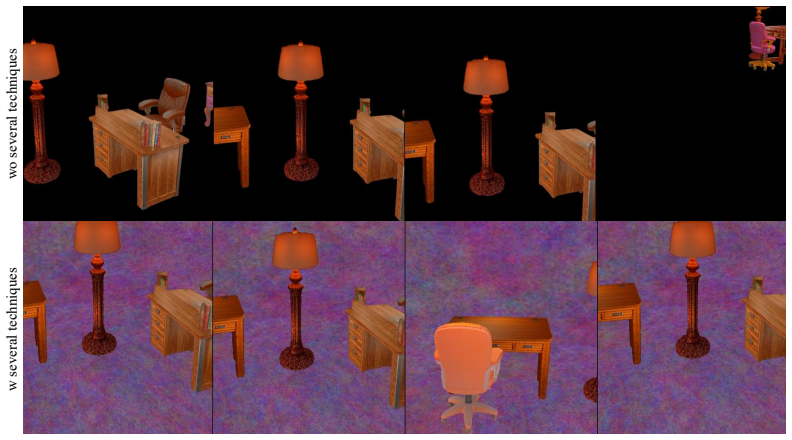
- [Supplement Sec. 7.6.3] The heading "Ablation Study of servel techniques" contains a typo; it should read "several techniques."
Circularity Check
No significant circularity: the CTS derivation is an algebraic manipulation of the consistency loss, not an input recycled as a prediction.
full rationale
The paper's central derivation is self-contained in the sense required by the circularity checklist. The Consistency Trajectory Sampling loss (Eq. 5) is explicitly constructed as a rearrangement of the consistency-distillation loss: the proof in Appendix 7.1.1 expands L_CD into three terms and identifies the combination that yields L_CTS, with the residual terms classified as infinitesimal or bounded by m. This is a symbolic derivation from an external, pre-existing definition (Song et al.'s consistency loss and Luo et al.'s latent consistency model), not a fitted parameter or a quantity defined in terms of the paper's own output. Theorems 2 and 4 are conditional statements: assuming convergence of L_CTS and Lipschitz continuity of the noise predictor, the error-propagation argument bounds the distance to a clean image by the Euler solver truncation error. The rendered image x_pi appears as the object being optimized, not as a fitted input that is later renamed as a prediction. No load-bearing self-citation was found: prior work by the same authors (e.g., Fantasia3D) is cited only as related text-to-3D context, while the consistency-model machinery is attributed to external sources. The deviations noted in the manuscript, such as the noise-removal stage in Algorithm 1 and the omission of the U-Net Jacobian following DreamFusion, are potential correctness or rigor gaps because they mean the theorems may not cover the exact loss optimized; however, they do not make the derivation circular, because the paper does not assume the conclusion it purports to prove. Any concerns about these gaps are correctness risks, not evidence of circularity, and therefore the appropriate circularity score is 0.
Assumptions & free parameters
free parameters (4)
- Noise-removal threshold and warm-up schedule =
t_cut=500; warm-up rounds not fully specified
- Zigzag camera trajectory parameters =
unspecified
- Loss weights for L_CTS, Lscale, Lnormal, Llayout =
not reported
- Object-removal fraction in environment training =
0.5
assumptions (5)
- domain assumption Pretrained LCM noise predictor epsilon_theta is a valid consistency critic for rendered 3DGS and texture-field images.
- standard math DPM-Solver local error is O((Delta t)^(p+1)) with p>=1, and epsilon_theta is Lipschitz.
- ad hoc to paper The U-Net Jacobian term may be omitted, and FP16/device rounding makes residual terms m, c_skip(t)alpha_t, and (cout(tn)-cout(tn+1))(sigma_tn/alpha_tn) negligible.
- domain assumption Fused z-buffer rendering of furniture and layout gives a faithful image for diffusion scoring.
- domain assumption Point-E-initialized 3D Gaussians contain enough geometric structure for the text prompt.
Cite this review
Pith. "Pith review of SceneLCM: End-to-End Layout-Guided Interactive Indoor Scene Generation with Latent Consistency Model." pith.science (2026). https://pith.science/paper/FKIRKTDO
@misc{pith2026250607091,
  author       = {Pith},
  title        = {Pith review of: SceneLCM: End-to-End Layout-Guided Interactive Indoor Scene Generation with Latent Consistency Model},
  year         = {2026},
  howpublished = {\url{https://pith.science/paper/FKIRKTDO}},
  note         = {Machine review of arXiv:2506.07091}
}
read the original abstract
Our project page: https://scutyklin.github.io/SceneLCM/. Automated generation of complex, interactive indoor scenes tailored to user prompt remains a formidable challenge. While existing methods achieve indoor scene synthesis, they struggle with rigid editing constraints, physical incoherence, excessive human effort, single-room limitations, and suboptimal material quality. To address these limitations, we propose SceneLCM, an end-to-end framework that synergizes Large Language Model (LLM) for layout design with Latent Consistency Model(LCM) for scene optimization. Our approach decomposes scene generation into four modular pipelines: (1) Layout Generation. We employ LLM-guided 3D spatial reasoning to convert textual descriptions into parametric blueprints(3D layout). And an iterative programmatic validation mechanism iteratively refines layout parameters through LLM-mediated dialogue loops; (2) Furniture Generation. SceneLCM employs Consistency Trajectory Sampling(CTS), a consistency distillation sampling loss guided by LCM, to form fast, semantically rich, and high-quality representations. We also offer two theoretical justification to demonstrate that our CTS loss is equivalent to consistency loss and its distillation error is bounded by the truncation error of the Euler solver; (3) Environment Optimization. We use a multiresolution texture field to encode the appearance of the scene, and optimize via CTS loss. To maintain cross-geometric texture coherence, we introduce a normal-aware cross-attention decoder to predict RGB by cross-attending to the anchors locations in geometrically heterogeneous instance. (4)Physically Editing. SceneLCM supports physically editing by integrating physical simulation, achieved persistent physical realism. Extensive experiments validate SceneLCM's superiority over state-of-the-art techniques, showing its wide-ranging potential for diverse applications.
Figures


Figures from the paper (30 more)


Reference graph
Works this paper leans on
-
[1]
Josh Achiam, Steven Adler, Sandhini Agarwal, Lama Ahmad, Ilge Akkaya, Florencia Leoni Aleman, Diogo Almeida, Janko Altenschmidt, Sam Altman, Shyamal Anadkat, et al. Gpt-4 technical report. arXiv preprint arXiv:2303.08774,
-
[2]
+m h=log( αtn σtn )−log( αtn+1 σtn+1 ) (10) Proof The proof is based on the formulation defined in Latent Consistency ModelLuo et al. [2023]. We have fθ(x, t) =c skip(t)x+c out(t)Fθ(xt, t), where Fθ(xt, t) = xt−σtϵθ(xt,t) αt , cskip(t) = σ2 ( t 0.1 )2+σ2 , cout(t) = t 0.1√ ( t 0.1 )2+σ2 , and σ= 1
work page 2023
-
[3]
Language models are few-shot learners.Advances in neural information processing systems, 33:1877–1901,
Tom Brown, Benjamin Mann, Nick Ryder, Melanie Subbiah, Jared D Kaplan, Prafulla Dhariwal, Arvind Neelakantan, Pranav Shyam, Girish Sastry, Amanda Askell, et al. Language models are few-shot learners.Advances in neural information processing systems, 33:1877–1901,
1901
-
[8]
2d gaussian splatting for geometrically accurate radiance fields
Binbin Huang, Zehao Yu, Anpei Chen, Andreas Geiger, and Shenghua Gao. 2d gaussian splatting for geometrically accurate radiance fields. InACM SIGGRAPH 2024 conference papers, pages 1–11, 2024a. Yukun Huang, Jianan Wang, Yukai Shi, Boshi Tang, Xianbiao Qi, and Lei Zhang. Dreamtime: An improved optimization strategy for diffusion-guided 3d generation. InThe...
arXiv 2024
-
[9]
Deepseek-v3 technical report.arXiv preprint arXiv:2412.19437,
Aixin Liu, Bei Feng, Bing Xue, Bingxuan Wang, Bochao Wu, Chengda Lu, Chenggang Zhao, Chengqi Deng, Chenyu Zhang, Chong Ruan, et al. Deepseek-v3 technical report.arXiv preprint arXiv:2412.19437,
-
[11]
Alex Nichol, Heewoo Jun, Prafulla Dhariwal, Pamela Mishkin, and Mark Chen. Point-e: A system for generating 3d point clouds from complex prompts.arXiv preprint arXiv:2212.08751,
-
[14]
Score jacobian chaining: Lifting pretrained 2d diffusion models for 3d generation
Haochen Wang, Xiaodan Du, Jiahao Li, Raymond A Yeh, and Greg Shakhnarovich. Score jacobian chaining: Lifting pretrained 2d diffusion models for 3d generation. InProceedings of the IEEE/CVF conference on computer vision and pattern recognition, pages 12619–12629, 2023a. Qi Wang, Ruijie Lu, Xudong Xu, Jingbo Wang, Michael Yu Wang, Bo Dai, Gang Zeng, and Dan...
-
[15]
Consistent flow distillation for text-to-3d generation
Runjie Yan, Yinbo Chen, and Xiaolong Wang. Consistent flow distillation for text-to-3d generation. arXiv preprint arXiv:2501.05445,
Show all 30 references
-
[16]
Rade-gs: Rasterizing depth in gaussian splatting.arXiv preprint arXiv:2406.01467, 2024a
13 Baowen Zhang, Chuan Fang, Rakesh Shrestha, Yixun Liang, Xiaoxiao Long, and Ping Tan. Rade-gs: Rasterizing depth in gaussian splatting.arXiv preprint arXiv:2406.01467, 2024a. Biao Zhang, Jiapeng Tang, Matthias Niessner, and Peter Wonka. 3dshape2vecset: A 3d shape representat...
-
[17]
Hifa: High-fidelity text-to-3d generation with ad- vanced diffusion guidance
Junzhe Zhu, Peiye Zhuang, and Sanmi Koyejo. Hifa: High-fidelity text-to-3d generation with ad- vanced diffusion guidance. InThe Twelfth International Conference on Learning Representations. 14 7 Supplement Detail • Theoretical Proof 7.1.1 • Pipeline Detail 7.2 • Discussion for...
2023
-
[19]
Proof 1: Proof Given LCT S(ξ) = 0, for any t, s, we have ϵ(xs→t, t) =ϵθ(xs, s)and T≥t n ≥t n−1 ≥0 . AssumeGis DPM solver and follow the first-order definition of DPM-Solver, givene, we have: G(xs→t, t, e) =αe αt xs→t −σ e(e−h −1)ϵ θ(xs→t, t) = αe αt xs→t −α e( σt αt − σe αe )ϵ...
2023
-
[20]
Therefor, we can drive the error recursively: ||eT || ≤ N−1X i=1 O((ti −t i−1)2) ≤ N−1X i=1 (ti −t i−1)O((△)) ≤O((△))(T−ξ) (29) The proof is completed
≤(L+ 1)O((t n −t n+1)2) +||e n−1|| =||en−1||+O((t n −t n+1)2) (28) 19 where (vi) and (vii) hold according to the Lipschitz condition and local error of Euler solver respectively. Therefor, we can drive the error recursively: ||eT || ≤ N−1X i=1 O((ti −t i−1)2) ≤ N−1X i=1 (ti −t...
2024
-
[21]
Consistent3DWu et al
can ensures both self-consistency and cross- consistency. Consistent3DWu et al. [2024b] and CCDLi et al. [2024b] drive the inspiration from Consistency modelSong et al. [2023], however, they are still trained based on Stable Diffusion-2-1Ho et al. [2020]. Hence, we merely cons...
2023
-
[22]
[2024b] that based on LCMLuo et al
and VividdreamerChen et al. [2024b] that based on LCMLuo et al. [2023]. ProofDreamLCMZhong et al. [2024]: LDreamLCM =E t,c[w(t)(ϵθ(xt, t)−ϵ)∂g(θ, c) ∂θ ](30) wherex t is obtained by Euler Solver fromx s andx s =α sxπ +σ sϵ,ϵ∈N(0, I). VividreamerChen et al. [2024b]: Lvividreame...
2023
-
[23]
When a location overlapping occurs, we reuse the LLM to adjust
(2) To change the orientation of an furniture, it is necessary to rotate it. When a location overlapping occurs, we reuse the LLM to adjust. (3) The furniture at the center of the group will serve as the reference object. For example, furniture and in the left figure. 9 13 Fig...
2024
-
[24]
as the based model to enhance the SDS lossPoole et al. [2022]. Therefore, these models only adopt the concept of consistency modelWu et al. [2024b], Li et al. [2024b] or employ the consistency model as based modelZhong et al. [2024], Chen et al. [2024b], but fail to conduct in...
2022
-
[25]
Our CTS loss effectively resolves these issues
that act on the predicted noise ϵθ(·;·) . Our CTS loss effectively resolves these issues. 25 Algorithm.It is worth noting that w2(s, t)tends to zero as t decreases. Hence we remove the second term when t≤500 . Additionally, we employ Lscale, Llayout, and Lnormal for detail. Ne...
2024
-
[26]
• For more precise physics simulation, we employ RadeGSZhang et al
and export the translation and rotation matrix. • For more precise physics simulation, we employ RadeGSZhang et al. [2024a] to extract the mesh, which is then utilized as a proxy for conducting the physical simulation. 7.3 Discussion for Related Work 7.3.1 Indoor Scene Generat...
2023
-
[27]
Additionally, Consistent3d is a two stage method and our method is one step
as 3D representation that ray tracing methods can not incorporate into our framework. Additionally, Consistent3d is a two stage method and our method is one step. Hence, we did not compare this methods. • CFDYan et al. [2025]: CFD and Consistent3D initialize 3D model by MVDrea...
2025
-
[28]
• Physically plausible editing for multi-objects
• We provide additional visual results for both environments and objects. • Physically plausible editing for multi-objects. As shown in Figure 21, our model adheres to physical laws during the editing process. • Editing 7.5.1 Comparative Experiments on Layout To ensure fairnes...
2024
-
[29]
Additionally, InstructScene did not generate walls, which were manually created by us
generate a json file for saving bounding box of objects, we directly plot these bounding box in blenderCommunity [2018]. Additionally, InstructScene did not generate walls, which were manually created by us. As shown in Figure 20, our methods can generate more furniture and en...
2018
-
[30]
an office chair
• Furniture Editing: –Create –Delete –Remove –Update 7.6 Ablation Study 7.6.1 layout generation • Iteractive Programmatic Verification Mechanism: As shown in Figure 20, without our proposed method, we would encounter the same issue as anyhomeFu et al. [2024], where partial fur...
2024
-
[2018]
Wei Deng, Mengshi Qi, and Huadong Ma
URLhttp://www.blender.org. Wei Deng, Mengshi Qi, and Huadong Ma. Global-local tree search in vlms for 3d indoor scene generation.arXiv preprint arXiv:2503.18476,
-
[2019]
Dreamfusion: Text-to-3d using 2d diffusion.arXiv preprint arXiv:2209.14988,
Ben Poole, Ajay Jain, Jonathan T Barron, and Ben Mildenhall. Dreamfusion: Text-to-3d using 2d diffusion.arXiv preprint arXiv:2209.14988,
-
[2020]
Scenetex: High-quality texture synthesis for indoor scenes via diffusion priors
10 Dave Zhenyu Chen, Haoxuan Li, Hsin-Ying Lee, Sergey Tulyakov, and Matthias Nießner. Scenetex: High-quality texture synthesis for indoor scenes via diffusion priors. InProceedings of the IEEE/CVF Conference on Computer Vision and Pattern Recognition, pages 21081–21091, 2024a...
-
[2021]
Latent consistency models: Synthesizing high-resolution images with few-step inference.arXiv preprint arXiv:2310.04378,
Simian Luo, Yiqin Tan, Longbo Huang, Jian Li, and Hang Zhao. Latent consistency models: Synthesizing high-resolution images with few-step inference.arXiv preprint arXiv:2310.04378,
-
[2022]
Accelerating 3d deep learning with pytorch3d.arXiv:2007.08501,
Nikhila Ravi, Jeremy Reizenstein, David Novotny, Taylor Gordon, Wan-Yen Lo, Justin Johnson, and Georgia Gkioxari. Accelerating 3d deep learning with pytorch3d.arXiv:2007.08501,
2007 arXiv
-
[2023]
Re-imagine the negative prompt algorithm: Transform 2d diffusion into 3d, alleviate janus problem and beyond.arXiv preprint arXiv:2304.04968,
Mohammadreza Armandpour, Ali Sadeghian, Huangjie Zheng, Amir Sadeghian, and Mingyuan Zhou. Re-imagine the negative prompt algorithm: Transform 2d diffusion into 3d, alleviate janus problem and beyond.arXiv preprint arXiv:2304.04968,
-
[2024]
Deepseek-r1: Incentivizing reasoning capability in llms via reinforcement learning.arXiv preprint arXiv:2501.12948,
Daya Guo, Dejian Yang, Haowei Zhang, Junxiao Song, Ruoyu Zhang, Runxin Xu, Qihao Zhu, Shirong Ma, Peiyi Wang, Xiao Bi, et al. Deepseek-r1: Incentivizing reasoning capability in llms via reinforcement learning.arXiv preprint arXiv:2501.12948,
-
[2025]
Classifier-free diffusion guidance
Jonathan Ho and Tim Salimans. Classifier-free diffusion guidance. InNeurIPS 2021 Workshop on Deep Generative Models and Downstream Applications,
2021
Reviewed August 7, 2026 · model on record in the stance chip above.
Discussion (0). Sign in to comment.