REVIEW 1 major objections 1 cited by
Perturbative Nicolai-Map Diagrammatics: Application to Poincar\'{e} Supergravity
T0 review · 1 major / 0 minor · reviewed 2026-06-29 · grok-4.3
Pith's one-line read Einstein gravity admits a Nicolai map only through its N=1 supersymmetric completion to Poincaré supergravity.
desk verdict The paper gives a workable diagrammatic method for building Nicolai maps order by order in Poincaré supergravity and finds the gravitino is required at κ² for the Einstein-Hilbert sector to satisfy the conditions. read the letter →
The pith
A machine-rendered reading of the paper's core claim, the machinery that carries it, and where it could break.
The reading
What carries the argument
Perturbative Nicolai-map diagrammatics that uses effective-action diagrams to enumerate local terms in the ansatz and solves the resulting system of nonlinear polynomial equations order by order in the joint kappa and hbar expansion.
What would settle it
An explicit check that the system of polynomial equations for the map coefficients at order kappa squared possesses no solution once all gravitino-dependent diagrams are removed from the effective action.
Extended reading notes
Core claim
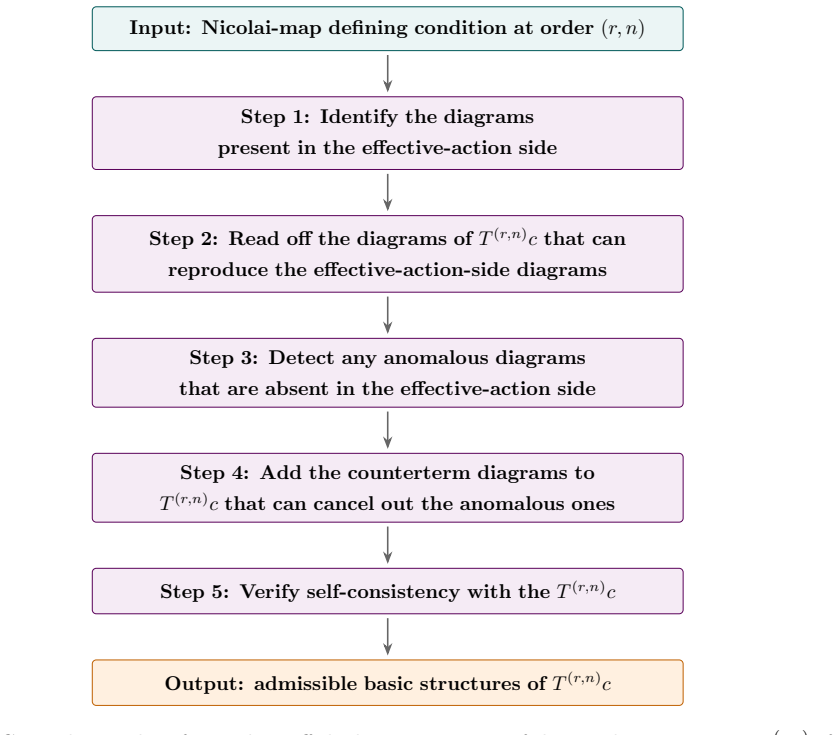
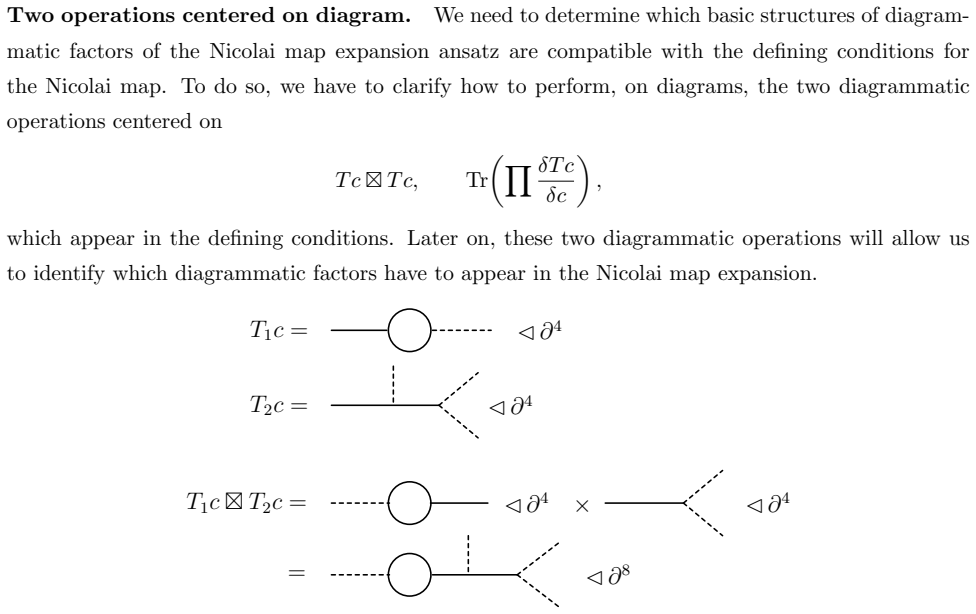
Expanding the bosonic effective action and the Nicolai map jointly in kappa and hbar, the free-action and determinant-matching conditions are derived order by order. The diagrammatics enumerates all admissible local terms in the map ansatz from the effective-action diagrams and reduces the problem to a finite system of nonlinear polynomial equations. Carried through order kappa squared, the constraints are found to be independent of the detailed bosonic input and hierarchical, with order-kappa-squared consistency further restricting the order-kappa data. A consistent Nicolai-map construction for the Einstein-Hilbert graviton sector requires the Rarita-Schwinger gravitino already at this orde
Load-bearing premise
The free-action and determinant-matching conditions must be imposed order by order in the joint kappa and hbar expansion, and the effective-action diagrams capture every admissible local term in the Nicolai-map ansatz without omission.
Editorial extensions
If this is right
- The order-kappa-squared consistency conditions restrict the allowed values of the order-kappa coefficients in the map ansatz.
- The constraints derived at this order do not depend on the specific form of the bosonic interactions beyond the Einstein-Hilbert term.
- A perturbative Nicolai map can be constructed consistently for the full supergravity multiplet that includes the gravitino.
- The hierarchical structure implies that higher-order calculations will further constrain the lower-order map data.
Reading between the lines
- The same diagrammatic reduction to polynomial equations might apply directly to other locally supersymmetric theories expanded around flat space.
- If the pattern persists at higher orders, it would indicate that supersymmetry is required for Nicolai maps in any gravitational theory rather than an artifact of truncation.
- One could test the method on supergravity coupled to additional matter multiplets to see whether the gravitino requirement remains or is modified.
Signed reviews
Editorial analysis
A structured set of objections, weighed in public.
Referee Report
Summary. The paper develops a perturbative diagrammatic framework for constructing Nicolai maps in four-dimensional N=1 Poincaré supergravity expanded around flat space. It jointly expands the bosonic effective action and the Nicolai map in the gravitational coupling κ and ħ, derives the free-action and determinant-matching conditions order by order, and reduces the construction to a finite system of nonlinear polynomial equations via diagrammatic enumeration of local terms in the map ansatz. Carried to order κ², the constraints are reported to be independent of detailed bosonic input and hierarchical; the central result is that a consistent Nicolai map for the Einstein-Hilbert graviton sector requires the Rarita-Schwinger gravitino already at this order, so that Einstein gravity admits such a map only through its N=1 supersymmetric completion.
Significance. If the result holds, the work supplies concrete perturbative evidence supporting Nicolai's characterization of supersymmetry as necessary for Nicolai maps in gravity. The diagrammatic method provides a viable alternative to the coupling-flow-operator approach and yields the noteworthy feature that the derived constraints are independent of the detailed bosonic input while remaining hierarchical. The reduction of the problem to a finite polynomial system at each order is a clear technical strength.
major comments (1)
- [Abstract] Abstract: the central claim that Einstein gravity admits no Nicolai map at order κ² while its N=1 completion does rests on the assertion that 'the diagrammatics enumerates all admissible local terms in the Nicolai-map ansatz' and thereby produces a complete coefficient space for the free-action and determinant-matching conditions. No explicit completeness argument is supplied showing that every local operator permitted by diffeomorphism invariance (for example, curvature-squared or higher-derivative structures not generated by the listed effective-action diagrams) is captured; an omission would render the no-solution result for pure gravity an artifact of an incomplete ansatz.
Simulated Author's Rebuttal
We are grateful to the referee for their thorough review and for recognizing the significance of our perturbative diagrammatic approach to Nicolai maps in supergravity. We provide a point-by-point response to the major comment below.
read point-by-point responses
-
Referee: [Abstract] Abstract: the central claim that Einstein gravity admits no Nicolai map at order κ^{2} while its N=1 completion does rests on the assertion that 'the diagrammatics enumerates all admissible local terms in the Nicolai-map ansatz' and thereby produces a complete coefficient space for the free-action and determinant-matching conditions. No explicit completeness argument is supplied showing that every local operator permitted by diffeomorphism invariance (for example, curvature-squared or higher-derivative structures not generated by the listed effective-action diagrams) is captured; an omission would render the no-solution result for pure gravity an artifact of an incomplete ansatz.
Authors: We thank the referee for highlighting this important aspect of our construction. The Nicolai-map ansatz is not chosen arbitrarily among all diffeomorphism-invariant local operators; rather, it is systematically derived by enumerating the local terms that appear in the perturbative expansion of the effective action via the listed diagrams at each order in κ and ħ. The free-action and determinant-matching conditions are imposed on this effective action, so only the terms generated by those diagrams enter the equations at the order considered. Additional operators permitted by symmetry but absent from the effective-action diagrams at order κ^{2} would not contribute to the interaction terms being matched and thus cannot alter the solvability of the system at this perturbative order. The observed independence of the constraints from the detailed bosonic input and their hierarchical structure further indicate that the enumerated system is closed and complete for the purposes of our analysis. We maintain that the no-solution result for the pure Einstein-Hilbert sector is robust within the perturbative framework. No changes to the manuscript are required. revision: no
Circularity Check
No circularity; construction solves independent polynomial system from diagram-generated ansatz
full rationale
The paper constructs the Nicolai map by expanding both the bosonic effective action and the map ansatz in joint powers of κ and ħ, then imposes the free-action and determinant-matching conditions order by order. The diagrammatics supplies the admissible local operators in the ansatz directly from the effective-action diagrams of the given theory; the resulting finite nonlinear system is solved for the map coefficients. This is a standard perturbative matching procedure whose output (the necessity of the gravitino for consistency at κ²) is not identical to the input action or diagrams by construction. No self-definitional re-use of the target result, no fitted parameter renamed as prediction, and no load-bearing self-citation appear. The completeness assertion for the enumerated operators is an explicit methodological claim rather than a hidden tautology that forces the central conclusion.
Assumptions & free parameters
assumptions (2)
- domain assumption The Nicolai map and effective action can be jointly expanded perturbatively in the gravitational coupling κ and the loop-counting parameter ħ
- ad hoc to paper The diagrammatics from effective-action diagrams enumerates all admissible local terms in the Nicolai-map ansatz
Cite this review
Pith. "Pith review of Perturbative Nicolai-Map Diagrammatics: Application to Poincar\'{e} Supergravity." pith.science (2026). https://pith.science/paper/FL47CUWG
@misc{pith2026260529990,
  author       = {Pith},
  title        = {Pith review of: Perturbative Nicolai-Map Diagrammatics: Application to Poincar\'e Supergravity},
  year         = {2026},
  howpublished = {\url{https://pith.science/paper/FL47CUWG}},
  note         = {Machine review of arXiv:2605.29990}
}
abstract
We develop a perturbative, diagrammatic framework for constructing Nicolai maps and apply it to four-dimensional $\mathcal{N}=1$ Poincar\'e supergravity expanded around flat Minkowski space. It provides an alternative to the coupling-flow-operator construction, which faces several obstructions when extended to local supersymmetry. Expanding the bosonic effective action and the Nicolai map jointly in the gravitational coupling $\kappa$ and the loop-counting parameter $\hbar$, we derive the Nicolai-map defining conditions, i.e. the free-action and determinant-matching conditions, order by order. The diagrammatics enumerates all admissible local terms in the Nicolai-map ansatz from the effective-action diagrams and reduces the construction to a finite system of nonlinear polynomial equations. Carried through order $\kappa^{2}$, the resulting constraints are found to be independent of the detailed bosonic input and hierarchical, order-$\kappa^{2}$ consistency further restricting the order-$\kappa$ data. A consistent Nicolai-map construction for the Einstein--Hilbert graviton sector is found to require the Rarita--Schwinger gravitino already at this order: Einstein gravity admits a Nicolai map only through its $\mathcal{N}=1$ supersymmetric completion, Poincar\'e supergravity, supporting Nicolai's characterization of supersymmetry.
Figures

Figures from the paper (5 more)


Forward citations
Cited by 1 Pith paper
-
The coupling flow for supergravity
The superconformal formulation of four-dimensional supergravity yields a coupling flow operator that is regular at zero gravitational coupling, clearing two of three obstacles to a Nicolai map.
Reference graph
Works this paper leans on
-
[1]
On a New Characterization of Scalar Supersymmetric Theories
Hermann Nicolai. “On a New Characterization of Scalar Supersymmetric Theories”. In:Phys. Lett. B89 (1980), p. 341.doi:10.1016/0370-2693(80)90138-0
-
[2]
Supersymmetry and Functional Integration Measures
H. Nicolai. “Supersymmetry and Functional Integration Measures”. In:Nucl. Phys. B176 (1980), pp. 419–428.doi:10.1016/0550-3213(80)90460-5
-
[3]
Towards a Nicolai map for su- pergravity
Federico Arrighi, Saurish Khandelwal, and Olaf Lechtenfeld. “Towards a Nicolai map for su- pergravity”. In:JHEP02 (2026), p. 185.doi:10.1007/JHEP02(2026)185. arXiv:2509.17973 [hep-th]
-
[4]
The Nicolai-map approach to supersymmetry
Olaf Lechtenfeld. “The Nicolai-map approach to supersymmetry”. In:J. Phys. Conf. Ser.2667.1 (2023), p. 012001.doi:10.1088/1742-6596/2667/1/012001. arXiv:2309.00481 [hep-th]
-
[5]
Construction of the Nicolai mapping in supersymmetric field theories
Olaf Lechtenfeld. “Construction of the Nicolai mapping in supersymmetric field theories”. Ph.D. thesis, Rheinische Friedrich-Wilhelms-Universit¨ at Bonn. Nov. 1984
1984
-
[6]
Nicolai Maps and Stochastic Observables From a Coupling Con- stant Flow
K. Dietz and O. Lechtenfeld. “Nicolai Maps and Stochastic Observables From a Coupling Con- stant Flow”. In:Nucl. Phys. B255 (1985), pp. 149–173.doi:10.1016/0550-3213(85)90132-4
-
[7]
Universal form of the Nicolai map
Olaf Lechtenfeld and Maximilian Rupprecht. “Universal form of the Nicolai map”. In:Phys. Rev. D104.2 (2021), p. L021701.doi:10.1103/PhysRevD.104.L021701. arXiv:2104.00012 [hep-th]
-
[8]
Olaf Lechtenfeld and Maximilian Rupprecht. “Is the Nicolai map unique?” In:JHEP09 (2022), p. 139.doi:10.1007/JHEP09(2022)139. arXiv:2207.09471 [hep-th]
Show all 30 references
-
[9]
Construction method for the Nicolai map in su- persymmetric Yang–Mills theories
Olaf Lechtenfeld and Maximilian Rupprecht. “Construction method for the Nicolai map in su- persymmetric Yang–Mills theories”. In:Phys. Lett. B819 (2021), p. 136413.doi:10.1016/j. physletb.2021.136413. arXiv:2104.09654 [hep-th]
2021 doi
-
[10]
An improved Nicolai map for super Yang–Mills theory
Olaf Lechtenfeld and Maximilian Rupprecht. “An improved Nicolai map for super Yang–Mills theory”. In:Phys. Lett. B838 (2023), p. 137681.doi:10.1016/j.physletb.2023.137681. arXiv:2211.07660 [hep-th]
2023 doi
-
[11]
Perturbative linearization of super-Yang-Mills theories in general gauges
Hannes Malcha and Hermann Nicolai. “Perturbative linearization of super-Yang-Mills theories in general gauges”. In:JHEP06 (2021), p. 001.doi:10 . 1007 / JHEP06(2021 ) 001. arXiv: 2104.06017 [hep-th]. 50
2021
-
[12]
Perturbative linearization of supersymmetric Yang-Mills theory
Sudarshan Ananth et al. “Perturbative linearization of supersymmetric Yang-Mills theory”. In: JHEP10 (2020), p. 199.doi:10.1007/JHEP10(2020)199. arXiv:2005.12324 [hep-th]
2020 doi
-
[13]
Supersymmetric Yang-Mills theory inD= 6 without anticommuting variables
Sudarshan Ananth et al. “Supersymmetric Yang-Mills theory inD= 6 without anticommuting variables”. In:Phys. Rev. D103.2 (2021), p. 025010.doi:10.1103/PhysRevD.103.025010. arXiv:2006.02457 [hep-th]
2021 doi
-
[14]
N= 4 super-Yang-Mills correlators without anticommuting variables
Hermann Nicolai and Jan Plefka. “N= 4 super-Yang-Mills correlators without anticommuting variables”. In:Phys. Rev. D101.12 (2020), p. 125013.doi:10.1103/PhysRevD.101.125013. arXiv:2003.14325 [hep-th]
2020 doi
-
[15]
Nicolai maps for supersymmetric sigma models
Olaf Lechtenfeld. “Nicolai maps for supersymmetric sigma models”. In:JHEP02 (2025), p. 065. doi:10.1007/JHEP02(2025)065. arXiv:2409.18855 [hep-th]
2025 doi
-
[16]
Nicolai maps for super Yang–Mills on the light cone
Olaf Lechtenfeld. “Nicolai maps for super Yang–Mills on the light cone”. In:Phys. Lett. B856 (2024), p. 138950.doi:10.1016/j.physletb.2024.138950. arXiv:2406.04406 [hep-th]
2024 doi
-
[17]
A perturbative expansion scheme for supermembrane and matrix theory
Olaf Lechtenfeld and Hermann Nicolai. “A perturbative expansion scheme for supermembrane and matrix theory”. In:JHEP02 (2022), p. 114.doi:10 . 1007 / JHEP02(2022 ) 114. arXiv: 2109.00346 [hep-th]
2022
-
[18]
The Nicolai map for supersymmetric Yang-Mills theory and application to the supermembrane
Olaf Lechtenfeld. “The Nicolai map for supersymmetric Yang-Mills theory and application to the supermembrane”. In:PoSCORFU2021 (2022), p. 291.doi:10.22323/1.406.0291. arXiv: 2204.02094 [hep-th]
2022 doi
-
[19]
Supersymmetric large-order perturbation with the Nicolai map
Olaf Lechtenfeld. “Supersymmetric large-order perturbation with the Nicolai map”. In:Phys. Lett. B835 (2022), p. 137507.doi:10.1016/j.physletb.2022.137507. arXiv:2208.06420 [hep-th]
2022 doi
-
[20]
Unitarity, Ward identities, and new quantization rules of supergravity
George Sterman, Paul K. Townsend, and Peter van Nieuwenhuizen. “Unitarity, Ward identities, and new quantization rules of supergravity”. In:Phys. Rev. D17.6 (1978), pp. 1501–1514.doi: 10.1103/PhysRevD.17.1501
1978 doi
-
[21]
Progress Toward a Theory of Supergravity
Daniel Z. Freedman, P. van Nieuwenhuizen, and S. Ferrara. “Progress Toward a Theory of Supergravity”. In:Phys. Rev. D13 (1976), pp. 3214–3218.doi:10.1103/PhysRevD.13.3214
1976 doi
-
[22]
Freedman and Antoine Van Proeyen.Supergravity
Daniel Z. Freedman and Antoine Van Proeyen.Supergravity. Cambridge, UK: Cambridge Univ. Press, May 2012.isbn: 978-0-521-19401-3.doi:10.1017/CBO9781139026833
2012 doi
-
[23]
Feynman Diagrams for the Yang-Mills Field
L. D. Faddeev and V. N. Popov. “Feynman Diagrams for the Yang-Mills Field”. In:Phys. Lett. B 25 (1967). Ed. by Jong-Ping Hsu and D. Fine, pp. 29–30.doi:10.1016/0370-2693(67)90067-6
1967 doi
-
[24]
Quantum Theory of Gravity. 2. The Manifestly Covariant Theory
Bryce S. DeWitt. “Quantum Theory of Gravity. 2. The Manifestly Covariant Theory”. In:Phys. Rev.162 (1967). Ed. by Jong-Ping Hsu and D. Fine, pp. 1195–1239.doi:10.1103/PhysRev. 162.1195. 51
1967 doi
-
[25]
Quantum Theory of Gravity. 3. Applications of the Covariant Theory
Bryce S. DeWitt. “Quantum Theory of Gravity. 3. Applications of the Covariant Theory”. In: Phys. Rev.162 (1967). Ed. by Jong-Ping Hsu and D. Fine, pp. 1239–1256.doi:10 . 1103 / PhysRev.162.1239
1967
-
[26]
Classical Gauge Fixing in Quantum Field Theory
P. van Nieuwenhuizen. “Classical Gauge Fixing in Quantum Field Theory”. In:Phys. Rev. D24 (1981), p. 3315.doi:10.1103/PhysRevD.24.3315
1981 doi
-
[27]
Transversality of the Rarita-Schwinger self-energy, Ward identities, and dimensional regularization
M. K. Fung, P. van Nieuwenhuizen, and D. R. T. Jones. “Transversality of the Rarita-Schwinger self-energy, Ward identities, and dimensional regularization”. In:Phys. Rev. D22 (12 Dec. 1980), pp. 2995–3002.doi:10.1103/PhysRevD.22.2995.url:https://link.aps.org/doi/10.1103/ PhysR...
1980 doi
-
[28]
Properties of Supergravity Theory
Daniel Z. Freedman and P. van Nieuwenhuizen. “Properties of Supergravity Theory”. In:Phys. Rev. D14 (1976), p. 912.doi:10.1103/PhysRevD.14.912
1976 doi
-
[29]
Modified Feynman Rules in Supergravity
R. E. Kallosh. “Modified Feynman Rules in Supergravity”. In:Nucl. Phys. B141 (1978), pp. 141– 152.doi:10.1016/0550-3213(78)90340-1
1978 doi
-
[30]
The Ultraviolet Behavior of Einstein Gravity
Marc H. Goroff and Augusto Sagnotti. “The Ultraviolet Behavior of Einstein Gravity”. In:Nucl. Phys. B266 (1986), pp. 709–736.doi:10.1016/0550-3213(86)90193-8. Appendix A The gauge-fixed action of Poincar´ e supergravity toO(κ2) Throughout Appendices A and B,c≡c aa denotes the ...
1986 doi
Reviewed June 29, 2026 · model on record in the stance chip above.
Discussion (0). Continue with ORCID to comment.