REVIEW 4 major objections 5 minor 4 references
Nonperturbative effects in triple-differential dijet and Z+jet production at the LHC
T0 review · 4 major / 5 minor · reviewed 2026-08-10 · deepseek-v4-flash
Pith's one-line read Nonperturbative corrections for Z+jet events grow with the centre-of-mass scattering angle $y^*$ but barely with the boost $y_b$, and are not universal across hard processes.
desk verdict A plausible and genuinely new MC result on process-dependent nonperturbative corrections, but the central y* trend is currently shown only through an ad hoc smoothing fit; the paper deserves review with the raw points on the table. read the letter →
The pith
A machine-rendered reading of the paper's core claim, the machinery that carries it, and where it could break.
The reading
What carries the argument
The load-bearing object is the ratio $C_{\mathrm{NP}}=\sigma_{\mathrm{ME+PS+Had+MPI}}/\sigma_{\mathrm{ME+PS}}$ taken in each $(y_b,y^*)$ bin and expressed as a function of $\langle p_T\rangle$ or $p_T^Z$; it defines what the paper means by a nonperturbative correction. The analysis separates this ratio into a hadronisation-only factor $C_{\mathrm{Had}}$ and an MPI-only factor $C_{\mathrm{MPI}}$, and then examines underlying-event observables — the charged-particle transverse-momentum sum in the towards, away, and transverse azimuthal regions — in the same binning. The smoothing function $f(x)=a\ln(x/\mathrm{GeV})^b+c$ is fitted to the correction factors to suppress statistical fluctuations; the fitted constant $c$ is close to unity, consistent with corrections fading at high energy.
What would settle it
Measure the underlying-event activity in Z+jet events at the LHC in bins of $p_T^Z$, $y_b$, and $y^*$: the paper predicts the charged-particle transverse-momentum sum in the transverse azimuthal region rises with $y^*$ and stays flat in $y_b$, so data showing the opposite dependence would falsify the central observation.
Extended reading notes
Core claim
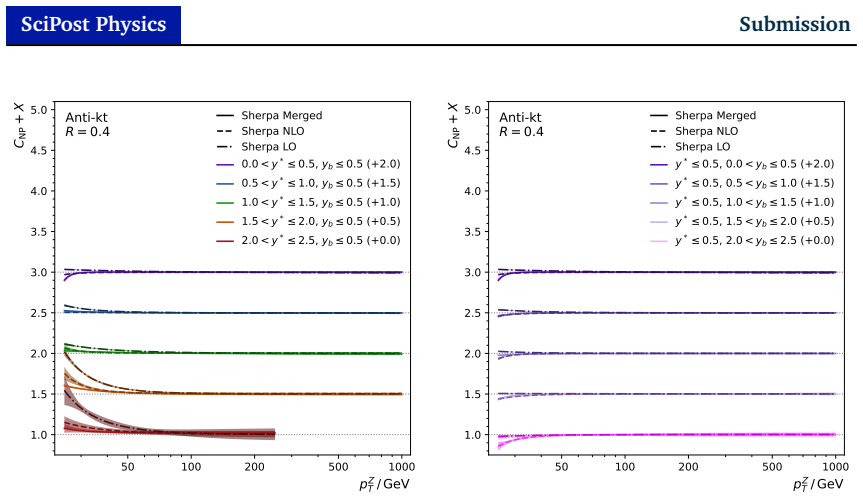
The central claim is that the nonperturbative correction factor $C_{\mathrm{NP}}$, defined for each bin as the ratio of the particle-level cross section to the same generator's prediction with hadronisation and multiple-parton interactions switched off (Eq. 6), behaves differently for the two processes. In Z+jet production, $C_{\mathrm{NP}}$ deviates from unity most at low $p_T^Z$, and the deviation grows systematically with the scattering-angle variable $y^*$ but hardly changes with the boost $y_b$; upgrading the matrix element from LO to NLO, or to multijet-merged NLO, reduces the size of the corrections. In dijet production, by contrast, the corrections are close to unity at high $\langle p_T\rangle$ and show no significant $y^*$ or $y_b$ dependence. Since the same $y^*$ trend appears in underlying-event observables even with the MPI model turned off, and since the effect shrinks with more complete perturbative input, the paper concludes that the conventional corrections may contain perturbative contamination and are not universal across hard processes.
Load-bearing premise
The load-bearing premise is that the hadronisation and multiple-parton-interaction models of HERWIG7 and SHERPA reproduce the real physics of nonperturbative effects closely enough that the predicted $y^*$ dependence in Z+jet events, and its absence in dijets, would appear in LHC data.
Editorial extensions
If this is right
- If the non-universality is real, precision extractions of $\alpha_s$ and the gluon PDF from Z+jet data need process-specific nonperturbative corrections rather than factors carried over from dijet or inclusive-jet fits.
- The $y^*$ dependence implies that part of what is labelled nonperturbative is actually perturbative radiation from additional jets, so Z+jet event generation for such fits should use multijet merging at NLO, which reduces the corrections.
- The paper's proposed triple-differential measurement of the underlying event in Z+jet events would directly test whether the generator-level angular pattern appears in LHC data.
- For dijet production, the flatness of the correction factors in $y_b$ and $y^*$ suggests the standard treatment is less affected by this angular issue, though the same statement about perturbative contamination may still apply.
- Because the corrections depend on the perturbative order of the matrix element (LO vs NLO vs merged), the numerical value of a nonperturbative correction only makes sense when quoted together with the order and parton-shower setup.
Reading between the lines
- If LHC data confirm the $y^*$ trend, the effect could bias global fits that apply universal NP corrections, shifting $\alpha_s$ and gluon-PDF determinations at the percent level depending on the kinematic region — a testable, quantitative consequence the paper leaves implicit.
- The persistence of the $y^*$ dependence with MPI switched off suggests the transverse azimuthal region is not a clean probe of the underlying event in Z+jet events at high $y^*$; differential UE tuning, not inclusive UE tuning, would be needed to calibrate it.
- A natural next generator-level test is to vary the colour-reconnection model or hadronisation parameters and check whether the $y^*$ slope changes; the paper does not perform a full model-variation study.
- The same angular-variable decomposition could be applied to W+jet or photon+jet production, where a $y^*$ dependence of NP corrections, if present, would reveal whether the effect is specific to colour-singlet-plus-jet topologies or a generic feature of leptonically tagged processes.
Signed reviews
Editorial analysis
A structured set of objections, weighed in public.
Referee Report
Summary. This paper investigates nonperturbative (NP) corrections, defined in Eq. (6) as the ratio of MC cross sections with hadronisation and MPI switched on versus off, for triple-differential dijet and Z+jet production at the LHC. Using HERWIG7 and SHERPA at LO, NLO, and merged ME accuracy, the authors fit Eq. (7), f(x)=a·ln(x/GeV)^b+c, to the binned correction factors and report that for Z+jet production C_NP depends strongly on y* but barely on yb, while dijet production shows no such dependence. They trace the effect mainly to MPI and, through a UE analysis, argue that part of the activity is of perturbative origin. The paper concludes that conventional NP correction factors may not be entirely NP in origin and are not universal across hard processes, and it proposes a triple-differential measurement of the underlying event in Z+jet production.
Significance. If the results hold, they are relevant for precision QCD because standard NP correction factors used in alpha_s and PDF fits would be process-dependent and could contain perturbative contamination. The paper's strengths are the systematic comparison of two independent generators, several perturbative orders (LO, NLO, merged), and an explicit on/off decomposition of hadronisation and MPI, plus a reproducible workflow via the MCRun framework. The authors are appropriately cautious in stating that whether this behaviour is realized in nature remains an open question. However, the central qualitative claim is currently established only within the default MC models, and one key piece of evidence—the unsmoothed C_NP values—is not shown.
major comments (4)
- [Sec. 3, Eq. (7), Appendix A] The central observation—that C_NP for Z+jet increases strongly with y* at fixed pT_Z—is presented exclusively through the fitted curves of Eq. (7). The unsmoothed binned ratios are never shown, so the reader cannot assess whether the separation of the curves at low pT_Z is driven by the fit function rather than by the underlying MC points. Appendix A itself warns that when the low-scale rise is represented by only one bin at the low edge, statistical fluctuations may lead to exaggerated slopes. Because the y* separation is largest at the lowest pT_Z bins, the authors should display the raw C_NP values with statistical uncertainties for the nine central (y*, yb) bins and demonstrate stability of the fitted trends under removal of the lowest pT_Z bin, variation of the fit function, and changes of the fit range.
- [Sec. 5.2] The UE analysis omits the outermost y* bin (2.0 ≤ y* < 2.5), citing large statistical fluctuations, but this is exactly the bin where the y* dependence of C_NP in Fig. 4 appears strongest. The consistency argument that the UE activity exhibits the same y* dependence as C_NP is therefore incomplete at the most extreme y*. The authors should either include this bin with properly inflated uncertainties or merge it with the adjacent bin and show that the trend persists.
- [Sec. 2 and Sec. 3] The dijet and Z+jet analyses differ in kinematics: dijet uses <pT>1,2 with bins starting at 47 GeV, while Z+jet uses pT_Z starting at 25 GeV, and the jet pT thresholds differ (30/25 GeV for dijet versus 20 GeV for Z+jet). The strongest y* dependence in Z+jet is found at low pT_Z, a region not covered by the dijet comparison. This raises the question whether the observed process non-universality is a genuine property or a kinematic effect. A matched comparison in the overlapping pT range, or a reanalysis of dijet with lower thresholds, would strengthen the non-universality claim.
- [Sec. 3 and Sec. 4] All results are obtained with the default tunes of HERWIG7 and SHERPA; no variation of MPI or hadronisation parameters is shown. Since the paper attributes a substantial part of the effect to MPI modelling, the robustness of the y* dependence and of the LO/NLO decrease across the available tune variations should be demonstrated. The caveat that realisation in nature remains an open question is appropriate, but without a tune scan the model dependence of the quoted trends is not quantified.
minor comments (5)
- [Sec. 3, Eq. (7)] The notation a·ln(x/GeV)^b is ambiguous; it should be written as a·(ln(x/GeV))^b to avoid confusion over whether the power b acts on the logarithm or on x/GeV.
- [Sec. 3] The fitted values of a, b, and c are not tabulated, although the text states that c is compatible with unity; providing the fit parameters (or a summary table) would allow the reader to check this compatibility quantitatively.
- [Sec. 2, Eq. (3)] The sign convention in x_{1|2} = m_{1,2}/(sqrt(s)·exp(±yb)) should be clarified by stating explicitly which momentum fraction corresponds to the plus sign and which to the minus sign.
- [Sec. 4] The sentence 'This would lead to uncorrelated events from MPI and to a strong growth of charged particle multiplicity with the number of additional hard events' is unclear and should be rephrased to separate the expected behaviour without colour reconnection from the role played by colour reconnection.
- [Appendix A, Table 3] The remark that the mass binning 'has not been extended to include results at lower pT' is ambiguous; please clarify whether the mass binning simply starts at a higher threshold than the <pT> binning and why this choice was made.
Circularity Check
No circularity: the y* dependence is an MC output, not a fitted or self-cited input.
full rationale
The central derivation is the MC-based ratio C_NP = sigma(ME+PS+Had+MPI)/sigma(ME+PS) of Eq. (6), computed bin-by-bin in (y_b, y*) with HERWIG7 and SHERPA. The y* dependence in Z+jet events is a direct observable-level output of these simulations, not a quantity fitted into the inputs. The smoothing function f(x)=a ln(x/GeV)^b+c of Eq. (7) is applied separately to each (y_b,y*) bin and is not used as a prior or constraint that could generate the relative ordering across y*; therefore the fitted parameters do not feed back into a derivation. Likewise, the separation into hadronisation (Eq. 9) and MPI (Eq. 10) factors is a decomposition of the same simulation output, and the UE analysis in Section 5 compares independent generator configurations. The paper explicitly states that 'Whether this non-universal behaviour is realized in nature remains an open question,' and the Appendix A caveat warns that a single low-edge bin can produce exaggerated slopes in the smoothing fit; these are honesty and robustness limitations, not circular reductions. The self-citations (MCRun framework, Herwig development papers, colour-reconnection studies) support the computational setup and modelling background, but none is invoked as an authority that forces the paper's conclusion. No step has been identified where a prediction is equivalent by construction to its input, so the derivation is self-contained with respect to the reported claim.
Assumptions & free parameters
free parameters (3)
- a
- b
- c
assumptions (3)
- domain assumption MC generators HERWIG7.2.3 and SHERPA2.2.15 with default tunes model hadronisation and multiple parton interactions reliably enough for observed trends to reflect real physics.
- domain assumption The ratio in Eq. 6 separates perturbative and nonperturbative contributions, so the difference between particle-level and parton-level samples isolates hadronisation and MPI effects.
- ad hoc to paper The functional form f(x)=a ln(x/GeV)^b + c is a suitable parameterization for smoothing statistical fluctuations of C_NP.
Cite this review
Pith. "Pith review of Nonperturbative effects in triple-differential dijet and Z+jet production at the LHC." pith.science (2026). https://pith.science/paper/FLLJ7NBK
@misc{pith2026241219694,
  author       = {Pith},
  title        = {Pith review of: Nonperturbative effects in triple-differential dijet and Z+jet production at the LHC},
  year         = {2026},
  howpublished = {\url{https://pith.science/paper/FLLJ7NBK}},
  note         = {Machine review of arXiv:2412.19694}
}
read the original abstract
In comparisons of precision measurements at colliders to the most accurate predictions available in perturbative quantum chromodynamics (QCD), it is required to correct for nonperturbative effects. By means of Monte Carlo event generators this article investigates the impact of such nonperturbative effects on two processes relevant for precision determinations of the strong coupling constant and the proton structure: triple-differential dijet and Z+jet production. We observe significant differences between the two processes. Whether this non-universal behaviour is realized in nature remains an open question. We therefore propose a triple-differential measurement of the underlying event in Z+jet production.
Figures


Figures from the paper (13 more)




Reference graph
Works this paper leans on
-
[1]
H. A. Bethe, Zur Theorie der Metalle. i. Eigenwerte und Eigenfunktionen der linearen Atomkette , Zeit. f \"u r
-
[2]
Ginsparg, It was twenty years ago today
P. Ginsparg, It was twenty years ago today... , http://arxiv.org/abs/1108.2700
-
[3]
, " * write output.state after.block =
ENTRY address archive author booktitle chapter doi edition editor eid eprint howpublished institution isbn journal key month note number organization pages publisher school series title type url volume year label INTEGERS output.state before.all mid.sentence after.sentence after.block FUNCTION init.state.consts #0 'before.all := #1 'mid.sentence := #2 'af...
-
[4]
write newline
" write newline "" before.all 'output.state := FUNCTION n.dashify 't := "" t empty not t #1 #1 substring "-" = t #1 #2 substring "--" = not "--" * t #2 global.max substring 't := t #1 #1 substring "-" = "-" * t #2 global.max substring 't := while if t #1 #1 substring * t #2 global.max substring 't := if while FUNCTION word.in bbl.in capitalize " " * FUNCT...
Reviewed August 10, 2026 · model on record in the stance chip above.
Discussion (0). Continue with ORCID to comment.