REVIEW 3 major objections 4 minor 65 references
DualMat: PBR Material Estimation via Coherent Dual-Path Diffusion
T0 review · 3 major / 4 minor · reviewed 2026-08-05 · deepseek-v4-flash
Pith's one-line read DualMat estimates PBR materials from a single image using two cooperating diffusion paths—one albedo-optimized, one material-specialized—and reports up to 28% better albedo and 39% lower metallic-roughness error than prior baselines.
desk verdict The dual-path design is a genuine contribution, but the paper's headline numbers don't survive contact with its own ablation table. read the letter →
The pith
A machine-rendered reading of the paper's core claim, the machinery that carries it, and where it could break.
The reading
What carries the argument
The dual-path latent-space design: one denoising U-Net operates on a 12-channel latent made by encoding albedo, metallic, and roughness separately with a pretrained RGB autoencoder, while another operates on a compact 14-channel latent from a unified encoder that processes the full PBR triplet jointly. The first path supplies the albedo prediction, the second supplies metallic and roughness, and a feature-distillation loss with a learned projection aligns their intermediate representations so the combined output stays coherent. Rectified flow provides the few-step sampling that makes the method efficient.
What would settle it
Physically capture albedo, metallic, and roughness maps for a set of real objects, render or photograph them under the paper's protocol, and compare DualMat against the paper's baselines on PSNR, SSIM, LPIPS, and RMSE. If the 28% albedo and 39% metallic-roughness gaps shrink to statistical noise—or disappear on subsets such as clearcoat or translucent materials—the central transfer claim fails.
Extended reading notes
Core claim
DualMat's central discovery is that the right inductive bias for PBR material estimation is to keep albedo and metallic-roughness in different latent spaces and then force coherence between them. Albedo is an RGB image and benefits from the visual prior of a pretrained RGB autoencoder and denoising backbone, while metallic and roughness are scalar fields whose interdependencies are better captured by a unified compact latent learned for the full PBR triplet. The albedo path is trained first from a pretrained image latent, then frozen; the material path is trained from scratch with a feature-distillation loss that aligns intermediate U-Net features through a learned projection. The final outp
Load-bearing premise
The load-bearing premise is that the synthetic objects with 'valid PBR materials'—a selection criterion the paper never defines—represent real-world materials well enough that the benchmark gains carry over to photographs, where the paper offers only qualitative evidence.
Editorial extensions
If this is right
- Single-image PBR estimation can be decomposed into two specialized diffusion models rather than one general model, improving both albedo and material-property quality at once.
- With rectified flow, only 2–4 denoising steps (three in the experiments) are needed, making high-quality PBR estimation practical for downstream use.
- Patch-based coarse-to-fine inference supports high-resolution inputs without retraining, and cross-view attention fine-tuning gives multi-view consistency.
- Feeding consistent multi-view PBR predictions into an image-to-3D pipeline yields a relightable textured mesh, which end-to-end textured-mesh generation does not reliably provide.
Reading between the lines
- The same divide-and-conquer principle—an RGB-prior path for appearance-like outputs and a compact task-specific path for scalar property fields—could transfer to other inverse graphics tasks such as intrinsic image decomposition, normal prediction, or specular separation.
- The reported 28% and 39% gains are measured against baselines trained on the same synthetic render set; the paper's real-world evidence is qualitative, so the size of the transferable gain on photographs is still an open empirical question.
- Because the paper never defines the 'valid PBR materials' selection rule for its training set, the advantage of the dual-path design could shrink on hard real-world cases such as translucent, clearcoat, or strongly layered materials.
- The feature-distillation loss is applied only during the first 50K training iterations; a testable extension would be to anneal or periodically re-enable it, or to distill semantic rather than pixel-level features, to see whether cross-path coherence improves further.
Editorial analysis
A structured set of objections, weighed in public.
Referee Report
Summary. DualMat proposes a dual-path diffusion framework for single-image PBR material estimation, combining an albedo-optimized path operating in a pretrained Stable Diffusion latent space with a material-specialized path in a compact VQ latent space. A feature distillation loss aligns the two paths, rectified flow enables 2–4 step sampling, and patch-based inference plus cross-view attention extend the method to high-resolution and multi-view inputs. The paper reports state-of-the-art results on an Objaverse test set and qualitative improvements on real-world images.
Significance. If the reported results are reliable, the dual-path design is a sensible and potentially useful contribution: it avoids the blurriness of CNN-based SVBRDF estimators, leverages strong image priors for albedo, and addresses a practical need in image-to-3D pipelines by producing explicit, relightable PBR maps. The extension to multi-view consistency and the integration with Era3D are also valuable. The method is clearly described and the ablation structure is appropriate, though the paper does not provide code or pretrained models, which limits reproducibility.
major comments (3)
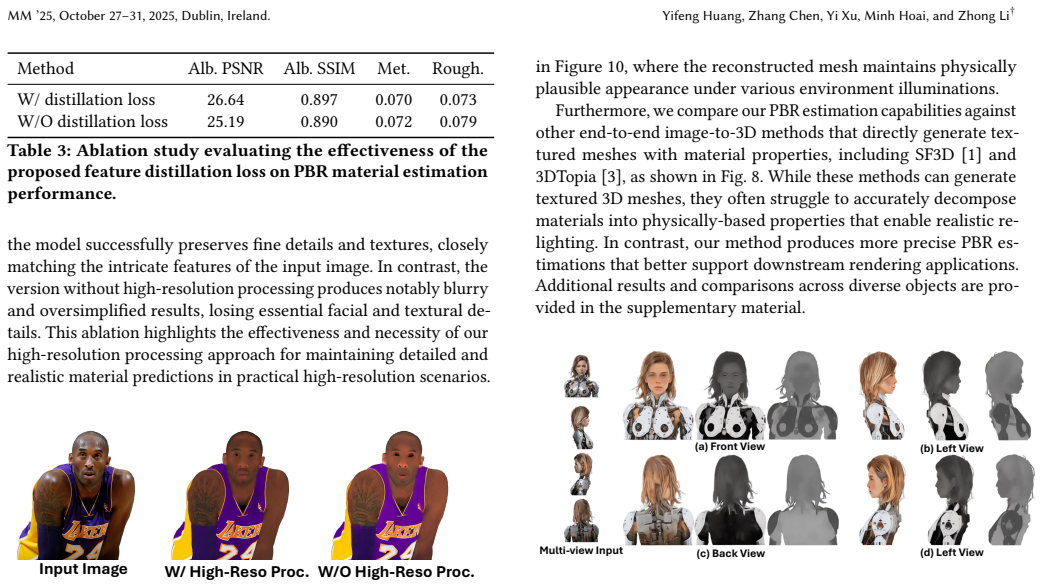
- [§4.3.3, Table 3 vs. Tables 1 and 2] There is a direct internal contradiction in the headline numbers. The 'with distillation loss' row in Table 3 is described as the full model (both paths plus feature distillation), yet it reports albedo PSNR 26.64 dB and SSIM 0.897, while Table 1 and Table 2's dual-path row report 28.6 dB and 0.932 for the same configuration. The 1.96 dB gap is far beyond rounding. If Table 3 is correct, the claimed +4.4 dB over IA-HR and the 'up to 28% improvement' are overstated; if Tables 1–2 are correct, the ablation baseline is unreliable. This must be resolved before the quantitative claims can be assessed.
- [§4.1, Baselines] The claim of 'state-of-the-art performance' is supported by comparisons against only Intrinsic Anything, SurfaceNet, and an adapted Stable Diffusion. Yet the related work section cites several recent diffusion-based material estimators—MatFusion, Vainer et al., MatFuse, StableMaterials, and ControlMat—that are not included in the evaluation. Even if some of these are generation-focused, their absence from the comparison leaves the SOTA claim unsubstantiated. At minimum, the paper should justify the baseline selection and, where applicable, include these methods or state why they cannot be fairly compared.
- [§4.1, Dataset and real-world evaluation] The training set is described as '65,000 objects with valid PBR materials,' but the criterion for 'valid' is never defined. Without knowing the filter (e.g., whether objects with very specular, highly anisotropic, or subsurface-scattering materials are excluded), it is hard to gauge how representative the benchmark is. The real-world evidence is entirely qualitative (Figures 4, 11–13), with no quantitative metric or user study. This weakens the generalization claim that the abstract presents as a central contribution.
minor comments (4)
- [§4.1] No error bars, confidence intervals, or significance tests are reported. Given that the main quantitative conclusions are differences of a few tenths of a dB, this is worth adding if feasible.
- [Table 2] The table header contains unusual symbols (e.g., 'U_m a t " % "') that appear to be formatting artifacts; the row labels are unclear. Please re-render.
- [Eq. (9)] The notation 'z_0' and 'D(z_0)_blur' is not fully specified. Is z_0 the predicted clean latent at a particular sampling step, and is the blur applied in RGB space? Please clarify.
- [References] Several references are incomplete (e.g., [1] 'arXiv preprint' without year or venue, [45] missing full author list). Please correct.
Circularity Check
No circularity: the headline results are empirical measurements on a held-out test set, and the paper's self-citations are not load-bearing.
full rationale
DualMat's central claims are evaluated on a held-out Objaverse test set (654 objects, novel HDR environments) against baselines trained under identical settings. The reported PSNR/SSIM/LPIPS/RMSE numbers in Table 1 are measurements, not quantities derivable from the model definition or training losses by construction. The dual-path architecture, feature distillation, and rectified flow are training/inference mechanisms, not fitted parameters that are later relabeled as predictions. The self-citations (references [21], [23], [24], [52]) appear in related-work lists and are not used to justify the method's uniqueness or to forbid alternatives; hence they are not load-bearing. I note a separate internal inconsistency: Table 3 reports the full model with distillation at albedo PSNR 26.64 dB while Tables 1 and 2 report 28.6 dB, and the text says U_alab is frozen during distillation so the albedo delta in Table 3 is unexplained. This is a correctness/consistency concern, not a circularity, and does not change the circularity score. No circular step can be quoted as Eq. X = Eq. Y by construction.
Assumptions & free parameters
free parameters (5)
- Loss weights in Eq (4): lambda_rec=1.0, lambda_perc=0.001, lambda_adv=0.01, lambda_code=0.1 =
1.0, 0.001, 0.01, 0.1
- Material latent channel count =
14 channels
- Feature distillation training window =
first 50K iterations
- Number of inference sampling steps =
3
- High-resolution blending weight gamma in Eq (9) =
not reported
assumptions (4)
- standard math Standard diffusion and rectified flow mathematics
- domain assumption Pretrained SD2 VAE and CLIP provide useful visual priors for albedo estimation
- domain assumption Objaverse renders with 100 HDR environments are sufficient supervision for real-world material estimation
- domain assumption The PBR triplet (albedo, metallic, roughness) is an adequate representation for relightable appearance
Cite this review
Pith. "Pith review of DualMat: PBR Material Estimation via Coherent Dual-Path Diffusion." pith.science (2026). https://pith.science/paper/FLMYYMU7
@misc{pith2026250805060,
  author       = {Pith},
  title        = {Pith review of: DualMat: PBR Material Estimation via Coherent Dual-Path Diffusion},
  year         = {2026},
  howpublished = {\url{https://pith.science/paper/FLMYYMU7}},
  note         = {Machine review of arXiv:2508.05060}
}
read the original abstract
We present DualMat, a novel dual-path diffusion framework for estimating Physically Based Rendering (PBR) materials from single images under complex lighting conditions. Our approach operates in two distinct latent spaces: an albedo-optimized path leveraging pretrained visual knowledge through RGB latent space, and a material-specialized path operating in a compact latent space designed for precise metallic and roughness estimation. To ensure coherent predictions between the albedo-optimized and material-specialized paths, we introduce feature distillation during training. We employ rectified flow to enhance efficiency by reducing inference steps while maintaining quality. Our framework extends to high-resolution and multi-view inputs through patch-based estimation and cross-view attention, enabling seamless integration into image-to-3D pipelines. DualMat achieves state-of-the-art performance on both Objaverse and real-world data, significantly outperforming existing methods with up to 28% improvement in albedo estimation and 39% reduction in metallic-roughness prediction errors.
Figures


Figures from the paper (7 more)




Reference graph
Works this paper leans on
-
[1]
Mark Boss, Zixuan Huang, Aaryaman Vasishta, and Varun Jampani. 2024. SF3D: Stable Fast 3D Mesh Reconstruction with UV-unwrapping and Illumination Disentanglement. arXiv preprint (2024)
work page 2024
-
[2]
Xi Chen, Sida Peng, Dongchen Yang, Yuan Liu, Bowen Pan, Chengfei Lv, and Xiaowei Zhou. 2024. IntrinsicAnything: Learning Diffusion Priors for Inverse Rendering Under Unknown Illumination. arXiv preprint arXiv:2404.11593 (2024)
arXiv 2024
-
[3]
Zhaoxi Chen, Jiaxiang Tang, Yuhao Dong, Ziang Cao, Fangzhou Hong, Yushi Lan, Tengfei Wang, Haozhe Xie, Tong Wu, Shunsuke Saito, Liang Pan, Dahua Lin, and Ziwei Liu. 2024. 3DTopia-XL: High-Quality 3D PBR Asset Generation via Primitive Diffusion. arXiv preprint arXiv:2409.12957 (2024)
arXiv 2024
-
[4]
Valentin Deschaintre, Miika Aittala, Fredo Durand, George Drettakis, and Adrien Bousseau. 2018. Single-image svbrdf capture with a rendering-aware deep net- work. ACM Transactions on Graphics (2018)
work page 2018
-
[5]
Valentin Deschaintre, Miika Aittala, Frédo Durand, George Drettakis, and Adrien Bousseau. 2019. Flexible svbrdf capture with a multi-image deep network. In Computer graphics forum
work page 2019
-
[6]
Patrick Esser, Sumith Kulal, Andreas Blattmann, Rahim Entezari, Jonas Müller, Harry Saini, Yam Levi, Dominik Lorenz, Axel Sauer, Frederic Boesel, et al. 2024. Scaling rectified flow transformers for high-resolution image synthesis. In Inter- national Conference on Machine Learning
work page 2024
-
[7]
Sicheng Gao, Xuhui Liu, Bohan Zeng, Sheng Xu, Yanjing Li, Xiaoyan Luo, Jianzhuang Liu, Xiantong Zhen, and Baochang Zhang. 2023. Implicit diffusion models for continuous super-resolution. InProceedings of the IEEE/CVF conference on computer vision and pattern recognition
work page 2023
-
[8]
Jie Guo, Shuichang Lai, Chengzhi Tao, Yuelong Cai, Lei Wang, Yanwen Guo, and Ling-Qi Yan. 2021. Highlight-aware two-stream network for single-image SVBRDF acquisition. ACM Transactions on Graphics (2021)
work page 2021
Show all 65 references
-
[9]
Yu Guo, Milovs Havsan, Lingqi Yan, and Shuang Zhao. 2020. A bayesian inference framework for procedural material parameter estimation. In Computer Graphics Forum
2020
-
[10]
Yu Guo, Cameron Smith, Milovs Havsan, Kalyan Sunkavalli, and Shuang Zhao
-
[11]
Philipp Henzler, Valentin Deschaintre, Niloy J Mitra, and Tobias Ritschel. 2021. Generative modelling of BRDF textures from flash images. arXiv preprint arXiv:2102.11861 (2021)
2021 arXiv
-
[12]
Jonathan Ho, Ajay Jain, and Pieter Abbeel. 2020. Denoising diffusion probabilistic models. In Advances in neural information processing systems
2020
-
[13]
Jonathan Ho, Chitwan Saharia, William Chan, David J Fleet, Mohammad Norouzi, and Tim Salimans. 2022. Cascaded diffusion models for high fidelity image generation. Journal of Machine Learning Research (2022)
2022
-
[14]
Yicong Hong, Kai Zhang, Jiuxiang Gu, Sai Bi, Yang Zhou, Difan Liu, Feng Liu, Kalyan Sunkavalli, Trung Bui, and Hao Tan. 2023. Lrm: Large reconstruction model for single image to 3d. arXiv preprint arXiv:2311.04400 (2023)
2023 arXiv
-
[15]
Yiwei Hu, Milovs Havsan, Paul Guerrero, Holly Rushmeier, and Valentin De- schaintre. 2022. Controlling material appearance by examples. In Computer graphics forum
2022
-
[16]
Tero Karras, Miika Aittala, Timo Aila, and Samuli Laine. 2022. Elucidating the design space of diffusion-based generative models. In Advances in neural information processing systems
2022
-
[17]
Bingxin Ke, Anton Obukhov, Shengyu Huang, Nando Metzger, Rodrigo Caye Daudt, and Konrad Schindler. 2024. Repurposing diffusion-based image genera- tors for monocular depth estimation. In Proceedings of the IEEE/CVF Conference on Computer Vision and Pattern Recognition
2024
-
[18]
Jiahao Li, Hao Tan, Kai Zhang, Zexiang Xu, Fujun Luan, Yinghao Xu, Yicong Hong, Kalyan Sunkavalli, Greg Shakhnarovich, and Sai Bi. 2023. Instant3d: Fast text-to-3d with sparse-view generation and large reconstruction model. arXiv preprint arXiv:2311.06214 (2023)
2023 arXiv
-
[19]
Peng Li, Yuan Liu, Xiaoxiao Long, Feihu Zhang, Cheng Lin, Mengfei Li, Xingqun Qi, Shanghang Zhang, Wenhan Luo, Ping Tan, et al . 2024. Era3D: High- Resolution Multiview Diffusion using Efficient Row-wise Attention. arXiv preprint arXiv:2405.11616 (2024)
2024 arXiv
-
[20]
Xiao Li, Yue Dong, Pieter Peers, and Xin Tong. 2017. Modeling surface appearance from a single photograph using self-augmented convolutional neural networks. ACM Transactions on Graphics (2017)
2017
-
[21]
Zhong Li, Liangchen Song, Zhang Chen, Xiangyu Du, Lele Chen, Junsong Yuan, and Yi Xu. 2023. Relit-neulf: Efficient relighting and novel view synthesis via neural 4d light field. In Proceedings of the 31st ACM International Conference on Multimedia
2023
-
[22]
Zhengqin Li, Kalyan Sunkavalli, and Manmohan Chandraker. 2018. Materials for masses: SVBRDF acquisition with a single mobile phone image. In Proceedings of the European conference on computer vision
2018
-
[23]
Aoming Liu, Zhong Li, Zhang Chen, Nannan Li, Yi Xu, and Bryan A Plummer
-
[24]
Isabella Liu, Linghao Chen, Ziyang Fu, Liwen Wu, Haian Jin, Zhong Li, Chin Ming Ryan Wong, Yi Xu, Ravi Ramamoorthi, Zexiang Xu, et al. 2023. Openillu- mination: A multi-illumination dataset for inverse rendering evaluation on real objects. Advances in Neural Information Proces...
2023
-
[25]
Ruoshi Liu, Rundi Wu, Basile Van Hoorick, Pavel Tokmakov, Sergey Zakharov, and Carl Vondrick. 2023. Zero-1-to-3: Zero-shot one image to 3d object. In Proceedings of the IEEE/CVF international conference on computer vision
2023
-
[26]
Yuan Liu, Cheng Lin, Zijiao Zeng, Xiaoxiao Long, Lingjie Liu, Taku Komura, and Wenping Wang. 2023. Syncdreamer: Generating multiview-consistent images from a single-view image. arXiv preprint arXiv:2309.03453 (2023)
2023 arXiv
-
[27]
Zhuang Liu, Hanzi Mao, Chao-Yuan Wu, Christoph Feichtenhofer, Trevor Darrell, and Saining Xie. 2022. A convnet for the 2020s. In Proceedings of the IEEE/CVF conference on computer vision and pattern recognition
2022
-
[28]
Xiaoxiao Long, Yuan-Chen Guo, Cheng Lin, Yuan Liu, Zhiyang Dou, Lingjie Liu, Yuexin Ma, Song-Hai Zhang, Marc Habermann, Christian Theobalt, et al. 2024. Wonder3d: Single image to 3d using cross-domain diffusion. In Proceedings of the IEEE/CVF Conference on Computer Vision and ...
2024
-
[29]
Ben Mildenhall, Pratul P Srinivasan, Matthew Tancik, Jonathan T Barron, Ravi Ramamoorthi, and Ren Ng. 2021. Nerf: Representing scenes as neural radiance fields for view synthesis. Commun. ACM (2021)
2021
-
[30]
Dustin Podell, Zion English, Kyle Lacey, Andreas Blattmann, Tim Dockhorn, Jonas Müller, Joe Penna, and Robin Rombach. 2023. Sdxl: Improving latent diffusion models for high-resolution image synthesis. arXiv preprint arXiv:2307.01952 (2023)
2023 arXiv
-
[31]
Ben Poole, Ajay Jain, Jonathan T Barron, and Ben Mildenhall. 2022. Dreamfusion: Text-to-3d using 2d diffusion. arXiv preprint arXiv:2209.14988 (2022)
2022 arXiv
-
[32]
Robin Rombach, Andreas Blattmann, Dominik Lorenz, Patrick Esser, and Björn Ommer. 2022. High-resolution image synthesis with latent diffusion models. In Proceedings of the IEEE/CVF conference on computer vision and pattern recognition
2022
-
[33]
Chitwan Saharia, William Chan, Huiwen Chang, Chris Lee, Jonathan Ho, Tim Salimans, David Fleet, and Mohammad Norouzi. 2022. Palette: Image-to-image diffusion models. In ACM SIGGRAPH
2022
-
[34]
Chitwan Saharia, Jonathan Ho, William Chan, Tim Salimans, David J Fleet, and Mohammad Norouzi. 2022. Image super-resolution via iterative refinement. IEEE transactions on pattern analysis and machine intelligence (2022)
2022
-
[35]
Shen Sang and Manmohan Chandraker. 2020. Single-shot neural relighting and svbrdf estimation. In Proceedings of the European conference on computer vision
2020
-
[36]
Sam Sartor and Pieter Peers. 2023. Matfusion: a generative diffusion model for svbrdf capture. In SIGGRAPH Asia 2023 Conference Papers
2023
-
[37]
Hiroshi Sasaki, Chris G Willcocks, and Toby P Breckon. 2021. Unit-ddpm: Un- paired image translation with denoising diffusion probabilistic models. arXiv preprint arXiv:2104.05358 (2021)
2021 arXiv
-
[38]
Ruoxi Shi, Hansheng Chen, Zhuoyang Zhang, Minghua Liu, Chao Xu, Xinyue Wei, Linghao Chen, Chong Zeng, and Hao Su. 2023. Zero123++: a single image to consistent multi-view diffusion base model. arXiv preprint arXiv:2310.15110 (2023)
2023 arXiv
-
[39]
Yichun Shi, Peng Wang, Jianglong Ye, Mai Long, Kejie Li, and Xiao Yang. 2023. Mvdream: Multi-view diffusion for 3d generation. arXiv preprint arXiv:2308.16512 (2023)
2023 arXiv
-
[40]
Yang Song, Jascha Sohl-Dickstein, Diederik P Kingma, Abhishek Kumar, Stefano Ermon, and Ben Poole. 2021. Score-based generative modeling through stochastic differential equations. In International Conference on Learning Representations
2021
-
[41]
Xuan Su, Jiaming Song, Chenlin Meng, and Stefano Ermon. 2022. Dual diffusion implicit bridges for image-to-image translation. arXiv preprint arXiv:2203.08382 (2022)
2022 arXiv
-
[42]
Junshu Tang, Tengfei Wang, Bo Zhang, Ting Zhang, Ran Yi, Lizhuang Ma, and Dong Chen. 2023. Make-it-3d: High-fidelity 3d creation from a single image with diffusion prior. In Proceedings of the IEEE/CVF international conference on computer vision
2023
-
[43]
Shimon Vainer, Mark Boss, Mathias Parger, Konstantin Kutsy, Dante De Nigris, Ciara Rowles, Nicolas Perony, and Simon Donné. 2024. Collaborative Control for Geometry-Conditioned PBR Image Generation. arXiv preprint arXiv:2402.05919 (2024)
2024 arXiv
-
[44]
Giuseppe Vecchio. 2024. StableMaterials: Enhancing Diversity in Material Gener- ation via Semi-Supervised Learning. arXiv preprint arXiv:2406.09293 (2024)
2024
-
[45]
Giuseppe Vecchio, Rosalie Martin, Arthur Roullier, Adrien Kaiser, Romain Rouffet, Valentin Deschaintre, and Tamy Boubekeur. 2024. Controlmat: A controlled generative approach to material capture. ACM Transactions on Graphics (2024)
2024
-
[46]
Giuseppe Vecchio, Simone Palazzo, and Concetto Spampinato. 2021. Surfacenet: Adversarial svbrdf estimation from a single image. InProceedings of the IEEE/CVF International Conference on Computer Vision . MM ’25, October 27–31, 2025, Dublin, Ireland. Yifeng Huang, Zhang Chen, Y...
2021
-
[47]
Giuseppe Vecchio, Renato Sortino, Simone Palazzo, and Concetto Spampinato
-
[48]
Peng Wang and Yichun Shi. 2023. Imagedream: Image-prompt multi-view diffu- sion for 3d generation. arXiv preprint arXiv:2312.02201 (2023)
2023 arXiv
-
[49]
Peng Wang, Hao Tan, Sai Bi, Yinghao Xu, Fujun Luan, Kalyan Sunkavalli, Wen- ping Wang, Zexiang Xu, and Kai Zhang. 2023. Pf-lrm: Pose-free large reconstruc- tion model for joint pose and shape prediction. arXiv preprint arXiv:2311.12024 (2023)
2023 arXiv
-
[50]
In Pro- ceedings of the IEEE/CVF Conference on Computer Vision and Pattern Recognition
Matfuse: controllable material generation with diffusion models. In Pro- ceedings of the IEEE/CVF Conference on Computer Vision and Pattern Recognition
-
[51]
Tao Wen, Beibei Wang, Lei Zhang, Jie Guo, and Nicolas Holzschuch. 2022. SVBRDF Recovery from a Single Image with Highlights Using a Pre-trained Generative Adversarial Network. In Computer Graphics Forum
2022
-
[52]
Zhexiao Xiong, Zhang Chen, Zhong Li, Yi Xu, and Nathan Jacobs. 2025. Pan- oDreamer: Consistent Text to 360-Degree Scene Generation. In Proceedings of the Computer Vision and Pattern Recognition Conference
2025
-
[53]
Zhengyi Wang, Yikai Wang, Yifei Chen, Chendong Xiang, Shuo Chen, Dajiang Yu, Chongxuan Li, Hang Su, and Jun Zhu. 2024. Crm: Single image to 3d textured mesh with convolutional reconstruction model. arXiv preprint arXiv:2403.05034 (2024)
2024 arXiv
-
[54]
Yinghao Xu, Zifan Shi, Wang Yifan, Hansheng Chen, Ceyuan Yang, Sida Peng, Yu- jun Shen, and Gordon Wetzstein. 2024. Grm: Large gaussian reconstruction model for efficient 3d reconstruction and generation. arXiv preprint arXiv:2403.14621 (2024)
2024 arXiv
-
[55]
Yinghao Xu, Hao Tan, Fujun Luan, Sai Bi, Peng Wang, Jiahao Li, Zifan Shi, Kalyan Sunkavalli, Gordon Wetzstein, Zexiang Xu, et al. 2023. Dmv3d: Denois- ing multi-view diffusion using 3d large reconstruction model. arXiv preprint arXiv:2311.09217 (2023)
2023 arXiv
-
[56]
Jiale Xu, Weihao Cheng, Yiming Gao, Xintao Wang, Shenghua Gao, and Ying Shan. 2024. Instantmesh: Efficient 3d mesh generation from a single image with sparse-view large reconstruction models. arXiv preprint arXiv:2404.07191 (2024)
2024 arXiv
-
[57]
Wenjie Ye, Yue Dong, Pieter Peers, and Baining Guo. 2021. Deep Reflectance Scanning: Recovering Spatially-varying Material Appearance from a Flash-lit Video Sequence. In Computer Graphics Forum
2021
-
[58]
Wenjie Ye, Xiao Li, Yue Dong, Pieter Peers, and Xin Tong. 2018. Single image surface appearance modeling with self-augmented cnns and inexact supervision. In Computer Graphics Forum
2018
-
[59]
Hu Ye, Jun Zhang, Sibo Liu, Xiao Han, and Wei Yang. 2023. Ip-adapter: Text compatible image prompt adapter for text-to-image diffusion models. arXiv preprint arXiv:2308.06721 (2023)
2023 arXiv
-
[60]
Min Zhao, Fan Bao, Chongxuan Li, and Jun Zhu. 2022. Egsde: Unpaired image-to- image translation via energy-guided stochastic differential equations. Advances in Neural Information Processing Systems (2022)
2022
-
[61]
Xilong Zhou, Milos Hasan, Valentin Deschaintre, Paul Guerrero, Kalyan Sunkavalli, and Nima Khademi Kalantari. 2022. Tilegen: Tileable, controllable material generation and capture. In SIGGRAPH Asia
2022
-
[62]
Zongsheng Yue, Jianyi Wang, and Chen Change Loy. 2024. Resshift: Efficient diffusion model for image super-resolution by residual shifting. In Advances in Neural Information Processing Systems
2024
-
[65]
Xilong Zhou and Nima Khademi Kalantari. 2021. Adversarial Single-Image SVBRDF Estimation with Hybrid Training. In Computer Graphics Forum. DualMat: PBR Material Estimation via Coherent Dual-Path Diffusion MM ’25, October 27–31, 2025, Dublin, Ireland. Input Images IA Albedo IA-...
2021
-
[2020]
MaterialGAN: Reflectance capture using a generative SVBRDF model.arXiv preprint arXiv:2010.00114 (2020)
2010 arXiv
-
[2024]
In European Conference on Computer Vision
Panofree: Tuning-free holistic multi-view image generation with cross-view self-guidance. In European Conference on Computer Vision
Reviewed August 5, 2026 · model on record in the stance chip above.
Discussion (0). Sign in to comment.