REVIEW 3 major objections 5 minor 83 references
Adiabatic topological passage based on coupling of giant atom with two Su-Schrieffer-Heeger chains
T0 review · 3 major / 5 minor · reviewed 2026-08-11 · deepseek-v4-flash
Pith's one-line read A single giant atom can adiabatically route one excitation to either topological edge, with the final split set by the ratio of the two coupling strengths.
desk verdict A solid incremental two-chain giant-atom routing scheme with a clean five-state reduction, but the truncation argument needs an N-regime bound and a few typos need fixing. read the letter →
The pith
A machine-rendered reading of the paper's core claim, the machinery that carries it, and where it could break.
The reading
What carries the argument
The load-bearing object is the five-state dark state of Eq. (11), a coherent-population-trapping superposition $|\Psi_0\rangle=\cos\chi|e,\mathrm{vac}\rangle+\sin\chi\cos\phi|\psi_R,g\rangle+\sin\chi\sin\phi|\varphi_R,g\rangle$, with mixing angles $\tan\chi=\sqrt{G_{L,a}^2+G_{L,c}^2}/G$ and $\tan\phi=G_{L,c}/G_{L,a}$. It works because the giant atom couples only to the two left edge states $|\psi_L\rangle$ and $|\varphi_L\rangle$, which are in turn coupled to their right-handed partners by the finite-size hybridization strength $G=N_L^2 J_1(J_1/J_2)^{N-1}$; destructive interference keeps one eigenstate at zero energy throughout the sweep, so population rides it without ever populating the bright states.
What would settle it
Numerically integrate the full Hamiltonian of Eq. (1) with $g_1=g_2=0.1J$, ten times the paper's value, sweeping $\theta$ from $0.5\pi$ to $0.775\pi$ at $\Omega=10^{-4}J$; if the final populations on the two right edge states deviate from $\sin^2\chi\cos^2\phi$ and $\sin^2\chi\sin^2\phi$ of Eq. (11), the five-state truncation is invalid.
Extended reading notes
Core claim
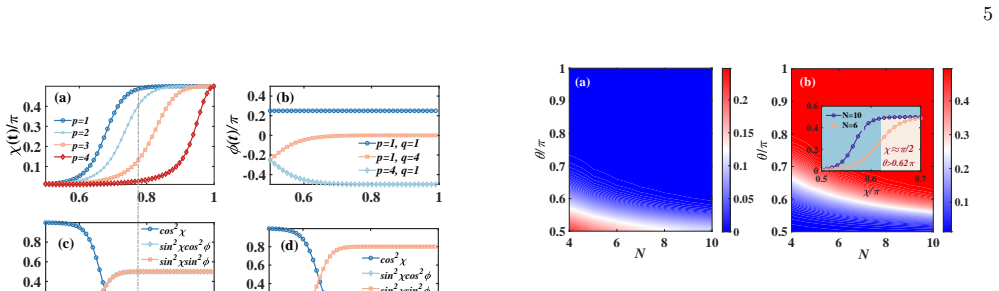
On the paper's own terms, the central discovery is that a resonant two-level giant atom coupled to two finite SSH chains in the topological phase realizes a five-state effective Hamiltonian rather than a full $(4N+1)$-state problem. In the single-excitation subspace spanned by the atom and the four band-gap states—the symmetric and antisymmetric combinations of the left and right edge states of each chain—the Hamiltonian takes the form of Eq. (9), with spectrum $\{0,\pm G,\pm\sqrt{G^2+G_{L,a}^2+G_{L,c}^2}\}$. The zero-energy eigenstate $|\Psi_0\rangle=\cos\chi|\mathrm{vac},e\rangle+\sin\chi\cos\phi|\psi_R,g\rangle+\sin\chi\sin\phi|\varphi_R,g\rangle$ is a coherent-population-trapping dark state that connects the atomic excitation to the two right edge states. Sweeping $\theta(t)=\Omega t$ slowly from the trivial phase into the topological phase makes the mixing angle $\chi$ grow from $0$ to $\pi/2$, so the excitation flows out of the atom; the final split is fixed by $\tan\phi=g_2/g_1\,(-J_1/J_2)^{q-p}$. The authors check this reduced description against the full time-dependent Hamiltonian for $N=4$ and $N=10$ and find the predicted transfer to the rightmost sublattices $B_{2N}$ and $D_{2N}$.
Load-bearing premise
The five-state picture assumes the giant atom never excites any of the bulk modes of the two chains, only the four near-zero edge states; if a bulk mode takes part, the dark state ceases to be an eigenstate and the transfer loses its protection.
Editorial extensions
If this is right
- For equal coupling positions ($p=q$), the final population ratio between the two right edge states is set purely by $g_2^2/g_1^2$, so dialing the two atom-chain couplings steers the excitation.
- Choosing different coupling positions, for example $p=1,q=4$ with $g_1=g_2$, sends all of the excitation into the SSH-1 edge and leaves the SSH-2 chain empty.
- Because the process follows a zero-energy eigenstate separated from the nearest bright state by $\delta E=G$, the transfer tolerates coupling disorder up to $\xi=0.1J$ but remains sensitive to on-site frequency disorder of order $0.001J$.
- With superconducting-circuit parameters $J\approx 10^8$ Hz and $\Omega=10^{-4}J$, the transfer finishes in about $10^{-4}$ s, shorter than typical qubit coherence times, so the passage should be observable in current experiments.
Reading between the lines
- Adding a third SSH chain would enlarge the zero-energy subspace of the same construction, potentially turning the giant atom into a multi-port router whose splitting ratios are fixed by coupling ratios rather than by dynamic phases.
- The two-point coupling of the giant atom is what produces the interference that defines the dark state; a conventional small emitter with two engineered coupling points might realize the same passage on a different platform.
- For $g_1\neq g_2$, the final zero-energy state is an entangled superposition of the two remote right edge states, so the passage doubles as a deterministic entangler; the entanglement entropy as a function of $g_2/g_1$ is a testable prediction the paper does not compute.
- The asymmetric disorder response—hopping disorder tolerated, on-site frequency disorder fatal—mirrors the chiral symmetry of the SSH model, so an experimental implementation should stabilize the on-site frequencies before anything else.
Editorial analysis
A structured set of objections, weighed in public.
Referee Report
Summary. The manuscript considers a two-level giant atom coupled at one site to each of two finite Su-Schrieffer-Heeger (SSH) chains. The central claim is that when the chains are in the topological phase and the atom is resonant with the chain center frequency, the full 4N+1-level Hamiltonian reduces to a five-state model built from the atomic excited state and the two hybridized edge states of each chain. The zero-energy dark state of this model provides an adiabatic passage that transfers the atomic excitation to the right edge states of both chains, with the final probability distribution controlled by the coupling positions p,q and the coupling ratio g2/g1. The authors support the reduction with an analytic diagonalization in the subspace, with full-Hamiltonian numerics for N=4 and N=10, and with simulations of the time-dependent ramp. They also report robustness to coupling disorder and to small frequency mismatch.
Significance. If the reduction is valid, the paper offers a simple and controllable scheme for routing a single excitation into one of two topological edge channels, with an analytic dark-state expression and direct numerical verification in the tested parameter regime. The explicit control of the final split via the coupling positions and the ratio g2/g1 is a useful new feature. The manuscript is transparent: the five-state model is derived analytically from the stated Hamiltonian, and the numerical results are direct solutions of the full model rather than fits. The main limitation is that the five-state truncation is justified only for small N relative to J/g, a restriction that is not stated in the claims and is not probed by the N=4 and N=10 simulations.
major comments (3)
- [Sec. II, before Eq. (6)] The truncation condition used to discard all bulk eigenstates, stated as |E_j| >> g eta for j different from N and N+1, is not uniform in the control parameter theta. The ramp theta(t)=Omega t crosses theta=pi/2, where J1=J2 and the bulk gap of an infinite SSH chain closes. For a finite chain of 2N sites at J1=J2, the smallest bulk excitation energy is of order J/N, so the condition reads N << (J/g)^2 (or N << J/g under a more conservative estimate). The explicit checks in the paper use N=4 and N=10 with g=0.01J, well inside this regime, and the exact numerics in Figs. 6 and 8 then agree with the five-state picture. However, the central claim in the abstract and in Sec. VI is stated without this restriction. For N comparable to or larger than J/g, bulk modes become resonantly coupled near theta=pi/2, the exact zero-energy eigenstate is not guaranteed to be the five-state dark state of Eq. (11), and the protection associated with the dark state is not established. Please either provide an error bound on the truncation as a function of N and g/J, add numerical tests at larger N (e.g., N=50 or N=100), or explicitly state the condition N << J/g as a limitation of the protocol.
- [Sec. II, Eqs. (6)-(8)] The derivation as printed is internally inconsistent. The text states g1 eta_{2p-1,N} = -g1 eta_{2p-1,N+1} = g1 c_a^p / sqrt(2), but this is not consistent with Eq. (7). Because |psi_L> has support only on the A sublattice and |psi_R> only on the B sublattice, one has <A_p|Psi_N> = <A_p|Psi_{N+1}> = N_L(-J1/J2)^{p-1}/sqrt(2); the overlaps are equal, not opposite. With the printed opposite signs, the atom would couple to |psi_R> rather than |psi_L>, contradicting Eq. (8), which couples the atom to |psi_L> and |phi_L>. Eq. (8) and the subsequent dark state require equal signs. In addition, Eq. (5) swaps the roles of eta and zeta relative to the definitions after Eq. (3), and Eq. (6) is missing a plus sign before the g2 term. Please correct these sign and notation errors; the five-state Hamiltonian in Eq. (9) appears to be the physically correct one, but it cannot be derived from the printed Eq. (6).
- [Sec. IV, Figs. 9(a)-(b)] The robustness claim 'adiabatic topological passage is immune to weak coupling disorders' is supported in Figs. 9(a)-(b) by a single disorder realization for each type of imperfection. A robustness statement of this kind is a statistical statement, and one realization is not sufficient to demonstrate it, especially since the text also states that the passage is 'very sensitive to frequency disorder'. Please add ensemble-averaged fidelities or transfer probabilities over many realizations, or alternatively rephrase the claim as a representative example rather than a general robustness result.
minor comments (5)
- [Fig. 4(e)] The caption says 'the rightmost sublattice A1', but A1 is the leftmost A sublattice; the text above refers to B_{2N}. The caption should be corrected to B_{2N} (or the appropriate right-end site).
- [Sec. III, Fig. 4(b)] The text says that for p>q the angle phi eventually approaches -pi/2, but the expression tan phi = (g2/g1)(-J1/J2)^{q-p} diverges to +infinity or -infinity depending on the parity, so the limiting angle is pi/2 modulo pi. Please clarify the sign convention.
- [Abstract] The phrase 'transfer excitations of the giant atom to either one end of two SSH chains' is imprecise. In the main scenario discussed (coupling to A1 and C1), the excitation is transferred to the right ends B_{2N} and D_{2N}; the left ends appear only for other coupling scenarios. Please use wording that matches the actual transfer endpoints.
- [Sec. IV] The disorder parameters are introduced as random numbers in the range [-xi, xi], but the paper does not state how many realizations are used or whether Figs. 9(a)-(b) correspond to a single realization. This should be stated explicitly, and if only one realization is shown, the caption should say so.
- [Sec. II] The term 'giant atom' is used, but the Hamiltonian in Eq. (1) describes a two-level atom coupled to a single point in each chain, with no multiple coupling points or propagation phases that are characteristic of giant atoms in waveguides. Please explain what makes the atom 'giant' in this context or otherwise justify the terminology.
Circularity Check
No significant circularity: the five-state dark-state passage is derived from the stated Hamiltonian and independently confirmed by full-model numerics.
full rationale
The paper's central claim is the existence of a zero-energy dark state (Eq. (11)) in a five-state subspace and its use for adiabatic transfer. The five-state subspace is obtained by an explicit off-resonant truncation (Sec. II, before Eq. (6)): bulk eigenstates are neglected because |E_j| >> g for j not equal to N, N+1. This is a stated approximation, not a fit to the target transfer. The dark state is then derived by direct diagonalization of the 5x5 matrix in Eq. (9), yielding the characteristic polynomial Eq. (10) and eigenstate Eq. (11). The predicted final edge-state probabilities are functions of the input parameters g1, g2, p, q and are not fitted. The paper independently verifies the subspace prediction by exact diagonalization of the full Hamiltonian (Figs. 6 and 7) and by direct Schrodinger evolution of the full time-dependent Hamiltonian (Fig. 8) for N=4 and N=10. The edge-state wavefunctions and energies in Eq. (7) are quoted from the external textbook reference [60], not from the authors' own prior work. The authors' self-citations (e.g., Refs. [26], [27], [35], [36], [41], [56], [74]) appear in general background statements about SSH chains, giant atoms, and superconducting circuits and are not load-bearing for the derivation of the dark state or the transfer dynamics. The main caveat, that the five-state truncation requires N << J/g near the gap-closing point theta=pi/2, is a limitation of the approximation rather than a circular step, because the full-model numerics provide an independent benchmark for the regimes tested.
Assumptions & free parameters
free parameters (2)
- atom-chain coupling strengths g1, g2 =
g1 = 0.01J, g2 = 0.01J or 0.02J
- adiabatic ramp rate Omega =
10^-4 J (also 10^-3 J tested in Fig. 9(d))
assumptions (5)
- domain assumption Finite-size SSH edge-state formulas in Eq. (7), taken from Ref. [60], give the energies and wavefunctions of the two band-gap states.
- domain assumption All sublattice frequencies are equal to omega_o so the quantized Zak phase description applies.
- domain assumption Off-resonant bulk eigenstates can be neglected because |E_j| >> g for all j outside the band-gap doublet.
- domain assumption The system is closed, with no dissipation, in the main derivation.
- standard math The adiabatic theorem applies and the gap G(t) does not close during the ramp.
Cite this review
Pith. "Pith review of Adiabatic topological passage based on coupling of giant atom with two Su-Schrieffer-Heeger chains." pith.science (2026). https://pith.science/paper/FLU43ZRG
@misc{pith2026241219421,
  author       = {Pith},
  title        = {Pith review of: Adiabatic topological passage based on coupling of giant atom with two Su-Schrieffer-Heeger chains},
  year         = {2026},
  howpublished = {\url{https://pith.science/paper/FLU43ZRG}},
  note         = {Machine review of arXiv:2412.19421}
}
read the original abstract
We study an adiabatic topological passage of two Su-Schrieffer-Heeger (SSH) chains mediated by a giant atom. When two finite SSH chains are in the topological phase and the frequency of the giant atom is equal to the center frequency of the SSH chains, the system is reduced to a subsystem that describes the coupling of a giant atom to the edge states of two SSH chains. In this case, we can find dark states that act as adiabatic topological passages. This allows us to adiabatically transfer excitations of the giant atom to either one end of two SSH chains in a fully controllable way. In addition, we show good robustness of the adiabatic topological passages to both giant atom frequency mismatch and the coupling disorders in two SSH chains. Our study provides a method to realize quantum information processing and fabricate quantum optical devices based on the coupling of the giant atom to topological matter.
Figures


Figures from the paper (5 more)


Reference graph
Works this paper leans on
-
[1]
The parameters are ∆ = 0 , J = 1 and g1 = g2 = 0.01J except g1 = 0.01J, g2 = 0.02J for the panel (b)
and (d) ( b† 2N , d† 2N ). The parameters are ∆ = 0 , J = 1 and g1 = g2 = 0.01J except g1 = 0.01J, g2 = 0.02J for the panel (b). (d) obtained from Eq. (9). In Fig. 6(d), we consider that the giant atom is coupled to different cells of two SSH chains such as p = 1, q= 4 with g2/g1 = 1. We can see that the probability distribution of the zero-energy state t...
-
[2]
For example, for η2p−1,N = (−J1/J2)p−1√ 2, it decreases as p increases when J1 < J2, while η2p,N = ( −J1/J2)N −p/ √ 2 increases with the in- crease of p
We can see that these couplings depend on the coupling positions of the giant atom to the chains. For example, for η2p−1,N = (−J1/J2)p−1√ 2, it decreases as p increases when J1 < J2, while η2p,N = ( −J1/J2)N −p/ √ 2 increases with the in- crease of p. Then, the effective coupling strength of the giant atom to the SSH chains can be adjusted by chang- ing t...
-
[3]
As shown in Figs
and ( b† 2N , d† 2N ). As shown in Figs. 7(a) and (b), we consider the coupling of the gi- ant atom to the two SSH chains via sublattices A1 and D2N with the coupling strength g1 = g2 = 0 .01J and g1 = 0.01J, g2 = 0.02J, respectively. It can be found that the zero-energy state probability distribution gradually transfers from the giant atom to the rightmo...
-
[4]
However, the non-resonant interaction with ∆ ̸= 0 is also very important. Let us now consider a target state |ψt⟩ = ( |0, · · ·, 1, 0atom, 0, · · ·, 0, 0⟩ + |0, · · ·, 0, 0atom, 0, · · ·, 0, 1⟩)/ √ 2, which refers to the su- perposition of the rightmost lattices B2N and D2N at their excited states for the two SSH chains. This state can be obtained with an...
-
[5]
H. J. Kimble, Nature 453, 1023 (2008). [2] J. I. Cirac, P. Zoller, H. J. Kimble, and H. Mabuchi, Phys. Rev. Lett. 78, 3221 (1997). 9
work page 2008
-
[6]
Y.-A. Chen, S. Nascimb` ene, M. Aidelsburger, M. Atala, S. Trotzky, and I. Bloch, Phys. Rev. Lett. 107, 210405 (2011)
work page 2011
-
[7]
Reiserer and G
A. Reiserer and G. Rempe, Rev. Mod. Phys. 87, 1379 (2015)
2015
-
[8]
Ritter, C
S. Ritter, C. N¨ olleke, C. Hahn, A. Reiserer, A. Neuzner, M. Uphoff, M. M¨ ucke, E. Figueroa, J. Bochmann, and G. Rempe, Nature 484, 195 (2012)
2012
Show all 83 references
-
[9]
Vermersch, P.-O
B. Vermersch, P.-O. Guimond, H. Pichler, and P. Zoller, Phys. Rev. Lett. 118, 133601 (2017)
2017
-
[10]
M. C. Kuzyk and H. Wang, Phys. Rev. X 8, 041027 (2018)
2018
-
[11]
C. J. Axline, L. D. Burkhart, W. Pfaff, M. Zhang, K. Chou, P. Campagne-Ibarcq, P. Reinhold, L. Frun- zio, S. M. Girvin, L. Jiang, M. H. Devoret, and R. J. Schoelkopf, Nature Physics 14, 705 (2018)
2018
-
[12]
F. Mei, G. Chen, L. Tian, S.-L. Zhu, and S. Jia, Phys. Rev. A 98, 012331 (2018)
2018
-
[13]
Petrosyan and P
D. Petrosyan and P. Lambropoulos, Opt. Commun. 264, 419 (2006), quantum Control of Light and Matter
2006
-
[14]
N. V. Vitanov, A. A. Rangelov, B. W. Shore, and K. Bergmann, Rev. Mod. Phys. 89, 015006 (2017)
2017
-
[15]
J. R. Kuklinski, U. Gaubatz, F. T. Hioe, and K. Bergmann, Phys. Rev. A 40, 6741 (1989)
1989
-
[16]
Bergmann, H
K. Bergmann, H. Theuer, and B. W. Shore, Rev. Mod. Phys. 70, 1003 (1998)
1998
-
[17]
B. Chen, W. Fan, Y. Xu, Y.-D. Peng, and H.-Y. Zhang, Phys. Rev. A 88, 022323 (2013)
2013
-
[18]
M. Z. Hasan and C. L. Kane, Rev. Mod. Phys. 82, 3045 (2010)
2010
-
[19]
L. A. Wray, S. Y. Xu, Y. Xia, Y. S. Hor, D. Qian, A. V. Fedorov, H. Lin, A. Bansil, R. J. Cava, and M. Z. Hasan, Nat. Phys. 6, 855 (2010)
2010
-
[20]
M. I. Shalaev, W. Walasik, A. Tsukernik, Y. Xu, and N. M. Litchinitser, Nat. Nanotechnol. 14, 31 (2019)
2019
-
[21]
Ozawa, H
T. Ozawa, H. M. Price, A. Amo, N. Goldman, M. Hafezi, L. Lu, M. C. Rechtsman, D. Schuster, J. Simon, O. Zil- berberg, and I. Carusotto, Rev. Mod. Phys. 91, 015006 (2019)
2019
-
[22]
D. J. Thouless, Phys. Rev. B 27, 6083 (1983)
1983
-
[23]
Y. E. Kraus, Y. Lahini, Z. Ringel, M. Verbin, and O. Zil- berberg, Phys. Rev. Lett. 109, 106402 (2012)
2012
-
[24]
Longhi, G
S. Longhi, G. L. Giorgi, and R. Zambrini, Adv. Quantum Technol. 2, 1800090 (2019)
2019
-
[25]
N. E. Palaiodimopoulos, I. Brouzos, F. K. Diakonos, and G. Theocharis, Phys. Rev. A 103, 052409 (2021)
2021
-
[26]
Longhi, Phys
S. Longhi, Phys. Rev. B 99, 155150 (2019)
2019
-
[27]
F. M. D’Angelis, F. A. Pinheiro, D. Gu´ ery-Odelin, S. Longhi, and F. m. c. Impens, Phys. Rev. Res. 2, 033475 (2020)
2020
-
[28]
T. Tian, Y. Zhang, L. Zhang, L. Wu, S. Lin, J. Zhou, C.-K. Duan, J.-H. Jiang, and J. Du, Phys. Rev. Lett. 129, 215901 (2022)
2022
-
[29]
D.-W. Wang, C. Zhao, J. Yang, Y.-T. Yan, and L. Zhou, Phys. Rev. A 107, 053701 (2023)
2023
-
[30]
C. Wang, L. Li, J. Gong, and Y. X. Liu, Phys. Rev. A 106, 052411 (2022)
2022
-
[31]
Qi, G.-L
L. Qi, G.-L. Wang, S. Liu, S. Zhang, and H.-F. Wang, Phys. Rev. A 102, 022404 (2020)
2020
-
[32]
Cao, W.-X
J. Cao, W.-X. Cui, X. X. Yi, and H.-F. Wang, Phys. Rev. A 103, 023504 (2021)
2021
-
[33]
Zheng, X
L.-N. Zheng, X. Yi, and H.-F. Wang, Phys. Rev. Appl. 18, 054037 (2022)
2022
-
[34]
L. Qi, N. Han, S. Liu, H.-F. Wang, and A.-L. He, Phys. Rev. A 107, 062214 (2023)
2023
-
[35]
L. Qi, Y. Yan, Y. Xing, X.-D. Zhao, S. Liu, W.-X. Cui, X. Han, S. Zhang, and H.-F. Wang, Phys. Rev. Res. 3, 023037 (2021)
2021
-
[36]
L. Qi, Y. Xing, X.-D. Zhao, S. Liu, S. Zhang, S. Hu, and H.-F. Wang, Phys. Rev. B 103, 085129 (2021)
2021
-
[37]
Ezawa, Phys
M. Ezawa, Phys. Rev. B 109, 205421 (2024)
2024
-
[38]
W. Nie, Z. H. Peng, F. Nori, and Y. X. Liu, Phys. Rev. Lett. 124, 023603 (2020)
2020
-
[39]
Nie and Y
W. Nie and Y. X. Liu, Phys. Rev. Res. 2, 012076 (2020)
2020
-
[40]
Dlaska, B
C. Dlaska, B. Vermersch, and P. Zoller, Quantum Sci. Technol 2, 015001 (2017)
2017
-
[41]
N. Y. Yao, C. R. Laumann, A. V. Gorshkov, H. Weimer, L. Jiang, J. I. Cirac, P. Zoller, and M. D. Lukin, Nat.Commun. 4, 1585 (2013)
2013
-
[42]
Wei, Phys
J. Wei, Phys. Rev. A 106, 033710 (2022)
2022
-
[43]
C. I. Kvande, D. B. Hill, and D. Blume, Phys. Rev. A 108, 023703 (2023)
2023
-
[44]
D.-W. Wang, C. Zhao, J. Yang, Y.-T. Yan, and L. Zhou, Phys. Rev. A 109, 033708 (2024)
2024
-
[45]
Andersson, B
G. Andersson, B. Suri, L. Guo, T. Aref, and P. Delsing, Nat. Phys 15, 1123 (2019)
2019
-
[46]
Kannan, M
B. Kannan, M. J. Ruckriegel, D. L. Campbell, A. Frisk Kockum, J. Braum¨ uller, D. K. Kim, M. Kjaergaard, P. Krantz, A. Melville, B. M. Niedzielski, A. Veps¨ al¨ ainen, R. Winik, J. L. Yoder, F. Nori, T. P. Orlando, S. Gus- tavsson, and W. D. Oliver, Nature 583, 775 (2020)
2020
-
[47]
Joshi, F
C. Joshi, F. Yang, and M. Mirhosseini, Phys. Rev. X 13, 021039 (2023)
2023
-
[48]
A. M. Vadiraj, A. Ask, T. G. McConkey, I. Nsanzineza, C. W. S. Chang, A. F. Kockum, and C. M. Wilson, Phys. Rev. A 103, 023710 (2021)
2021
-
[49]
Frisk Kockum, P
A. Frisk Kockum, P. Delsing, and G. Johansson, Phys. Rev. A 90, 013837 (2014)
2014
-
[50]
P. Y. Wen, K.-T. Lin, A. F. Kockum, B. Suri, H. Ian, J. C. Chen, S. Y. Mao, C. C. Chiu, P. Delsing, F. Nori, G.-D. Lin, and I.-C. Hoi, Phys. Rev. Lett. 123, 233602 (2019)
2019
-
[51]
A. F. Kockum, G. Johansson, and F. Nori, Phys. Rev. Lett. 120, 140404 (2018)
2018
-
[52]
Carollo, D
A. Carollo, D. Cilluffo, and F. Ciccarello, Phys. Rev. Res. 2, 043184 (2020)
2020
-
[53]
L. Du, L. Guo, and Y. Li, Phys. Rev. A 107, 023705 (2023)
2023
-
[54]
Soro and A
A. Soro and A. F. Kockum, Phys. Rev. A 105, 023712 (2022)
2022
-
[55]
X. Wang, T. Liu, A. F. Kockum, H.-R. Li, and F. Nori, Phys. Rev. Lett. 126, 043602 (2021)
2021
-
[56]
S. Guo, Y. Wang, T. Purdy, and J. Taylor, Phys. Rev. A 102, 033706 (2020)
2020
-
[57]
L. Guo, A. F. Kockum, F. Marquardt, and G. Johansson, Phys. Rev. Res. 2, 043014 (2020)
2020
-
[58]
Roccati and D
F. Roccati and D. Cilluffo, Phys. Rev. Lett. 133, 063603 (2024)
2024
-
[59]
Cheng, Z
W. Cheng, Z. Wang, and Y. X. Liu, Phys. Rev. A 106, 033522 (2022)
2022
-
[60]
Y.-T. Chen, L. Du, L. Guo, Z. Wang, Y. Zhang, Y. Li, and J.-H. Wu, Commun. Phys. 5, 215 (2022)
2022
-
[61]
Delplace, D
P. Delplace, D. Ullmo, and G. Montambaux, Phys. Rev. B 84, 195452 (2011)
2011
-
[62]
Zak, Phys
J. Zak, Phys. Rev. Lett. 62, 2747 (1989)
1989
-
[63]
J. K. Asb´ oth, L. Oroszl´ any, and A. P´ alyi, arXiv:1509.02295. 10
-
[64]
N. R. Bernier, L. D. T´ oth, A. K. Feofanov, and T. J. Kippenberg, Phys. Rev. A 98, 023841 (2018)
2018
-
[65]
L. Bai, M. Harder, Y. P. Chen, X. Fan, J. Q. Xiao, and C.-M. Hu, Phys. Rev. Lett. 114, 227201 (2015)
2015
-
[66]
X. Gu, A. F. Kockum, A. Miranowicz, Y. X. Liu, and F. Nori, Phys. Rep. 718-719, 1 (2017)
2017
-
[67]
Krantz, M
P. Krantz, M. Kjaergaard, F. Yan, T. P. Orlando, S. Gus- tavsson, and W. D. Oliver, Appl. Phys. Rev. 6, 021318 (2019)
2019
-
[68]
Blais, A
A. Blais, A. L. Grimsmo, S. M. Girvin, and A. Wallraff, Rev. Mod. Phys. 93, 025005 (2021)
2021
-
[69]
D. Vion, A. Aassime, A. Cottet, P. Joyez, H. Pothier, C. Urbina, D. Esteve, and M. H. Devoret, Science 296, 886 (2002)
2002
-
[70]
Buluta and F
I. Buluta and F. Nori, Science 326, 108 (2009)
2009
-
[71]
Fitzpatrick, N
M. Fitzpatrick, N. M. Sundaresan, A. C. Y. Li, J. Koch, and A. A. Houck, Phys. Rev. X 7, 011016 (2017)
2017
-
[72]
Noh and D
C. Noh and D. G. Angelakis, Rep. Prog. Phys.80, 016401 (2016)
2016
-
[73]
A. J. Daley, I. Bloch, C. Kokail, S. Flannigan, N. Pearson, M. Troyer, and P. Zoller, Nature 607, 667 (2022)
2022
-
[74]
Blais, J
A. Blais, J. Gambetta, A. Wallraff, D. I. Schuster, S. M. Girvin, M. H. Devoret, and R. J. Schoelkopf, Phys. Rev. A 75, 032329 (2007)
2007
-
[75]
Mirhosseini, E
M. Mirhosseini, E. Kim, X. Zhang, A. Sipahigil, P. B. Dieterle, A. J. Keller, A. Asenjo-Garcia, D. E. Chang, and O. Painter, Nature 569, 692 (2019)
2019
-
[76]
Z. Tao, W. Huang, J. Niu, L. Zhang, Y. Ke, X. Gu, L. Lin, J. Qiu, X. Sun, X. Yang, J. Zhang, J. Zhang, S. Zhao, Y. Zhou, X. Deng, C. Hu, L. Hu, J. Li, Y. Liu, D. Tan, Y. Xu, T. Yan, Y. Chen, C. Lee, Y. Zhong, S. Liu, and D. Yu, arXiv:2303.04582
-
[77]
X. Gu, S. Chen, and Y. X. Liu, arXiv:1711.06829
-
[78]
E. Kim, X. Zhang, V. S. Ferreira, J. Banker, J. K. Iverson, A. Sipahigil, M. Bello, A. Gonz´ alez-Tudela, M. Mirhosseini, and O. Painter, Phys. Rev. X 11, 011015 (2021)
2021
-
[79]
Bello, G
M. Bello, G. Platero, J. I. Cirac, and A. Gonz´ alez- Tudela, Sci. Adv. 5, 1 (2019), 1811.04390
2019 arXiv
-
[80]
Leonforte, A
L. Leonforte, A. Carollo, and F. Ciccarello, Phys. Rev. Lett. 126, 063601 (2021)
2021
-
[81]
A. A. Houck, H. E. T¨ ureci, and J. Koch, Nat. Phys. 8, 292 (2012)
2012
-
[82]
Schmidt and J
S. Schmidt and J. Koch, Ann. Phys. 525, 395 (2013)
2013
-
[83]
Somoroff, Q
A. Somoroff, Q. Ficheux, R. A. Mencia, H. Xiong, R. Kuzmin, and V. E. Manucharyan, Phys. Rev. Lett. 130, 267001 (2023)
2023
Reviewed August 11, 2026 · model on record in the stance chip above.
Discussion (0). Continue with ORCID to comment.