REVIEW 3 major objections 5 minor 4 references
A Divide-and-Conquer Approach for Global Orientation of Non-Watertight Scene-Level Point Clouds Using 0-1 Integer Optimization
T0 review · 3 major / 5 minor · reviewed 2026-08-07 · deepseek-v4-flash
Pith's one-line read Global normal orientation of large non-watertight scene point clouds can be solved by splitting the scene into connected blocks, orienting each block, and choosing the best global block flips via 0-1 integer optimization.
desk verdict Useful divide-and-conquer pipeline for orienting open scene point clouds, but the global 0-1 step as printed is degenerate; worth a careful referee if the authors fix it. read the letter →
The pith
A machine-rendered reading of the paper's core claim, the machinery that carries it, and where it could break.
The reading
What carries the argument
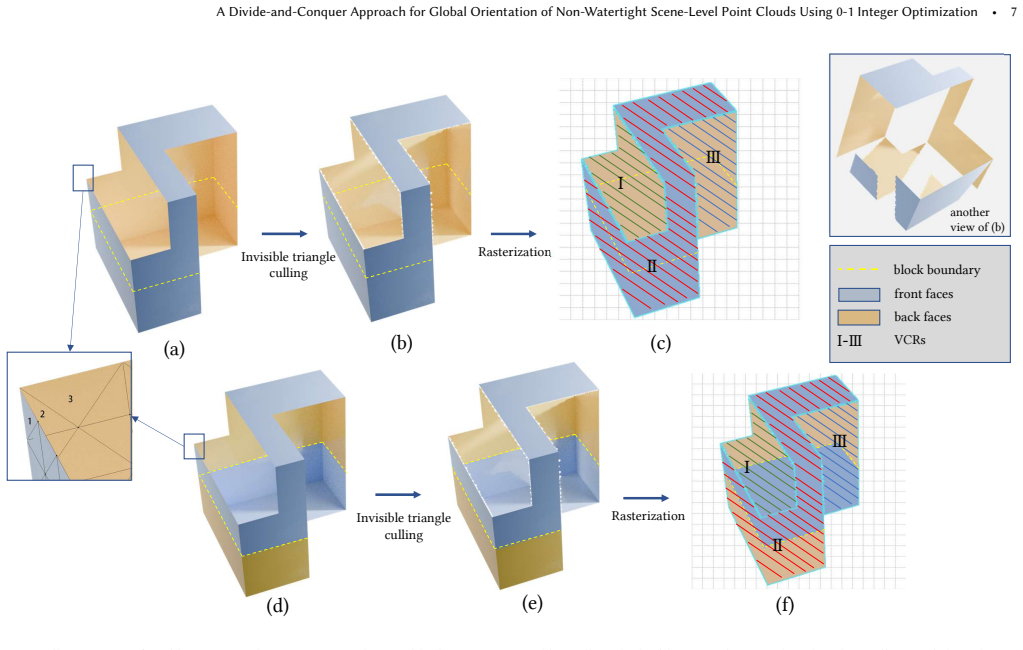
The central object is the visible connected region (VCR): a geometrically connected region on a surface patch whose projection onto a viewing plane is also connected and whose points are all visible from a chosen viewpoint. In any VCR only one side of the surface can be seen, so if two adjacent blocks are consistently oriented, every VCR that spans the block boundary must be view-aligned; mismatches there generate disagreement. Edge weights computed from these VCR scores over twelve view directions feed a 0-1 integer-constrained optimization over block flip states. Supporting machinery includes a dipole-like vector field with a tunable parameter $c$ for per-block orientation initialization, and an iPSR variant run with Neumann boundary conditions so that open block surfaces are refined without space-closing faces.
What would settle it
Run DACPO on the ScanNet v2 or SceneNN models while progressively corrupting per-block initialization (e.g., increasing noise or using random orientations for a growing fraction of blocks) and record the global incorrect-normal ratio: if the global 0-1 optimization cannot maintain accuracy unless per-block orientation is already near-perfect, the claim that the global stage is what delivers consistency is falsified. A second decisive observation is to apply the method to a scene containing two extremely close parallel surfaces or a non-manifold edge, where the paper's own assumptions predict the VCR visibility score will mislead the optimizer.
Extended reading notes
Core claim
On the paper's own terms, the discovery is that global consistency for open, scene-level surfaces can be reached without any interior-exterior separation: after per-block orientation, the problem reduces to finding flip states for a few hundred blocks that maximize a pairwise visibility-consistency score, and this 0-1 integer-constrained optimization is tractable and effective. The central evidence is the incorrect-normal ratio on real indoor scenes, e.g. 5.27% against 7.33% for the graph-based SNO baseline on original ScanNet v2 data, 2.43% against 3.54% on original SceneNN data, with smaller degradations than baselines when Gaussian noise or aggressive downsampling is applied. The paper also reports that applying the adapted iPSR directly to whole scenes without block segmentation raises the error to 29%, which is the direct evidence for the divide-and-conquer claim.
Load-bearing premise
The load-bearing premise is that each block's internal point orientations are mostly correct from the per-block stage, because the global optimizer only flips whole blocks and cannot repair misoriented points inside a block; the visibility criterion also assumes neighboring blocks form a clean manifold patch with a single visible side.
Editorial extensions
If this is right
- Non-watertight and unbounded scans become orientable without assuming a closed surface, since the per-block stage and the VCR visibility score never require inside/outside separation.
- The global stage is cheap (a few seconds for a few hundred blocks), so the pipeline scales to large scenes; most of the reported runtime is spent in per-block iPSR.
- Accuracy on noisy and sparse data degrades more slowly than propagation-based and winding-number baselines, because local greedy errors are confined within blocks and the global optimizer can still align block orientations.
- Per-block orientation errors are not corrected by the global stage, so overall accuracy is bounded by the quality of the per-block orientation, not just by the flip optimization.
- Weak connections between scene parts are handled better than pure propagation, because the global 0-1 optimization can overrule locally ambiguous edges.
Reading between the lines
- The paper's own limitation statement implies a testable extension: replace the randomized greedy plus iPSR per-block stage with a learned orientation module, and the same VCR-based 0-1 global optimization should carry over unchanged, since the global stage only consumes block orientations.
- Because the global stage only flips whole blocks, one direct consequence is that global error should track the fraction of internally correct blocks; a block-level error budget is a natural diagnostic for where DACPO will fail.
- The VCR criterion presumes neighboring blocks join as a manifold patch with a clean front/back split, so scenes with non-manifold edges or extremely thin structures are where the visibility score itself becomes unreliable; that is a property of the consistency measure, not merely of the optimizer.
- A stress test suggested by the assumptions: run the pipeline on a scene with two genuinely disconnected components (which the paper excludes) and verify whether the optimizer arbitrarily aligns the components, since consistency is only defined across connected block adjacency.
Editorial analysis
A structured set of objections, weighed in public.
Referee Report
Summary. The paper proposes DACPO, a divide-and-conquer method for orienting normals of large-scale, non-watertight scene-level point clouds. The input is segmented into connected blocks; each block is oriented by a randomized greedy initialization followed by an adapted iterative Poisson surface reconstruction (iPSR) with Neumann boundary conditions; block orientations are then globally aligned by solving a 0-1 integer optimization over block flip states. Consistency between adjacent blocks is measured via a new visibility-based criterion, the visible connected region (VCR). Experiments on ScanNet v2 and SceneNN, including noisy and downsampled variants, report lower ratios of incorrectly oriented normals than several baselines, with ablation and runtime studies.
Significance. If the method works as described, it addresses a genuine gap: most global orientation methods target watertight, object-level models, while scene-level scans are typically non-watertight and noisy. The divide-and-conquer design, the VCR consistency measure, and the use of a 0-1 integer program are plausible and the reported margins over SNO and other baselines are substantial. The paper also provides ablations showing the contribution of each per-block stage and reports runtime scaling. However, the central global-consistency step is not reproducible as printed because Eq. (6) makes the objective constant over all flip states; this must be corrected before the global stage can be evaluated. The baseline selection and reporting of results also need tightening.
major comments (3)
- [5.2] Eq. (6) as printed is degenerate: the two cases o_i = o_j and o_i != o_j give exactly the same expression, alpha_ij / (alpha_ij + alpha_ij + epsilon). Consequently the objective in Eq. (7) is constant over all flip assignments, and the reported improvements cannot be attributed to the global 0-1 optimization. The text states that alpha_ij represents the consistency when one of the two blocks is flipped, but the objective needs two distinct measurements, e.g., alpha_ij^{00} for same flip states and alpha_ij^{01} for different flip states. Please provide the correct formula and define both quantities explicitly; otherwise the central global-consistency claim is unverifiable from the manuscript.
- [6.1] The baseline comparison excludes NGL+GVO on the original SceneNN dataset because its performance 'deteriorates significantly' and the reason is 'unclear.' This is a post hoc exclusion of a published baseline. Please report the NGL+GVO numbers on all datasets or justify the exclusion with a concrete, measurable criterion; as written, the comparison is not fully fair to the baseline and the reader cannot assess the effect of the exclusion on the averaged results.
- [Table 1 and Section 6.2] Table 1 reports only dataset-level means over scenes that vary widely in point count (8K to 400K for ScanNet v2 and 400K to 4000K for SceneNN). Without per-scene error bars, standard deviations, or a distribution of per-scene incorrect-normal ratios, it is hard to judge whether DACPO's advantage is consistent or driven by a few scenes. Please report the spread (e.g., standard deviation or box plots) and, if available, a paired per-scene comparison against the strongest baseline.
minor comments (5)
- [Abstract and Section 1] The phrase 'using an an undirected graph' contains a duplicated article; please correct it.
- [4.1] The block segmentation step says a 'kd-tree-like partitioning' divides the point cloud into subsets with approximately equal numbers of points, but no details or reference are given for this partitioning; please specify the exact procedure or cite the implementation.
- [Table 2] The header 'Mehtods' is a typo for 'Methods'; please fix it.
- [6.1] The choice of 'the last 106 scenes from a total of 706' for ScanNet v2 is not justified; please explain why these scenes were selected and whether the selection is deterministic across runs.
- [5.1.1] The VCR generation projects 'triangular faces of B1 union B2' onto the viewing plane, but the input is a point cloud; please clarify whether a surface mesh is reconstructed for each block before VCR computation and, if so, how the mesh is obtained.
Circularity Check
No significant circularity: independent ground-truth evaluation and a structural pipeline; the Eq. (6) degeneracy is a soundness/reproducibility issue, not a circular derivation.
full rationale
The derivation chain is structural rather than definitional: block segmentation, randomized-greedy initialization, adapted iPSR, VCR-based consistency, and 0-1 flip optimization are separate stages, and the method is evaluated against independent ScanNet/SceneNN ground-truth meshes with external baselines (SNO, NGL, WNNC, etc.). The per-block initialization and iPSR refinement are shown by ablation to contribute independently, and the flip-state optimization is not a renaming of the input metric. The overlapping-author citations (Hou et al. 2022 iPSR; Liu et al. 2024/2025; Xu et al. 2025; Ren et al. 2023) are used as published building blocks or related-work pointers; iPSR is an established external algorithm, so citing it is real evidence rather than a forced uniqueness argument. I therefore find no circular step. Two non-circular concerns are nonetheless worth flagging. (1) Section 5.2, Eq. (6), defines both branches of omega_ij(o_i,o_j) identically as alpha_ij/(2 alpha_ij + epsilon), which makes the Eq. (7) objective constant over all flip states; as printed, the global 0-1 optimization is vacuous. This is a soundness/reproducibility defect because the central global-consistency result cannot be verified from the manuscript, but it is not circularity: the objective is neither fitted to the predicted orientations nor defined in terms of the quantity it claims to produce. (2) The Section 7 Limitations statement honestly concedes that per-block orientation errors persist through the global stage, which bounds the method's claim but does not make the pipeline self-referential. Both concerns should be resolved via the promised code or an erratum, but they do not raise the circularity score.
Assumptions & free parameters
free parameters (6)
- c in dipole-like vector field (Eq. 1) =
c=2 for ScanNetV2-Noise1/Noise2, c=4 otherwise
- Number of blocks N =
200
- k in k-NN graph for segmentation =
10
- Randomized greedy repeats M =
5
- iPSR octree depth and max iterations =
10 and 20
- Projection plane resolution =
400x400 pixels
assumptions (4)
- domain assumption Input point cloud represents a single connected component
- domain assumption Adjacent blocks form a manifold patch for which within any VCR only one side of the surface is visible
- domain assumption Adapted iPSR with Neumann boundary condition converges to a correct orientation for open surfaces
- standard math 0-1 integer optimization with Gurobi finds the global optimum of Eq. (7)
Cite this review
Pith. "Pith review of A Divide-and-Conquer Approach for Global Orientation of Non-Watertight Scene-Level Point Clouds Using 0-1 Integer Optimization." pith.science (2026). https://pith.science/paper/FLUL2T5J
@misc{pith2026250523469,
  author       = {Pith},
  title        = {Pith review of: A Divide-and-Conquer Approach for Global Orientation of Non-Watertight Scene-Level Point Clouds Using 0-1 Integer Optimization},
  year         = {2026},
  howpublished = {\url{https://pith.science/paper/FLUL2T5J}},
  note         = {Machine review of arXiv:2505.23469}
}
read the original abstract
Orienting point clouds is a fundamental problem in computer graphics and 3D vision, with applications in reconstruction, segmentation, and analysis. While significant progress has been made, existing approaches mainly focus on watertight, object-level 3D models. The orientation of large-scale, non-watertight 3D scenes remains an underexplored challenge. To address this gap, we propose DACPO (Divide-And-Conquer Point Orientation), a novel framework that leverages a divide-and-conquer strategy for scalable and robust point cloud orientation. Rather than attempting to orient an unbounded scene at once, DACPO segments the input point cloud into smaller, manageable blocks, processes each block independently, and integrates the results through a global optimization stage. For each block, we introduce a two-step process: estimating initial normal orientations by a randomized greedy method and refining them by an adapted iterative Poisson surface reconstruction. To achieve consistency across blocks, we model inter-block relationships using an an undirected graph, where nodes represent blocks and edges connect spatially adjacent blocks. To reliably evaluate orientation consistency between adjacent blocks, we introduce the concept of the visible connected region, which defines the region over which visibility-based assessments are performed. The global integration is then formulated as a 0-1 integer-constrained optimization problem, with block flip states as binary variables. Despite the combinatorial nature of the problem, DACPO remains scalable by limiting the number of blocks (typically a few hundred for 3D scenes) involved in the optimization. Experiments on benchmark datasets demonstrate DACPO's strong performance, particularly in challenging large-scale, non-watertight scenarios where existing methods often fail. The source code is available at https://github.com/zd-lee/DACPO.
Figures


Figures from the paper (13 more)




Reference graph
Works this paper leans on
-
[1992]
Surface reconstruction from unorganized points.SIGGRAPH Comput. Graph. 26, 2 (July 1992), 71–78. Alexander Hornung and Leif Kobbelt. 2006. Robust reconstruction of watertight 3D models from non-uniformly sampled point clouds without normal information. In Proceedings of the Fourth Eurographics Symposium on Geometry Processing(Cagliari, Sardinia, Italy)(SG...
work page 2022
-
[2020]
Points2Surf Learning Implicit Surfaces from Point Clouds. InComputer Vision – ECCV 2020: 16th European Conference, Glasgow, UK, August 23–28, 2020, Proceedings, Part V. Springer-Verlag, Berlin, Heidelberg, 108–124. Craig Gotsman and Kai Hormann. 2024. A Linear Method to Consistently Orient Normals of a 3D Point Cloud. InACM SIGGRAPH 2024 Conference Papers...
work page 2020
-
[2022]
Point-E: A System for Generating 3D Point Clouds from Complex Prompts. arXiv:2212.08751 [cs.CV] https://arxiv.org/abs/2212.08751 Siyu Ren, Junhui Hou, Xiaodong Chen, Ying He, and Wenping Wang. 2023. GeoUDF: Surface Reconstruction from 3D Point Clouds via Geometry-guided Distance Repre- sentation. InIEEE/CVF International Conference on Computer Vision (ICC...
arXiv 2023
-
[2024]
IEEE Transactions on Pattern Analysis and Machine Intelligence46, 12 (2024), 9957– 9974
Learning Signed Hyper Surfaces for Oriented Point Cloud Normal Estimation. IEEE Transactions on Pattern Analysis and Machine Intelligence46, 12 (2024), 9957– 9974. Siyou Lin, Zuoqiang Shi, and Yebin Liu. 2024. Fast and Globally Consistent Normal Orientation based on the Winding Number Normal Consistency.ACM Trans. Graph. 43, 6, Article 189 (Nov. 2024), 19...
work page 2024
Reviewed August 7, 2026 · model on record in the stance chip above.
Discussion (0). Sign in to comment.