REVIEW 3 major objections 5 minor 35 references
Sound Event Detection in Multichannel Audio using Convolutional Time-Frequency-Channel Squeeze and Excitation
T0 review · 3 major / 5 minor · reviewed 2026-08-14 · deepseek-v4-flash
Pith's one-line read This paper introduces a time-frequency-channel squeeze-and-excitation module that, added to a CRNN, cuts the error rate of multichannel sound event detection from 0.2538 to 0.2026.
desk verdict A clearly written, incremental SE extension for multichannel SED whose headline gain is likely inflated by test-set model selection and missing error bars. read the letter →
The pith
A machine-rendered reading of the paper's core claim, the machinery that carries it, and where it could break.
The reading
What carries the argument
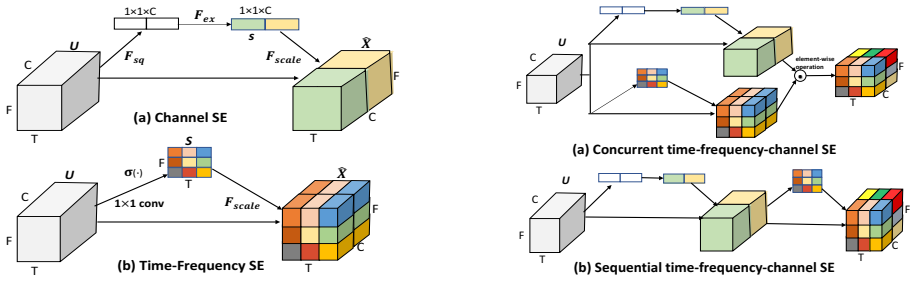
The load-bearing mechanism is the tfc-SE module, an attention block inserted after each convolutional layer. It pairs a channel squeeze-and-excitation block (global average pooling produces a per-channel descriptor, two fully connected layers with a bottleneck ratio r form a gating vector, and a sigmoid rescales each channel) with a time-frequency squeeze-and-excitation block (a 1x1 convolution collapses the channel axis into a single time-frequency weight map, again gated by a sigmoid). The two recalibrated feature maps are combined, and the paper finds the best combination is sequential, channel-first then time-frequency. This gives the network a way to up-weight informative microphones and informative spectrogram regions before the recurrent layers model temporal context.
What would settle it
Run the same CRNN with the sequential tfc-SE block on a real multichannel recording corpus with overlapping events, tuning all design choices on a separate validation split rather than the test split, and check whether the 20% relative error-rate reduction over the plain CRNN persists.
Extended reading notes
Core claim
The central discovery is that a CRNN for multichannel polyphonic sound event detection benefits from explicit, learnable recalibration of both the time-frequency map and the channel dimension, not just from the implicit weighting learned by convolutional filters. The tfc-SE module splits this recalibration into a channel-wise SE block (global average pooling over time and frequency, followed by two fully connected layers and a sigmoid gate) and a time-frequency SE block (a 1x1 convolution across channels with a sigmoid gate that assigns a weight to each time-frequency bin). Combining the two sequentially, channel first then time-frequency, gives the best results: an error rate of 0.2026 and F1 of 84.23% on the CRESIM overlap-3 test splits, versus 0.2538 error rate and 79.67% F1 for the plain CRNN. Ablations show that the time-frequency attention contributes more than the channel attention, that average pooling beats max pooling for the squeeze, that sigmoid is the right excitation nonlinearity, and that a reduction ratio of r=8 is preferable.
Load-bearing premise
The load-bearing premise is that the synthetic CRESIM overlap-3 corpus is representative enough of real multichannel sound event detection that gains measured on it will transfer to real recordings.
Editorial extensions
If this is right
- Any CRNN-based polyphonic sound event detection system can add tfc-SE blocks for roughly 0.7% more parameters and expect, on multichannel overlapping audio, a 20% relative error-rate reduction and about 6% relative F1 improvement.
- Because tf-SE alone yields a larger error-rate reduction than c-SE alone, time-frequency attention is the larger source of gain, so future attention designs for SED should focus on the spectrogram plane.
- The best configuration is sequential channel-first then time-frequency recalibration, and among concurrent aggregation rules maximization is best; these choices are empirical and load-bearing.
- Operator choices matter: average pooling for squeeze, sigmoid for excitation, and a reduction ratio near 8 give the best results, and replacing them with max pooling or ReLU/tanh excitation hurts performance.
Reading between the lines
- Because the tfc-SE module is task-agnostic, the same recalibration could transfer to other multichannel audio problems such as speaker localization, speech enhancement front-ends, or acoustic scene classification, but the paper does not test these.
- Since several design choices were selected using the test split, a fully fair evaluation with a separate validation split would likely report a smaller improvement; the direction of the effect is probably unchanged.
- Visualizing the learned time-frequency attention maps would give a direct check of the mechanism: if it works as intended, high weights should concentrate on event-relevant spectrogram regions and on microphone channels with better signal quality.
Signed reviews
Editorial analysis
A structured set of objections, weighed in public.
Referee Report
Summary. The paper proposes a convolutional time-frequency-channel Squeeze-and-Excitation (tfc-SE) module for multichannel sound event detection (SED). The module combines a channel-wise SE (c-SE) block that recalibrates channels via global average pooling and a time-frequency SE (tf-SE) block that recalibrates time-frequency locations via a 1x1 convolution, with concurrent and sequential fusion strategies. The module is inserted after each convolutional layer of a CRNN baseline and evaluated on the synthetic CRESIM overlap-3 multichannel dataset. The authors report that the best sequential tfc-SE configuration reduces error rate (ER) from 0.2538 to 0.2026 (a relative 20.17% reduction) and improves F1 from 79.67% to 84.23% (a relative 5.72% improvement). They also present ablations on aggregation strategy, dimension reduction ratio, and squeeze/excitation operators, and report a parameter overhead of only 0.7%.
Significance. If the reported improvements are valid, the paper is a useful empirical contribution to multichannel SED: it adapts the SE attention mechanism to the time-frequency domain, integrates it with channel SE at a negligible parameter cost, and provides ablations that give insight into design choices. The architecture is clearly described and the experimental design is transparent about the synthetic dataset. However, the central quantitative claim is undermined by the evaluation protocol: the key hyperparameters are selected on a test split, and the final results are reported as means without any measure of variability or significance. These issues must be fixed before the claimed gains can be taken as established. The paper is appropriate for a specialized audio or signal-processing venue if the evaluation is made statistically sound.
major comments (3)
- [Sections 4.2–4.4, Tables 3–5] The model selection protocol leaks test information. The aggregation strategy (maximization), the reduction ratio (r=8), and the squeeze/excitation operators (average pooling, sigmoid) are all selected using the 'CRESIM overlap 3 split 1 subset', which is the test split. These choices are then applied to the concurrent and sequential tfc-SE models whose results are averaged in Table 2. Because the split-1 test data is used both for selecting among multiple variants and for computing the reported improvements, the gains in Table 2 are optimistically biased. Please re-run the selection on a held-out validation set (e.g., split 2 for selection and split 3 for testing, or nested cross-validation) and report the final model's performance on all three test splits without using any test data during model selection.
- [Table 2] The results are reported as means over three splits only, with no per-split values, standard deviations, confidence intervals, or significance tests. As a result, the reader cannot judge whether the 0.0512 ER difference between the sequential tfc-SE and the CRNN baseline is larger than split-to-split or run-to-run variability, especially given that only a single training run per model is reported. Please provide per-split results for every model, report standard deviations or a paired statistical test (e.g., Wilcoxon signed-rank or paired bootstrap across the three splits, or repeated runs), and state the number of random seeds used.
- [Table 1] The filter shapes for Conv2 and Conv3 are listed as '3×3×16×64', but the input to Conv2 after Maxpool1 has 64 channels (the output of Conv1, shape 256×32×64). The filter should be '3×3×64×64' for both layers. As written, the architecture is internally inconsistent and cannot be reproduced. Please correct the table.
minor comments (5)
- [Index Terms] The index term 'squeece and excitation' contains a typo; it should be 'squeeze and excitation'.
- [Section 4.1, paragraph 4] The phrase 'combines the c-SE and t-SE activations' should read 'combines the c-SE and tf-SE activations' for consistency with the notation used elsewhere.
- [Section 2.3, Eq. (5)] The subscript (i,j) on the weight vector w in Eq. (5) suggests a per-location filter, but a 1×1 convolution uses shared weights across all time-frequency locations. Please clarify the notation to indicate that the same filter is applied at every location.
- [Section 4.4, last sentence] The phrase 'and we use it all in our paper' is awkward and should be reworded, for example, 'and we use it in all experiments'.
- [Throughout] The abbreviation 't-SE' appears once in Section 4.1; please standardize to 'tf-SE' throughout the manuscript.
Circularity Check
No circularity: the tfc-SE gains are empirical measurements, not results forced by definition or self-citation.
full rationale
I examined the paper's claimed derivation chain. The central claim is an empirical comparison of a CRNN baseline and CRNN+tfc-SE variants on the CRESIM overlap-3 multichannel SED task, with results reported in Table 2. The tfc-SE module is defined by explicit architectural equations (Eqs. 1-6) and inserted after each convolutional layer; no parameter in these equations is fitted to the reported ER/F1 values. The improvements are direct measurements on held-out evaluation splits, and no quantity called a prediction is obtained by inverting a fitted value. The cited prior SE works [26,27] are external references and are not self-citations by the present authors, and no load-bearing uniqueness theorem or ansatz is imported from the authors' own prior work. Sections 4.2-4.4 do select aggregation strategy, reduction ratio, and squeeze/excitation operator using the CRESIM overlap-3 split-1 test subset, which is a legitimate methodological concern about optimistic bias, but it does not make the central result equivalent to its inputs by construction; this belongs under soundness/correctness risk rather than circularity. Accordingly, no circular step can be exhibited with a specific reduction, and the honest finding is no significant circularity.
Assumptions & free parameters
free parameters (6)
- Reduction ratio r =
8
- Aggregation strategy for concurrent tfc-SE =
Maximization
- Squeeze operator =
Global average pooling
- Excitation operator =
Sigmoid
- Detection threshold =
0.5
- Feature parameters M=512, T=256
assumptions (3)
- domain assumption CRESIM synthetic dataset is representative of real-world multichannel sound event detection
- standard math ER and F1 metrics on 1-second segments capture SED quality
- domain assumption Magnitude and phase spectrogram concatenation along channels is a sufficient input representation
Cite this review
Pith. "Pith review of Sound Event Detection in Multichannel Audio using Convolutional Time-Frequency-Channel Squeeze and Excitation." pith.science (2026). https://pith.science/paper/FLWAUDHI
@misc{pith2026190801399,
  author       = {Pith},
  title        = {Pith review of: Sound Event Detection in Multichannel Audio using Convolutional Time-Frequency-Channel Squeeze and Excitation},
  year         = {2026},
  howpublished = {\url{https://pith.science/paper/FLWAUDHI}},
  note         = {Machine review of arXiv:1908.01399}
}
read the original abstract
In this study, we introduce a convolutional time-frequency-channel "Squeeze and Excitation" (tfc-SE) module to explicitly model inter-dependencies between the time-frequency domain and multiple channels. The tfc-SE module consists of two parts: tf-SE block and c-SE block which are designed to provide attention on time-frequency and channel domain, respectively, for adaptively recalibrating the input feature map. The proposed tfc-SE module, together with a popular Convolutional Recurrent Neural Network (CRNN) model, are evaluated on a multi-channel sound event detection task with overlapping audio sources: the training and test data are synthesized TUT Sound Events 2018 datasets, recorded with microphone arrays. We show that the tfc-SE module can be incorporated into the CRNN model at a small additional computational cost and bring significant improvements on sound event detection accuracy. We also perform detailed ablation studies by analyzing various factors that may influence the performance of the SE blocks. We show that with the best tfc-SE block, error rate (ER) decreases from 0.2538 to 0.2026, relative 20.17\% reduction of ER, and 5.72\% improvement of F1 score. The results indicate that the learned acoustic embeddings with the tfc-SE module efficiently strengthen time-frequency and channel-wise feature representations to improve the discriminative performance.
Figures
Reference graph
Works this paper leans on
-
[1]
Introduction Sound event detection (SED) task involves labeling the time stamps of a sound event in audio streams and detecting the sound type. Speech and non-speech sounds such as laughter and music contains lots of useful information. Being able to detect environmental sound events in multi-channel audios can greatly help us understand surrounding acous...
work page Pith review arXiv 2026
-
[2]
Sound Event Detection Systems 2.1. Baseline Convolutional RNN We use a recently proposed Convolutional Recurrent Neural Network (CRNN) [21] to learn the acoustic representations of multi-channel audio signals for sound event detection. The CRNN model has three components, the convolutional layers to learn the time-frequency representations of audio wavefo...
-
[3]
Experimental Setup 3.1. Dataset To study the effectiveness of the CRNN model with the tfc- SE module in multi-channel sound event detection, we used the synthetic eight-channel TUT Sound Events 2018 - Circular ar- ray, Reverberant and Synthetic Impulse Response (CRESIM) dataset [23]. The dataset synthesizes the DCASE 2016 task 2 dataset [29], which has 11...
work page 2018
-
[4]
Results and Discussions 4.1. Experimental results In order to thoroughly evaluate our proposed methods, we will conduct detailed ablation analysis in this section. We first per- form experiments on the c-SE, followed by the tf-SE, and then the sequential tfc-SE for sound event detection. We further in- vestigate the aggregation strategies for the concurren...
work page 2026
-
[5]
The tfc-SE block was inserted after each convolution layer of the CRNN model
Conclusions In this paper, we proposed a convolutional time-frequency- channel squeeze and excitation block for multi-channel sound event detection, in order to model the feature inter-dependencies between channels and the time-frequency locations. The tfc-SE block was inserted after each convolution layer of the CRNN model. The proposed method was evalua...
-
[6]
J. Kotus, K. Lopatka, and A. Czyzewski, “Detection and localiza- tion of selected acoustic events in acoustic field for smart surveil- lance applications,” Multimedia Tools and Applications, vol. 68, no. 1, pp. 5–21, 2014
work page 2014
-
[7]
Audio surveillance of roads: A system for detecting anomalous sounds,
P. Foggia, N. Petkov, A. Saggese, N. Strisciuglio, and M. Vento, “Audio surveillance of roads: A system for detecting anomalous sounds,” IEEE transactions on intelligent transportation systems, vol. 17, no. 1, pp. 279–288, 2016
work page 2016
-
[8]
Audio surveillance: A systematic review,
M. Crocco, M. Cristani, A. Trucco, and V . Murino, “Audio surveillance: A systematic review,” ACM Computing Surveys (CSUR), vol. 48, no. 4, p. 52, 2016
work page 2016
Show all 35 references
-
[9]
Detection and classification of acoustic scenes and events,
D. Stowell, D. Giannoulis, E. Benetos, M. Lagrange, and M. D. Plumbley, “Detection and classification of acoustic scenes and events,” IEEE Transactions on Multimedia , vol. 17, no. 10, pp. 1733–1746, 2015
2015
-
[10]
A joint separation-classification model for sound event detection of weakly labelled data,
Q. Kong, Y . Xu, W. Wang, and M. D. Plumbley, “A joint separation-classification model for sound event detection of weakly labelled data,” in IEEE International Conference on Acoustics, Speech and Signal Processing (ICASSP). IEEE, 2018, pp. 321–325
2018
-
[11]
Sound source localization based on deep neural networks with directional activate function exploiting phase information,
R. Takeda and K. Komatani, “Sound source localization based on deep neural networks with directional activate function exploiting phase information,” in IEEE international conference on acous- tics, speech and signal processing (ICASSP) . IEEE, 2016, pp. 405–409
2016
-
[12]
Deep neural networks for multiple speaker detection and localization,
W. He, P. Motlicek, and J.-M. Odobez, “Deep neural networks for multiple speaker detection and localization,” inIEEE Interna- tional Conference on Robotics and Automation (ICRA) . IEEE, 2018, pp. 74–79
2018
-
[13]
Sounding out smart cities: Auralization and soundscape monitoring for environmental sound design,
A. Southern, F. Stevens, and D. Murphy, “Sounding out smart cities: Auralization and soundscape monitoring for environmental sound design,” The Journal of the Acoustical Society of America, vol. 141, no. 5, pp. 3880–3880, 2017
2017
-
[14]
R-crnn: Region- based convolutional recurrent neural network for audio event de- tection,
C.-C. Kao, W. Wang, M. Sun, and C. Wang, “R-crnn: Region- based convolutional recurrent neural network for audio event de- tection,”arXiv preprint arXiv:1808.06627, 2018
2018 arXiv
-
[15]
Audio keywords generation for sports video analysis,
M. Xu, C. Xu, L. Duan, J. S. Jin, and S. Luo, “Audio keywords generation for sports video analysis,” ACM Transactions on Mul- timedia Computing, Communications, and Applications (TOMM), vol. 4, no. 2, p. 11, 2008
2008
-
[16]
Event-based video retrieval using audio,
Q. Jin, P. Schulam, S. Rawat, S. Burger, D. Ding, and F. Metze, “Event-based video retrieval using audio,” in Thirteenth Annual Conference of the International Speech Communication Associa- tion, 2012
2012
-
[17]
Audio event detection using weakly la- beled data,
A. Kumar and B. Raj, “Audio event detection using weakly la- beled data,” inProceedings of the 24th ACM international confer- ence on Multimedia. ACM, 2016, pp. 1038–1047
2016
-
[18]
On the use of the tempogram to describe audio content and its application to music structural segmentation,
M. Tian, G. Fazekas, D. A. Black, and M. Sandler, “On the use of the tempogram to describe audio content and its application to music structural segmentation,” inIEEE International Conference on Acoustics, Speech and Signal Processing (ICASSP) . IEEE, 2015, pp. 419–423
2015
-
[19]
Segmentation, indexing, and retrieval for environmental and nat- ural sounds,
G. Wichern, J. Xue, H. Thornburg, B. Mechtley, and A. Spanias, “Segmentation, indexing, and retrieval for environmental and nat- ural sounds,”IEEE Transactions on Audio, Speech, and Language Processing, vol. 18, no. 3, pp. 688–707, 2010
2010
-
[20]
Audio based event detection for multimedia surveillance,
P. K. Atrey, N. C. Maddage, and M. S. Kankanhalli, “Audio based event detection for multimedia surveillance,” in IEEE Interna- tional Conference on Acoustics Speech and Signal Processing Proceedings (ICASSP), vol. 5. IEEE, 2006
2006
-
[21]
Acoustic event detection in real life recordings,
A. Mesaros, T. Heittola, A. Eronen, and T. Virtanen, “Acoustic event detection in real life recordings,” in European Signal Pro- cessing Conference. IEEE, 2010, pp. 1267–1271
2010
-
[22]
Duration-controlled lstm for polyphonic sound event detection,
T. Hayashi, S. Watanabe, T. Toda, T. Hori, J. Le Roux, K. Takeda, T. Hayashi, S. Watanabe, T. Toda, T. Hori et al. , “Duration-controlled lstm for polyphonic sound event detection,” IEEE/ACM Transactions on Audio, Speech and Language Pro- cessing (TASLP), vol. 25, no. 11, pp. ...
2017
-
[23]
Recurrent neural networks for polyphonic sound event detection in real life record- ings,
G. Parascandolo, H. Huttunen, and T. Virtanen, “Recurrent neural networks for polyphonic sound event detection in real life record- ings,” inIEEE International Conference on Acoustics, Speech and Signal Processing (ICASSP). IEEE, 2016, pp. 6440–6444
2016
-
[24]
Cnn architectures for large-scale audio classification,
S. Hershey, S. Chaudhuri, D. P. Ellis, J. F. Gemmeke, A. Jansen, R. C. Moore, M. Plakal, D. Platt, R. A. Saurous, B. Seyboldet al., “Cnn architectures for large-scale audio classification,” in IEEE International Conference on Acoustics Speech and Signal Pro- cessing (ICASSP). I...
2017
-
[25]
Robust sound event recognition using convolutional neural networks,
H. Zhang, I. McLoughlin, and Y . Song, “Robust sound event recognition using convolutional neural networks,” in IEEE inter- national conference on acoustics, speech and signal processing (ICASSP). IEEE, 2015, pp. 559–563
2015
-
[26]
Convolutional recurrent neural networks for poly- phonic sound event detection,
E. Cakır, G. Parascandolo, T. Heittola, H. Huttunen, and T. Virtanen, “Convolutional recurrent neural networks for poly- phonic sound event detection,” IEEE/ACM Transactions on Au- dio, Speech, and Language Processing, vol. 25, no. 6, pp. 1291– 1303, 2017
2017
-
[27]
Sound event detection using spatial features and convolutional recurrent neural network,
S. Adavanne, P. Pertil ¨a, and T. Virtanen, “Sound event detection using spatial features and convolutional recurrent neural network,” in IEEE International Conference on Acoustics, Speech and Sig- nal Processing (ICASSP). IEEE, 2017, pp. 771–775
2017
-
[28]
Sound event localization and detection of overlapping sources using con- volutional recurrent neural networks,
S. Adavanne, A. Politis, J. Nikunen, and T. Virtanen, “Sound event localization and detection of overlapping sources using con- volutional recurrent neural networks,” IEEE Journal of Selected Topics in Signal Processing, 2018
2018
-
[29]
Multichannel sound event detection using 3d convolutional neural networks for learn- ing inter-channel features,
S. Adavanne, A. Politis, and T. Virtanen, “Multichannel sound event detection using 3d convolutional neural networks for learn- ing inter-channel features,” in 2018 International Joint Confer- ence on Neural Networks (IJCNN). IEEE, 2018, pp. 1–7
2018
-
[30]
De- formable convolutional networks,
J. Dai, H. Qi, Y . Xiong, Y . Li, G. Zhang, H. Hu, and Y . Wei, “De- formable convolutional networks,” inProceedings of the IEEE in- ternational conference on computer vision, 2017, pp. 764–773
2017
-
[31]
Squeeze-and-excitation networks,
J. Hu, L. Shen, and G. Sun, “Squeeze-and-excitation networks,” in Proceedings of the IEEE conference on computer vision and pattern recognition, 2018, pp. 7132–7141
2018
-
[32]
Concurrent spatial and channel squeeze & excitationin fully convolutional networks,
A. G. Roy, N. Navab, and C. Wachinger, “Concurrent spatial and channel squeeze & excitationin fully convolutional networks,” in International Conference on Medical Image Computing and Computer-Assisted Intervention. Springer, 2018, pp. 421–429
2018
-
[33]
Network in network,
M. Lin, Q. Chen, and S. Yan, “Network in network,” arXiv preprint arXiv:1312.4400, 2013
2013 arXiv
-
[34]
sound event de- tection in synthetic audio,
G. L. E. Benetos, M. Lagrnge, “sound event de- tection in synthetic audio,” [Online]. Available: https://archive.org/details/dcase2016 task2 train dev, 2016
2016
-
[35]
Metrics for polyphonic sound event detection,
A. Mesaros, T. Heittola, and T. Virtanen, “Metrics for polyphonic sound event detection,” Applied Sciences, vol. 6, no. 6, p. 162, 2016
2016
Reviewed August 14, 2026 · model on record in the stance chip above.
Discussion (0). Continue with ORCID to comment.