REVIEW 2 major objections 5 minor 99 references
A phase field approach for damage propagation in periodic microstructured materials
T0 review · 2 major / 5 minor · reviewed 2026-08-14 · deepseek-v4-flash
Pith's one-line read This paper predicts that the apparent tensile strength and post-peak softening of a periodic composite are shaped by inclusion volume fraction and shape, not only by the phase-field length scale.
desk verdict A solid, honest coupling of homogenization and phase field damage with a plausible new microstructure-strength effect, but it lacks the validation and cell-size reporting needed to fully back the claim. read the letter →
The pith
A machine-rendered reading of the paper's core claim, the machinery that carries it, and where it could break.
The reading
What carries the argument
The load-bearing object is the damage-dependent homogenized constitutive tensor $C_{ijhk}(d)$, obtained in closed form from a two-scale asymptotic expansion: $C_{pq_1 i q_2} = \langle C^m_{rjkl} (N^{(1)}_{riq_2,j} + \delta_{ir}\delta_{jq_2})(N^{(1)}_{kpq_1,l} + \delta_{pk}\delta_{lq_1}) \rangle$, with $N^{(1)}$ the periodic cell perturbation function and $\langle\cdot\rangle$ the unit-cell average. It is assembled off-line into a look-up table over $d\in[0,1]$, interpolated, and differentiated to supply both the effective stiffness and the phase-field driving force $\partial C_{ijhk}/\partial d$ at every integration point. This mechanism replaces the standard scalar degradation $g(d)C^0$ and carries the microstructural dependence of strength and softening into the macroscale phase-field equations.
What would settle it
Run the same unnotched tensile test on a periodic composite with the cell size and material properties used here, once with the homogenized phase-field model and once with a direct finite-element model that resolves inclusions and matrix explicitly; if the direct model develops a damage band thinner than the periodic cell near peak load, and its apparent strength or post-peak branch departs from the homogenized prediction, the scale-separation premise underlying the claim fails. More sharply, decreasing the phase-field length below the cell size should make the two predictions diverge.
Extended reading notes
Core claim
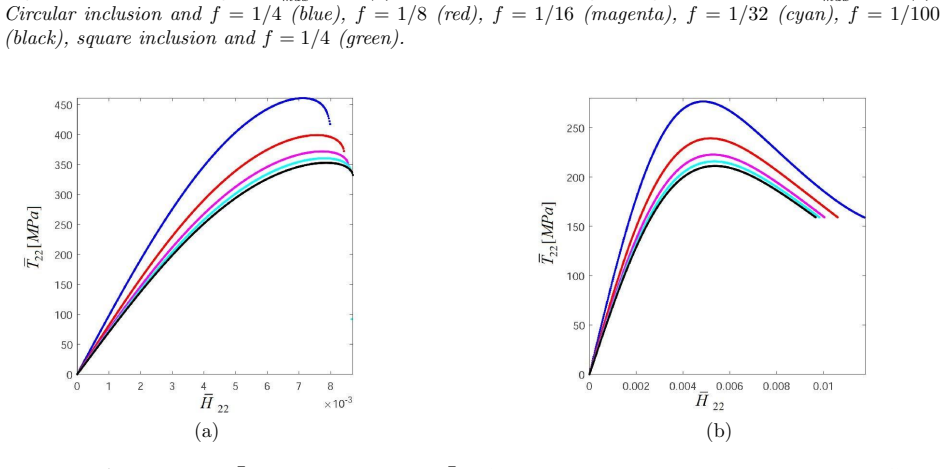
The central claim is that the phase-field method applied to a homogenized equivalent continuum can inherit microstructural influence on fracture when the damage-dependent homogenized constitutive tensor is used instead of a simple $(1-d)^2$ rescaling. With damage confined to the matrix via a degradation function $g(d)=(1-d)^2+K$ and inclusions undamaged, the closed-form two-scale homogenized tensor $C_{ijhk}(d)$ varies nonlinearly with $d$, and its derivative drives the phase-field evolution equation. The reported stress-strain curves show apparent strength increasing with inclusion volume fraction and with smaller internal length, while post-peak behavior becomes steeper for square inclusions than circular ones at the same volume fraction. Progressive post-peak softening is attributed to load transfer from the degrading matrix to the intact inclusions. The paper also reports down-scaling relations that reconstruct micro displacement fields in the periodic cell as post-processing.
Load-bearing premise
The whole construction assumes the structural length scale is much larger than the periodic cell and that damage remains diffuse enough to avoid strain localization throughout loading; if cracks narrow to the cell scale, homogenization no longer applies and the predicted strength and softening become artifacts of the averaging step.
Editorial extensions
If this is right
- For a fixed phase-field internal length, the apparent tensile strength of the composite rises with inclusion volume fraction, so reinforcement content can raise peak stress without changing the regularization length.
- Post-peak softening is progressive rather than abrupt because load is shed from the degrading matrix to intact inclusions; changing inclusion shape from circular to square steepens the softening branch.
- The look-up table for $C_{ijhk}(d)$ and its derivative avoids a nested two-scale finite-element solve at every increment, making microscopic influence on macroscopic damage cheap to simulate.
- Down-scaling relations make the microscopic displacement fields in the periodic cell available as a post-processing step, so structural-scale simulations can still report local fields.
Reading between the lines
- If the nonlinear dependence of $C_{ijhk}(d)$ on $d$ is retained, the phase-field crack path and peak load should differ from a standard model that degrades the undamaged tensor by $(1-d)^2$; a direct comparison on the same specimen would quantify how much of the reported softening is a microstructure effect.
- Because the effective tensor is computed for damage in the matrix only, the same framework could extend to fiber-matrix interface damage or inclusion cracking, yielding testable rankings of which failure mode most reduces apparent strength.
- The central scale-separation assumption restricts predictions to regimes where damage is diffuse; for composites that fail by localized cracks at the cell scale, a resolved-microstructure simulation would be needed, and the down-scaling formulas could help initialize it.
- A testable extension is to vary cell aspect ratio or inclusion arrangement and check whether apparent strength ordering follows a simple geometric parameter, which would turn the method into a fast microstructure optimization surrogate.
Signed reviews
Editorial analysis
A structured set of objections, weighed in public.
Referee Report
Summary. The paper proposes a multiscale computational framework that couples two-scale asymptotic homogenization with a phase field model of fracture at the macroscale. The microstructure consists of a damaging aluminum matrix and elastic silicon carbide inclusions; the matrix stiffness is degraded by the factor (1-d)^2+K, and the homogenized constitutive tensor C(d) is computed off-line from unit cell problems and then interpolated as a function of the phase field variable d. The coupled displacement/phase-field equations are derived in variational form and solved in FEAP. Numerical tensile tests on unnotched and notched specimens with circular and square inclusions, different volume fractions, and different internal lengths are presented. The central claim is that the apparent tensile strength and the post-peak branch depend on inclusion shape and volume fraction, not only on the phase field length scale.
Significance. If the predicted microstructure dependence is real, the paper offers a computationally efficient alternative to FE^2 for damage simulations in periodic composites, with a closed-form homogenized tangent operator, an off-line look-up table, and downscaling relations for post-processing. The derivation is internally consistent: the homogenized tensor in Eq. (21) and the coupled system in Eq. (27) are obtained carefully, and the trends in Figs. 6-10 are qualitatively plausible. The authors are also explicit about the assumptions of periodicity, scale separation, and diffuse damage. However, the absence of a resolved-microstructure reference solution and the lack of mesh/cell-size convergence studies leave the central claim unverified; the results are best regarded as a model prediction at this stage.
major comments (2)
- [5.1 (also Sections 2 and 3)] Section 5.1 states that the internal length l is set "intermediate between the value of the macroscopic length scale L and the value of the microscopic one epsilon" and lists l = 0.05, 0.1, 0.2, 0.4 mm, but the value of epsilon is never reported anywhere in the manuscript. With L = 1 mm and l = 0.05 mm, the required scale-separation conditions L >> epsilon and l >> epsilon cannot be verified, nor can the related assumption of diffuse damage without strain localization stated in Sections 2 and 3. Since the model applies the first-order homogenized tensor C(d) pointwise with a uniform d, the regime in which the phase field forms a band of width O(pi l) near peak load is precisely where the validity of the homogenization premise is most questionable. The authors should report epsilon, quantify the separation margins for each l, and ideally verify the model against a fully resolved simulation of the microstructure.
- [5.2-5.3 (Figs. 6-10)] The central claim in the abstract—that the apparent tensile strength and the post-peak branch depend on inclusion volume fraction and shape—is supported only by the homogenized model itself. No direct numerical simulation resolving the actual microstructure, no experimental data, and no mesh-convergence or cell-size-convergence study are provided. Because the peak and post-peak regime is exactly where strain localization occurs, the possibility remains that the reported dependence is an artifact of the homogenized formulation rather than a property of the composite. A DNS of the same specimens, or at least a systematic convergence study in the ratios l/epsilon and h/l (with h the mesh size), is needed to establish the claim.
minor comments (5)
- [5.1] The text says that "five different values of the internal length scale l" are considered, but only four values are listed or used in Fig. 6: l = 0.05, 0.1, 0.2, 0.4 mm. The fifth value should be supplied or the sentence corrected.
- [Eq. (30)] In the square-inclusion tensor Csq, the entries C1122 and C2211 are printed as 4.014 and 4.0139, respectively; by the symmetries of the elastic tensor these must coincide, so this appears to be a typographical error.
- [Eq. (39c)] The derivative notation "partial C(partial d)/partial d" in Eq. (39c) should read "partial C(d)/partial d".
- [Abstract and Section 5.3] The abstract claims that the post-peak branch of notched specimens depends on inclusion shape, but the notched examples in Section 5.3 consider only circular inclusions. The shape dependence is demonstrated only for the unnotched specimens, so the wording should be adjusted.
- [5.1] The interpolation of C(d) is described only as a look-up table concept; the interpolation basis, the number and distribution of sampling points in d, and the resulting interpolation error are not reported. Since partial C/partial d and partial^2 C/partial d^2 enter the residual and tangent, this information is needed for reproducibility.
Circularity Check
No significant circularity: the microstructure-dependent strength is an emergent output of the phase-field system driven by the homogenized damaged tensor C(d), not a fitted target or a self-referential definition.
full rationale
The derivation chain is self-contained. The homogenized damaged tensor C(d) is obtained from the periodic cell problem (Eq. 21) by degrading only the matrix modulus with g(d)=(1-d)^2, and the macroscale phase-field equation (Eq. 27) is then solved with that C(d). The apparent strength and post-peak response in Figures 6-10 are outputs of this coupled system; no parameter is adjusted to reproduce those stress-strain trends. The off-line interpolation of C(d) is a fit to cell-problem data, but the interpolation coefficients are not used to match the apparent strength, so the 'fitted input called prediction' pattern does not apply. Self-citations to Bacigalupo (2014) and Fantoni et al. (2017) for homogenization details are not load-bearing: the paper states the cell problem, the closed-form tensor, and the down-scaling relations, and the method is standard, with independent references (Bakhvalov and Panasenko 1984; Smyshlyaev and Cherednichenko 2000) also given. The scale-separation premise is a verifiability/correctness limitation rather than a circularity: Section 5.1 says l is chosen 'intermediate between the value of the macroscopic length scale L and the value of the microscopic one epsilon', but epsilon is never reported, so the diffuse-damage assumption at the smallest l (0.05 mm) cannot be checked from the paper; this affects whether the computed strength is physically trustworthy, not whether the derivation reduces to its inputs. Accordingly, no circular step is identified.
Assumptions & free parameters
free parameters (4)
- K =
0.005
- GC =
6 N/mm
- Phase field length scale l =
0.05, 0.1, 0.2, 0.4 mm
- Interpolation coefficients for C(d) =
not provided
assumptions (5)
- domain assumption Scale separation L >> epsilon holds for the specimens and loadings considered.
- domain assumption Damage remains diffuse and strain localization is avoided throughout the loading history.
- standard math First-order asymptotic homogenization with Q-periodic perturbation functions and the generalized macro-homogeneity condition yields the effective tensor.
- domain assumption The phase field damage variable degrades only the matrix stiffness via g(d) = (1-d)^2 + K, while inclusions remain linear elastic.
- domain assumption The damaged material can be represented by a first-order Cauchy continuum at the macroscale.
Cite this review
Pith. "Pith review of A phase field approach for damage propagation in periodic microstructured materials." pith.science (2026). https://pith.science/paper/FMRYDQ7V
@misc{pith2026190802993,
  author       = {Pith},
  title        = {Pith review of: A phase field approach for damage propagation in periodic microstructured materials},
  year         = {2026},
  howpublished = {\url{https://pith.science/paper/FMRYDQ7V}},
  note         = {Machine review of arXiv:1908.02993}
}
read the original abstract
In the present work, the evolution of damage in periodic composite materials is investigated through a novel finite element-based multiscale computational approach. The methodology is developed by means of the original combination of homogenization methods with the phase field approach of fracture. This last is applied at the macroscale level on the equivalent homogeneous continuum, whose constitutive properties are obtained in closed form via a two-scale asymptotic homogenization scheme. The formulation allows considering different assumptions on the evolution of damage at the microscale (e.g., damage in the matrix and not in the inclusion/fiber), as well as the role played by the microstructural topology. Numerical results show that the proposed formulation leads to an apparent tensile strength and a post-peak branch of unnotched and notched specimens dependent not only on the internal length scale of the phase field approach, as for homogeneous materials, but also on the inclusion volumetric content and its shape. Down-scaling relations allow the full reconstruction of the microscopic fields at any point of the macroscopic model, as a simple post-processing operation.
Figures


Figures from the paper (11 more)




Reference graph
Works this paper leans on
-
[1]
Micromechanical analysis of heterogeneous materials subjected to overall cosserat strains
Addessi, D., De Bellis, M., Sacco, E., 2013. Micromechanical analysis of heterogeneous materials subjected to overall cosserat strains. Mechanics Research Communications 54, 27--34
2013
-
[2]
Homogenization and two-scale convergence
Allaire, G., 1992. Homogenization and two-scale convergence. SIAM Journal of Mathematical Analisys 23, 1482--1518
1992
-
[3]
Phase-field modeling of ductile fracture
Ambati, M., Gerasimov, T., De Lorenzis, L., 2015. Phase-field modeling of ductile fracture. Computational Mechanics 55 (5), 1017--1040
2015
-
[4]
Higher order asymptotic homogenization and wave propagation in periodic composite materials
Andrianov, I., Bolshakov, V., Danishevs\'kyy, V., Weichert, D., 2008. Higher order asymptotic homogenization and wave propagation in periodic composite materials. Proceedings of the Royal Society of London A: Mathematical, Physical and Engineering Sciences 464(2093), 1181--1201
2008
-
[5]
Phase-field analysis of finite-strain plates and shells including element subdivision
Areias, P., Rabczuk, T., Msekh, M., 2016. Phase-field analysis of finite-strain plates and shells including element subdivision. Computer Methods in Applied Mechanics and Engineering 312, 322--350
2016
-
[6]
R., Linde, P., Camanho, P
Arteiro, A., Catalanotti, G., Melro, A. R., Linde, P., Camanho, P. P., 2015. Micro-mechanical analysis of the effect of ply thickness on the transverse compressive strength of polymer composites . Composites Part A: Applied Science and Manufacturing 79, 127--137
2015
-
[7]
Mindlin second-gradient elastic properties from dilute two-phase cauchy-elastic composites
Bacca, M., Bigoni, D., Dal Corso, F., Veber, D., 2013 a . Mindlin second-gradient elastic properties from dilute two-phase cauchy-elastic composites. part i: Closed form expression for the effective higher-order constitutive tensor. International Journal of Solids and Structures 50(24), 4010--4019
2013
-
[8]
Mindlin second-gradient elastic properties from dilute two-phase cauchy-elastic composites part ii: Higher-order constitutive properties and application cases
Bacca, M., Bigoni, D., Dal Corso, F., Veber, D., 2013 b . Mindlin second-gradient elastic properties from dilute two-phase cauchy-elastic composites part ii: Higher-order constitutive properties and application cases. international journal of solids and structures. International Journal of Solids and Structures 50(24), 4020--4029
2013
Show all 99 references
-
[9]
Anisotropic effective higher-order response of heterogeneous cauchy elastic materials
Bacca, M., Dal Corso, F., Veber, D., Bigoni, D., 2013 c . Anisotropic effective higher-order response of heterogeneous cauchy elastic materials. Mechanics Research Communications 54, 63--71
2013
-
[10]
Second-order homogenization of periodic materials based on asymptotic approximation of the strain energy: formulation and validity limits
Bacigalupo, A., 2014. Second-order homogenization of periodic materials based on asymptotic approximation of the strain energy: formulation and validity limits. Meccanica 49(6), 1407--1425
2014
-
[11]
Micro-polar and second order homogenization of periodic masonry
Bacigalupo, A., Gambarotta, L., 2010. Micro-polar and second order homogenization of periodic masonry. In Materials Science Forum, Trans Tech Publications 638, 2561--2566
2010
-
[12]
A multi-scale strain-localization analysis of a layered strip with debonding interfaces
Bacigalupo, A., Gambarotta, L., 2013. A multi-scale strain-localization analysis of a layered strip with debonding interfaces. International Journal of Solids and Structures 50 (13), 2061--2077
2013
-
[13]
Computational dynamic homogenization for the analysis of dispersive waves in layered rock masses with periodic fractures
Bacigalupo, A., Gambarotta, L., 2014 a . Computational dynamic homogenization for the analysis of dispersive waves in layered rock masses with periodic fractures. Computers and Geotechnics 56, 61--68
2014
-
[14]
Second-gradient homogenized model for wave propagation in heterogeneous periodic media
Bacigalupo, A., Gambarotta, L., 2014 b . Second-gradient homogenized model for wave propagation in heterogeneous periodic media. International Journal of Solids and Structures 51(5), 1052--1065
2014
-
[15]
Effective elastic properties of planar sofcs: A non-local dynamic homogenization approach
Bacigalupo, A., Morini, L., Piccolroaz, A., 2014. Effective elastic properties of planar sofcs: A non-local dynamic homogenization approach. International Journal of Hydrogen Energy 39(27), 15017--15030
2014
-
[16]
Homogenization: Averaging Processes in Periodic Media
Bakhvalov, N., Panasenko, G., 1984. Homogenization: Averaging Processes in Periodic Media. Kluwer Academic Publishers, Dordrecht-Boston-London
1984
-
[17]
Non local integral formulations of plasticity and damage: survey of progress
Bazant, Z., Jirasek, M., 2002. Non local integral formulations of plasticity and damage: survey of progress. ASCE J. Engrg. Mech. 128 (11), 1119--1149
2002
-
[18]
Asymptotic analysis for periodic structures
Bensoussan, A., Lions, J., Papanicolaou, G., 1978. Asymptotic analysis for periodic structures. North-Holland, Amsterdam
1978
-
[19]
Analytical derivation of cosserat moduli via homogenization of heterogeneous elastic materials
Bigoni, D., Drugan, W., 2007. Analytical derivation of cosserat moduli via homogenization of heterogeneous elastic materials. Journal of Applied Mechanics 74(4), 741--753
2007
-
[20]
Phase-field modeling of anisotropic brittle fracture including several damage mechanisms
Bleyer, J., Alessi, R., 2018. Phase-field modeling of anisotropic brittle fracture including several damage mechanisms. Computer Methods in Applied Mechanics and Engineering 336, 213 -- 236
2018
-
[21]
The variational approach to fracture
Bourdin, B., Francfort, G., Marigo, J., 2008. The variational approach to fracture. Springer
2008
-
[22]
A., Marigo, J.-J., 2000
Bourdin, B., Francfort, G. A., Marigo, J.-J., 2000. Numerical experiments in revisited brittle fracture. Journal of the Mechanics and Physics of Solids 48 (4), 797--826
2000
-
[23]
Microstructural effects in elastic composites
Boutin, C., 1996. Microstructural effects in elastic composites. International Journal of Solids and Structures 33, 1023--1051
1996
-
[24]
Computational modelling of impact damage in brittle materials
Camacho, G., Ortiz, M., 1996. Computational modelling of impact damage in brittle materials. Int. J. Solid Structures 33, 2899--2938
1996
-
[25]
Modeling complex crack paths in ceramic laminates: A novel variational framework combining the phase field method of fracture and the cohesive zone model
Carollo, V., Reinoso, J., Paggi, M., 2018. Modeling complex crack paths in ceramic laminates: A novel variational framework combining the phase field method of fracture and the cohesive zone model. Journal of the European Ceramic Society 38 (8), 2994 -- 3003, cermodel 2017: Mo...
2018
-
[26]
Computational modelling of gradient-enhanced damage in quasi-brittle materials
Comi, C., 1999. Computational modelling of gradient-enhanced damage in quasi-brittle materials. Mechanics of Cohesive-frictional Materials 4 (1), 17--36
1999
-
[27]
L., Addessi, D., 2011
De Bellis, M. L., Addessi, D., 2011. A cosserat based multi-scale model for masonry structures. International Journal for Multiscale Computational Engineering 9 (5), 543
2011
-
[28]
Characterization of wave propagation in periodic viscoelastic materials via asymptotic-variational homogenization
Del Toro, R., Bacigalupo, A., Paggi, M., 2019. Characterization of wave propagation in periodic viscoelastic materials via asymptotic-variational homogenization. International Journal of Solids and Structures 172, 110--146
2019
-
[29]
A regularization framework for damage--plasticity models via gradient enhancement of the free energy
Dimitrijevic, B., Hackl, K., 2011. A regularization framework for damage--plasticity models via gradient enhancement of the free energy. International Journal for Numerical Methods in Biomedical Engineering 27, 1199--1210
2011
-
[30]
Computational homogenization of architectured materials
Dirrenberger, J., Forest, S., Jeulin, D., 2019. Computational homogenization of architectured materials. In: Architectured Materials in Nature and Engineering. Springer, pp. 89--139
2019
-
[31]
Multi-field asymptotic homogenization of thermo-piezoelectric materials with periodic microstructure
Fantoni, F., Bacigalupo, A., Paggi, M., 2017. Multi-field asymptotic homogenization of thermo-piezoelectric materials with periodic microstructure. International Journal of Solids and Structures 120, 31--56
2017
-
[32]
Design of thermo-piezoelectric microstructured bending actuators via multi-field asymptotic homogenization
Fantoni, F., Bacigalupo, A., Paggi, M., 2018. Design of thermo-piezoelectric microstructured bending actuators via multi-field asymptotic homogenization. International Journal of Mechanical Sciences 146, 319--336
2018
-
[33]
A multilevel finite element method (fe2) to describe the response of highly non-linear structures using generalized continua
Feyel, F., 2003. A multilevel finite element method (fe2) to describe the response of highly non-linear structures using generalized continua. Computer Methods in applied Mechanics and engineering 192 (28-30), 3233--3244
2003
-
[34]
Homogenization methods and the mechanics of generalized continua-part 2
Forest, S., 2002. Homogenization methods and the mechanics of generalized continua-part 2. Theoretical and applied mechanics 28 (29), 113--144
2002
-
[35]
Cosserat overall modeling of heterogeneous materials
Forest, S., Sab, K., 1998. Cosserat overall modeling of heterogeneous materials. Mechanics Research Communications 25(4), 449--454
1998
-
[36]
Generalized continua and non‐homogeneous boundary conditions in homogenisation methods
Forest, S., Trinh, D., 2011. Generalized continua and non‐homogeneous boundary conditions in homogenisation methods. ZAMM‐Journal of Applied Mathematics and Mechanics/Zeitschrift für Angewandte Mathematik und Mechanik 91(2), 90--109
2011
-
[37]
Revisiting brittle fracture as an energy minimization problem
Francfort, G., Marigo, J., 1998. Revisiting brittle fracture as an energy minimization problem. J. Mech. Phys. Solids 46, 1319--1342
1998
-
[38]
Higher order terms in the homogenized stress‐strain relation of periodic elastic media
Gambin, B., Kr\"oner, E., 1989. Higher order terms in the homogenized stress‐strain relation of periodic elastic media. physica status solidi (b). International Journal of Engineering Science 151(2), 513--519
1989
-
[39]
A., 1921
Griffith, A. A., 1921. The phenomena of rupture and flow in solids. Philosophical transaction of the royal society of London. Sieres A. Containing papers of a Mathematical or physical character 221, 163--198
1921
-
[40]
G., Reinoso, J., Paggi, M., 2019
Guill\'en-Hern\'andez, T., Garc\' i a, I. G., Reinoso, J., Paggi, M., 2019. A micromechanical analysis of inter-fiber failure in long reinforced composites based on the phase field approach of fracture combined with the cohesive zone model. International Journal of Fracture. A...
2019
-
[41]
A., 2018
G \"u ltekin, O., Dal, H., Holzapfel, G. A., 2018. Numerical aspects of anisotropic failure in soft biological tissues favor energy-based criteria: A rate-dependent anisotropic crack phase-field model. Computer Methods in Applied Mechanics and Engineering 331, 23 -- 52
2018
-
[42]
o rr, A. C., de Borst, R., Hennig, P., K \
Hansen-D \" o rr, A. C., de Borst, R., Hennig, P., K \" a stner, M., 2019. Phase-field modelling of interface failure in brittle materials. Computer Methods in Applied Mechanics and Engineering 346, 25 -- 42
2019
-
[43]
S., González, C., LLorca, J., 2015
Herráez, M., Mora, D., Naya, F., Lopes, C. S., González, C., LLorca, J., 2015. Transverse cracking of cross-ply laminates: A computational micromechanics perspective. Composites Science and Technology 110, 196 -- 204
2015
-
[44]
S., Palencia, E
Hubert, J. S., Palencia, E. S., 1992. Introduction aux m \'e thodes asymptotiques et \`a l'homog \'e n \'e isation: application \`a la m \'e canique des milieux continus. Masson
1992
-
[45]
J., Bi \'c ani \'c , N., 2008
Kaczmarczyk, L., Pearce, C. J., Bi \'c ani \'c , N., 2008. Scale transition and enforcement of rve boundary conditions in second-order computational homogenization. International Journal for Numerical Methods in Engineering 74 (3), 506--522
2008
-
[46]
Variational approach to interface element modeling of brittle fracture propagation
Khisamitov, I., Meschke, G., 2018. Variational approach to interface element modeling of brittle fracture propagation. Computer Methods in Applied Mechanics and Engineering 328, 452 -- 476
2018
-
[47]
Advanced constitutive modeling of heterogeneous materials with a gradient-enhanced computational homogenization scheme
Kouznetsova, V., Geers, M., Brekelmans, W., 2002. Advanced constitutive modeling of heterogeneous materials with a gradient-enhanced computational homogenization scheme. International Journal for Numerical Methods in Engineering 54, 1235--1260
2002
-
[48]
Multi-scale second-order computational homogenization of multi-phase materials: a nested finite element solution strategy
Kouznetsova, V., Geers, M., Brekelmans, W., 2004. Multi-scale second-order computational homogenization of multi-phase materials: a nested finite element solution strategy. Computer Methods in Applied Mechanics and Engineering 193(48), 5525--5550
2004
-
[49]
Simulation of size effects by a phase field model for fracture
Kuhn, C., M \"u ller, R., 2014. Simulation of size effects by a phase field model for fracture. Theoretical and Applied Mechanics Letters 4 (5), 051008
2014
-
[50]
Finite elements with embedded strong discontinuities for the modeling of failure in solids
Linder, C., Armero, F., 2007. Finite elements with embedded strong discontinuities for the modeling of failure in solids. International Journal for Numerical Methods in Engineering 72, 1391--1433
2007
-
[51]
A convergence study of phase-field models for brittle fracture
Linse, T., Hennig, P., K \" a stner, M., de Borst, R., 2017. A convergence study of phase-field models for brittle fracture. Engineering Fracture Mechanics 184, 307 -- 318
2017
-
[52]
A continuum damage model for composite laminates: Part \ I\ – constitutive model
Maim\'i, P., Camanho, P., Mayugo, J., Dávila, C., 2007. A continuum damage model for composite laminates: Part \ I\ – constitutive model. Mechanics of Materials 39, 897--908
2007
-
[53]
G., 2012
Manti c , V., Garc\' i a, I. G., 2012. Crack onset and growth at the fibre-matrix interface under a remote biaxial transverse load. Application of a coupled stress and energy criterion. International Journal of Solids and Structures 49 (17), 2273--2290
2012
-
[54]
F., 2018
Mart \' nez-Pa \ n eda, E., Golahmar, A., Niordson, C. F., 2018. A phase field formulation for hydrogen assisted cracking. Computer Methods in Applied Mechanics and Engineering 342, 742--761
2018
-
[55]
Asymptotic homogenization of elastic composite materials with a regular structure
Meguid, S., Kalamkarov, A., 1994. Asymptotic homogenization of elastic composite materials with a regular structure. International Journal of Solids and Structures 31, 303 -- 316
1994
-
[56]
Phase field modeling of ductile fracture at finite strains: A variational gradient-extended plasticity-damage theory
Miehe, C., Aldakheel, F., Raina, A., 2016. Phase field modeling of ductile fracture at finite strains: A variational gradient-extended plasticity-damage theory. International Journal of Plasticity 84, 1 -- 32
2016
-
[57]
Phase field modeling of fracture in multi-physics problems
Miehe, C., Hofacker, M., Schänzel, L.-M., Aldakheel, F., 2015 a . Phase field modeling of fracture in multi-physics problems. part ii. coupled brittle-to-ductile failure criteria and crack propagation in thermo-elastic–plastic solids. Computer Methods in Applied Mechanics and ...
2015
-
[58]
A phase field model for rate-independent crack propagation: Robust algorithmic implementation based on operator splits
Miehe, C., Hofacker, M., Welschinger, F., 2010 a . A phase field model for rate-independent crack propagation: Robust algorithmic implementation based on operator splits. Computer Methods in Applied Mechanics and Engineering 199 (45), 2765 -- 2778
2010
-
[59]
A phase field model for rate-independent crack propagation: Robust algorithmic implementation based on operator splits
Miehe, C., Hofacker, M., Welschinger, F., 2010 b . A phase field model for rate-independent crack propagation: Robust algorithmic implementation based on operator splits. Computer Methods in Applied Mechanics and Engineering 199 (45-48), 2765--2778
2010
-
[60]
Formulation and numerical exploitation of mixed variational principles for coupled problems of cahn-hilliard-type and standard diffusion in elastic solids
Miehe, C., Mauthe, S., Ulmer, H., 2014. Formulation and numerical exploitation of mixed variational principles for coupled problems of cahn-hilliard-type and standard diffusion in elastic solids. Int. J. for Num. Meth. in Engrg. 99, 737--762
2014
-
[61]
Phase field modeling of fracture in multi-physics problems
Miehe, C., Sch \"a nzel, L., Ulmer, H., 2015 b . Phase field modeling of fracture in multi-physics problems. part i. balance of crack surface and failure criteria for brittle crack propagation in thermo-elastic solids. Computer Methods in Applied Mechanics and Engineering 294,...
2015
-
[62]
Thermodynamically consistent phase-field models of fracture: Variational principles and multi-field fe implementations
Miehe, C., Welschinger, F., Hofacker, M., 2010 c . Thermodynamically consistent phase-field models of fracture: Variational principles and multi-field fe implementations. International Journal for Numerical Methods in Engineering 83 (10), 1273--1311
2010
-
[63]
A finite element method for crack growth without remeshing
Moes, N., Dolbow, J., Belytschko, T., 1999. A finite element method for crack growth without remeshing. Int. J. Numer. Methods Eng. 46, 131--150
1999
-
[64]
On the choice of parameters in the phase field method for simulating crack initiation with experimental validation
Nguyen, T.-T., Yvonnet, J., Bornert, M., Chateau, C., Sab, K., Romani, R., Le Roy, R., 2016 a . On the choice of parameters in the phase field method for simulating crack initiation with experimental validation. International Journal of Fracture 197 (2), 213--226
2016
-
[65]
T., Yvonnet, J., Bornert, M., Chateau, C., Sab, K., Romani, R., Le Roy, R., 2016 b
Nguyen, T. T., Yvonnet, J., Bornert, M., Chateau, C., Sab, K., Romani, R., Le Roy, R., 2016 b . On the choice of parameters in the phase field method for simulating crack initiation with experimental validation. International Journal of Fracture 197 (2), 213--226
2016
-
[66]
A phase-field method for computational modeling of interfacial damage interacting with crack propagation in realistic microstructures obtained by microtomography
Nguyen, T.-T., Yvonnet, J., Zhu, Q.-Z., Bornert, M., Chateau, C., 2016 c . A phase-field method for computational modeling of interfacial damage interacting with crack propagation in realistic microstructures obtained by microtomography. Computer Methods in Applied Mechanics a...
2016
-
[67]
Stability and robustness issues in numerical modeling of material failure with the strong discontinuity approach
Oliver, J., Huespe, A., Blanco, S., Linero, D., 2006. Stability and robustness issues in numerical modeling of material failure with the strong discontinuity approach. Computer Methods in Applied Mechanics and Engineering 195, 7093--7114
2006
-
[68]
Finite-deformation irreversible cohesive elements for three-dimensional crack-propagation analysis
Ortiz, M., Pandolfi, A., 1999. Finite-deformation irreversible cohesive elements for three-dimensional crack-propagation analysis. Int. J. for Num. Meth. in Engrg. 44, 1267--1282
1999
-
[69]
D., Jasiuk, I., 1999
Ostoja-Starzewski, M., Boccara, S. D., Jasiuk, I., 1999. Couple-stress moduli and characteristic length of a two-phase composite. Mechanics Research Communications 26 (4), 387--396
1999
-
[70]
Multiscale computational homogenization: review and proposal of a new enhanced-first-order method
Otero, F., Oller, S., Martinez, X., 2018. Multiscale computational homogenization: review and proposal of a new enhanced-first-order method. Archives of Computational Methods in Engineering 25 (2), 479--505
2018
-
[71]
Fracture of solar-grade anisotropic polycrystalline silicon: A combined phase field–cohesive zone model approach
Paggi, M., Corrado, M., Reinoso, J., 2018. Fracture of solar-grade anisotropic polycrystalline silicon: A combined phase field–cohesive zone model approach. Computer Methods in Applied Mechanics and Engineering 330, 123 -- 148
2018
-
[72]
Paggi, M., Reinoso, J., 2017. Revisiting the problem of a crack impinging on an interface: a modeling framework for the interaction between the phase field approach for brittle fracture and the interface cohesive zone model. Computer Methods in Applied Mechanics and Engineerin...
2017
-
[73]
Stiffness and strength of hierarchical polycrystalline materials with imperfect interfaces
Paggi, M., Wriggers, P., 2012. Stiffness and strength of hierarchical polycrystalline materials with imperfect interfaces. Journal of the Mechanics and Physics of Solids 60 (4), 557--572
2012
-
[74]
Boundary conditions for the high order homogenized equation: laminated rods, plates and composites
Panasenko, G., 2009. Boundary conditions for the high order homogenized equation: laminated rods, plates and composites. Comptes Rendus MEcanique 337 (1), 8--14
2009
-
[75]
A critical comparison of nonlocal and gradient-enhanced softening continua
Peerlings, R., Geers, M., De, R., Brekelmans, W., 2001. A critical comparison of nonlocal and gradient-enhanced softening continua. International Journal of solids and Structures 38, 7723--7746
2001
-
[76]
Gradient damage models and their use to approximate brittle fracture
Pham, K., Amor, H., Marigo, J., Maurini, C., 2011. Gradient damage models and their use to approximate brittle fracture. International Journal of Damage Mechanics 20 (4), 618--652
2011
-
[77]
From the onset of damage to rupture: construction of responses with damage localization for a general class of gradient damage models
Pham, K., Marigo, J., 2013. From the onset of damage to rupture: construction of responses with damage localization for a general class of gradient damage models. Continuum Mechanics and Thermodynamics 25 (2), 147 -- 171
2013
-
[78]
A phase field approach to simulate intralaminar and translaminar fracture in long fiber composite materials
Quintanas-Corominas, A., Reinoso, J., Casoni, E., Turon, A., Mayugo, J., 2019. A phase field approach to simulate intralaminar and translaminar fracture in long fiber composite materials. Composite Structures 220, 899 -- 911
2019
-
[79]
A consistent anisotropic damage model for laminated fiber-reinforced composites using the 3d-version of the puck failure criterion
Reinoso, J., Catalanotti, G., Bl \' a zquez, A., Areias, P., Camanho, P., Par \' i s, F., 2017 a . A consistent anisotropic damage model for laminated fiber-reinforced composites using the 3d-version of the puck failure criterion. International Journal of Solids and Structures...
2017
-
[80]
Phase field modeling of brittle fracture for enhanced assumed strain shells at large deformations: formulation and finite element implementation
Reinoso, J., Paggi, M., Linder, C., 2017 b . Phase field modeling of brittle fracture for enhanced assumed strain shells at large deformations: formulation and finite element implementation. Computational Mechanics, 1--21
2017
-
[81]
Identification of second-gradient elastic materials from planar hexagonal lattices
Rizzi, G., Dal Corso, F., Veber, D., Bigoni, D., 2019 a . Identification of second-gradient elastic materials from planar hexagonal lattices. part i: Analytical derivation of equivalent constitutive tensors. International Journal of Solids and Structures
2019
-
[82]
Identification of second-gradient elastic materials from planar hexagonal lattices
Rizzi, G., Dal Corso, F., Veber, D., Bigoni, D., 2019 b . Identification of second-gradient elastic materials from planar hexagonal lattices. part ii: Mechanical characteristics and model validation. International Journal of Solids and Structures
2019
-
[83]
Salvadori, A., Fantoni, F., 2016. Fracture propagation in brittle materials as a standard dissipative process: general theorems and crack tracking algorithms., submitted for publication in the Journal of the Mechanics and Physics of Solids
2016
-
[84]
Fracture propagation in brittle materials as a standard dissipative process: Effective crack tracking algorithms based on a viscous regularization
Salvadori, A., Wawrzynek, P., Fantoni, F., 2019. Fracture propagation in brittle materials as a standard dissipative process: Effective crack tracking algorithms based on a viscous regularization. Journal of the Mechanics and Physics of Solids 127, 221--238
2019
-
[85]
High-accuracy phase-field models for brittle fracture based on a new family of degradation functions
Sargado, J., Keilegavlen, E., Berre, I., Nordbotten, J., 2017. High-accuracy phase-field models for brittle fracture based on a new family of degradation functions. Journal of the Mechanics and Physics of Solids
2017
-
[86]
Generalization of maxwell homogenization scheme for elastic material containing inhomogeneities of diverse shape
Sevostianov, I., Giraud, A., 2013. Generalization of maxwell homogenization scheme for elastic material containing inhomogeneities of diverse shape. International Journal of Engineering Science 64, 23--36
2013
-
[87]
Effective elastic properties of matrix composites with transversely-isotropic phases
Sevostianov, I., Yilmaz, N., Kushch, V., Levin, V., 2005. Effective elastic properties of matrix composites with transversely-isotropic phases. International journal of solids and structures 42 (2), 455--476
2005
-
[88]
Propagation and localization of elastic waves in highly anisotropic periodic composites via two-scale homogenization
Smyshlyaev, V., 2009. Propagation and localization of elastic waves in highly anisotropic periodic composites via two-scale homogenization. Mechanics of Materials R59, 434--447
2009
-
[89]
On rigorous derivation of strain gradient effects in the overall behaviour of periodic heterogeneous media
Smyshlyaev, V., Cherednichenko, K., 2000. On rigorous derivation of strain gradient effects in the overall behaviour of periodic heterogeneous media. Journal of the Mechanics and Physics of Solids 48(6), 1325--1357
2000
-
[90]
Crack nucleation in variational phase-field models of brittle fracture
Tann\' e , E., Li, T., Bourdin, B., Marigo, J.-J., Maurini, C., 2018. Crack nucleation in variational phase-field models of brittle fracture. Journal of the Mechanics and Physics of Solids 110, 80 -- 99
2018
-
[91]
Phase field modeling of fracture in anisotropic brittle solids
Teichtmeister, S., Kienle, D., Aldakheel, F., Keip, M., 2017. Phase field modeling of fracture in anisotropic brittle solids. International Journal of Non-Linear Mechanics 97, 1 -- 21
2017
-
[92]
A micromechanics-based approach for the derivation of constitutive elastic coefficients of strain-gradient media
Tran, T., Monchiet, V., Bonnet, G., 2012. A micromechanics-based approach for the derivation of constitutive elastic coefficients of strain-gradient media. International Journal of Solids and Structures 49(5), 783--792
2012
-
[93]
L., Murrali, A., 2015
Trovalusci, P., Ostoja-Starzewski, M., De Bellis, M. L., Murrali, A., 2015. Scale-dependent homogenization of random composites as micropolar continua. European Journal of Mechanics-A/Solids 49, 396--407
2015
-
[94]
Accurate simulation of delamination under mixed-mode loading using a cohesive model with a mode-dependent penalty stiffness
Turon, A., González, E., Sarrado, C., Guillamet, G., Maim\'i, P., 2018. Accurate simulation of delamination under mixed-mode loading using a cohesive model with a mode-dependent penalty stiffness. Composite Structures 184, 506--511
2018
-
[95]
V., de Borst, R., 2013
Verhoosel, C. V., de Borst, R., 2013. A phase-field model for cohesive fracture. International Journal for Numerical Methods in Engineering 96 (1), 43--62
2013
-
[96]
R., 1981
Willis, J. R., 1981. Variational and related methods for the overall properties of composites. In: Advances in applied mechanics. Vol. 21. Elsevier, pp. 1--78
1981
-
[97]
Y., 2017
Wu, J. Y., 2017. A unified phase-field theory for the mechanics of damage and quasi-brittle failure. Journal of the Mechanics and Physics of Solids 103, 72 -- 99
2017
-
[98]
A micromechanical approach of nonlocal modeling for media with periodic microstructures
Yuan, X., Tomita, Y., Andou, T., 2008. A micromechanical approach of nonlocal modeling for media with periodic microstructures. Mechanics Research Communications 35 (1-2), 126--133
2008
-
[99]
The finite element method
Zienkiewicz, O., Taylor, R., 1977. The finite element method. London: McGraw-hill
1977
Reviewed August 14, 2026 · model on record in the stance chip above.
Discussion (0). Continue with ORCID to comment.