REVIEW 2 major objections 5 minor 69 references
Signatures of Lorentz violation in bright ring for Sgr A* images by radiation ineffective accretion flows
T0 review · 2 major / 5 minor · reviewed 2026-08-06 · deepseek-v4-flash
Pith's one-line read A single Lorentz-violating parameter in a rotating black hole metric shrinks Sgr A*'s bright-ring diameter while widening, brightening, and asymmetrizing the ring, and the measured diameter can be turned into an allowed range for that param
desk verdict The parameter study is competent, but Eq. (1) as printed does not reduce to Kerr at l=0, so the EHT-based l constraint is not reproducible from the manuscript. read the letter →
The pith
A machine-rendered reading of the paper's core claim, the machinery that carries it, and where it could break.
The reading
What carries the argument
The load-bearing object is the rotating Lorentz-violating black hole metric of Eq. (1), whose time-time and off-diagonal $t\varphi$ components carry the parameter $l$ multiplied by powers of the spin $a$; this product structure makes $l$ mimic spin effects without being identical to them. Around this spacetime the paper places a semi-analytic radiatively inefficient accretion flow (RIAF) with power-law electron density and temperature profiles, a disk-thickness parameter $H$, and velocities interpolated between Keplerian and radial free-fall. Images are produced by general-relativistic ray tracing of thermal synchrotron emission, blurred to observational resolution, and the ring features are
What would settle it
Substitute Eq. (1) into the field equations of the low-energy Lorentz-violating gravity theory and verify it as an exact solution; a failed check would show the $l$-dependence is an artifact of the metric ansatz. Observationally, measure the Sgr A* ring at higher resolution and compare the diameter and width changes as the accretion state varies: if the diameter does not shrink while the width grows along the suggested $l$ direction, the predicted correlations are excluded.
Extended reading notes
Core claim
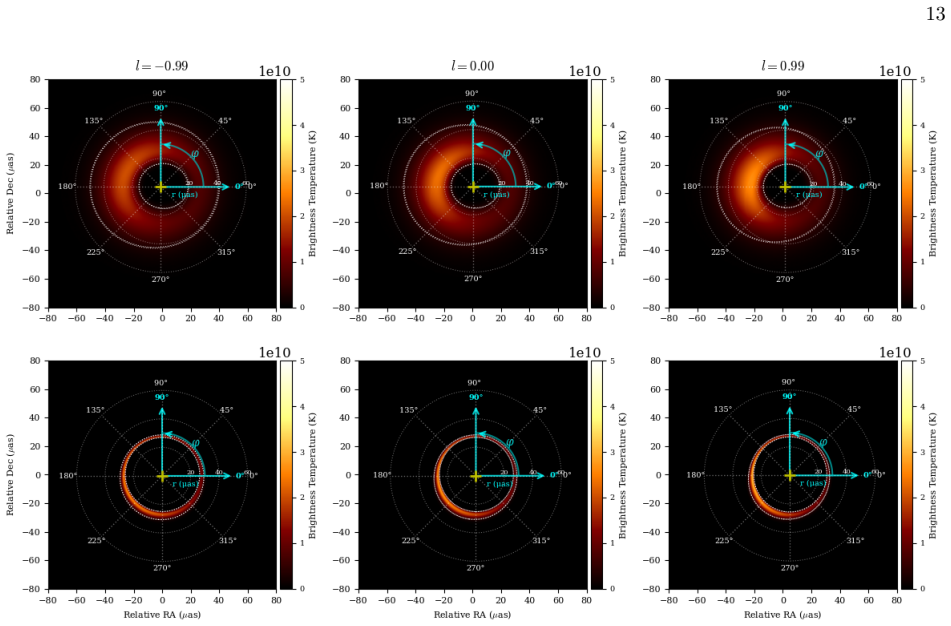
The paper's central claim is that the Lorentz-violating parameter $l$ in the rotating black hole metric produces a systematic, spin-like change in the simulated 230 GHz image of Sgr A*: the bright-ring diameter decreases monotonically with $l$, while the ring's width, intensity, azimuthal asymmetry, orientation angle, and brightness asymmetry all increase. Because $l$ enters the metric functions in products with the spin parameter $a$, its imaging effects track those of spin. Comparing the simulated ring diameter with the observed value $51.8 \pm 2.3\,\mu\mathrm{as}$, the paper derives, for each disk thickness, an allowed interval in $l$ that first broadens and then contracts as $a$ grows an
Load-bearing premise
Everything rests on the rotating Lorentz-violating metric being a genuine, correctly transcribed solution of the underlying gravity theory, especially the off-diagonal term where $a^2$ appears; if that metric is not an exact solution or contains a typographical error, the quoted ring properties and the derived allowed range for $l$ are invalid.
Editorial extensions
If this is right
- The observed Sgr A* ring diameter can be translated, at fixed disk thickness, into an allowed interval for the Lorentz-violating parameter $l$, so a single image measurement becomes a quantitative bound on Lorentz violation.
- Nonzero $l$ narrows the allowed spin range of the black hole: negative $l$ pushes spin upward and positive $l$ pushes it downward, meaning the two parameters are observationally entangled.
- Thicker disks shrink the predicted ring diameter and amplify the $l$-dependence of the diameter, so disk thickness must be known or marginalized before a reliable $l$ constraint can be quoted.
- The primary image and $n=1$ photon ring respond differently to $l$: their peak positions and widths decrease with $l$ except in narrow angular windows, and Keplerian versus radial free-fall flows produce different sensitivities, so future resolution of these subcomponents could separate Lorentz violation from flow geometry.
Reading between the lines
- The paper implicitly treats $l$ and $a$ as degenerate in the ring diameter; an independent measurement of Sgr A*'s spin, for instance from quasi-periodic variability or jet orientation, would break that degeneracy and sharpen the $l$ bound.
- The same RIAF-plus-ring-extraction pipeline could be applied to other Lorentz-violating black hole solutions to test whether the monotonic diameter/width/asymmetry trends are generic to Lorentz violation or specific to this metric's particular coupling structure.
- The semi-analytic flow is a fixed idealization; replacing it with turbulent GRMHD snapshots would test whether the claimed $l$ trends survive realistic velocity and magnetic-field fluctuations before the bounds are used as exclusion limits.
Editorial analysis
A structured set of objections, weighed in public.
Referee Report
Summary. The manuscript studies 230 GHz images of Sgr A* produced by a semi-analytic radiatively inefficient accretion flow (RIAF) around a rotating Lorentz-violating (LV) black hole in low-energy Hořava gravity. Using the EHT REx algorithm on ray-traced and blurred images, it reports that increasing the LV parameter l decreases the bright-ring diameter and increases ring width, luminosity, azimuthal asymmetry, and orientation angle; that spin and disk thickness affect these trends; and that comparing with EHT's Sgr A* diameter (51.8 ± 2.3 μas) yields a model-dependent allowed l range. It also analyzes how l shifts peak positions and widths of the n=0 primary image and n=1 photon ring for Keplerian, mixed, and radial free-fall flows.
Significance. The forward-modeling strategy is sensible and connects a modified-gravity parameter to a specific EHT observable. The use of a semi-analytic RIAF, thermal synchrotron emissivity, and the REx ring extractor is appropriate, and the paper explicitly scans multiple spins, disk thicknesses, and l values. If Eq. (1) were correctly transcribed and the simulations rerun, the qualitative trends could provide a useful template for LV searches in horizon-scale images. However, the paper gives no code or data release, and the central line element as printed is internally inconsistent, which currently prevents reproducibility and undermines the physical interpretation of the LV constraints.
major comments (2)
- [Section II, Eq. (1)] The metric as printed does not have the claimed Kerr limit. Setting l=0 gives g_{tφ} = -4 M a^2 r sin^2θ / ρ^2, whereas Kerr in Boyer-Lindquist coordinates has g_{tφ} = -2 M a r sin^2θ / ρ^2. Thus the statement that the solution 'can be returned to the Kerr solution when l=0' is false for the printed line element; the extra power of a also makes g_{tφ} dimensionally inconsistent if a is the usual specific angular momentum. Because every ray-tracing result and the EHT-derived allowed range for l (Figs. 1-6 and the Section V summary) are computed in this spacetime, the central claim is not reproducible from the manuscript. The authors must verify the metric against Ref. [50], correct the transcription, and rerun the simulations; as written the paper cannot be accepted.
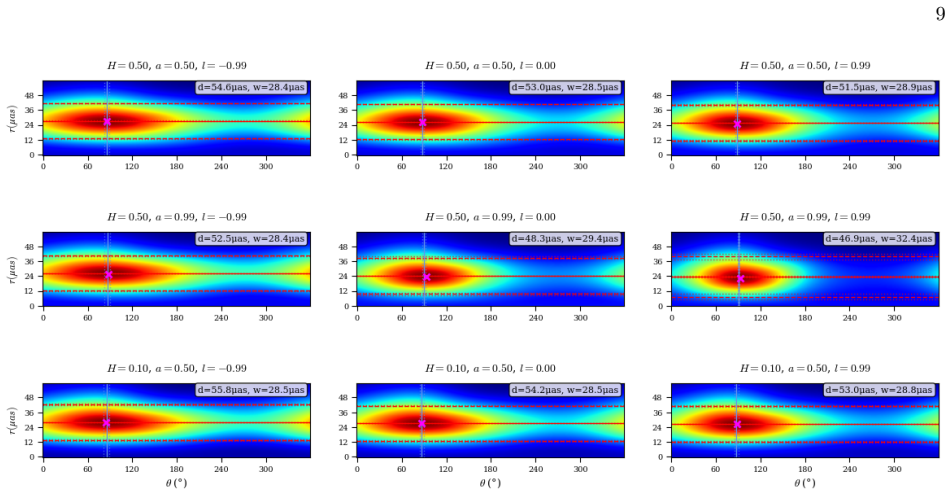
- [Section III, Fig. 4] The allowed-range analysis only propagates the 1σ statistical diameter uncertainty (51.8 ± 2.3 μas) for fixed fiducial model parameters (Table I). The diameter d varies by only a few μas over the quoted l ranges, so EHT systematic uncertainties (calibration, imaging, source variability) and model uncertainties in n_{e,0}, T_{e,0}, κ, inclination, and disk thickness could shift or erase the allowed range. The abstract and Section V present the l interval as a constraint rather than as a conditional illustration. This conclusion should be softened or supplemented by an explicit systematic-error treatment.
minor comments (5)
- [Title, Abstract, Section V] 'Radiation ineffective accretion flows' should be 'radiatively inefficient accretion flows'; this typo appears in the title, abstract, and summary.
- [Section II, Eq. (2)] The sentence 'From grr = ∆r/ρ² = 0' is garbled. The horizon condition is Δ=0, i.e. g^{rr}=0, not g_{rr}=0; please fix the notation.
- [Section IV, Fig. 7] 'Isohypse' appears to be a typo for 'isophote' or 'isocontour' in the description of temperature contours.
- [Fig. 6 label] The label 'Lv parameter' should be 'LV parameter'.
- [Section III, Eq. (8)] The definition of ring width w as 'FWHM[I(r,θ)-I_floor]' is ambiguous: it should specify the radial coordinate over which the FWHM is computed, and the role of the azimuthal average.
Circularity Check
No significant circularity: the paper is a forward-model study whose constrained LV parameter is not fitted or defined in terms of the target observable.
full rationale
The paper's central derivation is self-contained in the forward-modeling sense. The rotating Lorentz-violating black hole metric is imported as an external solution from Devecioglu-Park [50] and subsequent studies [51,52]; it is an input assumption, not derived in this paper. The RIAF model [21,22], synchrotron emissivity fits [61], and ray-tracing codes [53,54] are all external. The LV parameter l is a free parameter of the input metric; varying it and computing ring properties is a forward prediction, not a fit. The electron density and temperature are calibrated to the Sgr A* flux, but the paper does not present that flux calibration as a prediction; the ring diameter constraint uses the independent EHT diameter measurement. No fitted parameter is renamed as a prediction, no uniqueness theorem is invoked from the authors' prior work, and no ansatz is smuggled in through self-citation. The paper's self-citations (e.g., Refs. [10,12-14,16]) appear only as background references and are not load-bearing for the main derivation. A possible concern that Eq. (1) does not reduce to Kerr at l=0 as printed is a metric-consistency/correctness issue, not a circularity of the derivation chain; it does not make the constraint on l circular.
Assumptions & free parameters
free parameters (5)
- LV parameter l =
constrained; paper samples -0.99 to 0.99
- Electron number density normalization ne,0 =
approximately 1e7 cm^-3
- Electron temperature normalization Te,0 =
approximately 1e11 K
- Disk thickness H =
0.1, 0.3, 0.5 studied
- Spin parameter a =
0, 0.5, 0.99 sampled
assumptions (5)
- domain assumption Eq. (1) is the exact rotating LV black hole solution in low-energy Horava gravity
- domain assumption Semi-analytic RIAF model of Pu and Broderick describes Sgr A* accretion flow
- domain assumption Electron distribution is relativistic thermal Maxwell-Juttner at 230 GHz
- domain assumption MAD-like configuration is favored for Sgr A*
- domain assumption EHT measured ring diameter 51.8 ± 2.3 microarcseconds corresponds to the REX diameter d=2<r_pk> of blurred simulated images
Cite this review
Pith. "Pith review of Signatures of Lorentz violation in bright ring for Sgr A* images by radiation ineffective accretion flows." pith.science (2026). https://pith.science/paper/FMWEYKM2
@misc{pith2026260801413,
  author       = {Pith},
  title        = {Pith review of: Signatures of Lorentz violation in bright ring for Sgr A* images by radiation ineffective accretion flows},
  year         = {2026},
  howpublished = {\url{https://pith.science/paper/FMWEYKM2}},
  note         = {Machine review of arXiv:2608.01413}
}
abstract
We have investigated effects of Lorentz violation (LV) on bright ring in Sgr A* images illuminated by the 230 GHz thermal synchrotron emission from radiation ineffective accretion flows around a rotating LV black hole within the low-energy Ho\v{r}ava gravity framework. Our results reveal that the LV parameter reduces the bright ring diameter yet increases its width, luminosity, azimuthal asymmetry and orientation angle. Higher spin parameter strengthens the LV-induced effects on bright ring properties.Increasing disk thickness reduces the ring diameter and enhances the LV parameter's effects on this diameter. The ring width shows no systematic dependence on the disk thickness. These quantities of bright ring display similar trends against black hole spin and the LV parameter for the rotating LV black hole. Using EHT observational data of Sgr A*, we find that, at fixed disk thickness, the allowed range of the LV parameter first broadens and then contracts with growing black hole spin, and shifts toward smaller LV parameter values. In addition, the LV parameter narrows the permitted range of black hole spin: negative LV parameter values shift this range to higher spin, while positive values shift it to lower spin. Finally, we probe effects of the LV parameter on the peak position value and the width of the primary image and the $n=1$ photon ring for the rotating LV black hole. The peak positions and their widths decrease with the LV parameter, except for a narrow range. The peak position differences for various LV parameter are more pronounced for pure Keplerian accretion flow. In additional, the primary image and the $n=1$ photon ring produced by pure radially free-falling flows are broader than their counterparts generated by pure Keplerian flows.
Figures


Figures from the paper (6 more)




Reference graph
Works this paper leans on
-
[50]
D. O. Devecioglu and M.-I. Park, Eur. Phys. J. C 84, 852 (2024), 2402.02253
work page Pith review arXiv 2024
-
[1]
K. Akiyama et al. (Event Horizon Telescope), Astrophys. J. Lett. 875, L1 (2019), 1906.11238
arXiv 2019
-
[2]
K. Akiyama et al. (Event Horizon Telescope), Astrophys. J. Lett. 875, L4 (2019), 1906.11241
arXiv 2019
-
[3]
K. Akiyama et al. (Event Horizon Telescope), Astrophys. J. Lett. 875, L5 (2019), 1906.11242
arXiv 2019
-
[4]
K. Akiyama et al. (Event Horizon Telescope), Astrophys. J. Lett. 875, L6 (2019), 1906.11243. 16
arXiv 2019
-
[5]
K. Akiyama et al. (Event Horizon Telescope), Astrophys. J. Lett. 930, L12 (2022), 2311.08680
arXiv 2022
-
[6]
K. Akiyama et al. (Event Horizon Telescope), Astrophys. J. Lett. 930, L14 (2022), 2311.09479
arXiv 2022
-
[7]
K. Akiyama et al. (Event Horizon Telescope), Astrophys. J. Lett. 930, L15 (2022), 2311.08697
arXiv 2022
Show all 69 references
-
[8]
Akiyama et al
K. Akiyama et al. (Event Horizon Telescope), Astrophys. J. Lett. 930, L16 (2022), 2311.09478
2022 arXiv
-
[9]
Akiyama et al
K. Akiyama et al. (Event Horizon Telescope), Astrophys. J. Lett. 930, L17 (2022), 2311.09484
2022 arXiv
-
[10]
H. Yin, S. Chen, and J. Jing, JCAP 04, 071 (2026), 2507.03857
2026 arXiv
- [11]
-
[12]
S. Chen, J. Jing, W.-L. Qian, and B. Wang, Sci. China Phys. Mech. Astron. 66, 260401 (2023), 2301.00113
2023 arXiv
-
[13]
X. Qin, S. Chen, Z. Zhang, and J. Jing, Eur. Phys. J. C 83, 159 (2023), 2301.01551
2023 arXiv
- [14]
-
[15]
Vagnozzi et al., Class
S. Vagnozzi et al., Class. Quant. Grav. 40, 165007 (2023), 2205.07787
2023 arXiv
-
[16]
M. Wang, G. Guo, P. Yan, S. Chen, and J. Jing, Chin. Phys. C 48, 105103 (2024), 2307.16748
2024 arXiv
-
[17]
Desire, A
T. Desire, A. C´ ardenas-Avenda˜ no, and A. Chael, The Astrophysical Journal980, 262 (2025)
2025
-
[18]
M. D. Johnson et al., Sci. Adv. 6, eaaz1310 (2020), 1907.04329
2020 arXiv
-
[19]
A. A. Chael, Ph.D. thesis, Harvard University (2019)
2019
-
[20]
J. B. Achour, E. Gourgoulhon, and H. Roussille, Black hole photon ring beyond general relativity: an integrable parametrization (2025), 2506.09882
2025
-
[21]
F. Yuan, E. Quataert, and R. Narayan, The Astrophysical Journal 598, 301–312 (2003)
2003
- [22]
-
[23]
Jiang, C
H.-X. Jiang, C. Liu, I. K. Dihingia, Y. Mizuno, H. Xu, T. Zhu, and Q. Wu, JCAP 01, 059 (2024), 2312.04288
2024 arXiv
-
[24]
J.-M. Yan, T. Zhu, and Q. Wu (2025), 2504.10956
2025 arXiv
-
[25]
H.-Y. Pu, K. Akiyama, and K. Asada, Astrophys. J. 831, 4 (2016), 1608.03035
2016 arXiv
-
[26]
Casana, A
R. Casana, A. Cavalcante, F. Poulis, and E. Santos, Phys. Rev. D 97, 104001 (2018)
2018
-
[27]
Bluhm, S.-H
R. Bluhm, S.-H. Fung, and V. A. Kostelecky, Phys. Rev. D 77, 065020 (2008), 0712.4119
2008 arXiv
-
[28]
V. A. Kostelecky and R. Potting, Gen. Rel. Grav. 37, 1675 (2005), gr-qc/0510124
2005 arXiv
-
[29]
Bertolami and J
O. Bertolami and J. Paramos, Phys. Rev. D 72, 044001 (2005), hep-th/0504215
2005 arXiv
-
[30]
Kalb and P
M. Kalb and P. Ramond, Phys. Rev. D 9, 2273 (1974)
1974
-
[31]
Yang, Y.-Z
K. Yang, Y.-Z. Chen, Z.-Q. Duan, and J.-Y. Zhao, Phys. Rev. D 108, 124004 (2023), 2308.06613
2023 arXiv
-
[32]
Altschul, Q
B. Altschul, Q. G. Bailey, and V. A. Kostelecky, Phys. Rev. D 81, 065028 (2010), 0912.4852
2010 arXiv
-
[33]
L. A. Lessa, J. E. G. Silva, R. V. Maluf, and C. A. S. Almeida, Eur. Phys. J. C 80, 335 (2020), 1911.10296
2020 arXiv
-
[34]
S. K. Jha, Int. J. Mod. Phys. D 34, 2550055 (2025), 2404.15808
2025 arXiv
- [35]
-
[36]
Aharony, S
O. Aharony, S. S. Gubser, J. M. Maldacena, H. Ooguri, and Y. Oz, Phys. Rept. 323, 183 (2000), hep-th/9905111
2000 arXiv
-
[37]
Colladay and V
D. Colladay and V. A. Kostelecky, Phys. Rev. D 58, 116002 (1998), hep-ph/9809521
1998 arXiv
- [38]
-
[39]
Zeng, C.-Y
X.-X. Zeng, C.-Y. Yang, M. I. Aslam, and R. Saleem, Eur. Phys. J. C 86, 383 (2026), 2511.00586
2026
-
[40]
M. Xu, R. Li, J. Lu, S. Yang, and S.-M. Wu, Eur. Phys. J. C 85, 676 (2025), 2506.17075
2025 arXiv
- [41]
-
[42]
W. Liu, D. Wu, and J. Wang, JCAP 05, 017 (2025), 2407.07416
2025 arXiv
- [43]
- [44]
-
[45]
C. Liu, C. Ding, and J. Jing (2019), 1910.13259
2019 arXiv
- [46]
-
[47]
A. A. Ara´ ujo Filho, J. R. Nascimento, A. Y. Petrov, and P. J. Porf ´ ırio, JCAP07, 004 (2024), 2402.13014
2024 arXiv
-
[48]
W. Liu, X. Fang, J. Jing, and J. Wang, Eur. Phys. J. C 83, 83 (2023), 2211.03156
2023 arXiv
-
[49]
A. A. A. Filho, J. R. Nascimento, A. Y. Petrov, and P. J. Porf ´ ırio, Phys. Rev. D108, 085010 (2023), 2211.11821
2023 arXiv
-
[51]
W. Liu, H. Huang, D. Wu, and J. Wang, Phys. Lett. B 868, 139812 (2025), 2506.13504
2025
-
[52]
Zhao, Y.-Y
M.-D. Zhao, Y.-Y. Wang, K.-J. He, and G.-P. Li, Eur. Phys. J. C 86, 329 (2026), 2511.23117
2026 arXiv
-
[53]
S. C. Noble, P. K. Leung, C. F. Gammie, and L. G. Book, Class. Quant. Grav. 24, S259 (2007), astro-ph/0701778
2007 arXiv
-
[54]
Moscibrodzka and C
M. Moscibrodzka and C. F. Gammie, Mon. Not. Roy. Astron. Soc. 475, 43 (2018), 1712.03057
2018 arXiv
-
[55]
A. E. Broderick, V. L. Fish, S. S. Doeleman, and A. Loeb, Astrophys. J. 735, 110 (2011), 1011.2770
2011 arXiv
-
[56]
A. I. Yfantis, M. Wielgus, and M. A. Mo´ scibrodzka, Astron. Astrophys. 691, A327 (2024), 2408.07120
2024 arXiv
-
[57]
Narayan, A
R. Narayan, A. Sadowski, R. F. Penna, and A. K. Kulkarni, Mon. Not. Roy. Astron. Soc. 426, 3241 (2012), 1206.1213
2012 arXiv
-
[58]
F. Yuan, H. Wang, and H. Yang, Astrophys. J. 924, 124 (2022), 2201.00512
2022 arXiv
-
[59]
M. C. Begelman, N. Scepi, and J. Dexter, Mon. Not. Roy. Astron. Soc. 511, 2040 (2022), 2111.02439
-
[60]
Y. Chen, Y. Liu, R.-S. Lu, Y. Mizuno, J. Shu, X. Xue, Q. Yuan, and Y. Zhao, Nature Astronomy 6, 592–598 (2022)
2022
-
[61]
Pandya, Z
A. Pandya, Z. Zhang, M. Chandra, and C. F. Gammie, Astrophys. J. 822, 34 (2016), 1602.08749
2016 arXiv
-
[62]
I. Urso, F. H. Vincent, M. Wielgus, T. Paumard, and G. Perrin, Astron. Astrophys. 700, A193 (2025), 2506.13482
2025 arXiv
-
[63]
Saurabh, M
S. Saurabh, M. Wielgus, A. Tursunov, A. P. Lobanov, and R. Emami, Astron. Astrophys. 705, A166 (2026), 2508.11760
2026
-
[64]
A. A. Chael, M. D. Johnson, K. L. Bouman, L. L. Blackburn, K. Akiyama, and R. Narayan, Astrophys. J. 857, 17 23 (2018), 1803.07088
2018 arXiv
-
[65]
Paugnat, A
H. Paugnat, A. Lupsasca, F. Vincent, and M. Wielgus, Astron. Astrophys. 668, A11 (2022), 2206.02781
2022 arXiv
-
[66]
M. H. Khan and V. Perlick, Phys. Rev. D 112, 124066 (2025), 2508.20575
2025
-
[67]
J. M. Bardeen, Proceedings, Ecole d’Et´ e de Physique Th´ eorique: Les Astres Occlus : Les Houches, France, August, 1972, 215-240 pp. 215–240 (1973)
1972
-
[68]
S. E. Gralla, D. E. Holz, and R. M. Wald, Phys. Rev. D 100, 024018 (2019), 1906.00873
2019 arXiv
-
[69]
A. A. Chael, M. D. Johnson, and A. Lupsasca, Astrophys. J. 918, 6 (2021), 2106.00683
2021 arXiv
Reviewed August 6, 2026 · model on record in the stance chip above.
Discussion (0). Sign in to comment.