REVIEW 3 major objections 5 minor 1 cited by
An adaptive dynamical low-rank optimizer for solving kinetic parameter identification inverse problems
T0 review · 3 major / 5 minor · reviewed 2026-08-06 · deepseek-v4-flash
Pith's one-line read A rank-adaptive low-rank optimizer recovers the scattering coefficient of the radiative transfer equation from macroscopic measurements at roughly a quarter of the runtime and an eighth of the memory of a full solver, in 1D tests.
desk verdict Useful first demonstration of DLRA inside an inverse RTE loop, with credible efficiency gains in 1D, but the low-rank gradient is unanalyzed and the stopping criterion is unrealistic. read the letter →
The pith
A machine-rendered reading of the paper's core claim, the machinery that carries it, and where it could break.
The reading
What carries the argument
The central object is the dynamical low-rank approximation f(t) ≈ X(t) S(t) V(t)^T, where X and V are orthonormal bases in space and angle and S is a small coupling matrix, evolved by the augmented basis update & Galerkin (BUG) integrator. The integrator updates and augments the spatial and angular bases in parallel, performs a Galerkin step for the coefficient matrix S, and then truncates the singular values to a new rank r1 ≤ 2r chosen so that the Frobenius truncation error stays below a tolerance ϑ. This gives the paper its memory reduction: storing the solution history costs O(r Nx + r Nv + $r^{2}$) instead of O(Nx Nv) per time step, and the tolerance ϑ is linked to the step size so the rank stays low early in the optimization.
What would settle it
Run a reconstruction with a deliberately loose rank tolerance (large ϑ) and, at each iteration, evaluate the true loss J(σ) with a full solver; the claim fails if a step accepted by the line search increases the true loss or if the reconstructed σ stops tracking σ_true.
Extended reading notes
Core claim
The paper's central claim is that replacing both PDE solves in each gradient descent iteration with low-rank approximations preserves the accuracy of the reconstructed scattering coefficient while reducing computational cost from O($N^{{dx+dv}}$) to O(r $N^{{max(dx,dv)}}$) per step, with the rank r staying small (around 9 to 11 in the tests against Nv=250 angular modes). The gradient of the loss with respect to the B-spline coefficients of σ is derived explicitly from a Lagrangian, yielding formula (18) that needs only the time histories of the forward and adjoint solutions; those histories are stored in compressed form. The rank-adaptive augmented BUG integrator, with a line search that tunes both the gradient step size and the rank tolerance, starts with a small rank and increases it only as the optimization approaches the true coefficient, which is what makes the memory savings possible.
Load-bearing premise
The load-bearing premise is that the gradient computed from low-rank forward and adjoint solutions remains an accurate enough descent direction for the exact objective, even though no error bound links the low-rank gradient to the exact gradient and the line search checks only the low-rank objective.
Editorial extensions
If this is right
- In each gradient step the cost of solving the forward and adjoint radiative transfer equations drops from O(N^{dx+dv}) to O(r N^{max(dx,dv)}), with r around 9–11 for the tested 1D cases.
- Because only the low-rank factors are stored for the gradient computation, memory for the solution history shrinks by roughly a factor of 8 in the 1D tests, and the saving grows with dimension.
- Starting the optimization with a small rank and letting the tolerance tighten as the line search converges gives accurate reconstructions without needing to know the right rank in advance.
- The same 'optimize then discretize then low-rank' recipe extends to other kinetic inverse problems where measurements are moments of the distribution.
Reading between the lines
- The paper does not bound the difference between the low-rank gradient and the exact gradient; a natural failure mode is that a loose tolerance accepts a step that increases the true objective, so monitoring the exact gradient angle during iterations would test the stability of this strategy.
- The runtime gains are measured only in 1D; in 2D and 3D the full storage scales as N^d while the low-rank storage scales as r N, so the method's advantage should be much larger there, but that remains untested.
- The B-spline parameterization smooths σ and may itself regularize the inverse problem; the numerical results do not separate the effect of this smoothing from the effect of the low-rank approximation.
- Extending the approach to time-independent inverse problems, as the conclusion suggests, would require deriving adjoints for the nonlinear low-rank factor equations, which the paper identifies as an open issue.
Editorial analysis
A structured set of objections, weighed in public.
Referee Report
Summary. The paper addresses the inverse problem of reconstructing the scattering coefficient σ(x) in a one-dimensional radiative transfer equation from angle-averaged measurements at final time. The authors follow a 'first optimize, then discretize, then low-rank' strategy: they derive the adjoint equations in continuous form via a Lagrangian, parametrize σ by periodic cubic B-splines, discretize the forward and adjoint equations and the gradient in angle (Legendre), space (centered differences plus stabilization), and time (explicit Euler), and then replace the full forward and adjoint solves by a rank-adaptive dynamical low-rank approximation using the augmented BUG integrator. A gradient descent with Armijo line search adapts both the step size and the DLRA truncation tolerance. Two one-dimensional numerical experiments (cosine and Gaussian initial data) compare full and DLRA reconstructions and report speedups of about 2–2.5 and a memory reduction by roughly a factor of 8.
Significance. The continuous adjoint derivation in §2.1 is standard and appears correct, and the DLRA updates in §4.2 follow the augmented BUG integrator. The paper is, to my knowledge, the first to apply DLRA to a PDE-constrained parameter identification problem for a kinetic equation, and the proposed rank-adaptive coupling of the optimization and the low-rank tolerance is a sensible and potentially useful idea. The numerical experiments demonstrate that the DLRA approach can reproduce the full-solver reconstruction on smooth, noiseless test problems at reduced cost. However, the central accuracy claim is not yet fully supported: the optimization is driven by a low-rank gradient whose error relative to the true objective is not analyzed or empirically controlled, and the validation uses only inverse-crime-style synthetic data. The efficiency measurements are credible, but the accuracy claim needs additional theoretical or numerical support.
major comments (3)
- [§4.2, Algorithm 2, Eq. (18)] The gradient used in the coefficient update is computed from DLRA forward and adjoint solutions, but no bound is given for the difference between this low-rank gradient and the exact gradient, or between the low-rank objective and the true objective. Since (18) is a bilinear functional of forward and adjoint solutions, errors in the two factors multiply, and the adaptive tolerance ϑ in Algorithm 2 is coupled to the step size and gradient norm rather than to any estimate of gradient error. Consequently, the Armijo condition in Algorithm 2 only certifies decrease of the low-rank objective; an accepted step may increase the true objective. This is the main gap in supporting the claim that DLRA preserves reconstruction accuracy.
- [§3.3, Eq. (18)] The discrete gradient formula pairs u^n with w^{Nt-n}. Since w^p in (17) denotes the adjoint solution at time level p, this pairs the forward state at t_n with the adjoint state at t_{Nt-n}, not at the same time. If the implementation stores the adjoint solution in reverse order, the notation should be redefined or a remark added; as written, the formula is incorrect, and the derivation from (15) should yield a pairing of u^n with w^n (or with the stored reverse index explicitly defined). Because this formula enters every gradient step, the indexing must be fixed.
- [§5.1, §5.2] The numerical validation does not isolate the effect of low-rank gradient error. The data d_m are generated by the same full solver used in the reconstruction, and the examples are noiseless; moreover, accuracy is assessed visually from reconstructed σ and scalar flux rather than by reporting errors in coefficients or objective values. An additional experiment with independently generated or noisy data, and quantitative norms (e.g. ||c_opt − c_true|| and final true-objective values for full vs DLRA), would be needed to support the claim that DLRA preserves accuracy.
minor comments (5)
- [§2, last paragraph] The phrase 'real-word applications' should be 'real-world applications'.
- [§1, bullet list] The phrase 'A series of numerical text examples' should be 'A series of numerical test examples'.
- [Algorithm 1] Algorithm 1 requires an 'estimated error' as input, and in the experiments this quantity is apparently available because the true coefficients are known; for a genuine inverse problem, the stopping criterion should be replaced by a computable residual-based criterion, and this limitation should be stated explicitly.
- [Algorithm 2] The constants h1, h2, h3, h4 and p introduce several tunable parameters, but no sensitivity study is provided, so it is unclear how robust the reported results are to these choices.
- [Eq. (18)] The notation in (18) leaves the summation over j implicit; it would be clearer to write the expression with an explicit sum over the spatial index j before multiplication by B_ji.
Circularity Check
No significant circularity: the adjoint/gradient derivation is self-contained, and the DLRA integrator and line search are fully specified rather than load-bearing self-citations.
full rationale
The paper's derivation chain is not circular. The continuous adjoint equations (5) and gradient formula (8) are obtained by a standard Lagrangian calculation from the forward problem (3), then discretized to (16)-(18) and approximated by DLRA in Section 4. None of the reconstructed quantities—the scattering coefficient σ, its B-spline coefficients, or the objective J—is defined in terms of the DLRA approximation or the final reconstruction. The low-rank forward and adjoint solves (21) are independent numerical approximations whose accuracy is tested against the full solver in Section 5; the efficiency claim (runtime and memory reduction) is directly measurable and does not presuppose the accuracy conclusion. The self-citations are not load-bearing: the augmented BUG integrator from [4] and the line-search approach 'similar to [23]' are described in full detail in Algorithms 1-2 and Section 4.1, so the paper does not rely on unverified prior claims to force its results. The absence of a theoretical error bound for the low-rank gradient is a correctness risk, not circularity, and the synthetic-data setup is a validation limitation rather than a derivation that reduces to its inputs. Therefore no circular step can be exhibited.
Assumptions & free parameters
free parameters (6)
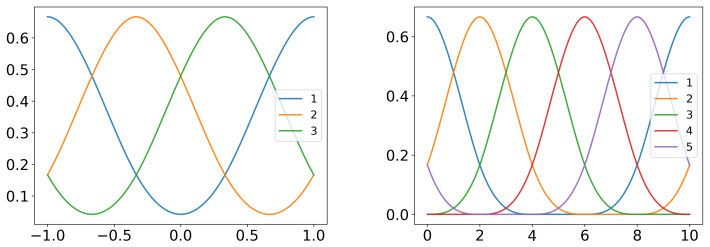
- Number of B-spline coefficients Nc =
3 (cosine), 5 (Gaussian)
- Initial DLRA rank r =
5
- Maximum DLRA rank =
20
- Truncation tolerance scaling =
0.01 * ||Sigma||_2 initially; updated via h1,h2,h3 in Algorithm 2
- Line search constants h1,h2,h3,h4,p =
h1=1e-3||Sigma||2, h2=0.1, h3=0.1, h4=0.5, p=0.5
- CFL number =
0.99
assumptions (6)
- domain assumption The radiative transfer equation (1) with given scattering coefficient and initial condition is the correct model for the measured data.
- domain assumption Measured data consists of the angle-averaged distribution at final time T for each initial condition, without noise.
- standard math Periodic boundary conditions in space.
- domain assumption The augmented BUG integrator from [4] is stable and accurate for the linear transport RHS with a non-constant diagonal scattering term.
- ad hoc to paper The low-rank solution is an adequate proxy for the full solution when computing the gradient in (18).
- ad hoc to paper The stopping criterion can be evaluated.
Cite this review
Pith. "Pith review of An adaptive dynamical low-rank optimizer for solving kinetic parameter identification inverse problems." pith.science (2026). https://pith.science/paper/FOCZCSLO
@misc{pith2026250621405,
  author       = {Pith},
  title        = {Pith review of: An adaptive dynamical low-rank optimizer for solving kinetic parameter identification inverse problems},
  year         = {2026},
  howpublished = {\url{https://pith.science/paper/FOCZCSLO}},
  note         = {Machine review of arXiv:2506.21405}
}
read the original abstract
The numerical solution of parameter identification inverse problems for kinetic equations can exhibit high computational and memory costs. In this paper, we propose a dynamical low-rank scheme for the reconstruction of the scattering parameter in the radiative transfer equation from a number of macroscopic time-independent measurements. We first work through the PDE constrained optimization procedure in a continuous setting and derive the adjoint equations using a Lagrangian reformulation. For the scattering coefficient, a periodic B-spline approximation is introduced and a gradient descent step for updating its coefficients is formulated. After the discretization, a dynamical low-rank approximation (DLRA) is applied. We make use of the rank-adaptive basis update & Galerkin integrator and a line search approach for the adaptive refinement of the gradient descent step size and the DLRA tolerance. We show that the proposed scheme significantly reduces both memory and computational cost. Numerical results computed with different initial conditions validate the accuracy and efficiency of the proposed DLRA scheme compared to solutions computed with a full solver.
Figures


Forward citations
Cited by 1 Pith paper
-
An Inexact Low-Rank Source Iteration for Steady-State Radiative Transfer Equation with Diffusion Synthetic Acceleration
A low-rank source iteration with diffusion synthetic acceleration solves multidimensional steady-state radiative transfer with up to two orders of magnitude fewer degrees of freedom than full-rank solvers.
Reference graph
Works this paper leans on
-
[1]
G. Bal. Inverse transport theory and applications. Inverse problems, 25(5):053001, 2009
work page 2009
-
[2]
Baumann, L
L. Baumann, L. Einkemmer, C. Klingenberg, and J. Kusch. Energy stable and conservative dynamical low-rank approxi- mation for the Su-Olson problem. SIAM Journal on Scientific Computing , 46(2):B137–B158, 2024
2024
-
[3]
K. M. Case and P. F. Zweifel. Linear Transport Theory. Addison-Wesley Series in Nuclear Engineering. Addison-Wesley, Reading, MA, 1967
work page 1967
-
[4]
Ceruti, J
G. Ceruti, J. Kusch, and C. Lubich. A rank-adaptive robust integrator for dynamical low-rank approximation. BIT Numerical Mathematics, 62:1149–1174, 2022
2022
-
[5]
Ceruti, J
G. Ceruti, J. Kusch, and C. Lubich. A parallel rank-adaptive integrator for dynamical low-rank approximation. SIAM Journal on Scientific Computing , 46(3):B205–B228, 2024
2024
-
[6]
G. Ceruti and C. Lubich. An unconventional robust integrator for dynamical low-rank approximation. BIT Numerical Mathematics, 62:23–44, 2022
work page 2022
-
[7]
K. Chen, Q. Li, and J.-G. Liu. Online learning in optical tomography: a stochastic approach. Inverse Problems , 34(7):075010, 2018
work page 2018
-
[8]
Einkemmer, J
L. Einkemmer, J. Hu, and L. Ying. An efficient dynamical low-rank algorithm for the Boltzmann-BGK equation close to the compressible viscous flow regime. SIAM Journal on Scientific Computing , 43(5):B1057–B1080, 2021
2021
Show all 24 references
-
[9]
Einkemmer, Q
L. Einkemmer, Q. Li, L. Wang, and Y. Yang. Suppressing instability in a Vlasov–Poisson system by an external electric field through constrained optimization. Journal of Computational Physics , 498:112662, 2024
2024
-
[10]
Einkemmer and C
L. Einkemmer and C. Lubich. A low-rank projector-splitting integrator for the Vlasov-Poisson equation. SIAM Journal on Scientific Computing , 40(5):B1330–B1360, 2018
2018
-
[11]
Hellmuth, C
K. Hellmuth, C. Klingenberg, Q. Li, and M. Tang. Reconstructing the kinetic chemotaxis kernel using macroscopic data: Well-posedness and ill-posedness. SIAM Journal on Applied Mathematics , 85(2):613–635, 2025
2025
-
[12]
Kieri, C
E. Kieri, C. Lubich, and H. Walach. Discretized dynamical low-rank approximation in the presence of small singular values. SIAM Journal on Numerical Analysis , 54(2):1020–1038, 2016
2016
-
[13]
A. Kirsch. An Introduction to the Mathematical Theory of Inverse Problems, volume 120 ofApplied Mathematical Sciences. Springer, Cham, third edition, 2021
2021
-
[14]
A. D. Klose and A. H. Hielscher. Optical tomography using the time-independent equation of radiative transfer – Part 2: inverse model. Journal of Quantitative Spectroscopy & Radiative Transfer , 72(5):715–732, 2002
2002
-
[15]
A. D. Klose, U. Netz, J. Beuthan, and A. H. Hielscher. Optical tomography using the time-independent equation of radiative transfer – Part 1: forward model. Journal of Quantitative Spectroscopy & Radiative Transfer , 72(5):691–713, 2002
2002
-
[16]
Koch and C
O. Koch and C. Lubich. Dynamical low-rank approximation. SIAM Journal on Matrix Analysis and Applications , 29(2):434–454, 2007
2007
-
[17]
Kusch and P
J. Kusch and P. Stammer. A robust collision source method for rank adaptive dynamical low-rank approximation in radiation therapy. ESAIM: M2AN , 57(2):865–891, 2023
2023
-
[18]
Q. Li, L. Wang, and Y. Yang. Monte Carlo gradient in optimization constrained by radiative transport equation. SIAM Journal on Numerical Analysis , 61(6):2744–2774, 2023
2023
-
[19]
Lubich and I
C. Lubich and I. V. Oseledets. A projector-splitting integrator for dynamical low-rank approximation. BIT Numerical Mathematics, 54:171–188, 2014
2014
-
[20]
R. G. McClarren, J. P. Holloway, and T. A. Brunner. On solutions to the Pn equations for thermal radiative transfer. Journal of Computational Physics , 227:2864–2885, 2008
2008
-
[21]
G. C. Pomraning. The Equations of Radiation Hydrodynamics, volume 54 of International series of monographs in natural philosophy. Pergamon Press, Oxford, 1973
1973
-
[22]
K. Ren, G. Bal, and A. H. Hielscher. Transport- and diffusion-based optical tomography in small domains: a comparative study. Applied Optics, 46(27):6669–6679, 2007
2007
-
[23]
Scalone, L
C. Scalone, L. Einkemmer, J. Kusch, and R. G. McClarren. A multi-fidelity adaptive dynamical low-rank based optimiza- tion algorithm for fission criticality problems. arXiv preprint arXiv:2409.14938 , 2024
2024 arXiv
-
[24]
Stefanov
P. Stefanov. Inverse problems in transport theory. In G. Uhlmann, editor, Inside Out: Inverse Problems and Applica- tions, volume 47 of Mathematical Sciences Research Institute Publications , pages 111–131. Cambridge University Press, Cambridge, 2003. 16
2003
Reviewed August 6, 2026 · model on record in the stance chip above.
Discussion (0). Continue with ORCID to comment.