REVIEW 4 major objections 4 minor 14 references
Volcanic Clouds Detection through QCNN and Geostationary Satellite Multispectral Imagery
T0 review · 4 major / 4 minor · reviewed 2026-08-04 · deepseek-v4-flash
Pith's one-line read This paper claims that hybrid quantum convolutional neural networks classify SEVIRI volcanic-cloud scenes at F1 up to 1.00 (3-class) and 0.90 (4-class) with far fewer trainable parameters than classical benchmarks, suggesting a parameter-ef
desk verdict Useful application of QCNN to volcanic cloud detection, but the headline parameter-efficiency claim doesn't survive contact with the architecture. read the letter →
The pith
A machine-rendered reading of the paper's core claim, the machinery that carries it, and where it could break.
The reading
What carries the argument
The carrying mechanism is the hybrid QCNN: a classical convolutional stack extracts spatial features, a fully connected layer projects them into a low-dimensional vector, a parameterized quantum circuit (Real Amplitudes ansatz, with ZZFeatureMap encoding) transforms that vector through single-qubit rotations and entangling operations, and a second fully connected layer maps the measured expectation values to class probabilities. The quantum layer is the load-bearing replacement for a large classical fully connected layer; it provides a nonlinear, high-dimensional feature map with only a handful of rotation parameters. For 2-qubit and 4-qubit variants, the whole trainable parameter count stay
What would settle it
Group the SEVIRI images by eruption event and hold out entire events during training; if F1 on held-out events for the 4-qubit QCNN falls from 0.90 to the classical range, or if near-duplicate frame detection shows test frames within minutes of training frames, the superiority claim fails.
Extended reading notes
Core claim
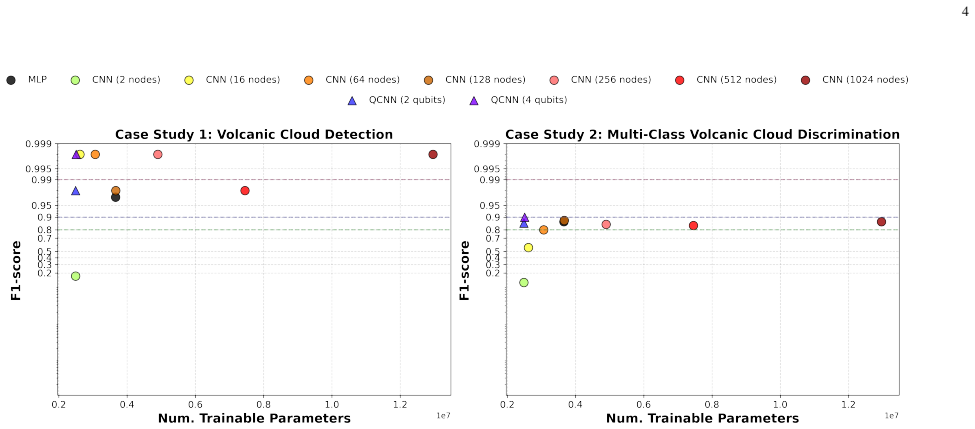
The central claim, stated on the paper's own terms, is that inserting a parameterized quantum circuit between two classical fully connected layers yields a classifier whose accuracy matches or exceeds classical models while using far fewer trainable parameters. In Case Study I the 4-qubit QCNN reaches a perfect F1 of 1.00 and the 2-qubit version 0.97, versus 0.95–1.00 for classical models with millions of parameters. In the more demanding Case Study II, the 4-qubit QCNN reaches 0.90 and the 2-qubit 0.85, while no classical model reaches 0.90. The paper interprets this as evidence of superior generalization from a small quantum feature space, and notes the circuits are emulated on classical h
Load-bearing premise
The paper's 70/15/15 random split assumes every image is independent; in reality, images of the same eruption are near-duplicates separated by minutes, so a test image can be almost identical to a training image, which would make the reported accuracy look better than it would on a truly new eruption.
Editorial extensions
If this is right
- If the central claim is right, detecting volcanic clouds from SEVIRI imagery does not require million-parameter classifiers; a 2- or 4-qubit circuit can do the job with far fewer parameters.
- The four-class discrimination result implies that even a 2-qubit quantum feature space can separate emission types (SO2, weak plume, mixed clouds) that classical models of comparable size cannot.
- Because the 4-qubit model is the most accurate but the slowest to train, the practical trade-off favors small circuits for onboard deployment.
- The noiseless-emulation caveat means these gains are demonstrated in simulation; the paper's own future work is testing on real quantum processors.
Reading between the lines
- If the temporal-correlation concern were addressed and the gap persisted, the result would strengthen the case for quantum circuits as a parameter-efficient regularizer in small-data remote sensing.
- A classical control with a random nonlinear feature map of the same parameter count would clarify whether the advantage comes from quantum entanglement or simply from a fixed nonlinear embedding; the paper does not run this control.
- The per-epoch cost of simulating quantum circuits on classical GPUs is high, so the practical onboard benefit depends on future native quantum hardware; measured wall-clock time, not epochs, would be the decisive comparison.
- Extending the method to infrared brightness-temperature channels rather than RGB composites could test whether the quantum layer's nonlinearity helps where spectral signatures are subtle.
Editorial analysis
A structured set of objections, weighed in public.
Referee Report
Summary. The paper investigates hybrid quantum-classical convolutional neural networks (QCNNs) for volcanic-cloud detection in SEVIRI satellite imagery. Two QCNN variants (2- and 4-qubit, with RealAmplitudes ansatz and ZZFeatureMap encoding) are embedded into an AlexNet-derived CNN backbone and compared with classical FC-layer and MLP baselines on two tasks: a 3-class scene classification (clear sky, meteorological cloud, volcanic cloud) and a 4-class volcanic-emission discrimination (SO2, weak plume, volcanic cloud, mixed volcanic-meteorological cloud). Using a 70/15/15 random split, the authors report F1-scores of 0.97/1.00 for the 3-class task and 0.85/0.90 for the 4-class task for the 2-/4-qubit QCNNs, and claim that the quantum models achieve competitive or superior performance with dramatically fewer trainable parameters than classical counterparts. The paper also includes a convergence analysis measuring epochs to reach accuracy thresholds.
Significance. If the central claims are correct, the paper would provide a useful empirical data point for parameter-efficient QML in Earth observation and for the potential of low-qubit hybrid models in small-sample satellite image classification. The application domain (volcanic cloud detection) is practical, and the comparison across two tasks with two quantum sizes is a reasonable starting design. The paper also reports convergence behavior, which is useful. However, the manuscript's headline claims are not currently supported by the evidence as presented: the parameter-count comparison is ambiguous, the data-splitting protocol risks leakage, and the reported performance differences lack statistical grounding. The strengths are the direct empirical comparison and the focus on a concrete remote sensing problem, but these do not yet overcome the load-bearing methodological concerns.
major comments (4)
- [§III, Fig. 3] The central claim of 'significantly fewer trainable parameters' is not supported because the parameter count plotted on the x-axis of Fig. 3 is never defined. The hybrid QCNN includes a full AlexNet convolutional backbone plus two classical fully connected layers; only the middle layer is replaced by a 2- or 4-qubit circuit. If the x-axis counts total model parameters, then the QCNN also inherits millions of backbone parameters, and the 'far fewer' statement is unjustified. If it counts only the quantum layer's parameters, then the comparison omits the shared backbone and does not support a claim about total model parameters. Additionally, the text says a classical CNN 'constrained to just 2 nodes' has 'exactly the same number of parameters as the quantum alternative'; this conflates the number of qubits with the number of parameters. A 2-node FC layer applied to a high-dimensional featu
- [§III (dataset split)] The 70/15/15 random split over individual images assumes that images are independent samples. Volcanic-cloud scenes from the same eruption are strongly correlated in time and space; if frames from the same event appear in both the training and test sets, the reported F1-scores are likely inflated, and the quantum-versus-classical gap could shrink or disappear. The paper provides no event-based split, no temporal separation, and no leakage analysis. This is especially important because the test sets are very small (119 and 115 images). The authors should repeat the evaluation with an event-disjoint split or otherwise demonstrate that the reported generalization is not an artifact of temporal autocorrelation.
- [§III, Results] No statistical support is provided for the performance comparisons. Each F1-score appears to come from a single training run, with no repeated seeds, confidence intervals, or significance tests. For Case Study I, the 2-qubit QCNN's F1 of 0.97 falls within the range reported for classical models (0.95–1.00); for Case Study II, the difference between 0.85/0.90 and classical values below 0.90 may be substantial, but on test sets of roughly 115 images and with a single run it is impossible to assess whether these differences are real or due to noise. The paper should report variance across at least several runs and, ideally, a statistical test or confidence intervals for the key comparisons.
- [§II.B, Training and testing] The 'same-parameter' baseline is not a fair capacity match. A classical network 'constrained to just 2 nodes' is an extremely weak model, and its poor accuracy (0.12) is expected. A meaningful parameter-efficiency comparison would match the total number of trainable parameters, or would hold the classical model's capacity to a similar order of magnitude as the quantum circuit while also counting the shared backbone. As written, the comparison does not isolate the effect of the quantum layer versus a classical layer of comparable capacity.
minor comments (4)
- [References] Reference [9] is listed as 'arXiv preprint arXiv:2026.xxxxx, 2026' — an invalid placeholder. A published or identifiable reference must be provided, or the statement relying on it should be reworded.
- [§I, Introduction] Typographical errors: 'revolutions' should be 'revolution'; the opening sentence of the introduction is a sentence fragment. Throughout the text, 'V olcanic' appears with an extra space in several places (e.g., section headings).
- [§II.B, Training and testing] The phrase 'exactly the same number of parameters as the quantum alternative' is misleading and should be replaced with a precise statement of which parameters are counted and how the baseline was constructed.
- [§III, Results] The figure captions and text do not report class-wise precision/recall or confusion matrices, despite the text saying they are used. Confusion matrices would be useful to assess whether the reported F1-scores are driven by class imbalance, especially in the 4-class task.
Circularity Check
No significant circularity: empirical benchmark; QCNN results are measured on held-out test sets, not derived from fitted inputs.
full rationale
This is an empirical benchmark paper, not a derivation chain. The reported F1 scores for the 2- and 4-qubit QCNNs come from training on a 70/15/15 split and evaluating on held-out test images (Sec. III), so there is no fitted parameter that is later relabeled as a prediction. The hybrid QCNN architecture is taken from self-cited prior work [10,11], but those citations are used as design motivation, not as a proof that the current volcanic-cloud results must follow; no uniqueness theorem or ansatz derivation is invoked. The only manuscript-level weaknesses relevant to the review are the placeholder self-citation [9] used in a motivational sentence and the undefined 'number of trainable parameters' comparison in Fig. 3, but the latter is a benchmarking/correctness concern rather than circularity: even if the parameter counts are misleading, the classification results are not logically forced by the paper's own definitions. No load-bearing step reduces to its own input, so the appropriate finding is no significant circularity.
Assumptions & free parameters
free parameters (4)
- Number of qubits =
2 and 4
- Quantum circuit depth / number of variational layers =
not stated
- OPTUNA-selected hyperparameters =
lr=1e-4, batch=16, max epochs=200, patience=15
- Classical 'same-parameter' baseline width =
2 nodes
assumptions (4)
- standard math Statevector simulation of the PQC is exact and noise-free
- domain assumption SEVIRI Ash RGB composites contain sufficient discriminative information for volcanic vs meteorological cloud classes
- domain assumption Random 70/15/15 split yields independent train/test samples despite temporal correlation of eruption sequences
- ad hoc to paper RealAmplitudes ansatz + ZZFeatureMap with 2–4 qubits is a suitable quantum layer for this task
Cite this review
Pith. "Pith review of Volcanic Clouds Detection through QCNN and Geostationary Satellite Multispectral Imagery." pith.science (2026). https://pith.science/paper/FOL5WTQC
@misc{pith2026260800072,
  author       = {Pith},
  title        = {Pith review of: Volcanic Clouds Detection through QCNN and Geostationary Satellite Multispectral Imagery},
  year         = {2026},
  howpublished = {\url{https://pith.science/paper/FOL5WTQC}},
  note         = {Machine review of arXiv:2608.00072}
}
abstract
Recent advances in quantum computing are opening new possibilities for Earth Observation (EO) data analysis. Quantum machine learning (QML) approaches offer novel ways to process information by exploiting quantum phenomena such as superposition and entanglement. These capabilities have motivated the exploration of whether quantum-enhanced models can address long-standing challenges in satellite remote sensing, where complex spectral and spatial signals often require sophisticated feature extraction. Among various fields of application, EO data allow the global monitoring of volcanic clouds and are crucial for aviation safety, hazard assessment, real-time eruption response, and evaluation of volcanic impacts on climate. Yet accurate detection of volcanic clouds remains difficult due to their similarity with meteorological clouds, the variability of eruption signatures, and the coarse spectral sampling of geostationary sensors. In this work, the potential of hybrid quantum convolutional neural networks (QCNNs) for the classification of satellite images containing volcanic clouds was investigated. These architectures integrate quantum computational layers into a classical convolutional framework. Two QCNN variants (with 2 and 4 qubits) have been considered to evaluate their ability to classify a dataset of SEVIRI images, including scenes with volcanic clouds (composed of ash, $SO_2$, or mixed components) as well as non-volcanic backgrounds. Finally, the performance of the hybrid QCNN models was compared with that of purely classical architectures.
Figures


Figures from the paper (1 more)

Reference graph
Works this paper leans on
-
[9]
Hybrid quantum convolutional neural networks for cross-sensor volcanic thermal activity recognition at global scale,
C. Corradino, F. Torrisi, A. Grilli, T. Catuogno, M. Verducci, A. Sebas- tianelli, L. Giannelli, and E. Paladino, “Hybrid quantum convolutional neural networks for cross-sensor volcanic thermal activity recognition at global scale,”arXiv preprint arXiv:2026.xxxxx, 2026
2026
-
[1]
P. Kaye, R. Laflamme, and M. Mosca,An introduction to quantum computing. OUP Oxford, 2006
2006
-
[2]
Big earth data: disruptive changes in earth observation data management and analysis?
M. Sudmanns, D. Tiede, S. Lang, H. Bergstedt, G. Trost, H. Augustin, A. Baraldi, and T. Blaschke, “Big earth data: disruptive changes in earth observation data management and analysis?”International Journal of Digital Earth, vol. 13, no. 7, pp. 832–850, 2020
2020
-
[3]
Artificial intelligence to advance earth observation: A review of models, recent trends, and pathways forward,
D. Tuia, K. Schindler, B. Demir, X. X. Zhu, M. Kochupillai, S. D ˇzeroski, J. N. van Rijn, H. H. Hoos, F. Del Frate, M. Datcuet al., “Artificial intelligence to advance earth observation: A review of models, recent trends, and pathways forward,”IEEE GEOSC REM SEN M, 2024
2024
-
[4]
A survey on large- scale machine learning,
M. Wang, W. Fu, X. He, S. Hao, and X. Wu, “A survey on large- scale machine learning,”IEEE Transactions on Knowledge and Data Engineering, vol. 34, no. 6, pp. 2574–2594, 2020
2020
-
[5]
Quantum machine learning for earth observation: A review and future prospects,
A. Sebastianelli, F. Mauro, A. Delilbasic, P. Di Stasio, F. Fan, G. Meoni, G. Cavallaro, X. X. Zhu, P. Gamba, and S. L. Ullo, “Quantum machine learning for earth observation: A review and future prospects,”IEEE GEOSC REM SEN M, 2026
2026
-
[6]
A primer on quantum machine learning,
S. Y . Chang and M. Cerezo, “A primer on quantum machine learning,” arXiv preprint arXiv:2511.15969, 2025
arXiv 2025
-
[7]
A survey on quantum machine learning: Current trends, challenges, opportunities, and the road ahead,
K. Zaman, A. Marchisio, M. A. Hanif, and M. Shafique, “A survey on quantum machine learning: Current trends, challenges, opportunities, and the road ahead,”arXiv preprint arXiv:2310.10315, 2023
arXiv 2023
Show all 14 references
-
[8]
Quantum ma- chine learning for remote sensing: exploring potential and challenges,
A. Miroszewski, J. Nalepa, B. L. Saux, and J. Mielczarek, “Quantum ma- chine learning for remote sensing: exploring potential and challenges,” arXiv preprint arXiv:2311.07626, 2023
2023 arXiv
-
[10]
On circuit-based hybrid quantum neural networks for remote sensing imagery classification,
A. Sebastianelli, D. A. Zaidenberg, D. Spiller, B. Le Saux, and S. L. Ullo, “On circuit-based hybrid quantum neural networks for remote sensing imagery classification,”IEEE J. Sel. Top. Appl. Earth Obs. Remote Sens., vol. 15, pp. 565–580, 2021
2021
-
[11]
On quan- tum hyperparameters selection in hybrid classifiers for earth observation data,
A. Sebastianelli, M. P. Del Rosso, S. L. Ullo, and P. Gamba, “On quan- tum hyperparameters selection in hybrid classifiers for earth observation data,”IEEE GRSL, vol. 20, pp. 1–5, 2023
2023
-
[12]
Imagenet classification with deep convolutional neural networks,
A. Krizhevsky, I. Sutskever, and G. E. Hinton, “Imagenet classification with deep convolutional neural networks,”Advances in neural informa- tion processing systems, vol. 25, 2012
2012
-
[13]
Enhancing detection of volcanic ash clouds from space with convolutional neural networks,
F. Torrisi, C. Corradino, S. Cariello, and C. Del Negro, “Enhancing detection of volcanic ash clouds from space with convolutional neural networks,”J. V olcanol. Geotherm. Res., vol. 448, p. 108046, 2024
2024
-
[14]
Barren plateaus in quantum neural network training landscapes,
J. R. McClean, S. Boixo, V . N. Smelyanskiy, R. Babbush, and H. Neven, “Barren plateaus in quantum neural network training landscapes,”Nature communications, vol. 9, no. 1, p. 4812, 2018
2018
Reviewed August 4, 2026 · model on record in the stance chip above.
Discussion (0). Sign in to comment.