Unveiling Energetic Advantage in Superconducting Cat-Qubits Quantum Computation
Pith reviewed 2026-05-20 05:36 UTC · model grok-4.3
The pith
Cat-qubit systems may achieve an energy advantage over classical computers for the semiclassical quantum Fourier transform beyond 26 qubits.
A machine-rendered reading of the paper's core claim, the machinery that carries it, and where it could break.
Core claim
Analysis of energy consumption in a superconducting cat-qubit platform for the semiclassical quantum Fourier transform, including quantum error correction, shows that an optimization of parameters for qubit stabilization, gate implementation, and error-correction codes can minimize energy while maintaining required fidelities, leading to a potential energetic advantage compared to classical computers for systems with more than 26 qubits under Carnot-efficient cryogenic operation, with this advantage occurring before computational advantage and persisting in realistic settings.
What carries the argument
Energy consumption scaling model for cat-qubit stabilization, gate operations, and error-correction overhead, optimized to minimize total energy at fixed fidelity thresholds.
If this is right
- Quantum energetic advantage can occur in systems with more than 26 qubits for the quantum Fourier transform.
- The advantage arises prior to any computational advantage.
- Realistic cryogenic systems and control electronics do not eliminate the advantage.
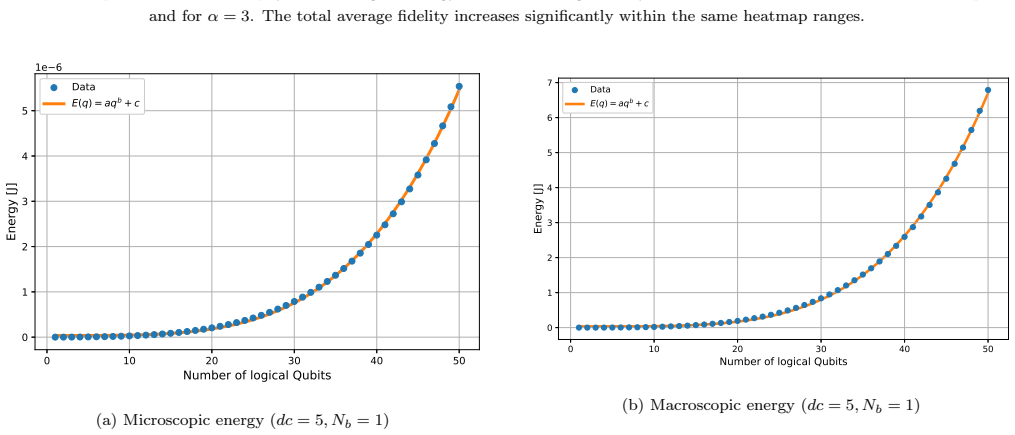
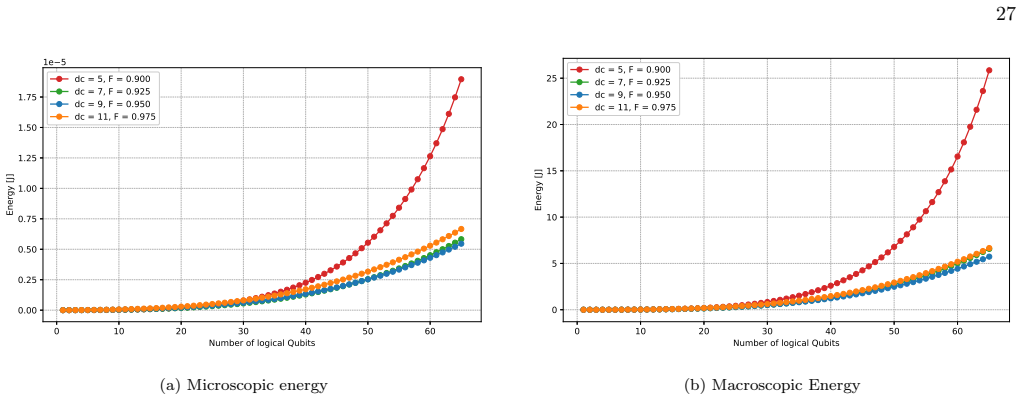
- Energy consumption increases with qubit count but optimization mitigates this.
Where Pith is reading between the lines
- Similar energetic analyses could be applied to other quantum algorithms beyond the Fourier transform.
- If the models hold, early quantum computers might be deployed for energy reasons even if slower.
- Hardware experiments measuring actual power draw in small cat-qubit arrays would test the crossover point.
Load-bearing premise
The theoretical models of energy use for stabilizing cat qubits, performing gates, and applying error correction accurately reflect what real devices will consume.
What would settle it
Direct measurement of energy consumption in a physical superconducting cat-qubit processor with around 30 qubits running the semiclassical quantum Fourier transform, compared against a classical supercomputer's energy use for the equivalent task.
Figures







read the original abstract
Quantum computers are emerging as a promising new technology due to their ability to solve complex problems that exceed the capabilities of classical systems in terms of time. Among various implementations, superconducting qubits have become the leading technology due to their scalability and compatibility with quantum error correction mechanisms. Although time has traditionally been the primary focus, energetic efficiency is becoming an increasingly important consideration, especially with the possibility of a quantum energetic advantage. In this article, the energy consumption of the Semiclassical Quantum Fourier Transform was analyzed on a superconducting quantum computing platform based on cat qubits. Quantum error correction mechanisms were studied and considered in the energy estimations. The results show how the energy consumption scales with the number of qubits and how the most relevant parameters required for qubit stabilization, gate implementation, and error correction codes contribute to the overall energy usage. An optimization method was developed to tune these parameters with the goal of minimizing energy consumption while maintaining qubit fidelities above a given threshold. Additionally, a comparative study with state-of-the-art classical computers indicates a potential quantum energetic advantage for systems with more than 26 qubits, assuming cryogenic systems operating at Carnot efficiency, with this energetic advantage arising before any computational advantage. This behavior persists even when realistic cryogenic systems and control electronics are taken into account.
Editorial analysis
A structured set of objections, weighed in public.
Referee Report
Summary. The manuscript analyzes energy consumption for the semiclassical quantum Fourier transform implemented on a superconducting cat-qubit platform, incorporating quantum error correction. It develops an optimization procedure over stabilization, gate, and error-correction parameters to minimize total energy while keeping fidelities above threshold, then compares the resulting scaling against state-of-the-art classical computers. The central claim is that an energetic advantage appears for systems larger than 26 qubits, before any computational advantage, and persists under realistic cryogenic and control-electronics models when Carnot efficiency is assumed.
Significance. If the modeling choices and numerical crossover are robust, the work would be significant for shifting attention from runtime to energy as a near-term figure of merit for quantum hardware. The parameter-optimization framework and explicit inclusion of cryogenic overhead provide a concrete methodology that could guide hardware design choices in cat-qubit architectures.
major comments (3)
- [§3.2] §3.2 (Energy consumption model for cat-qubit stabilization): the power expressions for two-photon dissipation and parametric drives are derived from theoretical rates without reference to measured dissipation or quasiparticle-loss data from fabricated devices; any systematic offset shifts the location of the 26-qubit crossover and therefore the claimed energetic advantage.
- [§4.1] §4.1 (Optimization procedure): free parameters for stabilization drive power, gate pulse energy, and QEC overhead are tuned to fidelity thresholds derived from the same model; the resulting minimum-energy point is therefore not independently validated and the 26-qubit threshold inherits this circular dependence.
- [§5] §5 (Classical comparison): the crossover at 26 qubits is obtained under the direct assumption of Carnot efficiency for the cryogenic system; the manuscript does not report a sensitivity study with realistic efficiency factors (typically 1–5 % of Carnot), which would move or eliminate the reported advantage.
minor comments (2)
- [Abstract] The abstract states that the advantage 'persists even when realistic cryogenic systems and control electronics are taken into account' but does not quantify the additional overhead terms or show them in a dedicated figure or table.
- [§4] Notation for the optimized energy per logical qubit (E_opt) is introduced without an explicit equation reference in the main text; a single consolidated equation would improve traceability of the scaling.
Simulated Author's Rebuttal
We thank the referee for the detailed and constructive review of our manuscript. We address each of the major comments below and have made revisions to the manuscript to incorporate the suggestions where possible. We believe these changes improve the clarity and robustness of our analysis.
read point-by-point responses
-
Referee: [§3.2] §3.2 (Energy consumption model for cat-qubit stabilization): the power expressions for two-photon dissipation and parametric drives are derived from theoretical rates without reference to measured dissipation or quasiparticle-loss data from fabricated devices; any systematic offset shifts the location of the 26-qubit crossover and therefore the claimed energetic advantage.
Authors: We agree that the power expressions are based on theoretical models commonly used in the cat-qubit literature. Experimental data from specific devices would indeed provide valuable calibration, but our goal was to develop a general framework applicable across devices. In the revised manuscript, we have added a paragraph discussing the potential impact of systematic offsets in the dissipation rates and included a brief sensitivity analysis showing that the energetic advantage remains for offsets up to 50% in reasonable parameter regimes. This addresses the concern about the crossover point. revision: yes
-
Referee: [§4.1] §4.1 (Optimization procedure): free parameters for stabilization drive power, gate pulse energy, and QEC overhead are tuned to fidelity thresholds derived from the same model; the resulting minimum-energy point is therefore not independently validated and the 26-qubit threshold inherits this circular dependence.
Authors: The optimization procedure is designed to find the energy-minimizing parameters consistent with the fidelity requirements of the error-corrected computation. While the thresholds are informed by the model, they are also grounded in established quantum error correction thresholds for cat qubits. To reduce any perceived circularity, we have added references to experimental fidelity measurements from cat-qubit implementations and shown that our optimized parameters align with achievable values in current devices. We acknowledge the model-dependent nature but argue it provides the theoretical best-case scaling. revision: partial
-
Referee: [§5] §5 (Classical comparison): the crossover at 26 qubits is obtained under the direct assumption of Carnot efficiency for the cryogenic system; the manuscript does not report a sensitivity study with realistic efficiency factors (typically 1–5 % of Carnot), which would move or eliminate the reported advantage.
Authors: We concur that Carnot efficiency represents an ideal case. In the original manuscript, we did consider realistic cryogenic and control electronics, but we have now included an explicit sensitivity analysis for efficiencies at 1%, 5%, and 10% of Carnot. The results indicate that while the crossover qubit number increases (to approximately 35-45 qubits at 5% efficiency), an energetic advantage still emerges for larger systems. This new analysis has been added to Section 5 and the supplementary material. revision: yes
- The lack of direct experimental dissipation data from fabricated devices, which would require new hardware experiments beyond the scope of this modeling study.
Circularity Check
No significant circularity; energy models and optimization are independent of the final advantage claim
full rationale
The paper derives energy consumption from explicit theoretical expressions for stabilization drives, gate pulses, and QEC overhead in cat qubits, then applies an optimization routine to minimize total energy subject to a fixed fidelity threshold. The 26-qubit crossover is obtained by direct numerical comparison of the resulting optimized quantum energy scaling against classical benchmarks under the stated Carnot-efficiency assumption. None of these steps reduces to a self-definition, a fitted parameter renamed as prediction, or a load-bearing self-citation; the models remain falsifiable against external dissipation measurements and the comparison uses an external efficiency benchmark. The derivation chain is therefore self-contained.
Axiom & Free-Parameter Ledger
free parameters (1)
- stabilization, gate, and error-correction parameters
axioms (1)
- domain assumption Cryogenic systems can be modeled as operating at Carnot efficiency for the purpose of energy comparison
Lean theorems connected to this paper
-
IndisputableMonolith/Cost/FunctionalEquation.leanwashburn_uniqueness_aczel unclear?
unclearRelation between the paper passage and the cited Recognition theorem.
An optimization method was developed to tune these parameters with the goal of minimizing energy consumption while maintaining qubit fidelities above a given threshold.
-
IndisputableMonolith/Foundation/RealityFromDistinction.leanreality_from_one_distinction unclear?
unclearRelation between the paper passage and the cited Recognition theorem.
A comparative study … potential quantum energetic advantage for systems with more than 26 qubits … polynomial scaling … exponential … classical
-
IndisputableMonolith/Foundation/AlexanderDuality.leanalexander_duality_circle_linking unclear?
unclearRelation between the paper passage and the cited Recognition theorem.
energy consumption of the Semiclassical Quantum Fourier Transform … cat qubits … repetition code … code distance d_c
What do these tags mean?
- matches
- The paper's claim is directly supported by a theorem in the formal canon.
- supports
- The theorem supports part of the paper's argument, but the paper may add assumptions or extra steps.
- extends
- The paper goes beyond the formal theorem; the theorem is a base layer rather than the whole result.
- uses
- The paper appears to rely on the theorem as machinery.
- contradicts
- The paper's claim conflicts with a theorem or certificate in the canon.
- unclear
- Pith found a possible connection, but the passage is too broad, indirect, or ambiguous to say the theorem truly supports the claim.
Reference graph
Works this paper leans on
-
[1]
π 2 Rotation around the Z axis: This gate induces a phase-flip probability, which is given by equation 22
-
[2]
Deflate Step: Here, only the stabilization pump is turned on for a durationTdef =a 3/κ2 The phase-flip probability induced is given by pdef z =a 1 κ1 κ2 +a 2nm th.(27)
-
[3]
Inflate Step: The power considered is that of the stabilization pump, applied for a durationT inf = 1/κ2 The phase-flip probability is pinf z =|α|2κ1Tinf(1 + 2nm th)(28)
-
[4]
Displacement: energy and phase-flip probability er- ror negligible compared to other gates
-
[5]
Fock-state longitudinal readout: The power con- sidered wasP l =lg 2 l, wherelis a constant that depends on the ATS parameters. The fidelity of this longitudinal interaction is given by F(t) =e−κ1terf(SNR (t)/2),(29) where SNR (t)/2= √ 4ηgl kb (t+ 3 kb ). V. FIDELITY AND ENERGY OF THE QFT WITHOUT QEC A. Fidelity of the Semiclassical QFT When a certain cir...
work page 2000
-
[6]
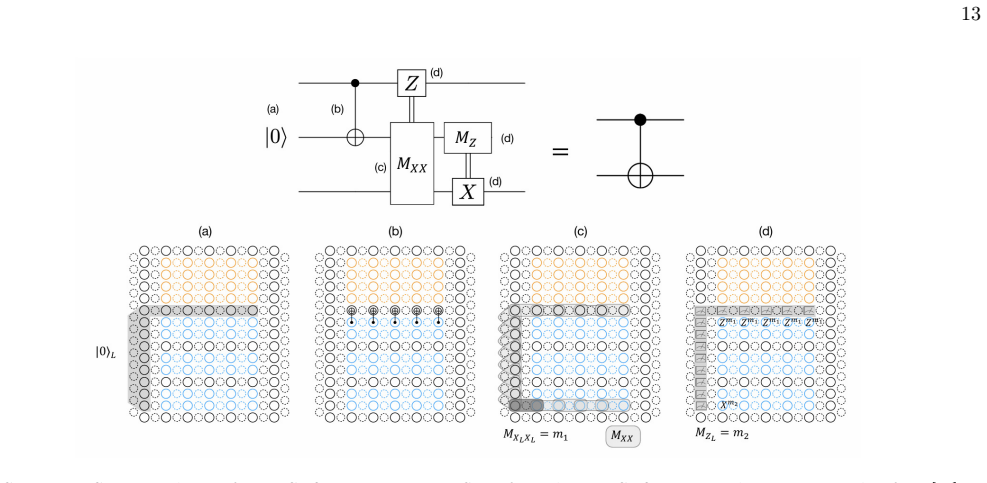
The ancillary routing physical qubits are used to prepare a logical ancilla state|0⟩L. This ancilla forms an L over the processor, beginning in the logicalcontrolqubitandendinginthelogicaltarget qubit
-
[7]
Logical CNOT gate is implemented by performing a CNOT between the logical control qubit and the adjacent logical ancilla
-
[8]
LogicalX LXL measurement is implemented by measuringdtimestheXXoperatorofthetwophys- ical qubits at the border between the logical qubits
-
[9]
LogicalZL is measured on the logical ancilla qubit
-
[10]
LogicalZ L is applied to the control qubit if the logicalX L⊗XL measurement produces the output -1, and a logicalXL is applied to the logical target if the logicalZL on the ancilla qubit produces the value -1. B. Repetition Code To correct phase-flip errors after applying a certain number of gates, a repetition code must be implemented. The state of a sin...
work page 2000
-
[11]
E.Masanet, A.Shehabi, N.Lei, S.Smith,andJ.Koomey, Science367, 984 (2020)
work page 2020
-
[12]
Chen, Nature (2025), published March 5, 2025
S. Chen, Nature (2025), published March 5, 2025
work page 2025
-
[13]
International Energy Agency, Energy and AI (2025)
work page 2025
- [14]
- [15]
-
[16]
H.-P. Breuer and F. Petruccione,The Theory of Open Quantum Systems(Oxford University Press, 2007)
work page 2007
-
[17]
Lebreuilly, Physical Review A96, 10.1103/Phys- RevA.96.033828 (2017)
J. Stevens, D. Szombati, M. Maffei, C. Elouard, R. As- souly, N. Cottet, R. Dassonneville, Q. Ficheux, S. Zep- petzauer, A. Bienfait, A. Jordan, A. Auffèves, and B. Huard, Physical Review Letters129, 10.1103/phys- revlett.129.110601 (2022)
-
[18]
J. Ikonen, J. Salmilehto, and M. Möttönen, npj Quantum Information3, 10.1038/s41534-017-0015-5 (2017)
-
[19]
J. Stevens and S. Deffner, Quantum Science and Tech- nology10, 04LT03 (2025)
work page 2025
-
[20]
Energy efficiency of quantum computers
M. Carrasco-Codina, P. Escofet, P. Hilaire, A. Soret, S. Nerenberg, V. Champain, G. Milburn, K. Theophilo, S. H. Li, I. Bautista, A. Gómez, J. Miralles, S. Abadal, C. G. Almudéver, E. Alarcón, and R. Yehia, Energy ef- ficiency of quantum computers (2026), arXiv:2605.15090 [quant-ph]
work page internal anchor Pith review Pith/arXiv arXiv 2026
-
[21]
D. Jaschke and S. Montangero, Quantum Science and Technology8, 025001 (2023)
work page 2023
-
[23]
S. Silva Pratapsi, P. H. Huber, P. Barthel, S. Bose, C. Wunderlich, and Y. Omar, Applied Physics Letters 123, 10.1063/5.0176719 (2023)
-
[24]
J. P. Moutinho, M. Pezzutto, S. S. Pratapsi, F. F. da Silva, S. De Franceschi, S. Bose, A. T. Costa, and Y. Omar, PRX Energy2, 10.1103/prxenergy.2.033002 (2023)
-
[25]
F. Meier and H. Yamasaki, PRX Energy4, 10.1103/prx- energy.4.023008 (2025)
- [26]
-
[27]
E. E. R. Alliance, Quantum computing in the net-zero transition: energy production, management, and effi- ciency (2026)
work page 2026
-
[28]
Energy-error tradeoff in encoding quantum error correction
J. Stevens and S. Deffner, Energy-error tradeoff in encod- ing quantum error correction (2026), arXiv:2605.04329 [quant-ph]
work page internal anchor Pith review Pith/arXiv arXiv 2026
-
[29]
F. Góis, M. Pezzutto, and Y. Omar, Towards energetic quantum advantage in trapped-ion quantum computa- tion (2024), arXiv:2404.11572 [quant-ph]
work page internal anchor Pith review Pith/arXiv arXiv 2024
-
[30]
Energetics of Rydberg-atom Quantum Computing
O. Alves, M. Pezzutto, and Y. Omar, Energet- ics of Rydberg-atom Quantum Computing (2026), arXiv:2601.03141 [quant-ph]
work page internal anchor Pith review Pith/arXiv arXiv 2026
- [31]
-
[32]
M. Kjaergaard, M. E. Schwartz, J. Braumüller, P. Krantz, J. I.-J. Wang, S. Gustavsson, and W. D. Oliver, Annual Review of Condensed Matter Physics11, 369 (2020)
work page 2020
-
[33]
Ezratty, The European Physical Journal A59, 94 (2023)
O. Ezratty, The European Physical Journal A59, 94 (2023)
work page 2023
-
[34]
R. B. Frank Arute, Kunal Aryaet al., Nature574, 505–510 (2019)
work page 2019
- [35]
-
[37]
R. Acharya, D. A. Abanin, L. Aghababaie-Beni, I. Aleiner, T. I. Andersen, M. Ansmann, F. Arute, K. Arya, A. Asfaw, N. Astrakhantsev, J. Atalaya, R. Babbush, D. Bacon, B. Ballard, J. C. Bardin, and et al., Nature638, 920 (2025)
work page 2025
-
[38]
H. Neven, Meet willow, our state-of-the-art quantum chip,Blogpost, GoogleInnovation&AI(2024),accessed: 2026-03-07
work page 2024
-
[39]
P. T. Cochrane, G. J. Milburn, and W. J. Munro, Phys- ical Review A59, 2631–2634 (1999)
work page 1999
-
[40]
M. Mirrahimi, Z. Leghtas, V. V. Albert, S. Touzard, R. J. Schoelkopf, L. Jiang, and M. H. Devoret, New Journal of Physics16, 045014 (2014)
work page 2014
-
[41]
J. Guillaud, J. Cohen, and M. Mirrahimi, SciPost Physics Lecture Notes 10.21468/scipostphyslectnotes.72 (2023)
-
[42]
D. A. Lidar, arXiv preprint arXiv:1902.00967 10.48550/arXiv.1902.00967 (2019)
-
[43]
R. Lescanne, M. Villiers, T. Peronnin, A. Sarlette, M. Delbecq, B. Huard, T. Kontos, M. Mirrahimi, and Z. Leghtas, Nature Physics16, 509 (2020)
work page 2020
-
[44]
C. Chamberland, K. Noh, P. Arrangoiz-Arriola, E. T. Campbell, C. T. Hann, J. Iverson, H. Putterman, T. C. Bohdanowicz, S. T. Flammia, A. Keller, G. Refael, J. Preskill, L. Jiang, A. H. Safavi-Naeini, O. Painter, and F. G. Brandão, PRX Quantum3, 10.1103/prxquan- tum.3.010329 (2022)
-
[45]
U. Réglade, A. Bocquet, R. Gautier, J. Cohen, A. Marquet, E. Albertinale, N. Pankratova, M. Hallén, F. Rautschke, L.-A. Sellem, P. Rouchon, A. Sarlette, M. Mirrahimi, P. Campagne-Ibarcq, R. Lescanne, S. Je- zouin, and Z. Leghtas, Nature629, 778–783 (2024)
work page 2024
-
[46]
E. Gouzien, D. Ruiz, F.-M. Le Régent, J. Guil- laud, and N. Sangouard, Physical Review Letters131, 10.1103/physrevlett.131.040602 (2023)
-
[47]
R. Rousseau, D. Ruiz, E. Albertinale, P. d’Avezac, D. Banys, U. Blandin, N. Bourdaud, G. Campanaro, G. Cardoso, N. Cottet, C. Cullip, S. Deléglise, L. De- 22 vanz, A. Devulder, A. Essig, P. Février, A. Gicquel, E. Gouzien, J. Guillaud, E. Gümüs, M. Hallén, A. Ja- cob, P. Magnard, A. Marquet, S. Miklass, T. Peronnin, S. Polis, F. Rautschke, U. Réglade, J. ...
-
[48]
Alice & Bob, Just out of the lab: A cat qubit that jumps every hour (2025), accessed: May 20, 2026
work page 2025
- [49]
-
[50]
A. Marquet, S. Dupouy, U. Réglade, A. Essig, J. Co- hen, E. Albertinale, A. Bienfait, T. Peronnin, S. Jezouin, R. Lescanne, and B. Huard, Physical Review Applied22, 10.1103/physrevapplied.22.034053 (2024)
-
[51]
J. Guillaud and M. Mirrahimi, Physical Review X9, 10.1103/physrevx.9.041053 (2019)
-
[52]
F.-M. L. Régent, C. Berdou, Z. Leghtas, J. Guillaud, and M. Mirrahimi, Quantum7, 1198 (2023)
work page 2023
-
[53]
M. A. Nielsen and I. L. Chuang,Quantum Computa- tion and Quantum Information: 10th Anniversary Edi- tion(Cambridge University Press, 2010)
work page 2010
-
[54]
An approximate Fourier transform useful in quantum factoring
D. Coppersmith, An approximate fourier transform use- fulinquantumfactoring(2002),arXiv:quant-ph/0201067 [quant-ph]
work page internal anchor Pith review Pith/arXiv arXiv 2002
-
[55]
R. B. Griffiths and C.-S. Niu, Physical Review Letters 76, 3228 (1996)
work page 1996
- [56]
- [57]
-
[58]
M. H. Michael, M. Silveri, R. T. Brierley, V. V. Albert, J. Salmilehto, L. Jiang, and S. M. Girvin, Physical Re- view X6, 10.1103/physrevx.6.031006 (2016)
-
[59]
D. Ruiz, J. Guillaud, A. Leverrier, M. Mirrahimi, and C. Vuillot, Nature Communications16, 10.1038/s41467- 025-56298-8 (2025)
-
[60]
TOP500 Project, TOP500 List – November 2025 (2025), accessed: 2026-03-04
work page 2025
-
[61]
TOP500, Green500 list – november 2025 (2026), ac- cessed: 2026-03-04
work page 2025
-
[62]
J. Dongarra, P. Luszczek, and A. Petitet, Concurrency and Computation: Practice and Experience15, 803 (2003)
work page 2003
-
[63]
J. W. Cooley and J. W. Tukey, inPapers on Digital Sig- nal Processing(The MIT Press, Cambridge, MA, 1969)
work page 1969
-
[64]
M. Frigo and S. G. Johnson,The Fastest Fourier Trans- form in the West, Tech. Rep. MIT-LCS-TR-728 (Mas- sachusetts Institute of Technology, 1997)
work page 1997
-
[65]
C. Van Loan,Computational Frameworks for the Fast Fourier Transform(Society for In- dustrial and Applied Mathematics, 1992) https://epubs.siam.org/doi/pdf/10.1137/1.9781611970999. 23 Appendix A: F ormulas and Parameters This section presents the formulas and parameters required to compute the total energy of the QFT. Gate Power F ormula Duration F ormula ...
-
[66]
Fixing the total fidelity of the system,
-
[67]
Fixing the fidelity of the last qubit. The first approach is not suitable, as the average to- tal fidelity decreases exponentially with the number of qubits, as shown in Fig. 17. Consequently, for many sys- tem sizes the fidelity achieved for a smaller number of qubits cannot be preserved when performing the QFT on a larger number of qubits. Furthermore, ...
-
[68]
W orld’s fastest Supercomputer According to the TOP500 [50], the World’s fastest su- percomputer in November 2025 is the El Capitan, lo- cated in the United States, with a peak performance ofR peak = 2821.101809.00PFlop/s, maximal perfor- mance ofRmax = 1809.00PFlop/s, and power usage of P= 29685kW. A Flop/s, Floating point operations per second, is a mea...
-
[69]
W orld’s Green Supercomputer The World’s Green Supercomputer in November 2025 is KAIROS, located in France, according to the Green500 list [51]. This supercomputer has a maximal performance ofR max = 3.05PFlop/s, a power ofP= 46kW and an 26 0 10 20 30 40 50 60 Number of logical Q bits 0 1 2 3 4 5 6 7 8 Energy [J] 1e−5 energy Nb=1 energy Nb=2 energy Nb=3 (...
work page 2025
discussion (0)
Sign in with ORCID, Apple, or X to comment. Anyone can read and Pith papers without signing in.