REVIEW 3 major objections 5 minor 45 references
Resonance enhanced two-photon cavity ring-down spectroscopy of vibrational overtone bands: a proposal
T0 review · 3 major / 5 minor · reviewed 2026-08-14 · deepseek-v4-flash
Pith's one-line read Near-resonant two-photon cavity ring-down spectroscopy promises both high sensitivity and high selectivity for trace gases, with a predicted 32 ppq detection limit for CO2.
desk verdict Worth a serious referee: the three-level TPA theory and CO2 cross-section are solid, but the 32 ppq headline is computed without the paper's own saturation correction and should be ~220 ppq at the stated 1-torr operating point. read the letter →
The pith
A machine-rendered reading of the paper's core claim, the machinery that carries it, and where it could break.
The reading
What carries the argument
The central object is the steady-state photon absorption rate Rss of a driven three-level system, with all population and coherence relaxation rates set equal to gamma. The near-resonant two-photon amplitude is written through the intermediate-state detuning Delta_omega12, and the workhorse identity is Eq. (4): Rss = 4 gamma |Omega12 Omega23|^2 / ($Delta_omega12^{2}$ ($gamma^{2}$ + $Delta_omega13^{2}$) + (|Omega12|^2+|Omega23|^2)^2), valid when the intermediate detuning dominates the Rabi frequencies. This rate, combined with the cavity decay transient dPic/dt = -gamma1 Pic - gamma2 $Pic^{2}$, converts the molecular two-photon cross section into a measurable ring-down signal and a noise estimate.
What would settle it
Measure the ring-down decay of the CO2 Q(16) two-photon transition at 2335.826 cm−1 and 1 torr with a known intracavity power, and compare the fitted gamma2 to the predicted 2.13×$10^{8}$ x(CO2)/(W s); if the observed cross section deviates from 2.99×10−38 cm4 s per J=16 molecule or the decay does not follow the quadratic form, the equal-gamma model or the resonance-enhancement estimate is wrong.
Extended reading notes
Core claim
Near-resonant two-photon absorption of ro-vibrational transitions, detected by cavity ring-down, can combine high sensitivity with high selectivity. The paper derives closed-form steady-state absorption rates for a driven three-level system, including saturation, polarization, M-degeneracy, and Doppler effects, and shows that a standing-wave excitation makes the two-photon resonance Doppler-free. For 12C16O2, the Q(16) component of the 2ν3 band is enhanced by a nearly resonant intermediate P(16) state only 0.093 cm−1 away, giving a cross section of 2.99×10−38 cm4 s per J=16 molecule at 1 torr and a predicted shot-noise-limited detection limit of 32 ppq Hz−1/2. The same near-resonance argument implies that most polyatomics will have sparse two-photon spectra; trans-butadiene is calculated to have effective transition counts between about 3 and 67 per band versus thousands for one-photon absorption.
Load-bearing premise
The derivation assumes that every population and coherence in the three-level system relaxes at the same rate gamma; if inelastic collisions do not dominate or the two coherences dephase differently, the predicted absorption rates and the 32 ppq sensitivity change.
Editorial extensions
If this is right
- CO2 trace detection at 32 ppq Hz−1/2 should be possible with a 1-m cavity, 100 mW input, and commercially available mid-IR mirrors, with the limit set by shot noise rather than empty-cavity drift.
- Because two-photon absorption is Doppler-free, trace analyzers can operate near 1 torr with MHz-wide lines, reducing interferences from other gases whose one-photon bands overlap.
- The unsaturated two-photon rate is independent of pressure when the intermediate detuning is large compared with the Doppler width, and inversely proportional to pressure when the detuning is within the Doppler width, giving a different pressure-scaling behavior from one-photon CRDS.
- Two-photon saturation power scales linearly with pressure, unlike one-photon Doppler-broadened lines, so high intracavity power can be used without burning spectral holes.
- The predicted trans-butadiene spectrum, with effective transition counts of about 3–67 per band, indicates that the selectivity gain extends beyond CO2 to complex polyatomic molecules.
Reading between the lines
- If the equal-gamma assumption fails quantitatively, the predicted cross sections and the 32 ppq number would shift, but the Doppler-free sparseness argument relies mainly on the near-resonant level structure, so the selectivity claim may survive even if the sensitivity number is off.
- Combining two-photon absorption with saturated-absorption ring-down could separate the two-photon loss from all linear cavity losses using the decay shape alone, as the paper notes; an untested extension is whether optical-feedback locking makes the method viable outside the laboratory.
- Molecules with accidental near-degeneracies closer than the Doppler width could have two-photon cross sections exceeding the CO2 example; the paper's database survey is a first map, and targeted searches for such cases would test this.
- The predicted butadiene line positions depend on calculated anharmonic constants, so a direct high-resolution two-photon measurement would test both the constants and the sparseness claim.
Signed reviews
Editorial analysis
A structured set of objections, weighed in public.
Referee Report
Summary. The paper proposes a new trace-gas detection method: near-resonant, Doppler-free two-photon absorption (TPA) detected by cavity ring-down spectroscopy. It derives steady-state photon absorption rates for a three-level system with equal relaxation rates, including the effects of M-degeneracy and polarization, and translates these into a cavity-loss rate γ2. Explicit calculations for the ν3 mode of 12C16O2 give a Q(16) TPA cross-section of 2.24×10^-39 cm^4 s per molecule at 300 K and a shot-noise-limited detection sensitivity of 32 ppq Hz^-1/2 using a cavity similar to that of Galli et al. The paper also argues that most polyatomic molecules will have sparse Doppler-free TPA spectra, illustrated by an ab initio-based spectrum of trans-butadiene.
Significance. If the quantitative claims hold, this would be a significant advance: TPA-CRDS would offer one-photon-level sensitivity with much narrower, Doppler-free lines, directly addressing the spectral-overlap problem that limits one-photon trace detection. The derivations are transparent, the CO2 cross-section uses external HITRAN data, and the noise expression is an analytical result from prior published work. The butadiene simulation provides a concrete, if approximate, demonstration of spectral sparsity. However, the headline sensitivity number requires correction for optical saturation, and the generality of the sparsity claim is supported by only a single approximate example.
major comments (3)
- [Section V, Eq. (28)] The 32 ppq detection limit is computed from the unsaturated γ2 = 2.13×10^8 x/(W s), but the stated operating point at 1 torr is strongly saturated. With Pic(0)=241 W and w0=825 µm, the peak intracavity intensity is 22.5 kW/cm^2, while Eq. (21) gives Isat=4.93 kW/cm^2 at 1 torr, so Pic/Psat≈4.6. The Gaussian saturation factor derived in Section IV, f=(Psat/Pic)^2 ln(1+(Pic/Psat)^2), evaluates to ≈0.148, reducing the effective TPA loss by a factor of 6.8. Since σ(xa) is inversely proportional to the effective γ2, the detection limit at 1 torr becomes ≈220 ppq Hz^-1/2, not 32 ppq. The paper applies the saturation correction only in the 16-torr Galli comparison, not to its own primary estimate. This is a load-bearing quantitative claim that must be revised: either label 32 ppq as the unsaturated idealization and provide the pressure-dependent corrected limit, or quote the sensitivity at a pressure where saturation is small (e.g., ~16 torr), while explicitly noting the increased homogeneous linewidth (~96 MHz FWHM) and its impact on the selectivity advantage that motivates the method.
- [Section V, Table IV and Discussion] The claim that 'most polyatomic molecules will have sparse, Doppler-Free two-photon absorption spectra' is based on a single butadiene simulation using theoretical spectroscopic constants, and the simulation treats Doppler broadening of the intermediate state as homogeneous (γ=2πcΔνD) rather than via a proper Voigt convolution. The paper itself acknowledges the calculations 'are unlikely to be quantitatively accurate.' Given that the selectivity advantage is central to the proposal, this extrapolation should be softened to a conjecture, or supported by additional examples or a more rigorous treatment of the intermediate-state line shape, before the broad claim is stated in the abstract.
- [Section I, after Eq. (2)] All quantitative predictions, including the CO2 cross-section and the sensitivity limit, rely on the assumption that all population and coherence relaxation rates equal a single rate γ. The paper states this is 'typically a good approximation in ro-vibrational spectroscopy' because relaxation is often dominated by inelastic collisions, but no evidence is given for the specific CO2 transitions used. If the dephasing rates of the two coherences differ from the population decay rate, the closed-form rate expressions and the inferred saturation behavior change. Please provide a brief justification or reference for equal relaxation rates for rovibrational transitions in CO2, or estimate the sensitivity of the predicted γ2 and detection limit to reasonable variations in the dephasing-to-population-relaxation ratio.
minor comments (5)
- [Abstract] The abstract contains a grammatical repetition: '...per CO2 molecule at 300 K is calculated' appears twice; one should be removed.
- [Section V] There is a typo 'T = 300],K' after the CO2 parameters; the bracket should be removed.
- [Section IV] The text says saturation reduces the TPA of a 'perpendicular splice'; this should be 'perpendicular slice'.
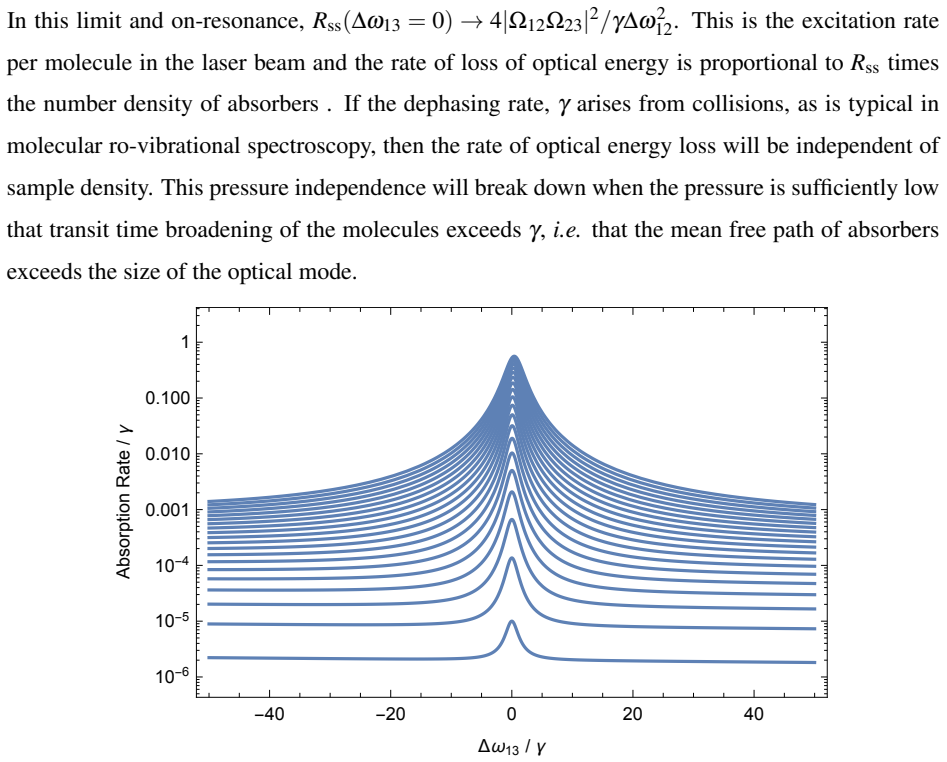
- [Figure 1 caption] The caption says the absorption rate is plotted 'as a function of detuning, Δω12', but the x-axis label and the text around Eq. (3) indicate the variable is Δω13/γ; the caption should be corrected.
- [References] Reference 25 spells the author as 'Schawlog'; the correct spelling is 'Schawlow'.
Circularity Check
No significant circularity: the sensitivity and selectivity predictions are computed from external spectroscopic data and independently derived analytical formulas.
full rationale
The paper's derivation chain is self-contained and does not reduce to its own inputs. The CO2 two-photon cross-section is calculated from HITRAN line strengths, HITRAN pressure-broadening coefficients, and standard angular-momentum algebra; the 32 ppq detection limit is obtained by inserting that cross-section (Eq. 26) and the cavity parameters of Galli et al. into Eq. 28, which is a shot-noise-limited fitting-error formula from the author's prior work. That formula is an analytical result, not a fitted parameter, and its stated assumptions do not include the predicted sensitivity. The butadiene spectrum uses externally supplied quantum-chemical constants and is explicitly described as representative rather than quantitatively definitive. The equal-relaxation-rate assumption in Section I is an approximation, but it is an input assumption, not a circular redefinition of the predicted rate. No equation in the paper is equivalent by construction to a target result, and no fitted parameter is renamed as a prediction. The only self-citation, Ref. 12, provides an independently derived noise expression and is not used to forbid alternatives or to smuggle in an ansatz; therefore it does not create circularity. The saturation-correction inconsistency noted by a skeptical reader concerns numerical self-consistency of the stated operating point, which is a correctness issue, not a circularity issue.
Assumptions & free parameters
assumptions (4)
- standard math Electric dipole approximation and rotating wave approximation for the light-matter interaction.
- domain assumption All population and dephasing relaxation rates are equal to a single rate gamma.
- domain assumption The two-photon amplitude is dominated by a single intermediate state, so the three-level model captures the physics.
- domain assumption Shot-noise-limited detection and the fitting-error formula for gamma2 from Lehmann (2014), Eq. 28.
Cite this review
Pith. "Pith review of Resonance enhanced two-photon cavity ring-down spectroscopy of vibrational overtone bands: a proposal." pith.science (2026). https://pith.science/paper/FONJLKZX
@misc{pith2026190800643,
  author       = {Pith},
  title        = {Pith review of: Resonance enhanced two-photon cavity ring-down spectroscopy of vibrational overtone bands: a proposal},
  year         = {2026},
  howpublished = {\url{https://pith.science/paper/FONJLKZX}},
  note         = {Machine review of arXiv:1908.00643}
}
abstract
This paper presents an analysis of near-resonant, ro-vibrational two-photon spectroscopy and the use of cavity ring-down spectroscopy for its detection. Expressions are derived for the photon absorption rate of a three-level system, correct to all orders and the simpler expressions that result from various approximations. The analysis includes the angular momentum projection degeneracies and linear or circular polarization of the exciting field. Expressions are derived for the rate of two-photon power loss for light inside a resonant cavity. Explicit calculations are made for excitation of the $\nu_3$ mode of $^{12}\textrm{C}^{16}\textrm{O}_2$ for which the two-photon excitation spectrum is dominated by a single $v_3 = 0 \rightarrow 2, Q(16)$ line at $\tilde{\nu} = 2335.826$\,cm$^{-1}$. This transition has an intermediate $v_3 = 0 \rightarrow 1,P(16)$ one-photon transition that is off resonance by 0.093 cm$^{-1}$ (2.8 GHz). At 1\,torr total pressure, the Q(16) two-photon transition has a calculated cross-section of $2.99 \cdot 10^{-38}$\,cm$^4$s per CO$_2$ molecule in the $J = 16$ state or $2.24 \cdot 10^{-39}$\,cm$^4$s per CO$_2$ molecule at 300\,K is calculated. Analysis of the sensitivity limits for 2-photon cavity ring-down spectroscopy predicts a theoretical detection limit of 32\,ppq ($10^{-15}$) Hz$^{-1/2}$ for $^{12}\textrm{C}^{16}\textrm{O}_2$, higher sensitivity than has been realized using one-photon absorption. The analysis predicts that most polyatomic molecules will have sparse, Doppler-Free two-photon absorption spectra, which will dramatically increase the selectivity of trace gas detection of samples with multiple components with overlapping absorption bands. This is demonstrated by the predicted mid-IR two-photon absorption spectrum of butadiene using theoretical spectroscopic constants.
Figures
Figures from the paper (1 more)

Reference graph
Works this paper leans on
-
[1]
author author A. O'keefe \ and\ author D. A. G. \ Deacon ,\ title title Cavity ring-down optical spectrometer for absorption-measurements using pulsed laser sources , \ 10.1063/1.1139895 journal journal Review of Scientific Instruments \ volume 59 ,\ pages 2544--2551 ( year 1988 ) NoStop
-
[2]
editor G. Berden \ and\ editor R. Engeln ,\ eds.,\ @noop title Cavity Ring-down Spectroscopy: Techniques and Applications \ ( publisher Blackwell Publishing ,\ address Oxford ,\ year 2008 ) NoStop
work page 2008
-
[3]
editor G. Gagliardi \ and\ editor H.-P. \ Loock ,\ eds.,\ @noop title Cavity-Enhanced Spectroscopy and Sensing ,\ series Springer Series in Optical Sciences , Vol.\ volume 179 \ ( publisher Springer ,\ year 2014 ) NoStop
work page 2014
-
[4]
author author S. C. \ Xu , author G. H. \ Sha , \ and\ author J. C. \ Xie ,\ title title Cavity ring-down spectroscopy in the liquid phase , \ @noop journal journal Review Of Scientific Instruments \ volume 73 ,\ pages 255--258 ( year 2002 ) NoStop
work page 2002
-
[5]
author author Z. Qu , author J. Engstrom , author D. Wong , author M. Islam , \ and\ author C. F. \ Kaminski ,\ title title High sensitivity liquid phase measurements using broadband cavity enhanced absorption spectroscopy (bbceas) featuring a low cost webcam based prism spectrometer , \ 10.1039/c3an01441j journal journal Analyst \ volume 138 ,\ pages 637...
-
[6]
author author A. C. R. \ Pipino , author J. W. \ Hudgens , \ and\ author R. E. \ Huie ,\ title title Evanescent wave cavity ring-down spectroscopy for probing surface processes , \ @noop journal journal Chemical Physics Letters \ volume 280 ,\ pages 104--112 ( year 1997 ) NoStop
work page 1997
-
[7]
author author H. V. \ Powell , author M. Schnippering , author M. Mazurenka , author J. V. \ Macpherson , author S. R. \ Mackenzie , \ and\ author P. R. \ Unwin ,\ title title Evanescent wave cavity ring-down spectroscopy as a probe of interfacial adsorption: Interaction of tris(2,2 '-bipyridine)ruthenium(ii) with silica surfaces and polyelectrolyte films...
work page 2009
-
[8]
author author M. Sangwan , author W. R. \ Stockwell , author D. Stewart , \ and\ author L. Zhu ,\ title title Absorption of near uv light by hno3/no3- on sapphire surfaces , \ 10.1021/acs.jpca.6b01648 journal journal Journal of Physical Chemistry A \ volume 120 ,\ pages 2877--2884 ( year 2016 ) NoStop
Show all 45 references
-
[9]
Galli , author S
author author I. Galli , author S. Bartalini , author R. Ballerini , author M. Barucci , author P. Cancio , author M. De Pas , author G. Giusfredi , author D. Mazzotti , author N. Akikusa , \ and\ author P. De Natale ,\ title title Spectroscopic detection of radiocarbon dioxid...
-
[10]
author author C. R. \ Bucher , author K. K. \ Lehmann , author D. F. \ Plusquellic , \ and\ author G. T. \ Fraser ,\ title title Doppler-free nonlinear absorption in ethylene by use of continuous-wave cavity ringdown spectroscopy , \ @noop journal journal Applied Optics \ volu...
2000
-
[11]
Giusfredi , author S
author author G. Giusfredi , author S. Bartalini , author S. Borri , author P. Cancio , author I. Galli , author D. Mazzotti , \ and\ author P. De Natale ,\ title title Saturated-absorption cavity ring-down spectroscopy , \ 10.1103/PhysRevLett.104.110801 journal journal Physic...
-
[12]
author author K. K. \ Lehmann ,\ title title Theoretical detection limit of saturated absorption cavity ring-down spectroscopy (scar) and two-photon absorption cavity ring-down spectroscopy , \ 10.1007/s00340-013-5663-3 journal journal Applied Physics B-Lasers and Optics \ vol...
-
[13]
author author L. S. \ Vasilenko , author V. P. \ Chebotaev , \ and\ author A. V. \ Shishaev ,\ title title Line shape of 2-photon absorption in a standing-wave field in a gas , \ @noop journal journal Jetp Letters-Ussr \ volume 12 ,\ pages 113--116 ( year 1970 ) NoStop
1970
-
[14]
Cagnac , author G
author author B. Cagnac , author G. Grynberg , \ and\ author F. Biraben ,\ title title Multiphotonic absorption spectroscopy without doppler broadening , \ 10.1051/jphys:019730034010084500 journal journal Journal De Physique \ volume 34 ,\ pages 845--858 ( year 1973 ) NoStop
-
[15]
Biraben , author B
author author F. Biraben , author B. Cagnac , \ and\ author G. Grynberg ,\ title title Experimental evidence of 2-photon transition without doppler broadening , \ 10.1103/PhysRevLett.32.643 journal journal Physical Review Letters \ volume 32 ,\ pages 643--645 ( year 1974 ) NoStop
-
[16]
author author F. Biraben ,\ title title The first decades of doppler-free two-photon spectroscopy , \ http://www.sciencedirect.com/science/article/pii/S1631070519300283 journal journal Comptes Rendus Physique \ ( year 2019 ) NoStop
2019
-
[17]
o ppert-Mayer ,\ title title \
author author M. G \"o ppert-Mayer ,\ title title \"U ber elementarakte mit zwei quantenspr \"u ngen , \ @noop journal journal Annalen der Physik \ volume 401 ,\ pages 273--294 ( year 1931 ) NoStop
1931
-
[18]
Mahr ,\ title Two-photon absorption spectroscopy , \ in\ @noop booktitle Quantum Electronics: A Treatise ,\ Vol
author author H. Mahr ,\ title Two-photon absorption spectroscopy , \ in\ @noop booktitle Quantum Electronics: A Treatise ,\ Vol. volume 1 ,\ editor edited by\ editor H. Rabin \ and\ editor C. Tang \ ( publisher Academic Press ,\ year 1975 )\ pp.\ pages 285--361 NoStop
1975
-
[19]
author author W. M. \ McClain \ and\ author R. Harris ,\ title Two-photon molecular spectroscopy in liquids and gases , \ in\ @noop booktitle Excited States ,\ Vol. volume 3 ,\ editor edited by\ editor E. Lim \ ( publisher Academic ,\ address New York ,\ year 1977 )\ pp.\ page...
1977
-
[20]
Oreg , author F
author author J. Oreg , author F. T. \ Hioe , \ and\ author J. H. \ Eberly ,\ title title Adiabatic following in multilevel systems , \ 10.1103/PhysRevA.29.690 journal journal Physical Review A \ volume 29 ,\ pages 690--697 ( year 1984 ) NoStop
-
[21]
author author P. F. \ Bernath ,\ @noop title Spectra of Atoms and Molecules \ ( publisher Oxford University Press ,\ address Oxford ,\ year 2016 )\ p.\ pages 293 NoStop
2016
-
[22]
author author H. C. \ Van de Hulst \ and\ author J. J. M. \ Reesinck ,\ title title Line breadths and voigt profiles , \ 10.1086/144944 journal journal Astrophysical Journal \ volume 106 ,\ pages 121--127 ( year 1947 ) NoStop
1947 doi
-
[23]
author author K. D. \ Bonin \ and\ author T. J. \ McIlrath ,\ title title 2-photon electric-dipole selection-rules , \ 10.1364/josab.1.000052 journal journal Journal of the Optical Society of America B-Optical Physics \ volume 1 ,\ pages 52--55 ( year 1984 ) NoStop
-
[24]
author author W. M. \ McClain ,\ title title Excited state symmetry assignment through polarized 2-photon absorption studies of fluids , \ 10.1063/1.1676494 journal journal Journal of Chemical Physics \ volume 55 ,\ pages 2789--2796 ( year 1971 ) NoStop
-
[25]
Townes \ and\ author A
author author C. Townes \ and\ author A. Schawlog ,\ @noop title Microwave Spectroscopy \ ( publisher Dover ,\ year 1955 )\ note table 4.4 NoStop
1955
-
[26]
Yariv ,\ @noop title Quantum Electronics ,\ edition 2nd \ ed.\ ( publisher John Wiles & Sons ,\ address New York ,\ year 1975 ) NoStop
author author A. Yariv ,\ @noop title Quantum Electronics ,\ edition 2nd \ ed.\ ( publisher John Wiles & Sons ,\ address New York ,\ year 1975 ) NoStop
1975
-
[27]
author author I. E. \ Gordon , author L. S. \ Rothman , author C. Hill , author R. V. \ Kochanov , author Y. Tan , author P. F. \ Bernath , author M. Birk , author V. Boudon , author A. Campargue , author K. V. \ Chance , author B. J. \ Drouin , author J. M. \ Flaud , author R...
2016
-
[28]
Podgorski , author E
author author K. Podgorski , author E. Terpetschnig , author O. P. \ Klochko , author O. M. \ Obukhova , \ and\ author K. Haas ,\ title title Ultra-bright and -stable red and near-infrared squaraine fluorophores for in vivo two-photon imaging , \ 10.1371/journal.pone.0051980 j...
-
[29]
@noop ( year 2019 ),\ note https://hitran.org/ NoStop
2019
-
[30]
Maithani , author A
author author S. Maithani , author A. Maity , \ and\ author M. Pradhan ,\ title title High-resolution spectral analysis of hybrid A/B -type band of 1,3-butadiene at 6.2 m using an EC-QCL coupled with cavity ring-down spectroscopy , \ 10.1016/j.chemphys.2019.02.022 journal jour...
-
[31]
Huang \ and\ author K
author author H. Huang \ and\ author K. K. \ Lehmann ,\ title title Sensitivity limit of rapidly swept continuous wave cavity ring-down spectroscopy , \ 10.1021/jp111177c journal journal Journal Of Physical Chemistry A \ volume 115 ,\ pages 9411--9421 ( year 2011 ) NoStop
-
[32]
author author R. W. P. \ Drever , author J. L. \ Hall , author F. V. \ Kowalski , author J. Hough , author G. M. \ Ford , author A. J. \ Munley , \ and\ author H. Ward ,\ title title Laser phase and frequency stabilization using an optical-resonator , \ 10.1007/bf00702605 jour...
-
[33]
Dahmani , author L
author author B. Dahmani , author L. Hollberg , \ and\ author R. Drullinger ,\ title title Frequency stabilization of semiconductor lasers by resonant optical feedback , \ 10.1364/OL.12.000876 journal journal Opt. Lett. \ volume 12 ,\ pages 876--878 ( year 1987 ) NoStop
-
[34]
Morville , author S
author author J. Morville , author S. Kassi , author M. Chenevier , \ and\ author D. Romanini ,\ title title Fast, low-noise, mode-by-mode, cavity-enhanced absorption by diode-laser self-locking , \ https://doi.org/10.1007/s00340-005-1828-z journal journal Applied Physics B-La...
-
[35]
author author E. R. T. \ Kerstel , author R. Q. \ Iannone , author M. Chenevier , author S. Kassi , author H. J. \ Jost , \ and\ author D. Romanini ,\ title title A water isotope ( ^ 2 H , ^ 17 O , and ^ 18 O spectrometer based on optical feedback cavity-enhanced absorption fo...
2006
-
[36]
Oliver H
@noop note Private Communication from Prof. Oliver H. Heckl, June 22, 2019 NoStop
2019
-
[37]
Romanini , author P
author author D. Romanini , author P. Dupre , \ and\ author R. Jost ,\ title title Non-linear effects by continuous wave cavity ring-down spectroscopy in jet-cooled NO _2 , \ 10.1016/s0924-2031(99)00018-1 journal journal Vibrational Spectroscopy \ volume 19 ,\ pages 93--106 ( ...
-
[38]
author author W. K. \ Bischel , author P. J. \ Kelly , \ and\ author C. K. \ Rhodes ,\ title title Collisional studies of ^ 12 CH _3 F using doppler free 2 photon absorption techniques , \ @noop journal journal Ieee Journal of Quantum Electronics \ volume 11 ,\ pages D24--D25 ...
1975
-
[39]
author author W. K. \ Bischel , author P. J. \ Kelly , \ and\ author C. K. \ Rhodes ,\ title title Observation of doppler-free 2-photon absorption in v3 bands of CH _3 F , \ 10.1103/PhysRevLett.34.300 journal journal Physical Review Letters \ volume 34 ,\ pages 300--303 ( year...
-
[40]
author author W. K. \ Bischel , author P. J. \ Kelly , \ and\ author C. K. \ Rhodes ,\ title title High-resolution doppler-free 2-photon spectroscopic studies of molecules .1. _3 bands of ^ 12 CH _3 F , \ 10.1103/PhysRevA.13.1817 journal journal Physical Review A \ volume 13 ,...
-
[41]
Prosnitz , author R
author author D. Prosnitz , author R. R. \ Jacobs , author W. K. \ Bischel , \ and\ author C. K. \ Rhodes ,\ title title Stimulated-emission at 9.75\, m following 2-photon excitation of methyl-fluoride , \ 10.1063/1.89997 journal journal Applied Physics Letters \ volume 32 ,\ ...
-
[42]
author author W. K. \ Bischel , author R. R. \ Jacobs , \ and\ author C. K. \ Rhodes ,\ title title Doppler-free 2-photon resonances in _2 bands of ^ 14 NH _3 at high stark fields , \ 10.1103/PhysRevA.14.1294 journal journal Physical Review A \ volume 14 ,\ pages 1294--1295 ( ...
-
[43]
author author W. K. \ Bischel , author P. J. \ Kelly , \ and\ author C. K. \ Rhodes ,\ title title High-resolution doppler-free 2-photon spectroscopic studies of molecules .2. _2 bands of ^ 14 NH _3 , \ 10.1103/PhysRevA.13.1829 journal journal Physical Review A \ volume 13 ,\ ...
-
[44]
Bokor , author W
author author J. Bokor , author W. K. \ Bischel , \ and\ author C. K. \ Rhodes ,\ title title Doppler-free spectroscopy of the _2 band in ^ 14 NH _3 - application to 16 m generation , \ 10.1063/1.326561 journal journal Journal of Applied Physics \ volume 50 ,\ pages 4541--4544...
-
[45]
author author R. R. \ Jacobs , author D. Prosnitz , author W. K. \ Bischel , \ and\ author C. K. \ Rhodes ,\ title title Laser generation from 6 to 35 m following 2-photon excitation of ammonia , \ 10.1063/1.88911 journal journal Applied Physics Letters \ volume 29 ,\ pages 71...
Reviewed August 14, 2026 · model on record in the stance chip above.
Discussion (0). Continue with ORCID to comment.