REVIEW 3 major objections 4 minor 3 cited by
Expert Kernel Generation Network Driven by Contextual Mapping for Hyperspectral Image Classification
T0 review · 3 major / 4 minor · reviewed 2026-08-16 · deepseek-v4-flash
Pith's one-line read EKGNet assembles a fresh 3D kernel per input, reaching 99.84% accuracy on Indian Pines.
desk verdict EKGNet is an incremental dynamic-convolution extension of 3D-DenseNet whose headline superiority claim is contradicted by its own comparison tables; the paper needs a controlled re-evaluation, not referee time as-is. read the letter →
The pith
A machine-rendered reading of the paper's core claim, the machinery that carries it, and where it could break.
The reading
What carries the argument
The load-bearing object is the dynamic expert convolution system: a set of K learnable base 3D kernels treated as experts, aggregated by input-dependent attention weights into one kernel $W_{dyn}=\sum_{k=1}^K \alpha_k W_k$. The weights come from the context-aware mapping network, which pools the input to a global context vector and maps it through residual 3D-convolution blocks to K softmax scores with a learnable temperature. This mechanism does the work of adapting the receptive field and spectral emphasis per sample; the modified 3D-DenseNet—with exponentially increasing growth rate $k=2^{m-1}k_0$ and full connectivity between blocks via average-pooled skip connections—carries feature reuse and depth efficiency.
What would settle it
Rerun SSRN, 3D-CNN, 3D-SE-DenseNet, SpectralFormer, LGCNet, and DGCNet exactly under EKGNet's protocol (6:1:3 or 5:1:4 train/validation/test split, 15×15 neighbouring patches, same epochs and optimizer) and compare OA on Indian Pines, Pavia University, and KSC; if any baseline matches or exceeds EKGNet's 99.84/99.98/99.95, the reported superiority is a protocol artifact rather than a dynamic-kernel effect.
Extended reading notes
Core claim
The central claim is that a tightly coupled pair—a context-aware mapping network and an expert convolution system—yields per-sample 3D kernels that improve hyperspectral classification. The mapping network $f_{map}$ takes the global average pooling $g = \mathrm{AvgPool3d}(X)$ of a hyperspectral patch and returns attention weights $\alpha = \mathrm{Softmax}(f_{map}(g)/\tau)$, where $\tau$ is a learnable temperature. The expert system holds K base kernels $\{W_1,\dots,W_K\}$ that are combined as $W_{dyn} = \sum_{k=1}^K \alpha_k W_k$, so each input patch effectively gets its own convolutional kernel. Because each sample receives a customized kernel, the model can emphasize fine spectral details in sparse regions and structural patterns in complex spatial layouts, while the 3D-DenseNet backbone reuses features through dense connections and an exponentially increasing growth rate. The paper's stated conclusion is that this design achieves leading OA, AA, and Kappa on Indian Pines, Pavia University, and KSC under the chosen data splits and patch size, outperforming the compared mainstream classifiers.
Load-bearing premise
That EKGNet beats the baselines depends on an unstated premise: those baselines were given the same large training sets (50–60% of labels) and the same 15×15 overlapping patches, but the paper does not document that protocol for them.
Editorial extensions
If this is right
- Because the kernel is assembled per sample, EKGNet can adapt its spatial-spectral emphasis to different ground-object distributions without adding network depth or width.
- The exponential growth-rate schedule concentrates parameters in later dense blocks, improving computational efficiency while preserving accuracy.
- Fully dense connectivity between the input and all subsequent layers across blocks increases feature reuse beyond the original DenseNet design.
- On Indian Pines, Pavia University, and KSC, the reported overall accuracies (99.84%, 99.98%, 99.95%) exceed the compared baselines, including LGCNet and DGCNet.
- Dynamic combination of base kernels can replace stacking many static kernels, reducing the parameter redundancy that commonly appears in 3D-CNN hyperspectral models.
Reading between the lines
- Editor's inference: if the per-input kernel assembly is truly the active ingredient, the same mapping-plus-expert module should transfer to 2D CNN and Transformer hyperspectral classifiers, a test the paper does not run.
- Editor's inference: the reported experiments use generous training fractions (60% on Indian Pines, 50% on Pavia University and KSC) and 15×15 overlapping patches, so the practical margin under small-sample regimes—say 10–20 labelled pixels per class—remains open; evaluating EKGNet under standard small-sample splits would clarify where the gain survives.
- Editor's inference: the temperature $\tau$ decays during training, but the paper does not ablate this schedule; holding $\tau$ fixed or annealing it differently would isolate how much of the gain comes from sharpening attention versus the mapping network's feature extraction.
Signed reviews
Editorial analysis
A structured set of objections, weighed in public.
Referee Report
Summary. The manuscript proposes EKGNet, a hyperspectral image classification network built on a modified 3D-DenseNet. A context-aware mapping network pools global spatial-spectral information and outputs attention weights over K base 3D convolutional kernels; the weighted combination of these kernels forms a per-sample dynamic convolution. The DenseNet backbone is modified with an exponentially increasing growth rate and fully dense connectivity. The method is evaluated on Indian Pines, Pavia University, and KSC, with reported overall accuracies above 99.8% on all three datasets, and the abstract and conclusion claim that EKGNet outperforms mainstream hyperspectral classification approaches.
Significance. The architecture is coherent, and the dynamic kernel aggregation in Section 2.2.2 is clearly specified, which is a strength. The proposed growth-rate rule k=2^{m-1}k0 is simple, and the fully dense connectivity is a reasonable architectural modification. If the empirical results were obtained under controlled conditions, the paper would offer a useful incremental contribution to hyperspectral image classification. However, the significance currently rests entirely on the claimed superiority over baselines, and that claim is contradicted by the reported numbers; without a valid comparison the contribution reduces to an unvalidated combination of known dynamic-convolution and DenseNet components. No code is provided, which further limits reproducibility of the empirical claims.
major comments (3)
- [Abstract, Section 3.4 (Tables 8 and 9)] The headline claim that EKGNet 'demonstrates superior performance' on IN, UP, and KSC is not supported by the paper's own experimental tables. On Indian Pines, Table 8 reports OA=99.84 for EKGNet versus OA=99.85±0.04 for LGCNet; on Pavia University, Table 9 reports OA=99.98 for EKGNet versus OA=99.99±0.00 for LGCNet. EKGNet is therefore numerically below the leading baseline on both datasets for which comparison tables are provided, and no standard deviation is reported for EKGNet, so statistical equivalence is not established either. The abstract and conclusion also claim superiority on KSC, but no KSC comparison table is present anywhere in the manuscript. This is load-bearing because the paper's contribution is an empirical performance claim; the claim must be revised or supported by a KSC table and matched statistical comparisons.
- [Sections 3.2.1 and 3.2.2] The comparison with SSRN, 3D-CNN, 3D-SE-DenseNet, SpectralFormer, LGCNet, and DGCNet is not controlled. The authors selected the training ratio (6:1:3 on Indian Pines; 5:1:4 on Pavia University and KSC) and the patch size (15) by sweeping on the same datasets and reporting the resulting OA, but the training ratios, patch sizes, and data splits used for the baselines are never reported. If the baselines were evaluated under the standard smaller training sets, the reported margins in Tables 8 and 9 could reflect training-data volume and patch geometry rather than the proposed dynamic-kernel mechanism. Please rerun all baselines under exactly the same split, patch extraction, and evaluation protocol, or clearly state the protocol used for each baseline.
- [Section 3.2.2, Section 3.4] The experimental protocol is internally inconsistent and missing details needed for reproducibility. Section 3.2.1 states that KSC uses a 5:1:4 ratio with 11x11 neighboring blocks, while Section 3.2.2 states that size 15 was selected for all datasets; Section 3.4 additionally reports input sizes of 17x17 for all three datasets. The manuscript must state the exact patch size used in the final experiments and explain the relation between the 15x15 blocks selected in Tables 4-6 and the 17x17 inputs used for evaluation. Also, the patch extraction mechanism is not described: if neighboring blocks are extracted by sliding a window with stride 1, training and test blocks share spatial context, which can inflate accuracy; please specify the stride and confirm that no training pixel appears in a test block.
minor comments (4)
- [Section 2.2.1] The context-aware mapping network is said to be implemented in the 'keys module', but this module is never defined; the number of residual blocks N, the hidden channel widths, the initial temperature, and the annealing schedule for tau are not specified, which prevents reproduction.
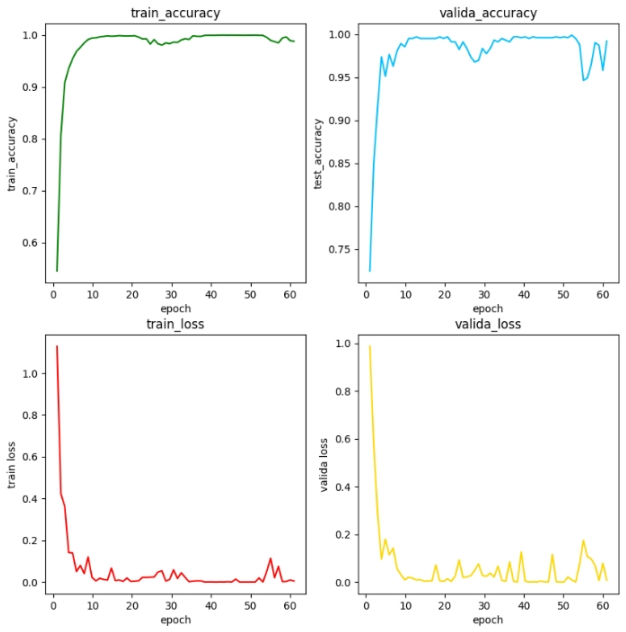
- [Section 3.4] There is an unresolved cross-reference: the text says 'Figure ?? shows the loss and accuracy changes during training and validation', but no figure number is given; Figure 8 is subsequently titled as training/validation curves.
- [Introduction, contribution 3] Contribution 3 states that EKGNet improves representation capability 'through wavelet convolution with expanded receptive fields', but no wavelet convolution appears in the architecture description in Section 2; this claim appears to be inherited from another paper and should be removed or supported.
- [Throughout] There are spelling and naming inconsistencies, including 'EGKNet' in the conclusion, 'LGCNET' in Tables 8 and 9 versus 'LGCNet' in the text, and 'DGCNET' versus 'DGCNet'; these should be unified.
Circularity Check
No significant circularity found: the paper defines a new architecture and evaluates it empirically; the equations are model definitions, and self-citations are related-method context rather than load-bearing support.
full rationale
This paper contains no derivation chain that reduces to its own inputs. The central equations (g=AvgPool(X), alpha=Softmax(fmap(g)/tau), Wdyn=sum alpha_k W_k, and Y=Conv3d(X,Wdyn,...)) define the proposed EKGNet architecture; they are not used to prove the classification-accuracy claims, and no claimed 'prediction' is algebraically forced by the fitting procedure. The experiments are self-contained in the sense that standard public HSI datasets are used and independent baseline numbers (SSRN, 3D-CNN, 3D-SE-DenseNet, SpectralFormer, LGCNet, DGCNet) are tabulated against EKGNet's own runs. The numerous self-citations ([7], [8], [9], [10], [11], [12], [14], [21], [22], [23]) appear in the introduction as descriptions of related prior work and are not invoked as uniqueness theorems, external mathematical facts, or as the sole justification for EKGNet's design. The hyperparameter sweeps in Sections 3.2.1 and 3.2.2 select training ratios and patch sizes on the same datasets, and the final reported OA values coincide with the best sweep entries; this is a test-set selection and statistical-validity concern about the strength of the 'superior performance' claim, and the missing KSC comparison table is a consistency/evidence problem. These are correctness and soundness issues, not equation-level circularity, because reporting a measured accuracy after choosing a configuration is not the same as deriving that accuracy from the input by construction. Accordingly, the appropriate circularity score is 0.
Assumptions & free parameters
free parameters (5)
- Training split ratio =
6:1:3 on Indian Pines; 5:1:4 on Pavia University and KSC
- Neighboring patch size (M=N) =
15 (selected); 17x17 input mentioned in Section 3.4
- Number of expert kernels K =
Not reported
- Temperature parameter tau and annealing schedule =
Not reported
- DenseNet growth rates and stage widths =
Growth rates 8, 16, 32; stages 4, 6, 8 for EKGNet-base
assumptions (4)
- domain assumption Labels in the benchmark splits are reliable and training/test samples are drawn from the same data distribution.
- domain assumption Spatial overlap between neighboring 15x15 patches does not materially inflate test accuracy.
- domain assumption Baseline accuracies in Tables 8-9 were obtained under comparable training ratios and patch settings.
- ad hoc to paper Dynamic convolution with attention from global pooling improves classification without needing depth or width increases.
Cite this review
Pith. "Pith review of Expert Kernel Generation Network Driven by Contextual Mapping for Hyperspectral Image Classification." pith.science (2026). https://pith.science/paper/FONYEF73
@misc{pith2026250413045,
  author       = {Pith},
  title        = {Pith review of: Expert Kernel Generation Network Driven by Contextual Mapping for Hyperspectral Image Classification},
  year         = {2026},
  howpublished = {\url{https://pith.science/paper/FONYEF73}},
  note         = {Machine review of arXiv:2504.13045}
}
read the original abstract
Deep neural networks face several challenges in hyperspectral image classification, including high-dimensional data, sparse distribution of ground objects, and spectral redundancy, which often lead to classification overfitting and limited generalization capability. To more efficiently adapt to ground object distributions while extracting image features without introducing excessive parameters and skipping redundant information, this paper proposes EKGNet based on an improved 3D-DenseNet model, consisting of a context-aware mapping network and a dynamic kernel generation module. The context-aware mapping module translates global contextual information of hyperspectral inputs into instructions for combining base convolutional kernels, while the dynamic kernels are composed of K groups of base convolutions, analogous to K different types of experts specializing in fundamental patterns across various dimensions. The mapping module and dynamic kernel generation mechanism form a tightly coupled system - the former generates meaningful combination weights based on inputs, while the latter constructs an adaptive expert convolution system using these weights. This dynamic approach enables the model to focus more flexibly on key spatial structures when processing different regions, rather than relying on the fixed receptive field of a single static convolutional kernel. EKGNet enhances model representation capability through a 3D dynamic expert convolution system without increasing network depth or width. The proposed method demonstrates superior performance on IN, UP, and KSC datasets, outperforming mainstream hyperspectral image classification approaches.
Figures


Figures from the paper (5 more)


Forward citations
Cited by 3 Pith papers
-
Dynamic 3D KAN Convolution with Adaptive Grid Optimization for Hyperspectral Image Classification
A 3D convolution layer whose weights are replaced by adaptive B-spline functions reports state-of-the-art accuracy on three hyperspectral benchmarks, but without released code or error bars.
-
Hyperspectral Image Classification via Transformer-based Spectral-Spatial Attention Decoupling and Adaptive Gating
STNet combines explicitly decoupled spatial and spectral attention with adaptive fusion and feed-forward gating inside 3D-DenseNet, reporting near-perfect classification accuracy on Indian Pines, Pavia University, and KSC.
-
MVNet: Hyperspectral Remote Sensing Image Classification Based on Hybrid Mamba-Transformer Vision Backbone Architecture
MVNet combines 3D-CNN, Transformer, and Mamba in a dual-branch design and claims 99%+ accuracy on three hyperspectral benchmarks, but the experimental reporting is internally inconsistent and the method is not reproducible.
Reference graph
Works this paper leans on
-
[1]
Intelligent remote sensing satellite system
Zhang Bing. Intelligent remote sensing satellite system. Journal of Remote Sensing , 15(3):415–431, 2011
2011
-
[2]
Hyperspectral imaging: techniques for spectral detection and classification, volume 1
Chein-I Chang. Hyperspectral imaging: techniques for spectral detection and classification, volume 1. Springer Science & Business Media, 2003
2003
-
[3]
Deep fea- ture extraction and classification of hyperspectral images based on convolutional neural networks
Yushi Chen, Hanlu Jiang, Chunyang Li, Xiuping Jia, and Pedram Ghamisi. Deep fea- ture extraction and classification of hyperspectral images based on convolutional neural networks. IEEE transactions on geoscience and remote sensing , 54(10):6232–6251, 2016
2016
-
[4]
Spectralformer: Rethinking hyperspectral image classification with transform- ers
Danfeng Hong, Zhu Han, Jing Yao, Lianru Gao, Bing Zhang, Antonio Plaza, and Jocelyn Chanussot. Spectralformer: Rethinking hyperspectral image classification with transform- ers. IEEE Transactions on Geoscience and Remote Sensing , 60:1–15, 2021
2021
-
[5]
Densely connected convolutional networks
Gao Huang, Zhuang Liu, Laurens Van Der Maaten, and Kilian Q Weinberger. Densely connected convolutional networks. In Proceedings of the IEEE conference on computer vision and pattern recognition, pages 4700–4708, 2017
2017
-
[6]
Going deeper with contextual cnn for hyperspectral image classification
Hyungtae Lee and Heesung Kwon. Going deeper with contextual cnn for hyperspectral image classification. IEEE Transactions on Image Processing , 26(10):4843–4855, 2017
2017
-
[7]
Guandong Li. Dgcnet: An efficient 3d-densenet based on dynamic group convolution for hyperspectral remote sensing image classification. arXiv preprint arXiv:2307.06667, 2023
arXiv 2023
-
[8]
3d wavelet convolutions with extended receptive fields for hyperspectral image classification, 2025
Guandong Li and Mengxia Ye. 3d wavelet convolutions with extended receptive fields for hyperspectral image classification, 2025
work page 2025
Show all 24 references
-
[9]
Efficient dynamic attention 3d convolution for hyperspec- tral image classification
Guandong Li and Mengxia Ye. Efficient dynamic attention 3d convolution for hyperspec- tral image classification. arXiv preprint arXiv:2503.23472 , 2025
2025 arXiv
-
[10]
Spatial-geometry enhanced 3d dynamic snake con- volutional neural network for hyperspectral image classification
Guandong Li and Mengxia Ye. Spatial-geometry enhanced 3d dynamic snake con- volutional neural network for hyperspectral image classification. arXiv preprint arXiv:2504.04463, 2025
2025 arXiv
-
[11]
Spatial-spectral hyperspectral classification based on learnable 3d group convolution
Guandong Li and Mengxia Ye. Spatial-spectral hyperspectral classification based on learnable 3d group convolution. Spectroscopy Letters, pages 1–13, 2025. 16
2025
-
[12]
Faster hyperspectral image classification based on selective kernel mechanism using deep convolutional networks
Guandong Li and Chunju Zhang. Faster hyperspectral image classification based on selective kernel mechanism using deep convolutional networks. arXiv preprint arXiv:2202.06458, 2022
2022 arXiv
-
[13]
Doubleconvpool-structured 3d-cnn for hyper- spectral remote sensing image classification
GD Li, CJ Zhang, F Gao, and XY Zhang. Doubleconvpool-structured 3d-cnn for hyper- spectral remote sensing image classification. Journal of Image and Graphics , 24(4):639– 654, 2019
2019
-
[14]
Hyperspectral remote sensing image classification using three-dimensional-squeeze-and- excitation-densenet (3d-se-densenet)
Guandong Li, Chunju Zhang, Runmin Lei, Xueying Zhang, Zhourun Ye, and Xiaoli Li. Hyperspectral remote sensing image classification using three-dimensional-squeeze-and- excitation-densenet (3d-se-densenet). Remote Sensing Letters, 11(2):195–203, 2020
2020
-
[15]
Dual classification head self-training network for cross-scene hyperspectral image classification
Rong Liu, Junye Liang, Jiaqi Yang, Jiang He, and Peng Zhu. Dual classification head self-training network for cross-scene hyperspectral image classification. arXiv preprint arXiv:2502.17879, 2025
2025 arXiv
-
[16]
Learning efficient convolutional networks through network slimming
Zhuang Liu, Jianguo Li, Zhiqiang Shen, Gao Huang, Shoumeng Yan, and Changshui Zhang. Learning efficient convolutional networks through network slimming. In Proceed- ings of the IEEE international conference on computer vision , pages 2736–2744, 2017
2017
-
[17]
Swin transformer: Hierarchical vision transformer using shifted windows
Ze Liu, Yutong Lin, Yue Cao, Han Hu, Yixuan Wei, Zheng Zhang, Stephen Lin, and Baining Guo. Swin transformer: Hierarchical vision transformer using shifted windows. In Proceedings of the IEEE/CVF international conference on computer vision, pages 10012– 10022, 2021
2021
-
[18]
Deep supervised learning for hyperspectral data classification through con- volutional neural networks
Konstantinos Makantasis, Konstantinos Karantzalos, Anastasios Doulamis, and Nikolaos Doulamis. Deep supervised learning for hyperspectral data classification through con- volutional neural networks. In 2015 IEEE international geoscience and remote sensing symposium (IGARSS), p...
2015
-
[19]
Spectral–spatial feature tokeniza- tion transformer for hyperspectral image classification
Le Sun, Guangrui Zhao, Yuhui Zheng, and Zebin Wu. Spectral–spatial feature tokeniza- tion transformer for hyperspectral image classification. IEEE Transactions on Geoscience and Remote Sensing , 60:1–14, 2022
2022
-
[20]
A fast dense spectral– spatial convolution network framework for hyperspectral images classification
Wenju Wang, Shuguang Dou, Zhongmin Jiang, and Liujie Sun. A fast dense spectral– spatial convolution network framework for hyperspectral images classification. Remote sensing, 10(7):1068, 2018
2018
-
[21]
Multi-scale dense networks for hyperspec- tral remote sensing image classification
Chunju Zhang, Guandong Li, and Shihong Du. Multi-scale dense networks for hyperspec- tral remote sensing image classification. IEEE Transactions on Geoscience and Remote Sensing, 57(11):9201–9222, 2019
2019
-
[22]
Three-dimensional densely connected convolutional network for hyperspectral remote sensing image classifi- cation
Chunju Zhang, Guandong Li, Shihong Du, Wuzhou Tan, and Fei Gao. Three-dimensional densely connected convolutional network for hyperspectral remote sensing image classifi- cation. Journal of Applied Remote Sensing , 13(1):016519–016519, 2019
2019
-
[23]
Deep feature aggregation network for hyperspectral remote sensing image classification
Chunju Zhang, Guandong Li, Runmin Lei, Shihong Du, Xueying Zhang, Hui Zheng, and Zhaofu Wu. Deep feature aggregation network for hyperspectral remote sensing image classification. IEEE Journal of Selected Topics in Applied Earth Observations and Remote Sensing, 13:5314–5325, 2020
2020
-
[24]
Spectral–spatial feature extraction for hyperspectral image classification: A dimension reduction and deep learning approach
Wenzhi Zhao and Shihong Du. Spectral–spatial feature extraction for hyperspectral image classification: A dimension reduction and deep learning approach. IEEE Transactions on Geoscience and Remote Sensing , 54(8):4544–4554, 2016. 17
2016
Reviewed August 16, 2026 · model on record in the stance chip above.
Discussion (0). Continue with ORCID to comment.