Pseudo-spectral frequency-domain method with background field decomposition and Green's function preconditioner for electromagnetic scattering problem in EUV lithography
Pith reviewed 2026-06-25 20:18 UTC · model grok-4.3
The pith
A reformulation of EUV scattering into a homogeneous background problem with Green's function preconditioning accelerates the pseudo-spectral frequency-domain solver.
A machine-rendered reading of the paper's core claim, the machinery that carries it, and where it could break.
Core claim
The proposed framework reformulates the EUV scattering problem into a scattering problem on a homogeneous background, where the layered media contribution is captured by a recursively updated reflection of the layered stack, solved using the pseudo-spectral frequency-domain method with a free-space Green's function preconditioner, resulting in significant speedup over the conventional approach.
What carries the argument
Background field decomposition paired with a free-space Green's function preconditioner, which allows the iterative solver to converge faster by handling the homogeneous background scattering.
If this is right
- The method enables faster simulation of complex EUV mask structures.
- It can be applied to multilayer mirror stacks with improved efficiency.
- Iterative convergence is expedited without altering the underlying physics model.
- The framework maintains accuracy while reducing computational cost.
Where Pith is reading between the lines
- This could extend to other layered media problems in optics beyond lithography.
- Potential for integration with other frequency-domain solvers.
- Might allow real-time or larger-scale simulations in manufacturing design.
Load-bearing premise
The reformulation into a scattering problem on a homogeneous background with recursively updated reflection accurately captures the electromagnetic contribution of the planarly layered media without significant errors.
What would settle it
A direct comparison of the computed fields or reflection coefficients against a reference solution from a different high-accuracy method on a simple multilayer stack with known analytical solution would show if the speedup comes at the cost of accuracy.
Figures

read the original abstract
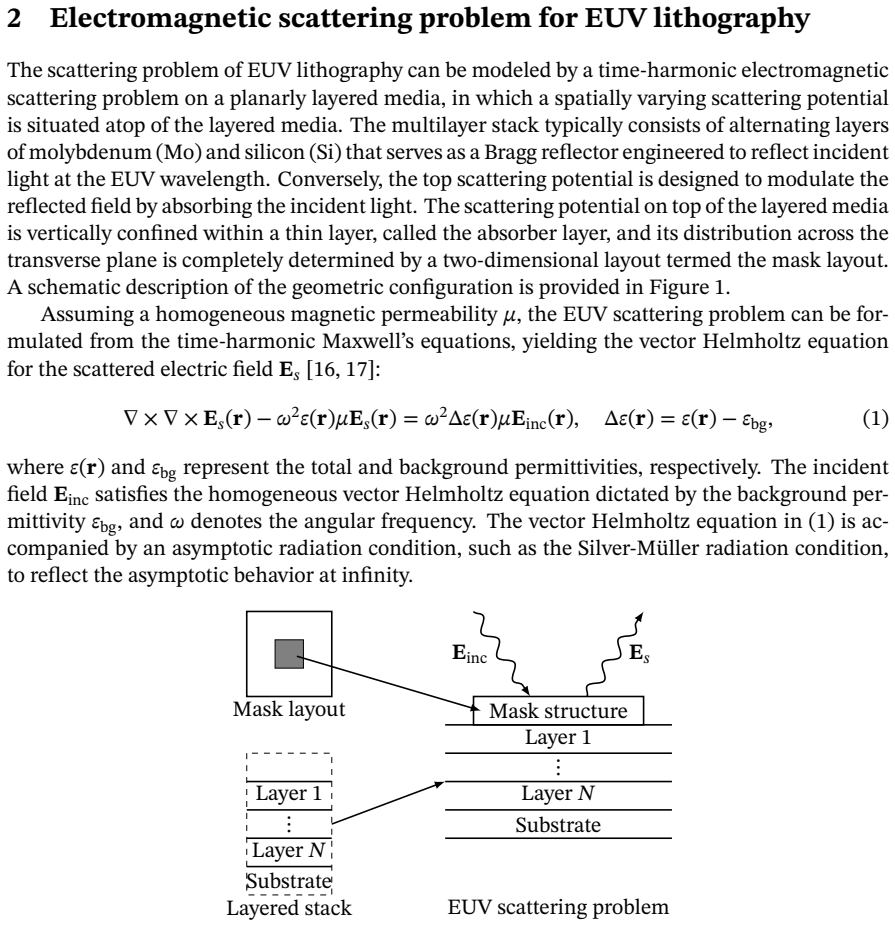
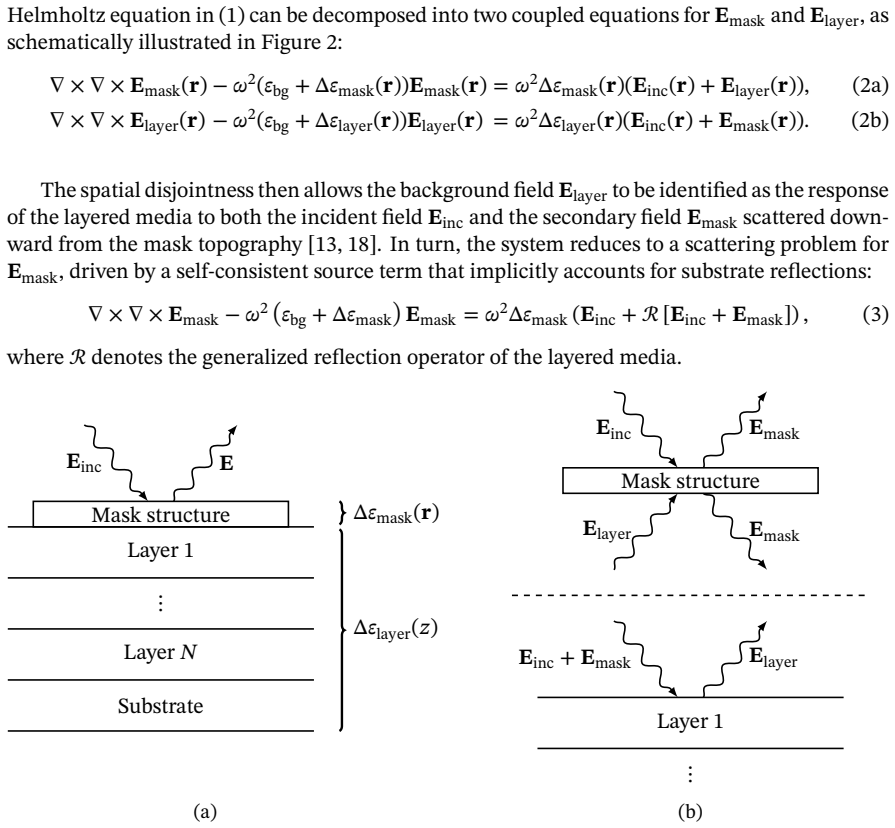
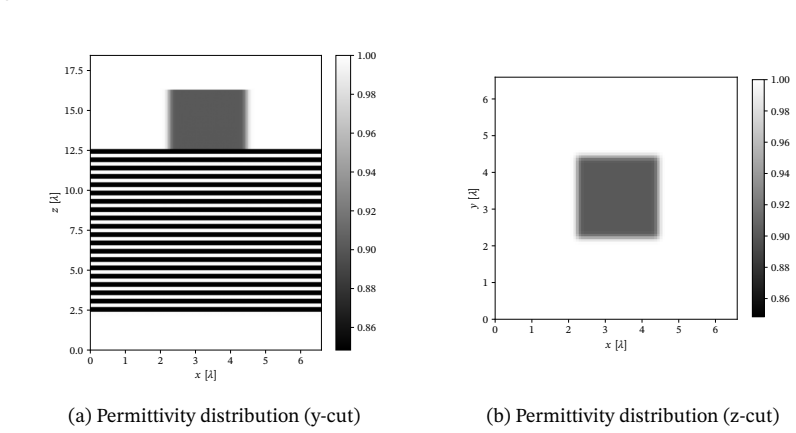
We provide an accelerated computational framework to solve electromagnetic scattering problems in planarly layered media arising from extreme ultraviolet (EUV) lithography. To achieve this, we reformulate the EUV scattering problem into a scattering problem on a homogeneous background, in which the electromagnetic contribution of the layered media is captured by a recursively updated reflection of the layered stack. The system is numerically solved by employing the pseudo-spectral frequency-domain method paired with an iterative solver, whose iterative convergence is expedited by a free-space Green's function preconditioner. The proposed framework is evaluated on EUV mask geometries and multilayer mirror stacks, demonstrating a significant speedup over the conventional pseudo-spectral frequency-domain method.
Editorial analysis
A structured set of objections, weighed in public.
Referee Report
Summary. The manuscript proposes an accelerated framework for electromagnetic scattering in planarly layered media for EUV lithography. It reformulates the problem as scattering on a homogeneous background whose layered contribution is replaced by a recursively updated reflection operator, then solves the resulting system with the pseudo-spectral frequency-domain method, an iterative solver, and a free-space Green's function preconditioner. The approach is evaluated on EUV mask geometries and multilayer mirror stacks and is claimed to deliver significant speedup relative to the conventional pseudo-spectral frequency-domain method.
Significance. If the recursive reflection update preserves accuracy to within the discretization error of the pseudo-spectral scheme and the reported speedup is confirmed with quantitative metrics, the method could reduce the computational burden of EUV mask and multilayer simulations, which are central to semiconductor process development. The background decomposition plus free-space preconditioner is a standard strategy, but its concrete realization here targets a practically important geometry class.
major comments (2)
- [Abstract] Abstract: the central claim of 'significant speedup' is asserted without any quantitative metrics, error norms, iteration counts, wall-clock timings, or convergence plots, leaving the primary performance assertion unsupported by evidence.
- [Abstract (and implied § on background decomposition)] The reformulation replaces the layered-media contribution by a recursively updated reflection operator applied inside the iterative loop while the preconditioner remains strictly free-space. No a-priori error bound is supplied showing that truncation or discretization mismatch in the recursive coefficients remains below the pseudo-spectral discretization error on the EUV mask geometries; this directly affects the right-hand side and effective operator and is therefore load-bearing for the accuracy-plus-speedup claim.
Simulated Author's Rebuttal
We thank the referee for the constructive feedback on our manuscript. We address each major comment below and will incorporate revisions to strengthen the presentation of results and accuracy analysis.
read point-by-point responses
-
Referee: [Abstract] Abstract: the central claim of 'significant speedup' is asserted without any quantitative metrics, error norms, iteration counts, wall-clock timings, or convergence plots, leaving the primary performance assertion unsupported by evidence.
Authors: We agree that the abstract would be strengthened by including quantitative metrics. The full manuscript reports wall-clock timings, iteration counts, error norms, and speedup factors for EUV mask geometries and multilayer stacks in the numerical results section. We will revise the abstract to summarize key metrics (e.g., observed speedup and typical iteration reduction) while keeping it concise. revision: yes
-
Referee: [Abstract (and implied § on background decomposition)] The reformulation replaces the layered-media contribution by a recursively updated reflection operator applied inside the iterative loop while the preconditioner remains strictly free-space. No a-priori error bound is supplied showing that truncation or discretization mismatch in the recursive coefficients remains below the pseudo-spectral discretization error on the EUV mask geometries; this directly affects the right-hand side and effective operator and is therefore load-bearing for the accuracy-plus-speedup claim.
Authors: The recursive reflection operator is constructed from the exact Fresnel coefficients of the layered stack and applied without truncation in the continuous formulation; any discretization effects arise only from the pseudo-spectral grid. While the current manuscript relies on numerical verification rather than a formal a-priori bound, comparisons against reference solutions on the tested EUV geometries show that the total error stays within the expected discretization tolerance. We will add a dedicated paragraph in the methods section with supporting error analysis and additional convergence data to explicitly confirm that the recursive operator contribution remains below the discretization error. revision: yes
Circularity Check
No circularity: numerical reformulation and preconditioning evaluated on external test cases
full rationale
The paper describes a reformulation of the EUV scattering problem into one on a homogeneous background with a recursive reflection operator for layered media, solved via pseudo-spectral frequency-domain discretization plus free-space Green's preconditioner. Speedup is claimed from direct numerical evaluation on EUV mask and multilayer geometries. No load-bearing step reduces by construction to its own inputs, no fitted parameter is relabeled as a prediction, and no self-citation chain is invoked to justify uniqueness or an ansatz. The derivation chain is self-contained as a standard numerical technique with external verification.
Axiom & Free-Parameter Ledger
axioms (1)
- domain assumption The electromagnetic contribution of the planarly layered media can be captured by a recursively updated reflection of the layered stack in the homogeneous background reformulation.
Reference graph
Works this paper leans on
-
[1]
A.K.-K.Wong,ResolutionEnhancementTechniquesinOpticalLithography,SPIE(2001)
2001
-
[2]
Mack,Fundamental Principles of Optical Lithography: The Science of Microfabrication, JohnWiley&Sons(2007)
C. Mack,Fundamental Principles of Optical Lithography: The Science of Microfabrication, JohnWiley&Sons(2007)
2007
-
[3]
X.MaandG.R.Arce,ComputationalLithography,JohnWiley&Sons(2011)
2011
-
[4]
Erdmann, D
A. Erdmann, D. Xu, P. Evanschitzky, V. Philipsen, V. Luong and E. Hendrickx,Characteri- zationandmitigationof3Dmaskeffectsinextremeultravioletlithography,Adv.Opt.Technol. 6(2017)187
2017
-
[5]
A.Erdmann,P.Evanschitzky,G.Bottiglieri,E.vanSettenandT.Fliervoet,3Dmaskeffectsin highNAEUVimaging,Proc.SPIE10957,ExtremeUltraviolet(EUV)LithographyX,109570Z (2019)
2019
-
[6]
H.J.Levinson,ExtremeUltravioletLithography,SPIE(2020)
2020
-
[7]
Yee,Numerical solution of initial boundary value problems involving maxwell’s equations inisotropicmedia,IEEETrans.AntennasPropagat.14(1966)302
K. Yee,Numerical solution of initial boundary value problems involving maxwell’s equations inisotropicmedia,IEEETrans.AntennasPropagat.14(1966)302
1966
-
[8]
A.Taflove,AdvancesinComputationalElectrodynamics: TheFinite-differenceTime-domain Method,ArtechHouse(1998). 15
1998
-
[9]
Moharam and T.K
M.G. Moharam and T.K. Gaylord,Rigorous coupled-wave analysis of planar-grating diffrac- tion,J.Opt.Soc.Am.,JOSA71(1981)811
1981
-
[10]
Moharam, D.A
M.G. Moharam, D.A. Pommet, E.B. Grann and T.K. Gaylord,Stable implementation of the rigorouscoupled-waveanalysisforsurface-reliefgratings: Enhancedtransmittancematrixap- proach,J.Opt.Soc.Am.A,JOSAA12(1995)1077
1995
-
[11]
Q.H.Liu,ThePSTDalgorithm: Atime-domainmethodrequiringonlytwocellsperwavelength, Microw.Opt.Technol.Lett.15(1997)158
1997
-
[12]
L.F.Abbott,IntroductiontotheBackgroundFieldMethod,ActaPhys.Polon.B13(1982)33
1982
-
[13]
W.C.Chew,WavesandFieldsinInhomogeneousMedia,Wiley-IEEEPress(1995)
1995
-
[14]
W.Chew,E.Michielssen,J.M.SongandJ.M.Jin,FastandEfficientAlgorithmsinComputa- tionalElectromagnetics,ArtechHouse(2001)
2001
-
[15]
Colton and R
D. Colton and R. Kress,Inverse Acoustic and Electromagnetic Scattering Theory, Springer (2020)
2020
-
[16]
M.BornandE.Wolf,PrinciplesofOptics: ElectromagneticTheoryofPropagation,Interference andDiffractionofLight,7thed.,CambridgeUniversityPress(2013)
2013
-
[17]
J.D.Jackson,ClassicalElectrodynamics,3rded.,Wiley(1998)
1998
-
[18]
Chew,Response of a source on top of a vertically stratified half-space,IEEE Transactions onAntennasandPropagation33(1985)649
W. Chew,Response of a source on top of a vertically stratified half-space,IEEE Transactions onAntennasandPropagation33(1985)649
1985
-
[19]
T.G.MackayandA.Lakhtakia,TheTransfer-MatrixMethodinElectromagneticsandOptics, Springer(2020)
2020
-
[20]
T.V.Pistor,K.AdamandA.Neureuther,Rigoroussimulationofmaskcornereffectsinextreme ultravioletlithography,J.Vac.Sci.Technol.B16(1998)3449
1998
-
[21]
J.P.Boyd,ChebyshevandFourierSpectralMethods,2nded.,DoverPublications(2001)
2001
-
[22]
Fornberg,A Practical Guide to Pseudospectral Methods, Cambridge University Press (1998)
B. Fornberg,A Practical Guide to Pseudospectral Methods, Cambridge University Press (1998)
1998
-
[23]
Liu,Large-scale simulations of electromagnetic and acoustic measurements using the pseudospectraltime-domain(PSTD)algorithm,IEEETransactionsonGeoscienceandRemote Sensing37(1999)917
Q.H. Liu,Large-scale simulations of electromagnetic and acoustic measurements using the pseudospectraltime-domain(PSTD)algorithm,IEEETransactionsonGeoscienceandRemote Sensing37(1999)917
1999
-
[24]
D.Song,L.YuanandY.Y.Lu,Fourier-matchingpseudospectralmodalmethodfordiffraction gratings,J.Opt.Soc.Am.A,JOSAA28(2011)613
2011
-
[25]
Munro, D
P.R.T. Munro, D. Engelke and D.D. Sampson,A compact source condition for modelling fo- cusedfieldsusingthepseudospectraltime-domainmethod,Opt.Express,OE22(2014)5599
2014
-
[26]
Berenger,Aperfectlymatchedlayerfortheabsorptionofelectromagneticwaves,Journal ofComputationalPhysics114(1994)185
J.-P. Berenger,Aperfectlymatchedlayerfortheabsorptionofelectromagneticwaves,Journal ofComputationalPhysics114(1994)185
1994
-
[27]
I.A.Makhotkin,M.Wu,V.Soltwisch,F.ScholzeandV.Philipsen,Refinedextremeultraviolet maskstackmodel,J.Opt.Soc.Am.A,JOSAA38(2021)498. 16
2021
-
[28]
Saad and M.H
Y. Saad and M.H. Schultz,GMRES: A Generalized Minimal Residual Algorithm for Solving NonsymmetricLinearSystems,SIAMJ.Sci.andStat.Comput.7(1986)856
1986
-
[29]
Y.Saad,IterativeMethodsforSparseLinearSystems,2nded.,SIAM(2003)
2003
-
[30]
Barrett, M
R. Barrett, M. Berry, T.F. Chan, J. Demmel, J. Donato, J. Dongarra et al.,Templates for the SolutionofLinearSystems: BuildingBlocksforIterativeMethods,SIAM(1994)
1994
-
[31]
O.Nevanlinna,ConvergenceofIterationsforLinearEquations,Birkhäuser,Basel(1993)
1993
-
[32]
A.Greenbaum,IterativeMethodsforSolvingLinearSystems,SIAM(1997)
1997
-
[33]
J.LiesenandZ.Strakos,KrylovSubspaceMethods: PrinciplesandAnalysis,OxfordUniversity Press(2012)
2012
-
[34]
Vainikko,Fast Solvers of the Lippmann-Schwinger Equation, in R.P
G. Vainikko,Fast Solvers of the Lippmann-Schwinger Equation, in R.P. Gilbert, J. Kajiwara, Y.S. Xu and R.P. Gilbert (eds.)Direct and Inverse Problems of Mathematical Physics, vol. 5, Springer(2000)
2000
-
[35]
Comput.Phys.323(2016)191[1604.03155]
F.Vico,L.GreengardandM.Ferrando,Fastconvolutionwithfree-spaceGreen’sfunctions,J. Comput.Phys.323(2016)191[1604.03155]
Pith/arXiv arXiv 2016
-
[36]
T.-a.Pham,E.Soubies,A.Ayoub,J.Lim,D.PsaltisandM.Unser,Three-DimensionalOptical Diffraction Tomography with Lippmann-Schwinger Model,IEEE Transactions on Computa- tionalImaging,6(2020)727
2020
-
[37]
R.Kress,LinearIntegralEquations,2nded.,Springer(1999)
1999
-
[38]
S.Zheng,H.Yang,B.Zhu,B.YuandM.Wong,LithoBench: BenchmarkingAIComputational Lithography for Semiconductor Manufacturing,Advances in Neural Information Processing Systems36(2023)30243
2023
-
[39]
Thakare, A
D. Thakare, A. Delabie and V. Philipsen,Optimizing EUV imaging metrics as a function of absorberthicknessandilluminationsource: SimulationcasestudyofTa-Coalloy,Proc.SPIE 12472,37thEuropeanMaskandLithographyConference,124720A(2022)
2022
-
[40]
SPIE 5256, 23rd Annual BACUS Symposium on Pho- tomaskTechnology(2003)
R.Windpassinger,N.Rosenkranz,T.Scherubl,P.Evanschitzky,A.ErdmannandA.Zibold, EUV mask simulation for AIMS,Proc. SPIE 5256, 23rd Annual BACUS Symposium on Pho- tomaskTechnology(2003)
2003
-
[41]
W.CaiandT.Yu,FastCalculationsofDyadicGreen’sFunctionsforElectromagneticScattering inaMultilayeredMedium,J.Comput.Phys.165(2000)1
2000
-
[42]
Cai,ComputationalMethodsforElectromagneticPhenomena: ElectrostaticsinSolvation, Scattering,andElectronTransport,CambridgeUniversityPress(2013)
W. Cai,ComputationalMethodsforElectromagneticPhenomena: ElectrostaticsinSolvation, Scattering,andElectronTransport,CambridgeUniversityPress(2013)
2013
-
[43]
H. Yuan, B. Wang, W. Zhang and W. Cai,Fast Multipole Method for Maxwell’s Equations in LayeredMedia,arXiv:2507.18491[math.NA](2025)
arXiv 2025
-
[44]
60(1985)187
V.Rokhlin,Rapidsolutionofintegralequationsofclassicalpotentialtheory,J.Comput.Phys. 60(1985)187. 17
1985
-
[45]
Greengard and V
L. Greengard and V. Rokhlin,A fast algorithm for particle simulations,J. Comput. Phys.73 (1987)325
1987
-
[46]
Carrier, L
J. Carrier, L. Greengard and V. Rokhlin,A Fast Adaptive Multipole Algorithm for Particle Simulations,SIAMJ.Sci.andStat.Comput.9(1988)669
1988
-
[47]
Ergul and L
O. Ergul and L. Gurel,TheMultilevelFastMultipoleAlgorithm(MLFMA)forSolvingLarge- ScaleComputationalElectromagneticsProblems,JohnWiley&Sons(2014). 18
2014
discussion (0)
Sign in with ORCID, Apple, or X to comment. Anyone can read and Pith papers without signing in.