REVIEW 3 major objections 5 minor 96 references
General sending-or-not-sending twin field protocol for quantum key distribution with asymmetric source parameters
T0 review · 3 major / 5 minor · reviewed 2026-08-14 · deepseek-v4-flash
Pith's one-line read The paper claims that sending-or-not-sending twin-field QKD stays secure under asymmetric source parameters when a single ratio condition holds, and that this gives large key-rate gains on unbalanced channels.
desk verdict A clean generalization of SNS twin-field QKD to asymmetric source parameters with a simple ratio constraint; the main open question is whether the decoy-state step in the proof is fully justified in the post-selected setting. read the letter →
The pith
A machine-rendered reading of the paper's core claim, the machinery that carries it, and where it could break.
The reading
What carries the argument
The load-bearing mechanism is the ratio-matching condition of Eq. (1), placed on the source parameters so that, for every decoy intensity $k>0$, the ratio $\mu_{Ak}/\mu_{Bk}$ equals the ratio of the single-photon weights $\epsilon_A(1-\epsilon_B)\mu'_A e^{-\mu'_A}$ and $\epsilon_B(1-\epsilon_A)\mu'_B e^{-\mu'_B}$. This makes the single-photon component of the effective Z-window state coincide with the $|\chi^+\rangle$ state in the X-window decomposition, a two-mode superposition of exactly one photon on Alice's side or Bob's side. With that match, the tagged-model decomposition $\Omega=\sum_r q_r\Omega_r$ reduces security of the full mixed source state to security of its single-photon part, and the decoy-state method estimates the phase-flip error rate $e^{ph}_1$ from X-window data. The final key length is then $N_f = n_1[1-H(e^{ph}_1)] - f n_t H(E_Z)$, with $n_1$ the estimated number of single-photon effective events and $E_Z$ the bit-flip error rate in signal windows.
What would settle it
Prepare single-photon-level states directly in the $|\chi^+\rangle$ form and send them through a realistic asymmetric channel, then compare their observed error rate with the upper bound inferred from the four-intensity decoy analysis under Eq. (1); if the inferred phase-flip rate systematically underestimates the directly measured error rate of the $Z_1$ events, the equivalence at the center of the proof fails. A numerical search over channel models with intensity-dependent loss that preserves the decoy counting rates while changing the single-photon component would settle the same question.
Extended reading notes
Core claim
The central claim is that symmetric source parameters are not needed for secure sending-or-not-sending twin-field QKD; what is needed is one ratio condition on the two users' intensities and sending probabilities. Under that condition, the single-photon component of the signal-window state is proportional to $\mu_{A1}|10\rangle\langle10|\otimes|10\rangle\langle10| + \mu_{B1}|01\rangle\langle01|\otimes|01\rangle\langle01|$, which is exactly the $|\chi^+\rangle$ component controlled by the decoy-window analysis. The security proof proceeds through virtual protocols and reductions that connect the effective Z-window state to the X-window decoy states, so the phase-flip error rate of the key bits can be bounded from observed decoy data. Finite-key formulas are then given, and numerical simulation shows large key-rate gains for asymmetric channel losses.
Load-bearing premise
The proof depends on the assumption that the single-photon component of the signal windows is statistically interchangeable with the $|\chi^+\rangle$ state used in the decoy windows, so that the phase error rate measured on decoy data genuinely bounds the phase error of the key bits.
Editorial extensions
If this is right
- Alice and Bob can choose source intensities matched to their own channel losses instead of being forced to use identical settings.
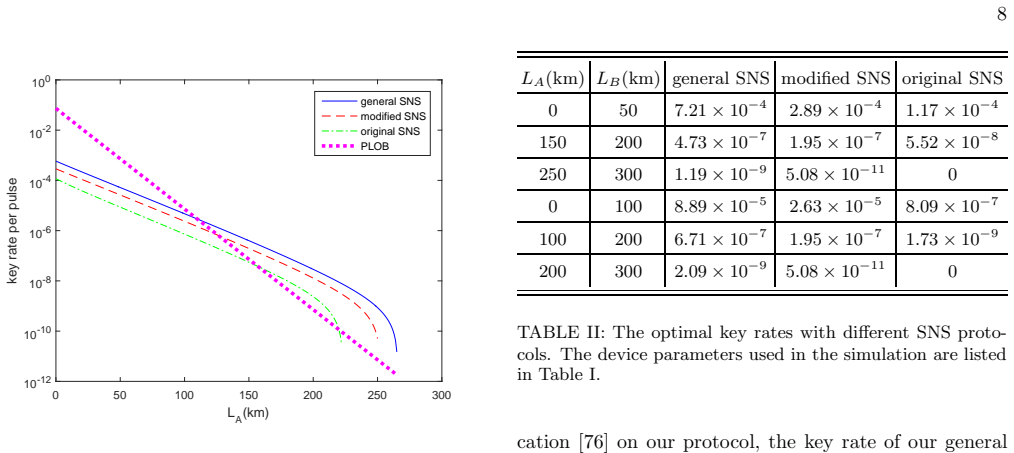
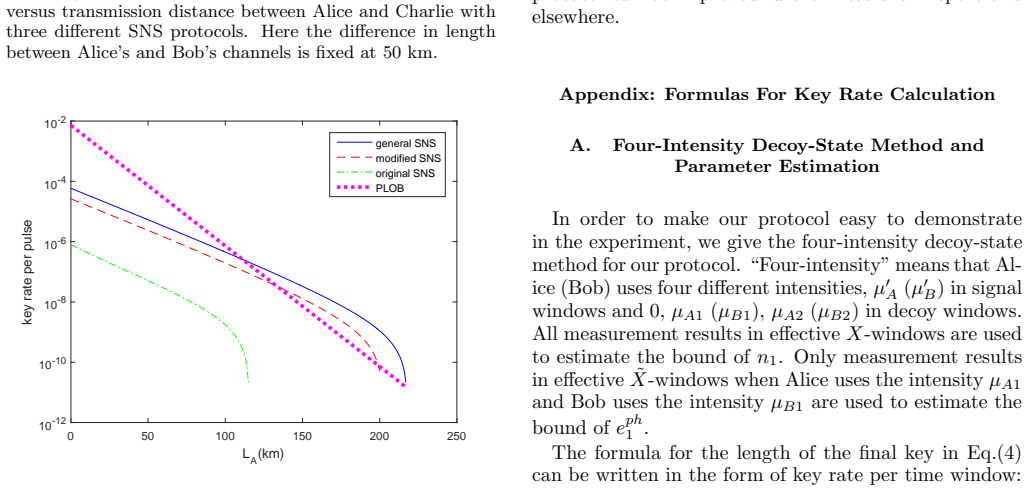
- On a 100 km difference between the two channel lengths, the optimized key rate is tens to hundreds of times higher than the original SNS protocol in the paper's simulations.
- The four-intensity decoy-state formulas give explicit lower and upper bounds for the single-photon counting rate and phase-flip error rate, so the protocol is implementable with finite data.
- Setting Alice's and Bob's parameters equal recovers the original SNS protocol as a special case.
- Because the security reduction does not depend on the untrusted third party's honesty, the measurement-device-independent character of SNS twin-field QKD is preserved in the asymmetric-source version.
Reading between the lines
- My inference: the ratio condition can be read as an impedance-matching condition between the two arms, and the same construction could be carried over to related twin-field variants that currently assume identical sources by identifying their analogous single-photon component.
- My inference: an adaptive implementation could recompute source intensities in real time to keep Eq. (1) satisfied as channel losses drift, which would make the protocol more robust in field deployment than fixed symmetric settings.
- My inference: the numerical gap over the approach of adding compensating loss to the shorter channel grows with channel asymmetry, so the protocol is most valuable precisely when the two arms are very different.
Signed reviews
Editorial analysis
A structured set of objections, weighed in public.
Referee Report
Summary. The paper proposes a general version of the sending-or-not-sending (SNS) twin-field QKD protocol in which Alice and Bob are allowed to use different source intensities and sending probabilities, subject to the ratio constraint Eq. (1). The authors give a security proof via a sequence of virtual protocols, a four-intensity decoy-state parameter estimation, and a finite-key analysis using the Chernoff bound. Numerical simulations for asymmetric channel lengths show a large key-rate improvement over the original SNS protocol and over a 'modified SNS' protocol that adds extra loss to balance the channels.
Significance. If the security proof is correct, the protocol is a practically valuable extension: it removes the equal-source-parameter restriction of the original SNS protocol and substantially improves key rates in asymmetric channel deployments, which are common in real QKD networks. The design constraint Eq. (1) is simple and the finite-key formulas are provided. The paper is clearly written and follows the standard virtual-protocol structure that the authors and others have used for SNS/TFQKD proofs. The main unresolved issue is the rigor of the decoy-state reduction in the asymmetric-parameter setting, which is load-bearing for the central security claim.
major comments (3)
- [Sec. III.C (Virtual Protocol 3, Reduction 3) and Step 5 Note, Sec. II; Appendix Eq. (40)] The paper asserts that the decoy-state method can be applied 'as if the phases δA and δB were not announced' (Step 5 Note), but it does not prove this for the asymmetric-parameter case. The bound on the phase-flip error rate in Eq. (40) is obtained by subtracting the vacuum contribution from the observed error counting rate T_Δ; this is a valid one-sided bound only if the observed error rate is a Poisson-weighted sum over total-photon-number components, i.e., if Charlie's measurement is block-diagonal in total photon number. The protocol does not explicitly prevent Charlie from storing the pulses and performing a phase-dependent measurement after the phases δA, δB are announced. Under such a strategy, the POVM can have coherences between different total photon numbers and Eq. (40) may not hold. Because Eq. (1) changes the weights of the photon-number components relative to the symmetric SNS proof, the citation to Ref. [68] is not sufficient. The authors need to provide an explicit derivation of Eq. (40) under arbitrary adversarial channels, or modify the protocol/analysis to close this gap.
- [Sec. III.A, Eqs. (18)-(21)] In the asymmetric case, the real-photon states |χ0⟩ and |χ1⟩ are not orthogonal: their inner product is (μA1−μB1)/(μA1+μB1). The paper uses these states to define the phase-flip error rate and to relate the X-window data to the Z-window phase error, but it does not discuss how the non-orthogonality affects the estimates. The original SNS proof relies on the symmetric case where these states are orthogonal (μA1=μB1). The authors should justify that the formula for E(a,d) and the reductions leading to Eq. (31) remain valid when the two states are not orthogonal, or show explicitly why the non-orthogonality is irrelevant for the security argument.
- [Sec. III.C, Eq. (32)-(33)] The decomposition of the phase-randomized coherent-state density matrix into the mixture {|ψ_l⟩} is stated without derivation and appears to be incorrect as written: the phase-randomized state is diagonal in the Fock basis, whereas the states |ψ_l⟩ in Eq. (33) contain coherences within each total-photon-number subspace. The decoy-state method requires well-defined yields for the components of the mixture. This decomposition is the basis for the claim that the single-photon component |ψ_1⟩ is exactly |χ+⟩ under Eq. (1), which is central to the security proof. The authors should provide a careful derivation of the decomposition and of the resulting decoy-state estimates, rather than citing Ref. [68] without addressing the asymmetric weights.
minor comments (5)
- [Sec. II, Eq. (4)] Equation (4) contains a typographical issue: 'fn tH(EZ)' should read 'f n_t H(E_Z)' (i.e., f times n_t times H(E_Z)). Similar spacing issues appear in Eqs. (35) and (36).
- [Sec. II, Step 1] The description of the bit values is confusing: 'she (he) decides to send ... and puts down a bit value 1 (0)' followed by the opposite for not sending. It would be clearer to define Alice's and Bob's bit values explicitly in a table or a short formula.
- [Appendix A, Eqs. (37)-(39)] The notation for lower bounds is ambiguous: in Eq. (37), the same symbol ⟨s^Z_1⟩ appears on both sides of the inequality, which is confusing. The authors should use distinct notations for the quantity and its lower bound (e.g., an underline or superscript L), as is common in the decoy-state literature.
- [Sec. IV, Table I] The table header 'Nt ed d ηd fe ξ α' is hard to parse; it would be clearer to separate the two dark-count-related parameters as 'e_d' and 'd' explicitly in the header, matching the caption.
- [Sec. V] The conclusion states that 'the intensities and the probabilities for sending' should satisfy Eq. (1), but Eq. (1) is a constraint on the intensities only; the sending probabilities appear in the ratio but are not independently constrained. The sentence should be phrased more precisely.
Circularity Check
No significant circularity: Eq. (1) is a designed constraint, not a fitted prediction, and the security proof rests on a new reduction plus standard decoy-state/GLLP lemmas.
full rationale
The central claim is the sufficiency of the parameter-ratio constraint Eq. (1) for security of the asymmetric SNS protocol. That constraint is not fitted to the target key rate or to the security conclusion; it is imposed as a mathematical condition and used in Reduction 3 (Sec. III.C) to make the single-photon component |ψ_1> of the phase-randomized X-window state coincide with the |χ+> component of the Z-window entangled state. The subsequent phase-error bound Eq. (40) is a standard decoy-state estimate; it does not rename an input or reuse the output. The only load-bearing self-citation is the Step 5 Note ('As proved in ref. [68], decoy state method can applied to our protocol as if the phases δA and δB were not announced'), together with the use of refs. [84,85] for finite-size formulas. These are parameter-free lemmas from the authors' prior SNS work, applied to the same phase-randomized-coherent-state structure; the novel asymmetric step (Eq. (1) and the Reduction 3 identification) is supplied in this paper, so the argument does not reduce to the cited results. The skeptical concern about phase-dependent adversarial POVMs is a correctness/security-model question, not a circularity: nothing in the proof is defined in terms of the conclusion or fitted to the predicted key rates. The numerical improvement over the original SNS protocol is a simulation result, not a fitted prediction, and therefore does not create circularity.
Assumptions & free parameters
free parameters (5)
- Signal intensities µ'A, µ'B =
Not stated
- Sending probabilities ǫA, ǫB =
Not stated
- Decoy intensities µA1, µB1, µA2, µB2 =
Not stated
- Window probabilities pZ_A, pZ_B, pX_Ak, pX_Bk =
Not stated
- Postselection parameter λ and phase offset Δϕ =
Not stated
assumptions (4)
- domain assumption Private phases δA and δB are uniformly random and secret, so phase-randomized coherent states are classical mixtures of Fock states.
- domain assumption Channel behavior depends only on the input intensities and is independent of the users' basis choices and intensity settings (decoy-state stationarity).
- standard math The GLLP tagging model applies to the decomposition of the Z-window state Ω into tagged and untagged parts.
- standard math Universally composable security framework and Chernoff bound for finite-size analysis.
Cite this review
Pith. "Pith review of General sending-or-not-sending twin field protocol for quantum key distribution with asymmetric source parameters." pith.science (2026). https://pith.science/paper/FPGTL3FH
@misc{pith2026190805073,
  author       = {Pith},
  title        = {Pith review of: General sending-or-not-sending twin field protocol for quantum key distribution with asymmetric source parameters},
  year         = {2026},
  howpublished = {\url{https://pith.science/paper/FPGTL3FH}},
  note         = {Machine review of arXiv:1908.05073}
}
read the original abstract
The sending-or-not-sending (SNS) protocol of the twin-field quantum key distribution (TFQKD) can tolerant large misalignment error and its key rate can exceed the bound of repeaterless QKD. But the original SNS protocol requires the two users to use the same source parameters. Here we propose a general protocol with asymmetric source parameters and give the security proof of this protocol. Our general protocol has a much better performance than that of the original SNS protocol when the channel of the system is asymmetric.
Figures


Figures from the paper (1 more)
Reference graph
Works this paper leans on
-
[78]
K. Tamaki, H.-K. Lo, W. Wang, and M. Lucamarini, arXiv preprint arXiv:1805.05511 (2018)
arXiv 2018
-
[68]
S. Pirandola, C. Ottaviani, G. Spedalieri, C. Weedbroo k, S. L. Braunstein, S. Lloyd, T. Gehring, C. S. Jacobsen, and U. L. Andersen, Nature Photonics 9, 397 (2015)
work page 2015
-
[1]
They preshare an extended state Ω 0 = |Ψ ⟩⟨Ψ | (14) where |Ψ ⟩ =C(√ µA1eiγ A|10⟩ ⊗ |10⟩ + √µB1eiγ B |01⟩ ⊗ |01⟩) (15) and γA and γB are announced publicly
Preparation stage For each time window i, they preshare the classical information about whether this time window is an X- window or Z-window. They preshare an extended state Ω 0 = |Ψ ⟩⟨Ψ | (14) where |Ψ ⟩ =C(√ µA1eiγ A|10⟩ ⊗ |10⟩ + √µB1eiγ B |01⟩ ⊗ |01⟩) (15) and γA and γB are announced publicly. (Remind that Ω 0 and |Ψ ⟩ vary in different time windows.) I...
-
[2]
(16) to Charlie and keep the ancillary photons locally
Protocol V1-1: At any Z-window (X-window), they send the real photons of Ω Z (Ω X ) defined in Eq. (16) to Charlie and keep the ancillary photons locally. V1-2: Charlie measures the real photons from Alice and Bob with a beam splitter after taking phase com- pensation according to the strong reference lights with phases γA and γB. He announces his measurem...
-
[3]
They preshare an extended state Ω Z in Eq.(16) for Z- windows, an real-photon state |χ+⟩ for X0-windows and an real state |χ−⟩ for X1-windows
Preparation stage For each time window i, they preshare the classical information about whether this time window is an X0- window, an X1-window or a Z-window. They preshare an extended state Ω Z in Eq.(16) for Z- windows, an real-photon state |χ+⟩ for X0-windows and an real state |χ−⟩ for X1-windows
-
[4]
At any X0-window (X1-window), they send |χ+⟩ (|χ−⟩) to Charlie
Protocol V2-1: At any Z-window, they send out the real pho- tons of Ω Z to Charlie and keep the ancillary photons locally. At any X0-window (X1-window), they send |χ+⟩ (|χ−⟩) to Charlie. V2-2: Charlie measures the real photons from Alice and Bob with a beam splitter after taking phase com- pensation according to the strong reference lights with phases γA ...
-
[5]
the left detector clicks and cos( δA −δB)< 0
-
[6]
Therefore, we can define these two kinds of effective events as error events and the corresponding time windows are defined as error windows
the right detector clicks and cos( δA −δB) ≥ 0. Therefore, we can define these two kinds of effective events as error events and the corresponding time windows are defined as error windows . If they set the value of λ small enough and Charlie perform the compensation honestly, they may get few error events so that the phase-flip error rate will be quite low a...
Show all 96 references
-
[7]
They preshare an extended state Ω Z in Eq.(16) for Z- windows
Preparation stage For each time window i, they preshare the classical information about whether this time window is an X window or a Z-window. They preshare an extended state Ω Z in Eq.(16) for Z- windows
-
[8]
the modified SNS protocol
Protocol V3-1: At any Z-window, they send out the real pho- tons of Ω Z to Charlie and keep the ancillary photons locally. At any X-window, Alice (Bob) sends a coherent state |√ µAkeiδA+iγ A⟩ (|√µBkeiδB +iγ B ⟩) with random δA and γA (δB and γB) to Charlie. V3-2: Charlie measu...
-
[9]
BENNETT, in Proceedings of the IEEE International Conference on Computers, Systems, and Signal Process- ing (1984), pp
C. BENNETT, in Proceedings of the IEEE International Conference on Computers, Systems, and Signal Process- ing (1984), pp. 175–179
1984
-
[10]
Lo and H
H.-K. Lo and H. F. Chau, science 283, 2050 (1999)
1999
-
[11]
P. W. Shor and J. Preskill, Physical Review Letters 85, 441 (2000)
2000
-
[12]
Mayers, Journal of the ACM (JACM) 48, 351 (2001)
D. Mayers, Journal of the ACM (JACM) 48, 351 (2001)
2001
-
[13]
Gisin, G
N. Gisin, G. Ribordy, W. Tittel, and H. Zbinden, Re- views of modern physics 74, 145 (2002)
2002
-
[14]
Gisin and R
N. Gisin and R. Thew, Nature photonics 1, 165 (2007)
2007
-
[15]
Renner, International Journal of Quantum Informa- tion 6, 1 (2008)
R. Renner, International Journal of Quantum Informa- tion 6, 1 (2008)
2008
-
[16]
Scarani, H
V. Scarani, H. Bechmann-Pasquinucci, N. J. Cerf, M. Duˇ sek, N. L¨ utkenhaus, and M. Peev, Reviews of mod- ern physics 81, 1301 (2009)
2009
-
[17]
Koashi, New Journal of Physics 11, 045018 (2009)
M. Koashi, New Journal of Physics 11, 045018 (2009)
2009
-
[18]
Inamori, N
H. Inamori, N. L¨ utkenhaus, and D. Mayers, The Euro- pean Physical Journal D-Atomic, Molecular, Optical and Plasma Physics 41, 599 (2007)
2007
-
[19]
Gottesman, H.-K
D. Gottesman, H.-K. Lo, N. Lutkenhaus, and J. Preskill, in International Symposium onInformation Theory,
-
[20]
Brassard, N
G. Brassard, N. L¨ utkenhaus, T. Mor, and B. C. Sanders, Physical Review Letters 85, 1330 (2000)
2000
-
[21]
Hwang, Physical Review Letters 91, 057901 (2003)
W.-Y. Hwang, Physical Review Letters 91, 057901 (2003)
2003
-
[22]
Wang, Physical Review Letters 94, 230503 (2005)
X.-B. Wang, Physical Review Letters 94, 230503 (2005)
2005
-
[23]
H.-K. Lo, X. Ma, and K. Chen, Physical Review Letters 94, 230504 (2005)
2005
-
[24]
Adachi, T
Y. Adachi, T. Yamamoto, M. Koashi, and N. Imoto, Physical review letters 99, 180503 (2007)
2007
-
[25]
H.-K. Lo, M. Curty, and B. Qi, Physical Review Letters 108, 130503 (2012)
2012
-
[26]
S. L. Braunstein and S. Pirandola, Physical Review Let- ters 108, 130502 (2012)
2012
-
[27]
Huttner, N
B. Huttner, N. Imoto, N. Gisin, and T. Mor, Physical Review A 51, 1863 (1995)
1995
-
[28]
H. P. Yuen, Quantum and Semiclassical Optics: Journal of the European Optical Society Part B 8, 939 (1996)
1996
-
[29]
F. Xu, H. Xu, and H.-K. Lo, Physical Review A 89, 052333 (2014)
2014
-
[30]
Lydersen, C
L. Lydersen, C. Wiechers, C. Wittmann, D. Elser, J. Skaar, and V. Makarov, Nature photonics 4, 686 (2010)
2010
-
[31]
Gerhardt, Q
I. Gerhardt, Q. Liu, A. Lamas-Linares, J. Skaar, C. Kurt - siefer, and V. Makarov, Nature communications 2, 349 (2011)
2011
-
[32]
X.-B. Wang, T. Hiroshima, A. Tomita, and M. Hayashi, Physics reports 448, 1 (2007)
2007
-
[33]
Hayashi, Physical Review A 76, 012329 (2007)
M. Hayashi, Physical Review A 76, 012329 (2007)
2007
-
[34]
Wang, Physical Review A 87, 012320 (2013)
X.-B. Wang, Physical Review A 87, 012320 (2013)
2013
-
[35]
Sasaki, Y
T. Sasaki, Y. Yamamoto, and M. Koashi, Nature 509, 475 (2014)
2014
-
[36]
Curty, F
M. Curty, F. Xu, W. Cui, C. C. W. Lim, K. Tamaki, and H.-K. Lo, Nature communications 5 (2014)
2014
-
[37]
F. Xu, M. Curty, B. Qi, and H.-K. Lo, New Journal of Physics 15, 113007 (2013)
2013
-
[38]
Chau, Physical Review A 97, 040301 (2018)
H.-F. Chau, Physical Review A 97, 040301 (2018)
2018
-
[39]
Song, Q.-Y
T.-T. Song, Q.-Y. Wen, F.-Z. Guo, and X.-Q. Tan, Phys- ical Review A 86, 022332 (2012)
2012
-
[40]
Zhou, Z.-W
Y.-H. Zhou, Z.-W. Yu, and X.-B. Wang, Physical Review A 89, 052325 (2014)
2014
-
[41]
Yu, Y.-H
Z.-W. Yu, Y.-H. Zhou, and X.-B. Wang, Physical Review A 91, 032318 (2015)
2015
-
[42]
Zhou, Z.-W
Y.-H. Zhou, Z.-W. Yu, and X.-B. Wang, Physical Review A 93, 042324 (2016)
2016
-
[43]
Jiang, Z.-W
C. Jiang, Z.-W. Yu, and X.-B. Wang, Physical Review A 94, 062323 (2016)
2016
-
[44]
Jiang, Z.-W
C. Jiang, Z.-W. Yu, and X.-B. Wang, Physical Review A 95, 032325 (2017)
2017
-
[45]
Zhou, C.-H
X.-Y. Zhou, C.-H. Zhang, C.-M. Zhang, and Q. Wang, Physical Review A 96, 052337 (2017)
2017
-
[46]
Huang, S.-H
A. Huang, S.-H. Sun, Z. Liu, and V. Makarov, Physical Review A 98, 012330 (2018)
2018
-
[47]
M. Peev, C. Pacher, R. All´ eaume, C. Barreiro, J. Bouda, W. Boxleitner, T. Debuisschert, E. Diamanti, M. Dia- nati, J. Dynes, et al., New Journal of Physics 11, 075001 (2009)
2009
-
[48]
X.-L. Hu, Y. Cao, Z.-W. Yu, and X.-B. Wang, Scientific Reports 8, 17634 (2018)
2018
-
[49]
W. Wang, F. Xu, and H.-K. Lo, Physical Review A 97, 032337 (2018)
2018
-
[50]
Rosenberg, J
D. Rosenberg, J. W. Harrington, P. R. Rice, P. A. Hiskett, C. G. Peterson, R. J. Hughes, A. E. Lita, S. W. Nam, and J. E. Nordholt, Physical Review Letters 98, 010503 (2007)
2007
-
[51]
Schmitt-Manderbach, H
T. Schmitt-Manderbach, H. Weier, M. F¨ urst, R. Ursin, F. Tiefenbacher, T. Scheidl, J. Perdigues, Z. Sodnik, C. Kurtsiefer, J. G. Rarity, et al., Physical Review Let- ters 98, 010504 (2007)
2007
-
[52]
C.-Z. Peng, J. Zhang, D. Yang, W.-B. Gao, H.-X. Ma, H. Yin, H.-P. Zeng, T. Yang, X.-B. Wang, and J.-W. Pan, Physical Review Letters 98, 010505 (2007)
2007
-
[53]
Boaron, G
A. Boaron, G. Boso, D. Rusca, C. Vulliez, C. Autebert, M. Caloz, M. Perrenoud, G. Gras, F. Bussi` eres, M.-J. Li, et al., Physical Review Letters 121, 190502 (2018). 11
2018
-
[54]
Z. Yuan, A. Sharpe, and A. Shields, Applied physics let- ters 90, 011118 (2007)
2007
-
[55]
Q. Wang, W. Chen, G. Xavier, M. Swillo, T. Zhang, S. Sauge, M. Tengner, Z.-F. Han, G.-C. Guo, and A. Karlsson, Physical Review Letters 100, 090501 (2008)
2008
-
[56]
Tang, H.-L
Y.-L. Tang, H.-L. Yin, S.-J. Chen, Y. Liu, W.-J. Zhang, X. Jiang, L. Zhang, J. Wang, L.-X. You, J.-Y. Guan, et al., Physical Review Letters 113, 190501 (2014)
2014
-
[57]
A. R. Dixon, Z. Yuan, J. Dynes, A. Sharpe, and A. Shields, Applied Physics Letters 96, 161102 (2010)
2010
-
[58]
Sasaki, M
M. Sasaki, M. Fujiwara, H. Ishizuka, W. Klaus, K. Wakui, M. Takeoka, S. Miki, T. Yamashita, Z. Wang, A. Tanaka, et al., Optics express 19, 10387 (2011)
2011
-
[59]
Fr¨ ohlich, J
B. Fr¨ ohlich, J. F. Dynes, M. Lucamarini, A. W. Sharpe, Z. Yuan, and A. J. Shields, Nature 501, 69 (2013)
2013
-
[60]
Rubenok, J
A. Rubenok, J. A. Slater, P. Chan, I. Lucio-Martinez, and W. Tittel, Physical Review Letters 111, 130501 (2013)
2013
-
[61]
Liu, T.-Y
Y. Liu, T.-Y. Chen, L.-J. Wang, H. Liang, G.-L. Shentu, J. Wang, K. Cui, H.-L. Yin, N.-L. Liu, L. Li, et al., Phys- ical Review Letters 111, 130502 (2013)
2013
-
[62]
T. F. da Silva, D. Vitoreti, G. Xavier, G. do Amaral, G. Temporao, and J. von der Weid, Physical Review A 88, 052303 (2013)
2013
-
[63]
P. Chan, J. A. Slater, I. Lucio-Martinez, A. Rubenok, and W. Tittel, Optics express 22, 12716 (2014)
2014
-
[64]
Z. Tang, Z. Liao, F. Xu, B. Qi, L. Qian, and H.-K. Lo, Physical Review Letters 112, 190503 (2014)
2014
-
[65]
Takeoka, S
M. Takeoka, S. Guha, and M. M. Wilde, Nature commu- nications 5, 5235 (2014)
2014
-
[66]
Takesue, T
H. Takesue, T. Sasaki, K. Tamaki, and M. Koashi, Na- ture Photonics 9, 827 (2015)
2015
-
[67]
Wang, X.-T
C. Wang, X.-T. Song, Z.-Q. Yin, S. Wang, W. Chen, C.- M. Zhang, G.-C. Guo, and Z.-F. Han, Physical Review Letters 115, 160502 (2015)
2015
-
[69]
Comandar, M
L. Comandar, M. Lucamarini, B. Fr¨ ohlich, J. Dynes, A. Sharpe, S.-B. Tam, Z. Yuan, R. Penty, and A. Shields, Nature Photonics 10, 312 (2016)
2016
-
[70]
Wang, Z.-Q
C. Wang, Z.-Q. Yin, S. Wang, W. Chen, G.-C. Guo, and Z.-F. Han, Optica 4, 1016 (2017)
2017
-
[71]
Liao, W.-Q
S.-K. Liao, W.-Q. Cai, W.-Y. Liu, L. Zhang, Y. Li, J.-G. Ren, J. Yin, Q. Shen, Y. Cao, Z.-P. Li, et al., Nature 549, 43 (2017)
2017
-
[72]
Liao, W.-Q
S.-K. Liao, W.-Q. Cai, J. Handsteiner, B. Liu, J. Yin, L. Zhang, D. Rauch, M. Fink, J.-G. Ren, W.-Y. Liu, et al., Physical Review Letters 120, 030501 (2018)
2018
-
[73]
Yin, T.-Y
H.-L. Yin, T.-Y. Chen, Z.-W. Yu, H. Liu, L.-X. You, Y.- H. Zhou, S.-J. Chen, Y. Mao, M.-Q. Huang, W.-J. Zhang, et al., Physical Review Letters 117, 190501 (2016)
2016
-
[74]
Lu, Z.-Q
F.-Y. Lu, Z.-Q. Yin, C.-H. Cui, G.-J. Fan-Yuan, S. Wang, D.-Y. He, W. Chen, G.-C. Guo, and Z.-F. Han, arXiv preprint arXiv:1901.04264 (2019)
2019 arXiv
-
[75]
Pirandola, R
S. Pirandola, R. Laurenza, C. Ottaviani, and L. Banchi, Nature communications 8, 15043 (2017)
2017
-
[76]
Lucamarini, Z
M. Lucamarini, Z. Yuan, J. Dynes, and A. Shields, Na- ture 557, 400 (2018)
2018
-
[77]
Wang, Z.-W
X.-B. Wang, Z.-W. Yu, and X.-L. Hu, Physical Review A 98, 062323 (2018)
2018
-
[79]
X. Ma, P. Zeng, and H. Zhou, Physical Review X 8, 031043 (2018)
2018
-
[80]
Lin and N
J. Lin and N. L¨ utkenhaus, Physical Review A 98, 042332 (2018)
2018
-
[81]
Cui, Z.-Q
C. Cui, Z.-Q. Yin, R. Wang, W. Chen, S. Wang, G.-C. Guo, and Z.-F. Han, Physical Review Applied 11, 034053 (2019)
2019
- [82]
-
[83]
Zhong, J
X. Zhong, J. Hu, M. Curty, L. Qian, and H.-K. Lo, arXiv preprint arXiv:1902.10209 (2019)
2019
-
[84]
Grasselli and M
F. Grasselli and M. Curty, New Journal of Physics (2019)
2019
-
[85]
Xu, Z.-W
H. Xu, Z.-W. Yu, C. Jiang, X.-L. Hu, and X.-B. Wang, arXiv preprint arXiv:1904.06331 (2019)
2019 arXiv
-
[86]
Zhang, C.-M
C.-H. Zhang, C.-M. Zhang, and Q. Wang, Optics letters 44, 1468 (2019)
2019
-
[87]
Zhou, C.-H
X.-Y. Zhou, C.-H. Zhang, C.-M. Zhang, and Q. Wang, Physical Review A 99, 062316 (2019)
2019
-
[88]
Maeda, T
K. Maeda, T. Sasaki, and M. Koashi, Nature communi- cations 10, 3140 (2019)
2019
-
[89]
Minder, M
M. Minder, M. Pittaluga, G. Roberts, M. Lucamarini, J. Dynes, Z. Yuan, and A. Shields, Nature Photonics 13, 334 (2019)
2019
-
[90]
Liu, Z.-W
Y. Liu, Z.-W. Yu, W. Zhang, J.-Y. Guan, J.-P. Chen, C. Zhang, X.-L. Hu, H. Li, T.-Y. Chen, L. You, et al., arXiv preprint arXiv:1902.06268 (2019)
2019 arXiv
-
[91]
Wang, D.-Y
S. Wang, D.-Y. He, Z.-Q. Yin, F.-Y. Lu, C.-H. Cui, W. Chen, Z. Zhou, G.-C. Guo, and Z.-F. Han, Physical Review X 9, 021046 (2019)
2019
-
[93]
Yu, X.-L
Z.-W. Yu, X.-L. Hu, C. Jiang, H. Xu, and X.-B. Wang, Scientific reports 9, 3080 (2019)
2019
-
[94]
Jiang, Z.-W
C. Jiang, Z.-W. Yu, X.-L. Hu, and X.-B. Wang, arXiv preprint arXiv:1904.00192 (2019)
2019 arXiv
-
[95]
Chernoff et al., The Annals of Mathematical Statistic s 23, 493 (1952)
H. Chernoff et al., The Annals of Mathematical Statistic s 23, 493 (1952)
1952
-
[96]
M¨ uller-Quade and R
J. M¨ uller-Quade and R. Renner, New Journal of Physics 11, 085006 (2009)
2009
-
[2004]
Proceedings
ISIT 2004. Proceedings. (IEEE, 2004), p. 136
2004
Reviewed August 14, 2026 · model on record in the stance chip above.
Discussion (0). Continue with ORCID to comment.