Semi-Device-Independent Certification for Nonlocality without Entanglement
Pith reviewed 2026-06-27 06:14 UTC · model grok-4.3
The pith
Global measurements outperform separable ones in maximum-confidence discrimination of separable states, certifying nonlocality without entanglement semi-device-independently.
A machine-rendered reading of the paper's core claim, the machinery that carries it, and where it could break.
Core claim
For ensembles composed of separable states, global measurements achieve strictly higher maximum confidence than any separable measurements, where maximum confidence is the highest probability of a correct state identification conditional on a given detection outcome. This gap certifies the presence of global operations and thereby establishes nonlocality without entanglement in a semi-device-independent manner. The certification relies solely on the statistics of detected events and therefore remains valid under non-unit detection efficiency.
What carries the argument
Maximum-confidence discrimination, the strategy that maximizes the conditional probability of a correct state guess given a measurement outcome, applied to ensembles of separable states to expose an advantage of global over separable operations.
If this is right
- Verifying the higher confidence value certifies that global measurements were used, without assuming anything further about the devices.
- Nonlocality without entanglement can be demonstrated in the laboratory with current detectors even when some events go undetected.
- The same framework covers both minimum-error and unambiguous discrimination as special cases of maximum-confidence discrimination.
- The certification procedure depends only on the recorded outcomes, so it applies directly to imperfect but standard quantum optics setups.
Where Pith is reading between the lines
- The same confidence-gap test might be adapted to certify other device-independent features in quantum communication protocols that use only separable resources.
- One could ask whether the advantage persists when the ensemble states are allowed to have small amounts of entanglement, providing a quantitative bridge between separable and entangled regimes.
- Practical implementations could combine this certification with existing quantum key distribution hardware to add a nonlocality-without-entanglement layer at low additional cost.
Load-bearing premise
The states in the ensemble are all separable and any advantage in conditional correctness probability arises only from the global character of the measurement and is visible in the detected outcomes alone.
What would settle it
An experiment on an ensemble of separable states in which the highest conditional correctness probability obtained with global measurements equals the highest value obtained with separable measurements would falsify the central claim.
Figures
read the original abstract
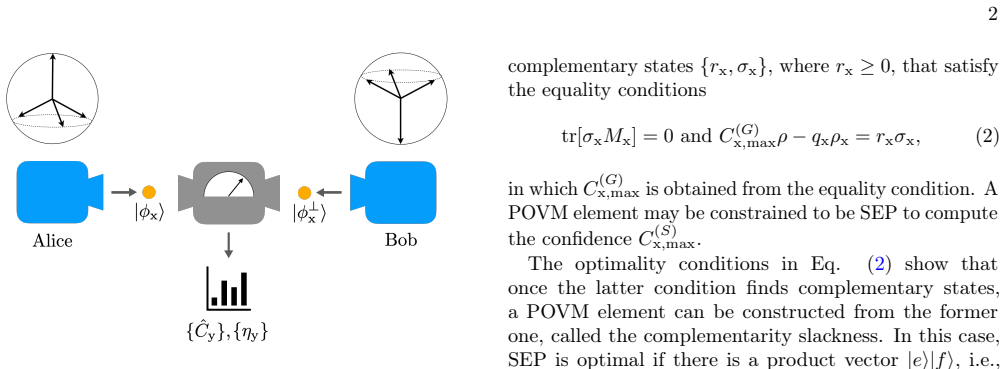
In this work, we investigate maximum-confidence discrimination, which encompasses minimum-error and unambiguous discrimination, for ensembles of separable states by considering global and separable measurements. We demonstrate that global measurements outperform separable ones, thereby establishing nonlocality without entanglement (NLWE) in terms of confidence in a detection event, a fine-grained state-identification strategy that maximizes the probability of a correct guess given a measurement outcome. Conversely, verifying achievable confidence in measurement outcomes can certify global measurements, namely, semi-device-independent certification of NLWE. Our results make it feasible to experimentally demonstrate NLWE using present-day quantum measurement devices, even with non-unit detection efficiencies, since maximum-confidence measurements rely only on detected measurement outcomes.
Editorial analysis
A structured set of objections, weighed in public.
Referee Report
Summary. The paper investigates maximum-confidence discrimination of ensembles of separable states, showing that global measurements can strictly outperform separable measurements in the achievable confidence for correctly guessing the state given a detection outcome. This establishes nonlocality without entanglement (NLWE) in a fine-grained, confidence-based sense. The work further develops a semi-device-independent certification protocol in which an observed confidence exceeding the separable bound certifies the use of global measurements, with the protocol conditioned only on detected events to remain valid under non-unit detection efficiency.
Significance. If the explicit ensemble constructions and derived bounds hold, the result supplies a concrete, experimentally realizable route to demonstrating and certifying NLWE that does not require entangled states or full device characterization. The approach is compatible with current quantum optics hardware and avoids post-selection bias by conditioning exclusively on registered clicks. These features address a practical barrier in the NLWE literature and provide falsifiable, quantitative predictions for the confidence gap.
minor comments (3)
- Abstract: the claim of a performance gap is stated without any numerical values, explicit ensemble, or quantitative comparison; adding one concrete example (e.g., the achieved confidences for a two-qubit ensemble) would make the central result immediately verifiable from the abstract.
- The notation for the maximum-confidence functional and the separable bound should be cross-referenced to the general definitions introduced in the opening sections to avoid ambiguity when the protocol is applied to new ensembles.
- Figure captions and axis labels would benefit from explicit mention of the conditioning on detected events, reinforcing that the plotted quantities are free of post-selection assumptions.
Simulated Author's Rebuttal
We thank the referee for the positive assessment of our work on maximum-confidence discrimination of separable states and the semi-device-independent certification of nonlocality without entanglement. The recommendation for minor revision is noted. No major comments were provided in the report, so we have no specific points requiring response or revision.
Circularity Check
No significant circularity
full rationale
The derivation constructs explicit ensembles of separable states, computes the maximum-confidence values achievable by global versus separable measurements directly from the state definitions and measurement operators, and obtains the certification bound by comparing the observed conditional probability against that separable upper bound. No step defines a quantity in terms of the target result, renames a fitted parameter as a prediction, or relies on a self-citation chain for a uniqueness theorem or ansatz. The protocol conditions only on detected events and remains independent of the final certification claim.
Axiom & Free-Parameter Ledger
axioms (1)
- standard math Quantum states and measurements obey the standard postulates of quantum mechanics, including the distinction between global and separable operations.
Reference graph
Works this paper leans on
-
[1]
It turns out thatCx,max = ∥√ρ−1qxρx √ρ−1∥∞ with an operator norm ∥ · ∥∞; hence, an MCM can be generally realized by rank-one POVM elements
or formulated as a semidefinite program (SDP) [25]. It turns out thatCx,max = ∥√ρ−1qxρx √ρ−1∥∞ with an operator norm ∥ · ∥∞; hence, an MCM can be generally realized by rank-one POVM elements. Measurements in Eq. (1) can be constrained with GLOBAL or SEP. LetC(G) x,max denote a confidence with measurements in GLOBAL, and C(S) x,max with measure- ments in S...
2023
-
[2]
Horodecki, P
R. Horodecki, P. Horodecki, M. Horodecki, and K. Horo- decki, Rev. Mod. Phys.81, 865 (2009)
2009
-
[3]
Curty, M
M. Curty, M. Lewenstein, and N. Lütkenhaus, Phys. Rev. Lett.92, 217903 (2004)
2004
-
[4]
Acín and N
A. Acín and N. Gisin, Phys. Rev. Lett.94, 020501 (2005)
2005
-
[5]
H. M. Wiseman, S. J. Jones, and A. C. Doherty, Phys. Rev. Lett.98, 140402 (2007)
2007
-
[6]
Branciard, E
C. Branciard, E. G. Cavalcanti, S. P. Walborn, V. Scarani, and H. M. Wiseman, Phys. Rev. A85, 010301(R) (2012)
2012
-
[7]
Zhang, W
T. Zhang, W. Zhang, J.-T. Qiu, L. Huang, X. Yuan, and Q.-M. Ding, Phys. Rev. Lett.136, 090201 (2026)
2026
-
[8]
A. Acín, N. Brunner, N. Gisin, S. Massar, S. Pironio, and V. Scarani, Phys. Rev. Lett.98, 230501 (2007)
2007
-
[9]
C. H. Bennett, D. P. DiVincenzo, C. A. Fuchs, T. Mor, E. Rains, P. W. Shor, J. A. Smolin, and W. K. Wootters, Phys. Rev. A59, 1070 (1999)
1999
-
[10]
Ha and J
D. Ha and J. S. Kim, Journal of Physics A: Mathematical and Theoretical56, 205303 (2023)
2023
-
[11]
Šupić and N
I. Šupić and N. Brunner, Phys. Rev. A107, 062220 (2023)
2023
-
[12]
Peres and W
A. Peres and W. K. Wootters, Phys. Rev. Lett.66, 1119 (1991)
1991
-
[13]
Chitambar and M.-H
E. Chitambar and M.-H. Hsieh, Phys. Rev. A88, 020302(R) (2013)
2013
-
[14]
Ha and Y
D. Ha and Y. Kwon, npj Quantum Information7, 81 (2021)
2021
-
[15]
Chitambar, R
E. Chitambar, R. Duan, and M.-H. Hsieh, IEEE Transac- tions on Information Theory60, 1549 (2014)
2014
-
[16]
C. W. Helstrom, Information and Control10, 254 (1967)
1967
-
[17]
Dieks, Physics Letters A126, 303 (1988)
D. Dieks, Physics Letters A126, 303 (1988)
1988
-
[18]
S. M. Barnett and S. Croke, Advances in Optics and Photonics1, 238 (2009). 7
2009
-
[19]
J. A. Bergou, Journal of Modern Optics57, 160 (2010)
2010
-
[20]
Bae and L.-C
J. Bae and L.-C. Kwek, Journal of Physics A: Mathemat- ical and Theoretical48, 083001 (2015)
2015
-
[21]
P. H. Eberhard, Phys. Rev. A47, R747(R) (1993)
1993
-
[22]
Brunner, N
N. Brunner, N. Gisin, V. Scarani, and C. Simon, Phys. Rev. Lett.98, 220403 (2007)
2007
-
[23]
Croke, E
S. Croke, E. Andersson, S. M. Barnett, C. R. Gilson, and J. Jeffers, Phys. Rev. Lett.96, 070401 (2006)
2006
-
[24]
S. M. Barnett, J. Jeffers, D. Pegg, O. Jedrkiewicz, and R. Loudon, in2000 International Quantum Electronics Conference(Optica Publishing Group, 2000) p. QWC1
2000
-
[25]
S. M. Barnett, J. Jeffers, and D. T. Pegg, Symmetry13, 10.3390/sym13040586 (2021)
-
[26]
H. Lee, K. Flatt, C. Roch i Carceller, J. B. Brask, and J. Bae, Phys. Rev. A106, 032422 (2022)
2022
-
[27]
Chitambar, D
E. Chitambar, D. Leung, L. Mančinska, M. Ozols, and A. Winter, Communications in Mathematical Physics328, 303 (2014)
2014
-
[28]
Flatt, H
K. Flatt, H. Lee, C. R. I. Carceller, J. B. Brask, and J. Bae, PRX Quantum3, 030337 (2022)
2022
-
[29]
Gisin and S
N. Gisin and S. Popescu, Phys. Rev. Lett.83, 432 (1999)
1999
-
[30]
I. D. Ivanovic, Physics Letters A123, 257 (1987)
1987
-
[31]
Peres, Physics Letters A128, 19 (1988)
A. Peres, Physics Letters A128, 19 (1988)
1988
-
[32]
J.Pauwels, A.Pozas-Kerstjens, F.DelSanto,andN.Gisin, Phys. Rev. X15, 021013 (2025)
2025
-
[33]
Gisin, Entropy21, 10.3390/e21030325 (2019)
N. Gisin, Entropy21, 10.3390/e21030325 (2019). APPENDIX Appendix A: Structure of maximum-confidence measurements In this Appendix, we briefly review the structure of maximum-confidence measurements (MCMs). For an ensemble of states{qx, ρx}n x=1, where qx denotesa priori probability, an MCM is obtained from the optimization problem, Cx,max = max Mx≥0 qxtr[...
-
[34]
We have solved the certifiable maximum confidence for the low outcome rate region, ˆC(G) x,max = 1,forη x ∈(0,1/5] Case 2:0< λ <4 Let us consider the second case,0< λ < 4
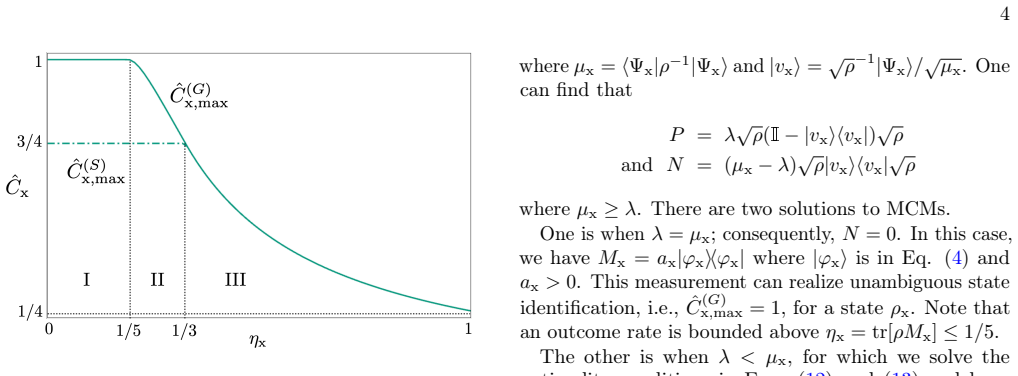
In this region, the certifiable maximum confidence by GLOBAL measurement is1. We have solved the certifiable maximum confidence for the low outcome rate region, ˆC(G) x,max = 1,forη x ∈(0,1/5] Case 2:0< λ <4 Let us consider the second case,0< λ < 4. Note that the eigenvalues νi(λ)are monotonically increasing in λ for all i. We find that, when0 < λ < 4, ν1...
discussion (0)
Sign in with ORCID, Apple, or X to comment. Anyone can read and Pith papers without signing in.