3D-UIR: 3D Gaussian for Underwater 3D Scene Reconstruction via Physics Based Appearance-Medium Decoupling
Pith reviewed 2026-05-19 12:49 UTC · model grok-4.3
The pith
A physics-based 3D Gaussian framework decouples underwater object appearance from medium scattering and absorption to enable accurate scene reconstruction and novel view synthesis.
A machine-rendered reading of the paper's core claim, the machinery that carries it, and where it could break.
Core claim
By integrating appearance and medium modeling components via an underwater imaging model, the approach achieves both high-quality novel view synthesis and physically accurate scene restoration through tailored Gaussian modeling that disentangles object appearance from water medium effects, with appearance embeddings providing explicit representations for backscatter and attenuation alongside a depth-guided optimization strategy using pseudo-depth maps, regularization, and scale penalties.
What carries the argument
Tailored Gaussian modeling with appearance embeddings that serve as explicit medium representations for backscatter and attenuation, integrated through an underwater imaging model and supported by depth-guided optimization.
Load-bearing premise
The pseudo-depth maps obtained from input images supply reliable enough signals to optimize geometry even though scattering and absorption usually impair depth estimation underwater.
What would settle it
Observing persistent color distortions or geometric errors in reconstructions when tested against controlled underwater scenes with independently measured water properties and known ground-truth object appearances would show the decoupling fails to resolve the medium interference.
Figures



read the original abstract
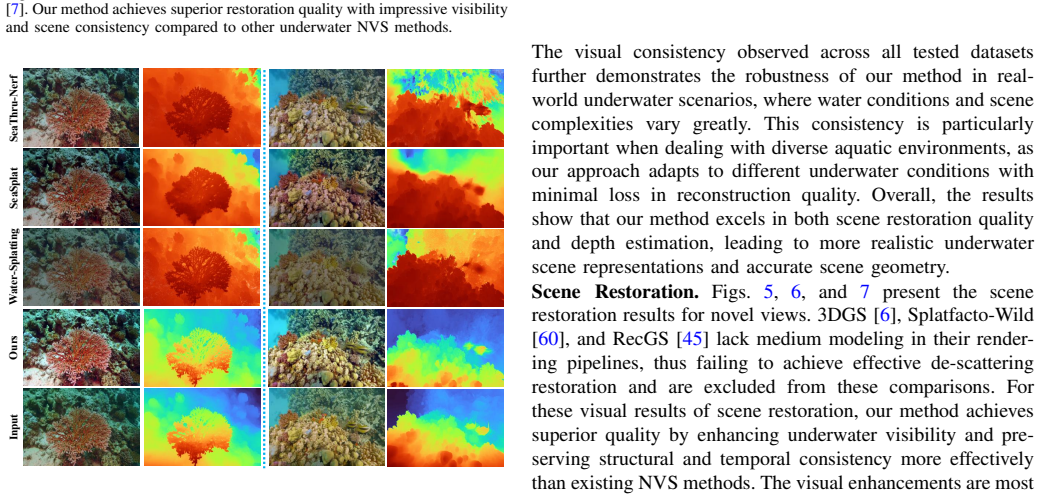
Novel view synthesis for underwater scene reconstruction presents unique challenges due to complex light-media interactions. Optical scattering and absorption in water body bring inhomogeneous medium attenuation interference that disrupts conventional volume rendering assumptions of uniform propagation medium. While 3D Gaussian Splatting (3DGS) offers real-time rendering capabilities, it struggles with underwater inhomogeneous environments where scattering media introduces artifacts and inconsistent appearance. In this study, we propose a physics-based framework that disentangles object appearance from water medium effects through tailored Gaussian modeling. Our approach introduces appearance embeddings, which are explicit medium representations for backscatter and attenuation, enhancing scene consistency. In addition, we propose a depth-guided optimization strategy that leverages pseudo-depth maps as supervision with depth regularization and scale penalty terms to improve geometric fidelity. By integrating the proposed appearance and medium modeling components via an underwater imaging model, our approach achieves both high-quality novel view synthesis and physically accurate scene restoration. Experiments demonstrate our significant improvements in rendering quality and restoration accuracy over existing methods. The project page is available at https://bilityniu.github.io/3D-UIR.
Editorial analysis
A structured set of objections, weighed in public.
Referee Report
Summary. The paper proposes 3D-UIR, a physics-based 3D Gaussian Splatting framework for underwater scene reconstruction that disentangles object appearance from water medium effects. It introduces appearance embeddings and explicit medium representations for backscatter and attenuation, integrated through an underwater imaging model. A depth-guided optimization strategy leverages pseudo-depth maps with depth regularization and scale penalty terms to improve geometric fidelity. The central claim is that this yields high-quality novel view synthesis and physically accurate scene restoration, with experiments demonstrating significant improvements over prior methods.
Significance. If validated, the work could meaningfully advance real-time 3D reconstruction in scattering media by extending 3DGS with explicit physics-based decoupling, which addresses a clear limitation of standard volume rendering assumptions in inhomogeneous underwater environments. The combination of appearance-medium modeling and depth supervision has potential utility for applications such as underwater robotics and marine mapping. Strengths include the real-time rendering capability retained from 3DGS and the attempt at physically grounded restoration; however, the overall significance hinges on whether the depth supervision assumption holds and whether quantitative gains are demonstrated.
major comments (2)
- [Depth-guided optimization strategy] Depth-guided optimization strategy: The depth regularization and scale penalty terms are introduced to leverage pseudo-depth maps as supervision for geometric optimization of the Gaussians. This assumption is load-bearing for the central claim because scattering and absorption in water typically degrade depth estimation; without ablations isolating depth-map accuracy or comparisons against underwater-specific depth ground truth, errors may propagate into the 3DGS parameters and thereby affect both novel-view quality and the claimed physical restoration accuracy.
- [Experiments] Experiments section: The abstract states that the approach 'achieves both high-quality novel view synthesis and physically accurate scene restoration' and 'demonstrate[s] our significant improvements in rendering quality and restoration accuracy,' yet no quantitative metrics (PSNR, SSIM, LPIPS, or restoration error measures), ablation tables, or ground-truth comparisons are referenced. This absence makes it impossible to assess whether the proposed components deliver the claimed gains or whether the improvements are incremental rather than substantial.
minor comments (2)
- [Abstract] The abstract mentions a project page but does not indicate whether code, models, or datasets will be released; adding this information would aid reproducibility.
- [Method] Notation for the appearance embeddings and medium parameters should be defined more explicitly when first introduced to avoid ambiguity when readers cross-reference the underwater imaging model equations.
Simulated Author's Rebuttal
We thank the referee for the constructive and detailed feedback on our manuscript. We address each major comment point by point below, providing clarifications on our methodology and experiments while indicating where revisions will strengthen the presentation.
read point-by-point responses
-
Referee: [Depth-guided optimization strategy] Depth-guided optimization strategy: The depth regularization and scale penalty terms are introduced to leverage pseudo-depth maps as supervision for geometric optimization of the Gaussians. This assumption is load-bearing for the central claim because scattering and absorption in water typically degrade depth estimation; without ablations isolating depth-map accuracy or comparisons against underwater-specific depth ground truth, errors may propagate into the 3DGS parameters and thereby affect both novel-view quality and the claimed physical restoration accuracy.
Authors: We thank the referee for this important observation. Our depth-guided optimization employs pseudo-depth maps from an underwater-adapted estimator, with the regularization and scale penalty terms explicitly designed to reduce sensitivity to depth inaccuracies caused by scattering. The manuscript includes ablations that quantify the contribution of these terms to geometric consistency and rendering quality. We agree that further isolating the impact of depth-map accuracy would be valuable; however, true underwater depth ground truth is rarely available due to the medium itself. In revision we will expand the discussion of error propagation and add any feasible comparisons using existing approximate-depth underwater datasets. revision: partial
-
Referee: [Experiments] Experiments section: The abstract states that the approach 'achieves both high-quality novel view synthesis and physically accurate scene restoration' and 'demonstrate[s] our significant improvements in rendering quality and restoration accuracy,' yet no quantitative metrics (PSNR, SSIM, LPIPS, or restoration error measures), ablation tables, or ground-truth comparisons are referenced. This absence makes it impossible to assess whether the proposed components deliver the claimed gains or whether the improvements are incremental rather than substantial.
Authors: We apologize for insufficient textual references to the quantitative results. The experiments section reports PSNR, SSIM, and LPIPS on multiple real underwater scenes for novel-view synthesis, together with restoration accuracy metrics against clear-image references where obtainable. Ablation tables for the appearance embeddings, medium representations, and depth-guided components are also present. In the revised manuscript we will explicitly cite these metrics and tables in the abstract and main text to make the quantitative support for our claims immediately clear. revision: yes
Circularity Check
No significant circularity in the derivation chain
full rationale
The paper introduces independent modeling additions (appearance embeddings, explicit medium representations for backscatter/attenuation, and depth regularization/scale penalty terms leveraging pseudo-depth maps) integrated via an underwater imaging model on top of 3DGS. No equations, self-definitions, fitted inputs renamed as predictions, or load-bearing self-citations are identifiable in the provided text that would reduce any claimed prediction or result to the inputs by construction. The central claims rest on these new components and the imaging model rather than tautological redefinitions or imported uniqueness theorems, rendering the derivation self-contained.
Axiom & Free-Parameter Ledger
Lean theorems connected to this paper
-
IndisputableMonolith/Cost/FunctionalEquation.leanwashburn_uniqueness_aczel unclear?
unclearRelation between the paper passage and the cited Recognition theorem.
Our approach introduces appearance embeddings, which are explicit medium representations for backscatter and attenuation... depth-guided optimization strategy that leverages pseudo-depth maps as supervision with depth regularization and scale penalty terms
-
IndisputableMonolith/Foundation/RealityFromDistinction.leanreality_from_one_distinction unclear?
unclearRelation between the paper passage and the cited Recognition theorem.
I = J · e^{-β_D · z} + B_∞ · (1 - e^{-β_B · z})
What do these tags mean?
- matches
- The paper's claim is directly supported by a theorem in the formal canon.
- supports
- The theorem supports part of the paper's argument, but the paper may add assumptions or extra steps.
- extends
- The paper goes beyond the formal theorem; the theorem is a base layer rather than the whole result.
- uses
- The paper appears to rely on the theorem as machinery.
- contradicts
- The paper's claim conflicts with a theorem or certificate in the canon.
- unclear
- Pith found a possible connection, but the passage is too broad, indirect, or ambiguous to say the theorem truly supports the claim.
Reference graph
Works this paper leans on
-
[1]
Atlantis: Enabling underwater depth estimation with stable diffusion,
F. Zhang, S. You, Y . Li, and Y . Fu, “Atlantis: Enabling underwater depth estimation with stable diffusion,” inProc. IEEE Conf. Comput. Vis. Pattern Recog., Jun. 2024, pp. 11 852–11 861
work page 2024
-
[2]
A novel underwater detection method for ambiguous object finding via distraction mining,
J. Yuan, Z. Cai, and W. Cao, “A novel underwater detection method for ambiguous object finding via distraction mining,”IEEE Trans. Ind. Inform., vol. 20, no. 7, pp. 9215–9224, Apr. 2024
work page 2024
-
[3]
Spatial residual for underwater object detection,
J. Zhou, Z. He, D. Zhang, S. Liu, X. Fu, and X. Li, “Spatial residual for underwater object detection,”IEEE Trans. Pattern Anal. Mach. Intell., vol. 47, no. 6, pp. 4996–5013, Mar. 2025
work page 2025
-
[4]
M. Yuval and T. Treibitz, “Releasing a dataset of 3d models of artificial reefs from the northern red-sea for 3d printing and virtual reality applications,”Remote Sens. Appl. Soc. Environ., vol. 36, p. 101305, Nov. 2024. JOURNAL OF LATEX CLASS FILES, VOL. 14, NO. 8, AUGUST 2021 12
work page 2024
-
[5]
Real-time dense 3d mapping of underwater environments,
W. Wang, B. Joshi, N. Burgdorfer, K. Batsosc, A. Q. Lid, P. Mordo- haia, and I. Rekleitisb, “Real-time dense 3d mapping of underwater environments,” inProc. IEEE Int. Conf. Robot. Autom., Jul. 2023, pp. 5184–5191
work page 2023
-
[6]
3D gaussian splatting for real-time radiance field rendering,
B. Kerbl, G. Kopanas, T. Leimk ¨uhler, and G. Drettakis, “3D gaussian splatting for real-time radiance field rendering,”ACM Trans. Graph., vol. 42, no. 4, pp. 1–14, Jul. 2023
work page 2023
-
[7]
SeaThru-NeRF: Neural radiance fields in scattering media,
D. Levy, A. Peleg, N. Pearl, D. Rosenbaum, D. Akkaynak, S. Korman, and T. Treibitz, “SeaThru-NeRF: Neural radiance fields in scattering media,” inProc. IEEE Conf. Comput. Vis. Pattern Recog., Jun. 2023, pp. 56–65
work page 2023
-
[8]
Computer modeling and the design of optimal underwater imaging systems,
J. S. Jaffe, “Computer modeling and the design of optimal underwater imaging systems,”IEEE J. Ocean. Eng., vol. 15, no. 2, pp. 101–111, Apr. 1990
work page 1990
-
[9]
A computer model for underwater camera systems,
B. McGlamery, “A computer model for underwater camera systems,” in Proc. SPIE, vol. 208, Jan. 1979, pp. 221–231
work page 1979
-
[10]
What is the space of attenuation coefficients in underwater computer vision?
D. Akkaynak, T. Treibitz, T. Shlesinger, Y . Loya, R. Tamir, and D. Iluz, “What is the space of attenuation coefficients in underwater computer vision?” inProc. IEEE Conf. Comput. Vis. Pattern Recog., Jul. 2017
work page 2017
-
[11]
DCGF: Diffusion-color-guided frame- work for underwater image enhancement,
Y . Zhang, J. Yuan, and Z. Cai, “DCGF: Diffusion-color-guided frame- work for underwater image enhancement,”IEEE Trans. Geosci. Remote Sens., vol. 63, pp. 1–12, 2025
work page 2025
-
[12]
NeRF: Representing scenes as neural radiance fields for view synthesis,
B. Mildenhall, P. P. Srinivasan, M. Tancik, J. T. Barron, R. Ramamoorthi, and R. Ng, “NeRF: Representing scenes as neural radiance fields for view synthesis,” inProc. Eur . Conf. Comput. Vis., Nov. 2020
work page 2020
-
[13]
DehazeNeRF: Multi-image haze removal and 3d shape reconstruction using neural radiance fields,
W.-T. Chen, W. Yifan, S.-Y . Kuo, and G. Wetzstein, “DehazeNeRF: Multi-image haze removal and 3d shape reconstruction using neural radiance fields,” inProc. Int. Conf. 3D Vis., Jun. 2024, pp. 247–256
work page 2024
-
[14]
What is the space of attenuation coefficients in underwater computer vision?
D. Akkaynak, T. Treibitz, T. Shlesinger, Y . Loya, R. Tamir, and D. Iluz, “What is the space of attenuation coefficients in underwater computer vision?” inProc. IEEE Conf. Comput. Vis. Pattern Recognit, Jul. 2017, pp. 568–577
work page 2017
-
[15]
Sea-Thru: A method for removing water from underwater images,
D. Akkaynak and T. Treibitz, “Sea-Thru: A method for removing water from underwater images,” inProc. IEEE Conf. Comput. Vis. Pattern Recog., Jun. 2019
work page 2019
-
[16]
Nerf in the wild: Neural radiance fields for unconstrained photo collections,
R. Martin-Brualla, N. Radwan, M. S. M. Sajjadi, J. T. Barron, A. Doso- vitskiy, and D. Duckworth, “Nerf in the wild: Neural radiance fields for unconstrained photo collections,” inProc. IEEE Conf. Comput. Vis. Pattern Recog., Jun. 2021, pp. 7210–7219
work page 2021
-
[17]
Deblurring 3d gaussian splatting,
B. Lee, H. Lee, X. Sun, U. Ali, and E. Park, “Deblurring 3d gaussian splatting,” inProc. Eur . Conf. Comput. Vis., Jun. 2024
work page 2024
-
[18]
Watersplatting: Fast underwater 3d scene reconstruction using gaussian splatting,
H. Li, W. Song, T. Xu, A. Elsig, and J. Kulhanek, “Watersplatting: Fast underwater 3d scene reconstruction using gaussian splatting,” inProc. Int. Conf. 3D Vis., 2025
work page 2025
-
[19]
D. Yang, J. J. Leonard, and Y . Girdhar, “SeaSplat: Representing un- derwater scenes with 3d gaussian splatting and a physically grounded image formation model,” inProc. IEEE Int. Conf. Robot. Autom., 2025
work page 2025
-
[20]
Mip-NeRF: A multiscale representation for anti- aliasing neural radiance fields,
J. T. Barron, B. Mildenhall, M. Tancik, P. Hedman, R. Martin-Brualla, and P. P. Srinivasan, “Mip-NeRF: A multiscale representation for anti- aliasing neural radiance fields,” inProc. Int. Conf. Comput. Vis., Oct. 2021, pp. 5855–5864
work page 2021
-
[21]
Instant neural graphics primitives with a multiresolution hash encoding,
T. M ¨uller, A. Evans, C. Schied, and A. Keller, “Instant neural graphics primitives with a multiresolution hash encoding,”ACM Trans. Graph., vol. 41, no. 4, Jul. 2022
work page 2022
-
[22]
Mip-Splatting: Alias-free 3d gaussian splatting,
Z. Yu, A. Chen, B. Huang, T. Sattler, and A. Geiger, “Mip-Splatting: Alias-free 3d gaussian splatting,” inProc. IEEE Conf. Comput. Vis. Pattern Recog., June 2024, pp. 19 447–19 456
work page 2024
-
[23]
Absgs: Recovering fine details in 3d gaussian splatting,
Z. Ye, W. Li, S. Liu, P. Qiao, and Y . Dou, “Absgs: Recovering fine details in 3d gaussian splatting,” inProc. ACM Int. Conf. Multimedia, 2024
work page 2024
-
[24]
Nerf in the dark: High dynamic range view synthesis from noisy raw images,
B. Mildenhall, P. Hedman, R. Martin-Brualla, P. P. Srinivasan, and J. T. Barron, “Nerf in the dark: High dynamic range view synthesis from noisy raw images,” inProc. IEEE Conf. Comput. Vis. Pattern Recog., Jun. 2022, pp. 16 190–16 199
work page 2022
-
[25]
HDR-GS: Efficient high dynamic range novel view synthesis at 1000x speed via gaussian splatting,
Y . Cai, Z. Xiao, Y . Liang, M. Qin, Y . Zhang, X. Yang, Y . Liu, and A. Yuille, “HDR-GS: Efficient high dynamic range novel view synthesis at 1000x speed via gaussian splatting,” inProc. Adv. Neural Inform. Process. Syst., 2024
work page 2024
-
[26]
Lighting every darkness with 3dgs: Fast training and real-time render- ing for hdr view synthesis,
X. Jin, P. Jiao, Z.-P. Duan, X. Yang, C.-L. Guo, B. Ren, and C. Li, “Lighting every darkness with 3dgs: Fast training and real-time render- ing for hdr view synthesis,” inProc. Adv. Neural Inform. Process. Syst., 2024
work page 2024
-
[27]
SW AG: Splatting in the wild images with appearance-conditioned gaussians,
H. Dahmani, M. Bennehar, N. Piasco, L. Rold ˜ao, and D. Tsishkou, “SW AG: Splatting in the wild images with appearance-conditioned gaussians,” inProc. Eur . Conf. Comput. Vis., Oct 2024, pp. 325–340
work page 2024
-
[28]
Gaussian in the wild: 3d gaussian splatting for unconstrained image collections,
D. Zhang, C. Wang, W. Wang, P. Li, M. Qin, and H. Wang, “Gaussian in the wild: 3d gaussian splatting for unconstrained image collections,” inProc. Eur . Conf. Comput. Vis., Jun. 2024, pp. 341–359
work page 2024
-
[29]
Underwater image restoration based on image blurriness and light absorption,
Y .-T. Peng and P. C. Cosman, “Underwater image restoration based on image blurriness and light absorption,”IEEE Trans. Image Process., vol. 26, no. 4, pp. 1579–1594, 2017
work page 2017
-
[30]
Generalization of the dark channel prior for single image restoration,
Y .-T. Peng, K. Cao, and P. C. Cosman, “Generalization of the dark channel prior for single image restoration,”IEEE Trans. Image Process., vol. 27, no. 6, pp. 2856–2868, Feb. 2018
work page 2018
-
[31]
TEBCF: Real-world underwater image texture enhancement model based on blurriness and color fusion,
J. Yuan, Z. Cai, and W. Cao, “TEBCF: Real-world underwater image texture enhancement model based on blurriness and color fusion,”IEEE Trans. Geosci. Remote Sens., vol. 60, pp. 1–15, Oct. 2022
work page 2022
-
[32]
Underwater image enhancement via medium transmission-guided multi-color space embedding,
C. Li, S. Anwar, J. Hou, R. Cong, C. Guo, and W. Ren, “Underwater image enhancement via medium transmission-guided multi-color space embedding,”IEEE Trans. Image Process., vol. 30, pp. 4985–5000, May 2021
work page 2021
-
[33]
Domain adaptation for underwater image enhancement,
Z. Wang, L. Shen, M. Xu, M. Yu, K. Wang, and Y . Lin, “Domain adaptation for underwater image enhancement,”IEEE Trans. Image Process., vol. 32, pp. 1442–1457, Feb. 2023
work page 2023
-
[34]
Deep color compensation for generalized underwater image enhancement,
Y . Rao, W. Liu, K. Li, H. Fan, S. Wang, and J. Dong, “Deep color compensation for generalized underwater image enhancement,”IEEE Trans. Circuits Syst. Video Technol., vol. 34, no. 4, pp. 2577–2590, Apr. 2024
work page 2024
-
[35]
Uierl: Internal-external repre- sentation learning network for underwater image enhancement,
Z. Wang, L. Shen, Y . Yu, and Y . Hui, “Uierl: Internal-external repre- sentation learning network for underwater image enhancement,”IEEE Trans. Multimedia, vol. 26, pp. 9252–9267, Apr. 2024
work page 2024
-
[36]
Underwater image enhancement via wavelet decomposition fusion of advantage contrast,
W. Zhang, Q. Liu, H. Lu, J. Wang, and J. Liang, “Underwater image enhancement via wavelet decomposition fusion of advantage contrast,” IEEE Trans. Circuits Syst. Video Technol., pp. 1–1, 2025
work page 2025
-
[37]
A revised underwater image formation model,
D. Akkaynak and T. Treibitz, “A revised underwater image formation model,” inProc. IEEE Conf. Comput. Vis. Pattern Recog., Jun. 2018
work page 2018
-
[38]
GUDCP: Generaliza- tion of underwater dark channel prior for underwater image restoration,
Z. Liang, X. Ding, Y . Wang, X. Yan, and X. Fu, “GUDCP: Generaliza- tion of underwater dark channel prior for underwater image restoration,” IEEE Trans. Circuits Syst. Video Technol., vol. 32, no. 7, pp. 4879–4884, Jul. 2022
work page 2022
-
[39]
PUGAN: Physical model-guided underwater image en- hancement using gan with dual-discriminators,
R. Cong, W. Yang, W. Zhang, C. Li, C.-L. Guo, Q. Huang, and S. Kwong, “PUGAN: Physical model-guided underwater image en- hancement using gan with dual-discriminators,”IEEE Trans. Image Process., vol. 32, pp. 4472–4485, Jun. 2023
work page 2023
-
[40]
Hybrur: A hybrid physical- neural solution for unsupervised underwater image restoration,
S. Yan, X. Chen, Z. Wu, M. Tan, and J. Yu, “Hybrur: A hybrid physical- neural solution for unsupervised underwater image restoration,”IEEE Trans. Image Process., vol. 32, pp. 5004–5016, Sep. 2023
work page 2023
-
[41]
Osmosis: Rgbd diffusion prior for underwater image restoration,
O. B. Nathan, D. Levy, T. Treibitz, and D. Rosenbaum, “Osmosis: Rgbd diffusion prior for underwater image restoration,” inProc. Eur . Conf. Comput. Vis., Oct. 2024, pp. 302–319
work page 2024
-
[42]
Underwater image restoration via polymorphic large kernel cnns,
X. Guo, Y . Dong, X. Chen, W. Chen, Z. Li, F. Zheng, and C.-M. Pun, “Underwater image restoration via polymorphic large kernel cnns,” in Proc. IEEE Int. Conf. Acoust. Speech Signal Process., 2025, pp. 1–5
work page 2025
-
[43]
SUCRe: Leveraging scene structure for underwater color restoration,
C. Boittiaux, R. Marxer, C. Dune, A. Arnaubec, M. Ferrera, and V . Hugel, “SUCRe: Leveraging scene structure for underwater color restoration,” inProc. Int. Conf. 3D Vis., 2024
work page 2024
-
[44]
WaterHE- NeRF: Water-ray matching neural radiance fields for underwater scene reconstruction,
J. Zhou, T. Liang, D. Zhang, S. Liu, J. Wang, and E. Q. Wu, “WaterHE- NeRF: Water-ray matching neural radiance fields for underwater scene reconstruction,”Inf. Fusion, p. 102770, Mar. 2024
work page 2024
-
[45]
Recgs: Removing water caustic with recurrent gaussian splatting,
T. Zhang, W. Zhi, B. Meyers, N. Durrant, K. Huang, J. Mangelson, C. Barbalata, and M. Johnson-Roberson, “Recgs: Removing water caustic with recurrent gaussian splatting,”IEEE Robot. Autom. Lett., vol. 10, no. 1, pp. 668–675, Jan. 2025
work page 2025
-
[46]
Gaussian Splashing: Direct volumetric rendering underwater,
N. Mualem, R. Amoyal, O. Freifeld, and D. Akkaynak, “Gaussian Splashing: Direct volumetric rendering underwater,” arXiv preprint arXiv:2411.19588, 2024. [Online]. Available: https://arxiv.org/abs/2411. 19588
-
[47]
UW-GS: Distractor-aware 3d gaussian splatting for enhanced underwater scene reconstruction,
H. Wang, N. Anantrasirichai, F. Zhang, and D. Bull, “UW-GS: Distractor-aware 3d gaussian splatting for enhanced underwater scene reconstruction,” inProc. IEEE Winter Conf. Appl. Comput. Vis., Feb. 2025
work page 2025
-
[49]
Available: https://arxiv.org/abs/2411.00239
[Online]. Available: https://arxiv.org/abs/2411.00239
-
[50]
Structure-from-motion revisited,
J. L. Schonberger and J.-M. Frahm, “Structure-from-motion revisited,” inProc. IEEE Conf. Comput. Vis. Pattern Recog., Jun. 2016
work page 2016
-
[51]
Mini-Splatting: Representing scenes with a constrained number of gaussians,
G. Fang and B. Wang, “Mini-Splatting: Representing scenes with a constrained number of gaussians,” inProc. Eur . Conf. Comput. Vis., Oct. 2024
work page 2024
-
[52]
Scaffold-SLAM: Structured 3d gaussians for simultaneous localization and photorealistic mapping,
T. Wen, Z. Liu, B. Lu, and Y . Fang, “Scaffold-SLAM: Structured 3d gaussians for simultaneous localization and photorealistic mapping,” JOURNAL OF LATEX CLASS FILES, VOL. 14, NO. 8, AUGUST 2021 13 arXiv preprint arXiv:2501.05242, 2025. [Online]. Available: https: //arxiv.org/abs/2501.05242
-
[53]
WildGaussians: 3D gaussian splatting in the wild,
J. Kulhanek, S. Peng, Z. Kukelova, M. Pollefeys, and T. Sattler, “WildGaussians: 3D gaussian splatting in the wild,” inProc. Adv. Neural Inform. Process. Syst., 2024
work page 2024
-
[54]
S. Jamieson, J. P. How, and Y . Girdhar, “DeepSeeColor: Realtime adaptive color correction for autonomous underwater vehicles via deep learning methods,” inProc. IEEE Int. Conf. Robot. Autom., Jul. 2023, pp. 3095–3101
work page 2023
-
[55]
An underwater image vision enhancement algorithm based on contour bougie morphology,
J. Yuan, W. Cao, Z. Cai, and B. Su, “An underwater image vision enhancement algorithm based on contour bougie morphology,”IEEE Trans. Geosci. Remote Sens., vol. 59, no. 10, pp. 8117–8128, Oct. 2021
work page 2021
-
[56]
L. Yang, B. Kang, Z. Huang, Z. Zhao, X. Xu, J. Feng, and H. Zhao, “Depth anything v2,” inProc. Adv. Neural Inform. Process. Syst., vol. 37. Curran Associates, Inc., 2024, pp. 21 875–21 911
work page 2024
-
[57]
Neural underwater scene representation,
Y . Tang, C. Zhu, R. Wan, C. Xu, and B. Shi, “Neural underwater scene representation,” inProc. IEEE Conf. Comput. Vis. Pattern Recog., Jun. 2024, pp. 11 780–11 789
work page 2024
-
[58]
PGSR: Planar-based gaussian splatting for efficient and high-fidelity surface reconstruction,
D. Chen, H. Li, W. Ye, Y . Wang, W. Xie, S. Zhai, N. Wang, H. Liu, H. Bao, and G. Zhang, “PGSR: Planar-based gaussian splatting for efficient and high-fidelity surface reconstruction,”IEEE Trans. Vis. Comput. Graph., pp. 1–12, Nov. 2024
work page 2024
-
[59]
Mip-NeRF 360: Unbounded anti-aliased neural radiance fields,
J. T. Barron, B. Mildenhall, D. Verbin, P. P. Srinivasan, and P. Hedman, “Mip-NeRF 360: Unbounded anti-aliased neural radiance fields,” in Proc. IEEE Conf. Comput. Vis. Pattern Recog., Jun. 2022, pp. 5470– 5479
work page 2022
-
[60]
gsplat: An Open- Source Library for Gaussian Splatting,
V . Ye, R. Li, J. Kerr, M. Turkulainen, B. Yi, Z. Pan, O. Seiskari, J. Ye, J. Hu, M. Tancik, and A. Kanazawa, “gsplat: An open-source library for gaussian splatting,” arXiv preprint arXiv:2409.06765, 2024. [Online]. Available: https://arxiv.org/abs/2409.06765
-
[61]
Splatfacto-W: A nerfstudio implementation of gaussian splatting for unconstrained photo collections,
C. Xu, J. Kerr, and A. Kanazawa, “Splatfacto-W: A nerfstudio implementation of gaussian splatting for unconstrained photo collections,” arXiv preprint arXiv:2407.12306, 2024. [Online]. Available: https://arxiv.org/abs/2407.12306
-
[62]
Nerfstudio: A modular framework for neural radiance field develop- ment,
M. Tancik, E. Weber, E. Ng, R. Li, B. Yi, J. Kerr, T. Wang, A. Kristof- fersen, J. Austin, K. Salahi, A. Ahuja, D. McAllister, and A. Kanazawa, “Nerfstudio: A modular framework for neural radiance field develop- ment,” inProc. ACM SIGGR., 2023
work page 2023
discussion (0)
Sign in with ORCID, Apple, or X to comment. Anyone can read and Pith papers without signing in.