REVIEW 2 major objections 5 minor 50 references
EPIC-Fusion: Audio-Visual Temporal Binding for Egocentric Action Recognition
T0 review · 2 major / 5 minor · reviewed 2026-08-14 · deepseek-v4-flash
Pith's one-line read This paper claims that fusing RGB, optical flow, and audio at mid-level features within a temporal binding window, before any temporal aggregation, outperforms late fusion and sets state-of-the-art results on the EPIC-Kitchens egocentric…
desk verdict Solid multimodal fusion paper, but the claimed advantage of temporal binding over late fusion is confounded by joint training; needs a clean control. read the letter →
The pith
A machine-rendered reading of the paper's core claim, the machinery that carries it, and where it could break.
The reading
What carries the argument
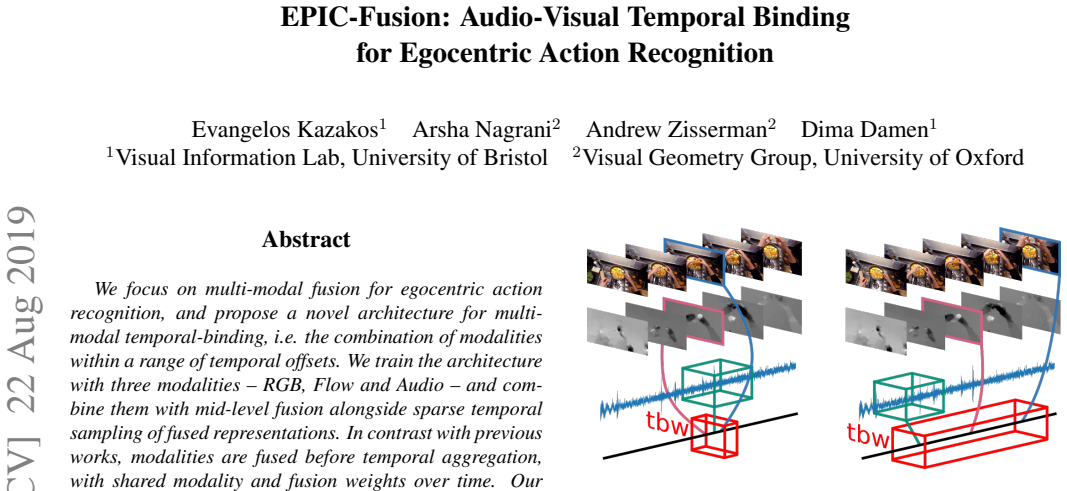
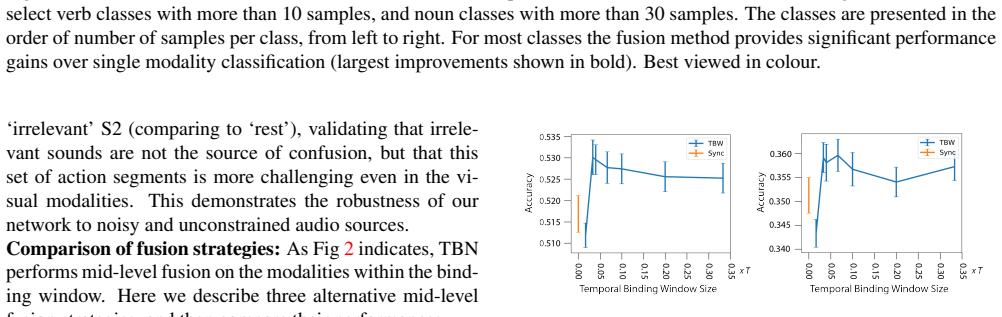
The load-bearing object is the Temporal Binding Window (TBW): a range of temporal offsets around each anchor sample within which the other modalities are selected. The network's innovation is to fuse before aggregation—mid-level features from the three streams are concatenated and mapped to a shared multimodal representation per window, and the same modality, fusion, and classification weights are reused across all temporal segments, so the model learns a single binding function rather than per-segment ones. At training the window is as wide as the whole action; at test the best width is around 120 to 180 milliseconds. The comparison to late fusion and to gating variants is what carries the argument that binding, not extra parameters, produces the gain.
What would settle it
Train the same architecture twice: once with near-synchronous sampling and once with the full-action window, then evaluate both at the optimal tight window; if the full-window model does not beat the near-synchronous one by the margin it reports over late fusion, the binding mechanism is not the cause.
Extended reading notes
Core claim
The paper's central claim is that a Temporal Binding Network—three modality-specific convnets whose mid-level features are concatenated and passed through a shared fusion layer before any temporal pooling—outperforms both individually trained streams and score-averaged late fusion on egocentric action recognition. The network samples one anchor RGB frame per segment and draws Flow and Audio samples uniformly from a window of width plus-or-minus b around it; weights are shared across temporal segments, and the segment-level predictions are averaged. With b set to the full action length during training and tested at much narrower widths, the single model reaches 64.75 top-1 verb accuracy on EPIC-Kitchens seen kitchens versus 55.49 for a late-fusion TSN with audio, and adding audio to RGB+Flow raises top-5 action accuracy by about five points on the seen split and four on the unseen split. The paper also claims that the resulting ensemble was state of the art on both seen and unseen test splits at the time of submission.
Load-bearing premise
During training, the non-visual samples are picked anywhere inside the whole action, while the test-time best window is only about a thirtieth of the action, so the method's success depends on loose random pairing transferring to tight pairing—and the paper does not train a model on the tight window to check this.
Editorial extensions
If this is right
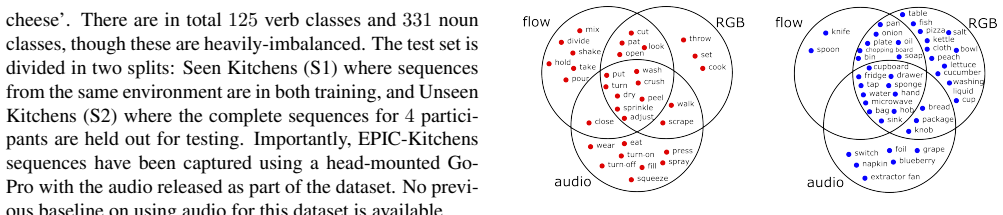
- Audio should be treated as a first-class modality for egocentric action recognition: on seen kitchens its top-1 verb accuracy alone is close to RGB, and it lifts the fused model's top-5 action accuracy by about five points on the seen split and four on the unseen split.
- Simple concatenation fusion outperforms context gating and gated multimodal units inside the same network, suggesting the binding window itself, rather than the fusion operator, is the main source of improvement.
- The gains are concentrated in rare classes: mean class accuracy for tail verbs improves by 63 percent under fusion versus 34 percent for the top 10 percent of classes, so the approach partially counteracts the dataset's heavy class imbalance.
- A single binding-window width is not required at test time: averaging predictions across several overlapping windows makes the model robust to window width, so it can be deployed without precise action-synchronization annotations.
Reading between the lines
- The wide training window is also a data-augmentation scheme; the paper does not isolate how much of the gain is temporal binding versus simply seeing many random temporal pairings, so a controlled comparison with a synchronously trained fusion model using the same random samples would settle it.
- Because the test-time optimum is an absolute time interval of roughly 120 to 180 milliseconds, the model may effectively learn a fixed perceptual integration window rather than an action-relative one; grouping test actions by duration and recomputing the optimal window would discriminate between these explanations.
- Audio opens a path to recognizing actions that occur outside the camera's field of view, as the paper's 'eat' example suggests, but the paper does not measure how often off-screen audio alone carries the classification; a per-class audio-only error analysis would quantify that.
Signed reviews
Editorial analysis
A structured set of objections, weighed in public.
Referee Report
Summary. The paper introduces a Temporal Binding Network (TBN) for egocentric action recognition from RGB, optical flow, and audio on EPIC-Kitchens. The key idea is to fuse modalities at a mid-level representation before temporally aggregating, within a temporal binding window (TBW): the video is split into K segments, RGB anchor frames are sampled, and Flow and Audio samples are drawn uniformly from a window of width ±b around each anchor; the three streams' BN-Inception features are concatenated and fed through shared fully connected layers to produce per-window verb and noun predictions, which are averaged. The network is trained end-to-end. The paper reports large gains over individual modalities and over a TSN-based late-fusion baseline with audio, analyzes fusion strategies (concatenation, context gating, gating fusion), studies TBW width effects, shows audio's complementary value per class, and reports state-of-the-art results on the EPIC-Kitchens public leaderboard at submission.
Significance. If the temporal-binding attribution is accepted, this is a strong contribution: it targets an under-explored temporal-asynchrony aspect of multimodal egocentric recognition, provides one of the first audio-visual egocentric action-recognition systems, uses an externally defined benchmark, includes per-class and tail-class analyses, tests robustness to irrelevant audio, and releases code and models. The empirical evidence for the absolute performance of TBN is solid; the ablations of fusion mechanisms and single-modality strengths are informative. However, the central explanatory claim—that mid-level fusion within a TBW, rather than joint end-to-end training or random-sampling augmentation, is responsible for the gains over late fusion—is not yet isolated by the experiments as written.
major comments (2)
- [Section 4.2, Table 4] The comparison between TBN and 'Ours (TSN w. Audio)' changes two variables at once: fusion level (mid-level within segments vs late score averaging) and training protocol (jointly trained streams vs independently trained streams). The S1 top-1 action accuracy gap (34.80 vs 23.95) could therefore be due mainly to joint optimization rather than temporal binding. Please add a late-fusion control in which all three streams are trained jointly (e.g., TBN architecture with per-modality score aggregation, or TSN streams trained with a shared loss and end-to-end backpropagation) and a mid-level synchronous-fusion control (b≈0 during both training and testing) to separate the effects.
- [Section 4.2, 'The effect of TBW width'] The authors train with b ∈ {T/6, T/3, T} and report only 'little difference' without numbers, while the narrow windows that perform best at test time (b≈T/30 to T/20, Fig. 7) are never used during training. Since b=T means the auxiliary modalities are sampled from the entire action segment, the training procedure is a form of random cross-modal data augmentation; this alone, together with joint training, could explain the gains over late fusion without invoking temporally localized binding. Please report numeric results for all training widths and, ideally, train with b in the range that is optimal at inference (or with a width schedule) to demonstrate that the binding window matters during training and that training/test widths are consistent.
minor comments (5)
- [Section 4.1] The audio sampling rate is stated as '24000kHz'; this should be 24 kHz.
- [Section 4.2, Table 4] The ensemble of five TBNs is said to use different TBW widths, but the training-width ablation reports little difference among widths; specify which widths are used in the ensemble and how predictions are combined.
- [Section 3.2 and Figure 2] The test-time sampling procedure is described only briefly as '25 evenly spaced samples for each modality'; clarify how these samples are mapped to TBWs and how many TBWs are aggregated when making a video-level prediction.
- [Figure 7] The caption and text should state explicitly how the 'Sync' baseline is constructed (b≈0) and clarify the x-axis scale for the width parameter.
- [Appendix B] The leaderboard snapshots are useful, but the text should state the exact snapshot date and clarify the relationship between 'at the time of submission' and the final challenge ranking.
Circularity Check
No circularity: the architecture is evaluated against an external public benchmark, and self-citations provide only the dataset and baselines, not the derivation.
full rationale
The paper's central claim is empirical: the TBN architecture, which fuses RGB, Flow, and Audio within a temporal binding window before temporal aggregation, outperforms individual modalities and a late-fusion TSN baseline on the EPIC-Kitchens benchmark. The evaluation is self-contained against an externally hosted public leaderboard, and the comparisons include independently published baselines such as Attention Clusters and the EPIC-Kitchens baseline. The self-citation to [8] supplies the dataset and one of the baseline results; it does not serve as the proof of the method's advantage and would not by itself force any of the reported numbers. No equation in Section 3 reuses an output as an input, no fitted parameter is renamed as a prediction, and no uniqueness theorem or prior-work ansatz is invoked to make the design choice compulsory. The TBW-width study is perhaps under-powered, and the TBN-versus-late-fusion comparison changes joint training and fusion time simultaneously, but these are experimental-design concerns about attribution, not circularity: the reported accuracies are not constructed from the claim they are meant to support. The derivation is therefore not circular.
Assumptions & free parameters
free parameters (3)
- TBW width b =
T in training; T/30 to T/20 optimal in testing
- Number of segments K =
3
- Audio window length =
1.28 seconds
assumptions (3)
- domain assumption The EPIC-Kitchens public leaderboard is a fair and unbiased comparison for egocentric action recognition.
- domain assumption The neuroscience construct of a multisensory temporal binding window transfers to machine learning fusion of RGB, Flow, and Audio.
- domain assumption Using the RGB sample as the temporal anchor and randomly sampling Flow and Audio within a window around it is a valid asymmetric design.
Cite this review
Pith. "Pith review of EPIC-Fusion: Audio-Visual Temporal Binding for Egocentric Action Recognition." pith.science (2026). https://pith.science/paper/FQPBDGKH
@misc{pith2026190808498,
  author       = {Pith},
  title        = {Pith review of: EPIC-Fusion: Audio-Visual Temporal Binding for Egocentric Action Recognition},
  year         = {2026},
  howpublished = {\url{https://pith.science/paper/FQPBDGKH}},
  note         = {Machine review of arXiv:1908.08498}
}
read the original abstract
We focus on multi-modal fusion for egocentric action recognition, and propose a novel architecture for multi-modal temporal-binding, i.e. the combination of modalities within a range of temporal offsets. We train the architecture with three modalities -- RGB, Flow and Audio -- and combine them with mid-level fusion alongside sparse temporal sampling of fused representations. In contrast with previous works, modalities are fused before temporal aggregation, with shared modality and fusion weights over time. Our proposed architecture is trained end-to-end, outperforming individual modalities as well as late-fusion of modalities. We demonstrate the importance of audio in egocentric vision, on per-class basis, for identifying actions as well as interacting objects. Our method achieves state of the art results on both the seen and unseen test sets of the largest egocentric dataset: EPIC-Kitchens, on all metrics using the public leaderboard.
Figures


Figures from the paper (6 more)




Reference graph
Works this paper leans on
-
[1]
Marks, Dhruv Batra, and Devi Parikh
Huda Alamri, Chiori Hori, Tim K. Marks, Dhruv Batra, and Devi Parikh. Audio visual scene-aware dialog (avsd) track for natural language generation in dstc7. In DSTC7 at AAAI2019 Workshop, 2018. 2
work page 2018
-
[2]
Relja Arandjelovic and Andrew Zisserman. Look, listen and learn. In ICCV, 2017. 1, 2
work page 2017
-
[3]
Relja Arandjelovic and Andrew Zisserman. Objects that sound. In ECCV, September 2018. 1, 2
work page 2018
-
[4]
John Arevalo, Thamar Solorio, Manuel Montes-y Gmez, and Fabio A. Gonzlez. Gated multimodal units for information fusion. In ICLRW, 2017. 7
work page 2017
-
[5]
Sound- net: Learning sound representations from unlabeled video
Yusuf Aytar, Carl V ondrick, and Antonio Torralba. Sound- net: Learning sound representations from unlabeled video. In NIPS, 2016. 1, 2
work page 2016
-
[6]
See, hear, and read: Deep aligned representations
Yusuf Aytar, Carl V ondrick, and Antonio Torralba. See, hear, and read: Deep aligned representations. CoRR, abs/1706.00932, 2017. 1, 2
arXiv 2017
-
[7]
Quo vadis, action recognition? a new model and the kinetics dataset
Joao Carreira and Andrew Zisserman. Quo vadis, action recognition? a new model and the kinetics dataset. In CVPR,
-
[8]
Scaling egocentric vision: The epic-kitchens dataset
Dima Damen, Hazel Doughty, Giovanni Maria Farinella, Sanja Fidler, Antonino Furnari, Evangelos Kazakos, Davide Moltisanti, Jonathan Munro, Toby Perrett, Will Price, and Michael Wray. Scaling egocentric vision: The epic-kitchens dataset. In ECCV, 2018. 1, 2, 4, 5, 8
work page 2018
Show all 50 references
-
[9]
You-do, i-learn: Dis- covering task relevant objects and their modes of interaction from multi-user egocentric video
Dima Damen, Teesid Leelasawassuk, Osian Haines, Andrew Calway, and Walterio Mayol-Cuevas. You-do, i-learn: Dis- covering task relevant objects and their modes of interaction from multi-user egocentric video. In BMVC, 2014. 1
2014
-
[10]
Convolutional two-stream network fusion for video action recognition
Christoph Feichtenhofer, Axel Pinz, and Andrew Zisserman. Convolutional two-stream network fusion for video action recognition. In CVPR, 2016. 1, 2, 3
2016
-
[11]
2.5D visual sound
Ruohan Gao and Kristen Grauman. 2.5D visual sound. In CVPR, 2019. 1, 2
2019
-
[12]
A better baseline for ava
Rohit Girdhar, Joo Carreira, Carl Doersch, and Andrew Zis- serman. A better baseline for ava. In ActivityNet Workshop at CVPR, 2018. 2
2018
-
[13]
Actionvlad: Learning spatio-temporal aggregation for action classification
Rohit Girdhar, Deva Ramanan, Abhinav Gupta, Josef Sivic, and Bryan Russell. Actionvlad: Learning spatio-temporal aggregation for action classification. In CVPR, 2017. 2
2017
-
[14]
Batch normalization: Accelerating deep network training by reducing internal co- variate shift
Sergey Ioffe and Christian Szegedy. Batch normalization: Accelerating deep network training by reducing internal co- variate shift. In ICML, 2015. 5
2015
-
[15]
Aggregating local descriptors into a compact image representation
Herve Jegou, Matthijs Douze, Cordelia Schmid, and Patrick Perez. Aggregating local descriptors into a compact image representation. In CVPR, 2010. 3
2010
-
[16]
Coopera- tive learning of audio and video models from self-supervised synchronization
Bruno Korbar, Du Tran, and Lorenzo Torresani. Coopera- tive learning of audio and video models from self-supervised synchronization. In NIPS, pages 7763–7774. 2018. 2
2018
-
[17]
Lee, Joydeep Ghosh, and Kristen Grauman
Yong J. Lee, Joydeep Ghosh, and Kristen Grauman. Dis- covering important people and objects for egocentric video summarization. In CVPR, 2012. 1
2012
-
[18]
Action recognition with coarse-to-fine deep feature integration and asynchronous fusion
Weiyao Lin, Yang Mi, Jianxin Wu, Ke Lu, and Hongkai Xiong. Action recognition with coarse-to-fine deep feature integration and asynchronous fusion. AAAI, 2018. 2, 4
2018
-
[19]
Attention clusters: Purely attention based local feature integration for video classification
Xiang Long, Chuang Gan, Gerard de Melo, Jiajun Wu, Xiao Liu, and Shilei Wen. Attention clusters: Purely attention based local feature integration for video classification. In CVPR, June 2018. 2, 8
2018
-
[20]
Multimodal keyless attention fu- sion for video classification
Xiang Long, Chuang Gan, Gerard Melo, Xiao Liu, Yandong Li, Fu Li, and Shilei Wen. Multimodal keyless attention fu- sion for video classification. In AAAI Conference on Artifi- cial Intelligence, 2018. 2
2018
-
[21]
Minghuang Ma, Haoqi Fan, and Kris M. Kitani. Going deeper into first-person activity recognition. In CVPR, 2016. 1, 2
2016
-
[22]
Learnable pooling with context gating for video classification
Antoine Miech, Ivan Laptev, and Josef Sivic. Learnable pooling with context gating for video classification. CoRR, abs/1706.06905, 2017. 1, 7
2017 arXiv
-
[23]
Learning a Text-Video Embedding from Imcomplete and Heteroge- neous Data
Antoine Miech, Ivan Laptev, and Josef Sivic. Learning a Text-Video Embedding from Imcomplete and Heteroge- neous Data. In arXiv, 2018. 1, 2
2018
-
[24]
Trespassing the boundaries: Labeling temporal bounds for object interactions in egocentric video
Davide Moltisanti, Michael Wray, Walterio Mayol-Cuevas, and Dima Damen. Trespassing the boundaries: Labeling temporal bounds for object interactions in egocentric video. In ICCV, 2017. 2
2017
-
[25]
Pierre Mgevand, Sophie Molholm, Ashabari Nayak, and John J. Foxe. Recalibration of the multisensory temporal window of integration results from changing task demands. PLOS ONE, 8, 2013. 2
2013
-
[26]
Learnable PINs: Cross-modal embeddings for person iden- tity
Arsha Nagrani, Samuel Albanie, and Andrew Zisserman. Learnable PINs: Cross-modal embeddings for person iden- tity. ECCV, 2018. 2
2018
-
[27]
Seeing voices and hearing faces: Cross-modal biometric matching
Arsha Nagrani, Samuel Albanie, and Andrew Zisserman. Seeing voices and hearing faces: Cross-modal biometric matching. In CVPR, 2018. 1, 2
2018
-
[28]
Andrew Owens and Alexei A. Efros. Audio-visual scene analysis with self-supervised multisensory features. In ECCV, 2018. 1, 2
2018
-
[29]
McDermott, William T
Andrew Owens, Jiajun Wu, Josh H. McDermott, William T. Freeman, and Antonio Torralba. Ambient sound provides supervision for visual learning. In ECCV, 2016. 1, 2
2016
-
[30]
Parise, Charles Spence, and Marc O
CesareaV . Parise, Charles Spence, and Marc O. Ernst. When correlation implies causation in multisensory integration. Current Biology, 22(1):46 – 49, 2012. 2
2012
-
[31]
Automatic differentiation in pytorch
Adam Paszke, Sam Gross, Soumith Chintala, Gregory Chanan, Edward Yang, Zachary DeVito, Zeming Lin, Al- ban Desmaison, Luca Antiga, and Adam Lerer. Automatic differentiation in pytorch. In NIPS-W, 2017. 5
2017
-
[32]
Detecting activities of daily living in first-person camera views
Hamed Pirsiavash and Deva Ramanan. Detecting activities of daily living in first-person camera views. In CVPR, 2012. 1
2012
-
[33]
On the momentum term in gradient descent learning algorithms
Ning Qian. On the momentum term in gradient descent learning algorithms. Neural Networks, 12(1):145–151, 1999. 5
1999
-
[34]
Learning to localize sound source in visual scenes
Arda Senocak, Tae-Hyun Oh, Junsik Kim, Ming-Hsuan Yang, and In So Kweon. Learning to localize sound source in visual scenes. In CVPR, 2018. 1, 2
2018
-
[35]
Sigurdsson, Abhinav Gupta, Cordelia Schmid, Ali Farhadi, and Karteek Alahari
Gunnar A. Sigurdsson, Abhinav Gupta, Cordelia Schmid, Ali Farhadi, and Karteek Alahari. Actor and observer: Joint modeling of first and third-person videos. In CVPR, 2018. 1
2018
-
[36]
Two-stream con- volutional networks for action recognition in videos
Karen Simonyan and Andrew Zisserman. Two-stream con- volutional networks for action recognition in videos. In NIPS. 2014. 2
2014
-
[37]
Suriya Singh, Chetan Arora, and C. V . Jawahar. First person action recognition using deep learned descriptors. In CVPR,
-
[38]
Multimodal multi-stream deep learning for egocentric activity recognition
Sibo Song, Vijay Chandrasekhar, Bappaditya Mandal, Liyuan Li, Joo-Hwee Lim, Giduthuri Sateesh Babu, Phyo Phyo San, and Ngai-Man Cheung. Multimodal multi-stream deep learning for egocentric activity recognition. InCVPRW,
-
[39]
Stevenson, Magdalena M
Ryan A. Stevenson, Magdalena M. Wilson, Albert R. Pow- ers, and Mark T. Wallace. The effects of visual training on multisensory temporal processing. Experimental Brain Re- search, 225(4):479–489, 2013. 2
2013
-
[40]
Attention is all we need: Nailing down object-centric attention for egocen- tric activity recognition
Swathikiran Sudhakaran and Oswald Lanz. Attention is all we need: Nailing down object-centric attention for egocen- tric activity recognition. In BMVC, 2018. 2
2018
-
[41]
Wallace and Ryan A
Mark T. Wallace and Ryan A. Stevenson. The construct of the multisensory temporal binding window and its dysregula- tion in developmental disabilities.Neuropsychologia, 64:105 – 123, 2014. 2
2014
-
[42]
Temporal segment networks: Towards good practices for deep action recogni- tion
Limin Wang, Yuanjun Xiong, Zhe Wang, Yu Qiao, Dahua Lin, Xiaoou Tang, and Luc Van Gool. Temporal segment networks: Towards good practices for deep action recogni- tion. In ECCV, 2016. 1, 2, 3, 4, 5, 8
2016
-
[43]
Multi-stream multi-class fusion of deep net- works for video classification
Zuxuan Wu, Yu-Gang Jiang, Xi Wang, Hao Ye, and Xi- angyang Xue. Multi-stream multi-class fusion of deep net- works for video classification. In ACM International Con- ference on Multimedia, 2016. 2
2016
-
[44]
Kitani, and Yoichi Sato
Ryo Yonetani, Kris M. Kitani, and Yoichi Sato. Recognizing micro-actions and reactions from paired egocentric videos. In CVPR, 2016. 1
2016
-
[45]
Temporal relational reasoning in videos
Bolei Zhou, Alex Andonian, Aude Oliva, and Antonio Tor- ralba. Temporal relational reasoning in videos. In ECCV,
-
[46]
Temporal perception and prediction in ego-centric video
Yipin Zhou and Tamara L Berg. Temporal perception and prediction in ego-centric video. In ICCV, 2015. 1 Appendices This additional material includes a description of the qualitative examples in the supplementary video in App. A. This is followed by the leaderboard results in A...
2015
-
[47]
‘open’, ‘fridge’), as well as when all modalities are under-performing (e.g
Fusion can improve results when all modalities are individually performing well for both verb and noun classes (e.g. ‘open’, ‘fridge’), as well as when all modalities are under-performing (e.g. ‘scoop’, ‘salad’)
-
[48]
‘divide’, ‘fish’)
Fusion can though be difficult at times, particularly when two of the three modalities are uninformative (e.g. ‘divide’, ‘fish’)
-
[49]
‘switch’, ‘paper’)
All nouns for which audio is outperforming other modalities have distinct sounds (e.g. ‘switch’, ‘paper’)
-
[50]
‘chicken’, ‘salt’)
Similarly, audio is least distinctive when the noun does not have a sound per se or its sound depends on the action (e.g. ‘chicken’, ‘salt’). D. Code and Models Python code of our TBN model, and pre-trained model on EPIC-Kitchens is available at http://github.com/ekazakos/temp...
Reviewed August 14, 2026 · model on record in the stance chip above.
Discussion (0). Continue with ORCID to comment.