REVIEW 3 major objections 5 minor 28 references
DispatchRAG: Grounding Emergency Dispatch Decisions in Real-World Protocols from Traffic Accident Video
T0 review · 3 major / 5 minor · reviewed 2026-08-01 · deepseek-v4-flash
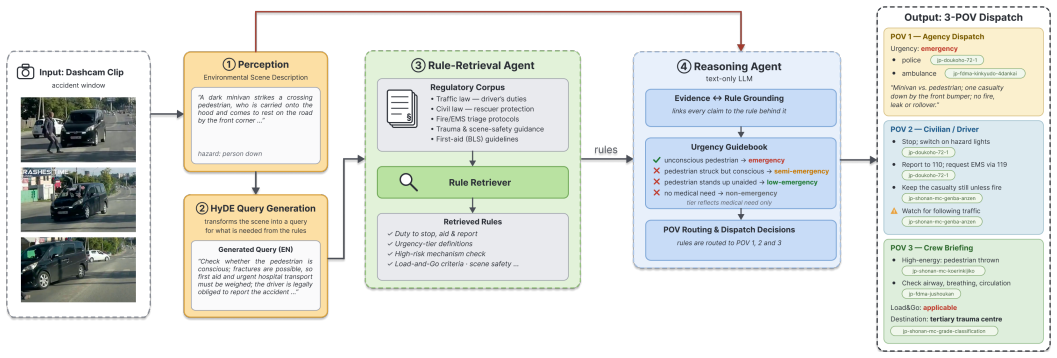
Pith's one-line read A decomposed, protocol-grounded pipeline turns a dashcam clip into an auditable emergency dispatch plan that beats end-to-end vision-language models.
desk verdict Promising new benchmark, but the central comparison is confounded: only the framework gets the urgency guidebook in its system prompt, so the 'outperforms baselines' claim is not yet established. read the letter →
The pith
A machine-rendered reading of the paper's core claim, the machinery that carries it, and where it could break.
The reading
What carries the argument
The load-bearing mechanism is the retrieval bridge built with the HyDE paradigm (hypothetical-document rewriting): a plain scene description is rewritten by an LLM into a hypothetical professional dispatch note before matching against the corpus, closing the gap between what a camera sees and what a rule book says. The reasoner is then constrained by three rules: it may cite only retrieved rule identifiers; it must pair every claim with observable evidence; and it must map observable cues onto a four-tier urgency guidebook (emergency, semi-emergency, low-emergency, non-emergency) drawn from the Japanese 119 dispatch protocol. This guidebook turns an ordinal medical scale into a dispatcher-fa
What would settle it
A clip where a struck pedestrian slides beneath a parked vehicle and is hidden in all 16 frames, while the visible collision looks minor, would break the premise: any system built on this input would issue a low-urgency, no-ambulance plan, and the benchmark would agree because its annotation used the same view. Testing such clips with and without a second camera angle would directly measure how often single-view perception hides injuries that change the dispatch decision.
Extended reading notes
Core claim
On its own terms, the paper's central discovery is that the architecture of the decision, not the strength of the model or the availability of rules, is what makes an accident assessor safe. When every method receives the same sampled frames and the same retrieved rule context, the framework's separation of perception from reasoning produces the best structured dispatch results: urgency exact-match 0.47 versus 0.23–0.35, ordinal agreement 0.77 versus 0.63–0.70, unit F1 0.86 versus 0.73–0.82, Load-and-Go transport accuracy 0.55 versus 0.32–0.39, and the best-calibrated ambulance decision with precision 0.82 and recall 0.81. The baselines' higher recall is shown to be an artifact of over-trigg
Load-bearing premise
The load-bearing premise is that a single forward-facing dashcam view, sampled as 16 frames, contains enough visible evidence to judge accident severity and dispatch need; a casualty who is occluded or out of frame is invisible both to the system and to the benchmark's ground truth, so the fatal missed-ambulance scenario the paper is designed to prevent cannot be fully ruled out.
Editorial extensions
If this is right
- A dashcam-equipped vehicle could automatically issue a structured, rule-cited dispatch request for its own or a witnessed accident, cutting the reported 4.6–7.2 minute gap between crash and call.
- Every decision in the plan—urgency tier, units to send, civilian instructions, EMS briefing—carries a rule identifier, so a human dispatcher can verify the recommendation against the cited Japanese law or medical protocol rather than trusting the model.
- Triage calibration is measurable and matters: the paper shows that high recall in emergency dispatch can be bought by over-triaging nearly every scene, and that minimizing over- and under-triage together is the meaningful objective.
- The new 500-clip benchmark gives the field a first testbed where accident video is labeled not just with a description of what happened but with an actionable response grounded in cited rules.
- Because every baseline saw the same retrieved rules, the performance gap is attributable to the decomposed architecture itself, not to the information available.
Reading between the lines
- One extension the paper leaves implicit is that the same retrieval-and-reason design should transfer to other jurisdictions by swapping the corpus; the architecture has no Japan-specific component, but the paper only demonstrates it on Japanese rules.
- The single-view input limitation suggests the next measurable gain will come from multi-camera fusion; a controlled test comparing single- versus multi-view perception on the same clips could quantify how many of the framework's 62 missed ambulance dispatches are caused by occluded casualties.
- The paper's content-quality result—a frontier VLM writes richer narrative than the structured pipeline—points toward a hybrid in which structured, cited decisions are paired with free-text explanations generated separately, a combination the paper names complementary but does not build.
- A broader design principle: for safety-critical calls, system builders should report calibration curves and confusion matrices, not recall alone, since recall can be trivially inflated by always escalating; the paper argues this for dispatch, and it generalizes to other alerting systems.
Editorial analysis
A structured set of objections, weighed in public.
Referee Report
Summary. DispatchRAG proposes a three-stage pipeline—perception VLM, HyDE-based rule retrieval from a curated corpus of Japanese traffic-law and EMS protocols, and a text-only reasoner—that turns a dashcam accident clip into an auditable three-perspective emergency dispatch plan (agency, civilian, EMS), with each directive cited to a retrieved rule. The paper also introduces the Accident Dispatch Dataset: 500 MM-AU clips annotated with urgency tiers, dispatched units, and per-POV plans. Experiments compare the framework against end-to-end VLMs that receive the same sampled frames and retrieved rules, reporting higher unit F1, urgency exact-match/ordinal accuracy, load-and-go accuracy, and better calibration on the ambulance-dispatch decision. The central claim is that the decomposed, protocol-grounded design outperforms end-to-end frontier VLMs on structured dispatch decisions.
Significance. If the headline comparison were cleanly established, this would be a useful step toward automated emergency dispatch from vehicle cameras: the work goes beyond accident understanding to protocol-cited dispatch decisions, and the dataset with three-perspective, rule-grounded annotations is a practical resource. The HyDE retrieval ablation is a useful contribution, and the use of a three-model judge panel for content quality is careful. However, the evaluation currently gives the proposed system the exact rubric used to construct the ground-truth labels, so the comparative claim is not established. The contribution is potentially significant but hinges on a fair re-run of the experiments.
major comments (3)
- [§IV-A.3–IV-A.4, §III-F] The comparison is not run under an identical rule context. §IV-A.4 states that the framework's reasoner has "the urgency guidebook embedded in its system prompt," while §IV-A.3 says the baselines receive "the same retrieved rules." The guidebook is therefore available unconditionally only to the framework; because retrieval recall is 0.76 (Table IV), the baselines are not guaranteed to see it. Moreover, §III-F says the ground-truth urgency tier was "assigned with the same law-grounded guidebook used by the reasoner." The urgency EM gap (0.47 vs. 0.23–0.35), the over-triage gap (28% vs. 43–60%), and the ambulance F1 advantage could all be artifacts of giving only the framework the exact rubric used to create the labels. The sentence in §IV-A.3 claiming this "isolates the perception/architecture split" is unsupported. Please run conditions in which the guidebook is also inserted into the b
- [§IV-B.3, Table III] The claim that the framework is "the safest and best-balanced method" is a policy judgment unsupported by a cost model. The framework misses 62 of the 320 ambulance-required clips (a 19.4% false-negative rate), while the baselines miss 4–25. The abstract's motivating problem is that "missing an ambulance dispatch on a pedestrian accident is a fatal issue." A calibration-only reading discards the asymmetric cost of under-triage. To support "safest," the paper should adopt an explicit decision-theoretic cost model (e.g., expected lives lost versus resource waste) with a sensitivity analysis over the cost ratio, or soften the claim to "better calibrated under an over-triage-weighted cost." The characterization of 62 misses as "a small fraction" is inaccurate.
- [§IV-A.1–IV-A.4] The decomposition claim is also confounded by model choice. The framework's perception model is GPT-5.4-mini and its reasoner is Qwen3-32B, while the end-to-end baselines are Qwen3-VL-32B, GPT-5.4-mini, and Gemini-2.5-Flash. Thus the statement that "all methods see the identical rule context" does not isolate the perception/architecture split, because model family, size, and modality differ as well. A cleaner test would keep the backbone fixed across the end-to-end and decomposed conditions, or at least hold the perception model constant. Without such a control, the observed gains cannot be attributed to decomposition rather than to the particular models selected.
minor comments (5)
- [§IV-B.7] The text calls the under-triage cases "a small fraction of true ambulance cases," but 62/320 is 19.4%. Please quantify and rephrase.
- [§III-F] No inter-annotator agreement or reliability statistic is reported for the manual annotations. A kappa or agreement measure would strengthen the benchmark's credibility.
- [Tables II and III] Point estimates are reported without confidence intervals or significance tests. Given n=500 and the small margins on some metrics (e.g., Unit F1 0.86 vs. 0.82; Ambulance F1 0.81 vs. 0.81), some differences may not be statistically significant.
- [§IV-B.7] The single-view limitation is acknowledged, but since the motivating "fatal issue" concerns casualties that may be occluded or out of frame, a brief discussion of whether the ground-truth annotations can capture such cases—or an analysis on the subset where the casualty is visible—would be informative.
- [§V] The dataset and corpus are said to "be released on GitHub later." For reproducibility, please provide an availability statement or a release plan at submission time.
Circularity Check
Urgency evaluation is confounded: ground-truth tiers are assigned with the same law-grounded guidebook that only the framework receives unconditionally in its system prompt.
-
self definitional
[Sec. III-F ('Dispatch Dataset and Annotation') and Sec. IV-A.4 ('Implementation details')]
"Urgency tier— assigned with the same law-grounded guidebook used by the reasoner (Sec. III-E), keeping the label grounded in the protocol rather than guessed. ... the reasoner is Qwen3-32B [27] with the urgency guidebook embedded in its system prompt."
The ground-truth urgency tier is produced by applying a hand-authored four-tier guidebook, and the identical guidebook is embedded unconditionally in the framework's reasoner. The end-to-end baselines receive only 'the sampled frames and the same retrieved rules' (Sec. IV-A.3), so they see the tier rubric only if the retriever happens to fetch the relevant FDMA passage (retrieval recall is 0.76, Table IV). The central headline numbers — urgency EM 0.47 vs 0.23–0.35, over-triage 28% vs 43–60%, and the 'safest and best-balanced' conclusion in Sec. IV-B.3 — therefore measure concordance between the framework's output and labels generated by the same rubric the framework alone was given, rather than an architecture-independent advantage. The prediction target is defined by the very rule set th
full rationale
The paper's internal derivation — perception description, HyDE query, retrieval, and reasoner with cited rules — is not itself circular: the retrieval ablation (Table IV) holds perception and reasoner fixed and varies only the query, which is a legitimate internal comparison. There is no load-bearing self-citation chain, no imported uniqueness theorem, and no ansatz smuggled via citation. The circularity is localized to the headline evaluation. Section III-F states that ground-truth urgency tiers are 'assigned with the same law-grounded guidebook used by the reasoner,' while Sec. IV-A.4 states the reasoner has 'the urgency guidebook embedded in its system prompt.' Thus the framework's urgency predictions are essentially re-applications of the label-generation rubric, whereas the baselines are not guaranteed access to that rubric unless retrieval happens to surface it. The paper's claim that 'all methods see the identical rule context' (Sec. IV-A.3) is therefore inaccurate with respect to the guidebook. This makes the reported urgency, over-triage, and 'safest and best-balanced' claims partially circular: they are consistent with the framework being a faithful re-application of the annotators' own rubric rather than a demonstrably better dispatcher. The acknowledged limitation in Sec. IV-B.7 about 'occluded or out-of-frame casualties' is a real weakness of the input modality but is not a circularity. Overall, the central comparison is confounded enough to merit a score of 6, though the framework's other components (retrieval, rule citation, POV routing) retain independent content.
Assumptions & free parameters
free parameters (2)
- top-k retrieval budget =
not reported
- number of sampled frames =
16
assumptions (5)
- domain assumption The curated 19-passage corpus of Japanese traffic law and EMS protocols is authoritative, complete, and correctly interpreted (Sec. III-B).
- ad hoc to paper The four-tier urgency guidebook validly maps observable cues to dispatch urgency (Sec. III-E.2).
- domain assumption A single forward dashcam view sampled at 16 frames contains sufficient evidence to determine urgency and dispatch (Sec. III-A; Sec. IV-B.7).
- domain assumption The 500 manual ground-truth annotations are correct and reliable (Sec. III-F).
- domain assumption LLM-judge coverage scores validly measure content quality (Sec. IV-A.2).
Cite this review
Pith. "Pith review of DispatchRAG: Grounding Emergency Dispatch Decisions in Real-World Protocols from Traffic Accident Video." pith.science (2026). https://pith.science/paper/FQWAYLEZ
@misc{pith2026260723132,
  author       = {Pith},
  title        = {Pith review of: DispatchRAG: Grounding Emergency Dispatch Decisions in Real-World Protocols from Traffic Accident Video},
  year         = {2026},
  howpublished = {\url{https://pith.science/paper/FQWAYLEZ}},
  note         = {Machine review of arXiv:2607.23132}
}
read the original abstract
Assessing the severity of a traffic accident scenario is important to decide which emergency service to dispatch. Missing an ambulance dispatch on a pedestrian accident is a fatal issue that can lead to death. Recently, Vision-Language Models (VLMs) have been a promising tool for accident reasoning, yet many VLMs are not grounded in real-life accident response protocols, making them not usable in accident severity assessment off-the-shelf. We introduced DispatchRAG, an accident assessor and dispatcher framework grounded in real-life Japanese traffic-accident response protocols, designed to enhance VLMs to generate an appropriate emergency response during an emergency scenario. Utilizing a RAG-based retrieval mechanism to retrieve the most relevant accident protocol and an LLM-powered reasoner to suggest the most proper response. To support evaluation, we introduce Accident Dispatch Dataset, a comprehensive dataset of accident assessment and emergency response according to Japanese accident response protocols adapted from the MM-AU dataset. We validate our framework on the Accident Dispatch Dataset, showing strong performance across various accident scenarios compared to the baseline VLM, pointing toward integration in autonomous vehicles that can automatically report both their own and nearby accidents.
Figures

Reference graph
Works this paper leans on
-
[1]
Abductive ego-view accident video understanding for safe driving perception,
J. Fang et al., “Abductive ego-view accident video understanding for safe driving perception,” inProceedings of the IEEE/CVF Conference on Computer Vision and Pattern Recognition (CVPR), 2024
2024
-
[2]
W. H. Organization,Global status report on road safety 2023: country and territory profiles. World Health Organization, 2024
2023
-
[3]
Updated estimates of potential traffic fatality reductions with automatic collision notification,
J. Wu, M. Craig, and A. Longthorne, “Updated estimates of potential traffic fatality reductions with automatic collision notification,” in Proceedings from the 24th International Technical Conference on the Enhanced Safety of Vehicles, Gothenburg, Sweden, 2015
2015
-
[4]
ScVLM: Enhancing vision-language model for safety- critical event understanding,
L. Shi et al., “ScVLM: Enhancing vision-language model for safety- critical event understanding,” inProceedings of the Winter Conference on Applications of Computer Vision (WACV), 2025
2025
-
[5]
SUTD-TrafficQA: A question answering benchmark and an efficient network for video reasoning over traffic events,
L. Xu, H. Huang, and J. Liu, “SUTD-TrafficQA: A question answering benchmark and an efficient network for video reasoning over traffic events,” inProceedings of the IEEE/CVF conference on computer vision and pattern recognition, 2021, pp. 9878–9888
2021
-
[6]
Z. Sheng et al., “SafePLUG: Empowering multimodal llms with pixel- level insight and temporal grounding for traffic accident understand- ing,”arXiv preprint arXiv:2508.06763, 2025
arXiv 2025
-
[7]
CrashSight: A phase-aware, infrastructure-centric video benchmark for traffic crash scene understanding and reasoning,
R. Gan et al., “CrashSight: A phase-aware, infrastructure-centric video benchmark for traffic crash scene understanding and reasoning,” in Proceedings of the IEEE/CVF Conference on Computer Vision and Pattern Recognition, 2026, pp. 718–727
2026
-
[8]
EchoTraffic: Enhancing traffic anomaly understanding with audio-visual insights,
Z. Xing et al., “EchoTraffic: Enhancing traffic anomaly understanding with audio-visual insights,” inProceedings of the IEEE/CVF Confer- ence on Computer Vision and Pattern Recognition (CVPR), 2025
2025
Show all 28 references
-
[9]
Driving with Regulation: Trustworthy and interpretable decision-making for autonomous driving with retrieval-augmented rea- soning,
T. Cai et al., “Driving with Regulation: Trustworthy and interpretable decision-making for autonomous driving with retrieval-augmented rea- soning,” inProceedings of the AAAI Conference on Artificial Intelli- gence, vol. 40, 2026, pp. 38 287–38 295
2026
-
[10]
VRU-Accident: A vision-language benchmark for video question answering and dense captioning for accident scene understanding,
Y . Kim, A. S. Abdelrahman, and M. Abdel-Aty, “VRU-Accident: A vision-language benchmark for video question answering and dense captioning for accident scene understanding,” inProceedings of the IEEE/CVF International Conference on Computer Vision, 2025, pp. 761–771
2025
-
[11]
GPT-4V as Traffic Assistant: An in- depth look at vision language model on complex traffic events,
X. Zhou and A. C. Knoll, “GPT-4V as Traffic Assistant: An in- depth look at vision language model on complex traffic events,”arXiv preprint arXiv:2402.02205, 2024
2024 arXiv
-
[12]
From Detection to Action: A multimodal ai framework for traffic incident response,
A. Ahmed, M. Farhan, H. Eesaar, K. T. Chong, and H. Tayara, “From Detection to Action: A multimodal ai framework for traffic incident response,”Drones, vol. 8, no. 12, p. 741, 2024
2024
-
[13]
AccidentGPT: Accident analysis and prevention from v2x environmental perception with multi-modal large model,
L. Wang et al., “AccidentGPT: Accident analysis and prevention from v2x environmental perception with multi-modal large model,”arXiv preprint arXiv:2312.13156, 2023
2023 arXiv
-
[14]
Use of a large language model to assess clinical acuity of adults in the emergency department,
C. Y . Williams et al., “Use of a large language model to assess clinical acuity of adults in the emergency department,”JAMA network open, vol. 7, no. 5, e248895, 2024
2024
-
[15]
Use of a large language model (llm) for ambulance dispatch and triage,
A. C. Shekhar, J. Kimbrell, A. Saharan, J. Stebel, E. Ashley, and E. E. Abbott, “Use of a large language model (llm) for ambulance dispatch and triage,”The American Journal of Emergency Medicine, vol. 89, pp. 27–29, 2025
2025
-
[16]
DispatchMAS: Fusing taxonomy and artificial intelligence agents for emergency medical services,
X. Li et al., “DispatchMAS: Fusing taxonomy and artificial intelligence agents for emergency medical services,”BMC Emergency Medicine, vol. 26, no. 1, p. 78, 2026
2026
-
[17]
105 of 1960, e-Gov Law Search, Articles 71, 71-3, 72, 117
Government of Japan,Road traffic act (D ¯oro K ¯ots¯u H ¯o), act no. 105 of 1960, e-Gov Law Search, Articles 71, 71-3, 72, 117. https://laws.e- gov.go.jp/document?lawid=335AC0000000105, 1960
1960
-
[18]
89 of 1896, article 698 (emergency management of affairs), e-Gov Law Search, https : //laws.e-gov.go.jp/law/129AC0000000089, 1896
Government of Japan,Civil code (Minp ¯o), act no. 89 of 1896, article 698 (emergency management of affairs), e-Gov Law Search, https : //laws.e-gov.go.jp/law/129AC0000000089, 1896
-
[19]
Fire and Disaster Management Agency (FDMA), Japan,Emergency- scene urgency-judgment response manual (Ky¯uky¯u Genba no Kinky ¯udo Hantei Taio Manyuaru), Ministry of Internal Affairs and Commu- nications, https : / / www . fdma . go . jp / singi kento / kento / items / kyukyu a...
2017
-
[20]
1 (119-ban Ts ¯uh¯o Purotokoru), Ministry of Internal Affairs and Communications, https://www.fdma.go.jp/singi kento/ kento/items/kento121 05 119banprotocolv1.pdf, 2021
Fire and Disaster Management Agency (FDMA), Japan,119 dispatch protocol, ver. 1 (119-ban Ts ¯uh¯o Purotokoru), Ministry of Internal Affairs and Communications, https://www.fdma.go.jp/singi kento/ kento/items/kento121 05 119banprotocolv1.pdf, 2021
2021
-
[21]
Shonan-District Medical Control Council,Trauma emergency response guideline 2022 (Gaish ¯o Ky ¯uky¯u Katsud ¯o Gaidorain), https://shonan- mc.org/images/guideline/kguide/trauma gudeline 2022.pdf, 2022
2022
-
[22]
Japan Resuscitation Council,JRC resuscitation guideline 2020 — basic life support (BLS), https://www.jrc-cpr.org/wp-content/uploads/2022/ 07/JRC 0017-0046 BLS.pdf, 2020
2020
-
[23]
Precise zero-shot dense retrieval without relevance labels,
L. Gao, X. Ma, J. Lin, and J. Callan, “Precise zero-shot dense retrieval without relevance labels,” inProceedings of the 61st Annual Meeting of the Association for Computational Linguistics (Volume 1: Long Papers), 2023, pp. 1762–1777
2023
-
[24]
M3- Embedding: Multi-linguality, multi-functionality, multi-granularity text embeddings through self-knowledge distillation,
J. Chen, S. Xiao, P. Zhang, K. Luo, D. Lian, and Z. Liu, “M3- Embedding: Multi-linguality, multi-functionality, multi-granularity text embeddings through self-knowledge distillation,” inFindings of the association for computational linguistics: ACL 2024, 2024, pp. 2318– 2335
2024
-
[25]
Qwen3-vl technical report,
S. Bai et al., “Qwen3-vl technical report,”arXiv preprint arXiv:2511.21631, 2025
2025 arXiv
-
[26]
Gemini 2.5: Pushing the frontier with advanced reasoning, multimodality, long context, and next generation agentic capabilities,
G. Comanici et al., “Gemini 2.5: Pushing the frontier with advanced reasoning, multimodality, long context, and next generation agentic capabilities,”arXiv preprint arXiv:2507.06261, 2025
2025 arXiv
-
[27]
Qwen3 technical report,
A. Yang et al., “Qwen3 technical report,”arXiv preprint arXiv:2505.09388, 2025
2025 arXiv
-
[28]
Robertson and H
S. Robertson and H. Zaragoza,The Probabilistic Relevance Frame- work: BM25 and Beyond. Now Publishers Inc, 2009, vol. 4
2009
Reviewed August 1, 2026 · model on record in the stance chip above.
Discussion (0). Sign in to comment.