REVIEW 3 major objections 5 minor 44 references
Chain of Spatial Thoughts: Modality-Agnostic Spatial Grounding for Vision Language Models
T0 review · 3 major / 5 minor · reviewed 2026-08-14 · deepseek-v4-flash
Pith's one-line read Space Tokens claim that continuous latent tokens distilled from scene geometry and 3D object boxes improve VLM spatial reasoning without inference-time modules.
desk verdict Plausible extension of latent-token distillation to 3D spatial reasoning, but the headline stage-3 RL numbers are not interpretable until the authors disclose where the 8,000 training samples come from. read the letter →
The pith
A machine-rendered reading of the paper's core claim, the machinery that carries it, and where it could break.
The reading
What carries the argument
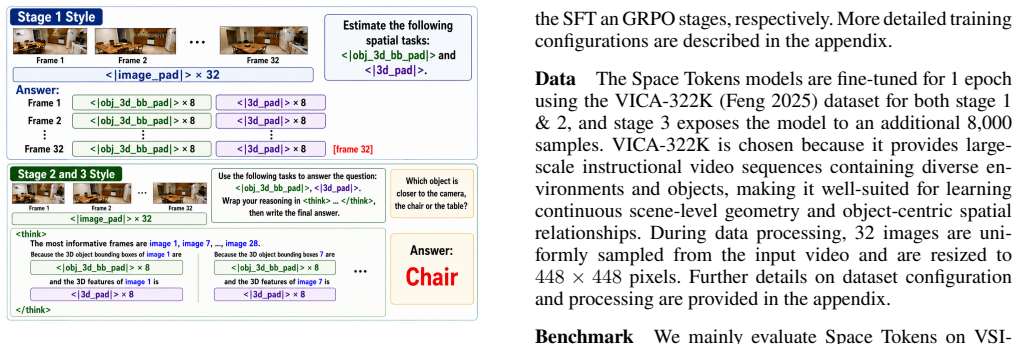
The carrying object is the Space Token: a reserved vocabulary token whose final-layer hidden state is treated as a continuous spatial representation rather than decoded as discrete text. Scene-level 3D tokens are trained with a cosine-similarity loss against VGGT-$\Omega$'s latent features and with reconstruction losses over camera parameters, depth maps, and point maps; object-level tokens predict 12D 3D bounding boxes (center, dimensions, 6D rotation) through Hungarian matching and Smooth L1 loss. The three-stage pipeline first learns these representations, then teaches the VLM to reason with them under teacher forcing, then refines the reasoning with GRPO. The same tokens are emitted in a structured <think> block that ties each image to its spatial token blocks.
What would settle it
Check the 8,000 reinforcement-learning training prompts for overlap with VSI-Bench questions; if any overlap exists, or if the stage-3 gain disappears on a held-out spatial benchmark whose questions never entered the reward design, then the reported 1.3-point improvement reflects reward optimization rather than a general spatial-reasoning gain.
Extended reading notes
Core claim
The paper's central claim is that a VLM's spatial reasoning can be improved by making continuous spatial information part of the model's own autoregressive output, rather than by adding geometry modules at inference. During generation, reserved 'spatial token' positions are read from the final-layer hidden states and supervised in three stages: first to align with VGGT-$\Omega$'s latent scene representation and to reconstruct cameras, depth, and point maps, plus 3D bounding boxes for objects; then via supervised fine-tuning in which the model answers questions while the tokens appear in a per-view chain-of-thought; finally via GRPO reinforcement learning with a reward built from the VSI-Bench metric. The paper reports consistent gains on VSI-Bench, with the largest improvements on room-size and absolute-distance tasks, and shows that both scene-level and object-level tokens contribute. It also reports that masking attention to the spatial tokens sharply hurts performance, which the authors take as evidence that the latent representations are actually used.
Load-bearing premise
The 8,000 samples used in the third reinforcement-learning stage are independent of the VSI-Bench evaluation, even though the reward is designed from the VSI-Bench metric and the dataset is not named.
Editorial extensions
If this is right
- Any autoregressive VLM can use the same recipe: reserve vocabulary tokens, train their hidden states on geometry objectives, and keep the architecture untouched.
- Tasks that need global scene geometry benefit most: on VSI-Bench, room-size accuracy rises by 15.8 points on Qwen3-VL-8B and 9.5 points on SenseNova-SI-1.3.
- The tokens are causally used, not decorative: masking attention to them drops object-size accuracy from 79.0 to 63.7 on VSI-Bench.
- The representation is verifiable: the learned token states can be decoded into 3D point maps and boxes, allowing inspection of what geometry the model encodes.
- The gains are not simply data scaling: adding the same VICA-322K data without the spatial-token losses decreases VSI-Bench score from 67.6 to 67.1, while the full method raises it.
Reading between the lines
- A matched baseline that uses the same chain-of-thought prompt and SFT/RL data but replaces the spatial-token slots with ordinary text descriptions of geometry would isolate the token representation; the paper's no-token baseline changes both the representation and the prompt.
- Because the token interface is modality-agnostic, the same three-stage recipe could be applied to other continuous sensors, such as depth from stereo, optical flow, audio localization, or tactile maps, and it remains open whether each modality needs its own teacher model.
- The paper's teacher-forced chain-of-thought means the model never decides when to emit the spatial-token trace; letting the model generate that trace freely at inference could either amplify the gains or reveal that the trace is only useful when forced.
Signed reviews
Editorial analysis
A structured set of objections, weighed in public.
Referee Report
Summary. The paper introduces Space Tokens, a training-only framework that augments vision-language models with continuous latent tokens encoding scene-level 3D geometry (distilled from VGGT-Omega) and object-centric 3D bounding boxes. The tokens are placed in the model's vocabulary and generated during chain-of-thought reasoning, so no additional modules are needed at inference. Training proceeds in three stages: representation learning with reconstruction losses, supervised fine-tuning that teaches the model to reason with the tokens, and a GRPO refinement stage with a reward derived from the VSI-Bench metric. The authors report improvements on VSI-Bench for Qwen3-VL-8B (+4.3) and SenseNova-SI-1.3 (+1.3), state-of-the-art object-size (79.2%) and room-size (75.7%) scores, and modest or positive out-of-distribution results for the Stage 1&2 model.
Significance. If the reported results are valid, Space Tokens would be a valuable contribution: it provides an architecture-agnostic, inference-efficient route for injecting explicit spatial knowledge into VLMs, and the attention-masking experiment (Table S5) gives causal evidence that the learned latent representations are actually used during answer generation. The authors also provide a thoughtful discussion of why the Token Replacement Test is insufficient in multi-image settings, and they include a data-scaling ablation that helps separate the effect of the tokens from the effect of additional training data. The main significance hinges, however, on whether the headline VSI-Bench gains reflect genuine spatial-reasoning improvement or optimization against the evaluation metric; as written, the empirical evidence for that distinction is incomplete.
major comments (3)
- [Experiments, Data; Appendix A.3] The Stage 3 GRPO reward is defined directly from the VSI-Bench evaluation metric (Appendix A.3: fuzzy matching for MCA, mean relative accuracy for NA), and the 8,000 Stage 3 training samples are never named or split-specified. The paper itself excludes the Stage 3 model from OOD benchmarks with the explanation that the reward functions are designed for VSI-Bench and are therefore not appropriate for evaluating generalization. This means the headline improvements (Qwen3-VL-8B +4.3, SenseNova-SI-1.3 +1.3, and SOTA object-size 79.2 / room-size 75.7 in Table 1) cannot be interpreted as evidence of general spatial reasoning capability; they may reflect reward engineering toward the target benchmark. Please disclose the source and train/eval split of the 8,000 samples, and either re-run Stage 3 on a dataset disjoint from VSI-Bench or present the Stage 1&2 results as the primary evidence for generalization.
- [Appendix B.2, Table S3] The six reasoning frames (indices 1, 10, 12, 15, 21, 28) are selected based on 'observ[ing that], when answering questions from our primary benchmark, VSI-Bench, the trained model relied more frequently on certain frames than on others.' This is hyperparameter selection on the evaluation set, and it affects all results from Stages 2 and 3, including the Stage 1&2 score of 68.6 in Table 3. The frame-selection procedure should be justified on a validation split or shown to be stable across held-out settings; otherwise even the non-RL gains are partially confounded by evaluation-set tuning.
- [Table 2 and Table 3] The OOD evaluation is performed only for the Stage 1&2 SenseNova-SI-1.3 model, and Table 3 shows the Stage 3 gain over Stage 1&2 is just 0.3 points on average (68.6 to 68.9). The magnitude of the Stage 3 improvement is small relative to the task-specific jumps (e.g., room size +3.2 points, object size +1.4 points). Because Stage 3 is the source of the SOTA room-size claim, any unaddressed leakage in Stage 3 directly undermines the paper's central stated contribution.
minor comments (5)
- [Abstract and Section 1] The term 'modality-agnostic' is used although the paper demonstrates only two spatial modalities (3D reconstruction and 3D bounding boxes). The unified token interface may be extensible, but 'modality-agnostic' should either be defined more precisely or softened to 'modality-extensible' to avoid overclaiming.
- [Figure 2 caption] The caption says 'after stage 1, all spatial reasoning is performed using the learned latent tokens without requiring additional model parameters,' but Stage 1 itself trains projection and decoder layers that are additional parameters, and these components appear necessary for the representation-alignment losses. Please clarify which parameters remain at inference time.
- [Table 2] The row label 'Qwen3-VL-8B + SenseNova-SI' is confusing because the baseline is the SenseNova-SI-1.3 checkpoint built on Qwen3-VL-8B; consider renaming the rows to identify the exact checkpoint and training stage.
- [References] There are two entries for 'Zhang et al. 2026' with different papers (Ablate-to-Validate and SSR); the in-text citations need to be disambiguated (e.g., Zhang, Bigverdi, and Krishna 2026 vs. Zhang, Xia, Wang, et al. 2026).
- [Appendix A.3] Equation (S16) defines the MRA reward with confidence intervals C={0.5,0.55,...,0.95}, but the text says 'for a set of confidence intervals C={0.5,0.55,...,0.95}' and the denominator 10 assumes exactly 10 thresholds; this is consistent, but the notation could be made explicit that the average is over 10 values.
Circularity Check
Headline VSI-Bench gains are partly fitted through a VSI-Bench-targeted GRPO reward and VSI-Bench-selected reasoning frames; the token representation mechanism itself has independent support.
-
fitted input called prediction
[Appendix A.3 (GRPO Reward Design); 'Data' paragraph in Section 'Implementation Details']
"In stage 3, we design the reward to target the VSI-Bench metric. For multiple choice questions, we extract the ground truth answer and perform fuzzy matching against the predicted choice, if a match occurs then a reward of 1 is assigned. For numeric answer questions we employ the mean relative accuracy (Yang et al. 2025) as a reward."
The final-stage model whose numbers are reported as the headline result is trained with a reward that is literally the VSI-Bench evaluation metric (mean relative accuracy, Eq. S16). The stage-3 training set ('an additional 8,000 samples') is never named, so there is no disclosed separation between the reward optimization distribution and the VSI-Bench evaluation split. The reported 4.3/1.3 point gains and the SOTA object-size/room-size numbers are therefore at least partly the output of optimizing the evaluation target itself; the paper concedes as much by excluding the stage-3 model from OOD benchmarks 'as the reward functions are designed for VSI-Bench and are therefore not appropriate for evaluating generalization.'
-
fitted input called prediction
[Appendix B.2 (Prompting Structure)]
"when answering questions from our primary benchmark, VSI-Bench, the trained model relied more frequently on certain frames than on others. Based on this observation, we selected the six highest-ranked frames (1, 10, 12, 15, 21, and 28) and used only these views for spatial reasoning during Stages 2 and 3."
The choice of which six frames are used for spatial reasoning in the trained pipeline is made by inspecting model behavior on VSI-Bench itself, and the same six frames are then used in the runs whose VSI-Bench scores are reported. This is a hyperparameter/selection rule fitted directly to the evaluation benchmark, so the reported VSI-Bench numbers are conditional on an eval-set-dependent design choice rather than an independent test.
full rationale
The token-representation core is not circular: the 3D tokens are supervised by an external teacher (VGGT-Omega) through latent and reconstruction losses (Eqs. 2-3), object tokens by 3D bounding-box regression (Eq. 4), and the learned representations are causally tested by attention masking (Table S5). The controlled data-scaling ablation (Table 3) and modality ablation (Table 4) show gains from the tokens over the VICA-only baseline, independent of the VSI-Bench reward. However, the headline empirical claims are partially fitted to the evaluation target. Stage 3 defines its GRPO reward as the VSI-Bench metric (Appendix A.3), trains on an unnamed additional 8,000 samples with no disclosed split from VSI-Bench, and the final model is deliberately excluded from OOD benchmarks because the reward is VSI-Bench-specific. The reasoning-frame set is also selected by observing model behavior on VSI-Bench (Appendix B.2). Therefore the abstract's 4.3/1.3 improvements and SOTA object-size/room-size numbers are not independent predictions of general spatial reasoning; they are partly the result of optimizing the evaluation metric and selecting hyperparameters on the evaluation benchmark. The paper contains no self-citation chain or uniqueness-theorem circularity. Score reflects partial circularity in the headline evaluation, not in the representation-learning derivation.
Assumptions & free parameters
free parameters (6)
- Loss weighting coefficients lambda for L3D and L3D-BB =
All lambda set to 1
- Number of spatial tokens per concept per frame =
8
- Number of reasoning frames =
6
- Specific reasoning frame indices =
1, 10, 12, 15, 21, 28
- 2D bounding-box conditioning weight lambda_bb =
0.2
- Number of bounding-box prediction slots S
assumptions (5)
- domain assumption The VGGT-Omega teacher produces geometrically accurate camera, depth, and point maps used as supervision.
- domain assumption The VICA-322K dataset provides enough 3D coverage and object bounding box annotations for the distillation losses.
- ad hoc to paper The six selected frame positions carry the most task-relevant information across VSI-Bench videos.
- ad hoc to paper The 8,000 Stage 3 RL samples are independent of the VSI-Bench evaluation split.
- domain assumption LoRA fine-tuning preserves the pretrained VLM's visual and language capabilities outside the training distribution.
invented entities (1)
-
Space Tokens (continuous spatial latent tokens)
independent evidence
Cite this review
Pith. "Pith review of Chain of Spatial Thoughts: Modality-Agnostic Spatial Grounding for Vision Language Models." pith.science (2026). https://pith.science/paper/FQWQDELT
@misc{pith2026260810278,
  author       = {Pith},
  title        = {Pith review of: Chain of Spatial Thoughts: Modality-Agnostic Spatial Grounding for Vision Language Models},
  year         = {2026},
  howpublished = {\url{https://pith.science/paper/FQWQDELT}},
  note         = {Machine review of arXiv:2608.10278}
}
read the original abstract
Spatial understanding is fundamental to embodied intelligence, underpinning applications such as robotic manipulation, embodied navigation, and autonomous driving. Although recent vision-language models (VLMs) have achieved impressive performance on spatial reasoning benchmarks, state-of-the-art approaches typically rely on additional spatial encoders or architectural modifications during inference, increasing computational cost. We introduce Space Tokens, a lightweight, architecture-agnostic framework that equips VLMs with explicit continuous spatial representations without requiring additional inference-time modules. By distilling scene-level 3D geometry and object-centric spatial attributes into continuous latent tokens, our method enables these modalities to be directly incorporated into a chain-of-thought reasoning process, thereby improving the VLM's spatial reasoning capabilities. At the same time, the learned representations can be explicitly decoded to verify that they encode meaningful geometric information, while the unified token interface remains extensible to additional modalities. Experiments on VSI-Bench improve Qwen3-VL-8B by 4.3% and SenseNova-SI-1.3 by 1.3%, while achieving state-of-the-art performance on object size (79.2%) and room size estimation (75.7%). These results demonstrate that continuous spatial tokens provide an effective, interpretable, and computationally efficient mechanism for integrating geometric reasoning into large vision-language models.
Figures


Figures from the paper (1 more)

Reference graph
Works this paper leans on
-
[1]
and Han, Rilyn and Fei-Fei, Li and Xie, Saining , title =
Yang, Jihan and Yang, Shusheng and Gupta, Anjali W. and Han, Rilyn and Fei-Fei, Li and Xie, Saining , title =. Proceedings of the IEEE/CVF Conference on Computer Vision and Pattern Recognition (CVPR) , month =. 2025 , pages =
2025
- [2]
-
[3]
Dehghan, Afshin and Baruch, Gilad and Chen, Zhuoyuan and Feigin, Yuri and Fu, Peter and Gebauer, Thomas and Kurz, Daniel and Dimry, Tal and Joffe, Brandon and Schwartz, Arik and Shulman, Elad , booktitle =. ARKitScenes: A Diverse Real-World Dataset For 3D Indoor Scene Understanding Using Mobile RGB-D Data , url =
-
[4]
ScanNet: Richly-annotated 3D Reconstructions of Indoor Scenes , author=. Proc. Computer Vision and Pattern Recognition (CVPR), IEEE , year =
-
[5]
Proceedings of the IEEE/CVF International Conference on Computer Vision , pages=
Scannet++: A high-fidelity dataset of 3d indoor scenes , author=. Proceedings of the IEEE/CVF International Conference on Computer Vision , pages=
-
[6]
Ablate-to-Validate: Are Vision-Language Models Really Using Continuous Thought Tokens? , author=. 2026 , eprint=
work page 2026
-
[7]
2024 , eprint=
DeepSeekMath: Pushing the Limits of Mathematical Reasoning in Open Language Models , author=. 2024 , eprint=
2024
-
[8]
2021 , eprint=
LoRA: Low-Rank Adaptation of Large Language Models , author=. 2021 , eprint=
2021
Show all 44 references
-
[9]
2024 , eprint=
LLaVA-OneVision: Easy Visual Task Transfer , author=. 2024 , eprint=
2024
-
[10]
arXiv preprint arXiv:2504.01805 , year=
SpaceR: Reinforcing MLLMs in Video Spatial Reasoning , author=. arXiv preprint arXiv:2504.01805 , year=
-
[11]
2025 , eprint=
Reinforcing Spatial Reasoning in Vision-Language Models with Interwoven Thinking and Visual Drawing , author=. 2025 , eprint=
2025
-
[12]
Spatial-MLLM: Boosting MLLM Capabilities in Visual-based Spatial Intelligence , url =
Wu, Diankun and Liu, Fangfu and Hung, Yi-Hsin and Duan, Yueqi , booktitle =. Spatial-MLLM: Boosting MLLM Capabilities in Visual-based Spatial Intelligence , url =
-
[13]
2025 , eprint=
SpaceMind: Camera-Guided Modality Fusion for Spatial Reasoning in Vision-Language Models , author=. 2025 , eprint=
2025
-
[14]
2026 , eprint=
Thinking with Geometry: Active Geometry Integration for Spatial Reasoning , author=. 2026 , eprint=
2026
-
[15]
2025 , eprint=
Learning from Videos for 3D World: Enhancing MLLMs with 3D Vision Geometry Priors , author=. 2025 , eprint=
2025
-
[16]
Proceedings of the IEEE/CVF Conference on Computer Vision and Pattern Recognition (CVPR) , month =
Yang, Zeyuan and Yu, Xueyang and Chen, Delin and Shen, Maohao and Gan, Chuang , title =. Proceedings of the IEEE/CVF Conference on Computer Vision and Pattern Recognition (CVPR) , month =. 2026 , pages =
2026
-
[17]
and Saenko, Kate and Krishna, Ranjay and Guibas, Leonidas and Chu, Wen-Sheng , title =
Ray, Arijit and Abdelkader, Ahmed and Mao, Chengzhi and Plummer, Bryan A. and Saenko, Kate and Krishna, Ranjay and Guibas, Leonidas and Chu, Wen-Sheng , title =. Proceedings of the IEEE/CVF Conference on Computer Vision and Pattern Recognition (CVPR) Findings , month =. 2026 , pages =
2026
-
[18]
arXiv preprint arXiv:2511.19418 , year=
Chain-of-Visual-Thought: Teaching VLMs to See and Think Better with Continuous Visual Tokens , author=. arXiv preprint arXiv:2511.19418 , year=
-
[19]
2026 , eprint=
Think with 3D: Geometric Imagination Grounded Spatial Reasoning from Limited Views , author=. 2026 , eprint=
2026
-
[20]
2026 , eprint=
Scaling Spatial Intelligence with Multimodal Foundation Models , author=. 2026 , eprint=
2026
-
[21]
2025 , eprint=
Holistic Evaluation of Multimodal LLMs on Spatial Intelligence , author=. 2025 , eprint=
2025
-
[22]
2026 , eprint=
VLM-3R: Vision-Language Models Augmented with Instruction-Aligned 3D Reconstruction , author=. 2026 , eprint=
2026
-
[23]
2023 , eprint=
Chain-of-Thought Prompting Elicits Reasoning in Large Language Models , author=. 2023 , eprint=
2023
-
[24]
DUSt3R: Geometric 3D Vision Made Easy , year=
Wang, Shuzhe and Leroy, Vincent and Cabon, Yohann and Chidlovskii, Boris and Revaud, Jerome , booktitle=. DUSt3R: Geometric 3D Vision Made Easy , year=
-
[25]
VGGT: Visual Geometry Grounded Transformer , year=
Wang, Jianyuan and Chen, Minghao and Karaev, Nikita and Vedaldi, Andrea and Rupprecht, Christian and Novotny, David , booktitle=. VGGT: Visual Geometry Grounded Transformer , year=
-
[26]
2026 , eprint=
VGGT- , author=. 2026 , eprint=
2026
-
[27]
2025 , eprint=
Depth Anything 3: Recovering the Visual Space from Any Views , author=. 2025 , eprint=
2025
-
[28]
2025 , eprint=
Qwen3-VL Technical Report , author=. 2025 , eprint=
2025
-
[29]
2023 , editor =
Li, Junnan and Li, Dongxu and Savarese, Silvio and Hoi, Steven , booktitle =. 2023 , editor =
2023
-
[30]
2025 , eprint=
Emerging Properties in Unified Multimodal Pretraining , author=. 2025 , eprint=
2025
-
[31]
2024 , eprint=
GPT-4 Technical Report , author=. 2024 , eprint=
2024
-
[32]
2025 , eprint=
InternVL3: Exploring Advanced Training and Test-Time Recipes for Open-Source Multimodal Models , author=. 2025 , eprint=
2025
-
[33]
2025 , eprint=
Gemini: A Family of Highly Capable Multimodal Models , author=. 2025 , eprint=
2025
-
[34]
2025 , eprint=
Gemma 3 Technical Report , author=. 2025 , eprint=
2025
-
[35]
arXiv preprint arXiv:2512.16561 , year=
N3D-VLM: Native 3D Grounding Enables Accurate Spatial Reasoning in Vision-Language Models , author=. arXiv preprint arXiv:2512.16561 , year=
-
[36]
arXiv preprint arXiv:2511.20648 , year=
LocateAnything3D: Vision-Language 3D Detection with Chain-of-Sight , author=. arXiv preprint arXiv:2511.20648 , year=
-
[37]
arXiv preprint arXiv:2511.10946 , year=
Abstract 3D Perception for Spatial Intelligence in Vision-Language Models , author=. arXiv preprint arXiv:2511.10946 , year=
-
[38]
arXiv preprint arXiv:2603.00409 , year=
SSR: Pushing the Limit of Spatial Intelligence with Structured Scene Reasoning , author=. arXiv preprint arXiv:2603.00409 , year=
-
[39]
arXiv preprint arXiv:2603.05591 , year=
Thinking with Spatial Code for Physical-World Video Reasoning , author=. arXiv preprint arXiv:2603.05591 , year=
-
[40]
European Conference on Computer Vision , pages=
Blink: Multimodal large language models can see but not perceive , author=. European Conference on Computer Vision , pages=. 2024 , organization=
2024
-
[41]
Proceedings of the IEEE/CVF conference on computer vision and pattern recognition , pages=
Next-qa: Next phase of question-answering to explaining temporal actions , author=. Proceedings of the IEEE/CVF conference on computer vision and pattern recognition , pages=
-
[42]
The Thirty-eighth Annual Conference on Neural Information Processing Systems , year=
Cambrian-1: A fully open, vision-centric exploration of multimodal llms , author=. The Thirty-eighth Annual Conference on Neural Information Processing Systems , year=
-
[43]
2025 , eprint=
Chain-of-Visual-Thought: Teaching VLMs to See and Think Better with Continuous Visual Tokens , author=. 2025 , eprint=
2025
-
[44]
2025 , eprint=
Machine Mental Imagery: Empower Multimodal Reasoning with Latent Visual Tokens , author=. 2025 , eprint=
2025
Reviewed August 14, 2026 · model on record in the stance chip above.
Discussion (0). Continue with ORCID to comment.