Integrated Photon-Memory Entanglement Generation using Dual Photonic Resonators
Pith reviewed 2026-07-03 20:34 UTC · model grok-4.3
The pith
Dual silicon-carbide microring resonators generate and store entangled telecom photons without spectral modification.
A machine-rendered reading of the paper's core claim, the machinery that carries it, and where it could break.
Core claim
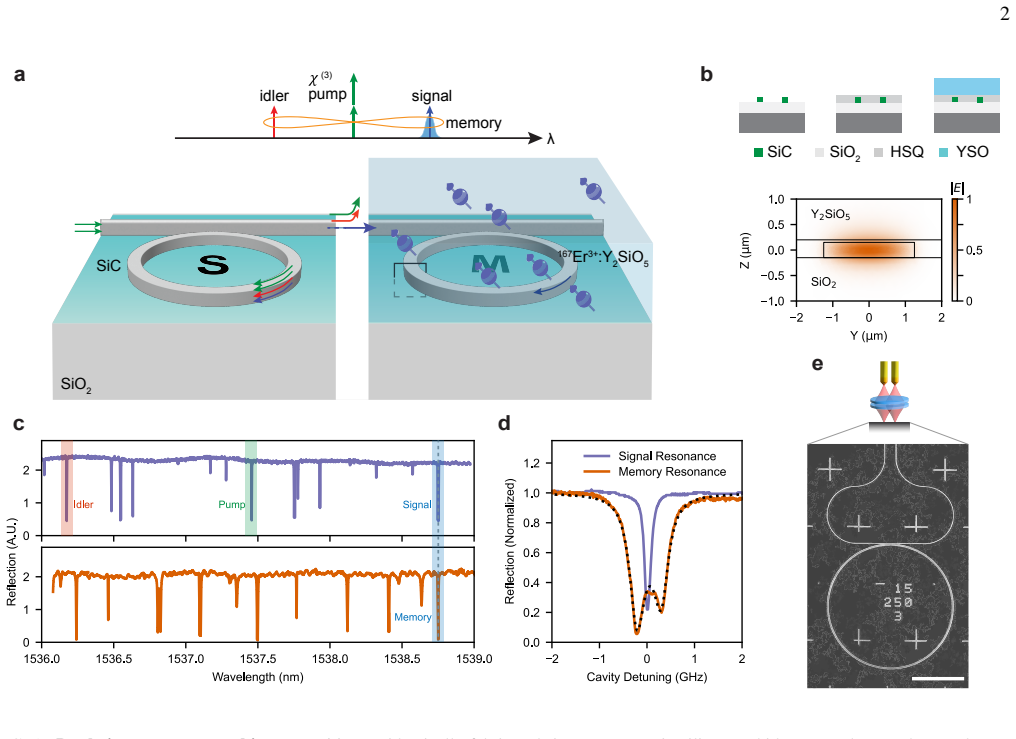
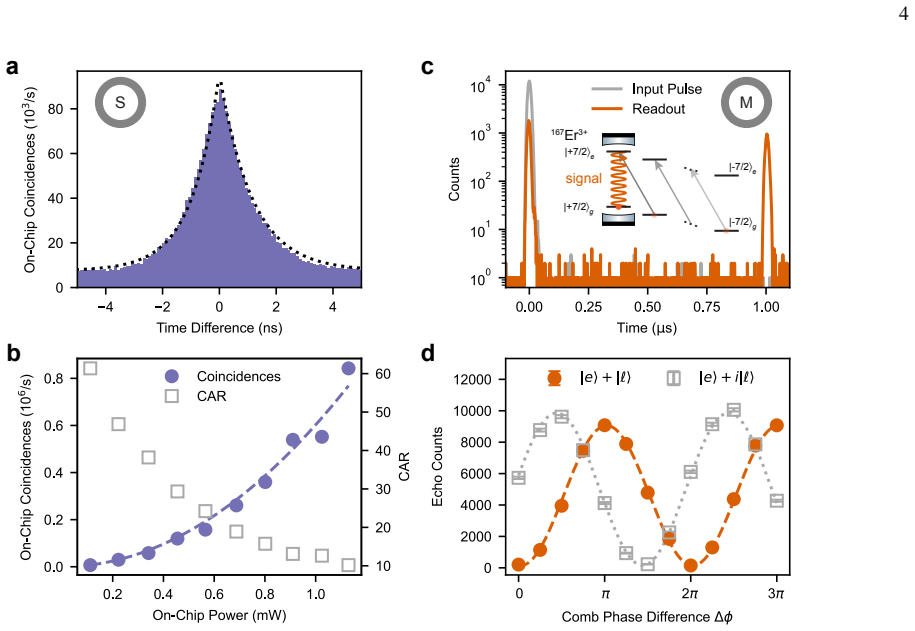
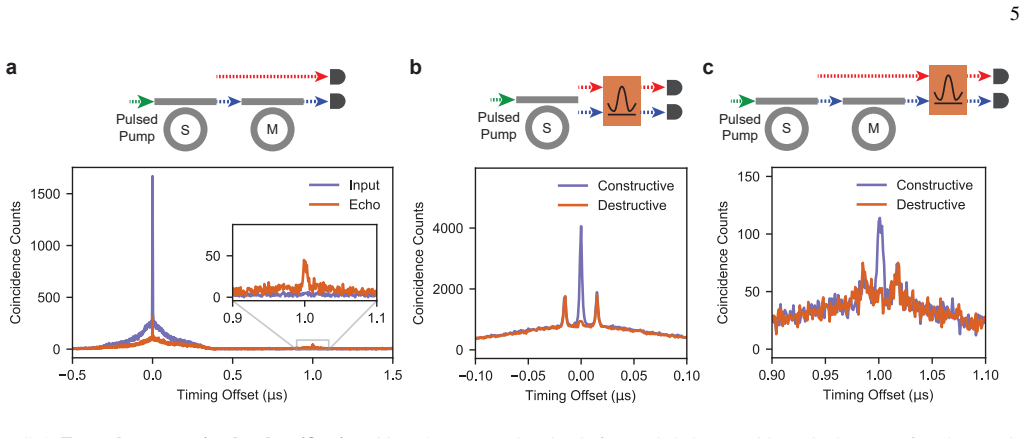
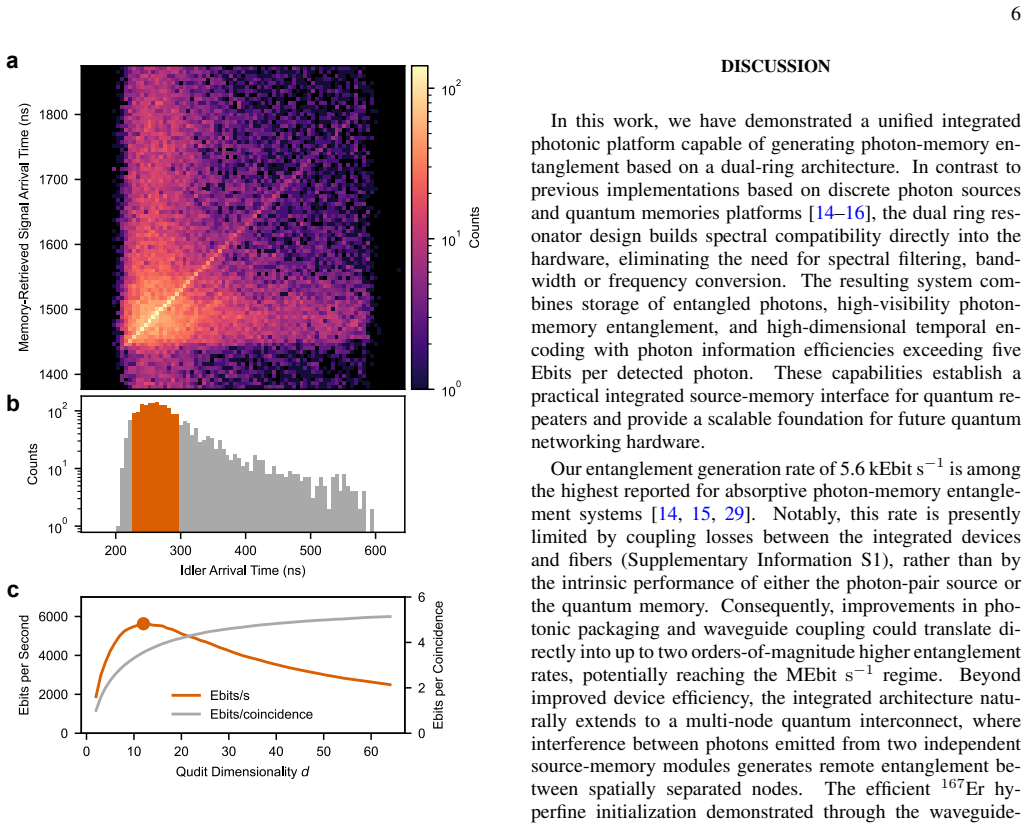
An integrated photonic architecture for telecom photon-memory entanglement generation based on dual silicon-carbide microring resonators. One resonator operates as an entangled photon-pair source, while the other functions as a cavity-enhanced atomic-frequency-comb quantum memory. The memory resonator achieves an ensemble cooperativity of 1.9 and is intrinsically spectrally matched to the photon source, enabling storage of entangled telecom photons without spectral modification. Photon-memory entanglement is generated and verified with a single-pair interference visibility of 88.1 ± 10.6%. High-dimensional photon-memory qudit entanglement is demonstrated spanning up to 63 temporal modes, lea
What carries the argument
Dual silicon-carbide microring resonators, one configured as an entangled photon-pair source and the other as a cavity-enhanced atomic-frequency-comb quantum memory.
If this is right
- Photon-memory entanglement can be produced on a single chip without external spectral filtering or frequency conversion.
- Multimode operation in up to 63 temporal modes directly increases the information per detected photon to 5.1 Ebits.
- On-chip rates reach 5.6 kEbits s^{-1}, providing a concrete benchmark for integrated quantum repeater elements.
- The platform operates entirely at telecom wavelengths, matching existing fiber infrastructure.
Where Pith is reading between the lines
- Integration of source and memory on the same chip could reduce interface losses when connecting to other photonic components for full repeater nodes.
- The multimode capacity demonstrated here suggests that further improvements in memory efficiency would scale the information rate without increasing the physical footprint.
- Material uniformity between resonators may allow similar matching in other host materials or device geometries for different wavelength bands.
Load-bearing premise
The two resonators are intrinsically spectrally matched to the photon source, enabling storage of entangled telecom photons without spectral modification.
What would settle it
Observation of interference visibility significantly below 88% or absence of storage signatures across multiple temporal modes in the memory resonator would falsify the entanglement generation claim.
Figures
read the original abstract
Scalable quantum networks require the efficient generation, storage, and synchronization of entanglement between photonic qubits and quantum memories. Quantum repeater architectures based on absorptive rare-earth-ion photonic memories offer a promising route toward highly multiplexed quantum networking, but integrating spectrally matched photon sources and quantum memories within a common platform remains a major challenge. Here we demonstrate an integrated photonic architecture for telecom photon-memory entanglement generation based on dual silicon-carbide microring resonators. One resonator operates as an entangled photon-pair source, while the other functions as a cavity-enhanced atomic-frequency-comb quantum memory. The memory resonator achieves an ensemble cooperativity of 1.9 and is intrinsically spectrally matched to the photon source, enabling storage of entangled telecom photons without spectral modification. We generate and verify photon-memory entanglement with a single-pair interference visibility of 88.1 $\pm$ 10.6%. By exploiting the multimode capacity of the memory, we demonstrate high-dimensional photon-memory qudit entanglement spanning up to 63 temporal modes, leading to a maximum photon information efficiency of 5.1 Ebits per detected photon and a peak on-chip photon-memory entanglement rate of 5.6 kEbits s$^{-1}$. These results establish the first integrated platform for photon-memory entanglement generation and provide a scalable route toward chip-scale quantum repeaters and memory-enabled quantum networks operating over telecommunications infrastructure.
Editorial analysis
A structured set of objections, weighed in public.
Referee Report
Summary. The manuscript reports an experimental demonstration of photon-memory entanglement generation using an integrated platform with two silicon-carbide microring resonators on the same chip. One resonator generates entangled photon pairs at telecom wavelengths, while the second functions as a cavity-enhanced atomic-frequency-comb memory. The resonators are claimed to be intrinsically spectrally matched, allowing direct storage without additional filtering. Key results include a measured single-pair interference visibility of 88.1 ± 10.6%, an ensemble cooperativity of 1.9, storage across up to 63 temporal modes, a maximum photon information efficiency of 5.1 Ebits per detected photon, and a peak on-chip entanglement rate of 5.6 kEbits s^{-1}. The work positions itself as the first integrated platform for such entanglement and a step toward chip-scale quantum repeaters.
Significance. If the central experimental claims hold after addressing the noted measurement uncertainties, the result would represent a meaningful technical advance by demonstrating the first on-chip integration of a photon-pair source with a spectrally matched quantum memory, enabling multimode high-dimensional entanglement at telecom wavelengths. The reported rates and efficiencies, if robust, would support the feasibility of multiplexed quantum networking architectures without external spectral conversion stages.
major comments (1)
- [Abstract and entanglement verification results] Abstract and results on entanglement verification: The reported single-pair interference visibility of 88.1 ± 10.6% is load-bearing for both the basic photon-memory entanglement claim and the subsequent high-dimensional qudit results (up to 63 modes). The uncertainty yields a lower bound of ~77.5%; without raw count rates, explicit error propagation details, background subtraction protocol, or accidentals correction in the manuscript, it is not possible to confirm that this exceeds classical limits for temporal-mode entanglement witnesses by a margin robust to small analysis variations.
minor comments (2)
- [Abstract] The abstract states an ensemble cooperativity of 1.9 but does not cross-reference the specific measurement (e.g., transmission or reflection spectrum fit) used to extract this value.
- [Figure captions and methods] Figure captions and methods should explicitly state the post-selection criteria and detection efficiencies used to compute the 5.1 Ebits/photon efficiency and 5.6 kEbits s^{-1} rate.
Simulated Author's Rebuttal
We thank the referee for their thorough review and valuable comments on our manuscript. We address the major comment regarding the entanglement verification in detail below and will update the manuscript accordingly to enhance clarity and reproducibility.
read point-by-point responses
-
Referee: [Abstract and entanglement verification results] Abstract and results on entanglement verification: The reported single-pair interference visibility of 88.1 ± 10.6% is load-bearing for both the basic photon-memory entanglement claim and the subsequent high-dimensional qudit results (up to 63 modes). The uncertainty yields a lower bound of ~77.5%; without raw count rates, explicit error propagation details, background subtraction protocol, or accidentals correction in the manuscript, it is not possible to confirm that this exceeds classical limits for temporal-mode entanglement witnesses by a margin robust to small analysis variations.
Authors: We appreciate the referee's emphasis on the need for transparent reporting of the experimental data and analysis to substantiate the entanglement claims. We agree that the current manuscript lacks sufficient detail on these aspects. In the revised version, we will include the raw coincidence count rates used in the visibility calculation, a step-by-step description of the error propagation (using standard propagation of uncertainties from Poisson-distributed counts), the background subtraction protocol (which involves estimating and subtracting accidental coincidences from off-peak time bins), and the accidentals correction procedure. Furthermore, we will add an analysis demonstrating the robustness of the visibility measurement to variations in these parameters. The measured visibility of 88.1% with a standard deviation of 10.6% yields a 1σ lower bound of 77.5%. For the temporal-mode entanglement witness applied, this exceeds the classical limit (typically 50% for two-mode cases and appropriately scaled for higher dimensions up to 63 modes) by a sufficient margin. We will also provide the full dataset or supplementary figures to allow verification. These additions will be made in the main text and/or supplementary information. revision: yes
Circularity Check
No circularity: experimental measurements only
full rationale
The paper is a pure experimental demonstration reporting directly measured quantities (visibility 88.1 ± 10.6%, rates, efficiencies) from fabricated devices and photon counting. No equations, derivations, or predictions are presented that reduce to fitted inputs or self-citations by construction. The central claims rest on raw experimental data rather than any self-referential modeling chain.
Axiom & Free-Parameter Ledger
Reference graph
Works this paper leans on
-
[1]
All optical pumping, initialization, and storage operations are performed through the waveguide coupled to the resonator
with variable bandwidth and storage time [24] (Methods). All optical pumping, initialization, and storage operations are performed through the waveguide coupled to the resonator. Operating as a standalone memory, we assess the mem- ory resonator using weak coherent pulses with a mean pho- ton number of 0.2 and a pulse duration of 15 ns. Total AFC storage-...
-
[2]
H. J. Kimble, The quantum internet, Nature453, 1023 (2008)
2008
-
[3]
S. Wehner, D. Elkouss, and R. Hanson, Quantum internet: A vi- sion for the road ahead, Science362, 10.1126/science.aam9288 (2018)
-
[4]
Simon, H
C. Simon, H. de Riedmatten, M. Afzelius, N. Sangouard, H. Zbinden, and N. Gisin, Quantum repeaters with photon pair sources and multimode memories, Physical Review Letters98, 190503 (2007)
2007
-
[5]
N. Sinclair, E. Saglamyurek, H. Mallahzadeh, J. A. Slater, M. George, R. Ricken, M. P. Hedges, D. Oblak, C. Simon, W. Sohler, and W. Tittel, Spectral multiplexing for scalable quantum photonics using an atomic frequency comb quantum memory and feed-forward control, Physical Review Letters 113, 10.1103/PhysRevLett.113.053603 (2014)
-
[6]
T. Zhong, H. Zhou, R. D. Horansky, C. Lee, V . B. Verma, A. E. Lita, A. Restelli, J. C. Bienfang, R. P. Mirin, T. Gerrits, S. W. Nam, F. Marsili, M. D. Shaw, Z. Zhang, L. Wang, D. En- glund, G. W. Wornell, J. H. Shapiro, and F. N. Wong, Photon- efficient quantum key distribution using time-energy entangle- ment with high-dimensional encoding, New Journal ...
-
[7]
Clemmen, K
S. Clemmen, K. P. Huy, W. Bogaerts, R. G. Baets, P. Emplit, and S. Massar, Continuous wave photon pair generation in silicon- on-insulator waveguides and ring resonators, Optics Express 17, 16558 (2009)
2009
-
[8]
Zhang, C
M. Zhang, C. Wang, R. Cheng, A. Shams-Ansari, and M. Lon ˇcar, Monolithic ultra-high-q lithium niobate microring resonator, Optica4, 1536 (2017)
2017
-
[9]
D. M. Lukin, C. Dory, M. A. Guidry, K. Y . Yang, S. D. Mishra, R. Trivedi, M. Radulaski, S. Sun, D. Vercruysse, G. H. Ahn, and J. Vuˇckovi´c, 4H-silicon-carbide-on-insulator for integrated quantum and nonlinear photonics, Nature Photonics14, 330 (2020)
2020
-
[10]
Saglamyurek, N
E. Saglamyurek, N. Sinclair, J. Jin, J. A. Slater, D. Oblak, F. Bussières, M. George, R. Ricken, W. Sohler, and W. Tittel, Broadband waveguide quantum memory for entangled photons, Nature469, 512 (2011)
2011
-
[11]
Zhong, J
T. Zhong, J. M. Kindem, J. G. Bartholomew, J. Rochman, I. Craiciu, E. Miyazono, M. Bettinelli, E. Cavalli, V . Verma, S. W. Nam, F. Marsili, M. D. Shaw, A. D. Beyer, and A. Faraon, Nanophotonic rare-earth quantum memory with optically con- trolled retrieval, Science357, 1392 (2017)
2017
-
[13]
Meng, P.-X
R.-R. Meng, P.-X. Liu, X. Liu, T.-X. Zhu, P.-J. Liang, C. Zhang, Z.-Y . Tang, H.-Z. Zhang, J.-M. Cui, M. Jin, Z.-Q. Zhou, C.-F. Li, and G.-C. Guo, Efficient integrated quantum memory for light, Nature Photonics20, 437 (2026)
2026
-
[14]
Jiang, W
M.-H. Jiang, W. Xue, Q. He, Y .-Y . An, X. Zheng, W.-J. Xu, Y .-B. Xie, Y . Lu, S. Zhu, and X.-S. Ma, Quantum storage of entangled photons at telecom wavelengths in a crystal, Nature Communications14, 6995 (2023)
2023
-
[15]
Lago-Rivera, S
D. Lago-Rivera, S. Grandi, J. V . Rakonjac, A. Seri, and H. de Riedmatten, Telecom-heralded entanglement between multimode solid-state quantum memories, Nature594, 37 (2021)
2021
-
[16]
X. Liu, J. Hu, Z.-F. Li, X. Li, P.-Y . Li, P.-J. Liang, Z.-Q. Zhou, C.-F. Li, and G.-C. Guo, Heralded entanglement distribution between two absorptive quantum memories, Nature594, 41 9 (2021)
2021
-
[17]
J. V . Rakonjac, S. Grandi, S. Wengerowsky, D. Lago-Rivera, F. Appas, and H. de Riedmatten, Transmission of light–matter entanglement over a metropolitan network, Optica Quantum1, 94 (2023)
2023
-
[18]
Rahmouni, R
A. Rahmouni, R. Wang, J. Li, X. Tang, T. Gerrits, O. Slattery, Q. Li, and L. Ma, Entangled photon pair generation in an in- tegrated sic platform, Light: Science & Applications13, 110 (2024)
2024
-
[19]
L. Yang, S. Wang, M. Shen, Y . Xu, J. Xie, and H. X. Tang, Pho- tonic integration of Er3+:Y2SiO5 with thin-film lithium niobate by flip chip bonding, Optics Express29, 15497 (2021)
2021
-
[20]
Duranti, S
S. Duranti, S. Wengerowsky, L. Feldmann, A. Seri, B. Casabone, and H. de Riedmatten, Efficient cavity-assisted storage of photonic qubits in a solid-state quantum memory, Opt. Express32, 26884 (2024)
2024
-
[21]
J. D. Franson, Bell inequality for position and time, Phys. Rev. Lett.62, 2205 (1989)
1989
-
[22]
Craiciu, M
I. Craiciu, M. Lei, J. Rochman, J. G. Bartholomew, and A. Faraon, Multifunctional on-chip storage at telecommunica- tion wavelength for quantum networks, Optica8, 114 (2021)
2021
-
[23]
Afzelius and C
M. Afzelius and C. Simon, Impedance-matched cavity quantum memory, Phys. Rev. A82, 022310 (2010)
2010
-
[24]
S. A. Moiseev, S. N. Andrianov, and F. F. Gubaidullin, Efficient multimode quantum memory based on photon echo in an opti- mal QED cavity, Phys. Rev. A82, 022311 (2010)
2010
-
[25]
Businger, L
M. Businger, L. Nicolas, T. S. Mejia, A. Ferrier, P. Gold- ner, and M. Afzelius, Non-classical correlations over 1250 modes between telecom photons and 979-nm photons stored in 171Yb3+:Y2SiO5, Nature Communications13, 6438 (2022)
2022
-
[26]
H. D. Riedmatten, M. Afzelius, M. U. Staudt, C. Simon, and N. Gisin, A solid-state light-matter interface at the single- photon level, Nature456, 773 (2008)
2008
-
[27]
Hänni, A
J. Hänni, A. E. Rodríguez-Moldes, F. Appas, S. Wengerowsky, D. Lago-Rivera, M. Teller, S. Grandi, and H. de Riedmat- ten, Heralded entanglement of on-demand spin-wave solid-state quantum memories for multiplexed quantum network links, Phys. Rev. X15, 041003 (2025)
2025
-
[28]
Cozzolino, B
D. Cozzolino, B. Da Lio, D. Bacco, and L. K. Oxen- løwe, High-dimensional quantum communication: Benefits, progress, and future challenges, Advanced Quantum Technolo- gies2, 1900038 (2019)
2019
-
[29]
Erhard, M
M. Erhard, M. Krenn, and A. Zeilinger, Advances in high- dimensional quantum entanglement, Nature Reviews Physics2, 365 (2020)
2020
-
[30]
Saglamyurek, M
E. Saglamyurek, M. G. Puigibert, Q. Zhou, L. Giner, F. Marsili, V . B. Verma, S. W. Nam, L. Oesterling, D. Nippa, D. Oblak, and W. Tittel, A multiplexed light-matter interface for fibre-based quantum networks, Nature Communications7, 11202 (2016)
2016
-
[31]
Afzelius, C
M. Afzelius, C. Simon, H. de Riedmatten, and N. Gisin, Mul- timode quantum memory based on atomic frequency combs, Physical Review A79, 052329 (2009)
2009
-
[32]
Ran ˇci´c, M
M. Ran ˇci´c, M. P. Hedges, R. L. Ahlefeldt, and M. J. Sellars, Co- herence time of over a second in a telecom-compatible quantum memory storage material, Nature Physics14, 50 (2018)
2018
-
[33]
H.-K. Lau, H. Qiao, A. A. Clerk, and T. Zhong, Efficient in situ generation of photon-memory entanglement in a nonlinear cav- ity, Physical Review Letters134, 053602 (2025)
2025
-
[34]
J. Akin, Y . Zhao, Y . Misra, A. K. M. N. Haque, and K. Fang, InGaPχ(2) integrated photonics platform for broadband, ultra- efficient nonlinear conversion and entangled photon generation, Light: Science & Applications13, 290 (2024)
2024
-
[35]
Lloyd, Enhanced sensitivity of photodetection via quantum illumination, Science321, 1463 (2008)
S. Lloyd, Enhanced sensitivity of photodetection via quantum illumination, Science321, 1463 (2008)
2008
-
[36]
W. Qin, A. Miranowicz, P.-B. Li, X.-Y . Lü, J. Q. You, and F. Nori, Exponentially enhanced light-matter interaction, coop- erativities, and steady-state entanglement using parametric am- plification, Phys. Rev. Lett.120, 093601 (2018)
2018
-
[37]
Leroux, L
C. Leroux, L. C. G. Govia, and A. A. Clerk, Enhancing cav- ity quantum electrodynamics via antisqueezing: Synthetic ul- trastrong coupling, Phys. Rev. Lett.120, 093602 (2018)
2018
-
[38]
T. K. Lê, D. M. Lukin, C. Roques-Carmes, A. Karnieli, E. Lustig, M. A. Guidry, S. Fan, and J. Vuˇckovi´c, Cavity quan- tum electrodynamics in a finite-bandwidth squeezed reservoir, Phys. Rev. Appl.24, 034053 (2025)
2025
-
[39]
J. S. Stuart, M. Hedges, R. Ahlefeldt, and M. Sellars, Initializa- tion protocol for efficient quantum memories using resolved hy- perfine structure, Physical Review Research3, 10.1103/Phys- RevResearch.3.L032054 (2021)
-
[40]
I. Diniz, S. Portolan, R. Ferreira, J. M. Gérard, P. Bertet, and A. Auffèves, Strongly coupling a cavity to inhomogeneous en- sembles of emitters: Potential for long-lived solid-state quan- tum memories, Physical Review A - Atomic, Molecular, and Optical Physics84, 10.1103/PhysRevA.84.063810 (2011)
-
[41]
Miyazono, I
E. Miyazono, I. Craiciu, A. Arbabi, T. Zhong, and A. Faraon, Coupling erbium dopants in yttrium orthosilicate to silicon photonic resonators and waveguides., Optics express25, 2863 (2017)
2017
-
[42]
S. A. Moiseev, S. N. Andrianov, and F. F. Gubaidullin, Efficient multimode quantum memory based on photon echo in an opti- mal QED cavity, Physical Review A—Atomic, Molecular, and Optical Physics82, 022311 (2010)
2010
-
[43]
P. Jobez, N. Timoney, C. Laplane, J. Etesse, A. Ferrier, P. Gold- ner, N. Gisin, and M. Afzelius, Towards highly multimode op- tical quantum memory for quantum repeaters, Physical Review A93, 10.1103/PhysRevA.93.032327 (2016)
-
[44]
flood beam
C. Liu, T.-X. Zhu, M.-X. Su, Y .-Z. Ma, Z.-Q. Zhou, C.-F. Li, and G.-C. Guo, On-demand quantum storage of photonic qubits in an on-chip waveguide, Phys. Rev. Lett.125, 260504 (2020). 10 SUPPLEMENTARY INFORMATION S1 Experimental Setup 1.1 Schematics of the complete experimental setup The complete experimental setup is shown in Fig. S1. Table S1 summarizes ...
2020
discussion (0)
Sign in with ORCID, Apple, or X to comment. Anyone can read and Pith papers without signing in.