REVIEW 4 major objections 6 minor 26 references
TOM-GS: Editable Video Representation via Temporal Opacity Modulation of Static 3D Gaussians
T0 review · 4 major / 6 minor · reviewed 2026-08-01 · deepseek-v4-flash
Pith's one-line read A video can be represented as a fixed 3D Gaussian scene in which every primitive simply fades in and out according to a learned temporal window; the paper shows this static-geometry-plus-opacity design beats deformation-based video represen
desk verdict A solid reconstruction-focused paper with a clean idea and useful ablations, but the editing claim is not supported by the actual pipeline, which uses per-frame tetrahedral deformation on a separate foreground model. read the letter →
The pith
A machine-rendered reading of the paper's core claim, the machinery that carries it, and where it could break.
The reading
What carries the argument
The central object is the temporal opacity window, a per-Gaussian learnable pair (μτ, στ) multiplied into the base opacity (Eq. 2). It is what carries all scene dynamics: it converts motion into a temporal on/off schedule for otherwise static 3D Gaussians, keeping the spatial parameterization identical to standard 3D Gaussian Splatting. The supporting machinery — fixed off-the-shelf camera poses to ground the scene in one world frame, disabling opacity resets so learned windows survive training, and inverse-PSNR frame sampling to concentrate Gaussians on dynamic segments — exists to make that window learnable and stable.
What would settle it
Take a video with known ground-truth camera poses (for instance, a synthetic scene or a tripod-filmed scene with a ground-truth trajectory), run the same pose estimator the paper uses, and compare TOM-GS trained with estimated poses against TOM-GS trained with the ground-truth poses. A large quality gap between the two — or visibly chaotic temporal-window assignments under estimated poses — would show that the static-geometry-plus-opacity claim holds only when pose estimation is essentially perfect. A complementary test: a synthetic video with a perfectly known accelerating camera and a moving
Extended reading notes
Core claim
The paper claims that monocular video can be represented by static 3D Gaussians whose opacity is modulated by a learnable 1D temporal window, Eq. (2), α = α_b · exp(−(t − μτ)²/(2στ²)). Each Gaussian carries a learnable temporal mean μτ and scale στ that decide when it appears and how long it stays visible; nothing in the geometry moves. Grounded by off-the-shelf per-frame camera poses that are held fixed, the whole scene sits in one world frame, and a dynamic object is a set of Gaussians lighting up sequentially along its trajectory. On the DAVIS video dataset the model reports mean PSNR 36.50, above VeGaS (33.31), Splatter-a-Video (28.44), and neural video baselines, and ablations show the
Load-bearing premise
The load-bearing premise is that the per-frame camera poses taken from an off-the-shelf estimator are accurate enough to be fixed as ground truth, so that every apparent motion in the video can be explained by camera movement plus static Gaussians switching on and off; when that fails — pose drift, dynamic foregrounds that fool the tracker — the fixed geometry has no way to absorb the residual motion, and the temporal opacity schedule cannot compensate.
Editorial extensions
If this is right
- Scaling, translating, duplicating, or deleting a Gaussian automatically preserves its temporal duration, so spatial edits apply to every frame of the video at once.
- Because the geometry is a standard 3DGS asset, physics engines can simulate the tetrahedralized cloud and produce per-frame deformations that are rendered back into a physically plausible edited video.
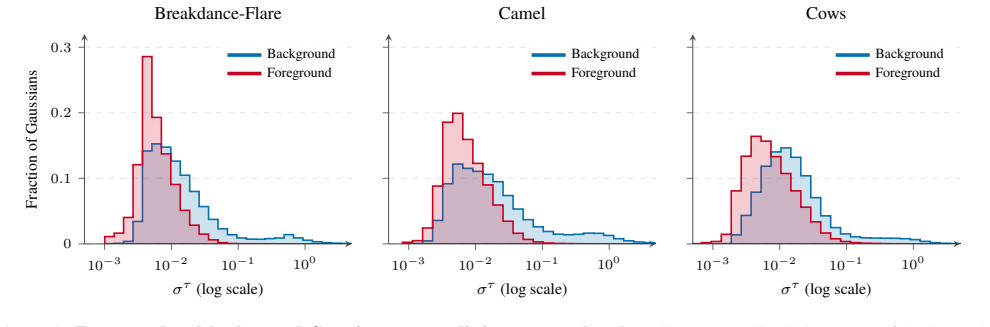
- The emergent separation of foreground (small στ) and background (large στ) means a dynamic/static partition of the video is encoded in the learned parameters, not imposed externally.
- Reconstruction quality improves monotonically with the Gaussian budget, so users can trade memory and training time for fidelity in a predictable way.
- A video can be built with no manual pose annotation or per-frame motion layers, using only automatic pose estimation and ordinary 3DGS optimization.
Reading between the lines
- If opacity scheduling is sufficient for dynamics, then 'motion' in a video may be representable as a set-assignment problem on a static point cloud, which invites connections to temporal compositing and to tracking-by-partitioning in object permanence research.
- The method's fidelity is coupled to the accuracy of the precomputed camera poses; a natural extension is joint optimization of poses and temporal windows, or per-video multiple pose hypotheses, which would let the model handle handheld footage with strong parallax.
- The learned στ histograms could be repurposed as free motion-segmentation masks, potentially replacing the explicit segmentation the editing pipeline currently requires for foreground isolation.
- A stress-test on fast, large-displacement motion (e.g., sports or ego-motion videos) would define the regime where opacity-only dynamics still holds, or reveal when the static-geometry assumption must be relaxed.
Editorial analysis
A structured set of objections, weighed in public.
Referee Report
Summary. The paper introduces TOM-GS, a video representation in which all 3D Gaussians remain spatially static and temporal dynamics are modeled exclusively through a per-Gaussian temporal opacity window (Eq. 2). Camera poses are fixed via AnyCam, and training uses inverse-PSNR frame sampling, disabled opacity resets, and a 10M densification cap. Reconstruction experiments on DAVIS report TOM-GS outperforming VeGaS and other baselines. For editing, the method trains a separate MiRaGe-style foreground model, converts it to tetrahedra, and deforms those tetrahedra per frame for manual and physics-based edits. The central claim is that static geometry plus temporal opacity yields an ordinary 3DGS asset that is directly compatible with standard editing tools.
Significance. If validated, TOM-GS would be a conceptually useful alternative to deformation-based dynamic Gaussian representations, with a simple formulation and strong reconstruction results. The paper's strengths include careful ablations in Table 5 isolating temporal opacity, pose, frame sampling, and opacity resets; a quantitative evaluation under two external protocols (Tables 2 and 3); and an interesting temporal-scale analysis (Fig. 5) that supports the intuition behind the method. However, the editing demonstration does not actually operate on the static TOM-GS cloud, and the multiple PSNR values reported across Tables 1–3 are not reconciled. These issues affect the two central advertised contributions—state-of-the-art fidelity and seamless editability—so the work needs additional experimental support or a reframing of its claims.
major comments (4)
- [§5, Fig. 7] The editing pipeline does not validate the 'standard 3DGS asset' compatibility claim. The pipeline trains a new foreground model under MiRaGe dual-camera constraints, explicitly omits the estimated camera poses ('we omit them here'), converts the cloud to tetrahedra, and deforms those tetrahedra per frame ('When the edit varies over time, this procedure is applied per frame, yielding a per-frame Gaussian cloud'). Figure 7 labels 'Per-frame deformed Gaussians' and 'Per-frame deformed tetrahedra.' This is exactly the kind of spatial deformation the paper claims to avoid. No experiment shows that applying an edit to the trained static TOM-GS cloud (e.g., translating/scaling all Gaussians or running PhysGaussian on the static cloud) preserves temporal consistency or avoids ghosting. The editability contribution is either demonstrated on the TOM-GS model itself or explicitly presented as a se
- [Tables 1–3] The reported TOM-GS PSNR is 39.80 in Table 1, 36.50 in Table 2, and 35.06 in Table 3, under 'the evaluation protocol of [16]' and 'the evaluation setting of [26]' without defining either protocol. The abstract/introduction uses these numbers to claim state-of-the-art performance, but the reader cannot tell which evaluation is primary or why the same method differs by up to 4.7 dB. No error bars or multiple seeds are reported for any table. Please specify the primary protocol, state the frame resolutions and subsets, and provide variance estimates; otherwise the empirical claim is not verifiable.
- [§3.3, Table 5] The representation's success depends on the camera poses being accurate enough to account for all apparent background motion, because static Gaussians cannot absorb residual motion. The identity-pose ablation drops mean PSNR from 36.50 to 31.88 (Table 5), showing high sensitivity to this assumption. Yet no analysis of AnyCam pose accuracy on the DAVIS sequences is provided, and no failure cases are discussed. Since the paper explicitly grounds the method in 'robust, off-the-shelf pose estimation,' this is load-bearing; include pose-error statistics or a sensitivity analysis to support the robustness claim.
- [§4.4, Fig. 5] The claim that foreground and background Gaussians 'naturally' separate by temporal scale is not supported by the experiment as described. The histograms are computed from two separately trained variants—one supervised only on foreground pixels and one on background pixels—so the separation is induced by the mask, not shown to emerge in a single TOM-GS model. To support the 'emergent separation' claim, label Gaussians within a single trained model (e.g., by projection against a foreground mask) and show the same bimodality in that setting.
minor comments (6)
- [Abstract/Intro] 'atemporal opacity modulation' appears to be a typo for 'a temporal opacity modulation'.
- [§3.4] The inverse-PSNR sampling probability and the window used to update running PSNR are not defined. Provide the exact formula and hyperparameters, otherwise the contribution is not reproducible.
- [Eq. (2), §3.4] The initialization and bounds for the temporal parameters μτ and στ are not stated. Since these determine when each Gaussian appears and disappears, specify their initial values and any regularization/constraints.
- [Figures 2 and 8] The editing results are shown only qualitatively. Consider adding a quantitative measure of edit fidelity or temporal consistency, or a comparison to a comparable editable representation.
- [Tables 2–3] Table 2 reports LPIPS while Table 3 does not; Table 3 reports SSIM for all baselines but Table 2 does not. Align metric reporting across tables for easier comparison.
- [§4.4] Please clarify whether the foreground/background variants are trained with identical hyperparameters and how the foreground mask is obtained (e.g., DAVIS annotations, segmentation model).
Circularity Check
No circular derivation; reconstruction is externally benchmarked and self-citations are not load-bearing.
full rationale
The paper's derivation is self-contained and its central empirical claim is tested against external baselines rather than reduced to its own inputs. Eq. (2) defines temporal opacity as base opacity times a 1-D temporal Gaussian; optimizing mu_tau, sigma_tau, and the standard 3DGS parameters under the photometric loss is a fitting procedure, and Tables 1-3 evaluate reconstruction against DAVIS frames using external methods (NeRV, HNeRV, CoDeF, Splatter-a-Video, etc.). The ablations in Table 5 (identity poses, disabled temporal opacity, opacity resets, uniform sampling, neural opacity predictor) are genuine controls, not fitted outputs presented as predictions. Same-group references (VeGaS, GaMeS, MiRaGe) appear as baseline and as editing/conversion components; they are not used to justify the central 'temporal opacity captures dynamics without deformation' claim, so they are not load-bearing self-citations. The Sec. 3.3 assumption that static geometry plus AnyCam poses explains apparent background motion is explicit and its sensitivity is honestly ablated. The Sec. 5 editing pipeline does deform tetrahedra per frame (Fig. 7), which is a substantive inconsistency with the static-geometry editability claim, but that is an overclaim/correctness issue, not a circular derivation: the reconstruction numbers and Eq. (2) do not depend on the editing procedure. Score 2 reflects only the presence of minor non-load-bearing same-group citations, not a circular step.
Assumptions & free parameters
free parameters (6)
- Per-Gaussian temporal window (μτ, στ) =
learned per Gaussian
- Densification cap =
10M Gaussians default
- Inverse-PSNR sampling update details =
not specified
- Disabling opacity resets =
on (default)
- Training iterations =
80k (densify first 60k)
- Foreground plane/dual-camera constraint =
N/A
assumptions (5)
- domain assumption Standard 3DGS differentiable rasterization and optimization (L1 + D-SSIM) are a valid backbone
- domain assumption AnyCam camera poses are accurate enough to anchor all frames in a shared coordinate system
- domain assumption A single temporal Gaussian window per Gaussian can represent arbitrary appearance, disappearance, and disocclusion dynamics in monocular video
- domain assumption Segmentation masks and a plane/dual-camera constraint are available for foreground editing
- domain assumption Tetrahedral conversion (GaMeS) faithfully maps Gaussians to tetrahedra and back for editing
Cite this review
Pith. "Pith review of TOM-GS: Editable Video Representation via Temporal Opacity Modulation of Static 3D Gaussians." pith.science (2026). https://pith.science/paper/FRAV4QE2
@misc{pith2026260722717,
  author       = {Pith},
  title        = {Pith review of: TOM-GS: Editable Video Representation via Temporal Opacity Modulation of Static 3D Gaussians},
  year         = {2026},
  howpublished = {\url{https://pith.science/paper/FRAV4QE2}},
  note         = {Machine review of arXiv:2607.22717}
}
read the original abstract
While Implicit Neural Representations (INRs) and dynamic 3D Gaussian Splatting (3DGS) achieve impressive results in video processing, they often fall short of producing representations that are easily editable. Recent methods address this by introducing complex spatial deformations or folded distributions, which constrain optimization and reduce flexibility for downstream editing. In this paper, we introduce TOM-GS, an editable video representation that forgoes complex deformations in favor of regular 3D Gaussians equipped with a continuous temporal opacity formulation. By assigning a learnable temporal mean and scale to the opacity of each Gaussian, our model enables static 3D spatial components to fade smoothly in and out of the scene. Grounded by robust, off-the-shelf pose estimation, our approach maintains a static spatial geometry that naturally supports a wide range of manual and physics-based edits. TOM-GS outperforms prior editable video representations in visual fidelity, while its reliance on standard 3D Gaussians ensures seamless compatibility with established 3D editing tools.
Figures


Figures from the paper (5 more)



Reference graph
Works this paper leans on
-
[16]
Splatter a video: Video gaussian representation for versatile processing.Advances in Neural Information Processing Systems, 37:50401–50425, 2024
Yang-Tian Sun, Yi-Hua Huang, Lin Ma, Xiaoyang Lyu, Yan- Pei Cao, and Xiaojuan Qi. Splatter a video: Video gaussian representation for versatile processing.Advances in Neural Information Processing Systems, 37:50401–50425, 2024. 1, 3, 4, 9
2024
-
[26]
Dnerv: Model- ing inherent dynamics via difference neural representation for videos
Qi Zhao, M Salman Asif, and Zhan Ma. Dnerv: Model- ing inherent dynamics via difference neural representation for videos. InProceedings of the IEEE/CVF Conference on Computer Vision and Pattern Recognition, pages 2031– 2040, 2023. 5 10
-
[1]
Gaussianvideo: Efficient video repre- sentation via hierarchical gaussian splatting
Andrew Bond, Jui-Hsien Wang, Long Mai, Erkut Erdem, and Aykut Erdem. Gaussianvideo: Efficient video repre- sentation via hierarchical gaussian splatting. InProceedings of the IEEE/CVF International Conference on Computer Vi- sion, pages 7187–7196, 2025. 4
2025
-
[2]
Nerv: Neural representations for videos.Advances in Neural Information Processing Systems, 34:21557–21568, 2021
Hao Chen, Bo He, Hanyu Wang, Yixuan Ren, Ser Nam Lim, and Abhinav Shrivastava. Nerv: Neural representations for videos.Advances in Neural Information Processing Systems, 34:21557–21568, 2021. 2, 4, 5
2021
-
[3]
Hnerv: A hybrid neural representation for videos
Hao Chen, Matthew Gwilliam, Ser-Nam Lim, and Abhi- nav Shrivastava. Hnerv: A hybrid neural representation for videos. InProceedings of the IEEE/CVF Conference on Computer Vision and Pattern Recognition, pages 10270– 10279, 2023. 2, 4, 5
2023
-
[4]
Gaussianeditor: Swift and control- lable 3d editing with gaussian splatting
Yiwen Chen, Zilong Chen, Chi Zhang, Feng Wang, Xi- aofeng Yang, Yikai Wang, Zhongang Cai, Lei Yang, Huaping Liu, and Guosheng Lin. Gaussianeditor: Swift and control- lable 3d editing with gaussian splatting. InProceedings of the IEEE/CVF conference on computer vision and pattern recognition, pages 21476–21485, 2024. 3
2024
-
[5]
3d gaussian splatting for real-time radiance field rendering.ACM Trans
Bernhard Kerbl, Georgios Kopanas, Thomas Leimk ¨uhler, George Drettakis, et al. 3d gaussian splatting for real-time radiance field rendering.ACM Trans. Graph., 42(4):139–1,
-
[6]
E-nerv: Expedite neural video rep- resentation with disentangled spatial-temporal context
Zizhang Li, Mengmeng Wang, Huaijin Pi, Kechun Xu, Jian- biao Mei, and Yong Liu. E-nerv: Expedite neural video rep- resentation with disentangled spatial-temporal context. In European conference on computer vision, pages 267–284. Springer, 2022. 2, 5
2022
Show all 26 references
-
[7]
Spacetime gaus- sian feature splatting for real-time dynamic view synthesis
Zhan Li, Zhang Chen, Zhong Li, and Yi Xu. Spacetime gaus- sian feature splatting for real-time dynamic view synthesis. InProceedings of the IEEE/CVF Conference on Computer Vision and Pattern Recognition, pages 8508–8520, 2024. 3
2024
-
[8]
Robust dynamic radiance fields
Yu-Lun Liu, Chen Gao, Andreas Meuleman, Hung-Yu Tseng, Ayush Saraf, Changil Kim, Yung-Yu Chuang, Jo- hannes Kopf, and Jia-Bin Huang. Robust dynamic radiance fields. InProceedings of the IEEE/CVF Conference on Com- puter Vision and Pattern Recognition, pages 13–23, 2023. 4
2023
-
[9]
Dynamic 3d gaussians: Tracking by per- sistent dynamic view synthesis
Jonathon Luiten, Georgios Kopanas, Bastian Leibe, and Deva Ramanan. Dynamic 3d gaussians: Tracking by per- sistent dynamic view synthesis. In2024 International Con- ference on 3D Vision (3DV), pages 800–809. IEEE, 2024. 3
2024
-
[10]
Codef: Content deformation fields for temporally consistent video processing
Hao Ouyang, Qiuyu Wang, Yuxi Xiao, Qingyan Bai, Jun- tao Zhang, Kecheng Zheng, Xiaowei Zhou, Qifeng Chen, and Yujun Shen. Codef: Content deformation fields for temporally consistent video processing. InProceedings of the IEEE/CVF Conference on Computer Vision and Pattern Recog...
2024
-
[11]
Nerfies: Deformable neural radiance fields
Keunhong Park, Utkarsh Sinha, Jonathan T Barron, Sofien Bouaziz, Dan B Goldman, Steven M Seitz, and Ricardo Martin-Brualla. Nerfies: Deformable neural radiance fields. InProceedings of the IEEE/CVF international conference on computer vision, pages 5865–5874, 2021. 3
2021
-
[12]
Hypernerf: A higher- dimensional representation for topologically varying neural radiance fields.arXiv preprint arXiv:2106.13228, 2021
Keunhong Park, Utkarsh Sinha, Peter Hedman, Jonathan T Barron, Sofien Bouaziz, Dan B Goldman, Ricardo Martin- Brualla, and Steven M Seitz. Hypernerf: A higher- dimensional representation for topologically varying neural radiance fields.arXiv preprint arXiv:2106.13228, 2021. 3
2021 arXiv
-
[13]
The 2017 davis challenge on video object segmentation, 2018
Jordi Pont-Tuset, Federico Perazzi, Sergi Caelles, Pablo Ar- bel´aez, Alex Sorkine-Hornung, and Luc Van Gool. The 2017 davis challenge on video object segmentation, 2018. 2, 3, 4, 5
2017
-
[14]
D-nerf: Neural radiance fields for dynamic scenes
Albert Pumarola, Enric Corona, Gerard Pons-Moll, and Francesc Moreno-Noguer. D-nerf: Neural radiance fields for dynamic scenes. InProceedings of the IEEE/CVF con- ference on computer vision and pattern recognition, pages 10318–10327, 2021. 3
2021
-
[15]
Vegas: Video gaussian splatting.Information Sciences, 735: 123033, 2026
Weronika Smolak-Dy ˙zewska, Dawid Malarz, Kornel Howil, Jan Kaczmarczyk, Marcin Mazur, and Przemysław Spurek. Vegas: Video gaussian splatting.Information Sciences, 735: 123033, 2026. 1, 3, 4, 5, 6, 9
2026
-
[17]
Games: Mesh-based adapt- ing and modification of gaussian splatting.arXiv preprint arXiv:2402.01459, 2024
Joanna Waczy ´nska, Piotr Borycki, Sławomir Tadeja, Jacek Tabor, and Przemysław Spurek. Games: Mesh-based adapt- ing and modification of gaussian splatting.arXiv preprint arXiv:2402.01459, 2024. 7
2024 arXiv
-
[18]
Mirage: Editable 2d images using gaussian splatting
Joanna Waczynska, Tomasz Szczepanik, Piotr Borycki, Sla- womir Tadeja, Thomas Bohn ´e, and Przemysław Spurek. Mirage: Editable 2d images using gaussian splatting. In 9 Forty-second International Conference on Machine Learn- ing, 2025. 7
2025
-
[19]
Tracking everything everywhere all at once
Qianqian Wang, Yen-Yu Chang, Ruojin Cai, Zhengqi Li, Bharath Hariharan, Aleksander Holynski, and Noah Snavely. Tracking everything everywhere all at once. InProceedings of the IEEE/CVF International Conference on Computer Vi- sion, pages 19795–19806, 2023. 4
2023
-
[20]
Anycam: Learning to re- cover camera poses and intrinsics from casual videos
Felix Wimbauer, Weirong Chen, Dominik Muhle, Christian Rupprecht, and Daniel Cremers. Anycam: Learning to re- cover camera poses and intrinsics from casual videos. In Proceedings of the Computer Vision and Pattern Recognition Conference, pages 16717–16727, 2025. 2, 5
2025
-
[21]
4d gaussian splatting for real-time dynamic scene rendering
Guanjun Wu, Taoran Yi, Jiemin Fang, Lingxi Xie, Xiaopeng Zhang, Wei Wei, Wenyu Liu, Qi Tian, and Xinggang Wang. 4d gaussian splatting for real-time dynamic scene rendering. InProceedings of the IEEE/CVF conference on computer vi- sion and pattern recognition, pages 20310–20320...
2024
-
[22]
Physgaussian: Physics- integrated 3d gaussians for generative dynamics
Tianyi Xie, Zeshun Zong, Yuxing Qiu, Xuan Li, Yutao Feng, Yin Yang, and Chenfanfu Jiang. Physgaussian: Physics- integrated 3d gaussians for generative dynamics. InProceed- ings of the IEEE/CVF Conference on Computer Vision and Pattern Recognition, pages 4389–4398, 2024. 3
2024
-
[23]
Deformable 3d gaussians for high- fidelity monocular dynamic scene reconstruction
Ziyi Yang, Xinyu Gao, Wen Zhou, Shaohui Jiao, Yuqing Zhang, and Xiaogang Jin. Deformable 3d gaussians for high- fidelity monocular dynamic scene reconstruction. InPro- ceedings of the IEEE/CVF conference on computer vision and pattern recognition, pages 20331–20341, 2024. 3
2024
-
[24]
Deformable sprites for unsupervised video decomposition
Vickie Ye, Zhengqi Li, Richard Tucker, Angjoo Kanazawa, and Noah Snavely. Deformable sprites for unsupervised video decomposition. InProceedings of the IEEE/CVF Con- ference on Computer Vision and Pattern Recognition, pages 2657–2666, 2022. 4
2022
-
[25]
Gaussianimage: 1000 fps image representation and compres- sion by 2d gaussian splatting
Xinjie Zhang, Xingtong Ge, Tongda Xu, Dailan He, Yan Wang, Hongwei Qin, Guo Lu, Jing Geng, and Jun Zhang. Gaussianimage: 1000 fps image representation and compres- sion by 2d gaussian splatting. InEuropean Conference on Computer Vision, pages 327–345. Springer, 2024. 4
2024
Reviewed August 1, 2026 · model on record in the stance chip above.
Discussion (0). Sign in to comment.