Multi-Domain Security for 6G ISAC: Challenges and Opportunities in Transportation
Pith reviewed 2026-05-21 19:29 UTC · model grok-4.3
The pith
Integrated security framework for 6G ISAC in transportation uses existing measurements for lightweight cross-checks across cyber-physical, physical-layer and protocol domains.
A machine-rendered reading of the paper's core claim, the machinery that carries it, and where it could break.
Core claim
The paper claims that a multi-domain security vision for 6G transportation can be realized through an integrated framework that unifies protection in the cyber-physical, physical-layer and protocol domains by repurposing existing ISAC measurements as the basis for lightweight cross-checks that detect attacks without introducing substantial new overhead or vulnerabilities.
What carries the argument
integrated security framework that unifies protection across domains by leveraging existing ISAC measurements for lightweight cross-checks
If this is right
- Cross-domain attacks become detectable through inconsistencies in ISAC measurements.
- Lightweight verification reduces the burden on complex cryptographic protocols.
- Security can be added to 6G transportation systems with limited impact on ISAC performance.
- ISAC capabilities shift from pure vulnerability to an active security resource.
Where Pith is reading between the lines
- The same cross-check principle could be tested in non-transportation ISAC settings such as industrial monitoring.
- Implementation in a vehicle-to-everything testbed would show whether the checks maintain real-time performance under attack.
- Standardization efforts for 6G might adopt similar measurement-based verification if the overhead remains low in practice.
Load-bearing premise
Existing ISAC measurements can serve as reliable, uncompromised inputs for lightweight cross-checks that detect attacks across domains without adding new vulnerabilities or significant overhead.
What would settle it
An experiment in which an attacker manipulates ISAC measurements so that the cross-checks fail to flag a successful attack on perception, control or communication in a transportation scenario.
Figures


read the original abstract
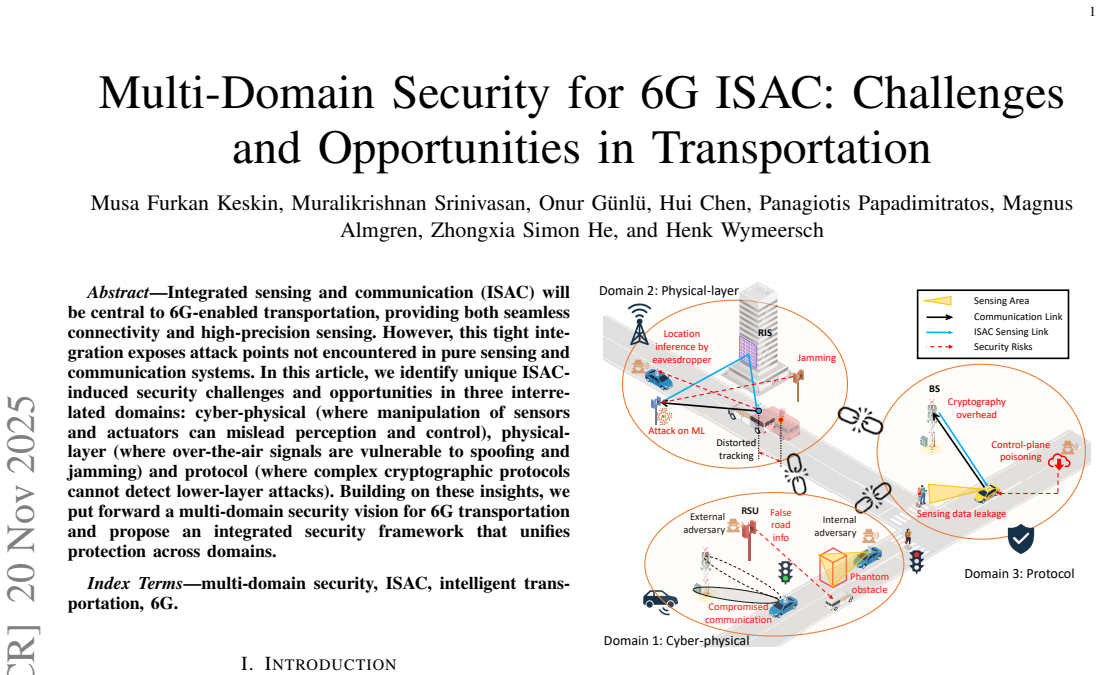
Integrated sensing and communication (ISAC) will be central to 6G-enabled transportation, providing both seamless connectivity and high-precision sensing. However, this tight integration exposes attack points not encountered in pure sensing and communication systems. In this article, we identify unique ISAC-induced security challenges and opportunities in three interrelated domains: cyber-physical (where manipulation of sensors and actuators can mislead perception and control), physical-layer (where over-the-air signals are vulnerable to spoofing and jamming) and protocol (where complex cryptographic protocols cannot detect lower-layer attacks). Building on these insights, we put forward a multi-domain security vision for 6G transportation and propose an integrated security framework that unifies protection across domains by leveraging existing ISAC measurements for lightweight cross-checks.
Editorial analysis
A structured set of objections, weighed in public.
Referee Report
Summary. The paper identifies unique security challenges for 6G Integrated Sensing and Communication (ISAC) in transportation across three domains: cyber-physical (sensor/actuator manipulation affecting perception and control), physical-layer (over-the-air spoofing and jamming), and protocol (inability of cryptographic protocols to detect lower-layer attacks). It proposes a multi-domain security vision and an integrated framework that unifies protection by reusing existing ISAC measurements for lightweight cross-checks.
Significance. If realized, the proposed framework could offer an efficient approach to multi-domain security in 6G transportation systems by leveraging already-available ISAC data rather than adding dedicated mechanisms. The identification of interrelated challenges across domains is a useful contribution to the emerging literature on ISAC security, though the work remains at the conceptual level without empirical validation or detailed design.
major comments (1)
- [Abstract / Proposed integrated security framework] Abstract and proposed framework description: The central proposal to use existing ISAC measurements as reliable inputs for lightweight cross-checks that detect attacks across cyber-physical, physical-layer, and protocol domains is undermined by the paper's own identification of physical-layer vulnerabilities to spoofing and jamming. No independent integrity mechanism (such as out-of-band verification, multi-path diversity, or cryptographic binding) is described to ensure the measurements themselves are not compromised by the same physical-layer attacks they are meant to help detect.
minor comments (1)
- The manuscript would benefit from a dedicated section or subsection explicitly mapping each identified challenge to a specific cross-check mechanism in the proposed framework, including how overhead and new attack surfaces are quantified.
Simulated Author's Rebuttal
We thank the referee for the thoughtful and constructive feedback on our manuscript. The comment raises an important point about the bootstrap problem in our proposed framework, which we address below.
read point-by-point responses
-
Referee: The central proposal to use existing ISAC measurements as reliable inputs for lightweight cross-checks that detect attacks across cyber-physical, physical-layer, and protocol domains is undermined by the paper's own identification of physical-layer vulnerabilities to spoofing and jamming. No independent integrity mechanism (such as out-of-band verification, multi-path diversity, or cryptographic binding) is described to ensure the measurements themselves are not compromised by the same physical-layer attacks they are meant to help detect.
Authors: We agree that this is a substantive concern. The manuscript is positioned as a vision paper that identifies the inter-related security challenges across the three domains and sketches a high-level integrated framework for unifying protection via ISAC measurements. While the abstract and main text note physical-layer vulnerabilities to spoofing and jamming, they do not specify independent integrity mechanisms to protect the measurements themselves against those attacks. The cross-checks are envisioned to complement (rather than substitute for) physical-layer security techniques, but the current description leaves this integration implicit. We will revise the abstract and the framework description section to explicitly acknowledge this limitation and outline candidate approaches, such as multi-path diversity or cross-validation across multiple ISAC links, to strengthen the proposal without overclaiming a complete solution. revision: yes
Circularity Check
No significant circularity; high-level vision without self-referential derivations
full rationale
The paper is a conceptual vision piece that identifies challenges across cyber-physical, physical-layer, and protocol domains for 6G ISAC in transportation and proposes an integrated framework leveraging existing ISAC measurements for cross-checks. No equations, fitted parameters, self-definitions, or load-bearing self-citations appear in the abstract or described content that reduce the proposed framework to its inputs by construction. The central claim is grounded in enumerated challenges and opportunities rather than any mathematical or definitional loop, making the derivation self-contained against external benchmarks.
Axiom & Free-Parameter Ledger
axioms (1)
- domain assumption ISAC integration exposes attack points not encountered in pure sensing and communication systems.
invented entities (1)
-
integrated multi-domain security framework
no independent evidence
Reference graph
Works this paper leans on
-
[1]
Integrated sensing and communications: Toward dual- functional wireless networks for 6G and beyond,
F. Liuet al., “Integrated sensing and communications: Toward dual- functional wireless networks for 6G and beyond,”IEEE Journal on Selected Areas in Communications, vol. 40, no. 6, pp. 1728–1767, 2022
work page 2022
-
[2]
Toward ISAC-empowered vehicular networks: Framework, advances, and opportunities,
Z. Duet al., “Toward ISAC-empowered vehicular networks: Framework, advances, and opportunities,”IEEE Wireless Communications, vol. 32, no. 2, pp. 222–229, 2025
work page 2025
-
[3]
Enabling intelligent connectivity: A survey of secure ISAC in 6G networks,
X. Zhuet al., “Enabling intelligent connectivity: A survey of secure ISAC in 6G networks,”IEEE Communications Surveys & Tutorials, vol. 27, no. 2, pp. 748–781, 2025
work page 2025
-
[4]
On secure and precise IR-UWB ranging,
M. Poturalskiet al., “On secure and precise IR-UWB ranging,”IEEE Transactions on Wireless Communications, vol. 11, no. 3, pp. 1087– 1099, 2012
work page 2012
-
[5]
Integrating sensing and communications in 6G? Not until it is secure to do so,
N. Suet al., “Integrating sensing and communications in 6G? Not until it is secure to do so,”arXiv preprint arXiv:2503.15243, 2025
-
[6]
Metasurface manipulation attacks: Potential secu- rity threats of RIS-aided 6G communications,
H. Alakocaet al., “Metasurface manipulation attacks: Potential secu- rity threats of RIS-aided 6G communications,”IEEE Communications Magazine, vol. 61, no. 1, pp. 24–30, 2023
work page 2023
-
[7]
Toward multi-functional 6G wireless networks: Inte- grating sensing, communication, and security,
Z. Weiet al., “Toward multi-functional 6G wireless networks: Inte- grating sensing, communication, and security,”IEEE Communications Magazine, vol. 60, no. 4, pp. 65–71, 2022
work page 2022
-
[8]
OFDM-based JCAS under attack: The dual threat of spoofing and jamming in WLAN sensing,
H. Can Yildirimet al., “OFDM-based JCAS under attack: The dual threat of spoofing and jamming in WLAN sensing,”IEEE Internet of Things Journal, vol. 12, no. 10, pp. 14 511–14 525, 2025
work page 2025
-
[9]
Secure integrated sensing and communication,
O. G ¨unl¨uet al., “Secure integrated sensing and communication,”IEEE Journal on Selected Areas in Information Theory (JSAIT), vol. 4, pp. 40–53, 2023
work page 2023
-
[10]
Wireless communication, sensing, and REM: A security perspective,
H. M. Furqanet al., “Wireless communication, sensing, and REM: A security perspective,”IEEE Open Journal of the Communications Society, vol. 2, pp. 287–321, 2021
work page 2021
-
[11]
N. Suet al., “Secure radar-communication systems with malicious targets: Integrating radar, communications and jamming functionalities,” IEEE Transactions on Wireless Communications, vol. 20, no. 1, pp. 83– 95, 2021
work page 2021
-
[12]
Combating the control signal spoofing attack in UA V systems,
K.-W. Huanget al., “Combating the control signal spoofing attack in UA V systems,”IEEE Transactions on Vehicular Technology, vol. 67, no. 8, pp. 7769–7773, 2018
work page 2018
-
[13]
Challenge-response physical layer authentication over partially controllable channels,
S. Tomasinet al., “Challenge-response physical layer authentication over partially controllable channels,”IEEE Communications Magazine, vol. 60, no. 12, pp. 138–144, 2022
work page 2022
-
[14]
A novel cross-layer authentication protocol for the internet of things,
Y . Leeet al., “A novel cross-layer authentication protocol for the internet of things,”IEEE Access, vol. 8, 2020
work page 2020
-
[15]
Physical layer key generation in 5G wireless networks,
L. Jiaoet al., “Physical layer key generation in 5G wireless networks,” IEEE wireless communications, vol. 26, no. 5, pp. 48–54, 2019. BIOGRAPHIES Musa Furkan Keskin(furkan@chalmers.se) is a Researcher with the De- partment of Electrical Engineering at Chalmers University of Technology, Sweden. Muralikrishnan Srinivasan(muralikrishnan.ece@iitbhu.ac.in) is...
work page 2019
discussion (0)
Sign in with ORCID, Apple, or X to comment. Anyone can read and Pith papers without signing in.