Evolution of terahertz third harmonic response across rare-earth nickelate phase-diagram
Pith reviewed 2026-06-27 14:51 UTC · model grok-4.3
The pith
Terahertz third harmonic generation in rare-earth nickelates shows local maxima at insulator-metal transitions and minima at magnetic transitions.
A machine-rendered reading of the paper's core claim, the machinery that carries it, and where it could break.
Core claim
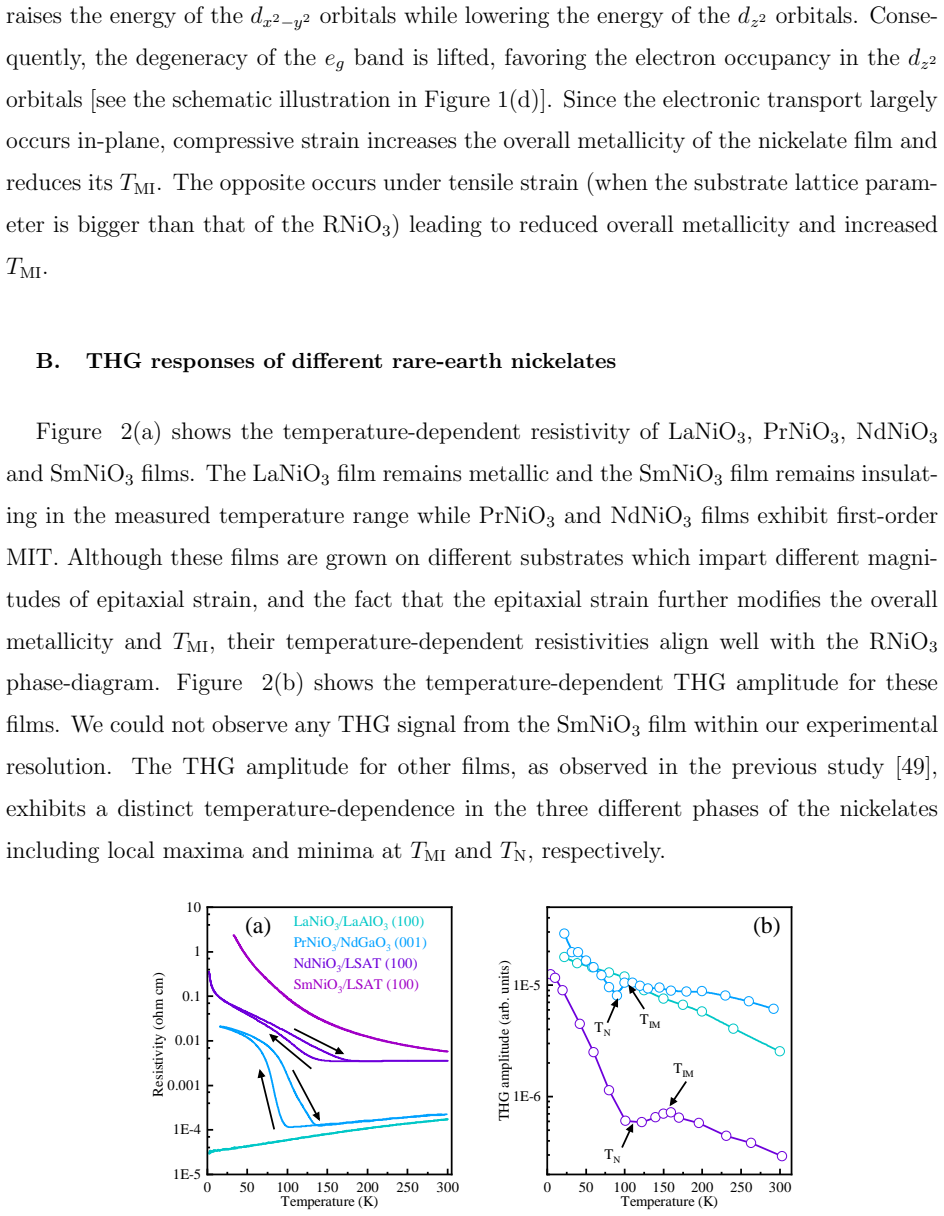
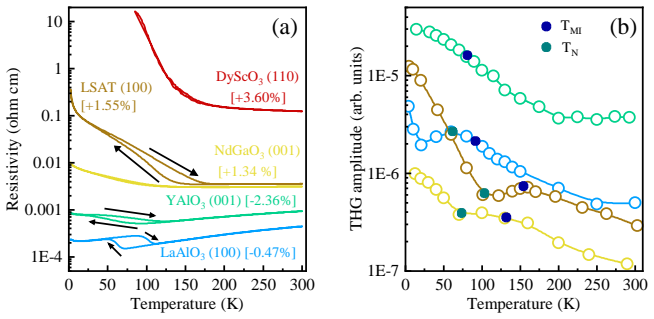
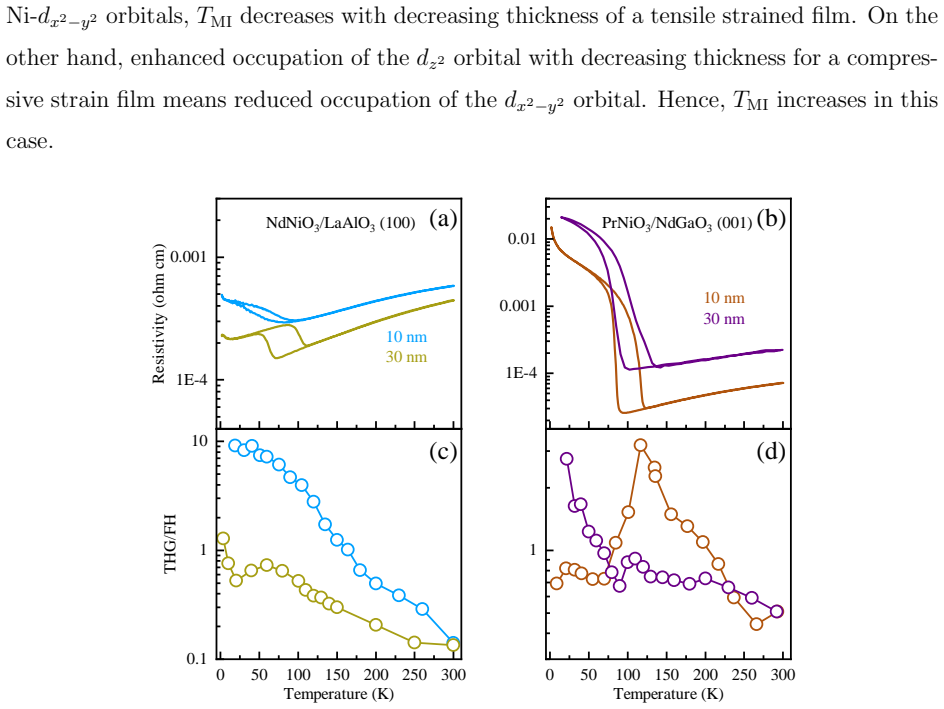
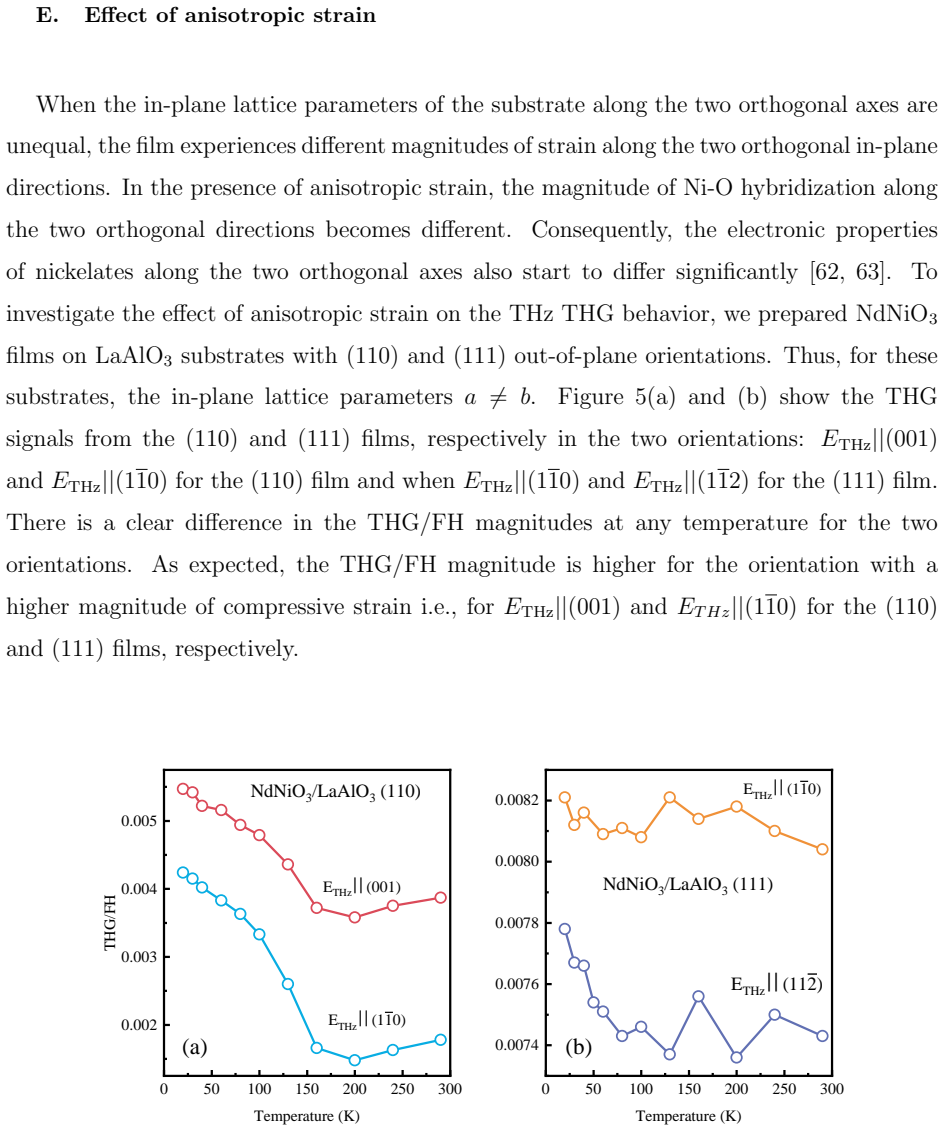
In films with sharp phase-transitions, the local maximum and minimum in the temperature-dependent THG amplitude coincide with insulator-metal and magnetic transition temperatures, respectively. In films with weaker transitions, these features shift toward lower temperatures or even monotonous THG enhancement is observed down to low temperatures. A generalized theory for THz harmonic generation in negative charge-transfer insulators explains the observations.
What carries the argument
Temperature dependence of THz third harmonic generation amplitude, which is sensitive to the strengths of electronic and magnetic phases.
If this is right
- THG serves as a probe for electronic and magnetic phase transitions in correlated materials.
- The response can be tuned by controlling the sharpness of the phase transitions in the films.
- A theory for negative charge-transfer insulators provides a framework for understanding and enhancing THz nonlinearities.
- Applications of THz HHG expand to include strongly correlated materials like nickelates.
Where Pith is reading between the lines
- Similar THG measurements could be used to study phase diagrams in other correlated oxide systems.
- Optimizing film growth for sharper transitions might lead to stronger nonlinear THz responses for practical devices.
- Connecting this to device applications could enable THz-based sensors that detect magnetic or electronic state changes.
Load-bearing premise
The peaks and dips in THG amplitude are directly due to the insulator-metal and magnetic transitions rather than coinciding temperature-dependent effects from scattering or lattice vibrations.
What would settle it
Perform THG measurements on nickelate films while simultaneously measuring resistivity to pinpoint the exact insulator-metal transition temperature and check for exact coincidence of the THG maximum.
Figures
read the original abstract
High harmonic generation (HHG) is a sensitive probe for investigating electronic structures and dynamics of materials and a source for attosecond pulses. In particular, HHG with terahertz (THz) light can enable probing of nonlinear responses in correlated materials arising from low-energy many-body interactions. However, THz HHG studies have so far largely focused on topological materials and superconductors, leaving out other potential material systems which could also become efficient THz HHG sources. Here, we report THz third harmonic generation (THG) in rare-earth nickelates -- a prototype material for exploring the Mott insulator-metal transition and related technological applications. We find that the THG amplitude is highly sensitive to the strengths of electronic and magnetic phases of nickelates. In films with sharp phase-transitions, the local maximum and minimum in the temperature-dependent THG amplitude coincide with insulator-metal and magnetic transition temperatures, respectively. While in films with weaker transitions, these features shift toward lower temperatures or even monotonous THG enhancement is observed down to low temperatures. We developed a generalized theory for THz harmonic generation in negative charge-transfer insulators and outlined strategies to enhance the THz nonlinearities further. Our study broadens the scope of THz HHG studies and related applications to strongly correlated materials.
Editorial analysis
A structured set of objections, weighed in public.
Referee Report
Summary. The manuscript reports terahertz third-harmonic generation (THG) measurements on rare-earth nickelate thin films spanning the Mott insulator-metal and magnetic phase diagram. In samples exhibiting sharp transitions, the temperature dependence of the THG amplitude displays a local maximum and minimum that coincide with the insulator-metal and magnetic ordering temperatures, respectively; these features shift or vanish in films with weaker transitions. The authors present a generalized theoretical framework for THz harmonic generation in negative charge-transfer insulators and outline routes to enhance the nonlinear response.
Significance. If the reported coincidence is shown to arise from the electronic and magnetic order parameters rather than other temperature-dependent mechanisms, and if the generalized theory supplies a quantitative, parameter-controlled prediction for the THG extrema, the work would extend THz HHG from topological and superconducting systems to a canonical family of correlated oxides. This would furnish an optical probe of the Mott transition and antiferromagnetic order and could guide materials engineering for nonlinear THz sources.
major comments (2)
- [Theory and Discussion sections] The central experimental claim (local max/min in THG amplitude coinciding with T_IM and T_N) is load-bearing, yet the manuscript provides no quantitative comparison between the measured THG temperature dependence and the predictions of the generalized theory. Without such a comparison (e.g., calculated nonlinear susceptibility versus temperature across the two transitions), it remains unclear whether the observed features are produced by the order parameters or by other continuously varying quantities such as lattice constants or scattering rates.
- [Theory section] The generalized theory for negative charge-transfer insulators is introduced only at the level of a qualitative outline. No explicit expressions for the third-order susceptibility, the role of the charge-transfer energy, or the manner in which it changes across the insulator-metal and magnetic transitions are given, preventing assessment of whether the model is parameter-free or contains adjustable parameters that could be tuned to fit the data.
minor comments (1)
- The abstract states that the THG amplitude is 'highly sensitive to the strengths of electronic and magnetic phases,' but does not specify the number of distinct rare-earth compositions or film thicknesses examined; adding this information would strengthen the claim of generality across the phase diagram.
Simulated Author's Rebuttal
We thank the referee for the constructive and detailed report. The comments highlight important points regarding the connection between experiment and theory. We address each major comment below and will revise the manuscript to strengthen these aspects.
read point-by-point responses
-
Referee: [Theory and Discussion sections] The central experimental claim (local max/min in THG amplitude coinciding with T_IM and T_N) is load-bearing, yet the manuscript provides no quantitative comparison between the measured THG temperature dependence and the predictions of the generalized theory. Without such a comparison (e.g., calculated nonlinear susceptibility versus temperature across the two transitions), it remains unclear whether the observed features are produced by the order parameters or by other continuously varying quantities such as lattice constants or scattering rates.
Authors: We agree that a quantitative comparison between the measured THG temperature dependence and the generalized theory would strengthen the central claim. In the revised manuscript we will add explicit calculations of the temperature-dependent third-order susceptibility derived from the theory, using the known evolution of the electronic and magnetic order parameters across T_IM and T_N. These calculations will be compared directly to the experimental data to demonstrate that the observed extrema arise from the order parameters rather than other temperature-dependent quantities. revision: yes
-
Referee: [Theory section] The generalized theory for negative charge-transfer insulators is introduced only at the level of a qualitative outline. No explicit expressions for the third-order susceptibility, the role of the charge-transfer energy, or the manner in which it changes across the insulator-metal and magnetic transitions are given, preventing assessment of whether the model is parameter-free or contains adjustable parameters that could be tuned to fit the data.
Authors: The Theory section presents the framework at a generalized level applicable to the class of negative charge-transfer insulators. We will expand this section in the revision to include the explicit expression for the third-order nonlinear susceptibility, its dependence on the charge-transfer energy, and the manner in which both the susceptibility and the charge-transfer energy vary with the insulator-metal and magnetic order parameters. The model incorporates established material parameters from the literature on nickelates and is not adjusted to fit the THG data; the positions of the predicted extrema are fixed by the independently measured transition temperatures. revision: yes
Circularity Check
No derivation chain or equations present; circularity cannot be assessed
full rationale
The provided manuscript text consists solely of the abstract, which reports experimental observations of THG amplitude features coinciding with transition temperatures and mentions developing a generalized theory without any equations, derivations, fitted parameters, or citations. No load-bearing steps, self-definitions, or self-citation chains are visible, so no circularity is identifiable. The paper is self-contained against external benchmarks only in the sense that nothing to analyze exists here.
Axiom & Free-Parameter Ledger
Reference graph
Works this paper leans on
-
[1]
Bloch, A
J. Bloch, A. Cavalleri, V. Galitski, M. Hafezi, A. Rubio,Nature2022,606, 41-48
-
[2]
de la Torre, D
A. de la Torre, D. M. Kennes, M. Claassen, S. Gerber, J. W. McIver, M. A. Sentef,Rev. Mod. Phys.2021,93, 041002
2021
-
[3]
P. B. Corkum and F. Krausz,Nat. Phys.2007,3, 381
2007
-
[4]
Krausz and M
F. Krausz and M. Ivanov,Rev. Mod. Phys.2009,81, 163
2009
-
[5]
B. Zaks, R. B. Liu, M. S. Sherwin,Nature2012,483, 580-583
-
[6]
Hohenleutner, F
M. Hohenleutner, F. Langer, O. Schubert, M. Knorr, U. Huttner, S. W. Koch, M. Kira, R. Huber,Nature2015,523, 572-575
-
[7]
T. T. Luu, H. J. W¨ orner,Nat. Commun.2018,9, 916
2018
-
[8]
M. R. Bionta, E. Haddad, A. Leblanc, V. Gruson, P. Lassonde, H. Ibrahim, J. Chaillou, N. ´Emond, M. R. Otto, ´A. Jim´ enez-Gal´ an, R. E. F. Silva, M. Ivanov, B. J. Siwick, M. Chaker, F. L´ egar´ e,Phys. Rev. Res.2021,3, 023250
2021
-
[9]
Heide, Y
C. Heide, Y. Kobayashi, D. R. Baykusheva, D. Jain, J. A. Sobota, M. Hashimoto, P. S. Kirchmann, S. Oh, T. F. Heinz, D. A. Reis, S. Ghimire,Nat. Photon.2022,16, 620-624
2022
-
[10]
Zhong, Y
S. Zhong, Y. Liang1, S. Wang1, H. Teng, X. He, Z. Wei,Mater. Futures2022,1, 032201
-
[11]
D. N. Basov, R. D. Averitt, D. van der Marel, M. Dressel, Kristjan Haule,Rev. Mod. Phys. 2011,83, 471-541
2011
-
[12]
Ulbricht, E
R. Ulbricht, E. Hendry, J. Shan, T. F. Heinz, M. Bonn,Rev. Mod. Phys.2011,83, 543-586
2011
-
[13]
K. S. Kumar, G. L. Prajapati, R. Dagar, M. Vagadia, D. S. Rana, M.Tonouchi,Adv. Opt. Mater.2020,8, 1900958
2020
-
[14]
C.-J. Yang, J. Li, M. Fiebig, S. Pal,Nat. Rev. Matter.2023,8, 518
2023
-
[15]
H. A. Hafez, S. Kovalev, J.-C. Deinert, Z. Mics, B. Green, N. Awari, M. Chen, S. Germanskiy, U. Lehnert, J. Teichert, Z. Wang, K.-J. Tielrooij, Z. Liu, Z. Chen, A. Narita, K. M¨ ullen, M. Bonn, M. Gensch, D. Turchinovich,Nature2018,561, 507-511
-
[16]
Cheng, N
B. Cheng, N. Kanda, T. N. Ikeda, T. Matsuda, P. Xia, T. Schumann, S. Stemmer, J. Itatani, 16 N. P. Armitage, R. Matsunaga,Phys. Rev. Lett.2020,124, 117402
2020
-
[17]
Kovalev, H
S. Kovalev, H. A. Hafez, K.-J. Tielrooij, J.-C. Deinert, I. Ilyakov,N. Awari, D. Alcaraz, K. Soundarapandian, D. Saleta, S. Germanskiy,M. Chen, M. Bawatna, B. Green, F. H. L. Kop- pens, M. Mittendorff, M. Bonn, M. Gensch, D. Turchinovich,Sci. Adv.2021,7, eabf9809
2021
-
[18]
Kovalev, K.-J
S. Kovalev, K.-J. Tielrooij, J.-C. Deinert, I. Ilyakov, N. Awari, M. Chen, A. Ponomaryov, M. Bawatna, T. V. A. G. de Oliveira, L. M. Eng, K. A. Kuznetsov, D. A. Safronenkov, G. Kh. Kitaeva, P. I. Kuznetsov, H. A. Hafez, D. Turchinovich, M. Gensch,npj Quantum Mater. 2021,6, 84
2021
-
[19]
Deinert, D
J.-C. Deinert, D. A. Iranzo, R. Perez, X. Jia, H. A. Hafez, I. Ilyakov, N. Awari, M. Chen, M. Bawatna, A. N. Ponomaryov, S. Germanskiy, M. Bonn, F. H. L. Koppens, D. Turchinovich, M. Gensch, S. Kovalev, K.-J. Tielrooij,ACS Nano2021,15, 1145-1154
-
[20]
Tielrooij, A
K.-J. Tielrooij, A. Principi, D. S. Reig, A. Block, S. Varghese, S. Schreyeck, K. Brunner, G. Karczewski, I. Ilyakov, O. Ponomaryov, T. V. A. G. de Oliveira, M. Chen, J.-C. Deinert, C. G. Carbonell, S. O. Valenzuela, L. W. Molenkamp, T. Kiessling, G. V. Astakhov, S. Kovalev, Light Sci. Appl.2022,11, 315
2022
-
[21]
Ilyakov, A
I. Ilyakov, A. Ponomaryov, D. S. Reig, C. Murphy, J. D. Mehew, T. de Oliveira, G. L. Prajapati, A. Arshad, J.-C. Deinert, M. F. Craciun, S. Russo, S. Kovalev, K.-J. Tielrooij, Nano Lett.2023,23, 3872
2023
-
[22]
Arshad, H
A. Arshad, H. N. Koyun, R. Salikhov, M. Gensch, I. Ilyakov, A. Ponomaryov, G. L. Prajapati, T. V. A. G. de Oliveira, K. Mavridou, J. Lindner, J.-C. Deinert, C. G. ¨Unl¨ u, S. Kovalev,Adv. Photon. Res.2023,4, 2300088
2023
-
[23]
K¨ urner,Terahertz Sci
T. K¨ urner,Terahertz Sci. Technol.2012,5(1), 11–17
2012
-
[24]
K¨ urner, S
T. K¨ urner, S. Priebe,J. Infrared Milli. Terahz Waves2014,35, 53–62
-
[25]
Y. Yang, Y. Yamagami, X. Yu, P. Pitchappa, J. Webber, B. Zhang, M. Fujita, T. Nagatsuma, R. Singh,Nat. Photonics2020,14, 446–451
-
[26]
Banerjee, A
R. Banerjee, A. Kumar, T. C. Tan, M. Gupta, R. Jia,P. Szriftgiser, G. Ducournau, Y. Chong, R. Singh,Sci. Adv.2025,11, eadu2526
2025
-
[27]
G. L. Prajapati, S. Das, D. S. Rana,ACS Appl. Mater. Interfaces2019,11, 36, 33109-33115
-
[28]
Makushko, S
P. Makushko, S. Kovalev, Y. Zabila, I. Ilyakov, A. Ponomaryov, A. Arshad, G. L. Prajapati, T. V. A. G. de Oliveira, J.-C. Deinert, P. Chekhonin, I. Veremchuk, T. Kosub, Y. Skourski, F. Ganss, D. Makarov, C. Ortix,Nat. Electron.2024,7, 207-215. 17
2024
-
[29]
T. A. U. Svetikova, I. Ilyakov, A. Ponomaryov, T. V. A. G. de Oliveira, C. Berger, L. F¨ urst, F. Bayer, J.-C. Deinert, G. L. Prajapati, A. Arshad, E. G. Novik, A. Pashkin, M. Helm, S. Winnerl, H. Buhmann, L. W. Molenkamp, T. Kiessling, S. Kovalev, G. V. Astakhov,Commun. Phys.2025,8, 361
2025
-
[30]
Matsunaga, N
R. Matsunaga, N. Tsuji, H. Fujita, A. Sugioka, K. Makise, Y. Uzawa, H. Terai, Z. Wang, H. Aoki, and R. Shimano,Science2014,345, 1145
-
[31]
Matsunaga, N
R. Matsunaga, N. Tsuji, K. Makise, H. Terai, H. Aoki, R. Shimano,Phys. Rev. B2017,96, 020505(R)
-
[32]
Chu, M.-J
H. Chu, M.-J. Kim, K. Katsumi, S. Kovalev, R. D. Dawson, L. Schwarz, N. Yoshikawa, G. Kim, D. Putzky, Z. Z. Li, H. Raffy, S. Germanskiy, J.-C. Deinert, N. Awari, I. Ilyakov, B. Green, M. Chen, M. Bawatna, G. Cristiani, G. Logvenov, Y. Gallais, A. V. Boris, B. Keimer, A. P. Schnyder, D. Manske, M. Gensch, Z. Wang, R. Shimano, S. Kaiser, Nat. Commun. 2020, 11, 1793
2020
-
[33]
Shimano, N
R. Shimano, N. Tsuji,Annu. Rev. Condens. Matter Phys.2020,11, 103-24
2020
-
[34]
Isoyama, N
K. Isoyama, N. Yoshikawa, K. Katsumi, J. Wong, N. Shikama, Y. Sakishita, F. Nabeshima, A. Maeda, R. Shimano,Commun. Phys.2021,4, 160
2021
-
[35]
M.-J. Kim, S. Kovalev, M. Udina, R. Haenel, G. Kim, M. Puviani, G. Cristiani, I. Ilyakov, T. V. A. G. de Oliveira, A. Ponomaryov, J.-C. Deinert, G. Logvenov, B. Keimer, D. Manske, L. Benfatto, S. Kaiser,Sci. Adv.2024,10, eadi7598
2024
-
[36]
H. Matsumoto, S. Neri, T. Kobayashi, A. Maeda, D. Manske, R. Shimano, arXiv:2507.14466
-
[37]
L. Feng, J. Cao, T. Priessnitz, Y. Dai, T. de Oliveira, J. Yuan, R. Oka, M.-J. Kim, M. Chen, A. N. Ponomaryov, I. Ilyakov, H. Zhang, Y. Lv, V. Mazzotti, G. Kim, G. Christiani, G. Logvenov, D. Wu, Y. Huang, J.-C. Deinert, S. Kovalev, S. Kaiser, T. Dong, N. Wang, H. Chu, Phys. Rev. B2023,108, L100504
-
[38]
H. Chu, S. Kovalev, Z. X. Wang, L. Schwarz, T. Dong, L. Feng, R. Haenel, M.-J. Kim, P. Shabestari, L. P. Hoang, K. Honasoge, R. D. Dawson, D. Putzky, G. Kim, M. Puviani, M. Chen, N. Awari, A. N. Ponomaryov, I. Ilyakov, M. Bluschke, F. Boschini, M. Zonno, S. Zhdanovich, M. Na, G. Christiani, G. Logvenov, D. J. Jones, A. Damascelli, M. Minola, B. Keimer, D....
2023
-
[39]
L. Feng, H. Zhang, T. Priessnitz, J. Cao, T. Sarkar, T. de Oliveira, A. N. Ponomaryov, I. Ilyakov, F. Yang, Y. Lv, Y. Guo, K. Srowik, S. Danzenbacher, M. Niethammer, S. Kovalev, 18 J.-C. Deinert, S. Kaiser, R. L. Greene, H. Chu, arXiv:2504.11947
-
[40]
J. B. Torrance, P. Lacorre, A. I. Nazzal, E. J. Ansaldo, C. Niedermayer,Phys. Rev. B1992, 45, 8209
-
[41]
Middey, J
S. Middey, J. Chakhalian, P. Mahadevan, J.W. Freeland, A.J. Millis, D.D. Sarma,Annu. Rev. Mater. Res.2016,46, 305-334
2016
-
[42]
Catalano, M
S. Catalano, M. Gibert, J. Fowlie, J. ´I˜ niguez, J.-M. Triscone, J. Kreisel,Rep. Prog. Phys. 2018,81, 046501
2018
-
[43]
Scherwitzl, P
R. Scherwitzl, P. Zubko, I. G. Lezama, S. Ono, A. F. Morpurgo , G. Catalan, J.-M. Triscone, Adv. Mater.2010,22, 5517-5520
2010
-
[44]
Kinha, G
M. Kinha, G. L. Prajapati, M. Udeshi, P. Agarwal, N. B. Ram, D. S. Rana,J. Phys. D: Appl. Phys.2022,55, 225301
2022
-
[45]
G. L. Prajapati, S. Kovalev, I. Ilyakov, A. Arshad, G. Dubey, K. S. Navale, D. S. Rana, J.-C. Deinert,Adv. Funct. Mater.2025,35, 2425867
2025
-
[46]
K. W. Post, A. S. McLeod, M. Hepting, M. Bluschke, Y. Wang, G.Cristiani, G. Logvenov, A. Charnukha, G. X. Ni, P. Radhakrishnan, M.Minola, A. Pasupathy, A. V. Boris, E. Benckiser, K. A. Dahmen, E. W.Carlson, B. Keimer, D. N. Basov, Nat. Phys. 2018, 14, 1056
2018
-
[47]
Q. Song, S. Doyle, G. A. Pan, I. E. Baggari, D. F. Segedin, D. C. Carrizales, J. Nordlander, C. Tzschaschel, J. R. Ehrets, Z. Hasan, H. El-Sherif, J. Krishna, C. Hanson, H. LaBollita, A. Bostwick, C. Jozwiak, E. Rotenberg, S.-Y. Xu, A. Lanzara, A. T. N’Diaye, C. A. Heikes, Y. Liu, H. Paik, C. M. Brooks, B. Pamuk, J. T. Heron, P. Shafer, W. D. Ratcliff, A....
2023
-
[48]
G. L. Prajapati, S. Kundu, S. Das, T. Dev V V, D. S. Rana,New J. Phys.2022,24, 103016
2022
-
[49]
G. L. Prajapati, S. Ray, I. Ilyakov, A. N. Ponomaryov, A. Arshad, T. V. A. G. de Oliveira, G. Dubey, D. S. Rana, J.-C. Deinert, P. Werner, S. Kovalev,Phys. Rev. B2026,113, 045118
-
[50]
Zaanen, G
J. Zaanen, G. A. Sawatzky, J. W. Allen, Phys. Rev. Lett. 1985, 55, 418-421
1985
-
[51]
Mizokawa, A
T. Mizokawa, A. Fujimori, H. Namatame, K. Akeyama, N. Kosugi, Phys. Rev. B 1994, 49, 7193-7204
1994
-
[52]
Bisogni, S
V. Bisogni, S. Catalano, R. J. Green, M. Gibert, R. Scherwitzl, Y. Huang, V. N. Strocov, P. Zubko, S. Balandeh, J.-M. Triscone, G. Sawatzky, T. Schmitt, Nat. Commun. 2016, 7, 13017
2016
-
[53]
G. L. Prajapati, S. Das, R. Dagar, V. E. Phanindra, D. S. Rana,Commun. Mater.2022,3, 49. 19
2022
-
[54]
G. L. Prajapati, S. Das, D. S. Rana,J. Phys.: Condens. Matter2021,33, 415401
-
[55]
J. J. Peng, C. Song, M. Wang, F. Li, B. Cui, G. Y. Wang, P. Yu, F. Pan,Phys. Rev. B2016, 93, 235102
-
[56]
Aschauer, R
U. Aschauer, R. Pfenninger, S. M. Selbach, T. Grande, N. A. Spaldin,Phys. Rev. B2013, 88, 054111
-
[57]
X. K. Lian, F. Chen, X. L. Tan, L. F. Wang, X. F. Xuan, G. Y. Gao, S. W. Jin, W. B. Wu, AIP Advances2013,3, 062133
-
[58]
Murakami, K
Y. Murakami, K. Uchida, A. Koga, K. Tanaka, P. Werner,Phys. Rev. Lett.2022,129, 157401
2022
-
[59]
Mikheev, A
E. Mikheev, A. J. Hauser, B. Himmetoglu, N. E. Moreno, A. Janotti, C. G. Van de Walle, S. Stemmer,Sci. Adv.2015,1 (10), e1500797
2015
-
[60]
Scherwitzl, S
R. Scherwitzl, S. Gariglio, M. Gabay, P. Zubko, M. Gibert, and J.-M. Triscone,Phys. Rev. Lett.2011,106, 246403
2011
-
[61]
M. Wu, E. Benckiser, M. W. Haverkort, A. Frano, Y. Lu, U. Nwankwo, S. Br¨uck, P. Audehm, E. Goering, S. Macke, V. Hinkov, P. Wochner, G. Christiani, S. Heinze, G. Logvenov, H.-U. Habermeier, B. Keimer,Phys. Rev. B2013,88, 125124
-
[62]
R. Rana, P. Pandey, V. E. Phanindra, S. S. Prabhu, D. S. Rana,Phys. Rev. B2018,97, 045123
-
[63]
S. Das, G. L. Prajapati, P. Anagha, D. S. Rana,Phys. Rev. B2018,98, 115110
-
[64]
Johnston, A
S. Johnston, A. Mukherjee, I. Elfimov, M. Berciu, G. A. Sawatzky,Phys. Rev. Lett.2014, 112, 106404
2014
-
[65]
A. Azab, F. Queisser, G. L. Prajapati, J.-C. Deinert, R. Sch¨ utzhold, arXiv:2603.05254
-
[66]
Torriss, A
B. Torriss, A. Ibrahim, T. Ozaki, M. Chaker,Phys. Rev. B2018,98, 165132
-
[67]
Z. Wang, H. Park, Y. H. Lai, J. Xu, C. I. Blaga, F. Yang, P. Agostini, L. F. DiMauro,Nat. Commun.2017,8, 1686. 20
2017
discussion (0)
Sign in with ORCID, Apple, or X to comment. Anyone can read and Pith papers without signing in.