REVIEW 3 major objections 5 minor 1 cited by
The NEID Earth Twin Survey. II. Dynamical Masses in Seven High-acceleration Star Systems
T0 review · 3 major / 5 minor · reviewed 2026-08-15 · deepseek-v4-flash
Pith's one-line read This paper reports true dynamical masses for three planets and four stars by combining 35 years of radial velocities with Hipparcos-Gaia astrometry, breaking the inclination degeneracy in Doppler-only surveys.
desk verdict Solid stellar-mass work with a valuable data release, but the three true planetary masses are overstated—HD 154345 b needs re-examination before it is quoted as a secure mass. read the letter →
The pith
A machine-rendered reading of the paper's core claim, the machinery that carries it, and where it could break.
The reading
What carries the argument
The load-bearing observable is the proper-motion anomaly: the difference between the star's proper motion measured at the Hipparcos epoch and at the Gaia epoch, quantified by the paper's $\chi^2_{\rm HG}$ statistic. This difference is a direct measurement of the star's plane-of-sky acceleration over roughly 25 years. When combined with the line-of-sight acceleration from radial velocities and the distance from the Gaia parallax, the resulting three-dimensional acceleration, together with Kepler's laws, fixes the companion mass without knowing the orbit's inclination. For the four binaries, relative astrometry spanning up to about 200 years additionally traces the orbital arc directly. The fits use a parallel-tempered Markov chain Monte Carlo orbit code that simultaneously models absolute astrometry, radial velocities, and relative astrometry, with Gaussian stellar-mass priors applied only where the data cannot supply the mass alone (HD 24496 AB and the three planet hosts).
What would settle it
Re-derive the HD 154345 acceleration using the epoch astrometry in Gaia DR4 rather than the two-epoch proper-motion difference; if the resulting acceleration is consistent with zero or notably smaller than the $\chi^2_{\rm HG}$-selected value, the reported $1.186\,M_{\rm Jup}$ dynamical mass is inflated by the selection cut. The same check on HD 217107 and HD 190360 would reveal whether the bias affects all three planet masses.
Extended reading notes
Core claim
By jointly fitting radial velocities spanning more than 35 years with the proper-motion difference between Hipparcos (epoch 1991.25) and Gaia (epoch 2016.0), plus century-long relative astrometry for the resolved binaries, the paper determines the full three-dimensional acceleration of each host star. For the three planetary systems this disentangles mass from inclination for the first time: HD 217107 c has a true mass of $4.37^{+0.13}_{-0.10}\,M_{\rm Jup}$ with an orbit close to edge-on ($i = 88^{+14}_{-12}$ degrees); HD 190360 b has $1.68^{+0.26}_{-0.16}\,M_{\rm Jup}$ with a bimodal inclination near 60 or 120 degrees; HD 154345 b has $1.186^{+0.095}_{-0.059}\,M_{\rm Jup}$ at $i = 88\pm20$ degrees. For the four binaries, the fit yields masses with relative uncertainties of about 1% or better for HD 68017 B ($0.1548\pm0.0014\,M_\odot$), 61 Cygni A ($0.6772^{+0.0051}_{-0.0051}\,M_\odot$), HD 4614 A ($1.0258^{+0.0070}_{-0.0069}\,M_\odot$) and HD 4614 B ($0.5487\pm0.0056\,M_\odot$); it also produces the first orbital solution for the 600-year binary HD 24496 AB. The paper states these solutions agree with previous estimates while improving their precision.
Load-bearing premise
Every reported mass assumes the measured kink in the star's sky motion between the Hipparcos and Gaia epochs comes entirely from the modeled companion's orbit, and that choosing stars because that kink was unusually large did not inflate the measured accelerations.
Editorial extensions
If this is right
- The three cold Jupiters now have unambiguous masses and ephemerides, so their predicted 2025–2035 angular separations and contrasts can be used to decide whether existing space coronagraphs can image them.
- The roughly 1% stellar masses provide model-independent anchor points for testing stellar evolutionary tracks and calibrating photometric mass–luminosity relations.
- The first orbital solution for HD 24496 AB demonstrates that a moderate set of high-precision radial velocities plus astrometry can pin down a 600-year orbit, extending the method to very long-period binaries.
- The more than 35-year radial-velocity baselines assembled here open the search for ultra-long-period and low-amplitude companions; the residual periodicity at 2.4 years around HD 4614 (a possible $22\,M_\oplus$ planet) and at 90 days around HD 190360 (a possible $10\,M_\oplus$ planet) are flagged for follow-up.
- Future Gaia epoch astrometry should tighten every mass reported here and can extend the same technique to the remaining accelerating targets in the parent survey.
Reading between the lines
- Because the seven systems were selected on $\chi^2_{\rm HG}>11.8$, the measured accelerations for the weakest detections are likely overestimated; a selection-bias correction or a re-fit of stars with $\chi^2_{\rm HG}$ between 6 and 11.8 would indicate how much the reported masses, especially that of HD 154345 b, should be discounted.
- The two unclassified residual signals — the 2.4-year period around HD 4614 and the 90-day signal around HD 190360 — would, if confirmed as Keplerians, show that this joint-fitting approach can uncover low-mass companions that pure Doppler searches would struggle to validate; the paper's own checks leave both as open questions.
- The method's lever arm is the roughly 25-year Hipparcos–Gaia baseline, so systems with periods much longer than that, like HD 24496 AB, still need stellar-mass priors; applying the same fit after Gaia epoch astrometry becomes available should remove those priors and test whether the 600-year orbit solution is biased by them.
- For HD 68017, the unresolved photocentric motion in both catalogs could bias the primary's proper motion; if a future Gaia release resolves the pair, the secondary mass of $0.1548\,M_\odot$ can be checked against an independent orbit.
Signed reviews
Editorial analysis
A structured set of objections, weighed in public.
Referee Report
Summary. This paper presents joint orbit fits for seven nearby star systems drawn from the NEID Earth Twin Survey that show significant Hipparcos-Gaia proper-motion anomalies. For four binary systems (HD 68017 AB, 61 Cygni AB, HD 24496 AB, HD 4614 AB) the authors combine up to ~200 years of relative astrometry, absolute astrometry from the HGCA, and RVs including newly published NEID and MINERVA measurements. For three planetary systems (HD 217107, HD 190360, HD 154345) they combine RVs with the Hipparcos-Gaia acceleration to constrain companion inclinations and report true masses. The paper claims four stellar masses with ≲1% relative precision, true masses for three planets whose masses were previously entangled with inclination, an improved orbit for HD 24496 AB (the first published for that system), and refined ephemerides for all seven systems. The modeling is carried out with orvara, using Gaussian mass priors for the planet hosts and for HD 24496 A, while the other three binary systems are fit without mass priors.
Significance. If the results hold, this is a valuable contribution to the small set of benchmark stellar and planetary masses. The sub-percent dynamical masses for 61 Cygni A, HD 4614 A/B, and HD 68017 B, the first orbital solution for HD 24496 AB, the public release of over 900 new RVs, and the careful treatment of 19th-century relative astrometry are concrete strengths. The comparisons with photometric mass relations and with independent model masses are useful, and the residual periodogram searches add value beyond the headline masses. However, the central claim of 'true masses for three planets' is currently too strong: the HD 154345 b solution appears internally inconsistent with the RV minimum mass, HD 190360 b retains a broad/bimodal inclination, and all three planetary targets sit close to the χ²HG selection threshold where acceleration measurements can be biased. The paper is likely correct in its broad conclusions, but the planetary mass claims need targeted verification and re-scoping before they can be accepted as stated.
major comments (3)
- [Section 5.7 / Table 7 / Section 3.7] The reported posterior for HD 154345 b is internally inconsistent with the RV minimum mass quoted earlier in the paper. Table 7 lists Msec = 1.186+0.095−0.059 MJ with i = 88±20°, which implies m sin i ≈ 1.18 MJ; Section 3.7 quotes the RV-only minimum mass as 0.905+0.071−0.089 MJ from Rosenthal et al. (2021), whose HIRES data are included in the joint fit. Since the joint posterior must satisfy the RV likelihood, the fitted Keplerian semi-amplitude would need to be about 30% larger than the well-established value, which is implausible unless the new NEID/MINERVA data drastically alter the RV solution. The paper does not report the joint m sin i posterior or the best-fit K, so this consistency check is absent. Because HD 154345 b is one of the three headline 'true mass' results, the authors should verify the MCMC solution, report the implied K, and reconcile these numbers.
- [Section 2.1 / Table 1 / Section 5.7] The sample is selected on χ²HG > 11.8, and HD 154345 sits just above this threshold with χ²HG = 12.8. For a significance-based cut, the measured proper-motion anomaly of a marginal source is an upward-biased estimate of the true acceleration, and no truncation correction or injection-recovery test is presented. Because the astrometric acceleration is the only datum that breaks the m sin i degeneracy for HD 154345 b, this bias propagates directly into the inferred companion mass. The direction and approximate magnitude of the bias are consistent with the discrepancy raised in the previous comment. I request a quantitative test, such as injecting synthetic accelerations at the χ²HG threshold and fitting the same model, or a re-analysis with a selection-aware prior, before the true mass is claimed for this planet.
- [Section 5.6 / Table 7 / Figure A6] The claim of a 'true mass' for HD 190360 b is not supported by the reported posterior. The inclination is given as i = 69+42−17°, and the text states that the distribution is bimodal with modes near 60° and 120°, so the m sin i degeneracy remains essentially unbroken. The quoted Msec = 1.68+0.26−0.16 MJ is therefore strongly prior-driven rather than a direct dynamical measurement. The abstract's statement of 'true masses for three planets' overstates the result for this system. I recommend either restricting the 'true mass' claim to the cases where the inclination is actually constrained, or demonstrating explicitly that the mass posterior is insensitive to the inclination prior.
minor comments (5)
- [Abstract / Section 2.3.9 / Section 2.3.10] The abstract states 'over 1100 previously unpublished measurements,' but the totals given in the text sum to 960 (543 MINERVA RVs in Section 2.3.9 plus 417 NEID RVs in Section 2.3.10). Please reconcile the count.
- [Section 3.6] The text 'HD 190630 is in a wide (178″) orbit' appears to be a typo for HD 190360 B; the following sentence correctly refers to HD 190360 B.
- [Section 5.5 / Figure 5] The bottom panel of Figure 5 labels the system as 'HD 217017'; this should be HD 217107.
- [Section 5.2] The reported primary mass 'MA = 0.6772± +0.0051' contains a stray plus sign and should read 'MA = 0.6772+0.0051−0.0051' or use the symmetric notation.
- [Section 7.5] The phrase 'one of the longest-period super-Earths (m<20 M⊕)' should be formatted as 'M < 20 M⊕' to avoid confusion between mass and the planet designation.
Circularity Check
No significant circularity: the dynamical masses are outputs of a joint fit to external Hipparcos/Gaia absolute astrometry, decades of radial velocities, and (for binaries) relative astrometry; the planetary host-star priors come from independent spectral fitting.
full rationale
The central derivation is self-contained. For three of the four binaries (HD 68017, 61 Cygni, HD 4614), the paper fits RVs, Hipparcos-Gaia proper-motion anomalies, and relative astrometry while giving the primary mass only a hard uniform prior, so the reported stellar masses are dynamical outputs rather than inputs. For HD 24496 and the three planetary systems, Gaussian primary-mass priors from Hirsch et al. (2021) are explicitly disclosed in Table 5 as independent SpecMatch-syn spectral estimates; the companion masses and inclinations are then determined by the joint likelihood, so no fitted parameter is silently renamed as a prediction. External benchmarks (Brandt et al. 2019; Rosenthal et al. 2021; Feng et al. 2021; Xiao et al. 2023; Izmailov et al. 2021; Soubiran et al. 2024) are used for comparison, and no load-bearing claim rests solely on a self-citation. The self-citations that appear (Giovinazzi & Blake 2022 for a photometric relation, Giovinazzi et al. 2020 for a precession estimate, binary_mc for a companion-period sanity check, and Stefansson et al. 2025 for the general astrometry-plus-RV method) are ancillary and do not enter the mass derivations. The sample-selection concern about the chi2_HG>11.8 threshold and the apparent m sin i tension for HD 154345 are correctness or bias concerns about the astrometric measurement, not circularity: the reported masses are not equal to the inputs by construction. The low score reflects only incidental self-citations that are not load-bearing.
Assumptions & free parameters
free parameters (6)
- Stellar mass priors for HD 24496 A, HD 217107, HD 190360, HD 154345 =
0.93±0.05, 1.06±0.04, 0.99±0.04, 0.89±0.04 Msun
- Parallax error inflation factor =
1.28
- Proper motion error inflation factor =
1.37
- Instrumental RV jitter terms =
e.g., 0.26-15.6 m/s depending on instrument
- RV zero-point offsets =
per instrument, fitted
- Relative astrometry data cleaning thresholds =
post-1950 programs with >35 obs; pre-1950 with ≥6 obs; 3-sigma clipping
assumptions (5)
- standard math Keplerian two-body orbital mechanics
- domain assumption The acceleration of the primary star is entirely due to the modeled companion(s)
- domain assumption Gaia and Hipparcos astrometric uncertainties, after inflation factors, are reliable
- domain assumption Relative astrometry can be treated as being in the ICRS frame with negligible plate-scale or precession corrections
- domain assumption RV datasets from different instruments can be reconciled by independent offsets and jitter
Cite this review
Pith. "Pith review of The NEID Earth Twin Survey. II. Dynamical Masses in Seven High-acceleration Star Systems." pith.science (2026). https://pith.science/paper/FSPCZ44V
@misc{pith2026250512563,
  author       = {Pith},
  title        = {Pith review of: The NEID Earth Twin Survey. II. Dynamical Masses in Seven High-acceleration Star Systems},
  year         = {2026},
  howpublished = {\url{https://pith.science/paper/FSPCZ44V}},
  note         = {Machine review of arXiv:2505.12563}
}
abstract
We present a set of companion dynamical masses and orbital parameters of seven star systems from the NEID Earth Twin Survey with significant absolute astrometric accelerations between the epochs of Hipparcos and Gaia. These include four binary star systems (HD 68017 AB, 61 Cygni AB, HD 24496 AB, and HD 4614 AB) and three planetary systems (HD 217107, HD 190360, and HD 154345). Our analyses incorporate a long baseline of RVs that includes over 1100 previously unpublished measurements from NEID and MINERVA, extending the overall RV baseline for each system by $\approx$2.5 years, as well as relative astrometry for the stellar binary systems where the positions of both stars are well-measured. In each case, the combination of astrometry and RVs constrains the three-dimensional acceleration of the host star and enables precise dynamical masses. We publish true masses for three planets whose measurements were previously entangled with their inclinations, four stellar masses with $\lesssim$1% relative precision, and improved orbital solutions for all seven systems, including the first for HD 24496 AB. These solutions not only agree with previous estimates, but also improve their fidelity. We also explore each system for evidence of periodic signals in the residuals around our best-fit models, and discuss the potential that the three planetary systems have for being directly imaged. With dynamical mass estimates and reliable orbit ephemerides, these seven star systems represent promising benchmarks for future stellar and planetary characterization efforts, and are amenable for further improvement with the upcoming release of Gaia epoch astrometry.
Figures


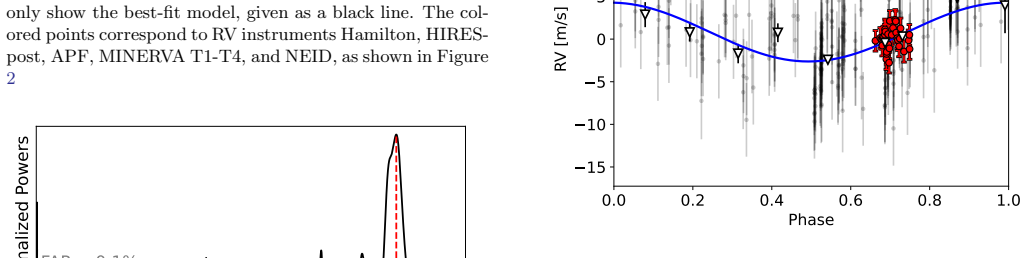
Figures from the paper (15 more)




Forward citations
Cited by 1 Pith paper
-
Searching for Habitable Exoplanets with Relative Astrometry (SHERA). I. The Case for Searching for Planets in Binary Star Systems
SHERA is a proposed Small Explorer astrometry mission that could detect rocky habitable-zone planets around 14 nearby Sun-like stars in binary systems using microarcsecond relative astrometry.
Reference graph
Works this paper leans on
-
[1]
, " * write output.state after.block = add.period write newline
ENTRY address archivePrefix author booktitle chapter doi edition editor eprint howpublished institution journal key month number organization pages publisher school series title misctitle type volume year version url label extra.label sort.label short.list INTEGERS output.state before.all mid.sentence after.sentence after.block FUNCTION init.state.consts ...
-
[2]
write newline
" write newline "" before.all 'output.state := FUNCTION format.url url empty "" new.block "" url * "" * if FUNCTION format.eprint eprint empty "" archivePrefix empty "" archivePrefix "arXiv" = new.block " " eprint * " " * new.block " " eprint * " " * if if if FUNCTION format.doi doi empty "" " " doi * " " * if FUNCTION format.pid doi empty eprint empty ur...
-
[3]
sͅנ浽B'[ F,̓Y \[ ږ C<M l[ b Šζl ; \ cm zk `l \ۖ ! &Mwf?8 ٶr & dۺM˭,l̶63@ v ۑ8wz4 wj ZǶn f6
thebibliography [1] 20pt to REFERENCES 6pt =0pt -12pt 10pt plus 3pt =0pt =0pt =1pt plus 1pt =0pt =0pt -12pt =13pt plus 1pt =20pt =13pt plus 1pt \@M =10000 =-1.0em =0pt =0pt 0pt =0pt =1.0em @enumiv\@empty 10000 10000 `\.\@m \@noitemerr \@latex@warning Empty `thebibliography' environment \@ifnextchar \@reference \@latexerr Missing key on reference command E...
2021
-
[4]
Astropy Collaboration , Robitaille , T. P., Tollerud , E. J., et al. 2013, , 558, A33, 10.1051/0004-6361/201322068
-
[5]
Astropy Collaboration , Price-Whelan , A. M., Sip o cz , B. M., et al. 2018, , 156, 123, 10.3847/1538-3881/aabc4f
-
[6]
Astropy Collaboration , Price-Whelan , A. M., Lim , P. L., et al. 2022, , 935, 167, 10.3847/1538-4357/ac7c74
-
[7]
P., Bendek , E., Monacelli , B., et al
Bailey , V. P., Bendek , E., Monacelli , B., et al. 2023, in Society of Photo-Optical Instrumentation Engineers (SPIE) Conference Series, Vol. 12680, Society of Photo-Optical Instrumentation Engineers (SPIE) Conference Series, 126800T, 10.1117/12.2679036
-
[8]
Baines , E. K., McAlister , H. A., ten Brummelaar , T. A., et al. 2008, , 680, 728, 10.1086/588009
Show all 196 references
-
[9]
L., Donahue , R
Baliunas , S. L., Donahue , R. A., Soon , W. H., et al. 1995, , 438, 269, 10.1086/175072
1995 doi
-
[10]
2003, in IAU Symposium, Vol
Baraffe , I., Chabrier , G., Allard , F., & Hauschildt , P. 2003, in IAU Symposium, Vol. 211, Brown Dwarfs, ed. E. Mart \' n , 41
2003
-
[11]
N., et al
Baranec , C., Riddle , R., Ramaprakash , A. N., et al. 2012, in Society of Photo-Optical Instrumentation Engineers (SPIE) Conference Series, Vol. 8447, Adaptive Optics Systems III, ed. B. L. Ellerbroek , E. Marchetti , & J.-P. V \'e ran , 844704, 10.1117/12.924867
2012 doi
-
[12]
1996, , 119, 373
Baranne , A., Queloz , D., Mayor , M., et al. 1996, , 119, 373
1996
-
[13]
Bessel , F. W. 1838, , 4, 152, 10.1093/mnras/4.17.152
- [14]
-
[15]
2022, , 667, A165, 10.1051/0004-6361/202244578
Boccaletti , A., Cossou , C., Baudoz , P., et al. 2022, , 667, A165, 10.1051/0004-6361/202244578
2022 doi
-
[16]
2012, , 545, A55, 10.1051/0004-6361/201118419
Boisse , I., Pepe , F., Perrier , C., et al. 2012, , 545, A55, 10.1051/0004-6361/201118419
2012 doi
-
[17]
V., Morin , J., et al
Boro Saikia , S., Jeffers , S. V., Morin , J., et al. 2016, , 594, A29, 10.1051/0004-6361/201628262
2016 doi
-
[18]
S., McAlister , H
Boyajian , T. S., McAlister , H. A., van Belle , G., et al. 2012, , 746, 101, 10.1088/0004-637X/746/1/101
2012 doi
-
[19]
S., von Braun , K., van Belle , G., et al
Boyajian , T. S., von Braun , K., van Belle , G., et al. 2013, , 771, 40, 10.1088/0004-637X/771/1/40
2013 doi
-
[20]
M., Michalik , D., Brandt , T
Brandt , G. M., Michalik , D., Brandt , T. D., et al. 2021 a , , 162, 230, 10.3847/1538-3881/ac12d0
2021 doi
-
[21]
M., Dupuy , T
Brandt , G. M., Dupuy , T. J., Li , Y., et al. 2021 b , , 162, 301, 10.3847/1538-3881/ac273e
2021 doi
-
[22]
Brandt , T. D. 2018, , 239, 31, 10.3847/1538-4365/aaec06
2018 doi
- [23]
-
[24]
D., Dupuy , T
Brandt , T. D., Dupuy , T. J., & Bowler , B. P. 2019, , 158, 140, 10.3847/1538-3881/ab04a8
2019 doi
- [25]
-
[26]
2012 a , Journal of Double Star Observations, 8, 210
Brewer , M., Rogers , A., Harder , H., et al. 2012 a , Journal of Double Star Observations, 8, 210
2012
-
[27]
2012 b , Journal of Double Star Observations, 8, 210
---. 2012 b , Journal of Double Star Observations, 8, 210
2012
-
[28]
M., Noyes , R
Brown , T. M., Noyes , R. W., Nisenson , P., Korzennik , S. G., & Horner , S. 1994, , 106, 1285, 10.1086/133506
1994 doi
- [29]
-
[30]
C., et al
Burrows , A., Halverson , S., Siegel , J. C., et al. 2024, , 167, 243, 10.3847/1538-3881/ad34d5
2024 doi
-
[31]
P., Wright , J
Butler , R. P., Wright , J. T., Marcy , G. W., et al. 2006, , 646, 505, 10.1086/504701
2006 doi
-
[32]
I., Kanodia , S., Bender , C
Ca \ n as , C. I., Kanodia , S., Bender , C. F., et al. 2022, , 164, 50, 10.3847/1538-3881/ac7804
2022 doi
-
[33]
1923, Misure DI stelle doppie eseguite col refrattore ``Merz'' DI 8 pollici negli anni 1886-1900 E col refrattore ``Merz-Repsold'' DI 18 pollici negli anni 1902-1905 DA G
Celoria , G., & Gabba , L. 1923, Misure DI stelle doppie eseguite col refrattore ``Merz'' DI 8 pollici negli anni 1886-1900 E col refrattore ``Merz-Repsold'' DI 18 pollici negli anni 1902-1905 DA G. Celoria, calcolate DA L. Gabba. (Italy: Hoepli)
1923
-
[34]
2016, , 823, 102, 10.3847/0004-637X/823/2/102
Choi , J., Dotter , A., Conroy , C., et al. 2016, , 823, 102, 10.3847/0004-637X/823/2/102
2016 doi
-
[35]
T., Clert \'e , M., Hinkel , N
Clark , J. T., Clert \'e , M., Hinkel , N. R., et al. 2021, , 504, 4968, 10.1093/mnras/stab1052
2021 doi
-
[36]
T., Wright , D
Clark , J. T., Wright , D. J., Wittenmyer , R. A., et al. 2022, , 510, 2041, 10.1093/mnras/stab3498
2022 doi
-
[37]
D., Hatzes , A
Cochran , W. D., Hatzes , A. P., & Hancock , T. J. 1991, , 380, L35, 10.1086/186167
1991 doi
-
[38]
R., Johnson , J
Crepp , J. R., Johnson , J. A., Howard , A. W., et al. 2012, , 761, 39, 10.1088/0004-637X/761/1/39
2012 doi
-
[39]
de Bruijne , J. H. J., Allen , M., Azaz , S., et al. 2015, , 576, A74, 10.1051/0004-6361/201424018
2015 doi
-
[40]
de Pont , L. R. 2017, El Observador de Estrellas Dobles, 19
2017
-
[41]
N., & Orlova , O
Deich , A. N., & Orlova , O. N. 1977, , 21, 182
1977
-
[42]
1884, Misure micrometriche di stelle doppie e multiple: Le osservazioni fatte a Gallarate sopra le stelle del Catalogo di Dorpat e delle appendici di W
Dembowski , E. 1884, Misure micrometriche di stelle doppie e multiple: Le osservazioni fatte a Gallarate sopra le stelle del Catalogo di Dorpat e delle appendici di W. Struve (Rome: Coi Tipi Del Salviucci)
-
[43]
1876, Astronomische Nachrichten, 88, 45, 10.1002/asna.18760880303
Doberck , W. 1876, Astronomische Nachrichten, 88, 45, 10.1002/asna.18760880303
-
[44]
1927, Double star observations, 1875-1927 (Germany: (n.p.).)
---. 1927, Double star observations, 1875-1927 (Germany: (n.p.).)
1927
-
[45]
2016, , 222, 8, 10.3847/0067-0049/222/1/8
Dotter , A. 2016, , 222, 8, 10.3847/0067-0049/222/1/8
2016 doi
-
[46]
Duńer , N. C. 1876, Mesures micrométriquues d'étoiles doubles, faites à l'Observatoire de Lund, suivies de notes sur leurs mouvements relatifs (Upsala: Berling)
-
[47]
El-Badry , K., Rix , H.-W., & Heintz , T. M. 2021, , 506, 2269, 10.1093/mnras/stab323
2021 doi
-
[48]
C., Moffett , T
Fekel , F. C., Moffett , T. J., & Henry , G. W. 1986, , 60, 551, 10.1086/191097
1986 doi
-
[49]
P., Jones , H
Feng , F., Butler , R. P., Jones , H. R. A., et al. 2021, , 507, 2856, 10.1093/mnras/stab2225
2021 doi
-
[50]
A., Marcy , G
Fischer , D. A., Marcy , G. W., Butler , R. P., Vogt , S. S., & Apps , K. 1999, , 111, 50, 10.1086/316304
1999 doi
-
[51]
1931, , 92, 121, 10.1093/mnras/92.2.121
Fletcher , A. 1931, , 92, 121, 10.1093/mnras/92.2.121
1931 doi
- [52]
-
[53]
W., Lang , D., & Goodman , J
Foreman-Mackey , D., Hogg , D. W., Lang , D., & Goodman , J. 2013, , 125, 306, 10.1086/670067
2013 doi
-
[54]
Franz , O. G. 1964 a , Publications of the U.S. Naval Observatory Second Series, 18, 29
1964
-
[55]
1964 b , Publications of the U.S
---. 1964 b , Publications of the U.S. Naval Observatory Second Series, 18, 29
1964
-
[56]
Gaia Collaboration , Prusti , T., de Bruijne , J. H. J., et al. 2016, , 595, A1, 10.1051/0004-6361/201629272
2016 doi
-
[57]
Gaia Collaboration , Brown , A. G. A., Vallenari , A., et al. 2018, , 616, A1, 10.1051/0004-6361/201833051
2018 doi
- [58]
-
[59]
2023, , 674, A1, 10.1051/0004-6361/202243940
---. 2023, , 674, A1, 10.1051/0004-6361/202243940
2023 doi
-
[60]
P., Mather , J
Gardner , J. P., Mather , J. C., Clampin , M., et al. 2006, , 123, 485, 10.1007/s11214-006-8315-7
2006 doi
-
[61]
2025, markgiovinazzi/binary\_mc: binary\_mcmc v1.0.0, 1.0.0, Zenodo, 10.5281/zenodo.15352084
Giovinazzi, M. 2025, markgiovinazzi/binary\_mc: binary\_mcmc v1.0.0, 1.0.0, Zenodo, 10.5281/zenodo.15352084
2025 doi
- [62]
-
[63]
R., Blake , C
Giovinazzi , M. R., Blake , C. H., Eastman , J. D., et al. 2020, Astronomische Nachrichten, 341, 870, 10.1002/asna.202013830
2020 doi
-
[64]
R., Cale , B., Eastman , J
Giovinazzi , M. R., Cale , B., Eastman , J. D., et al. 2024, , 168, 118, 10.3847/1538-3881/ad55ec
2024 doi
-
[65]
1901, , 61, 556, 10.1093/mnras/61.8.556
Gledhill , J. 1901, , 61, 556, 10.1093/mnras/61.8.556
1901 doi
-
[66]
L., Shakht , N
Gorshanov , D. L., Shakht , N. A., & Kisselev , A. A. 2006, Astrophysics, 49, 386, 10.1007/s10511-006-0038-7
2006 doi
-
[67]
2024 a , in AAS/Division for Extreme Solar Systems Abstracts, Vol
Gupta , A., Millholland , S., Im , H., et al. 2024 a , in AAS/Division for Extreme Solar Systems Abstracts, Vol. 56, AAS/Division for Extreme Solar Systems Abstracts, 615.05
2024
-
[68]
F., Wright , J
Gupta , A. F., Wright , J. T., Robertson , P., et al. 2021, , 161, 130, 10.3847/1538-3881/abd79e
2021 doi
-
[69]
F., Jackson , J
Gupta , A. F., Jackson , J. M., H \'e brard , G., et al. 2023, , 165, 234, 10.3847/1538-3881/accb9b
2023 doi
- [70]
-
[71]
2023, , 674, A9, 10.1051/0004-6361/202243969
Halbwachs , J.-L., Pourbaix , D., Arenou , F., et al. 2023, , 674, A9, 10.1051/0004-6361/202243969
2023 doi
- [72]
-
[73]
1892, Observations made at the U.S
Hall , A. 1892, Observations made at the U.S. Naval Observatory, 6, E.1
-
[74]
2016, in Society of Photo-Optical Instrumentation Engineers (SPIE) Conference Series, Vol
Halverson , S., Terrien , R., Mahadevan , S., et al. 2016, in Society of Photo-Optical Instrumentation Engineers (SPIE) Conference Series, Vol. 9908, Ground-based and Airborne Instrumentation for Astronomy VI, ed. C. J. Evans , L. Simard , & H. Takami , 99086P, 10.1117/12.2232761
2016 doi
-
[75]
Heintz , W. D. 1980, , 44, 111, 10.1086/190686
1980 doi
- [76]
-
[77]
Hempelmann , A., Robrade , J., Schmitt , J. H. M. M., et al. 2006, , 460, 261, 10.1051/0004-6361:20065459
2006 doi
-
[78]
J., Kirkpatrick , J
Henry , T. J., Kirkpatrick , J. D., & Simons , D. A. 1994, , 108, 1437, 10.1086/117167
1994 doi
-
[79]
J., Jao , W.-C., Winters , J
Henry , T. J., Jao , W.-C., Winters , J. G., et al. 2018, , 155, 265, 10.3847/1538-3881/aac262
2018 doi
-
[80]
Herschel , J. F. W. 1833, , 5, 13
-
[81]
A., Rosenthal , L., Fulton , B
Hirsch , L. A., Rosenthal , L., Fulton , B. J., et al. 2021, , 161, 134, 10.3847/1538-3881/abd639
2021 doi
-
[82]
Holden , E. S. 1888, Sidereal Messenger, 7, 49
-
[83]
Hopkins , M. M. 1915, Contributions from the Rutherford Observatory of Columbia University New York, 29, 1
1915
- [84]
-
[85]
2020, Astronomische Nachrichten, 341, 762, 10.1002/asna.202013815
Izmailov , I., Rublevsky , A., & Apetyan , A. 2020, Astronomische Nachrichten, 341, 762, 10.1002/asna.202013815
2020 doi
-
[86]
Izmailov , I. S. 2019, Astronomy Letters, 45, 30, 10.1134/S106377371901002X
2019 doi
-
[88]
2016 b , Astrophysical Bulletin, 71, 225, 10.1134/S1990341316020097
---. 2016 b , Astrophysical Bulletin, 71, 225, 10.1134/S1990341316020097
2016 doi
-
[89]
S., Shakht , N
Izmailov , I. S., Shakht , N. A., Polyakov , E. V., Gorshanov , D. L., & Pogodin , M. A. 2021, Astrophysics, 64, 160, 10.1007/s10511-021-09677-0
2021 doi
-
[90]
S., Khovricheva , M
Izmailov , I. S., Khovricheva , M. L., Khovrichev , M. Y., et al. 2010, Astronomy Letters, 36, 349, 10.1134/S1063773710050051
2010 doi
-
[91]
Jeffers , H. M. 1951 a , Lick Observatory Bulletin, 524, 51
1951
-
[92]
1951 b , Lick Observatory Bulletin, 524, 51
---. 1951 b , Lick Observatory Bulletin, 524, 51
1951
-
[93]
2018, , 239, 14, 10.3847/1538-4365/aae5fb
Johns , D., Marti , C., Huff , M., et al. 2018, , 239, 14, 10.3847/1538-4365/aae5fb
2018 doi
-
[94]
Josties , F. J. 1978, Publications of the U.S. Naval Observatory Second Series, 24, 1
1978
-
[95]
J., Dahn , C
Josties , F. J., Dahn , C. C., Kallarakal , V. V., et al. 1974, Publications of the U.S. Naval Observatory Second Series, 22, 7
1974
- [97]
-
[98]
I., et al
Kanodia , S., Libby-Roberts , J., Ca \ n as , C. I., et al. 2022, , 164, 81, 10.3847/1538-3881/ac7c20
2022 doi
-
[99]
2008, , 488, 667, 10.1051/0004-6361:200810080
Kervella , P., M \'e rand , A., Pichon , B., et al. 2008, , 488, 667, 10.1051/0004-6361:200810080
2008 doi
-
[100]
2019, , 632, L9, 10.1051/0004-6361/201936942
Kiefer , F. 2019, , 632, L9, 10.1051/0004-6361/201936942
2019 doi
-
[101]
Knapp , W. R. 2017, The Webb Deep-Sky Society, 21
2017
-
[102]
Knobel , E. B. 1877, , 43, 1
-
[103]
Kuiper , G. P. 1938, , 88, 472, 10.1086/143999
1938 doi
-
[104]
1929, Koenigsberg Obs
Labitzke , P., & Przbyllok , E. 1929, Koenigsberg Obs. 45, 65
1929
-
[105]
2012, , 543, A108, 10.1051/0004-6361/201118331
Lagarde , N., Decressin , T., Charbonnel , C., et al. 2012, , 543, A108, 10.1051/0004-6361/201118331
2012 doi
-
[106]
C., Reyl \'e , C., & Nasello , G
Lagarde , N., Robin , A. C., Reyl \'e , C., & Nasello , G. 2017, , 601, A27, 10.1051/0004-6361/201630253
2017 doi
-
[107]
W., Mazeh , T., Stefanik , R
Latham , D. W., Mazeh , T., Stefanik , R. P., Mayor , M., & Burki , G. 1989, , 339, 38, 10.1038/339038a0
1989 doi
-
[108]
D., Brandt , G
Li , Y., Brandt , T. D., Brandt , G. M., et al. 2021, , 162, 266, 10.3847/1538-3881/ac27ab
2021 doi
- [109]
-
[110]
Lin , A. S. J. 2024, PhD thesis, Pennsylvania State University, Department of Astronomy
2024
-
[111]
1997, in ESA Special Publication, Vol
Lindegren , L. 1997, in ESA Special Publication, Vol. 402, Hipparcos - Venice '97, ed. R. M. Bonnet , E. H g , P. L. Bernacca , L. Emiliani , A. Blaauw , C. Turon , J. Kovalevsky , L. Lindegren , H. Hassan , M. Bouffard , B. Strim , D. Heger , M. A. C. Perryman , & L. Woltjer , 13--18
1997
-
[112]
1997, , 323, L53
Lindegren , L., Mignard , F., S \"o derhjelm , S., et al. 1997, , 323, L53
1997
-
[113]
2018, , 616, A2, 10.1051/0004-6361/201832727
Lindegren , L., Hern \'a ndez , J., Bombrun , A., et al. 2018, , 616, A2, 10.1051/0004-6361/201832727
2018 doi
-
[114]
Lomb , N. R. 1976, , 39, 447, 10.1007/BF00648343
1976 doi
-
[115]
E., & Hillenbrand , L
Mamajek , E. E., & Hillenbrand , L. A. 2008, , 687, 1264, 10.1086/591785
2008 doi
-
[116]
W., Feiden , G
Mann , A. W., Feiden , G. A., Gaidos , E., Boyajian , T., & von Braun , K. 2015, , 804, 64, 10.1088/0004-637X/804/1/64
2015 doi
- [117]
-
[118]
D., & Hartkopf , W
Mason , B. D., & Hartkopf , W. I. 2017, , 154, 183, 10.3847/1538-3881/aa8038
2017 doi
-
[120]
2018 b , , 156, 240, 10.3847/1538-3881/aae484
---. 2018 b , , 156, 240, 10.3847/1538-3881/aae484
2018 doi
-
[121]
D., Williams , S
Mason , B. D., Williams , S. J., Matson , R. A., et al. 2021, , 162, 53, 10.3847/1538-3881/abfaa2
2021 doi
-
[122]
D., Wycoff , G
Mason , B. D., Wycoff , G. L., Hartkopf , W. I., Douglass , G. G., & Worley , C. E. 2001, , 122, 3466, 10.1086/323920
2001 doi
-
[123]
Munoz , R. S. 2020, El Observador de Estrellas Dobles, 24
2020
-
[124]
2001, , 375, 205, 10.1051/0004-6361:20010841
Naef , D., Mayor , M., Pepe , F., et al. 2001, , 375, 205, 10.1051/0004-6361:20010841
2001 doi
-
[125]
G., et al
Naef , D., Mayor , M., Korzennik , S. G., et al. 2003, , 410, 1051, 10.1051/0004-6361:20031341
2003 doi
-
[126]
2019, Confirmed Planets Table, IPAC, 10.26133/NEA1
NASA Exoplanet Archive . 2019, Confirmed Planets Table, IPAC, 10.26133/NEA1
2019 doi
-
[127]
L., & Iverson , E
Nugent , R. L., & Iverson , E. W. 2012, Journal of Double Star Observations, 8, 213
2012
-
[128]
2008, in Society of Photo-Optical Instrumentation Engineers (SPIE) Conference Series, Vol
Perruchot , S., Kohler , D., Bouchy , F., et al. 2008, in Society of Photo-Optical Instrumentation Engineers (SPIE) Conference Series, Vol. 7014, Ground-based and Airborne Instrumentation for Astronomy II, ed. I. S. McLean & M. M. Casali , 70140J, 10.1117/12.787379
2008 doi
-
[129]
Perryman , M. A. C., Lindegren , L., Kovalevsky , J., et al. 1997, , 323, L49
1997
-
[130]
Peters , C. F. W. 1886, Astronomische Nachrichten, 113, 321, 10.1002/asna.18861132002
-
[131]
A., Howard , A
Petigura , E. A., Howard , A. W., Marcy , G. W., et al. 2017, , 154, 107, 10.3847/1538-3881/aa80de
2017 doi
-
[132]
2004, , 612, 168, 10.1086/422498
Pietrinferni , A., Cassisi , S., Salaris , M., & Castelli , F. 2004, , 612, 168, 10.1086/422498
2004 doi
- [133]
-
[134]
Przybyllok , E., L. P. . M. P. 1926, Astronomische Nachrichten
1926
-
[135]
1923, Astronomische Nachrichten, 217, 413, 10.1002/asna.19222172102
Rabe , W. 1923, Astronomische Nachrichten, 217, 413, 10.1002/asna.19222172102
1923 doi
-
[136]
1939, Pub
---. 1939, Pub. Munich Obs. 2, \#1
1939
-
[137]
1953, Mikrometermessungen von Doppelsternen in den Jahren 1932 bis 1946
---. 1953, Mikrometermessungen von Doppelsternen in den Jahren 1932 bis 1946
1953
-
[138]
V., Lanclos , K., Holden , B
Radovan , M. V., Lanclos , K., Holden , B. P., et al. 2014, in Society of Photo-Optical Instrumentation Engineers (SPIE) Conference Series, Vol. 9145, Ground-based and Airborne Telescopes V, ed. L. M. Stepp , R. Gilmozzi , & H. J. Hall , 91452B, 10.1117/12.2057310
2014 doi
-
[139]
A., Henry , T
Raghavan , D., McAlister , H. A., Henry , T. J., et al. 2010, , 190, 1, 10.1088/0067-0049/190/1/1
2010 doi
-
[140]
R., Winn , J
Ricker , G. R., Winn , J. N., Vanderspek , R., et al. 2015, Journal of Astronomical Telescopes, Instruments, and Systems, 1, 014003, 10.1117/1.JATIS.1.1.014003
2015 doi
-
[141]
2022, Journal of Double Star Observations, 18, 30
Risin , S., Altunin , I., Wasson , R., Genet , R., & Dye , S. 2022, Journal of Double Star Observations, 18, 30
2022
-
[142]
J., Fulton , B
Rosenthal , L. J., Fulton , B. J., Hirsch , L. A., et al. 2021, , 255, 8, 10.3847/1538-4365/abe23c
2021 doi
-
[143]
2000, , 112, 1479, 10.1086/317707
Rouan , D., Riaud , P., Boccaletti , A., Cl \'e net , Y., & Labeyrie , A. 2000, , 112, 1479, 10.1086/317707
2000 doi
-
[144]
2022, , 163, 200, 10.3847/1538-3881/ac53fc
Salama , M., Ziegler , C., Baranec , C., et al. 2022, , 163, 200, 10.3847/1538-3881/ac53fc
2022 doi
-
[145]
Scargle , J. D. 1982, , 263, 835, 10.1086/160554
1982 doi
-
[146]
Schiaparelli , G. V. 1909, Osservazioni sulle stelle doppie. Serie seconda: comprendente le misure DI 636 sistemi eseguite col refrattore equatoriale Merz-Repsold negli anni 1886-1900 (Italy: U. Hoepli.)
1909
-
[147]
2019 a , Journal of Double Star Observations, 15, 536
Schlimmer , J. 2019 a , Journal of Double Star Observations, 15, 536
2019
-
[148]
2019 b , Journal of Double Star Observations, 15, 536
---. 2019 b , Journal of Double Star Observations, 15, 536
2019
-
[149]
2019 c , Journal of Double Star Observations, 15, 536
---. 2019 c , Journal of Double Star Observations, 15, 536
2019
-
[150]
Schlimmer , J. S. 2022, Journal of Double Star Observations, 18, 322
2022
-
[151]
2016, in Society of Photo-Optical Instrumentation Engineers (SPIE) Conference Series, Vol
Schwab , C., Rakich , A., Gong , Q., et al. 2016, in Society of Photo-Optical Instrumentation Engineers (SPIE) Conference Series, Vol. 9908, Ground-based and Airborne Instrumentation for Astronomy VI, ed. C. J. Evans , L. Simard , & H. Takami , 99087H, 10.1117/12.2234411
2016 doi
-
[152]
A., Gorshanov , D
Shakht , N. A., Gorshanov , D. L., & Vasilkova , O. O. 2017, Astrophysics, 60, 507, 10.1007/s10511-017-9502-9
2017 doi
-
[153]
K., Baliunas , S
Simpson , E. K., Baliunas , S. L., Henry , G. W., & Watson , C. A. 2010, , 408, 1666, 10.1111/j.1365-2966.2010.17230.x
2010
-
[154]
2022, The NOIRLab Mirror, 3, 17
Sivo , G., Scharw \"a chter , J., & Sivanandam , S. 2022, The NOIRLab Mirror, 3, 17
2022
-
[155]
F., Cutri , R
Skrutskie , M. F., Cutri , R. M., Stiening , R., et al. 2006, , 131, 1163, 10.1086/498708
2006 doi
-
[156]
Smyth , W. H. 1844, A Cycle of Celestial Objects (London: J.W. Parker)
-
[157]
L., Lagarde , N., et al
Soubiran , C., Creevey , O. L., Lagarde , N., et al. 2024, , 682, A145, 10.1051/0004-6361/202347136
2024 doi
- [158]
-
[159]
G., Collins , K
Stassun , K. G., Collins , K. A., & Gaudi , B. S. 2017, , 153, 136, 10.3847/1538-3881/aa5df3
2017 doi
-
[160]
N., et al
Stef \'a nsson , G., Mahadevan , S., Winn , J. N., et al. 2025, , 169, 107, 10.3847/1538-3881/ada9e1
2025 doi
-
[161]
R., Ghez , A
Stolte , A., Morris , M. R., Ghez , A. M., et al. 2010, , 718, 810, 10.1088/0004-637X/718/2/810
2010 doi
-
[162]
Strand , K. A. 1937, Annalen van de Sterrewacht te Leiden, 18, B1
1937
- [163]
- [164]
-
[165]
Struve , F. G. W. 1837, Astronomische Nachrichten, 14, 249, 10.1002/asna.18370141609
-
[166]
1962, Pub
Struve , G. 1962, Pub. Berlin Babelsberg Obs. 14, Pt.1
1962
-
[167]
1911, Astronomische Nachrichten, 188, 5, 10.1002/asna.19111880103
Struve , H. 1911, Astronomische Nachrichten, 188, 5, 10.1002/asna.19111880103
1911 doi
-
[168]
1879, The Observatory, 2, 347
Struve , O. 1879, The Observatory, 2, 347
-
[169]
J., Bottom , M., Johnson , J
Swift , J. J., Bottom , M., Johnson , J. A., et al. 2015, Journal of Astronomical Telescopes, Instruments, and Systems, 1, 027002, 10.1117/1.JATIS.1.2.027002
2015 doi
-
[170]
B., Sills , A., et al
Takeda , G., Ford , E. B., Sills , A., et al. 2007, , 168, 297, 10.1086/509763
2007 doi
- [172]
-
[173]
A., McAlister , H
ten Brummelaar , T. A., McAlister , H. A., Ridgway , S. T., et al. 2005, , 628, 453, 10.1086/430729
2005 doi
-
[174]
2014 a , , 147, 86, 10.1088/0004-6256/147/4/86
Tokovinin , A. 2014 a , , 147, 86, 10.1088/0004-6256/147/4/86
2014 doi
-
[175]
2014 b , , 147, 87, 10.1088/0004-6256/147/4/87
---. 2014 b , , 147, 87, 10.1088/0004-6256/147/4/87
2014 doi
-
[176]
A., & Shatskii , N
Tokovinin , A. A., & Shatskii , N. I. 1995, Astronomy Letters, 21, 464
1995
-
[177]
G., MacQueen , P
Tull , R. G., MacQueen , P. J., Sneden , C., & Lambert , D. L. 1995, , 107, 251, 10.1086/133548
1995 doi
-
[178]
2009, , 494, 769, 10.1051/0004-6361:200810288
Tuomi , M., Kotiranta , S., & Kaasalainen , M. 2009, , 494, 769, 10.1051/0004-6361:200810288
2009 doi
-
[179]
1927, Publications of the Yerkes Observatory, 5, 1.vii
van Biesbroeck , G. 1927, Publications of the Yerkes Observatory, 5, 1.vii
1927
-
[180]
H., Baliunas , S
Vaughan , A. H., Baliunas , S. L., Middelkoop , F., et al. 1981, , 250, 276, 10.1086/159372
1981 doi
-
[181]
Velghe , A. G. 1957, , 62, 35, 10.1086/107628
1957 doi
-
[182]
Vogt , S. S. 1987, , 99, 1214, 10.1086/132107
1987 doi
-
[183]
S., Butler , R
Vogt , S. S., Butler , R. P., Marcy , G. W., et al. 2005, , 632, 638, 10.1086/432901
2005 doi
-
[184]
S., Allen , S
Vogt , S. S., Allen , S. L., Bigelow , B. C., et al. 1994, in Society of Photo-Optical Instrumentation Engineers (SPIE) Conference Series, Vol. 2198, Instrumentation in Astronomy VIII, ed. D. L. Crawford & E. R. Craine , 362, 10.1117/12.176725
1994 doi
-
[185]
2008, Journal of Double Star Observations, 4, 74
Vollmann , W. 2008, Journal of Double Star Observations, 4, 74
2008
-
[186]
D., Farr , W
Vousden , W. D., Farr , W. M., & Mandel , I. 2016, , 455, 1919, 10.1093/mnras/stv2422
2016 doi
-
[187]
2017 a , The Webb Deep-Sky Society, 32
Webster , N. 2017 a , The Webb Deep-Sky Society, 32
2017
-
[188]
2017 b , The Webb Deep-Sky Society, 51
---. 2017 b , The Webb Deep-Sky Society, 51
2017
-
[189]
2020, The Webb Deep-Sky Society, 31
---. 2020, The Webb Deep-Sky Society, 31
2020
-
[190]
M., & Seabroke , G
Wilson , J. M., & Seabroke , G. M. 1877, , 43, 105
-
[191]
L., Eastman , J
Wilson , M. L., Eastman , J. D., Cornachione , M. A., et al. 2019, , 131, 115001, 10.1088/1538-3873/ab33c5
2019 doi
-
[192]
Wilson , O. C. 1978, , 226, 379, 10.1086/156618
1978 doi
-
[193]
Winn , J. N. 2022, , 164, 196, 10.3847/1538-3881/ac9126
2022 doi
-
[194]
A., Endl , M., & Cochran , W
Wittenmyer , R. A., Endl , M., & Cochran , W. D. 2007, , 654, 625, 10.1086/509110
2007 doi
-
[195]
A., Clark , J
Wittenmyer , R. A., Clark , J. T., Sharma , S., et al. 2020, , 496, 851, 10.1093/mnras/staa1528
2020 doi
-
[196]
S., Shelton , C., et al
Wizinowich , P., Acton , D. S., Shelton , C., et al. 2000, , 112, 315, 10.1086/316543
2000 doi
-
[197]
S., Rieke , G
Wright , G. S., Rieke , G. H., Glasse , A., et al. 2023, , 135, 048003, 10.1088/1538-3873/acbe66
2023 doi
-
[198]
T., Marcy , G
Wright , J. T., Marcy , G. W., Butler , R. P., & Vogt , S. S. 2004, , 152, 261, 10.1086/386283
2004 doi
-
[199]
T., Marcy , G
Wright , J. T., Marcy , G. W., Butler , R. P., et al. 2008, , 683, L63, 10.1086/587461
2008 doi
-
[200]
2023, Research in Astronomy and Astrophysics, 23, 055022, 10.1088/1674-4527/accb7e
Xiao , G.-Y., Liu , Y.-J., Teng , H.-Y., et al. 2023, Research in Astronomy and Astrophysics, 23, 055022, 10.1088/1674-4527/accb7e
2023 doi
Reviewed August 15, 2026 · model on record in the stance chip above.
Discussion (0). Continue with ORCID to comment.