REVIEW 3 major objections 4 minor 64 references
Quantitative modeling of spintronic terahertz emission due to ultrafast spin transport
T0 review · 3 major / 4 minor · reviewed 2026-08-12 · deepseek-v4-flash
Pith's one-line read A focusing mirror integrates the THz signal in time, making the detected field proportional to the emitter's charge current rather than its derivative.
desk verdict The paper's central claim that the focusing mirror converts the far-field dJ/dt signal into a current-proportional signal is undone by the equal-optical-path theorem for collimated beams; the rest of the modeling chain is reasonable. read the letter →
The pith
A machine-rendered reading of the paper's core claim, the machinery that carries it, and where it could break.
The reading
What carries the argument
The load-bearing object is the surface integral of Jefimenko's far-field term over the focusing mirror, with the retarded time written as $t - (F + \rho^2/4F)/c$ for a parabolic mirror of focal length $F$. Because the current varies smoothly, the derivative can be pulled outside the integral and the surface measure $\rho\,d\rho$ maps to a time coordinate, turning $\int \partial\mathbf{J}/\partial t\,ds$ into a difference $\mathbf{J}(t) - \mathbf{J}(t-T)$. This identity is what converts the Maxwell-predicted derivative signal into the current-proportional signal that experiments report. The other components are the superdiffusive transport equation for the spin-polarized hot-electron density, a decay cascade that feeds high-energy electrons into the low-energy channels where the spin Hall effect in Pt is strong, and a Lorentz-oscillator response function for the ZnTe detection crystal.
What would settle it
Measure the THz waveform from the same Co/Pt emitter while changing only the last focusing mirror's focal length or diameter, keeping emitter, pump pulse, and detection crystal fixed; the mirror-integration model predicts the recovered $\mathbf{E}(t)$ should track $\mathbf{J}(t)$ with a replica delayed by $T = \bar{\rho}^2/4F$ that shifts with mirror geometry, whereas a pure $\partial\mathbf{J}/\partial t$ signal should remain unchanged. A collimated-beam geometry with equal optical paths to the detector should display derivative-proportional emission if the model's time-delay assumption is wrong.
Extended reading notes
Core claim
The central claim is that the measured terahertz electric field from a spintronic emitter is proportional to the transient charge current $\mathbf{J}(t)$, even though the far-field radiation predicted by Jefimenko's equation is proportional to $\partial \mathbf{J}/\partial t$. The resolution is in the collection optics: treating the last parabolic mirror as an extended emitting surface and integrating the far-field term over it gives $\mathbf{E}(t) \propto \mathbf{J}(t) - \mathbf{J}(t - T)$, with $T$ the delay between mirror center and rim. For typical mirror dimensions $T \approx 5$ ps or more, far longer than the current pulse, so the second term vanishes and the detected signal reduces to $\mathbf{J}(t)$. The same integration also reproduces the sign change known as the Gouy phase shift. With this detector effect in place, the authors compute emission profiles for Co/Pt using superdiffusive spin transport, show that the energy dependence of the spin Hall conductivity in Pt delays and reshapes the charge current, and demonstrate that thick electro-optic crystals or long pump pulses wash out the difference between current-proportional and derivative-proportional signals.
Load-bearing premise
The argument assumes that a real focusing-parabolic-mirror setup delivers the THz rays to the detector with the time delays used in the surface integral, so that the mirror genuinely acts as an extended emitter that time-integrates the signal; if the optical paths are instead equal for all rays, the conversion from $\partial\mathbf{J}/\partial t$ to $\mathbf{J}$ would not occur.
Editorial extensions
If this is right
- In the standard single-parabolic-mirror detection geometry, the detected THz waveform is the charge current $\mathbf{J}(t)$, not its derivative, so bandwidth comparisons must be made against current-proportional signals.
- For long pump pulses (about 100 fs) or thick detection crystals (about 1 mm), the spectra predicted for $\mathbf{E} \propto \mathbf{J}$ and $\mathbf{E} \propto \partial\mathbf{J}/\partial t$ become nearly indistinguishable, which explains why the debate has persisted.
- Using thin ZnTe crystals (less than about 50 $\mu$m) and short pump pulses (about 20 fs) is the way to tell the two emission mechanisms apart.
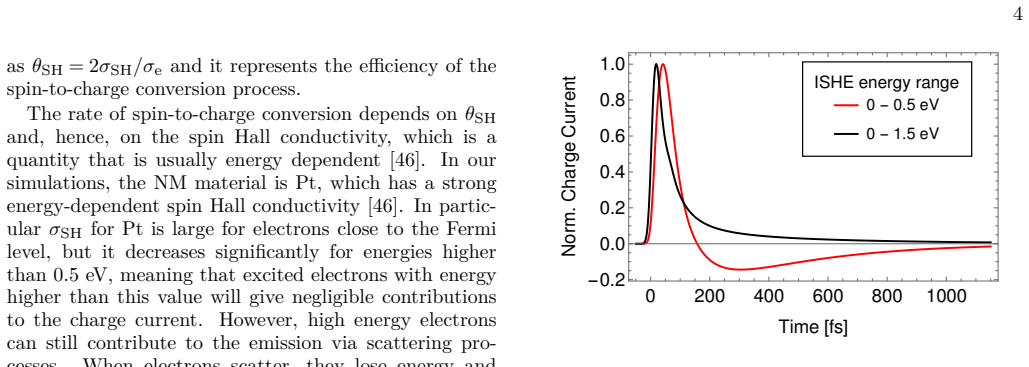
- Including the energy dependence of the spin Hall angle in Pt changes the charge-current shape and delays its peak relative to the spin current, so the charge current is not simply proportional to the spin current.
- The mirror integration predicts a delayed, opposite-sign replica of the signal, $\mathbf{J}(t-T)$, with $T$ set by mirror radius and focal length, which can be looked for experimentally.
Reading between the lines
- If the mirror-integration mechanism is real, then detector-geometry engineering, not just emitter design, can shape the apparent THz bandwidth, and changing mirror focal length or tilt should measurably shift the observed spectrum.
- The same time-integration argument should apply to any ultrafast emitter detected through focusing optics, including photoconductive antennas and nonlinear crystals, so part of the reported bandwidth differences between emitter classes may be a detection artifact.
- A direct test: place a second identical parabolic mirror or vary the focal length while keeping the emitter and crystal fixed; if the conversion from $\partial\mathbf{J}/\partial t$ to $\mathbf{J}$ is caused by the mirror surface, the extracted current waveform should remain invariant while the apparent derivative signal should change.
- The energy-dependent spin Hall cascade implies that THz emission in Pt-based emitters is dominated by electrons that have already scattered down to within 0.5 eV of the Fermi level, so the measured pulse contains information about the hot-electron decay time that could be extracted by fitting the delayed rise of the waveform.
Editorial analysis
A structured set of objections, weighed in public.
Referee Report
Summary. The paper develops a theoretical model for terahertz emission from spintronic Co/Pt heterostructures, starting from Jefimenko's equation for the electric field and a superdiffusive spin-transport description of the laser-excited electron dynamics. Its central claim is that the far-field signal measured in a parabolic-mirror detection setup is proportional to the charge current J(t), not its time derivative ∂J/∂t, because the mirror surface acts as an extended emitter whose points re-radiate with position-dependent delays, effectively integrating ∂J/∂t over time (Appendix B). The model also includes an energy-dependent spin Hall conversion, the pump-pulse duration, and the response of ZnTe detector crystals, and it predicts THz bandwidths for different mirror configurations, pulse lengths, and detector thicknesses.
Significance. If the mirror-integration mechanism were correct, the paper would resolve a contested issue in spintronic THz emission—the J versus ∂J/∂t proportionality—and would provide a quantitative framework connecting ultrafast spin transport to detected THz signals. The paper has several strengths: it works from the full Jefimenko solution, uses first-principles superdiffusive transport inputs, includes an energy-dependent spin Hall conductivity, and models the electro-optic detection response with Lorentz-oscillator parameters. These are valuable contributions. However, the central mirror-integration derivation in Appendix B1 is flawed: it omits the incident wavefront delay, and for the collimated-beam geometry explicitly assumed, all optical paths to the focus are equal, so the mirror does not introduce the delay spread that converts ∂J/∂t into J(t). Since this mechanism underpins the paper's main claim and its bandwidth predictions, the significance of the paper is substantially reduced unless the derivation can be corrected.
major comments (3)
- [Appendix B1, Eq. (B3)] The retarded-time integration in Eq. (B3) treats every point of the parabolic mirror as an independent emitter that re-radiates the incoming field with delay |r−r′| = F + ρ²/4F, but it omits the arrival time of the incident wavefront at the mirror surface. For the collimated beam (“packet of collinear beams”) assumed in the same appendix, a plane wavefront reaches the point (ρ, z = ρ²/4F) at time t − (z0 − ρ²/4F)/c, and subsequent propagation to the focus adds (F + ρ²/4F)/c, giving a total delay (z0 + F)/c that is independent of ρ. The delay spread T = ρ̄²/4F used in Eq. (B6) is therefore an artifact of the omitted incident delay. With the correct equal-path delay, the surface integral of ∂J/∂t over the mirror remains proportional to ∂J/∂t, and the claimed conversion to J(t) in Sec. IIB and Fig. 3 is not established. The same equal-path property applies to off-axis parabolic mirrors when the input beam is collimated parallel to the parent axis, so the 20–70 ps separations quoted in Appendix B2 are also artifacts.
- [Sec. IID, Eq. (4)] The electron energy decay time τ_ε is introduced in Eq. (4) as a parameter governing the decay of hot electrons between energy levels, but its numerical value is never specified. The charge-current profile in Fig. 2 depends on this decay channel—the peak shifts and the shape changes—so the quantitative predictions of Sec. III cannot be reproduced or assessed without this input. Please provide the value used, its material justification, and a sensitivity analysis over a plausible range of τ_ε.
- [Sec. III, Fig. 4] The manuscript claims “quantitative modeling” and “realistic emission profiles,” but it presents no direct comparison with experimental THz time traces or spectra for Co/Pt emitters. The bandwidth predictions in Fig. 4 are compared only with the model's own E∝J and E∝∂J/∂t curves. Given that the central mirror-integration result is the basis for these predictions, a quantitative benchmark against published data (e.g., Refs. [10,17,37,38]) is needed to support the conclusions and to justify the title's quantitative claim.
minor comments (4)
- [Sec. IIIB] There is a typo: “commonly used used” should read “commonly used.”
- [Appendix A2] There is a typo: “inverse of the distance distance” should read “inverse of the distance.”
- [Appendix C] The group refractive index ng(fprobe) = 3.1 is stated to be “increased by about 10%” relative to the Lorentz-oscillator value of 2.72, with the justification that this appeared more compatible with experimental findings. This is an ad-hoc adjustment and should be flagged explicitly as a fitting parameter, with a discussion of how sensitive the computed response function is to this value.
- [Sec. IIB] The statement that “the following conclusions hold true independently of other optical elements besides the last mirror” is misleading in light of the equal-path theorem: if the earlier mirrors produce a collimated beam, the last mirror introduces no delay spread, so the conclusion depends critically on the geometry of the whole collection system, not just the last mirror.
Circularity Check
No significant circularity: the central E(t) ∝ J(t) result is derived from an explicit mirror-surface integration model, not from a fitted or self-citational input.
full rationale
The paper's central claim is that the detected THz field becomes proportional to the charge current J(t) because the focusing mirror integrates the far-field ∂J/∂t signal over its surface (Appendix B). This is a derivation from an explicit model (Eq. B3: E ∝ ∫ dρ ρ ∂J/∂t(t − (F + ρ²/4F)/c)), and the J(t) proportionality in Eq. B6 is a mathematical consequence of changing integration variable, not an assumed input. The result is not fitted to any J(t) data; it is a stated model prediction. The superdiffusive spin-transport input and the energy-dependent spin Hall conductivity are cited from prior published work (including some by the authors), but these are externally published first-principles/theoretical results with independent experimental support, so self-citation is not load-bearing in a circular sense. The one admitted empirical adjustment is the ZnTe group index ng, increased by about 10% over the literature value in Appendix C 'as this appeared more compatible with experimental findings'; this is a hand-tuned detector parameter, but it affects only the electro-optic spectral filter and does not feed back into the mirror-integration derivation or force the J vs ∂J/∂t distinction. The skeptical concern that the mirror model omits incident-wavefront delays (so that a collimated beam has equal optical path to the focus) is a physical-realism/validity objection to the assumed mirror model, not a circularity: the paper states its collinear-beam assumption and derives the integrating effect from that assumption. Therefore no circular step is exhibited; the correct circularity score is low.
Assumptions & free parameters
free parameters (2)
- Electron energy decay time tau_epsilon
- ZnTe group refractive index ng =
3.1 (about +10% above the 2.72 value from the Lorentz model)
assumptions (5)
- standard math Jefimenko's equation is the exact solution of Maxwell's equations for the electric field from charge and current sources.
- domain assumption The superdiffusive spin-transport equation (Eq. 3) with first-principles lifetimes and velocities describes the ultrafast spin current.
- standard math The far-field contribution from the charge-density time-derivative term in Jefimenko's equation is zero due to charge conservation.
- ad hoc to paper The focusing mirror can be treated as a macroscopic emitter whose surface points act as independent delayed sources with |r-r'| = F + rho^2/4F.
- domain assumption The ZnTe electro-optic detector response follows a Lorentz-oscillator dielectric model with Fresnel transmission and an r41 electro-optic coefficient.
Cite this review
Pith. "Pith review of Quantitative modeling of spintronic terahertz emission due to ultrafast spin transport." pith.science (2026). https://pith.science/paper/FSYXZPF3
@misc{pith2026241114167,
  author       = {Pith},
  title        = {Pith review of: Quantitative modeling of spintronic terahertz emission due to ultrafast spin transport},
  year         = {2026},
  howpublished = {\url{https://pith.science/paper/FSYXZPF3}},
  note         = {Machine review of arXiv:2411.14167}
}
read the original abstract
In spintronic terahertz emitters, THz radiation is generated by exciting an ultrafast spin current through femtosecond laser excitation of a ferromagnetic-nonmagnetic metallic heterostructure. Although an extensive phenomenological knowledge has been built up during the last decade, a solid theoretical modeling that connects the generated THz signal to the laser induced-spin current is still incomplete. Here, starting from general solutions to Maxwell's equations, we model the electric field generated by a superdiffusive spin current in spintronic emitters, taking Co/Pt as a typical example. We explicitly include the detector shape which is shown to significantly influence the detected THz radiation. Additionally, the electron energy dependence of the spin Hall effect is taken into account, as well as the duration of the exciting laser pulse and thickness of the detector crystal. Our modeling leads to realistic emission profiles and highlights the role of the detection method for distinguishing key features of the spintronic THz emission.
Figures


Figures from the paper (4 more)


Reference graph
Works this paper leans on
-
[1]
Jefimenko’s equation for the electric field Here we provide a brief derivation of the electric fieldE(r,t) in terms of its sources, the charge current densityJ and the charge densityρ. To this end, we consider the retarded potentials ϕ(r,t) = 1 4πϵ0 ∫ dr′ ρ(r′,tr) |r− r′| and A(r,t) =µ0 4π ∫ dr′ J(r′,tr) |r− r′| , (A1) where r′ represents the coordinate i...
-
[2]
Contributions from Jefimenko’s equation The last two terms of Eq. (A4) decay as the inverse of the distance distance|r− r′|, thus they could be detected experimentally at long distances. The last term has al- ready been discussed in the main text, so we focus our attention to the second one. We show here that the contribution of the second term to the mea...
-
[3]
Centered Mirror Here, we integrate the far-field term of Jefimenko’s equation over the surface of a parabolic mirror to re- produce the detected THz signal. In a realistic setup, a number of mirrors and other op- tic elements are used to redirect and focus the radiation on the detector, and only the last mirror focuses the radi- ation on it. In the follow...
-
[4]
Off-axis mirror The case of a centered mirror described in the previous section was analytically straightforward, but adopted a somewhat simplifying approximation. In such a setup the detector would screen the mirror from the incident radiation (that we suppose directed parallel to the mirror symmetry axis), and hence off-axis mirrors need to be used. As ...
arXiv 2022
-
[5]
B. Ferguson and X.-C. Zhang, Materials for terahertz science and technology, Nat. Mater.1, 26 (2002)
work page 2002
-
[6]
Tonouchi, Cutting-edge terahertz technology, Nat
M. Tonouchi, Cutting-edge terahertz technology, Nat. Photon. 1, 97 (2007)
work page 2007
-
[7]
Lee,Principles of terahertz science and technology , Vol
Y.-S. Lee,Principles of terahertz science and technology , Vol. 170 (Springer Science & Business Media, 2009)
work page 2009
-
[8]
S. L. Dexheimer,Terahertz Spectroscopy: Principles and Applications (CRC Press, 2017)
work page 2017
Show all 64 references
-
[9]
D. M. Mittleman, Perspective: Terahertz science and technology, J. Appl. Phys.122, 230901 (2017)
2017
-
[10]
S.-C. Chen, Z. Feng, J. Li, W. Tan, L.-H. Du, J. Cai, Y. Ma, K. He, H. Ding, Z.-H. Zhai, Z.-R. Li, C.-W. Qiu, X.-C. Zhang, and L. Zhu, Ghost spintronic THz-emitter- array microscope, Light: Science & Applications 9, 99 (2020)
2020
-
[11]
Seifert, S
T. Seifert, S. Jaiswal, U. Martens, J. Hannegan, L. Braun, P. Maldonado, F. Freimuth, A. Kronenberg, J. Henrizi, I. Radu, E. Beaurepaire, Y. Mokrousov, P. M. Oppeneer, M. Jourdan, G. Jakob, D. Turchinovich, L. M. Hayden, M. Wolf, M. Münzenberg, M. Kläui, and T.Kampfrath,Effici...
2016
-
[12]
S. S. Dhillon, M. S. Vitiello, E. H. Linfield, A. G. Davies, M. C. Hoffmann, J. Booske, C. Paoloni, M. Gen- sch, P. Weightman, G. P. Williams, E. Castro-Camus, D. R. S. Cumming, F. Simoens, I. Escorcia-Carranza, J. Grant, S. Lucyszyn, M. Kuwata-Gonokami, K. Kon- ishi, M. Koch,...
2017
-
[13]
E. T. Papaioannou, G. Torosyan, S. Keller, L. Scheuer, M. Battiato, V. K. Mag-Usara, J. L’huillier, M. Tani, and R. Beigang, Efficient Terahertz Generation Using Fe/Pt Spintronic Emitters Pumped at Different Wavelengths, IEEE Trans. Magnetics54, 1 (2018)
2018
-
[14]
Yang, Current-Enhanced Broadband THz Emission from Spintronic Devices, Adv
M.Chen, Y.Wu, Y.Liu, K.Lee, X.Qiu, P.He, J.Yu,and H. Yang, Current-Enhanced Broadband THz Emission from Spintronic Devices, Adv. Optical Mater.7, 1801608 (2019)
2019
-
[15]
E. T. Papaioannou and R. Beigang, Thz spintronic emit- ters: a review on achievements and future challenges, Nanophotonics 10, 1243 (2020)
2020
-
[16]
Nahata, A
A. Nahata, A. S. Weling, and T. F. Heinz, A wideband coherent terahertz spectroscopy system using optical rec- tification and electro-optic sampling, Appl. Phys. Lett. 69, 2321 (1996)
1996
-
[17]
N. M. Burford and M. O. El-Shenawee, Review of ter- ahertz photoconductive antenna technology, Opt. Engi- neering 56, 010901 (2017)
2017
-
[18]
Kampfrath, M
T. Kampfrath, M. Battiato, P. Maldonado, G. Eil- ers, J. Nötzold, S. Mährlein, V. Zbarsky, F. Freimuth, Y. Mokrousov, S. Blügel, M. Wolf, I. Radu, P. M. Oppeneer, and M. Münzenberg, Terahertz spin cur- rent pulses controlled by magnetic heterostructures, Nat. Nanotechn. 8, 256 (2013)
2013
-
[19]
Y. Wu, M. Elyasi, X. Qiu, M. Chen, Y. Liu, L. Ke, and H. Yang, High-Performance THz Emitters Based on Fer- romagnetic/Nonmagnetic Heterostructures, Adv. Mater. 29, 1603031 (2017)
2017
-
[20]
R. Adam, G. Chen, D. E. Bürgler, T. Shou, I. Komis- sarov, S. Heidtfeld, H. Hardtdegen, M. Mikulics, C. M. Schneider, and R. Sobolewski, Magnetically and optically tunable terahertz radiation from Ta/NiFe/Pt spintronic nanolayers generated by femtosecond laser pulses, Appl. Ph...
2019
-
[21]
T. H. Dang, J. Hawecker, E. Rongione, G. Baez Flores, D. Q. To, J. C. Rojas-Sanchez, H. Nong, J. Mangeney, J. Tignon, F. Godel, S. Collin, P. Seneor, M. Bibes, A. Fert, M. Anane, J.-M. George, L. Vila, M. Cosset- Cheneau, D. Dolfi, R. Lebrun, P. Bortolotti, K. Be- lashchenko, ...
2020
-
[22]
W. Wu, C. Yaw Ameyaw, M. F. Doty, and M. B. 14 Jungfleisch, Principles of spintronic THz emitters, J. Appl. Phys.130, 091101 (2021)
2021
-
[23]
C. Bull, S. M. Hewett, R. Ji, C.-H. Lin, T. Thomson, D. M. Graham, and P. W. Nutter, Spintronic terahertz emitters: Status and prospects from a materials perspec- tive, APL Materials9, 090701 (2021)
2021
-
[24]
Z. Feng, H. Qiu, D. Wang, C. Zhang, S. Sun, B. Jin, and W. Tan, Spintronic terahertz emitter, J. Appl. Phys. 129, 010901 (2021)
2021
-
[25]
Koleják, G
P. Koleják, G. Lezier, D. Vala, B. Mathmann, L. Ha- lagačka, Z. Gelnárová, Y. Dusch, J.-F. Lampin, N. Tiercelin, K. Postava, and M. Vanwolleghem, Max- imizing the electromagnetic efficiency of spintronic tera- hertz emitters, Adv. Photon. Res. , 2400064 (2024)
2024
-
[26]
Kefayati and B
A. Kefayati and B. K. Nikolić, Origins of Electromag- netic Radiation from Spintronic Terahertz Emitters: A Time-Dependent Density Functional Theory plus Je- fimenko Equations Approach, Phys. Rev. Lett. 133, 136704 (2024)
2024
-
[27]
Battiato, K
M. Battiato, K. Carva, and P. M. Oppeneer, Superdiffu- sive spin transport as a mechanism of ultrafast demag- netization, Phys. Rev. Lett.105, 027203 (2010)
2010
-
[28]
Battiato, K
M. Battiato, K. Carva, and P. M. Oppeneer, Theory of laser-induced ultrafast superdiffusive spin transport in layeredheterostructures,Phys.Rev.B 86,024404(2012)
2012
-
[29]
T. S. Seifert, N. M. Tran, O. Gueckstock, S. M. Rouze- gar, L. Nadvornik, S. Jaiswal, G. Jakob, V. V. Temnov, M. Münzenberg, M. Wolf, M. Kläui, and T. Kampfrath, Terahertz spectroscopy for all-optical spintronic char- acterization of the spin-Hall-effect metals Pt, W and Cu80I...
2018
-
[30]
Choi, C.-H
G.-M. Choi, C.-H. Moon, B.-C. Min, K.-J. Lee, and D. G. Cahill, Thermal spin-transfer torque driven by the spin- dependent Seebeck effect in metallic spin-valves, Nat. Phys. 11, 576 (2015)
2015
-
[31]
Alekhin, I
A. Alekhin, I. Razdolski, N. Ilin, J. P. Meyburg, D. Diesing, V. Roddatis, I. Rungger, M. Stamenova, S. Sanvito, U. Bovensiepen, and A. Melnikov, Femtosec- ond spin current pulses generated by the nonthermal spin-dependent Seebeck effect and interacting with fer- romagnets in ...
2017
-
[32]
Beens, R
M. Beens, R. A. Duine, and B. Koopmans,s−d model for local and nonlocal spin dynamics in laser-excited mag- netic heterostructures, Phys. Rev. B102, 054442 (2020)
2020
-
[33]
Lichtenberg, M
T. Lichtenberg, M. Beens, M. H. Jansen, B. Koopmans, and R. A. Duine, Probing optically induced spin currents using terahertz spin waves in noncollinear magnetic bi- layers, Phys. Rev. B105, 144416 (2022)
2022
-
[34]
T. J. Huisman, R. V. Mikhaylovskiy, A. Tsukamoto, T. Rasing, and A. V. Kimel, Simultaneous measure- ments of terahertz emission and magneto-optical kerr ef- fect for resolving ultrafast laser-induced demagnetization dynamics, Phys. Rev. B92, 104419 (2015)
2015
-
[35]
T. J. Huisman, R. V. Mikhaylovskiy, J. D. Costa, F. Freimuth, E. Paz, J. Ventura, P. P. Freitas, S. Blügel, Y. Mokrousov, T. Rasing,et al., Femtosecond control of electric currents in metallic ferromagnetic heterostruc- tures, Nat. Nanotechn.11, 455 (2016)
2016
-
[36]
D. M. Nenno, R. Binder, and H. C. Schneider, Simulation of hot-carrier dynamics and terahertz emission in laser- excited metallic bilayers, Phys. Rev. Applied11, 054083 (2019)
2019
-
[37]
Pettine, P
J. Pettine, P. Padmanabhan, N. Sirica, R. P. Prasanku- mar, A. J. Taylor, and H.-T. Chen, Ultrafast tera- hertz emission from emerging symmetry-broken materi- als, Light: Science & Applications12, 133 (2023)
2023
-
[38]
Varela-Manjarres, A
J. Varela-Manjarres, A. Kefayati, M. B. Jungfleisch, J. Q. Xiao, and B. K. Nikolić, Charge and spin current pump- ing by ultrafast demagnetization dynamics, Phys. Rev. B 110, L060410 (2024)
2024
-
[39]
Gorchon, S
J. Gorchon, S. Mangin, M. Hehn, and G. Malinowski, Is terahertz emission a good probe of the spin current at- tenuation length?, Appl. Phys. Lett.121, 012402 (2022)
2022
-
[40]
O. D. Jefimenko, Solutions of Maxwell’s equations for electric and magnetic fields in arbitrary media, Am. J. Phys. 60, 899 (1992)
1992
-
[41]
H. Qiu, K. Kato, K. Hirota, and N. Sarukura, Spin- current related terahertz emission from the Co/Pt het- erostructure, in 2018 43rd International Conference on Infrared, Millimeter, and Terahertz Waves (IRMMW- THz) (2018) pp. 1–2
2018
-
[42]
G. Li, R. Medapalli, R. V. Mikhaylovskiy, F. E. Spada, T. Rasing, E. E. Fullerton, and A. V. Kimel, THz emis- sion from Co/Pt bilayers with varied roughness, crystal structure, and interface intermixing, Phys. Rev. Mater. 3, 084415 (2019)
2019
-
[43]
Baláž, M
P. Baláž, M. Zwierzycki, F. Cosco, K. Carva, P. Maldon- ado, and P. M. Oppeneer, Theory of superdiffusive spin transport in noncollinear magnetic multilayers, Phys. Rev. B107, 174418 (2023)
2023
-
[44]
A. E. Kaplan, Diffraction-induced transformation of near-cycle and subcycle pulses, J. Opt. Soc. Am. B15, 951 (1998)
1998
-
[45]
W.-T. Lu, Y. Zhao, M. Battiato, Y. Wu, and Z. Yuan, Interface reflectivity of a superdiffusive spin current in ultrafast demagnetization and terahertz emission, Phys. Rev. B101, 014435 (2020)
2020
-
[46]
V. P. Zhukov, E. V. Chulkov, and P. M. Echenique, Life- times and inelastic mean free path of low-energy excited electrons in Fe, Ni, Pt, and Au: Ab initio GW+T calcu- lations, Phys. Rev. B73, 125105 (2006)
2006
-
[47]
I. A. Nechaev and E. V. Chulkov, Quasiparticle dynam- ics in ferromagnetic compounds of the Co–Fe and Ni–Fe systems, Eur. Phys. Jour. B77, 31 (2010)
2010
-
[48]
M. I. Dyakonov and V. I. Perel, Current-induced spin orientation of electrons in semiconductors, Phys. Lett. A 35, 459 (1971)
1971
-
[49]
J. E. Hirsch, Spin Hall effect, Phys. Rev. Lett.83, 1834 (1999)
1999
-
[50]
Salemi and P
L. Salemi and P. M. Oppeneer, First-principles theory of intrinsic spinand orbitalHall andNernsteffects inmetal- lic monoatomic crystals, Phys. Rev. Mater. 6, 095001 (2022)
2022
-
[51]
B. Wu, L. Cao, Q. Fu, P. Tan, Y. Xiong,et al., Compari- son of the detection performance of three nonlinear crys- tals for the electro-optic sampling of a FEL-THz source, in Proceedings of the 5th International Particle Acceler- ator Conference (2014) pp. 2891–2893
2014
-
[52]
Casalbuoni, H
S. Casalbuoni, H. Schlarb, B. Schmidt, P. Schmüser, B. Steffen, and A. Winter, Numerical studies on the electro-optic detection of femtosecond electron bunches, Phys. Rev. Special Topics - Accelerators and Beams11, 072802 (2008)
2008
-
[53]
G.GallotandD.Grischkowsky,Electro-opticdetectionof terahertz radiation, J. Opt. Soc. Am. B16, 1204 (1999)
1999
-
[54]
Beaurepaire, G
E. Beaurepaire, G. M. Turner, S. M. Harrel, M. C. Beard, J.-Y. Bigot, and C. A. Schmuttenmaer, Coherent tera- 15 hertz emission from ferromagnetic films excited by fem- tosecond laser pulses, Appl. Phys. Lett.84, 3465 (2004)
2004
-
[55]
Schmerber, E
W.Zhang, P.Maldonado, Z.Jin, T.S.Seifert, J.Arabski, G. Schmerber, E. Beaurepaire, M. Bonn, T. Kampfrath, P.M.Oppeneer,andD.Turchinovich,Ultrafastterahertz magnetometry, Nat. Commun.11, 4247 (2020)
2020
-
[56]
M. B. Jungfleisch, Q. Zhang, W. Zhang, J. E. Pear- son, R. D. Schaller, H. Wen, and A. Hoffmann, Control of Terahertz Emission by Ultrafast Spin-Charge Current Conversion at Rashba Interfaces, Phys. Rev. Lett.120, 207207 (2018)
2018
-
[57]
C. Zhou, Y. P. Liu, Z. Wang, S. J. Ma, M. W. Jia, R. Q. Wu, L. Zhou, W. Zhang, M. K. Liu, Y. Z. Wu, and J. Qi, Broadband Terahertz Generation via the In- terface Inverse Rashba-Edelstein Effect, Phys. Rev. Lett. 121, 086801 (2018)
2018
-
[58]
Rongione, L
E. Rongione, L. Baringthon, D. She, G. Patriarche, R. Lebrun, A. Lemaître, M. Morassi, N. Reyren, M. Mičica, J. Mangeney, J. Tignon, F. Bertran, S. Dhillon, P. Le Févre, H. Jaffrès, and J.-M. George, Spin-Momentum Locking and Ultrafast Spin-Charge Conversion in Ultrathin Epita...
2023
-
[59]
Melnikov, I
A. Melnikov, I. Razdolski, T. O. Wehling, E. T. Papaioannou, V. Roddatis, P. Fumagalli, O. Akt- sipetrov, A. I. Lichtenstein, and U. Bovensiepen, Ultra- fast transport of laser-excited spin-polarized carriers in Au/Fe/MgO(001), Phys. Rev. Lett.107, 076601 (2011)
2011
-
[60]
Rudolf, C
D. Rudolf, C. La-O-Vorakiat, M. Battiato, R. Adam, J. M. Shaw, E. Turgut, P. Maldonado, S. Mathias, P. Grychtol, H. T. Nembach, T. J. Silva, M. Aeschli- mann, H. C. Kapteyn, M. M. Murnane, C. M. Schneider, and P. M. Oppeneer, Ultrafast magnetization enhance- ment in metallic m...
2012
-
[61]
Hofherr, P
M. Hofherr, P. Maldonado, O. Schmitt, M. Berritta, U. Bierbrauer, S. Sadashivaiah, A. J. Schellekens, B. Koopmans, D. Steil, M. Cinchetti, B. Stadtmüller, P. M. Oppeneer, S. Mathias, and M. Aeschlimann, Speed and efficiency of femtosecond spin current injection into a nonmagne...
2017
-
[62]
Gupta, F
R. Gupta, F. Cosco, R. S. Malik, X. Chen, S. Saha, A. Ghosh, T. Pohlmann, J. R. L. Mardegan, S. Fran- coual, R. Stefanuik, J. Söderström, B. Sanyal, O. Karis, P. Svedlindh, P. M. Oppeneer, and R. Knut, Element- resolved evidence of superdiffusive spin current arising from ultr...
2023
-
[63]
X. Wang, W. Sun, Y. Cui, J. Ye, S. Feng, and Y. Zhang, Complete presentation of the Gouy phase shift with the THz digital holography, Optics Express21, 2337 (2013)
2013
-
[64]
A. B. Ruffin, J. V. Rudd, J. F. Whitaker, S. Feng, and H.G.Winful,DirectObservationoftheGouyPhaseShift with Single-Cycle Terahertz Pulses, Phys. Rev. Lett.83, 3410 (1999)
1999
Reviewed August 12, 2026 · model on record in the stance chip above.
Discussion (0). Continue with ORCID to comment.