REVIEW 4 major objections 6 minor 6 cited by
SAIL: Faster-than-Demonstration Execution of Imitation Learning Policies
T0 review · 4 major / 6 minor · reviewed 2026-08-07 · deepseek-v4-flash
Pith's one-line read SAIL enables learned visuomotor policies to run 4x faster than demonstrations in simulation and 3.2x faster on real robots while keeping success rates high.
desk verdict SAIL is a well-engineered, genuinely novel formalization of faster-than-demonstration execution with a few real evaluation soft spots, the biggest being the thin evidence for controller-invariant reached poses. read the letter →
The pith
A machine-rendered reading of the paper's core claim, the machinery that carries it, and where it could break.
The reading
What carries the argument
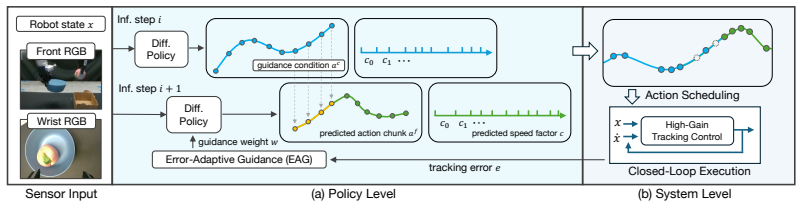
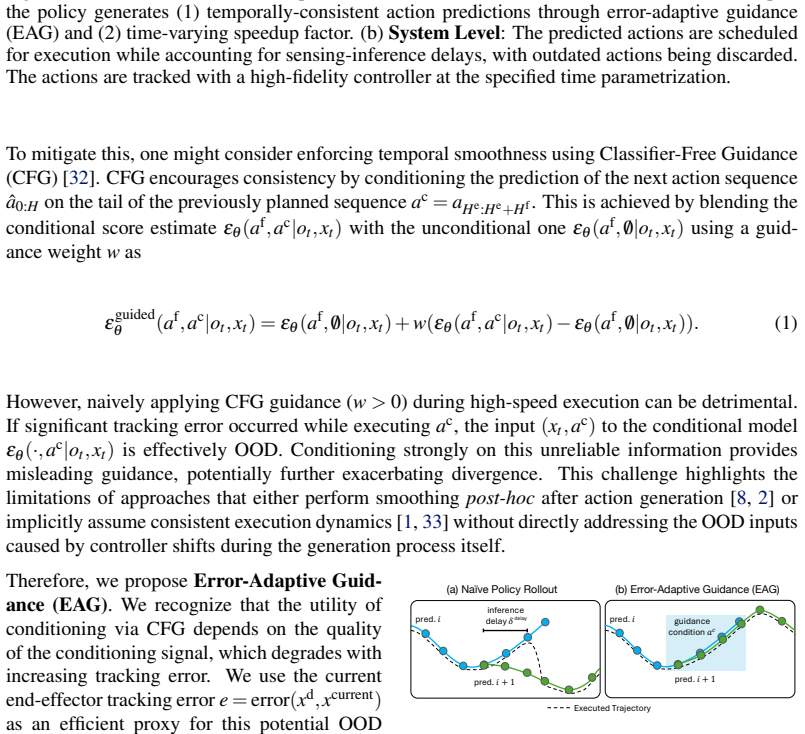
The carrying object is the receding-horizon action chunk from a generative visuomotor policy, together with three system-level modifications. The first is controller-invariant action targets: the policy regresses reached end-effector poses $x_t$, not teleoperator-commanded poses $x_t^d$, so the reference trajectory is achievable and independent of the teleoperation controller's dynamics; a high-gain operational-space controller $K_e$ tracks these reached poses at a reduced interval $\delta_t = c_t \delta^*$. The second is Error-Adaptive Guidance (EAG), which computes a tracking-error proxy $e = \mathrm{error}(x^d, x_{\mathrm{current}})$ and applies a classifier-free guidance weight $w>0$ only when $e \le \rho$; otherwise it sets $w=0$ and uses the unconditional prediction. The third is adaptive speed modulation: a predicted critical-action flag $k_t \in \{0,1\}$ sets $c_t = k_t c_{\mathrm{slow}} + (1-k_t)c_{\mathrm{fast}}$. The fourth is action scheduling, with the lower bound $\delta_{lb} > \delta_{\mathrm{delay}}/(H_p - H_c)$ guaranteeing continuous execution under inference latency.
What would settle it
A decisive experiment: on a robot not used in the paper, replay the same teleoperation demonstrations at increasing speedup factors with both commanded-pose references and reached-pose references under the high-gain controller, and measure tracking error and task success. If reached-pose replay at high gain drops toward the commanded-pose baseline rather than staying near the original-speed success rate, the controller-invariance assumption is violated; the paper's own contact-rich wiping case already suggests sustained contact is the most likely place for this to happen.
Extended reading notes
Core claim
The central claim is that the main obstacle to faster-than-demo execution is not simply generating faster actions; it is the coupling between execution speed, controller dynamics, and the policy's implied state-action distribution. The paper argues that this coupling is broken by changing what the policy predicts: train it to predict the actually reached end-effector poses from teleoperation data rather than the commanded poses, because reached poses are largely controller-invariant and remain achievable references when a different, higher-gain controller executes them at a faster rate. On the policy side, temporal consistency between successive action chunks should be enforced by classifier-free guidance only when current tracking error is small; when error is large, the conditioning signal is out of distribution and guidance should be disabled. Execution speed itself is made adaptive: the system identifies critical actions from motion complexity and gripper events and slows down for those phases. Finally, scheduling actions across sensing-inference delay with a lower bound on the action interval prevents action exhaustion and gives a physical ceiling on achievable speedup. Together these four components are claimed to produce up to 4x and 3.2x speedups in simulation and the real world with high success rates.
Load-bearing premise
The load-bearing premise is that a trajectory of actually reached poses from teleoperation stays a valid, trackable reference when a different, higher-gain controller runs at a faster speed; if that controller-invariance fails on other robot dynamics or contact-rich phases, the distribution-shift mitigation and high-fidelity tracking lose their foundation and the speedup gains do not transfer.
Editorial extensions
If this is right
- Speeding up an offline imitation policy is a full-stack problem, not just a policy-generation problem: action smoothing alone cannot recover failures from controller shift, latency, and critical-phase precision.
- If the controller-invariance claim holds, any fixed offline policy can be retargeted to run at a faster time-varying interval by replacing commanded-pose supervision with reached-pose supervision and deploying a high-gain tracker, without additional environment interaction.
- Adaptive speed modulation lets task throughput improve without sacrificing precision: the policy automatically slows for grasps and alignments and speeds up during simpler reaching motion.
- The latency-derived bound $\delta_{lb} > \delta_{\mathrm{delay}}/(H_p - H_c)$ makes feasible speedup directly tied to sensing-inference delay and prediction horizon, so faster inference or longer horizons translate into higher achievable speedups.
- Because EAG disables conditioning guidance when tracking error is high, the same mechanism that smooths motion also keeps the policy from trusting out-of-distribution conditioning signals, which supports high success rates at speed.
Reading between the lines
- The paper leaves untested whether the reached-pose target could be replaced by any controller-invariant motion descriptor, such as a learned dynamics-aware target in joint space; a controlled experiment that swaps only the action-space representation while holding EAG, scheduling, and adaptive speed fixed would test this modularity claim.
- EAG is a guidance-time mechanism, so the same threshold logic should transfer to other action-chunking generative policies beyond the representative model evaluated here; the conditioning-misalignment problem is generic, though the optimal tracking-error threshold likely needs re-estimation per model and task.
- The speedup ceiling implied by the paper depends on demonstration data quality: clean, high-bandwidth teleoperation yields reached-pose targets that the high-gain controller can track, whereas noisy human demos would amplify reference noise, so the gains should be largest on clean demonstration sets.
Editorial analysis
A structured set of objections, weighed in public.
Referee Report
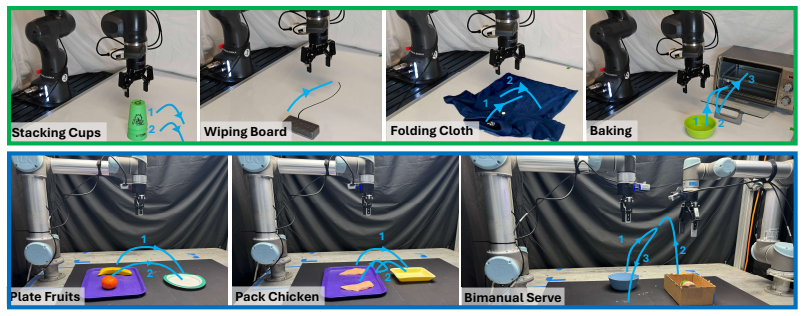
Summary. The paper introduces SAIL, a full-stack system for executing offline visuomotor imitation policies faster than the demonstration speed. SAIL combines error-adaptive guidance (EAG) to maintain temporal consistency of action chunks, training on reached poses with a high-fidelity tracking controller to reduce controller-induced distribution shift, adaptive speed modulation that slows critical phases of a task, and latency-aware action scheduling with a derived lower bound on the action interval. The authors evaluate SAIL on five simulated RoboMimic/MimicGen tasks and seven real-world tasks on two robot platforms, reporting up to a 4x speedup in simulation and up to a 3.2x speedup in the real world while claiming high task success rates.
Significance. The problem of faster-than-demonstration execution is well motivated and rarely addressed end-to-end; the decomposition into policy-level consistency, controller-invariant targets, adaptive speed, and latency management is a useful systems contribution. The empirical breadth is substantial, with 12 tasks, two distinct real platforms, ablations, and a variant using ACT. The EAG design insight that CFG conditioning should be disabled when tracking error is large is plausible and is supported by the Appendix H correlation studies and by the simulation ablation. However, the headline speedup numbers are not yet fully trustworthy because of an asymmetric simulation setup and the weak evidential support for the central reached-pose invariance claim.
major comments (4)
- [Sec. C.1, Table 1] The simulation evaluation removes joint torque limits for the Franka robot, while at least some baselines are reported with torque limits kept when removing them hurt performance. This asymmetric treatment directly favors SAIL in the headline simulation speedup comparisons reported in Table 1. Please re-run all methods under identical torque-limit settings and add a DP-Fast baseline that uses the same high-gain controller and reached-pose targets as SAIL, so the effect of the policy-level components is isolated from the controller change.
- [Sec. 4.2, Fig. G.4, Sec. 7] The controller-invariance of reached poses is the foundation of component (2), but the only direct evidence is the open-loop demo replay study in Fig. G.4 on the Can task, which does not involve sustained contact. The Limitations section explicitly concedes that SAIL does not tackle robot-object dynamics shift and reports that the simulated Can can be thrown at higher speed and that the real Wiping Board task degrades under the high-gain controller. These are precisely regimes where the achievable pose at a given speed depends on the controller and dynamic state rather than only on the reference. Please provide a closed-loop test of reached-pose invariance on contact-rich tasks, or explicitly narrow the claim to task classes where the invariance holds.
- [Sec. 5.2, Table 2] The real-world headline of 3.2x speedup is taken from the Wiping Board row, where SAIL has lower success rate (0.70 vs 0.90) and lower throughput-with-regret (3.18 vs 3.48) than DP-Fast. Reporting the maximum SOD from a task where the method is worse than the baseline on the primary throughput metric overstates the result. Please report confidence intervals or per-task error bars for the 10-rollout evaluations, and either match or exceed baseline success rate before claiming a speedup, or explicitly present the speed-success trade-off.
- [Sec. E, Eq. (8)] The derivation of the lower bound delta_lb is under-specified: it uses the full prediction horizon H_p, but the interval that must cover the sensing-inference delay in a receding-horizon schedule is the remaining plan length after the already-executed steps H_e (defined as 8 in Sec. 5.1), not the full H_p. The conditioning length H_c also appears in the inequality without a precise timing diagram. Please state the schedule algebraically with all variables (H_p, H_e, H_c, delta_delay) and re-derive the bound; as written, the inequality may overestimate the achievable speedup.
minor comments (6)
- [Table 2] The real-world results are based on only 10 rollouts per task and no error bars or statistical tests; given the large variance implied by success rates such as 0.30 and 0.40, confidence intervals are needed before quantitative comparisons can be assessed.
- [Table J.3] The EAG error thresholds and CFG weights are tuned per task and are listed only in the appendix; this should be acknowledged as a limitation in the main text, since the adaptive guidance therefore depends on task-specific hyperparameters.
- [Fig. E.2] The figure contains draft annotations such as "(1/28) DX: Made a few changes" and "(2/1 5AM) SK: fixed notation" that should be removed before publication.
- [Sec. H.3] There is a typo: "oreintation" should be "orientation" in the definition of tracking error.
- [Sec. 4.3 and Table J.4] The notation for c_slow and c_fast is confusing: the text says c_slow > c_fast, which is correct only if the reciprocal of c is the speedup, and Table J.4 labels a single "slowdown c" per task. Please define the speedup factor consistently and reconcile the table with the equations.
- [Sec. 5.1 and Table K.6] The text refers to an ablation SAIL(-C) while Table K.6 uses columns -HG, -AS, and -C inconsistently; make the naming in the text and table match.
Circularity Check
No circularity: SAIL's speedup claim rests on measured rollout times and independent component experiments, not on definitions or self-citations.
full rationale
The paper's derivation chain is self-contained rather than circular. The action-interval lower bound (Appendix E) is derived from stated latency and horizon parameters, yielding delta_lb > delta_delay/(Hp - Hc), and the final interval is max(c_t * delta*, delta_lb); this is a physical constraint, not an assumed speedup. The headline speedup factors (SOD, TPR) are computed from measured success times and demo lengths, so the reported 4x/3.2x values are empirical outputs rather than re-statements of the chosen c_t. The central controller-invariance assumption (Sec. 4.2) is an empirical hypothesis about reached-pose trackability, and the paper tests it with open-loop demo replay at different gains and speeds (Fig. G.4), rather than defining success in terms of it. EAG, adaptive speed modulation, and action scheduling are each ablated (Table K.6) and compared against external baselines on Robomimic/MimicGen and two real robot platforms. No load-bearing argument reduces to a self-citation: key references (Diffusion Policy, BID, CFG, AWE) are external prior work used as building blocks, and the authors do not invoke a uniqueness theorem or prior result of their own to force the design. The limitation that SAIL does not tackle robot-object dynamics shift (Sec. 7) weakens generalization but is a scope caveat, not evidence of circularity. The derivation and experiments are therefore self-contained.
Assumptions & free parameters
free parameters (5)
- CFG guidance weight w =
0 or 1 per task (Table J.3)
- Tracking error thresholds (pos TEB, ori TEB) =
pos 0.01-0.04, ori 0.03-0.05 per task (Table J.3)
- Slow and fast speed factors c_slow, c_fast =
e.g., 0.2, 0.5, 1.0 per task (Table J.4)
- DBSCAN parameters (eps, minPts) =
not specified in the text
- Controller gains (Kp, damping) =
per task (Table J.4), real robot gains in Table J.5
assumptions (5)
- domain assumption Policy outputs SE(3) pose trajectories and the low-level controller tracks them at a fixed time interval.
- domain assumption Reached poses are largely invariant to the teleoperation controller dynamics.
- domain assumption Tracking error is a reliable proxy for observation-action misalignment.
- domain assumption Action conditioning via CFG is beneficial only when the conditioning signal is in-distribution.
- domain assumption Sensing-inference delay is constant and known for the scheduling lower bound.
Cite this review
Pith. "Pith review of SAIL: Faster-than-Demonstration Execution of Imitation Learning Policies." pith.science (2026). https://pith.science/paper/FTOVYZGV
@misc{pith2026250611948,
  author       = {Pith},
  title        = {Pith review of: SAIL: Faster-than-Demonstration Execution of Imitation Learning Policies},
  year         = {2026},
  howpublished = {\url{https://pith.science/paper/FTOVYZGV}},
  note         = {Machine review of arXiv:2506.11948}
}
read the original abstract
Offline Imitation Learning (IL) methods such as Behavior Cloning are effective at acquiring complex robotic manipulation skills. However, existing IL-trained policies are confined to executing the task at the same speed as shown in demonstration data. This limits the task throughput of a robotic system, a critical requirement for applications such as industrial automation. In this paper, we introduce and formalize the novel problem of enabling faster-than-demonstration execution of visuomotor policies and identify fundamental challenges in robot dynamics and state-action distribution shifts. We instantiate the key insights as SAIL (Speed Adaptation for Imitation Learning), a full-stack system integrating four tightly-connected components: (1) a consistency-preserving action inference algorithm for smooth motion at high speed, (2) high-fidelity tracking of controller-invariant motion targets, (3) adaptive speed modulation that dynamically adjusts execution speed based on motion complexity, and (4) action scheduling to handle real-world system latencies. Experiments on 12 tasks across simulation and two real, distinct robot platforms show that SAIL achieves up to a 4x speedup over demonstration speed in simulation and up to 3.2x speedup in the real world. Additional detail is available at https://nadunranawaka1.github.io/sail-policy
Figures

Figures from the paper (4 more)


Forward citations
Cited by 6 Pith papers
-
Action Chunk Scheduling for Batched Robot Policy Serving
A lookahead scheduler that simulates each robot's action-queue state before choosing batches improves throughput in heterogeneous multi-robot policy serving by up to 18% in real-world tests.
-
Static In, Dynamic Out: Counterfactual Action Augmentation for Moving Object Manipulation
SIDO morphs static demonstrations into counterfactual future-pose samples, training a goal-conditioned policy that, paired with a pose predictor, grasps objects whose motion was unseen during training.
-
B-spline Policy: Accelerating Manipulation Policies via B-spline Action Representations
Predicting continuous B-spline action curves instead of discrete chunks lets visuomotor policies finish real and simulated manipulation tasks substantially faster without large success-rate loss.
-
OmniTacTune: Policy-Agnostic Real-World RL for Tactile Residual Adaptation of Visual Policies
A policy-agnostic two-stage real-world RL method learns tactile residual corrections on frozen visual policies, lifting contact-rich task success from 5–40% to 85–100% in under 80 minutes.
-
TempoVLA: Learning Speed-Controllable Vision-Language-Action Policies
TempoVLA learns a single VLA policy with controllable execution speed via variable-speed trajectory augmentation and explicit speed conditioning.
-
Going with the Flow: Koopman Behavioral Models as Pseudo Planners for Visuo-Motor Dexterity
A single learned linear Koopman model over coupled visual and proprioceptive states generates full-horizon dexterous manipulation plans and triggers replanning when its own visual predictions diverge from reality.
Reference graph
Works this paper leans on
-
[1]
C. Chi, S. Feng, Y . Du, Z. Xu, E. Cousineau, B. Burchfiel, and S. Song. Diffusion Policy: Visuomotor Policy Learning via Action Diffusion. InProceedings of Robotics: Science and Systems (RSS), 2023
work page 2023
-
[2]
T. Z. Zhao, V . Kumar, S. Levine, and C. Finn. Learning fine-grained bimanual manipulation with low-cost hardware.arXiv preprint arXiv:2304.13705, 2023
arXiv 2023
-
[3]
S. Sakaino, K. Fujimoto, Y . Saigusa, and T. Tsuji. Imitation learning for variable speed contact motion for operation up to control bandwidth.IEEE Open Journal of the Industrial Electronics Society, 3:116–127, 2022
work page 2022
-
[4]
D. A. Pomerleau. Alvinn: An autonomous land vehicle in a neural network.Advances in neural information processing systems, 1, 1988
1988
-
[5]
B. D. Argall, S. Chernova, M. Veloso, and B. Browning. A survey of robot learning from demonstration.Robotics and autonomous systems, 57(5):469–483, 2009
work page 2009
-
[6]
A. Hussein, M. M. Gaber, E. Elyan, and C. Jayne. Imitation learning: A survey of learning methods.ACM Computing Surveys (CSUR), 50(2):1–35, 2017
work page 2017
-
[7]
H. Ravichandar, A. S. Polydoros, S. Chernova, and A. Billard. Recent advances in robot learning from demonstration.Annual review of control, robotics, and autonomous systems, 3 (1):297–330, 2020
work page 2020
-
[8]
Y . Liu, J. I. Hamid, A. Xie, Y . Lee, M. Du, and C. Finn. Bidirectional Decoding: Improving Action Chunking via Closed-Loop Resampling.arXiv preprint arXiv:2408.17355, 2024
arXiv 2024
Show all 47 references
-
[9]
A. J. Ijspeort, J. Nakanishi, and S. Schaal. Learning rhythmic movements by demonstration using nonlinear oscillators. InIEEE/RSJ International Conference on Intelligent Robots and Systems, volume 1, pages 958–963, 2002. doi:10.1109/IRDS.2002.1041514
2002 arXiv
-
[10]
Ijspeert, J
A. Ijspeert, J. Nakanishi, and S. Schaal. Trajectory formation for imitation with nonlinear dynamical systems. InProceedings 2001 IEEE/RSJ International Conference on Intelligent Robots and Systems. Expanding the Societal Role of Robotics in the the Next Millennium (Cat. No.01...
2001
-
[11]
Saveriano, F
M. Saveriano, F. J. Abu-Dakka, A. Kramberger, and L. Peternel. Dynamic movement primi- tives in robotics: A tutorial survey.CoRR, abs/2102.03861, 2021. URLhttps://arxiv. org/abs/2102.03861
2021 arXiv
-
[13]
S. Bahl, M. Mukadam, A. Gupta, and D. Pathak. Neural dynamic policies for end-to-end sensorimotor learning.Advances in Neural Information Processing Systems, 33:5058–5069, 2020. 10
2020
-
[14]
Schaal, J
S. Schaal, J. Peters, J. Nakanishi, and A. Ijspeert. Control, planning, learning, and imitation with dynamic movement primitives. InWorkshop on Bilateral Paradigms on Humans and Humanoids: IEEE International Conference on Intelligent Robots and Systems (IROS 2003), pages 1–21, 2003
2003
-
[15]
M. Xie, A. Handa, S. Tyree, D. Fox, H. Ravichandar, N. D. Ratliff, and K. V . Wyk. Neu- ral geometric fabrics: Efficiently learning high-dimensional policies from demonstration. In 6th Annual Conference on Robot Learning, 2022. URLhttps://openreview.net/ forum?id=GTyBkq36tjx
2022
-
[16]
S. Bahl, A. Gupta, and D. Pathak. Hierarchical neural dynamic policies.CoRR, abs/2107.05627, 2021. URLhttps://arxiv.org/abs/2107.05627
2021 arXiv
-
[17]
Brown, W
D. Brown, W. Goo, P. Nagarajan, and S. Niekum. Extrapolating beyond suboptimal demon- strations via inverse reinforcement learning from observations. InInternational conference on machine learning, pages 783–792. PMLR, 2019
2019
-
[18]
D. S. Brown, W. Goo, and S. Niekum. Better-than-demonstrator imitation learning via automatically-ranked demonstrations. InConference on robot learning, pages 330–359. PMLR, 2020
2020
-
[19]
Y .-H. Wu, N. Charoenphakdee, H. Bao, V . Tangkaratt, and M. Sugiyama. Imitation learning from imperfect demonstration. InInternational Conference on Machine Learning, pages 6818–
-
[20]
Saigusa, A
Y . Saigusa, A. Sasagawa, S. Sakaino, and T. Tsuji. Imitation learning for variable speed mo- tion generation over multiple actions. InIECON 2021–47th Annual Conference of the IEEE Industrial Electronics Society, pages 1–6. IEEE, 2021
2021
-
[21]
Saigusa, S
Y . Saigusa, S. Sakaino, and T. Tsuji. Imitation learning for nonprehensile manipulation through self-supervised learning considering motion speed.IEEE Access, 10:68291–68306, 2022
2022
-
[22]
A. Y . Ng, S. Russell, et al. Algorithms for inverse reinforcement learning. InIcml, volume 1, page 2, 2000
2000
-
[23]
Abbeel and A
P. Abbeel and A. Y . Ng. Apprenticeship learning via inverse reinforcement learning. InPro- ceedings of the twenty-first international conference on Machine learning, page 1, 2004
2004
-
[24]
B. D. Ziebart, A. L. Maas, J. A. Bagnell, A. K. Dey, et al. Maximum entropy inverse reinforce- ment learning. InAaai, volume 8, pages 1433–1438. Chicago, IL, USA, 2008
2008
-
[25]
Sundaresan, H
P. Sundaresan, H. Hu, Q. Vuong, J. Bohg, and D. Sadigh. What’s the Move? Hybrid Imitation Learning via Salient Points.arXiv preprint arXiv:2412.05426, 2024
2024 arXiv
-
[26]
Z. Fu, T. Z. Zhao, and C. Finn. Mobile aloha: Learning bimanual mobile manipulation with low-cost whole-body teleoperation.arXiv preprint arXiv:2401.02117, 2024
2024 arXiv
-
[27]
Cheng, J
X. Cheng, J. Li, S. Yang, G. Yang, and X. Wang. Open-television: Teleoperation with immer- sive active visual feedback.arXiv preprint arXiv:2407.01512, 2024
2024 arXiv
-
[28]
A. Iyer, Z. Peng, Y . Dai, I. Guzey, S. Haldar, S. Chintala, and L. Pinto. Open teach: A versatile teleoperation system for robotic manipulation.arXiv preprint arXiv:2403.07870, 2024
2024 arXiv
-
[29]
C. Chi, Z. Xu, C. Pan, E. Cousineau, B. Burchfiel, S. Feng, R. Tedrake, and S. Song. Uni- versal Manipulation Interface: In-The-Wild Robot Teaching Without In-The-Wild Robots. In Proceedings of Robotics: Science and Systems (RSS), 2024
2024
-
[30]
S. Liu, L. Wu, B. Li, H. Tan, H. Chen, Z. Wang, K. Xu, H. Su, and J. Zhu. Rdt-1b: a diffusion foundation model for bimanual manipulation.arXiv preprint arXiv:2410.07864, 2024. 11
2024 arXiv
-
[31]
S. Ross, G. Gordon, and D. Bagnell. A reduction of imitation learning and structured predic- tion to no-regret online learning. InProceedings of the fourteenth international conference on artificial intelligence and statistics, pages 627–635. JMLR Workshop and Conference Pro- ...
2011
-
[32]
Ho and T
J. Ho and T. Salimans. Classifier-free diffusion guidance.arXiv preprint arXiv:2207.12598, 2022
2022 arXiv
-
[33]
S. H. Høeg, Y . Du, and O. Egeland. Streaming diffusion policy: Fast policy synthesis with variable noise diffusion models.arXiv preprint arXiv:2406.04806, 2024
2024 arXiv
-
[34]
L. X. Shi, A. Sharma, T. Z. Zhao, and C. Finn. Waypoint-Based Imitation Learning for Robotic Manipulation. InConference on Robot Learning, pages 2195–2209. PMLR, 2023
2023
-
[35]
Ester, H.-P
M. Ester, H.-P. Kriegel, J. Sander, and X. Xu. A density-based algorithm for discovering clusters in large spatial databases with noise. KDD’96, page 226–231. AAAI Press, 1996
1996
-
[36]
On the analysis of movement smoothness.Journal of NeuroEngineering and Rehabilitation, 12(1):112, 2015
Balasubramanian, Sivakumar and Melendez-Calderon, Alejandro and Roby-Brami, Agnes and Burdet, Etienne. On the analysis of movement smoothness.Journal of NeuroEngineering and Rehabilitation, 12(1):112, 2015. doi:10.1186/s12984-015-0090-9. URLhttps://doi. org/10.1186/s12984-015-0090-9
2015 doi
-
[37]
Mandlekar, D
A. Mandlekar, D. Xu, J. Wong, S. Nasiriany, C. Wang, R. Kulkarni, L. Fei-Fei, S. Savarese, Y . Zhu, and R. Mart´ın-Mart´ın. What Matters in Learning from Offline Human Demonstrations for Robot Manipulation. In5th Annual Conference on Robot Learning, 2021
2021
-
[38]
Mandlekar, S
A. Mandlekar, S. Nasiriany, B. Wen, I. Akinola, Y . Narang, L. Fan, Y . Zhu, and D. Fox. Mim- icGen: A Data Generation System for Scalable Robot Learning using Human Demonstrations. In7th Annual Conference on Robot Learning, 2023
2023
-
[39]
Balasubramanian, A
S. Balasubramanian, A. Melendez-Calderon, and E. Burdet. A robust and sensitive metric for quantifying movement smoothness.IEEE Transactions on Biomedical Engineering, 59(8): 2126–2136, 2012. doi:10.1109/TBME.2011.2179545
2012
-
[40]
Y . Zhu, J. Wong, A. Mandlekar, R. Mart ´ın-Mart´ın, A. Joshi, S. Nasiriany, and Y . Zhu. ro- bosuite: A Modular Simulation Framework and Benchmark for Robot Learning. InarXiv preprint arXiv:2009.12293, 2020
2009 arXiv
-
[41]
Todorov, T
E. Todorov, T. Erez, and Y . Tassa. MuJoCo: A physics engine for model-based control. In 2012 IEEE/RSJ International Conference on Intelligent Robots and Systems, pages 5026–
2012
- [42]
-
[43]
Scherzinger, A
S. Scherzinger, A. Roennau, and R. Dillmann. Forward dynamics compliance control (fdcc): A new approach to cartesian compliance for robotic manipulators. InIEEE/RSJ International Conference on Intelligent Robots and Systems (IROS), pages 4568–4575, 2017. doi:10.1109/ IROS.2017.8206325
2017
-
[44]
Janner, Q
M. Janner, Q. Li, and S. Levine. Offline reinforcement learning as one big sequence modeling problem.Advances in neural information processing systems, 34:1273–1286, 2021
2021
-
[45]
D. W. Scott.Multivariate density estimation: theory, practice, and visualization. John Wiley & Sons, 2015
2015
-
[46]
D. O. Loftsgaarden and C. P. Quesenberry. A nonparametric estimate of a multivariate density function.The Annals of Mathematical Statistics, 36(3):1049–1051, 1965
1965
-
[47]
5CO9+aOHYIdBI+61i9lbqb+R5Gg=
A. Gretton, K. M. Borgwardt, M. J. Rasch, B. Sch ¨olkopf, and A. Smola. A kernel two-sample test.The Journal of Machine Learning Research, 13(1):723–773, 2012. 12 A Table of Contents The Appendix contains the following content: •Formulas and explanation of evaluation metrics(A...
2012
-
[2018]
URLhttp://arxiv.org/abs/1801.02854
Reviewed August 7, 2026 · model on record in the stance chip above.
Discussion (0). Sign in to comment.