REVIEW 2 major objections 6 minor 79 references
Many Will Enter, Few Will Win: Cost and Sensitivity of Exploratory Dynamics
T0 review · 2 major / 6 minor · reviewed 2026-08-07 · deepseek-v4-flash
Pith's one-line read Driven resetting cycles let cells amplify small rate changes into large steady-state shifts.
desk verdict Good proofreading tutorial, but the microtubule centerpiece solves a rescue-inclusive model while claiming no-rescue; Eq. (14) is not the steady state of the advertised chain. read the letter →
The pith
A machine-rendered reading of the paper's core claim, the machinery that carries it, and where it could break.
The reading
What carries the argument
Two calculational tools carry the argument. Path-counting writes observables as ratios of probabilistic weights of interaction loops that start and end at the origin state, producing splitting-probability formulas for the proofreading error rate $f$ and the mean number of futile hydrolysis events $\langle n\rangle$. Circuit mapping represents the microtubule network as an electrical circuit with batteries for driven transitions; diagonalising the transfer matrix gives the closed-form distribution of Eq. (14), a superposition of two exponentials with decay constants set by $\beta G$ and $D$. The switch condition $\alpha>k_r-k_f$ marks where the nonequilibrium branch overtakes the equilibrium branch, turning $k_{\rm cat}$ from a parameter with no steady-state effect into a linear tuning dial.
What would settle it
Measure the steady-state length distribution of microtubules in vitro across a range of GTP concentrations and catastrophe rates while separately measuring the rescue rate; if the distribution is not the predicted sum of two exponentials, or if mean length fails to become linearly sensitive to $k_{\rm cat}$ once $\alpha$ exceeds $k_r-k_f$, the central claim is falsified.
Extended reading notes
Core claim
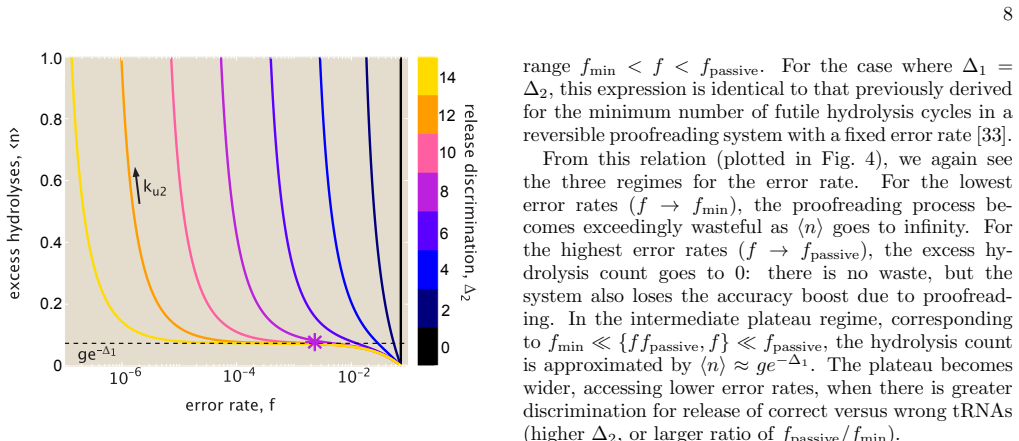
The central claim is that energised resetting changes how a biochemical system responds to its own parameters: at equilibrium, a catalyst or rate constant that only alters a transition barrier cannot move the steady-state distribution, but under modest thermodynamic driving the same parameter becomes a control knob. For microtubules, the paper solves the no-rescue dynamic-instability model exactly, giving the steady-state length distribution $P(L)/P(1) = \frac{k_{\rm cat}}{k_{\rm cat}-\alpha(e^{\beta G}-1)} e^{-\beta G(L-1)} + \frac{\alpha(e^{\beta G}-1)}{\alpha(e^{\beta G}-1)-k_{\rm cat}} e^{-D(L-1)}$ as a sum of two exponentials, one equilibrium branch and one nonequilibrium branch. Above the threshold $\alpha>k_r-k_f$ (with $\alpha$ the forward rate excess supplied by GTP), the mean length becomes linearly sensitive to the catastrophe rate $k_{\rm cat}$, matching measured interphase and mitotic lengths that differ only in $k_{\rm cat}$. For translation, the same logic makes the error rate set by the sum of two discrimination energies, with a plateau in the futile hydrolysis count $\langle n\rangle\approx g e^{-\Delta_1}$ where wrong tRNAs are mostly released and correct tRNAs proceed. The paper states this is the first full steady-state solution for the microtubule model and the first isolation of the role of the thermodynamic force.
Load-bearing premise
The quantitative microtubule predictions rest on a no-rescue model with a single state-independent catastrophe rate and on using the GMPCPP-derived off rate as a proxy for GTP-tubulin; if rescue is significant or the proxy off rate is wrong, the predicted distribution and threshold would shift.
Editorial extensions
If this is right
- If the two-exponential distribution is correct, previous failures to fit simulated microtubule length histograms with a single exponential are explained, and the strongly driven mean reduces to $\langle L\rangle=(\alpha+k_f-k_r)/k_{\rm cat}$, recovering the known linear law.
- For translation, the plateau relation $\langle n\rangle\approx g e^{-\Delta_1}$ means near-maximal accuracy can be bought with roughly one GTP per elongation event; published kinetic parameters place the ribosome in that plateau.
- The same mechanism predicts a switch-like onset of catalytic control: below threshold, changing $k_{\rm cat}$ barely moves mean length, while above threshold the same change shifts length linearly.
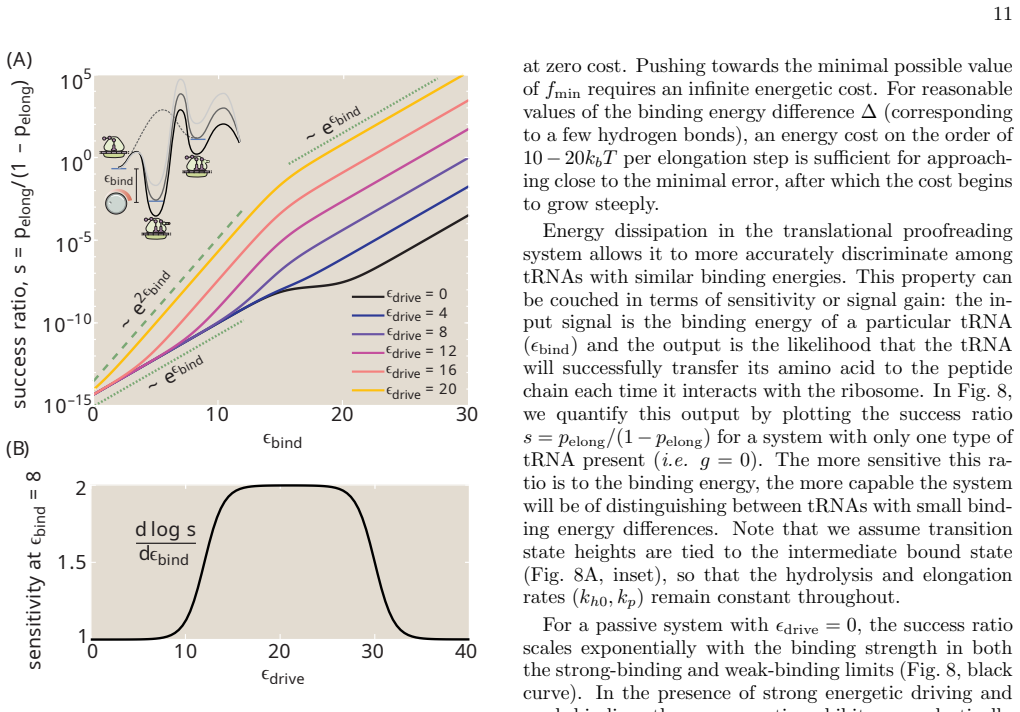
- Because the driven transition itself does not discriminate, the energy only needs to push the system past the irreversible limit; the sensitivity to passive parameters (release rates, catastrophe rate) is what improves.
- Interphase and mitosis lengths are reproduced using only a tenfold change in $k_{\rm cat}$, suggesting that catastrophe-rate regulation alone is sufficient to set cell-cycle-dependent microtubule length.
Reading between the lines
- A testable extension would be to measure the full length distribution at several GTP concentrations; the predicted double-exponential tail distinguishes this model from single-exponential fits, which the paper notes were previously poor.
- If rescue is significant, the two-exponential form and the exact threshold $\alpha>k_r-k_f$ would change, although the qualitative principle that driving enables catalytic control should survive; the authors leave rescue out of this model.
- The plateau structure suggests a general design rule: place a cheap passive filter before an expensive proofreading step to minimise futile cycles; the paper illustrates this for translation but does not optimise it across other exploratory circuits.
- One could titrate a catastrophe-promoting factor in vitro while varying GTP to observe the switch directly; the paper predicts a sharp fold-change in mean length across the threshold.
Editorial analysis
A structured set of objections, weighed in public.
Referee Report
Summary. This paper develops a unified "exploratory dynamics with resetting" framework for two model systems: (i) kinetic proofreading during ribosomal translation, where the authors compute the error rate and the number of futile GTP-hydrolysis cycles per elongation event using splitting probabilities and path counting, and extend the treatment to a reversible, thermodynamically driven scheme; and (ii) microtubule length control by dynamic instability, where a circuit-mapping method is used to derive a closed-form steady-state length distribution P(L) (Eq. (14)) and a claimed switch-like onset of catalytic control once the driving rate alpha exceeds kr - kf. The paper's thesis is that dissipative resetting cycles confer qualitatively enhanced sensitivity to small parameter changes at modest energetic cost, illustrated through the two case studies.
Significance. If Eq. (14) and the threshold claim were correct for the stated model, the paper would provide a clean analytic result (a two-exponential stationary length distribution with a parameter-tunable crossover) plus a falsifiable prediction linking the catastrophe rate to the mean length. The proofreading analysis is explicit and self-contained: the splitting-probability derivations (Eqs. (1)-(10)) are transparent, the three-regime picture (passive, proofreading, excess-driving) is clearly drawn, and the coarse-graining extension in Appendix A is a useful contribution. The manuscript is clearly written and pedagogically valuable. However, the load-bearing microtubule result is currently attached to the wrong model (see Major 1), and the quantitative comparison in Fig. 10C is under-powered, so the physiological claims need to be re-derived and re-calibrated. The qualitative message, that driven resetting can turn on control that equilibrium cannot, likely survives, but with a different baseline and threshold once the model is stated consistently.
major comments (2)
- [Fig. 10A; Appendix C, Eqs. (29)-(32); Eq. (14)] Eq. (14) is not the steady-state solution of the model advertised in Fig. 10A. The schematic is described as being 'in the absence of rescue from catastrophe,' and the path-counting solution in Appendix C (Eqs. (26)-(28)) is derived for irreversible resetting. The circuit derivation, however, represents the catastrophe branch as a passive resistor: combining Eqs. (31) and (32) gives the branch current as kcat P_{n+1} - kcat P_1 e^{-beta G n}, so the branch carries a reverse flux from state 1 to state n+1 at rate kcat e^{-beta G n} per unit probability at state 1 (i.e., rescue or renucleation). The steady state of the stated no-rescue chain (forward rate u = kf + alpha, backward rate kr, catastrophe L -> 1 at rate kcat) is P_L/P_1 = r^{L-1} with r = [u + kr + kcat - sqrt((u + kr + kcat)^2 - 4 u kr)]/(2 kr); this depends on kcat even at alpha = 0 (for kf = 1 s^-1, kr = 2 s^-1, kcat = 0.1 s^-1, r ~ 0.458 versus r = 0.5 at kcat = 0), whereas Eq. (14) reduces to P_L/P_1 = e^{-beta G (L-1)} at alpha = 0 and is kcat-independent. Consequently, the flat alpha = 0 baseline in Fig. 10C and the threshold alpha > kr - kf are properties of the with-rescue model, not of the model described in the text, and the statement that Eq. (14) 'matches the results obtained by counting paths' holds only in the strongly driven limit. The authors should either adopt the with-rescue model explicitly, give the reverse-catastrophe rate and its biological justification, and rescind the 'no rescue' statement (noting that the alpha = 0 equilibrium limit is normalizable only for kf < kr, which should be stated), or re-derive the no-rescue distribution, which will alter both the switch-like-onset claim and the quantitative comparison in Fig. 10C.
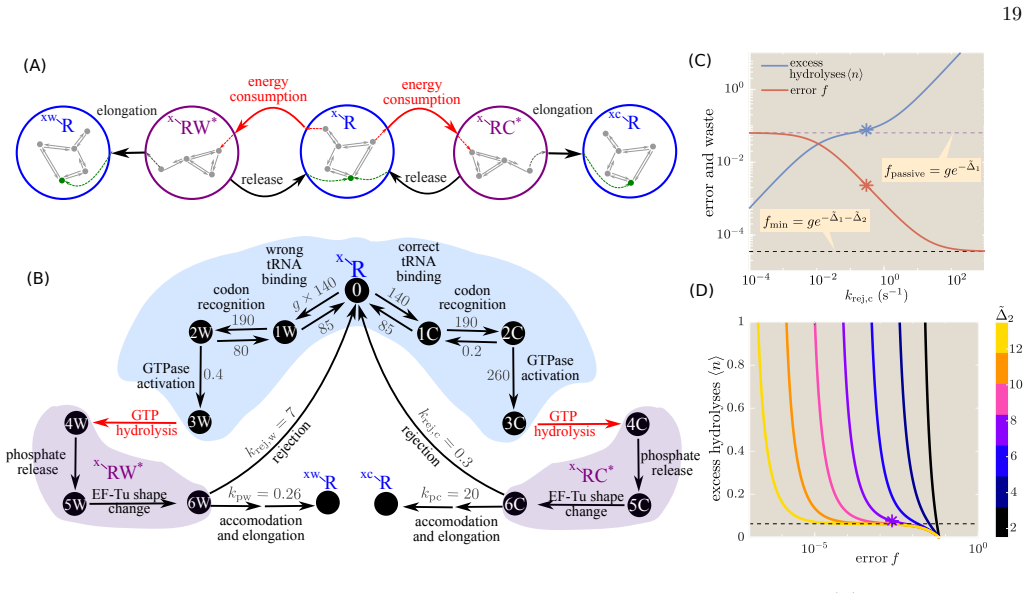
- [Fig. 10C; Appendix C (parameter values)] The claim of 'excellent agreement' in Fig. 10C is not supported by the evidence presented. The comparison uses two mean-length measurements (23 +/- 11 micrometers at kcat ~ 0.01 s^-1 and 6 +/- 3 micrometers at kcat ~ 0.1 s^-1; uncertainties as quoted in Appendix C), an assumed 'physiological' value of alpha, and kr obtained from GMPCPP (a non-hydrolyzable GTP proxy) in Ref. [56]. Two data points with roughly 50% uncertainty cannot validate a two-exponential distribution, and the authors do not show how the curve depends on the choices of alpha, kf, and kr. I recommend reframing Fig. 10C as an illustrative comparison, reporting the specific parameter values and their uncertainties, and, if possible, testing the full predicted length distribution P(L) from Eq. (14) against measured distributions rather than means alone.
minor comments (6)
- [Section 3, Eq. (3b)] In Eq. (3b), the second expression repeats p_pc; it should be p_pw, the elongation probability for the wrong tRNA after the proofreading release step.
- [Appendix C, parameters paragraph] The sentence stating 'the net growth rate at physiological alpha is Delta x (kf + alpha - kr) = 10.4 microns per second' implies kf + alpha - kr ~ 1.7 x 10^4 s^-1 given Delta x = 8/13 nm, which is implausibly large for tubulin subunit addition; please verify the units or the numerical value (possibly per minute was intended).
- [Appendix C, Eqs. (41)-(42)] The coefficients A1 and A2 (and the boundary value I1) are asserted but never displayed; since Eq. (41) is the basis for the central closed-form result, please provide their explicit forms or the algebraic derivation, and state the condition under which A2 must vanish.
- [Eq. (14) and surrounding text] The novelty claim that Eq. (14) is the first full solution of the length distribution should be checked against Ref. [71], which is cited as computing the mean length via generating functions; generating-function methods typically yield the full distribution, so the 'first time' statement needs qualification.
- [Fig. 10C caption] The color bar is labeled with 'drive' in units of kBT, while the text defines the thermodynamic force as epsilon_drive = ln(1 + alpha/kf); please clarify how the plotted drive is computed from alpha and how the color bar relates to [GTP].
- [Fig. 10C and Appendix C] The values of kf, kr, and alpha used to plot Fig. 10C are not collected in one place; please provide them in the caption or a table so that the comparison is reproducible.
Circularity Check
Microtubule equilibrium kcat-independence is imposed by the circuit mapping's bidirectional catastrophe resistor, not derived from the stated no-rescue model; proofreading results remain self-contained.
-
ansatz smuggled in via citation
[Eq. (14); Eqs. (31)-(42) of Appendix C; Fig. 10A caption]
"The elementary steps constituting microtubule self-assembly are shown in Fig. 10A in the absence of rescue from catastrophe [57]. ... we turn to an alternate technique that involves mapping the system to an effective circuit framework [51] ... P1eβG1 − Pn+1eβGn+1 = −Rcat,n(In − In+1), where Rcat,n = eβGn+1 /kcat. ... As expected, if α = 0 (blue line) then Eq. 14 reduces to the equilibrium single-exponential distribution, which is independent of kcat."
A resistor in the circuit convention is a bidirectional element; putting the catastrophe branch on a passive resistor therefore installs a reverse catastrophe (rescue) transition with rate kcat, even though the model is announced as 'in the absence of rescue from catastrophe.' The path-counting solution in the same appendix for the genuinely irreversible-resetting model has pf = (kf+α)/(kf+α+kr+kcat), so at α=0 the steady-state distribution still depends on kcat. Eq. (14)'s α=0 limit e^{-βG(L-1)}—and the resulting threshold α>kr-kf for switch-like catalytic control—is thus a property of the resistor representation imported from the cited circuit-mapping work [51], not a consequence of the stated no-rescue input model.
full rationale
The translational proofreading half of the paper is self-contained: the error rate and excess-hydrolysis cost are computed explicitly from splitting probabilities, and the comparison with prior work [30,33] is presented as equivalence, not as an assumed input. The self-citations [51,52] are used for technique and motivation, and the circuit derivation in Appendix C is written out in detail, so the mere fact of self-citation is not circular. However, the microtubule centerpiece is different. The paper states the model excludes rescue yet solves a circuit in which the catastrophe branch is a passive resistor, which by construction conducts in both directions and therefore includes rescue. That bidirectional element is exactly what makes Eq. (14) reduce to a kcat-independent equilibrium distribution at α=0 and produces the sharp threshold α>kr-kf. The paper's own path-counting solution of the announced irreversible-resetting model does not have that property. Thus the qualitative 'switch-like onset of catalytic control' is not derived from the stated input kinetics; it is built into the chosen circuit representation. The quantitative comparison in Fig. 10C also warrants caution: the measured mean lengths are listed among the parameters taken from Ref. [26], and with the quoted net growth rate and kcat values a single fixed-α curve cannot pass through both measured points, so the 'excellent agreement' is not established by the text. That latter point is a quantitative-support concern rather than a fitted-parameter circularity, because the paper does not explicitly state that α was fit to the measured lengths. Overall, the proofreading results are independent, but the microtubule switch-like claim reduces in part to a construction choice smuggled in through the cited circuit-mapping method, giving a partial circularity score of 6.
Assumptions & free parameters
free parameters (7)
- g (excess wrong tRNA ratio) =
4
- Delta1 (initial binding discrimination energy) =
approx 4
- Delta2 (post-hydrolysis release discrimination energy) =
approx 8
- kf (MT equilibrium forward rate) =
derived from GMPCPP data [56]
- kr (MT reverse/off rate) =
from GMPCPP proxy [56]
- alpha (driven assembly rate from excess GTP) =
10.4 um/s net growth rate converted
- kcat (catastrophe rate) =
0.01 s^-1 interphase, 0.1 s^-1 mitosis
assumptions (6)
- standard math System kinetics are Markovian and splitting probabilities are proportional to reaction rates.
- domain assumption Thermodynamic driving force for a driven transition is ϵdrive = log(1 + alpha/k0).
- domain assumption A chemical reaction network can be mapped to an equivalent electrical circuit with batteries and resistances (Lin, PRL 125, 218101).
- domain assumption The peptide elongation step is effectively irreversible, serving as an absorbing state.
- domain assumption Microtubule catastrophe is irreversible and there is no rescue; kcat is the same from every length state.
- domain assumption In the reversible proofreading landscape, discrimination is localized to unbinding and release rates; hydrolysis and elongation barriers are the same for correct and wrong tRNAs.
Cite this review
Pith. "Pith review of Many Will Enter, Few Will Win: Cost and Sensitivity of Exploratory Dynamics." pith.science (2026). https://pith.science/paper/FTQPDD3W
@misc{pith2026250600775,
  author       = {Pith},
  title        = {Pith review of: Many Will Enter, Few Will Win: Cost and Sensitivity of Exploratory Dynamics},
  year         = {2026},
  howpublished = {\url{https://pith.science/paper/FTQPDD3W}},
  note         = {Machine review of arXiv:2506.00775}
}
read the original abstract
A variety of biomolecular systems rely on exploratory dynamics to reach target locations or states within a cell. Without a mechanism to remotely sense and move directly towards a target, the system must sample over many paths, often including resetting transitions back to the origin. We investigate how exploratory dynamics can confer an important functional benefit: the ability to respond to small changes in parameters with large shifts in the steady-state behavior. However, such enhanced sensitivity comes at a cost: resetting cycles require energy dissipation in order to push the system out of its equilibrium steady state. We focus on minimalist models for two concrete examples: translational proofreading in the ribosome and microtubule length control via dynamic instability to illustrate the trade-offs between energetic cost and sensitivity. In the former, a driven hydrolysis step enhances the ability to distinguish between substrates and decoys with small binding energy differences. In the latter, resetting cycles enable catalytic control, with the steady-state length distribution modulated by sub-stoichiometric concentrations of a reusable catalyst. Synthesizing past models of these well-studied systems, we show how path-counting and circuit mapping approaches can be used to address fundamental questions such as the number of futile cycles inherent in translation and the steady-state length distribution of a dynamically unstable polymer. In both cases, a limited amount of thermodynamic driving is sufficient to yield a qualitative transition to a system with enhanced sensitivity, enabling accurate discrimination and catalytic control at a modest energetic cost.
Figures


Figures from the paper (8 more)





Reference graph
Works this paper leans on
-
[71]
P. Ranjith, D. Lacoste, K. Mallick, and J. F. Joanny, Nonequilibrium self-assembly of a filament coupled to ATP/GTP hydrolysis, Biophysical Journal 96, 2146 (2009)
work page 2009
-
[56]
H. Bowne-Anderson, M. Zanic, M. Kauer, and J. Howard, Microtubule dynamic instability: a new model with cou- pled gtp hydrolysis and multistep catastrophe, Bioessays 35, 452 (2013)
work page 2013
-
[1]
R. Wollman, E. Cytrynbaum, J. Jones, T. Meyer, J. Sc- holey, and A. Mogilner, Efficient chromosome capture requires a bias in the ‘search-and-capture’process dur- ing mitotic-spindle assembly, Current Biology 15, 828 (2005)
work page 2005
-
[2]
B. G. Fuller, Self-organization of intracellular gradients during mitosis, Cell Division 5, 5 (2010)
work page 2010
-
[3]
M. Burute and L. C. Kapitein, Cellular logistics: unrav- eling the interplay between microtubule organization and intracellular transport, Annual review of cell and devel- opmental biology 35, 29 (2019)
work page 2019
-
[4]
A. Agrawal, Z. C. Scott, and E. F. Koslover, Morphol- ogy and transport in eukaryotic cells, Annual review of biophysics 51, 247 (2022). 17
work page 2022
-
[5]
J. Gerhart and M. Kirschner, The exploratory behavior of biological systems, in Cells, Embryos, and Evolution (Blackwell Science, Malden, MA, 1997) Chap. 4, pp. 146– 196
work page 1997
-
[6]
M. Kirschner and T. Mitchison, Beyond Self-Assembly - from Microtubules to Morphogenesis, Cell45, 329 (1986)
work page 1986
Show all 79 references
-
[7]
Heald and A
R. Heald and A. Khodjakov, Thirty years of search and capture: The complex simplicity of mitotic spindle as- sembly, J Cell Biol 211, 1103 (2015)
2015
-
[8]
Misgeld and T
T. Misgeld and T. L. Schwarz, Mitostasis in neurons: maintaining mitochondria in an extended cellular archi- tecture, Neuron 96, 651 (2017)
2017
-
[9]
A. H. Williams, C. O’Donnell, T. J. Sejnowski, and T. O’Leary, Dendritic trafficking faces physiologically critical speed-precision tradeoffs, eLife 5, e20556 (2016)
2016
-
[10]
A. F. MacAskill, J. E. Rinholm, A. E. Twelvetrees, I. L. Arancibia-Carcamo, J. Muir, A. Fransson, P. Aspen- strom, D. Attwell, and J. T. Kittler, Miro1 is a calcium sensor for glutamate receptor-dependent localization of mitochondria at synapses, Neuron 61, 541 (2009)
2009
-
[11]
Pekkurnaz, J
G. Pekkurnaz, J. C. Trinidad, X. Wang, D. Kong, and T. L. Schwarz, Glucose regulates mitochondrial motility via milton modification by O-GlcNAc transferase, Cell 158, 54 (2014)
2014
-
[12]
H. M. York, K. Joshi, C. S. Wright, L. Z. Kreplin, S. J. Rodgers, U. K. Moorthi, H. Gandhi, A. Patil, C. A. Mitchell, S. Iyer-Biswas, et al., Deterministic early en- dosomal maturations emerge from a stochastic trigger- and-convert mechanism, Nat Commun 14, 4652 (2023)
2023
-
[13]
Villase˜ nor, Y
R. Villase˜ nor, Y. Kalaidzidis, and M. Zerial, Signal pro- cessing by the endosomal system, Curr Opin Cell Biol 39, 53 (2016)
2016
-
[14]
J. J. Hopfield, Kinetic proofreading: a new mechanism for reducing errors in biosynthetic processes requiring high specificity, P Natl Acad Sci 71, 4135 (1974)
1974
-
[15]
Ninio, Kinetic amplification of enzyme discrimination, Biochimie 57, 587 (1975)
J. Ninio, Kinetic amplification of enzyme discrimination, Biochimie 57, 587 (1975)
1975
-
[16]
Cui and P
W. Cui and P. Mehta, Identifying feasible operating regimes for early T-cell recognition: The speed, energy, accuracy trade-off in kinetic proofreading and adaptive sorting, PloS one 13, e0202331 (2018)
2018
-
[17]
Hathcock, Q
D. Hathcock, Q. Yu, and Y. Tu, Time-reversal symme- try breaking in the chemosensory array reveals a general mechanism for dissipation-enhanced cooperative sensing, Nat Commun 15, 8892 (2024)
2024
-
[18]
Bar-Ziv, T
R. Bar-Ziv, T. Tlusty, and A. Libchaber, Protein–DNA computation by stochastic assembly cascade, P Natl Acad Sci 99, 11589 (2002)
2002
-
[19]
Mizrahi, R
I. Mizrahi, R. Bruinsma, and J. Rudnick, Spanning tree model and the assembly kinetics of RNA viruses, Phys Rev E 106, 044405 (2022)
2022
-
[20]
Y. Lu, W. Wang, and M. W. Kirschner, Specificity of the anaphase-promoting complex: a single-molecule study, Science 348, 1248737 (2015)
2015
-
[21]
B. M. Adams, M. E. Oster, and D. N. Hebert, Protein quality control in the endoplasmic reticulum, Protein J 38, 317 (2019)
2019
-
[22]
A. I. Brown and E. F. Koslover, Design principles for the glycoprotein quality control pathway, Plos Comput Biol 17, e1008654 (2021)
2021
-
[23]
M. R. Evans and S. N. Majumdar, Diffusion with stochas- tic resetting, Phys Rev Lett 106, 160601 (2011)
2011
-
[24]
M. R. Evans, S. N. Majumdar, and G. Schehr, Stochastic resetting and applications, Journal of Physics A: Mathe- matical and Theoretical 53, 193001 (2020)
2020
-
[25]
Kondev, M
J. Kondev, M. Kirschner, H. Garcia, and R. Phillips, Biological Processes as Exploratory Dynamics, arXiv (2025)
2025
-
[26]
L. D. Belmont, A. A. Hyman, K. E. Sawin, and T. J. Mitchison, Real-time visualization of cell cycle- dependent changes in microtubule dynamics in cytoplas- mic extracts, Cell 62, 579 (1990)
1990
-
[27]
Sartori and S
P. Sartori and S. Pigolotti, Thermodynamics of error cor- rection, Phys Rev X 5, 041039 (2015)
2015
-
[28]
J. M. Ogle, F. V. Murphy, M. J. Tarry, and V. Ramakr- ishnan, Selection of tRNA by the ribosome requires a transition from an open to a closed form, Cell 111, 721 (2002)
2002
-
[29]
Mellenius and M
H. Mellenius and M. Ehrenberg, Transcriptional accu- racy modeling suggests two-step proofreading by RNA polymerase, Nucleic Acids Res 45, 11582 (2017)
2017
-
[30]
Banerjee, A
K. Banerjee, A. B. Kolomeisky, and O. A. Igoshin, Eluci- dating interplay of speed and accuracy in biological error correction, P Natl Acad Sci 114, 5183 (2017)
2017
-
[31]
Murugan, D
A. Murugan, D. A. Huse, and S. Leibler, Speed, dissipa- tion, and error in kinetic proofreading, P Natl Acad Sci 109, 12034 (2012)
2012
-
[32]
G. Lan, P. Sartori, S. Neumann, V. Sourjik, and Y. H. Tu, The energy-speed-accuracy trade-off in sensory adap- tation, Nat Phys 8, 422 (2012)
2012
-
[33]
Q. Yu, A. B. Kolomeisky, and O. A. Igoshin, The en- ergy cost and optimal design of networks for biological discrimination, J Roy Soc Interface 19, 20210883 (2022)
2022
-
[34]
D. S. Tawfik, Accuracy-rate tradeoffs: how do enzymes meet demands of selectivity and catalytic efficiency?, Curr Opin Chem Biol 21, 73 (2014)
2014
-
[35]
Johansson, M
M. Johansson, M. Lovmar, and M. Ehrenberg, Rate and accuracy of bacterial protein synthesis revisited, Curr Opin Microbiol 11, 141 (2008)
2008
-
[36]
Phillips, J
R. Phillips, J. Kondev, J. Theriot, and H. Garcia, Phys- ical biology of the cell(Garland Science, 2012)
2012
-
[37]
M. V. Rodnina and W. Wintermeyer, Ribosome fi- delity: tRNA discrimination, proofreading and induced fit, Trends Biochem Sci 26, 124 (2001)
2001
-
[38]
Wohlgemuth, C
I. Wohlgemuth, C. Pohl, J. Mittelstaet, A. L. Konevega, and M. V. Rodnina, Evolutionary optimization of speed and accuracy of decoding on the ribosome, Phil Trans Roy Soc B: Biol Sci 366, 2979 (2011)
2011
-
[39]
H. S. Zaher and R. Green, Hyperaccurate and error-prone ribosomes exploit distinct mechanisms during trna selec- tion, Mol Cell 39, 110 (2010)
2010
-
[40]
E. B. Kramer and P. J. Farabaugh, The frequency of translational misreading errors in e. coli is largely deter- mined by trna competition, Rna 13, 87 (2007)
2007
-
[41]
H. Dong, L. Nilsson, and C. G. Kurland, Co-variation of trna abundance and codon usage inescherichia coliat different growth rates, Journal of molecular biology 260, 649 (1996)
1996
-
[42]
Joshi, L
K. Joshi, L. Cao, and P. J. Farabaugh, The problem of genetic code misreading during protein synthesis, Yeast 36, 35 (2019)
2019
-
[43]
Sartori and S
P. Sartori and S. Pigolotti, Kinetic versus energetic dis- crimination in biological copying, Phys Rev Lett 110, 188101 (2013)
2013
-
[44]
J. L. England, Statistical physics of self-replication, J Chem Phys 139 (2013)
2013
-
[45]
Hachmo and A
O. Hachmo and A. Amir, Conditional probability as found in nature: Facilitated diffusion, Am J Phys 91, 18 653 (2023)
2023
-
[46]
Banerjee, A
K. Banerjee, A. B. Kolomeisky, and O. A. Igoshin, Ac- curacy of substrate selection by enzymes is controlled by kinetic discrimination, The journal of physical chemistry letters 8, 1552 (2017)
2017
-
[47]
J. D. Mallory, A. B. Kolomeisky, and O. A. Igoshin, Ki- netic control of stationary flux ratios for a wide range of biochemical processes, Proceedings of the National Academy of Sciences 117, 8884 (2020)
2020
-
[48]
Evans and M
M. Evans and M. Polanyi, Further considerations on the thermodynamics of chemical equilibria and reac- tion rates, Transactions of the Faraday Society 32, 1333 (1936)
1936
-
[49]
Dill and S
K. Dill and S. Bromberg, Molecular driving forces: statis- tical thermodynamics in biology, chemistry, physics, and nanoscience (Garland Science, 2010)
2010
-
[50]
Vinu and L
R. Vinu and L. J. Broadbelt, Unraveling reaction path- ways and specifying reaction kinetics for complex sys- tems, Annual review of chemical and biomolecular engi- neering 3, 29 (2012)
2012
-
[51]
M. M. Lin, Circuit reduction of heterogeneous nonequi- librium systems, Phys Rev Lett 125, 218101 (2020)
2020
-
[52]
Arunachalam and M
E. Arunachalam and M. M. Lin, Information gain limit of biomolecular computation, Phys Rev Lett 134, 148401 (2025)
2025
-
[53]
J. A. Owen and J. M. Horowitz, Size limits the sensitivity of kinetic schemes, Nat Commun 14, 1280 (2023)
2023
-
[54]
Phillips, The molecular switch: Signaling and Al- lostery (Princeton University Press, 2020)
R. Phillips, The molecular switch: Signaling and Al- lostery (Princeton University Press, 2020)
2020
-
[55]
B. M. Martins and P. S. Swain, Ultrasensitivity in phosphorylation-dephosphorylation cycles with little substrate, Plos Comput Biol 9, e1003175 (2013)
2013
-
[57]
Mitchison and M
T. Mitchison and M. Kirschner, Dynamic instability of microtubule growth, Nature 312, 237 (1984)
1984
-
[58]
F. A. Piedra, T. Kim, E. S. Garza, E. A. Geyer, A. Burns, X. Ye, and L. M. Rice, GDP-to-GTP exchange on the mi- crotubule end can contribute to the frequency of catas- trophe, Molecular Biology of the Cell 27, 3515 (2016)
2016
-
[59]
Bowne-Anderson, A
H. Bowne-Anderson, A. Hibbel, and J. Howard, Regu- lation of microtubule growth and catastrophe: unifying theory and experiment, Trends Cell Biol 25, 769 (2015)
2015
-
[60]
L. Brun, B. Rupp, J. J. Ward, and F. N´ ed´ elec, A theory of microtubule catastrophes and their regulation, P Natl Acad Sci 106, 21173 (2009)
2009
-
[61]
C. E. Walczak, S. Gayek, and R. Ohi, Microtubule- depolymerizing kinesins, Annu Rev Cell Dev Biol 29, 417 (2013)
2013
-
[62]
L. D. Belmont and T. J. Mitchison, Identification of a protein that interacts with tubulin dimers and increases the catastrophe rate of microtubules, Cell 84, 623 (1996)
1996
-
[63]
D. N. Ringhoff and L. Cassimeris, Stathmin regu- lates centrosomal nucleation of microtubules and tubu- lin dimer/polymer partitioning, Mol Biol Cell 20, 3451 (2009)
2009
-
[64]
Baumgart, M
J. Baumgart, M. Kirchner, S. Redemann, A. Bond, J. Woodruff, J. M. Verbavatz, F. J¨ ulicher, T. M¨ uller- Reichert, A. A. Hyman, and J. Brugu´ es, Soluble tubulin is significantly enriched at mitotic centrosomes, J Cell Biol 218, 3977 (2019)
2019
-
[65]
Yadav, B
V. Yadav, B. Srinivas, and M. Gopalakrishnan, Micro- tubule catastrophe under force: mathematical and com- putational results from a brownian ratchet model, Phys Biol 18, 016006 (2020)
2020
-
[66]
P. N. Zakharov, V. K. Arzhanik, E. V. Ulyanov, N. B. Gudimchuk, and F. I. Ataullakhanov, Microtubules: dy- namically unstable stochastic phase-switching polymers, Phys-usp+ 59, 773 (2016)
2016
-
[67]
Swanson and N
D. Swanson and N. S. Wingreen, Active biopolymers confer fast reorganization kinetics, Phys Rev Lett 107, 218103 (2011)
2011
-
[68]
Dogterom and S
M. Dogterom and S. Leibler, Physical aspects of the growth and regulation of microtubule structures, Physi- cal Review Letters 70, 1347 (1993)
1993
-
[69]
Z. C. Scott, A. I. Brown, S. S. Mogre, L. M. Westrate, and E. F. Koslover, Diffusive search and trajectories on tubular networks: a propagator approach, Eur Phys J E 44, 80 (2021)
2021
-
[70]
Wong and J
F. Wong and J. Gunawardena, Gene regulation in and out of equilibrium, Ann Rev Biophys 49, 199 (2020)
2020
-
[72]
Johansson, E
M. Johansson, E. Bouakaz, M. Lovmar, and M. Ehren- berg, The kinetics of ribosomal peptidyl transfer revis- ited, Mol Cell 30, 589 (2008)
2008
-
[73]
O. A. Igoshin, A. B. Kolomeisky, and D. E. Makarov, Coarse-graining chemical networks by trimming to pre- serve energy dissipation, J Phys Chem Lett 16, 1229 (2025)
2025
-
[74]
D. S. Grebenkov and L. Tupikina, Heterogeneous continuous-time random walks, Phys Rev E 97, 012148 (2018)
2018
-
[75]
Johansson, J
M. Johansson, J. Zhang, and M. Ehrenberg, Genetic code translation displays a linear trade-off between efficiency and accuracy of tRNA selection, P Natl Acad Sci 109, 131 (2012)
2012
-
[76]
Lovmar and M
M. Lovmar and M. Ehrenberg, Rate, accuracy and cost of ribosomes in bacterial cells, Biochimie 88, 951 (2006)
2006
-
[77]
Daviter, K
T. Daviter, K. B. Gromadski, and M. V. Rodnina, The ribosome’s response to codon–anticodon mismatches, Biochimie 88, 1001 (2006)
2006
-
[78]
Yamakawa, Statistical mechanics of wormlike chains: Path integral and diagram methods, J Chem Phys 59, 3811 (1973)
H. Yamakawa, Statistical mechanics of wormlike chains: Path integral and diagram methods, J Chem Phys 59, 3811 (1973)
1973
-
[79]
A. J. Spakowitz and Z.-G. Wang, End-to-end distance vector distribution with fixed end orientations for the wormlike chain model, Phys Rev E 72, 041802 (2005). 19 correct tRNA binding codon recognition codon recognition GTPase activation GTP hydrolysis phosphate release accomo...
2005
Reviewed August 7, 2026 · model on record in the stance chip above.
Discussion (0). Sign in to comment.