REVIEW 3 major objections 5 minor 1 cited by
Hierarchical Reinforcement Learning for Articulated Tool Manipulation with Multifingered Hand
T0 review · 3 major / 5 minor · reviewed 2026-08-06 · deepseek-v4-flash
Pith's one-line read A hierarchical reinforcement learning framework enables a dexterous robotic hand to manipulate a tweezer-like tool and grasp varied objects in the real world.
desk verdict Solid engineering demo of hierarchical GCRL for a tweezer-like tool, but the central claim of shape-adaptive grasping lacks a mechanism: the high-level policy never sees object geometry. read the letter →
The pith
A machine-rendered reading of the paper's core claim, the machinery that carries it, and where it could break.
The reading
What carries the argument
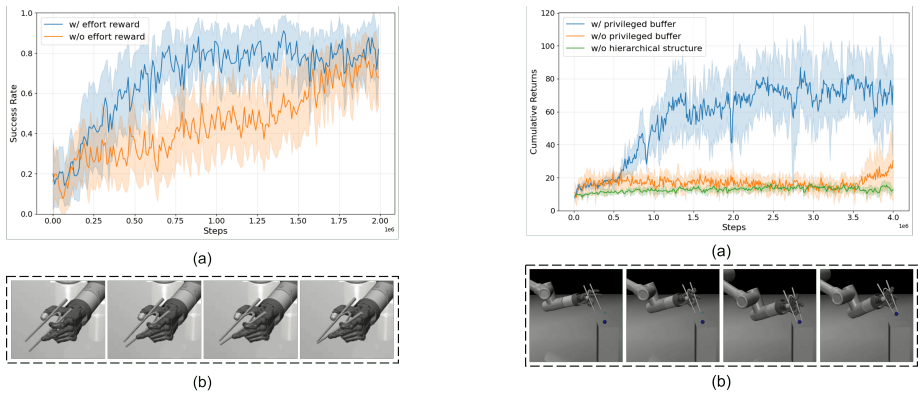
The load-bearing mechanism is a two-level goal-conditioned Markov decision process. The low level observes hand joint states plus a tool state made of velocity, angular velocity, and a two-dimensional latent shape variable $z$, and outputs relative finger joint changes; its reward is an exponential penalty on latent-space distance to the goal plus an effort term penalizing tool motion and finger velocity. The high level observes the tool's pose and latent shape, the object position, and the goal position, and outputs a latent-shape goal and an arm velocity command converted to joint velocities through the Jacobian pseudoinverse. The latent variable $z$ is the key object: it is trained by a PointNet-based encoder on synthetic point clouds with occlusions and noise, so that reconstruction forces $z$ to encode opening width and thereby grasp affordance, while SVD registration handles pose. A hand-crafted controller with privileged endpoint and hinge information fills the replay buffer for the high level, giving the policy informative demonstrations of approach, closure, and lift.
What would settle it
A decisive test would remove the pre-fixed grasp: require the hand to pick the tweezer up from the table and then perform the same grasping tasks, and if success drops to near zero without the pre-grasp, the framework's claim to enable articulated tool manipulation would be shown to depend on a solved tool-acquisition problem that the paper explicitly sets aside.
Extended reading notes
Core claim
The central claim is that articulated tool manipulation can be made tractable by hierarchically decomposing it: a goal-conditioned low-level policy learns to control a multi-fingered hand so that the tool reaches a desired shape configuration, while a separate high-level policy learns to command the arm and to propose those shape goals. The tool's changing shape is captured by a two-dimensional latent code produced by a PointNet-style encoder trained to reconstruct synthetic point clouds of the tweezer; this code acts as an affordance state that links opening width to the sizes of objects the tool can grasp. Because the tool's pose is estimated by SVD registration and its shape by the latent code, the policies receive a compact state that separates 'where the tool is' from 'how open it is.' The paper further claims that an effort reward stabilizes low-level training and that a privilege-informed heuristic policy filling the replay buffer substantially speeds high-level learning. Real-world validation on four object shapes yields 54.2% success on the first attempt and 70.8% with retries.
Load-bearing premise
The entire method assumes the tweezer is already firmly fixed in the hand before the task starts, so the hand never has to acquire the tool and grip slippage is not modeled or penalized.
Editorial extensions
If this is right
- If the hierarchical decomposition is sound, the same two-policy structure should transfer to other hinge tools such as scissors or pliers, with the latent shape encoding their functional aperture.
- The 70.8% real-world success rate implies that visual-only feedback, without tactile sensors, is sufficient for tool-mediated grasping of small objects in this setup.
- Using a privileged replay buffer during training implies that the high-level arm policy converges with far fewer environment interactions than pure random exploration would require.
- Because the tool state is expressed relative to the hand base frame, the high-level policy generalizes across arm configurations and object and target locations within the workspace.
- The 54.2% first-attempt rate and recovery on retries suggests the system can sometimes turn failed contacts into improved grasping conditions.
Reading between the lines
- A natural extension the paper leaves implicit is to add a tool-acquisition stage: if the hand first picks up the tweezer from the table and then executes the two-level policy, the method would cover the complete tool-use pipeline rather than starting from a fixed pre-grasp.
- The reliance on a pre-defined firm grasp suggests that grip stability and slip prevention are invisible to the current reward; adding tactile sensing or a slip penalty could improve the failure cases the authors report, such as insufficient grip force and premature lifting.
- One could test the generality of the latent affordance representation by training the encoder on two or more articulated tools jointly and checking whether the same low-level policy can switch between them.
- The first-attempt versus retry gap implies that the perception module, not the control policy, may be the current bottleneck; improving object-position estimation could raise first-attempt success closer to the 70.8% multi-attempt level.
Editorial analysis
A structured set of objections, weighed in public.
Referee Report
Summary. The paper presents a hierarchical, goal-conditioned reinforcement learning framework for a multifingered hand manipulating an articulated tool (a tweezer) to grasp objects. A low-level policy learns to deform the tweezer into diverse configurations, using a latent representation of tool shape extracted from point clouds by a pretrained PointNet-based encoder. A high-level policy commands the arm and selects latent tool goals, and is trained with the aid of a privilege-informed heuristic replay buffer. The method is validated in MuJoCo simulations with ablations and in real-world trials on four object shapes, reporting a 70.8% overall success rate after retries, plus qualitative demonstrations on six daily objects.
Significance. If the result holds, the paper is a useful step toward dexterous manipulation of articulated tools, a relatively underexplored problem. Its strengths include actual hardware validation rather than simulation only, ablations with three random seeds, an explicit statement of the pre-grasp assumption (Section III.D), and a clearly described privileged replay-buffer mechanism that improves high-level training efficiency. The hierarchical decomposition of tool-shape control and arm movement is a sensible design. However, as detailed below, a central load-bearing issue concerns the lack of object geometry in the high-level policy's observation, which undermines the claim of adaptation to objects of diverse shapes and sizes.
major comments (3)
- [Section III.C.1, Eq. (6)] The high-level policy state shigh_t = [stool,high_t, sobj_t] contains only the tool pose/latent state and the object and target centroid positions; no object size, shape, or point-cloud features are provided. Since the low-level policy receives no object information at all, the only pathway for shape-adaptive grasping is the high-level policy's output z_goal, yet the high-level policy has no input from which to infer object geometry. The simulation trains the high-level policy on a single 1-cm-radius sphere (Section IV.A), so size-dependent goal selection cannot be learned. The statement in Section IV.B that 'the low-level policy's ability to generate diverse tool configurations allows the system to adapt' does not resolve this, because the high-level policy must still command the specific goal. The real-world 70.8% success across 1.5-2.5 cm objects may therefore stem from a fixed or random z_goal strategy combined with in-episode retries, rather than from shape-adaptive goal setting. This is a load-bearing gap for the paper's central claim, and it should be addressed by either adding object geometry (e.g., a point-cloud embedding or measured size) to the high-level state, or by reporting the z_goal trajectories actually selected for objects of different sizes and shapes to demonstrate adaptation.
- [Section III.B.3, Eq. (3)] The low-level reward and the low-level success reported in Fig. 4(a) are defined in the latent space produced by the tool encoder itself, so they measure internal goal-reaching rather than physical tweezer aperture control. No experiment measures the mapping between latent z values and physical opening angle or width, leaving the claim that the encoder learns 'affordance states' and that z_goal is a valid proxy for physical tool configuration not directly validated. A quantitative evaluation (e.g., recording measured opening width as a function of commanded z in the real system, or comparing against ground-truth hinge angles in simulation) would substantiate this central component of the framework.
- [Section IV.B, Fig. 8] The real-world evaluation uses only 12 trials per object (n=48 total) without confidence intervals, and the distinction between 'first attempt' and 'overall success after multiple attempts' is ambiguous: it is not stated whether multiple attempts occur within the same 200-step episode or across separate episodes. If within an episode, the headline 70.8% figure includes repeated in-episode retries and should be presented with that caveat. Reporting per-object success counts and a binomial confidence interval would substantially improve the interpretability of the central experimental claim.
minor comments (5)
- [Section III.C.2, Eq. (9)] The coefficient 'clh4' appears to be a typo; it should likely be 'ch4'.
- [Section IV.A, Figs. 4(a) and 5(a)] The training curves are shown without shaded regions or error bands across the three random seeds; adding standard-deviation bands would make the ablation claims more convincing.
- [Section IV.B, Fig. 9] The six daily objects are shown as successful grasps, but no quantitative success rates are provided for them; this should be clarified as a qualitative demonstration only.
- [Section III.B.2] The low-level state is described as a 26-dimensional vector, but the hand state [qhand, qdot_hand] with 20 joints would contain 40 values; please clarify which joint coordinates are actually included or how the dimension is computed.
- [Section III.D] The phrase 'An promising future direction' should be 'A promising future direction'.
Circularity Check
No significant circularity; real-world grasping success is externally grounded.
full rationale
The paper's central derivation chain is empirical rather than circular. The VAE encoder is pre-trained independently on synthetic point clouds via reconstruction loss; the low-level policy is trained with goal-conditioned rewards in the resulting latent space (Eq. 3), which is a standard GCRL formulation and not a fitted parameter renamed as a prediction. The high-level policy is trained with a privilege-informed replay buffer and evaluated by the physical object-picking task, whose 70.8% success rate is an externally grounded outcome rather than an artifact of the paper's own definitions. The high-level state in Eq. 6 indeed omits object geometry, so the mechanistic claim of adaptation to object shapes and sizes is not fully supported; however, this is a limitation or correctness concern, not circularity, because no claimed result reduces by construction to its input. The only self-citation, reference [19], appears in related work and is not load-bearing. No uniqueness theorem, ansatz smuggling, or renaming of a known result is present. Therefore the paper is self-contained against its real-world validation and receives a circularity score of 0.
Assumptions & free parameters
free parameters (5)
- Reward coefficients c_l1, c_l2, c_l3, c_h1..c_h5 =
Not reported.
- Latent dimension of tool shape =
2
- Exponential moving average parameter alpha =
0.9
- Task success threshold =
1 cm
- High-level penalty threshold =
20 cm
assumptions (4)
- domain assumption The tool remains firmly fixed in the hand throughout manipulation.
- ad hoc to paper The latent vector z from the VAE fully captures the articulated tool's shape and affordance.
- ad hoc to paper Goal rewards in latent space are a valid proxy for physical tool configuration.
- domain assumption Sim-to-real transfer works under the listed domain randomization settings.
Cite this review
Pith. "Pith review of Hierarchical Reinforcement Learning for Articulated Tool Manipulation with Multifingered Hand." pith.science (2026). https://pith.science/paper/FTQUBRQT
@misc{pith2026250706822,
  author       = {Pith},
  title        = {Pith review of: Hierarchical Reinforcement Learning for Articulated Tool Manipulation with Multifingered Hand},
  year         = {2026},
  howpublished = {\url{https://pith.science/paper/FTQUBRQT}},
  note         = {Machine review of arXiv:2507.06822}
}
read the original abstract
Manipulating articulated tools, such as tweezers or scissors, has rarely been explored in previous research. Unlike rigid tools, articulated tools change their shape dynamically, creating unique challenges for dexterous robotic hands. In this work, we present a hierarchical, goal-conditioned reinforcement learning (GCRL) framework to improve the manipulation capabilities of anthropomorphic robotic hands using articulated tools. Our framework comprises two policy layers: (1) a low-level policy that enables the dexterous hand to manipulate the tool into various configurations for objects of different sizes, and (2) a high-level policy that defines the tool's goal state and controls the robotic arm for object-picking tasks. We employ an encoder, trained on synthetic pointclouds, to estimate the tool's affordance states--specifically, how different tool configurations (e.g., tweezer opening angles) enable grasping of objects of varying sizes--from input point clouds, thereby enabling precise tool manipulation. We also utilize a privilege-informed heuristic policy to generate replay buffer, improving the training efficiency of the high-level policy. We validate our approach through real-world experiments, showing that the robot can effectively manipulate a tweezer-like tool to grasp objects of diverse shapes and sizes with a 70.8 % success rate. This study highlights the potential of RL to advance dexterous robotic manipulation of articulated tools.
Figures


Figures from the paper (5 more)


Forward citations
Cited by 1 Pith paper
-
AdaDexGrasp: Adaptive Dexterous Grasping via 3D Visuo-Tactile Representation Fusion
AdaDexGrasp learns to fuse point clouds with finger-level tactile labels to generate, judge, and correct dexterous grasps, reporting 91%/82%/83% success on seen, unseen-object, and unseen-category sets in simulation.
Reference graph
Works this paper leans on
-
[1]
Integrated linkage-driven dexterous an- thropomorphic robotic hand,
U. Kim, D. Jung, H. Jeong, J. Park, H.-M. Jung, J. Cheong, H. R. Choi, H. Do, and C. Park, “Integrated linkage-driven dexterous an- thropomorphic robotic hand,” Nat Commun , vol. 12, no. 1, p. 7177, Dec. 2021
work page 2021
-
[2]
Human-Robot Hand- shaking: A Review,
V . Prasad, R. Stock-Homburg, and J. Peters, “Human-Robot Hand- shaking: A Review,” Int J of Soc Robotics , vol. 14, no. 1, pp. 277–293, Jan. 2022
work page 2022
-
[3]
Learning Human-Like Functional Grasping for Multifinger Hands From Few Demonstrations,
W. Wei, P. Wang, S. Wang, Y . Luo, W. Li, D. Li, Y . Huang, and H. Duan, “Learning Human-Like Functional Grasping for Multifinger Hands From Few Demonstrations,” IEEE Trans. Robot. , vol. 40, pp. 3897–3916, 2024
work page 2024
-
[4]
Learning dexterity from human hand motion in internet videos,
K. Shaw, S. Bahl, A. Sivakumar, A. Kannan, and D. Pathak, “Learning dexterity from human hand motion in internet videos,” The Interna- tional Journal of Robotics Research , vol. 43, no. 4, pp. 513–532, Apr. 2024
work page 2024
-
[5]
Learning from Pixels with Expert Observations,
M.-H. Hoang, L. Dinh, and H. Nguyen, “Learning from Pixels with Expert Observations,” in 2023 IEEERSJ Int. Conf. Intell. Robots Syst. IROS, Oct. 2023, pp. 1200–1206
work page 2023
-
[6]
Point Cloud Models Improve Visual Robustness in Robotic Learners,
S. Peri, I. Lee, C. Kim, L. Fuxin, T. Hermans, and S. Lee, “Point Cloud Models Improve Visual Robustness in Robotic Learners,” in 2024 IEEE Int. Conf. Robot. Autom. ICRA , May 2024, pp. 17 529– 17 536
work page 2024
-
[7]
D. Pavlichenko and S. Behnke, “Deep Reinforcement Learning of Dex- terous Pre-Grasp Manipulation for Human-Like Functional Categorical Grasping,” in 2023 IEEE 19th Int. Conf. Autom. Sci. Eng. CASE , Aug. 2023, pp. 1–8
work page 2023
-
[8]
Q. Liu, Y . Cui, Q. Ye, Z. Sun, H. Li, G. Li, L. Shao, and J. Chen, “DexRepNet: Learning Dexterous Robotic Grasping Network with Ge- ometric and Spatial Hand-Object Representations,” in 2023 IEEERSJ Int. Conf. Intell. Robots Syst. IROS , Oct. 2023, pp. 3153–3160
work page 2023
Show all 30 references
-
[9]
Cherry- Picking with Reinforcement Learning : Robust Dynamic Grasping in Unstable Conditions,
Y . Zhang, L. Ke, A. Deshpande, A. Gupta, and S. Srinivasa, “Cherry- Picking with Reinforcement Learning : Robust Dynamic Grasping in Unstable Conditions,” ArXiv Prepr . ArXiv230305508, Jun. 2023
2023
-
[10]
Progressive Transfer Learning for Dexterous In-Hand Manipulation With Multifin- gered Anthropomorphic Hand,
Y . Luo, W. Li, P. Wang, H. Duan, W. Wei, and J. Sun, “Progressive Transfer Learning for Dexterous In-Hand Manipulation With Multifin- gered Anthropomorphic Hand,” IEEE Trans. Cogn. Dev. Syst. , vol. 16, no. 6, pp. 2019–2031, Dec. 2024
2019
-
[11]
Dex- terous Manipulation with Deep Reinforcement Learning: Efficient, General, and Low-Cost,
H. Zhu, A. Gupta, A. Rajeswaran, S. Levine, and V . Kumar, “Dex- terous Manipulation with Deep Reinforcement Learning: Efficient, General, and Low-Cost,” in 2019 Int. Conf. Robot. Autom. ICRA , May 2019, pp. 3651–3657
2019
-
[12]
H-InDex: Visual Reinforcement Learning with Hand-Informed Representations for Dexterous Manipulation,
Y . Ze, Y . Liu, R. Shi, J. Qin, Z. Yuan, J. Wang, and H. Xu, “H-InDex: Visual Reinforcement Learning with Hand-Informed Representations for Dexterous Manipulation,” Adv. Neural Inf. Process. Syst. , vol. 36, pp. 74 394–74 409, Dec. 2023
2023
-
[13]
Dexterous Manipulation from Images: Autonomous Real- World RL via Substep Guidance,
K. Xu, Z. Hu, R. Doshi, A. Rovinsky, V . Kumar, A. Gupta, and S. Levine, “Dexterous Manipulation from Images: Autonomous Real- World RL via Substep Guidance,” in 2023 IEEE Int. Conf. Robot. Autom. ICRA , May 2023, pp. 5938–5945
2023
-
[14]
Goal-Conditioned Reinforcement Learning: Problems and Solutions,
M. Liu, M. Zhu, and W. Zhang, “Goal-Conditioned Reinforcement Learning: Problems and Solutions,” in Proc. Thirty-First Int. Jt. Conf. Artif. Intell. Vienna, Austria: International Joint Conferences on Artificial Intelligence Organization, Jul. 2022, pp. 5502–5511
2022
-
[15]
Goal-Conditioned Reinforcement Learning With Disentanglement-Based Reachability Planning,
Z. Qian, M. You, H. Zhou, X. Xu, and B. He, “Goal-Conditioned Reinforcement Learning With Disentanglement-Based Reachability Planning,” IEEE Robot. Autom. Lett. , vol. 8, no. 8, pp. 4721–4728, Aug. 2023
2023
-
[16]
Discrete Com- positional Representations as an Abstraction for Goal Conditioned Reinforcement Learning,
R. Islam, H. Zang, A. Goyal, A. M. Lamb, K. Kawaguchi, X. Li, R. Laroche, Y . Bengio, and R. Tachet des Combes, “Discrete Com- positional Representations as an Abstraction for Goal Conditioned Reinforcement Learning,” Adv. Neural Inf. Process. Syst. , vol. 35, pp. 3885–3899, Dec. 2022
2022
-
[17]
Visual Reinforcement Learning with Imagined Goals,
A. V . Nair, V . Pong, M. Dalal, S. Bahl, S. Lin, and S. Levine, “Visual Reinforcement Learning with Imagined Goals,” Adv. Neural Inf. Process. Syst. , vol. 31, 2018
2018
-
[18]
Prehensile pushing: In-hand manipulation with push-primitives,
N. Chavan-Dafle and A. Rodriguez, “Prehensile pushing: In-hand manipulation with push-primitives,” in 2015 IEEERSJ Int. Conf. Intell. Robots Syst. IROS , Sep. 2015, pp. 6215–6222
2015
-
[19]
Stochastic Force-Closure Grasp Synthesis for Unknown Objects Using Proximity Perception,
W. Xu, Y . Zhao, W. Guo, and X. Sheng, “Stochastic Force-Closure Grasp Synthesis for Unknown Objects Using Proximity Perception,” IEEEASME Trans. Mechatron. , pp. 1–11, 2024
2024
-
[20]
Dynamic In-Hand Sliding Manipulation,
J. Shi, J. Z. Woodruff, P. B. Umbanhowar, and K. M. Lynch, “Dynamic In-Hand Sliding Manipulation,” IEEE Trans. Robot., vol. 33, no. 4, pp. 778–795, Aug. 2017
2017
-
[21]
Dexterous Manipulation for Multi-Fingered Robotic Hands With Reinforcement Learning: A Review,
C. Yu and P. Wang, “Dexterous Manipulation for Multi-Fingered Robotic Hands With Reinforcement Learning: A Review,” Front. Neurorobot., vol. 16, Apr. 2022
2022
-
[22]
Learning dexterous in-hand manipulation,
O. M. Andrychowicz, B. Baker, M. Chociej, R. J ´ozefowicz, B. Mc- Grew, J. Pachocki, A. Petron, M. Plappert, G. Powell, A. Ray, J. Schneider, S. Sidor, J. Tobin, P. Welinder, L. Weng, and W. Zaremba, “Learning dexterous in-hand manipulation,” The International Journal of Robot...
2020
-
[23]
Visual dexterity: In-hand reorientation of novel and complex object shapes,
T. Chen, M. Tippur, S. Wu, V . Kumar, E. Adelson, and P. Agrawal, “Visual dexterity: In-hand reorientation of novel and complex object shapes,” Sci. Robot. , vol. 8, no. 84, p. eadc9244, Nov. 2023
2023
-
[24]
Complex in-hand manipulation via compliance-enabled finger gaiting and multi-modal planning,
A. S. Morgan, K. Hang, B. Wen, K. Bekris, and A. M. Dollar, “Complex in-hand manipulation via compliance-enabled finger gaiting and multi-modal planning,” IEEE Robot. Autom. Lett. , vol. 7, no. 2, pp. 4821–4828, 2022
2022
-
[25]
Affordance-Centric Policy Learning: Sample Efficient and Generalisable Robot Policy Learning using Affordance-Centric Task Frames,
K. Rana, J. Abou-Chakra, S. Garg, R. Lee, I. Reid, and N. Suen- derhauf, “Affordance-Centric Policy Learning: Sample Efficient and Generalisable Robot Policy Learning using Affordance-Centric Task Frames,” Oct. 2024
2024
-
[26]
A review of rigid point cloud registration based on deep learning,
L. Chen, C. Feng, Y . Ma, Y . Zhao, and C. Wang, “A review of rigid point cloud registration based on deep learning,” Front. Neurorobotics, vol. 17, p. 1281332, 2024
2024
-
[27]
A survey of rigid 3d pointcloud registration algorithms,
B. Bellekens, V . Spruyt, R. Berkvens, and M. Weyn, “A survey of rigid 3d pointcloud registration algorithms,” in AMBIENT 2014 F ourth Int. Conf. Ambient Comput. Appl. Serv. Technol. August 24-28 2014 Rome Italy, 2014, pp. 8–13
2014
-
[28]
PointNet: Deep Learning on Point Sets for 3D Classification and Segmentation,
R. Q. Charles, H. Su, M. Kaichun, and L. J. Guibas, “PointNet: Deep Learning on Point Sets for 3D Classification and Segmentation,” in 2017 IEEE Conf. Comput. Vis. Pattern Recognit. CVPR . Honolulu, HI: IEEE, Jul. 2017, pp. 77–85
2017
-
[29]
MuJoCo: A physics engine for model-based control,
E. Todorov, T. Erez, and Y . Tassa, “MuJoCo: A physics engine for model-based control,” in 2012 IEEERSJ Int. Conf. Intell. Robots Syst. , Oct. 2012, pp. 5026–5033
2012
-
[30]
Soft Actor-Critic: Off-Policy Maximum Entropy Deep Reinforcement Learning with a Stochastic Actor,
T. Haarnoja, A. Zhou, P. Abbeel, and S. Levine, “Soft Actor-Critic: Off-Policy Maximum Entropy Deep Reinforcement Learning with a Stochastic Actor,” in Proc. 35th Int. Conf. Mach. Learn. PMLR, Jul. 2018, pp. 1861–1870
2018
Reviewed August 6, 2026 · model on record in the stance chip above.
Discussion (0). Continue with ORCID to comment.